September 21, 2021
The End of Political Contempt
In September 2020, something shifted for me, after an agonizing decade of partisan politics. It was a decade that began with the inexplicable election of Rob Ford as our city’s mayor, complely bursting my comfortable left-wing Twitter bubble, continuing on to you-know-who’s election to the White House in 2016, and then Rob Ford’s less likeable brother becoming premier of Ontario in 2018. Which would kick off a roller coaster of a four year term in which incompetence has been matched only by sheer callousness.
So much has been terrible in Ontario since 2018 that it’s easy for all the specifics to be lost in a whirlwind of nightmarish absurdity. From the widespread consultation of parents on school curricula whose results were never released, to random plans to scrap the full-day kindergarten program, undermining conservation authorities to permit development of green space, policies keeping communities from accessing developer funds to build vital infrastructure, plans to gut public health programs, and so much more—including the egregious act of arbitrarily interfering with Toronto’s municipal structure in the middle of an election, subverting the democratic rights of millions of people.
Labour disputes beginning in the fall of 2019 meant that the school year was regularly disrupted right up until schools closed altogether due to Covid in March 2020—and children in Ontario would remain out of school for the following 18 months longer than anywhere else in the country.
But when schools reopened in September 2020, I just couldn’t do it anymore, the fighting, the anger, the rage. I could no longer go on treating the government as my adversary. It would be impossible to send my children to school and preserve my mental health under such an arrangement, and so I had to shift my perspective. It helped too that the government—in spite of numerous pandemic failings, in particular in the area of long term care, resulting in thousands of devastating deaths—stopped behaving egregiously with such consistency, and seemed to understand (although always too late, always as a reaction) that people need governments after all. And while they weren’t a great government, or even a particularly good one, they were the government that we had right now and I had to put my trust in them as we made our way forward into a most uncertain future.
When I look back on the last five years of my own political action, there’s a lot that I reflect on. I am grateful for the empowerment and unity of the women’s marches, for example, the first time I ever walked in a crowd carrying a placard. But I wonder too if we’d be seeing the same display of rabid right-wing activism today, seemingly ordinary moms putting their kids on display, if there had been no pussy-hatted inspiration. (Those people have never had an original idea in their lives.) I have also reconsidered my feelings about the government of Ontario’s illegitimacy after they were elected in 2018, joining in calls for leaders to resign. While I do think this government’s tenure has brought significant damage to our province and its institutions, both the last year in American politics and our most recent election in Canada have underlined to me how fragile our democracies are and that those who try to delegitimize democratically elected governments do so at all everyone’s peril. And I’m thinking again about the power of rage as a political tool, which seemed all fine and well when we were raging for our own truly noble causes, but what happens when other angry people start to use that tool too, and their anger is cruel, divorced from reality and terrifying?
When I look back at the last five years of my own political action, what I regret is the contempt I felt, contempt which is not so different from that which resulted from Barack Obama’s political success in 2008, and which has a direct line to the election of Obama’s successor 8 years later. It was actually Trump’s election which made our own contempt for Premier Doug Ford all the more vociferous—does the world really need more than one yellow haired angry populist? (Apparently we needed three.) But of course it was contempt for the previous premier, Kathleen Wynne, that had paved the way for Ford’s unlikely win in the first place.
“Contempt is the opposite of empathy,” Edward Keenan wrote earlier this month in The Toronto Star. “And as U.S. President Joe Biden has said, “empathy is the fuel of democracy.” If we cannot imagine ourselves in the shoes of other people, we have little hope of working with them in a healthy democratic society.”
The Ontario government has been terrible and inept, but they were voted in—not for better, but for worse, it’s true—by a fair election by my fellow Ontarians. And this idea that I myself perpetuated that somehow those people’ votes were less valid than mine or didn’t matter is so absolutely anathema to a functioning democracy—and we see the same dynamics playing out now in far right politics underlined by racism and white supremacy. “Canada use to be a great country to bad its not anymore cause of people like you,” in the brilliant words of a friend-of-a-friend on Facebook last week, and you could almost print that on a little red ball cap, you know?
“I don’t know how to explain to you why you should care about other people.” In the tidal wave of despair that was 2017 and onward, that viral phrase (often mis-attributed) was something to cling to, so perfectly articulating the powerlessness and despair that so many of were experiencing in the face of cruelty and obtuseness. The first time I saw that phrase, in a tweet, no doubt, I am sure that I RT’d it. THIS. But here is something else I’m thinking twice about, this politicization of care, or maybe the partisan politicization is what I mean, because care is certainly political. But I’m resisting the arrogance now that me and people who think like me occupy a kind of moral high ground, and that people who vote for other political parties don’t care for other people too, that they aren’t good neighbours, and generous friends, and charitable donors, and nurses, and teachers, and personal support workers. I’m resisting the idea that in order to care, you have to care the same way I do. I’m resisting the idea that we have no common ground.
Last night was the first election in as long as I can remember that didn’t, to paraphrase Sally Rooney in her latest novel, Beautiful World, Where Are You, “make me feel like I was physically getting kicked in the face.” The election that nobody wanted, perhaps, but its low stakes were almost refreshing—the angry Trumpy man in the purple suit leads a racist fringe part emboldened by anti-vaxxers this time but, statistically speaking in Ontario, our anti-vax population is so tiny that they’re having a hard time spreading the Delta variant, let alone fascism. And while I know details are sketchy and shifty, the other parties were all talking about vaccine mandates, and climate change, and the PC leader was at least trying not to come across as a troglodyte who wants to get all up in my uterus, and I’ve got to give him points for that. It’s certainly better than the alternative.
It’s certainly better than the alternative. A phrase that’s occurred to me several times in the past year or so, especially since we’ve seen the alternative, glimpsed on January 6 in Washington DC, in democratic crackdowns in countries like Belarus and Afghanistan, and so many more, places where political contempt has opened the door to extremism bringing forth a vicious spiral of democratic unravelling. I don’t want to do that anymore.
September 16, 2021
The Albatross
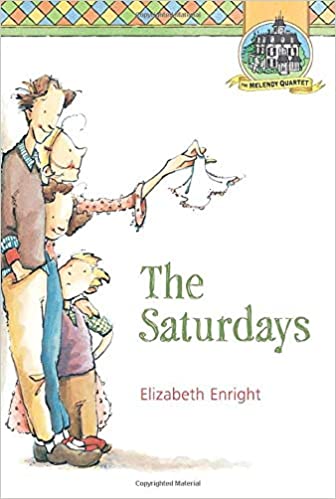
“Outside the moist air had become moister. A fine mist was driving down. Mrs. Oliphant disentangled an umbrella from her handbag and the tail of one of her furs. When it was opened the umbrella proved to be extremely large and deep. They walked under it close together, as under a small pavilion. “I’ve had it for twenty-five years,” Mrs. Oliphant told Randy. “It’s been lost once on a bus, twice on railway trains, and once at the London Zoo. But I always get it back. I call it the albatross.” —Elizabeth Enright, The Saturdays
(Literary Lost Umbrellas is one of my favourite Pickle Me This features, but it’s been awhile. So I was so excited to find this literary lost umbrella in our family read aloud tonight—and even better that this particular lost literary umbrella so resolutely refuses to stay lost. I love it. PS this book is great. I found it after googling “Books that are like The Penderwicks.)
September 15, 2021
Beautiful World, Where Are You
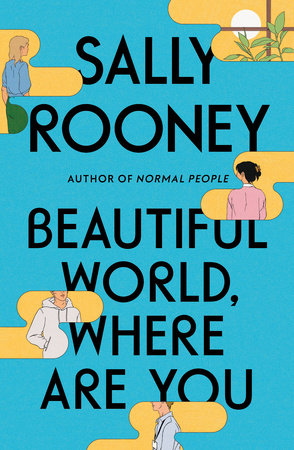
It’s been more than two years since I read Normal People, and even more since Conversations With Friends (which I wasn’t crazy about, didn’t live up to the hype for me) so I can’t remember if all Sally Rooney’s novels have reminded me of Virginia Woolf, but Beautiful World, Where Are You, her latest, sure did. The curious omniscience, the sea, the tide, the house, echoes of Chloe and Olivia… It’s a strange and demanding novel, really, and so intense. I wasn’t really reading it at first with the appropriate amount of focus, and it was hard to get into. There’s nothing light and breezy about it with its lack of breaks for dialogue and paragraphs, and the density of the narrative as well, capturing every little detail of modern life for these twenty-somethings in contemporary Ireland.
Alice and Eileen are friends, and Alice, who has just published two successful novels and become a publishing sensation, is living alone in the countryside, she and Eileen writing each other long and involved emails about their daily lives, about the men who are their preoccupations—Alice has a strange connection to Felix, a working class local she met on Tinder, and Eileen is infatuated with Simon, an older family friend who she’s known her entire life who sometimes she sleeps with, sometimes even when he has a girlfriend. There’s also a whole lot that goes unsaid between the friends, or unconsidered (the email chapters are broken by chapters with the four characters going about their daily lives) which is a strange thing considering how no one ever shuts up.
The exchanges between Eileen and Alice are heavy, as their consider the prospect of societal collapse, and the meaning of life, or if there’s even such a thing, and I honestly found it all very stressful at first, just because I worry about this stuff all the time and I don’t really need literature that leads me deeper into my worst anxieties. But also the narrative is wholly engaging—as I’ve written in other posts, I’m so profoundly not interested in many contemporary novels featuring bored and detached protagonists where there really isn’t any meaning at all. There is a heart and soul to this book, even with its navel gazing consideration and preoccupation with minutiae. Things matter. Life matters. Friendship matters, and in fact it may be that the connections between us are all that matters—and I loved this as a revelation. How subversive in our age of cool detachment to even venture such a thing, but Sally Rooney’s already mindblowingly popular so the haters are going to hate, so why not just go all in on the feeling. Which is not sentimental, I mean, if sentimental is a bad thing. If sentimental means slight or shallow, because there is substance here, truth and beauty.
Turns out I loved this book a lot.
September 14, 2021
Gleanings
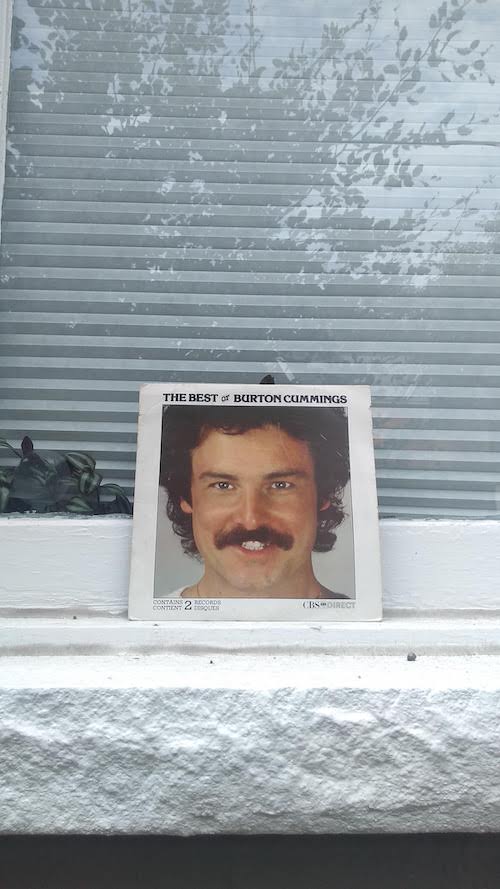
- My heart goes out to Nicki Minaj’s cousin’s friend with the swollen testicles.
- I feel helpless and lost and angry. Screaming into a pillow would feel great about now, and I might do that later, but as a balm, this morning when I got back from a walk around the neighbourhood, I made cookies.
- what does it mean to be fake? to be unreal? to live inside a different and brighter world, where good and bad are clear and immediate?
- I hate being a data point on someone’s learning curve.
- This is the story about a woman who has so far made it through the pandemic relatively unscathed but who has been changed by now in more ways than she will be able to set down in a simple blog post on the internet.
- Today I am delighted to be writing about Margery Sharp, who has somehow flown beneath my radar for far too many years. And this in spite of her being the author behind one of my favourite childhood movies—The Rescuers.
- What if the decision is one to experiment? To play? To fear, and do it anyway? Heck, to fail?
- James is back on campus this week for the first time since February 2020. He returned to a time capsule covered in a layer of fine dust. On the wall above his desk he found print-outs of a newly minted three-year-old and a kindergartener just learning to ride a two-wheeler and no pictures at all of the baby who hadn’t been born and is now marching herself into daycare.
- The beast in Red X – a barghest, a mythical creature that traces its origins back to northern England – is the spirit of a 19th-century homosexual now haunting Toronto’s gay village, where a succession of people have disappeared without a trace.
- I didn’t expect to find myself sitting in the Urgent Care department at the Hotel Dieu Hospital a mere three days into our arrival in Kingston. Who would?
- It takes character to wait well—not usually my strong suit.
- Flowers and poetry, wine and celebration, sweeping and polishing. These are ways we remember our dead.
- In fact, simply having the piano in the house is a source of incredible pleasure.
- I went sailing for chrissakes. The kids were left to fend for themselves for dinner. Can you even believe that? Guess what? They were totally fine. And I was even better than that.
- How wonderful to exclaim “I exist like this and I’m actually quite ok with it!” Such a simple sentence and yet for so long, so impossible to utter.
- Everything is connected, isn’t it? The hearths uncovered on Orkney, their spiral pots broken.
September 13, 2021
Taking Stock: September
(Thanks to Pip Lincolne for the list!)
Taking Stock
Making: lunches! And I’m so goshdarn happy about it. (Mostly because I don’t have to make them all by myself. So happy to have kids back to school.
Getting: ready to go camping the weekend after next! Bringing a little summer into September is important.
Cooking: SmittenKitchen’s corn chowder on the weekend. It was delicious.
Sipping: Yorkshire gold tea. As usual.
Reading: Beautiful World Where Are You, by Sally Rooney
Thinking: too much about the perspective of people refusing to be vaccinated, twisting my brain into knots.
Remembering: the surreal month of September 20 years ago, which would have been significant to me even without what happened on that Tuesday.
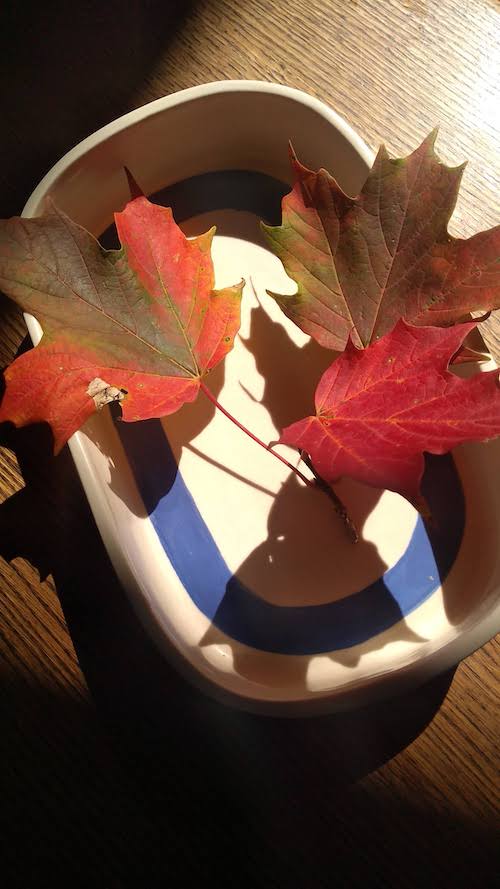
Looking: at the golden sunshine in my kitchen, which means the end of summer, and that the end of summer brings beautiful things.
Listening: to someone drilling or sawing something in my neighbourhood, OBVIOUSLY. Never stops. Before that, I was listening to the new episode of You’re Wrong About but had to turn it off so I could think about this post!
Wishing: that everybody would just calm down.
Enjoying: a return to normalish life in Toronto and that our vaccination rates are high and ever climbing.
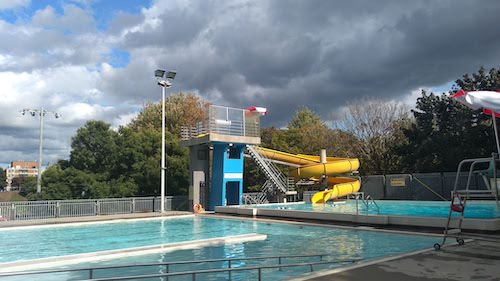
Appreciating: that after a summer of outdoor swimming, I am able to book lane swims at a local community centre’s salt water pool!
Wanting: to hear from my kid about their days at school.
Eating: will shortly be eating a coronation grape muffin I baked last evening. A return to baking muffins and packing lunches is just the quotidian I’ve been longing for.
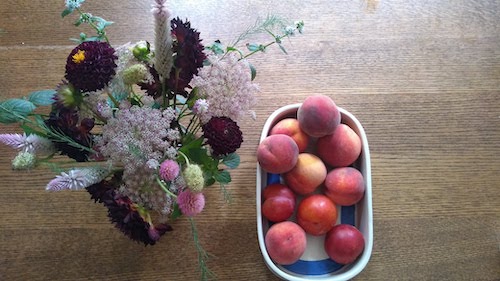
Finishing: peaches. Only another week or two left, if we’re lucky, and then it’s APPLE SEASON
Liking: taking Iris to school in the morning
Loving: the writers in my September blogging course!!
Buying: Orange shirts for Orange Shirt Day
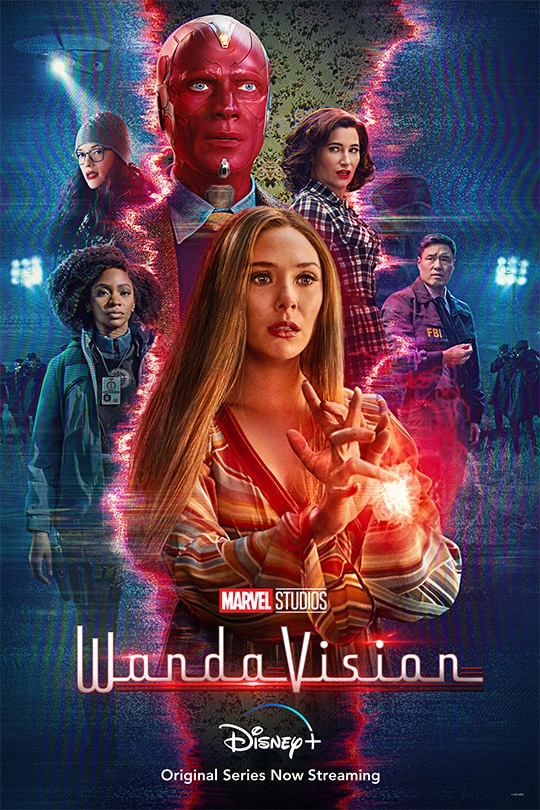
Watching: Wandavision! I am totally obsessed.
Hoping: For a less disrupted school year in Toronto/Ontario
Wearing: My Zuri dress, because this still warm but crisp September day is the weather it was made for.
Walking: to school to drop off Iris (this morning, at least). Have I mentioned that this makes me happy?
Following: Five gorgeous new-to-me blogs from the writers in my course. Check out “Gleanings” tomorrow for a selection.
Noticing: That angry white women protesting outside hospitals under the auspices of “rights” look like the same people who picketed against integrated schools 60 years ago under the auspices of “rights”, and the expressions on their faces are terrifying.
Saving: The whole chicken in my freezer for that perfect day for roasting/boiling stock. (PS I originally wrong “the whole children” in my freezer, which is weird, especially since my freezer is quite small.)
Waiting: For edits on my next novel!
Bookmarking: Elizabeth Renzetti’s amazing article on Little Free Libraries
Coveting: Nothing? I’m good.
Feeling: All right.
Hearing: A DRILL! It just started again. Somebody whistling. A distant siren. No cicadas for the first time in weeks.
September 10, 2021
September
My children went back to school on Thursday, and two days seems about the appropriate length for the first week of school after six months at home. Happy to report that both kids are having a wonderful time, but that two days is not really sufficient for a work week. Also that going on summer holiday repeatedly is not conducive to productivity, particularly when you keep booking mid-morning swims at the public school. All of which is to say that I’ve had a very good summer, but have a lot of catching up to do. Further, my blogging course is running again this month (it’s been two years since I launched Blog School) and, once again, my group is amazing, and I am enjoying their work so much. And hoping that five days next week to sit down and focus will yield great results in terms of me catching up on everything I’m behind on. In cased you missed it elsewhere, I abandoned a 72,000 word novel in June because it wasn’t even halfway done and didn’t have a plot, and then I started something new that is proving achingly slow-going but perhaps is really good. Just got to 26,000 and I’m really pleased with it, but it’s hard. Though this project will soon be temporarily put aside when I get notes back on my next novel and get back to revising a book I’ve been writing since 2015. In wonderful news, you’re going to be able to read it one of these days, and yes, working on something that will one day see the light of day will prove to be a most refreshing change.
September 7, 2021
Gleanings
- When I set out on my walk, I hadn’t expected to find Bertrand Russell and Judith Krantz curled up together.
- In a way I think of frogs as my familiars. I don’t mean this in a New Age way, or maybe I do.
- I debated googling “how to swim in waves”, but strapped on my orange tow float, and went straight into the water, remembering how much easier it is to let the waves carry you, instead of standing and having them crash into you.
- But there is something I’m beginning to crawl towards, a small crack embracing and flowing with the beauty of the imperfect chaos of life, a reminder of life’s cyclical patterns, an inner orientation of being with what is, versus controlling or perfecting it … noticing and marveling at the wonder of life, and that there is never an arrival, that all things, especially cleaned counters, are impermanent and fleeting.
- And I am and it is, but why the need to explain away a pretty serious injury? Why minimize the trauma just because, well shit it could have been worse?
- Thirteen years ago today, I bought the convertible VW bug an early 50th birthday present to myself. I fell in love with this car the moment I saw it. A mid-life crisis? Maybe. But my motivation was driven more by the fact that I no longer needed to ferry my girls to softball games and I now had the time and the means to head off on road trips.
- There it is again, the idea to start small. All you need is a little inkling, a little idea.
- I’ve been trying out new things. This past year and a half, this pandemic year, staying home has stretched me further. Take my painting endeavours – Please! (Sorry, bad joke).
- Every day the light is different. It illuminates this then that.
- in my head i’m calling people cocksuckers a lot. i’ve also had the kids today for ten days straight with no break and so i think i need a literal quiet moment and also a much larger reorganization of my entire life.
- It made me realise the horrible cycle an exhausted mind and body will find themselves in and struggle to get out of. It made me re-think reaching out to the therapist a friend recommended the other day. I was interested because honestly, who couldn’t use therapy after the last 18 months, but turned away because I figured I was fine. I think my body has been trying to tell me otherwise.
- So, yes, I’m taking them as sign and symbol, my perfectly wonderful twenty-four jars, of the fabulous years we’ve had and the many good things to come.
- They had come by once, they might come back again.
- Regardless of the outcome of Election 2021, on Tuesday morning, 21st September, the politicians will all disappear — some home to pack for their Ottawa residencies, others to resume their former lives. The rest of us will still be here in the trenches, slogging through the same mire, trying to find solutions to impossible problems, trying to get the necessary assistance for our vulnerable.
- But The Mimifesto has become one way I measure—and capture—time. Here are a few others.
- Keeping in line with my inadvertent summer theme of fantasy novels, I recently turned the last page on A Deadly Education, the first book in Naomi Novik’s projected Scholomance trilogy.
- But what if we all just started planting a LOT of flowers, metaphorically speaking? What if we filled up our metaphorical walls with ART?
- That night, in the middle of the night, the refrigerator began working again, but for how long?
- Sounds of summer have already begun to transition into those of autumn.
- It will get dirty and it will fade and I don’t have a perfect plan for keeping it clean except, perhaps, to take it down from its hooks should I have the need to deep fry a batch of beignets. Good thing the objective here isn’t perfection and there’s a donut shop down the street.
- Her Name Was Margaret is a compelling, unputdownable and strangely optimistic book for many reasons, not the least being that Davy shows us there IS a way out, a way both humane and economically viable. For that reason alone it’s must reading.
- One of the things I love about travelling is coming home.
- It’s the time of year, I guess, or the time of my life, or maybe my eyesight is fading. Or maybe this is how I will see the world for the next few years as I write this novel. This novel? I’m going to leave the question mark there for now.
- Because for all the talk these days about blogging being over, it remains, for me, the best form the internet has come up with for the kinds of things that I value about the internet.
Do you like reading good things online and want to make sure you don’t miss a “Gleanings” post? Then sign up to receive “Gleanings” delivered to your inbox each week(ish). And if you’ve read something excellent that you think we ought to check out, share the link in a comment below.
September 3, 2021
Householders, by Kate Cayley
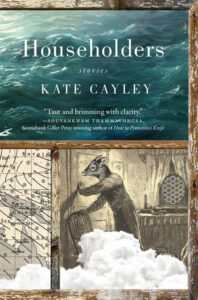
I was a big fan of Kate Cayley’s How You Were Born in 2015, and have been looking forward to her latest release, the short fiction collection Householders, which is out this month from Biblioasis, and it didn’t disappoint in the slightest. The first story, “The Crooked Man,” literally took my breath away, a story of overwhelming motherhood, family life in the city, and violence on the margins of everyday experience, and a similar ominousness infuses all the stories throughout the the rest of the collection. That no matter how much we try to hunker down in our houses (whether they be a Toronto semi, a bunker during the zombie apocalypse, or a commune in rural Maine), the world creeps in, and we can’t stop it.
The stories are loosely connected, the narrative about the commune in Maine serving as an anchor. Carol and Nancy arrive there in the late 1960s, and Nancy stays, becomes Naomi, falls under the spell. Naomi’s story and that of her daughter are woven throughout the rest of the book, right up to the present day, amidst stories of a man who offers mercy (or is it?) to a legendary musician past his prime; a woman who pretends to be an nun online; a woman reflecting on a strange and complicated relationship with a troubled woman she’d known during her university years.
Kate Cayley is splendid in her deft arrangement of the sentence, and in her depiction of the quotidian but just askew enough to be new and surprising. These stories are rich, absorbing, and oh so satisfying, and I predict this as one of the big books of the fall literary season.
August 31, 2021
Sidewalk Stories
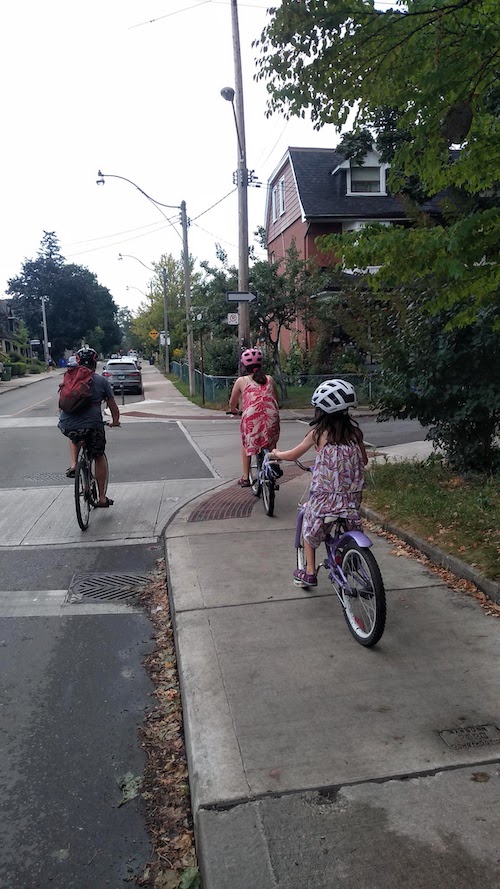
There were so many children I swore I’d never have—the three-year-old with a soother; the baby in my bed; giant child in the stroller—but one I’ve successfully managed to keep at bay was Annoying Bicycle Bell child. The bane of my pedestrian existence, Annoying Bicycle Bell child is the kid riding his bike along the sidewalk who wants you to get out of the way so he can get by, and demonstrates this by ringing a bell. As though you weren’t two human beings, one of whom has a voice, the other who has ears. I found ABB child so insufferably rude, and omnipresent on my sidewalk journeys, that it got to the point where I would turn around and exclaim, “You know, you could say ‘excuse me.'”
My children always say ‘excuse me’ when they’re riding their bikes on the sidewalk. They don’t always ride their bikes on the sidewalk either, because there is an impressive spread of bike lanes throughout downtown Toronto these days that makes cycling safer and accessible for all of us, but on streets without bike lanes where traffic can be treacherous, I make the choice that most likely to have my beloved babies not be hit by a truck.
And so they ride on the sidewalk (not fast!), and they ring their bells when they’re riding past cars with occupants inside to avoid being doored (as they do when they’re riding in the cycle lanes), but when they’re faced with other people who are also using the same sidewalks in other ways, I’ve taught them to say, “Excuse me!” and then to say, “Thank you!” once the person has moved aside to let them pass.
I am writing about this now not to be smug (though I am smug, I am always smug, from which I’ve learned the lesson of smugness: “whenever I’m smug about anything, it bites me in the ass”), but instead because teaching my kids to engage with public space and other people this way is not just about sidewalks and cycling.
It teaches them their entitlement to take up space, to use the space that’s provided in a way that’s safe. It also teaches them not just entitlement, which can be obnoxious, but gracious entitlement, which is not about apology but instead about respect for our neighbours and to the people we share spaces with (and for ourselves!). Not being rude is really important.
They learn too that everything about living among other people is about negotiation, and we owe those people something, but also that they owe us the same consideration in return.
And finally, I like too the way it’s made them comfortable talking to adults, and how it makes speaking up and advocating for themselves into a habit.
Bicycle bells are important to have, but knowing how to use one’s voice is even better.
August 23, 2021
Holiday Reading Part 2
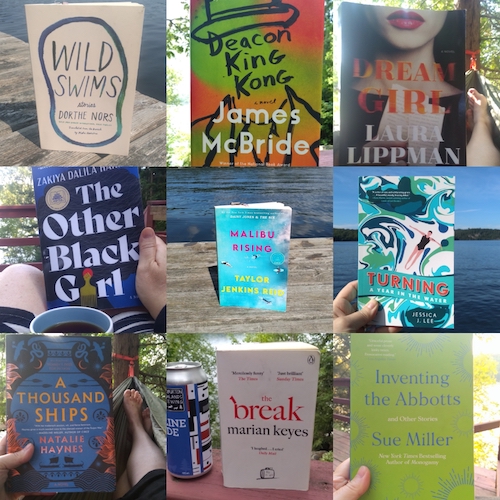
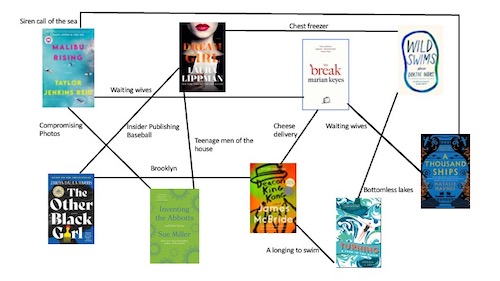
There were no duds in this stack, and even the title I was most intimidated by (hello, novel about the Trojan War!) blew me away. Every single one of these very different books was an absolute stunner, and the connections between them (as always!) were fascinating—see chart below. I was also so happy to reread Turning, which I’d read on vacation three or so years ago, and which I enjoyed but found so SPECIFIC that I wasn’t quite sure it would resonate again, so I gave it away, which I regretted for years. A new copy found its way back into my life this year, however, so I was happy to read it again. By a lake, of course.
I LOVED Malibu Rising—while I liked her previous novel, it didn’t quite live up to the hype for me. This one, however, was amazing. Every Sue Miller book I read is a pleasure. The Laura Lippman book was the most wonderful mindfuck, as was The Other Black Girl, both of which take on writing and publishing. Happy to read my second Marian Keyes—she’s really so good. A Thousand Ships was incredible, and Stuart and Harriet both devoured it after I did. Wild Swims was weird, but neat, and short, which is just the kind of portion I can take my weird in.
And finally Deacon King Kong, which I heard of somewhere, and then found in a Little Free Library shortly thereafter. It was rollicking, kaleidoscopic, huge in its scope, and tragicomic brilliance. Absolutely amazing.