December 8, 2022
Ducks: Two Years in the Oil Sands, by Kate Beaton
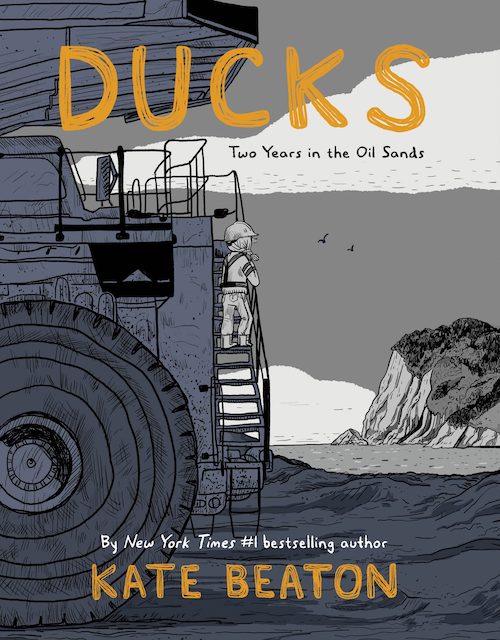
In October I went to see Kate Beaton present her graphic memoir Ducks: Two Years in the Oil Sands at the Art Gallery of Ontario, and the force of that presentation kind of made the book itself beside the point, hence the reason I’m posting about it two months later, but it’s still on my mind.
Before Kate Beaton made a name for herself drawing ridiculously clever comics inspired by classic literature and history, she was an arts grad from Cape Breton, Nova Scotia, with student loans to pay off and little opportunity for lucrative employment, and certainly not anywhere near her home, from which people have been leaving to find work since even before the coal mining industry went bust. In her AGO presentation (the most riveting, hilarious, generous, and vulnerable author talk I’ve ever been to, complete with music and singing), Beaton talked about her grandfather travelling to the prairies to find work as a farmhand, decades before her own journey west. She talked about what it does to a place to be robbed of its people and connections, and what it does to a self to belong to a place where you’re taught that a future isn’t possible.
In the early 2000s, Beaton moved to Alberta for well-paid work in the oil sands, and it was a strange and lonely existence rife with contradictions, which she captures beautifully in Ducks. Lonely and never alone, out of place but surrounded by people she recognizes as like those from home, earning money but nothing to spend it on, small in an immense awe-inspiring landscape being desecrated by industry.
Beaton’s drawings are composed in shades of grey, which is fitting for a story with such nuance. While Beaton doesn’t shy away from showing the reality of such a peculiar social environment, that women suffer in places like this, she also shows that the suffering isn’t limited, and that people being forced to travel far from home for work that is soul-destroying, not to mention ecologically devastating, are suffering too, and the real culprit is capitalism, a system that devalues people and communities, a system that pushes people to the point of breaking.
Beaton’s dream is to work in museums, putting her degree to good use, and she gets her break after a year in the oil sands, which she leaves for a part time position at a marine museum in Victoria…which turns out to barely be enough to live on, let alone pay off her loans, and so Beaton returns for another year in the Oil Sands, but here she begins publishing her comics on her Livejournal, pieces that would become Hark A Vagrant, from which Beaton would make her name, become a bestselling author, and (that rarest of things) an artist able to earn a living from her work. After a stint as a New York art sensation, Beaton once again lives in Cape Breton.
A happy ending then, but Kate Beaton is truly one in a million, and in the years since her time in the oil sands, she hasn’t forgotten what she saw, and what she learned. About humanity in the midst of inhumanity, and the worthiness of ordinary people to live good lives in the places where they come from. It’s not black and white, and that’s why Ducks is worth reading.
December 7, 2022
Gleanings
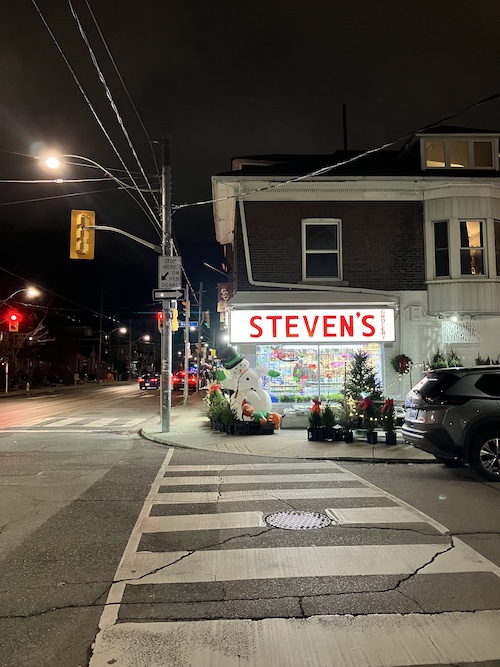
- As far as traditions go, chopping down a tree and planting it between the chesterfield and the tele for a month is pretty bizarre. But no one can dispute the delight a tree festooned with lights brings to a home and those who live in it
- I think it’s wise to check in from time to time with those stories we’re telling ourselves, about who we are.
- Considering myself one who’s typically up for an adventure, I’m always surprised how I long for familiarity. I’m still opening 3 drawers to find my hairbrush. I’m aware of the living room clock ticking and the buzz of the lights. I was cautious about setting off for a walk alone this morning for fear I might never find my way back.
- I was, and remain, furious at the caprice of memory. Someone mentioned to me recently being sorry they didn’t ask their parents more questions before they died and that’s the thing: I DID ask my dad all the questions I could think of. But you just can’t elicit interesting stories by demanding them–you have to know specifically that there was a ragman to ask if he had a horse, and to know that there was a horse to ask if anyone ever got to ride it.
- She says that if you think “I get you” often enough, you will feel the vulnerability of the other person and your judgement will shift to compassion.
- And so, to live a month in utter happiness, contentedness, joy: I can tell you that it rewired my brain, reset my soul. Obviously, I want to keep those good vibes going. How? So that will be my ongoing quest.
- Alissa achieves greatness (and very nearly the Nobel Prize). What does Roland have to show for his life, in his old age? A small hand in his, to lead him across the room. It’s an unexpectedly sentimental ending, from McEwan, another way in which this novel surprised me, but also pleased me. Maybe in his old age, he has tired of acerbity and cynicism, of twists that make us cringe or that shake our faith in each other and in the stories we tell.
- No heroism, no dramatic sopranos, no red capes. Just people being nice.
- There is a link here – but I’m aware I’m asking you, dear reader, to fill in some blanks*. Memories. Witnessing. Loss.
- I hope my work shines a bit of light in dark places and I hope it offers some inspiration and some joy, and I hope it’s always grounded in a bit of reality. Here’s to making a bit of magic where and when we’re able. Here’s to opting out of the traditions that don’t suit us. There are no supermoms here (or anywhere).
December 5, 2022
The Elephant on Karluv Bridge, by Thomas Trofimuk
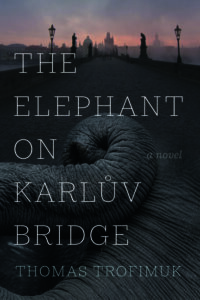
“The elephant came, as I predicted, Really, in the span of more than six hundred years, an elephant was inevitable.”
A novel about an elephant escaped from the Prague Zoo, narrated by centuries-old bridge?
I wanted to read it, and purchased a copy in the summer that I’ve now scrambled to fit into my 2022 reads, and I’m so glad I did, because I loved it. Thoughtful, artful, playful (a note on an opening page reads, “Any resemblance to actual elephants, living or dead, is entirely deliberate), Thomas Trofimuk’s latest novel, The Elephant on Karluv Bridge, is an absorbing literary puzzle and truly a delight to encounter.
Sál, the elephant, escapes from the zoo, and The Bridge saw it coming, but of course, The Bridge has seen a lot already in six centuries. Everyone else on the streets of Prague, however, is caught unaware, including the zoo’s night watchman whose psychologist wife has decided she wants to have a baby, and an American recovering-alcoholic whose isolated life attending a lighthouse on a Scottish island is interrupted by her father taking ill in Prague and necessity that she rush to his bedside, her taxi colliding with a street performer with whom she finds immediate connection; an aging ballerina haunted by the ghostly presence of Anna Pavlova; the conductor whose choir is due to perform early morning on the bridge from which Wolfgang Amadeus Mozart peed into the river in April 1792, and whose lead soprano is keeping a secret; and a bodyguard with PTSD. All of these lives intersecting in ways that are both remarkable and otherwise, these intersections woven with the story of the elephant herself who carries memories of her early life in Zambia and the moments that brought her across continents and into captivity.
December 1, 2022
Holiday (Good) Burdens
We can pick and choose our seasonal (good) burdens. Halloween, for instance, for me, is barely a blip on the calendar, except for the week or so afterwards replete with tiny chocolate bars. No seasonal decorations at my house, I don’t dress up, my children dress up just barely—this year my youngest put an old shade on her head and went out as a lamp. I’m just not that invested in the rituals, which is not to say that they’re not meaningful, but just that they don’t hold meaning for me, and that’s fine. (I return once again to the ancient pre-internet art of not liking something without it being a manifesto.)
Christmas, on the other hand, I’m big into, in a secular fashion, but still I’m picking and choosing where my energy goes, and it doesn’t go as far as, say, homemade advent calendars. I actually aspire to be a creator of homemade advent calendars, but I’ve accepted that I’d need to be a different human for that to happen, someone more fond of shopping and crafting than I am. And speaking of crafting, homemade gifts are another item that won’t be ticked off my list anytime soon. I’ve accepted my limits, the realities of ROI, and—as Christina Cook writes in her book Good Burdens, which I think about a lot—deciding not to do certain things (JOMO—the Joy of Missing Out!) leaves room for those other things that really matter.
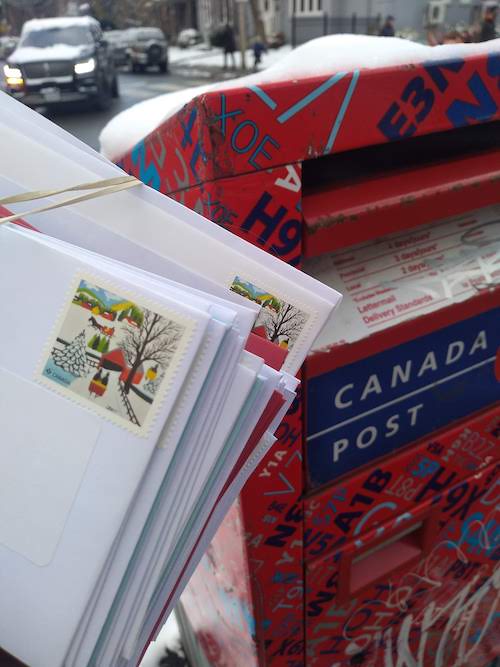
Which, for me, include writing and sending Christmas cards, something that’s particularly important to me as we live far from so many friends and family. I’ve been writing Christmas cards for 20 years now, since the very first Christmas I spent away from home, and I continue to see these cards—even with their notes rather hastily scrawled!—as a way to show people near and far to us that they matter. (It also means that we get a lot of Christmas cards in return, though I also completely understand when other people don’t reciprocate, in fact I respect those who’ve made deliberate choices and peace with Christmas cards being on their JOMO list.)
I also love Christmas baking, and creating a homemade gingerbread house, and reading Christmas stories with my kids, and the coziness of winter knitting projects, and fashioning the leftovers of a roasted turkey into every kind of leftover imaginable. These are the kinds of jobs I like to be doing.
One further thing that’s important to me during the holidays is small tokens of appreciation for members of our community, my kids’ teachers, and piano teachers, and crossing guards, and girl guide leaders, and sometimes I drive myself a little bit crazy trying to cross everything off on this list and something I adore about my husband (on a very long list of things) is how he saw that I was finding this good burden a little overwhelming but didn’t use my overwhelm as an excuse to devalue this labour. Instead of saying, “If it’s stressing you out so much, why do you do it?” (a too familiar pattern in heterosexual partnerships, I think?) he supported me in finding ways to make the job easier, which is why, for the past three years, I’ve purchased holiday gift bundles from local fave Carolina’s Brownies, and my husband has shrugged and said, “Yes, of course, you’re spending hundreds of dollars on gourmet brownies for the crossing guard.” (He also made the address labels for my Christmas cards. He’s truly the best, and goes out of the way to help me with my good burdens, even when they’re not as important to him, but, you see, *I* am important to him.)
“Let’s make this a season of humble gestures that light up the world,” is a thought that occurred to me this morning as I photographed a green Christmas bauble fastened to a twiggy tree, someone else’s gesture that added sparkle to my morning.
There can be meaning in all these things if we choose to be deliberate in our choices.
How wonderful that we get to pick and choose our seasonal (good) burdens.
November 30, 2022
Flight, by Lynn Steger Strong
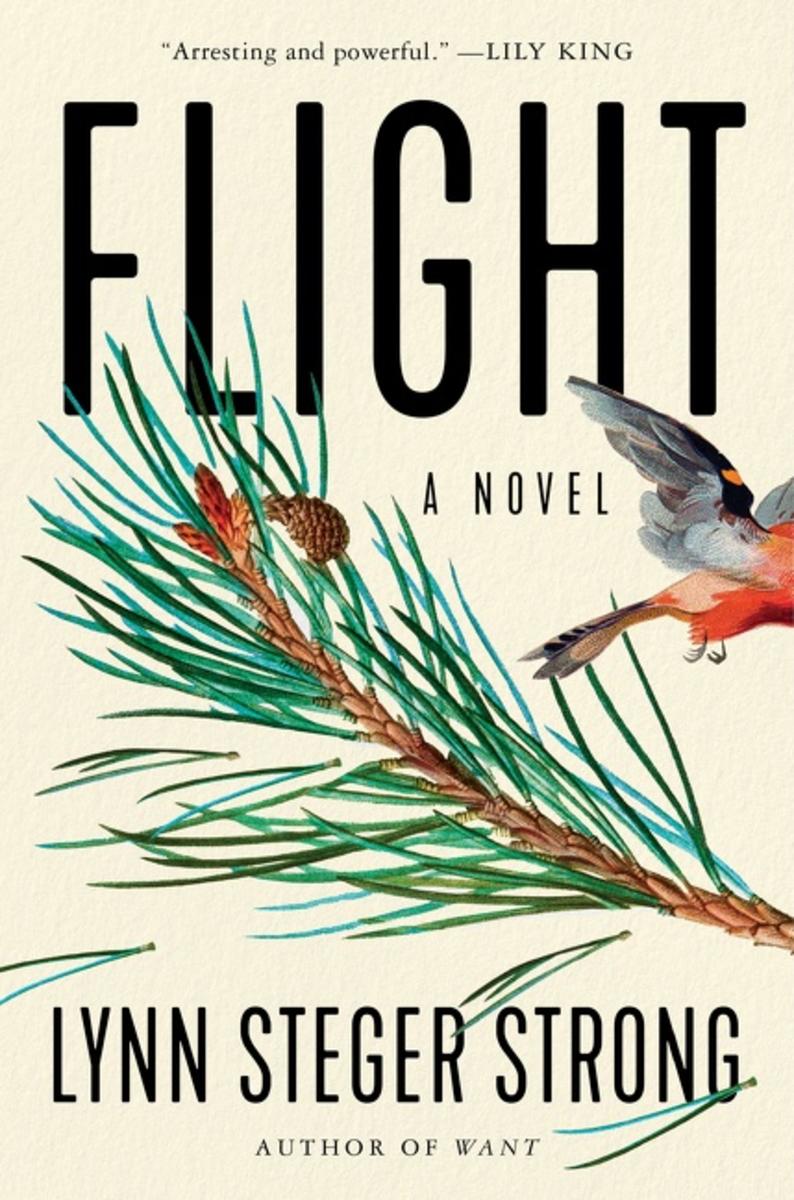
“What were the rules for loving people who were not obliged to love you? How did you know when and how to trust they wouldn’t destroy you too?”
Readers who were drawn to Lynn Steger Strong’s articulation of parenting and family life amidst an age of anxiety in her previous novel Want will find the same frantic tension in her follow-up Flight, but with an expanded canvas exploring the psyches of eight different people, including three siblings celebrating their first Christmas since their mother’s death, their respective spouses, and a local woman and her daughter in the rural town where they’re all spending the holiday with the looming question of what to do with their mother’s house hanging over their heads.
And oh yes, anxiety abounds, including financial anxiety, and parenting anxiety, and climate anxiety, and the existential drama of trying to be in the world when the one person who’d held that world and all its meaning together…is gone.
The book resonated, and I devoured it, the plot taut and so compelling as the siblings come together in a moment of extra-family crisis, but I also read it with great interst in and respect for its crafting, for the cumulative depths of so many different points of view, for how so many parts culminate in such a rich and satisfying whole.
Of course, there’s obligatory bitchiness and bad behaviour, all delicious and readable, inevitable when any family dynamic gets put under the microscope, but where Steger Strong really succeeds is in making her story more than that. Imagining something better, the possibility of warmth and connection persisting, of mutual understanding.
November 29, 2022
Gleanings
- A living tree died, its length bucked into logs, each one so beautiful I want them to stay in this gallery of open air, green salal, perfumed by the resin.
- How well Woolf understood: I see myself in Jacob’s bereft mother, baffled, as I have so often been baffled, by the puzzle that completely ordinary things like shoes and clothes remain, even though the person who gave them meaning is gone.
- That is to say, all the small moments, the flickers, the ordinary, the mundane, the sacred, the profane, much which goes unnoticed, none of which will ever be written down anywhere, well, except here. For years and years I’ve been searching, seeking, and all along it seems it was right in front of me … wonder. Life, all of it, you, me, them, the cat that refuses to use the litter box … miraculous. And so it is.
- But I’d been writing novels every weekday morning since 2006! What was I supposed to do with myself?Just try other creative stuff, is what I was thinking. Here’s what I did instead.
- After a while, I realized, turning down a summer’s worth of work wasn’t just about resting. Recovering from burn-out, or what have you. This was about getting back in touch with who I truly am, and never fucking letting her go again. Learning how to separate THE VOICE THAT IS YELLING WHAT I SHOULD DO, from the voice that is whispering what I love to do.
- “An attitude of gratitude was embedded in older people’s recollections of the past,” said Kavedija, “but also allowed them to think about the present in a hopeful way. A world in which one has received much goodwill from others is a different place from one in which one has experienced loss, even if the facts of life are the same.”
November 23, 2022
Postcards to the Future
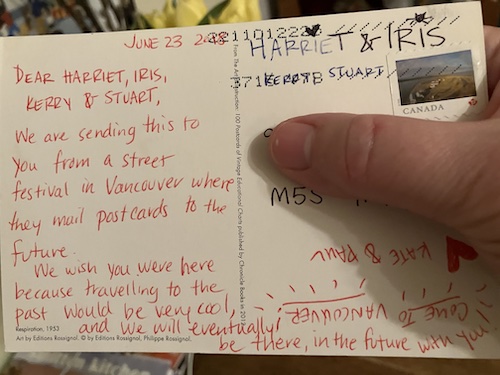
A few weeks ago, we received a postcard from our friends Paul and Kate who live in Vancouver. I will admit that I did not read the note on it very carefully (the image on the front was a diagram of the respiratory system?), but it read something along the lines of that they’d written the card at a street festival “where they mail postcards to the future.”
Which was kind of remarkable, I guess, but then aren’t all postcards letters to the future after all?
The salient part for me, however, was the way the postcard concluded: “…and we will eventually be there, in the future with you!” Because we haven’t seen Kate and Paul since 2019, but this month they’ve finally returned to Ontario for a whirlwind visit, and we’ve been lucky enough to be part of it, which is what I’d so been looking forward to when I received this postcard at the beginning of November.
Tonight we all sat together in my living room eating Thai food, celebrating Stuart’s birthday, Kate and Paul, and our friend Erin, and 3 year-old Clara whom we last saw as a baby, and her little brother Gabriel, who has just learned to climb stairs, and who we’ve been overjoyed to be meeting for the very first time.
“Oh, I got your postcard!” I exclaimed suddenly, remembering. Kate and Paul were both confused. They hadn’t sent us a postcard. “No, you know. The one from the street festival? Where you were sending a message into the future.” They had no idea what I was talking about. “It’s on my fridge!” I insisted. “Here, I’ll show you.”
I went to get it…and realized the most important thing I’d missed when looking at it before. The date at the top: June 23, 2018. The people at the street festival really weren’t kidding about the future thing. I realized too that the note was only signed from Kate and Paul, because Clara and Gabriel didn’t exist then. We hadn’t had a pandemic then. None of us had had any idea of what was coming. And yet.
“…and we will eventually be there in the future with you.” A line that might have hit very differently if this letter had arrived at any other moment during the last few years. But it was a promise.
What are the odds of this very postcard to the future arriving on the cusp of the first time we’ve all been together in so long?
But here we are. I feel so lucky. And looking forward to what other wondrous things the future has in store.
November 22, 2022
Gleanings
- Today, I see ambivalence to difficult situations as a gift because it means that I’m allowing myself a fuller human experience.
- The sweetest plums of publication vary by writer, but for those of us for whom the call is coming from inside the house, as it were, I think one has got to be the copyeditor’s style sheet.
- I mean, summers are always good for swimming, but this summer, I decided to pack three summers into one and jumped into any and every body of water I could.
- Given the sheer number of possible interactions one might have in a lifetime, I often wonder, how we don’t marvel more at the amazing miracle it is when two paths cross, the fact that somehow, someway, the two of us, both fighting the odds, even to be here in this moment, are now together, if even for this moment.
- Sometimes writing is like swimming in deep and unknown water. How deep is it? What else is there? What about the currents? A strong swimmer knows she has the ability to stay afloat, buoyant in the turbulence, if it arrives. I’m not a good swimmer but I am strong and at this point in the writing, I am ready for the deep.
- And so I made an updated version, which uses ribbon instead of machine embroidery and has a hood! I don’t think I’ve ever cried looking at a finished garment before. It’s just…so many feelings, and so warm…I wore it ALL WEEKEND LONG on our trip to Montreal for our daughter’s “champagne birthday,” including as a cozy blanket on the plane, and while watching films with friends. I
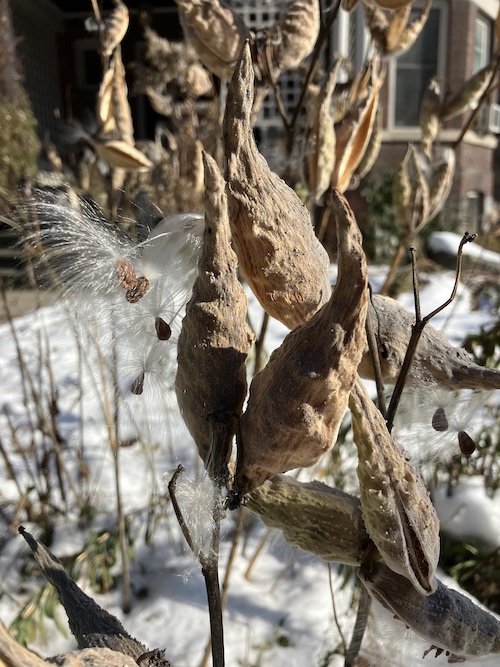
- Thank heavens for pops of pink! Thank heavens for the last remaining autumnal leaves, tiny crimson catchalls for the snow. All signs that it is indeed mid-November. A month to expect the unexpected. Like wierd weather and time travel. Or is that just life?
- As I stood there holding my little shopping bag of cosmetics, not wanting to leave, I knew I must talk to her more. Get to know her better. We had more to learn about each other’s lives. I asked if I could take her to lunch and she excitedly agreed.
- How do the places where we grow up shape who we become? What do we take with us when we immigrate to a new home and what do we leave behind?
November 21, 2022
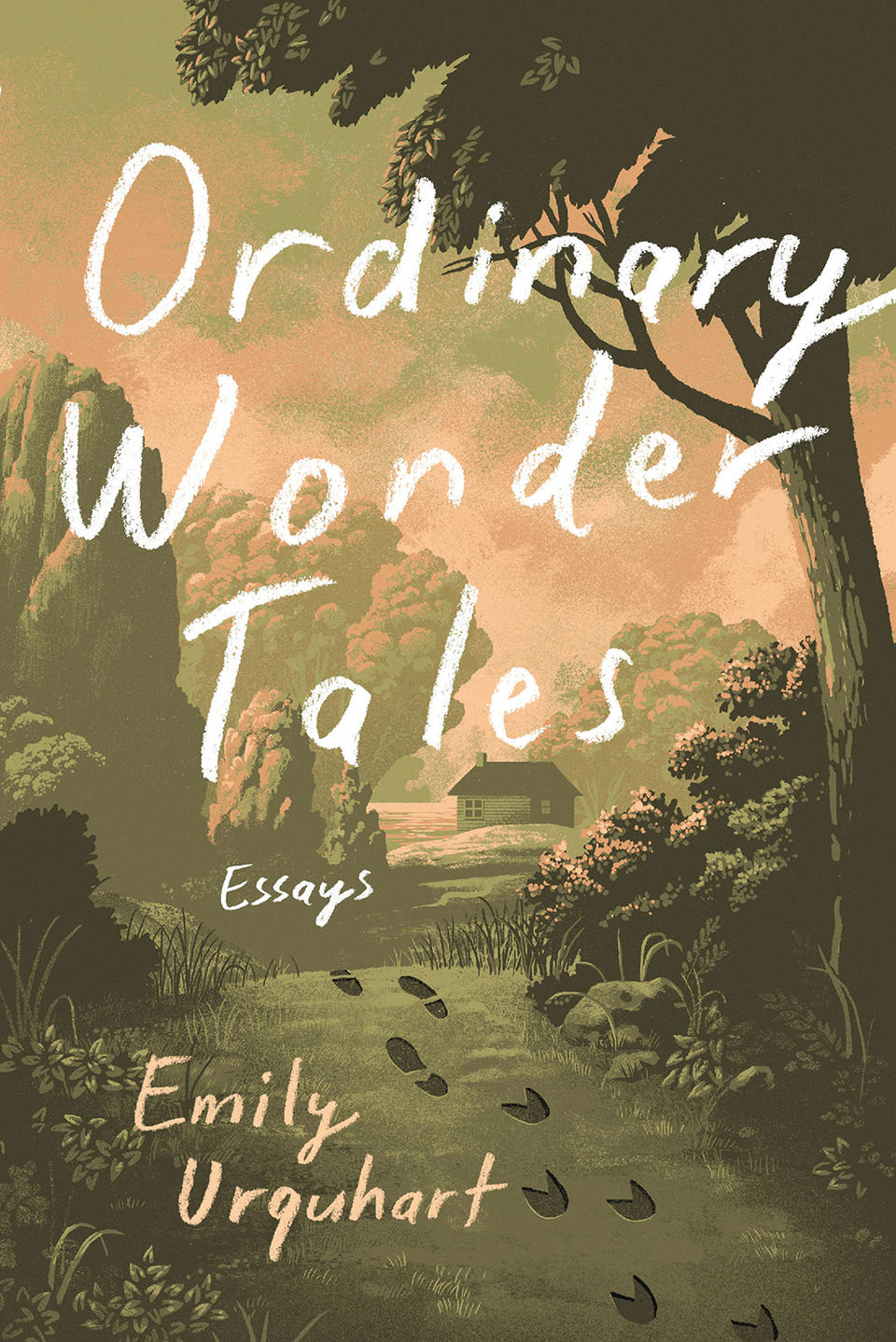
Ordinary Wonder Tales, by Emily Urquhart
‘I don’t think I just imagined her, the woman I was left alone with in the last few minutes before I was taken into surgery. I don’t know if she was a nurse, or some kind of technician, but she seemed terribly official, sitting at a table with paperwork while I contemplated the IV needle stuck in my hand. “Section?” she asked me, and I told her yes. “What for?” I said, “The baby’s transverse.” Lying across my womb, its little bum wedged in at the top and refusing to budge no matter how much I stood on my head, played soothing music into my pelvis, or shone a flashlight into my vagina. “Well,” said the woman at the table, sorting through her papers. “Kids will screw you somehow. If it wasn’t that, it would be labour, then they’d grow up to be teenagers. They always find a way.” “But it’s all worth it, right?” I asked her. “No.” She put down her papers. “I don‘t think it is.” Then she got up, left through a different door, and I never saw her again.’ —from my 2010 essay LOVE IS A LET-DOWN, first published in The New Quarterly
“She was a witch,” I said to my husband on Friday night as I was reading Emily Urquhart’s essay collection Ordinary Wonder Tales. (Our baby from the essay is now actually a teenager and was out babysitting somebody else’s children down the street.) “The woman from the hospital who told me that kids always screw you. You remember.”
And he did. Even though he hadn’t been there when it happened, had already been whisked away to get read for the surgery that would deliver our first child into the world, even though these were throwaway comments that someone had made almost fourteen years ago now, but those commets had haunted us, especially in those difficult months after her birth when I was afflicted with what I now know was postpartum depression, and they’d felt like a curse.
“If that was a story, she would have been a witch,” I said, Urquhart’s stories blowing my mind with their illumination of the links between ordinary and extraordinary, how the otherworldly lessons of fairy tales (or “wonder tales”) have much to teach us about our own experiences. Experiences including pregnancy, parenthood and living through a pandemic underlining that we’re all more connected to these stories than we might have imagined, to all that came before us, to superstition, signs and omens, and folklore. We’re all old wives, at heart, is what Urquhart is saying.
Urquhart, whose academic background in folklore informed her first book Beyond the Pale (she is also author of a celebrated book inspired by her artist-father), brings that same approach to these beautiful essays exploring the sublime edge of ordinary experiences including an ectopic pregnancy, childhood memories of a ghostly presence, sightings of her elder half-brother after his death in his 30s, a violent assault delineating the dynamic of woman as prey, an amniocentesis in an essay called “Child Unwittingly Promised,” a radioactive house in Port Hope, Ontario, and her father’s dementia against the backdrop of the Covid-19 Pandemic.
These essays—beautiful, rich and absorbing-will change the way you see your place in the world, and they’ll leave you noticing all the magic at its fringes.