January 13, 2023
235 Days

235 days until Asking for a Friend is released! And in the meantime, my previous novels are still out there in the world, being read, and (in one case) wearing a moustache. Thank you to everybody who’s reading and sharing.
January 12, 2023
Gleanings

- Fiction is a remarkable way to conjure up a world you didn’t know. There’s a comfort in facing those questions; in imagining those answers. Simply going there put to rest so much unrest in me. I really do feel like something very deep in my psyche has been solved.
- Foreign interventions in Haiti have failed because the bases for these interventions have had little to do with supporting Haiti’s sovereignty, the rights of its people, or alleviating its financial burdens.
- There are a whole bunch of skills that we teach our kids about how to be good humans in the physical world. We teach them what it looks like to be kind, to be safe, to help others, and to learn new things. But if we never explicitly show them what those skills look like in a digital space, transferring those skills online can be very hard.
- If I have any resolution this year, it’s to try to roll with what the world offers me, rather than to wrestle life into my control.
- It hasn’t made logical sense, not from a financial perspective, nor from an artistic perspective either, really; which is why I’m curious to know: will I still be able to make a beautiful book, with alive characters, built on an elaborate structure I see in my head, if I’m not obsessed, or in pain, or seeking to soothe deep anxiety? I’m hopeful. I am.
- And then, channeling some of the greatest philosophers of our time, I started singing, “All You Need Is Love.” By the third round of the chorus, I was almost skipping, singing, “All you need is love!”
- Enough people were on twitter denouncing folks’ end-of-year summaries as “bragging” if they were too positive that I was reminded that it might not be so terrible if that site just immolates.
- Leonard wasn’t my first up-close experience with a mascot. When I was twelve, a mascot had punched me in the face.
- There is power in numbers, but united, in community, their strength lies in their common values and purpose.
- Endings. Beginnings. All pieces of the mosaic of our lives, some pieces that we can fit effortlessly into our life story, others more difficult, that require us to adjust and accept.
- Basically my mood for the next year is to hang onto what I call my Rome vibe at all costs. Because life really isn’t meant to be like that, the profound unhappiness I was dipping into on the regular.
- I woke up this morning, and like most mornings, had to re-orient myself to where I am. The rock-hard mattresses (a truly adequate description, as the girls look under the sheets to see if the bed is in fact, made of concrete) reminds me quickly that I am not at home.
- This has been an unusual year for Novel Readings, one in which my reading life was overtaken by my real life—or, since I firmly believe that “the world of books is still the world,” a better way to put it would be that my reading life changed because so did the rest of my life.
- There is shame, there is guilt, there are more than a few regrets. You are writing down the words, hoping they will make sense.
- Every year at year-end, I set goals for the upcoming year. It sounds kind of hardcore, but really it’s more of a reflection on things like, where do I want to be? what do I want to learn? what projects do I want to start and finish? how do I want my relationships to be? where do I want to travel?
- I feel the white sheet of the bed around me and think of Aida in prison. How different two friends’ lives turned out to be.
- There are no rules for good writing. There are only guidelines which will serve you 75-95% of the time.
- Let’s read more books, sing and dance more, take more walks, print photos of family moments, make some art, write some letters, play more, go barefoot, and sit with silence from time to time. Surprise yourself.
Do you like reading good things online and want to make sure you don’t miss a “Gleanings” post? Then sign up to receive “Gleanings” delivered to your inbox each week(ish). And if you’ve read something excellent that you think we ought to check out, share the link in a comment below.
January 10, 2023
The Radiant Way, Again.

The case against rereading The Radiant Way, by Margaret Drabble, was that my copy was a battered paperback with a tiny faded font, the cover stuck on with Scotch tape, that the novel was nearly 400 pages long, and that my ambition to reread Drabble’s entire ouvre in order a few years back had fizzled into nothing. That I’d just spent an entire fortnight on holiday reading one splendid back list book after another, and perhaps this one wouldn’t measure up. That I have a small mountain of brand new books to be read and if I fail to tackle it, the pile could possibly overwhelm me.
The case for it, however: that this was, perhaps, one of the most pivotal novels of my life. A novel that helped me come into my own as a reader and to begin to come into my own as a writer, after years of having my reading selections determined by course lists and ideas about what the classics were. In 2004, I picked up The Radiant Way in a Japanese bookshop (Wantage Books in Kobe, though there is a stamp for something called Juso Academy Used English Bookstore on the inside cover), the first Margaret Drabble novel I’d ever read, and I fell in love with this work, and decided that this was kind of book I’d like to read and write forever. And yes, in 2020, I’d decided to read through all her novels again (I have them all—secondhand copies until The Red Queen, at which point I began to read her as new hardbacks instead of battered old Penguins) but it never worked out. The early Margaret Drabbles were never so resonant for me anyway, too dated by the time I read them, preoccupied by once-provocative ideas that had ceased to be so. Too fixed in the first person, shallow in their grasp—but then perhaps I was expecting too much from novels written by someone in their early 20s more than 60 years ago.
I preferred Drabble’s novels published in the 1970s to the early ones anyway, but 1987’s The Radiant Way was where it really starts for me, possibly because it’s where it DID start for me. And I wanted to read it again, to see if it would measure up to my first experience of it almost twenty years ago when I was twenty-five and on the cusp of so many things, idealistic and yet disbelieving that real life could ever happen. When I didn’t know the stakes of things.
So I picked it up. And then closed it—the tape! That font! And then I opened it again, and started reading: “New Year’s Eve, and the end of a decade. A portentous moment, for those who pay attention to portents.” And I do pay attention to portents, so kept reading, supposing this a most fitting book for early January, and immediately captured by the incredible omniscience of this story, and the Dalloway-esque preparations for the Headleand’s New Year’s Party, except that Liz is hardly going to buy the flowers herself. Wife, mother of five, prominent psychiatrist to the upper classes—she is far too busy for that.
And that was it, I was hooked, and I read this book with butterflies in my stomach, as giddy as the first time I’d ever picked it up, moved because everything I’d loved so much about it twenty years ago was still remarkable—that omniscience, the novel’s consciousness of its form, the playfulness, postmodernism, the blurry line between fact and fiction (there is a part about the advent of a new political party which “also attracted the support of a good many of the characters in, and potential readers of, this novel…”), how Drabble is attempting to use the novel as a container for society, for the universe:
“Liz, Esther, and Alix were talking, with much animation and many an apparent non sequitur, about London districts, property prices, houses, the police, no-go areas, rape, violence, murder, robbery, Tennyson and Arthur Hallam, Leslie Stephen and Virginia Woolf… There was, perhaps, a thread linking this rambling, discursive, allusive, exclusive, jumbled topographical discourse…”
But even more remarkable was what I hadn’t noticed the first time—the attendance of characters at the Headleand’s party, for instance, who appear in previous Drabble novels, which I hadn’t yet read in 2004. I was reading this time too as a contemporary of the three protagonists, Liz, Alix and Esther, friends from Cambridge who’d found themselves in very different milieus by middle age, whereas before I’d been twenty years younger—and this is very much a novel about middle age, about middle grounds (Alix, a longtime socialist who’s now disillusioned, wonders if “making up one’s mind involves internalizing lies.)
Mostly, what blew my mind about rereading The Radiant Way was how familiar it all was, and not just because I’ve finally become the age its characters are. But instead how much England in 1980 feels like here and now, the same preoccupations, fears and instability. Rising inflation, right-wing governments, people losing their faith in any wing governments, labour unrest, budget cuts, a sense that the old ways and allegiances don’t apply anymore, disruptive technologies, how the working people pay for this change while the wealthy profit. Crime rates, an obsession with crime rates, and grisly murders, and an unwillingness to address the causes of such crime, and (for the labour types) to address just how difficult people can be—Tories are bad, but also (“wanted, idle, pointless, awful”) people wreck stuff just because they can. The tension between notions of the individual and society, which becomes especially fraught in the Thatcher years and and is so again in our current age of a new-new-Right (“What I can’t see, said Esther to Alix, is what any of this has got to do with you. Or with me. It’s simply not our problem. We didn’t make it, and that’s that. I’ve never met a miner, and I’m sure a miner wouldn’t want to meet me./ It’s not as simple as that, said Alix.)
A book full of questions that we’ve still not yet begun to answer…and yet it gives me some comfort to know that it was ever thus?
Anyway, I absolutely couldn’t get enough of this timely, artful, remarkable novel…but thankfully Drabble followed it up with two more books to make a trilogy, and I’ll be rereading both of these soon.
January 9, 2023
Holiday Reads

Our holiday break started a day before it was supposed to, as a blizzard raged outside and cancelled school and I curled up with THEY CAME LIKE SWALLOWS, by William Maxwell, a novel set against the Spanish Flu Pandemic and made me wonder why the word “unprecedented” was used at all in March 2020, because it really wasn’t.
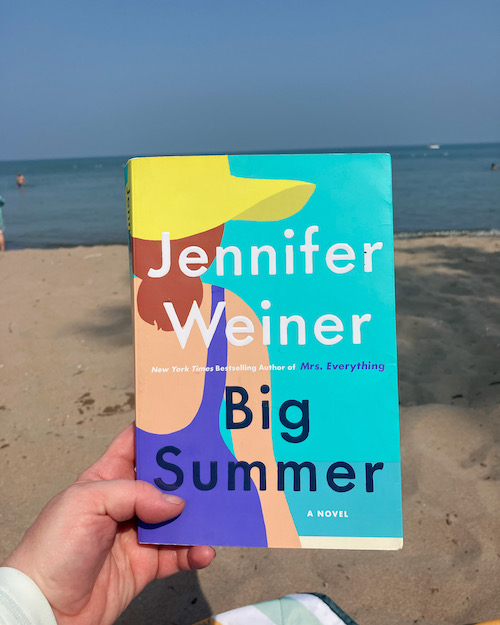
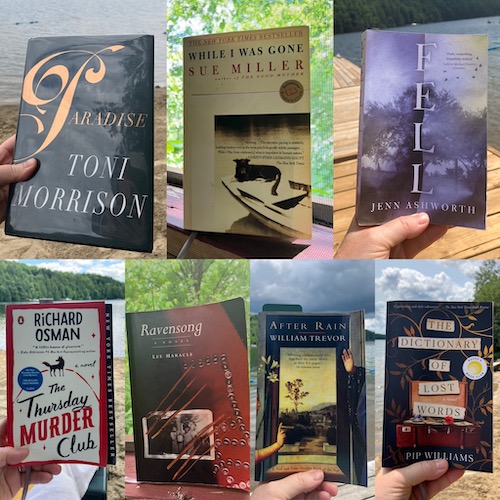
And I read and I read, books I’ve been picking up here and there over the last year and finally time away from work (and social media) gave me time to delve into them. Some new books, others authors I love whose backlists I still get to delight my way through (Sue Miller! Toni Morrison! Natalia Ginzburg!). Barbara Trapido, whose work I’m falling in love with. I read HAPPENING, by Annie Ernaux, 2022 Nobel Prize Winner. OMG, SONG OF SOLOMON! GIOVANNI’S ROOM! Connie Willis’s time travel epic (and I have its conclusion still before me).
What a satisfying stack this is, a stack that’s inspired me to read (even) more off the beaten track in 2023, to pursue my own curious avenues.
Also now my “to be read” shelf is as spare and orderly as it will be for at least another year, and so before the deluge of new releases begins, I want to take a moment and appreciate that.
December 22, 2022
A Box of Cloud

A year ago, a box arrived, a big box that was so light that it felt like we’d just had a cloud delivered to our doorstep, and at this point I was really suffering in a mental health crisis, and a cloud in a box felt like the gift of lightness. Even though we’d sent it to ourselves, eight big balls of wool because I’d determined that our family would spend the holiday break knitting scarves, such a calming and restorative occupation. And we did! And it was! By the new year we had four gorgeous scarves that attracted admiring comments from strangers when we wore them out and about (but not in a weird way). A great skill for our kids (and their dad!) to learn and we enjoyed the holiday knitting so much, we’re doing it again, this time to be donated to a shelter. I’m excited to get started. The wool was just delivered so it looks like the holidays are nearly here.
December 21, 2022
Gleanings

- Have you ever been to the theatre to watch a dance company perform a classical story ballet? If so, was your first, The Nutcracker? Mine was, at age three. My memory of that performance is understandably sketchy but I clearly remember being wowed. It was my first of many magical and fantastical ballet moments.
- *This post took me all day to write and I will never write in a coffee shop again**
- It felt like an adventure. It still does, here in the warmth of the fire, snow falling, remembering (and yes, wishing, wishing) the winter afternoon when friends knocked on the door, in snow, and came in bearing gifts.
- As the lyrics to this song go on to implore, “Pray for peace, people everywhere” and perhaps instead of waiting for ‘the Child’ to bring us “goodness and light” we could do what we can to bring goodness and light this year.
- Epiphany is actually an invitation for us to leave routine intentionally, because when we leave that structure that we are so comfortable in, we learn things about ourselves and about the world around us.
- My observation is, gone are the days of the shushing Librarian who lay in wait to collect a late fee. Contemporary libraries serve communities with programs to expand curiosity, kindness, and sharing.
- For hikers, there is a code to leave no trace behind. How does that translate to our everyday lives?
- I try and remind myself that social media has always been about the people we connect with there, but maybe it’s time to migrate our connections to better spaces yes?
- I am sure that if Davis were alive today he would be fighting alongside Ontarians against the current government’s anti-environment Bill 23 and Greenbelt land grab.
- Aries is a fire sign and to boot, I’m a double Aries, though I don’t know enough about astrology to explain what that means, but I do think it means I’m doubly fiery, which is both good and bad. Regardless, it requires some taming and being by a body of water does that for me.
- The truth is, I don’t know why I bother to write, but I listen and notice lately that I am writing myself somewhere unknown. And maybe it is there … there behind the intellect and the masks, the emotions and the knowledge, the will and the ego, comparisons or cares of what others think, past the external motivations and desires or bigger projects and clear pathways… maybe it is there, as I unclench my jaw, relax my belly, undo the button and let it hang loose, empty … I might find or hear … or glimpse…or write or dance my way towards something … somewhere … nearer to soul.
Do you like reading good things online and want to make sure you don’t miss a “Gleanings” post? Then sign up to receive “Gleanings” delivered to your inbox each week(ish). And if you’ve read something excellent that you think we ought to check out, share the link in a comment below.
December 19, 2022
Awesome
Once they started coming for positivity, I got defensive. *Who are you calling “toxic”?* I thought. Looking on the bright side, for me, is like a reflex. It’s how I make it through, and while I think all of us learned something from conversations around positive thinking (guys, don’t tell a person with terminal cancer, “You got this”) “toxic positivity” became one of those internet ideas thoroughly drained of its meaning, lugubrious people using it justify their worst impulses in a world that seemed more doom-laden than ever, and I was having none of it. That light at the end of the tunnel was my lodestar and, without it, I’d be a heap on the floor.
And then the light went out, and I lost my way, robbed of tool that had always served me to keep going, one day at a time, and it was at this point that I learned two things about my relationship to positivity. One, that I suffer from anxiety, and so what might look like toxic positivity from the outside is actually me recalibrating from the fact that I was convinced we were all going to die and then we didn’t and oh my god how amazing is that. And two, that while finally learning to feel sad hard and difficult feelings is my path away from anxiety, positivity has a role to play too on this awfully bumpy journey. In March I was really struggling, and actually started a gratitude journal, walking cliche that I’m becoming, and oh my gosh, it’s been a wonderful tool. Along with therapy, and reading, and learning how to dig down deep into painful emotions I’d been avoiding my whole life, and learn how to really feel them. As with all things, it’s not one or the other, but both. The pleasure and the pain, the darkness and the light.
And to that end, Our Book of Awesome, Neil Pasricha’s first “Awesome” book in a decade, has made for a most enjoyable year-end read. Pasricha’s career as a bestselling author began years ago at a remarkably low point from which he started climbing out of the darkness one awesome idea at a time, illuminating miraculous aspects of ordinary life (warm clothes out of the dryer!), which he’d post on a blog that became a book…and here we are. This latest collection includes Pasricha’s own mini-essays, as well as contributions from members of his online community, teachers who’d used the book in their classrooms, and more.
Seeing someone in an online meeting smile as they read the direct message you’ve just sent them in the chat. When a human answers the phone. Actual newspapers. Good hand sanitizer. Library holds. “When the cake pops flawlessly out of the pan.”
Yup. It’s awesome.
December 14, 2022
Gleanings

- I don’t want a neat ending. I don’t even really care about plot. What matters most to me is latching onto a voice that fascinates and challenges me. I’m still unraveling how this works and finding a way to describe it when I see it.
- Yes, I’ve felt unsettled. No amount of advance preparation or knowledge or planning could shift what came at me, poured through me, but as the year progressed, I got more comfortable with that. Comfortable with being unsettled. Or, perhaps more accurately, comfortable exploring the sensation.
- When will I ever learn to relax and leave it to the wind shifts and Angels?
- The other day I put on a coat I hadn’t worn in several months, put my hand in the pocket, and pulled out a scrunched up poop bag.
- Every year we are very warmly invited, indeed encouraged, to spend Christmas Day with friends. ‘Though generous and sweet, and ‘though we are very grateful for the offer and to have such thoughtful friends, we find it is not a day we want to spend in the midst of another family, much preferring our own wee celebration. And so it is.
- For a while, all of that worked, until it stopped working. When I took a year off writing novels, I took a year off from all of that as well. And that’s when things started moving forward, with barely any effort from me.
- And once we arrive at ‘the truth of life’, after decade upon decade of life events that bruise us and elevate us, crush us and uplift us, scar us and teach us, what do we do? We hide our glory. We conceal who we have become and what we’ve gained along the way. Because flaunting is for the young. Because who will want to know? Who will be interested in our stories? Who will say, “I am listening”?
- What is it I want? I want everything. I want to know the long line of my family going back centuries, I want to know their houses, their gardens, their sorrows, their hopes, the names of each and every one of them. I want to know about the feuds and the weddings.
- I think Bewilderment is, in part, about the limits of explanations, which are not, after all, instructions. What lies beyond them, as deep and vast and mysterious as space, is love.
December 12, 2022
2022: Books of the Year

A Convergence of Solitudes, by Anita Anand
Shrines of Gaiety, by Kate Atkinson
Cambium Blue, by Maureen Brownlee
What Storm, What Thunder, by Myriam J.A. Chancy
Marrying the Ketchups, by Jennifer Close
Susanna Hall: Her Book, by Jennifer Falkner
10 Days That Shaped Modern Canada, Aaron W. Hughes
The Department of Rare Books and Special Collections, by Eva Jurczyk
Looking for Jane, by Heather Marshall
The Hero of This Book, by Elizabeth McCracken
Finding Edward, by Sheila Murray
Woman, Watching, by Merilyn Simonds
Francie’s Got a Gun, by Carrie Snyder
The School of Mirrors, by Eva Stachniak
This Time Tomorrow, by Emma Straub
Ezra’s Ghosts, by Darcy Tamayose
The Long Road Home: On Blackness and Belonging, by Debra Thompson
The Elephant on Karluv Bridge, by Thomas Trofimuk
Ordinary Wonder Tales, by Emily Urquhart
December 9, 2022
Reason to Believe

“I still love this song, but I no longer live in it,” is something I texted my friend Marissa this morning about the Counting Crows song “A Long December,” usually on constant rotation for me around this time of year. But last night I’d realized I’d made it eight days into December without listening to it once, and it occurred to me even that this is the first December in a very long time in which I’ve not been desperate to believe that “maybe this year will be better than the last.” That I’m not listening to those lyrics with the same sense of abject sense of loss and longing that characterizes every Counting Crows song, but this one in particular. And the feeling that it’s all a lot of oysters, but no pearls
I’ve written before about how my mental health was at a breaking point a year ago, and I entered 2022 resolving to do things differently, to learn to be okay even when things weren’t okay, which was a perfect resolution for 2022, really, a year of a lot of not-okayness. And I’m not saying I’ve managed it with aplomb—the first six months of this year were really hard for me and I struggled a lot, and still do here and there—but I certainly have learned a thing or two about how to manage this, how to be okay in the midst of uncertainty, how to keep myself steady when the world’s falling apart, when “the winter makes you laugh a little slower/ Makes you talk a little lower about the things you could not show her.”
What I have learned is that value judgements such as “worse” or “better” are ideas, and that reality is reality no matter how you frame it, and that leaning in closer to that reality and how it makes me feel instead of my ideas about it—what’s good and bad, worse or better—is how to live more fully and with less anxiety. That a year is a year, and also a year is a lot of things running a spectrum from wondrous to horrible, and this one—while far from easy—has been better than the last mostly because I’m finally figuring all this out.
The reason I thought about “A Long December” last night was because Christa Couture re-shared a link to her New Year’s song “To Us” last night, a song that started off my new year, and whose message was what I needed instead of Adam Duritz’s maudlin tones:
No I’m not one to tell you, hon, “we’re in the clear”
Of course we might be, but here’s the rub:
Probably not this year
So happy new year to resentment, to enjoyment, disappointment
To all the best laid plans we won’t pull off
Happy new year to the weary, to fury, and recovery
To that which doesn’t kill us that makes us soft…