November 5, 2006
Listening
I have no set opinions about the teaching of creative writing, but it is a debate that interests me and is worthwhile even without conclusions. Personally, I know it’s worked for me in some ways. I am definitely a better writer than I was a year ago, in terms of what I produce and how efficiently I do it, but I also find myself confused by so much feedback from all sides, and different advice that goes around telling us how it’s done. I think when one is reading about writing, it has to be kept in mind that no advice is surefire and that different things work for different people. It is helpful to read contradictory advice and figure out what works, picking and choosing from the pile. I have managed this pretty well, though it took awhile, but I am getting the hang of who I am as a writing creature.
What I am less sure of, however, is my relationship to my work. I still find myself following prescriptions about what fiction is and what I am permitted to do with it. I realize I am still early on in my apprenticeship, but still it bothers me that I don’t own my work yet. I write what I write, hoping that when I put it out to the world, someone will say “yes, that’s right” more than anything else. Which is crap. And that this is crap never occured to me until today. I realize I am never going to write anything terribly experimental and I think my speciality is stories rather than language, but I want those stories to be mine. I want someone to give me feedback and for me to be able to dismiss it, and not just out of fatigue or insult. I want everything in my work to function because I made it that way, and because it has to function that way. I want my work not to be eager to please, but still to please. I want to remain receptive to feedback, but I also want my work to be my own.
I was listening to that Creative Writing podcast a few weeks back, a writer saying she never showed anyone her work until she was ready to publish it, and I thought how much I could never do that because I don’t know anything, and my instincts are all wrong. This is a big problem with creative writing classes, and something I need to get over. My work suffered in the past, not because my instincts were so wrong but because I was not sufficiently engaged with what I was doing. I need to get inside my work more, take it back and get to know it so well. I need to be engaged with my work on a level I have never been before, on a level that is so demanding it’s nearly painful. Every single bit of my story and its entire container have to be so deliberate and meaningful. But the important thing I realized today is that if I have done these things, I can throw all the writing advice in the world out the window.
This is a revelation. It came upon me today as I was flipping through Francine Prose’s Mrs. Dalloway Reader. An essayist (I can’t remember which) wrote about how in Mrs. Dalloway, Woolf turned fiction on its head. She told rather than showed, and the pace was slow, and the story was cluttered etc etc but her book was magnificent. She wasn’t listening to anyone but herself, oh but she was listening to herself so intently. Do this.
This might not sound revelatory on a grand scale, but I suspect anyone who has been mired in the questions surrounding how to write a novel will understand the significance of the line I crossed today.
Note: I find it interesting that searching for “how to write a novel” on amazon comes up with a 1994 book called How to Write a Damn Good Novel by James Frey! James N Frey, that is.
November 5, 2006
StuffRead
I loved Camilla Gibb’s piece in The Globe today, weaving together Borat, Peter McKay’s alleged dog slur, Anna Politkovskaya, and freedom of speech to say something good and profound. I also enjoyed Doug Saunders’ piece The Blueprints of Human Unrest, about the relationship between architecture and the social problems. The Giller Debate was all right, and I also appreciated Warren Clements’ attempts to understand why Fergie-Ferg is a “dutchess” instead of a “duchess”. And lovely! Something nice to say about those of us who aspire to bookwrite. Paul Auster on fiction.
November 5, 2006
New Editions
Last night at Katie D’s bachelorette, guests received Shakespeare’s Complete Sonnets, which I thought was a pretty fantastic gift. And today I picked up A History of Love by Nicole Krauss, which I am excited to read.
November 3, 2006
The Octopus and other readings
Last night, I went to see the brilliant Jennica Harper read, and it was wonderful to put a voice to those words. I enjoyed the evening very much, as Rebecca Rosenblum was there, and we got to hear other readers too, including Leon Rooke, Terence Young and Patricia Young. If I haven’t implored you to check out Jennica Harper’s The Octopus and other poems yet, you should do so. It’s a top-rated Pickle Me This Pick of 2006.
And Jennica signed my copy and I got a bookmark!
November 3, 2006
Moral Disorder by Margaret Atwood

1) In 2006, the prolific Margaret Atwood has released three books: The Penelopiad which reworks the Ulysses myth from Penelope’s point of view; The Tent, a collection of fable-like stories and poems; and Moral Disorder, a collection of connected short stories. I’ve read them all. They were all excellent. Most people are lucky to publish three good books in a lifetime.
2) Last night, as we were lying in bed, I read my husband the story “Moral Disorder” from the book of the same name. My husband and I don’t usually read to one another; we’re just not that way inclined. Originally, I just wanted to read him a passage from the story but I couldn’t stop and he didn’t want me to, and by the end of the story we were laughing so hard, we were crying. The best bit was the haunted peacock. This is Margaret Atwood. Remember Margaret Atwood- the dark, bleak, feminist man-hater (as you no doubt learned when you read Handmaid’s Tale at school?) Margaret Atwood is a first class comedian.
3) At the end of her story “The Entities”, Margaret Atwood writes, “But what else could I do with all that? thinks Nell, wending her way back to her own house. All that anxiety and anger, those dubious good intentions, those tangled lives, that blood. I can tell about it or I can bury it. In the end, we’ll all become stories. Or else we’ll become entities. Maybe it’s the same.” I cite this passage, as Moral Disorder has been remarked on profusely for being quite autobiographical in its content, and herein lies the clue. I don’t see this book as autobiographical, but it is clear thoughout Atwood’s oeuvre that she mines her own life for stuff. Not her own experiences particularly, although they do appear, but more objects and settings. Having just read Cat’s Eye, Moral Disorder, and now rereading Lady Oracle, this is quite apparent. And I think it’s really fascinating to understand the different ways authors use their own lives in their work, and rather than supplying us with the story of Atwood, Moral Disorder provides insight into this process.
4) In addition, I don’t think a story such as “Moral Disorder” could have been written unless it came from some experience, or combination of experience. That sort of story is too absurd to be imagined, and could only be captured by someone who has lived through it. I’m just guessing.
5) I think Moral Disorder is essentially a novel. The stories all could stand alone (and they do– I’d read two in previous Toronto Life Fiction Issues) but the links are essential, a chronology is present. This book is a novel in the way that Lives of Girls and Women is a novel, though I think as a novel Atwood’s book actually works better.
6) I have written this entry as a list, to reflect my confusion about short story collections and how they should be reviewed. I could treat this book like the novel I believe it is, and sum up the narrative trajectory, but somehow that feels cheap. And my automatic response to this work was indeed rent and chaptered, as you can see. So it’s not completely a novel, but I stress its novel-like tendencies so those of you who dislike short story collections will not be put off this most excellent reading experience.
7) I could say this. Some short stories are not meant for collection, and might be happier wandering free. The stories in Moral Disorder, on the other hand, belong together. They centre around a character called Nell, and begin with the story “Bad News” in a present day, which takes a page from The Tent in form and content, I thought. From the second story, we return to Nell’s childhood and the stories continue in first-person until about half-way through when I becomes Nell (and her house is possessed by a lovesick peacock). She grows up, falls in love, struggles with the realities of modern love ala David Bowie (well, no David Bowie but you know, it’s the seventies). The last two stories of the collection beautifully deal with the decline of Nell’s parents and her relationships with them, and contribute to the circular structure of this collection. A fascinating dynamic is apparent, as Nell is caring for the ailing parents and their roles are reversed, and yet she is more a child than she ever was, because this is how they know and remember her.
8) This was a deeply satisfying book.
November 2, 2006
Today
When a shite piece of prose grows legs, and Stuart’s eggs show signs of imminent chickenhood. And there’s Japanese curry for dinner. Cheers all around then.
November 2, 2006
Joe saw me first
Joe saw me first, which wasn’t technically true because I’d seen him plenty before that. I knew him, but so did everyone, in that way a whole crowd knows a singer on the stage but no one expects him to know them back. Joe Brighton had been President of the Student Council the year before, when a radical group organized a sit-in at the Chancellor’s Office in protest of the Vietnam War and the university administration’s draconian authoritarianism. Rather unfashionably, Joe had condemned the students’ actions as irresponsible and ill-conceived, and he lent his support to a police raid that saw the protesters jailed. He’d stood up on behalf of mild-mannered, clean-cut boys everywhere, and even when the school paper pasted a headline over his face proclaiming him a fascist, you still had to admire his gumption. Joe’s council impeached him before his term was up, which only heightened his fame really. Felled politician though he was, Joe Brighton was six foot five and gorgeous, star forward of the Varsity Hockey Team, and when I used to take his order at the restaurant where I worked, I could hardly speak without a stammer.
November 2, 2006
Seen Reading
Bookninja links to Seen Reading, a wonderful blog tracking who’s reading what around town. I’ve gone through it looking for me, but there’s no sign yet.
November 1, 2006
Cat's Eye
Usually when I read marginalia from former academic selves of mine, it makes me want to gouge out my eyeballs. Particularly my high school self, which destroyed my Great Gatsby with banality, but my undergrad self was no treat either– the river, as I noted in The Diviners, “=life”. Now reading Cat’s Eye, which I’ve read a thousand other times. One of those times was 1998 for a course in my first year at university, and I highlighted all important passages in green highlighter. No idiot comments, fortunately, just the highlighter. It’s not so annoying actually, and this time, as I’ve made my own markings through it (which undoubtedly will make me want to kill myself in the future), I’ve become oddly conscious of some sort of dialogue with my former me. It’s sort of wonderful.
November 1, 2006
Trick or Treat?
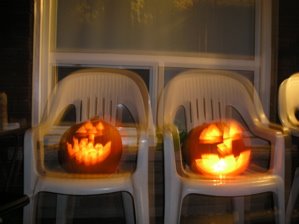 Trick-or-treating was a smash! Highlights were various princesses and tigers who were too little to walk, and the boy in the noose who was “an emo kid”. Lowlights were the various boys in baggy pants who were “rappers”, and me asking another boy in baggy pants (an old biddy voice), “Are you a rapper too?” except he was a soccer player.






