December 7, 2007
Now reading finally
I’ve been a bit deranged lately, and Stuart says I’m missing fiction. He keeps trying to foist novels upon me because I’m annoying to live with, but I am bloody minded and as I resolved to read six non-fiction books in a row, surely I will. I am not really convinced the derangement has to do with the non-fic anyway– more instead with Seasonal Mania (which I do seem to come down with every single season).
Anyway, finally, after ages and ages, I am reading Guns Germs and Steel. It has been sitting on my bedside for ages– for so long in fact that the person who lent it to me (Curtis) moved away months ago. 56 pages in, I am enthralled and learning so very much about things I can’t believe I don’t know or never thought to ask. Today as I read it on my lunch break, two strangers stopped me to tell me what a great book it was. Which was strange, really, because the only other time that has ever happened to me was way back when I was reading The Selfish Gene and nobody would leave me alone with it. Strange because you wouldn’t think these unliterary books would be the ones to inspire such bookish enthusiasm. What to make of that?
I am wary though, as both people who stopped to rave about Guns Germs and Steel admitted they hadn’t been able to get all the way through it. And both Curtis and Stuart said pretty much the same, though they enjoyed it still a great deal. Doesn’t bode well though, does it? What if nobody has ever finished this book ever? And as I’m so bloody-minded, what if I end up reading it for the rest of my life?
December 6, 2007
Post in books
 My love of post is so unabashed, and I’ve still got that tremendous crush on our mailman, even though I am sure it’s unrequited because during my previous incarnation as student/ housewife I used to meet him at our door each morning wearing track pants. But I don’t care much– I get excited at Canada Post vans, I covet pen pals, I subscribe to far too many periodicals, I make out with postboxes in airports, I’ve got an in the post label here on my blog.
On Sunday I sent out my Christmas cards– 43 of them, and at least one to every continent except Africa (where unfortunately I don’t know anybody), and when I say every continent I really mean it. What a treat indeed to post a letter to The South Pole. Doesn’t post make the world so delightfully small and in a way not even the internet could ever manage?
At Crooked House Stephany Aulenback has been celebrating postalness lately, in particular the very best thing since “books in the post” which is, of course, “post in the books.” I’d never made the connection before, between my love of mail and how much I enjoy reading collections of letters (which I’ve only really discovered in the past year actually with Decca and A Memoir of Friendship. ) But there clearly is a link, and Stephany has made me think back far to the postal books I’ve been loving for a long time. The Jolly Postman, of course, but also Beverly Cleary’s Dear Mr. Henshaw which I read over and over again when I was little. When I first moved to England I found a book called Dear Exile in my hostel (and stole it, I think) and loved this story of friends separated by continents. I am very much looking forward to reading A Celibate Season, the epistolary novel by Blanche Howard and Carol Shields. “For Esme– with Love and Squalor”. Stephany mentions the wonderous 84 Charing Cross Road.
It’s not really such a stretch, is it? That those of us who love books and love letters might be the same people in the end?
~She is always delighted by the arrival of the post, though it ought to be routine by now because the postman comes each day at three. But no, she anticipates the tip tap of his shoes, the thunk in through the letterbox and the footsteps’ retreat. A bundle of ephemera waiting on the floor. There is always something, a stack of something.~
December 6, 2007
Teacups with stories
“The vast waterfall of history pours down, and a few obituarists fill teacups with the stories.” –Marilyn Johnson, The Dead Beat
December 6, 2007
Parentbooks Contest
Though I’m not a parent, the Toronto bookshop Parentbooks still has much to offer. In addition to their specialty books, they’ve got a lovely little kids book section (Corduroy! Be still my heart!) and they’re running an Olivia promotion. Stop in (on Harbord, just west of Bathurst) to enter to win a marvelous basket of Olivia tricks. Contest closes December 14th.
December 5, 2007
Villa Air-Bel by Rosemary Sullivan
 Full disclosure requires a note that I know Rosemary Sullivan, and like and admire her very much. But it is just as essential to point out also that no amount of affection and admiration alone could have sustained my interest as indeed it was sustained as I read Villa Air-Bel.
Of course the subject matter only helped. Human nature at its most base and then such courage in contrast. And set in France during the early 1940s, which other books like Suite Francaise and April in Paris have so recently brought to life for me. I had never managed to get a real handle on occupied France until encountering these books, which showed that France during WW2 was more than a place on a map upon whose coasts boys died in droves. That there was life going on there all the while, however bizarrely and this France had the very same Paris we know so well from 1920s’ lore– just one example of incongruity. This France, that France; how can we be expected to reconcile this?
Which was just the trouble as Fascism’s grip took hold during the 1930s. It was perhaps the reason why Fascism took hold at all and nobody noticed, because it certainly couldn’t happen there. The very same reason Soviet dissidents flocked to France under Stalin, and others escaped there from the Nazis in the 1930s. France was an oasis of freedom on a continent where totalitarianism was steadily creeping. That the creeping could pervade France as well seemed unfathomable.
All of this leads to the fact that when northern France fell to the Germans in 1940 and Petain et al took up their puppet regime in the south, the country was full of people who would be persecuted under the new regime. Socialists, former Communists, anti-Nazis, intellectuals, bohemians, artists of a leftist sort (ie most), and Jews as anti-semitism became more blatant (the first round-up of French and foreign Jewish residents of Marseille, Sullivan writes, took place in April1941).
The villa itself– that “house in Marseille”– is not as central to the book as the title would suggest. For in order to tell the story of this house which provided refuge for those looking to escape France (the escape no easy trick, by the way, requiring exit visas, transit visas, a country willing to receive them) Sullivan must go back to the early 1930s to explain how these people got to France at all, how France got to France at all, and where the nerve of their rescuers had come from.
At the centre of the story as much as the house is Varian Fry, an American inspired to anti-Fascism after seeing 2 Nazi stormtroopers impale a man’s hand upon a table in a Berlin cafe in 1935. He is sent to Merseille by an American relief organization to facilitate the removal of refugees from France, but soon finds that he is quite powerless under the law. American authorities are willing to do very little to assist his efforts, eager to comply with the Vichy government instead. Fry must resort to illegal means, obtaining fraudulent visas, smuggling refugees over mountains, black market dealings. With his committee he rents Villa Air-Bel, which becomes home to refugees awaiting their departures– artists and writers including Victor Serge, Andre Breton, Max Ernst and Wilfredo Lam.
Truly the idea of these people living together in a French villa while hell was creeping on all sides around them is compelling. Stories of the surrealist games they played to pass the time, the outdoor art shows they held to raise funds, the dinner party upon which the whole book hinges–this is fascinating stuff, particularly when one acknowledges that these people were perpetually under threat. But as the house was a stopgap, of course, there is so much more to the story.
All of this Sullivan, a poet and a skilled and experienced biographer, is well aware of, as she traces the trajectory of these artists’ lives once they’ve left Villa Air-Bel, following their meandering routes towards safe haven. With suspense and such fine detail, she also illustrates the risks Fry and his associates take to help these refugees, eventually, it is said, enabling the escape of 1500 of them.
December 5, 2007
Links
What is it– this weird thing where one book leads to another. Would The Dead Beat: Lost Souls, Lucky Stiffs and the Perverse Pleasure of Obituaries be the same book had I not just finished Villa Air-Bel? Two books which, you would think, would not be so blatantly linked, but aren’t books surprising?
Villa Air-Bel opens with Lisa Fittko (who I’d never heard of before) guiding Walter Benjamin out of France, over the mountains into Spain. And then she turns up again in The Dead Beat page 50: “Douglas Martin’s vivid obit on Lisa Fittko, a World War II heroine who smuggled numerous people out of Europe, appeared nine days after her death because… “You can’t know all this stuff. That whole period is extremely vague. There are people who will tell you they did this, that, and the other thing, and Doug took days to separate the wheat from the chaff. The Chicago Tribune ran an obit that then had to be corrected extensively because it was all “ucked fup,” as they say in the business.” Though Fittko’s obit weaves together multiple stories and locations and mentions more than a dozen names, one peripheral name had to be correct the next day; an s had been mistakenly tacked onto a French surname.”
What are the odds, I wonder?
December 5, 2007
Their glasses are lying
They’ve heard me coming and now they’re sitting on either end of the L-shaped couch. Watching The Weather Channel, but their glasses are lying on the coffee table, arms entwined. Both of them keep blinking.
December 4, 2007
Library Page
Okay, I don’t know that it’s my favourite song but I am very impressed that Guelph band The BarMitzvah Brothers have a song called “Library Page”. Which is, naturally, about the plight of the library page.
“I first saw this job in grade ten, I really wanted it then.”
December 3, 2007
Lists
The Globe 100 was published this weekend. Such lists, I believe, are valuable, but not worth a knicker-twist. Perhaps if you haven’t read a book this year, or have been living in a cave, these lists could be worth following to the letter. But if you are a moderate book lover who has read many books this year that you’ve enjoyed, then shouldn’t such a list just be a very mild point of reference? As a voracious reader I approach year-end lists as follows: “Hmm, yes. The books I read and liked, the books I still have no intention of reading no matter that they say, and look! One or two I may have overlooked. All right then.” So it goes.
And we all know that the only list that matters is the Pickle Me This Picks anyway. To come…
December 3, 2007
Too much totalitarianism
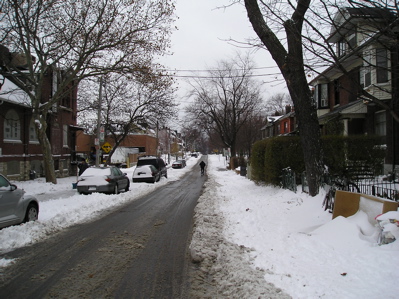 This weekend was Christmas parties and bridal showers, the wonderful Bite Noodles and Rice, snow falling outside, and then some rain. Christmas cards sent, decs up, The History Boys, corn muffins and wine. I am very distracted by a variety of things, and wish the days were longer.
Book trauma again– I have been way too immersed of late in totalitarian regimes. Now reading Villa Air Bel by Rosemary Sullivan, and I keep spouting totalitarian tidbits when I’m out in public, which is a good way to kill a mood (or at least a good one). My next non-fic pick is The Dead Beat: Lost Souls, Lucky Stiffs and the Perverse Pleasure of Obituaries, which, though it is about death, hopefully will be lighter? Villa Bel Air is really fascinating though, and look for a review maybe Tuesday.






