November 10, 2010
The kind of mother I wanted to be
 I’ve read two really excellent pieces on mothering blogs lately, the first being “I was a better mom before I had kids…” and then Her Bad Mother’s “On Being a Good Mother In Spite of It All.” Both play with the expectations we set for ourselves before we become parents, and what the reality turns out to be, and I think these kinds of discussions are useful actually, to a point. HBM rounds out her piece with the idea that trying to be a certain kind of mother when your heart’s not in it isn’t going to be good for anyone– for example, baby-wearing because you think you should, but your back is killing you and you hate it, or quitting work to stay home with the baby when it makes you miserable. She was writing in response to a recent article by Erica Jong about the ridiculousness of attachment parenting (“On the Madness of Modern Motherhood”).
Now I am fortunate, because I came into parenting completely unaware that “attachment parenting” was even a thing. Or rather, I knew about it, but simply as one of the faddy things I learned about from reading Christina Hardyment’s Dream Babies (along with Baby Whispering, and airing your child in a cage suspended from an apartment window). So my idea of the kind of mother I wanted to be didn’t come with a doctrine. My parenting philosophy, if I have one (but I don’t) has kind of grown up with me– for example, I learned that strollers are awkward in narrow Bloor Street shops and many places have steps, so I became a Baby Trekker convert (and we’re at 28 lbs and still going). I learned that some nights the only way anyone in our house would get some sleep was if Harriet came to bed with me and so (I guess?) we became part-time co-sleepers. It has always been important to me to take responsibility for having brought a child into the world, thereby doing some extra laundry instead of contributing to landfill, so I am a bit of a cloth diaper fanatic. I still breastfeed, but was never able to pump, so Harriet had formula when I wasn’t around. I don’t buy plastic toys We don’t own a car or a television, and I don’t want to own either, and it has been important to me to learn how to be a parent without both of these things.
-
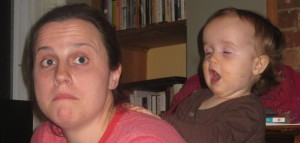
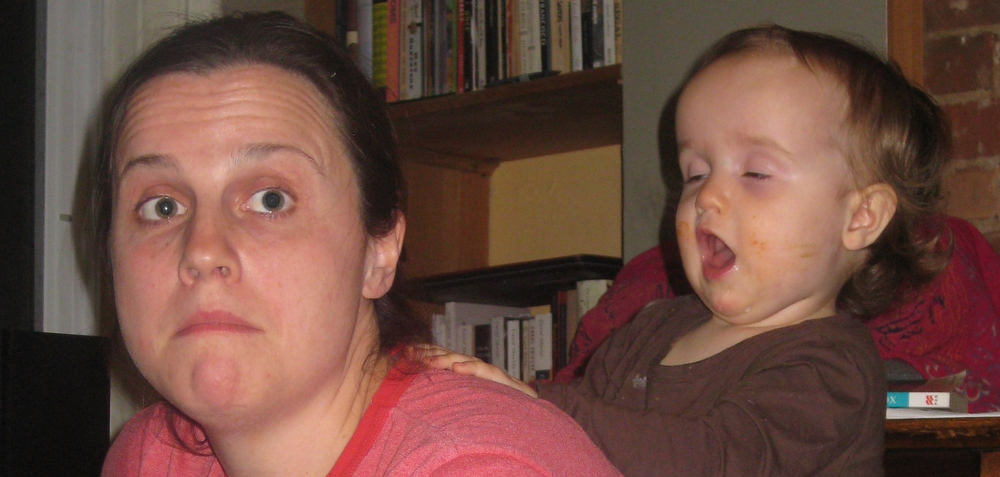
Believe it or not, this photo was not staged. We are this lovely naturally.
And so what I dislike about the discussions I noted is the way they descend into this bad-mother free-for-all. As if the very idea of using cloth diapers is laughable, or keeping small children away from television or limiting consumption . And I realize that a lot of this is very easy to say from the perspective of a mother of one, though I will point out that my belief in these ideas is part of the reason I am a mother of one (for now)– having one child is one of the reasons we’re able to make things work for us the way we want to. But I just feel that sometimes we’re all so busy congratulating ourselves for our honesty (like that a six month old got turned on to McDonalds. Really???) that we forget that some of these ideals are really sound ideas, and maybe the reason we feel guilty sometimes is that we should… Not because we let our children go out with dirty faces (see photo), or go out looking dumpy (also, see photo) of course, or lose our tempers etc. These are little things, they’re silly things. But there are bigger issues at hand, and somehow they get swept into the same catagory of impossible things. Like motherhood is just a slippery slope, and we’re all now looking up from the bottom.
I really am writing this now not to be a smug pain in the ass, but as reassurance for women who aren’t moms yet but who have an idea about the kind of mothers they want to be. If that idea comes from an authentic place within you, if you’re doing it because you want to and you believe in it (as opposed to the unsustainable arrangement derided by HBM of what you think you should be doing), then it’s totally possible. Of course, half the equation is your baby, and all bets are off as to what he or she will decide, but I want to assert that motherhood as an institution does not necessary push you to the bottom of that slippery slope. You’re exactly as indomitable as you feel.
November 10, 2010
The Carnivore by Mark Sinnett
 I first learned of The Carnivore when it was on the shortlist for the Toronto Book Award, and its author Mark Sinnett was reading an excerpt on the radio. The excerpt was intriguing, featuring a husband and wife meeting together on the shore of Lake Ontario as swimmer Marilyn Bell completed her crossing of the lake in 1954. The simple dynamic between the couple belied something darker and deeper, and the historical detail was inconspicuously well done. When The Carnivore ended up taking the prize, I knew that I had to read it.
When Ray Townes is in the final stages of emphysema, he and his wife Mary look back on the course of their marriage, and how their lives hinged on Hurricane Hazel, which ravaged Toronto in October 1954. The couple doesn’t look back together, however, the book consisting of alternating chapters from their two solitudes. The effect of this is interesting, as we learn that each of them has their own secrets about how much they know about the other and what they’ve chosen to withhold.
Ray is a police man who spent the hurricane rescuing citizens clinging to rooftops and washed out bridges. What the newspaper articles profiling his heroics fail to reveal, however, is that his courage that night stemmed from a mania that arose from a terrible act he’d committed, and that while he was supposed to be on duty, Ray had been driving around the city with his mistress. Mary is aware of all of this, however, which is why she resents the rehashing of events as the 50th anniversary of the hurricane approaches. She has never been able to forgive her husband for what he did and what he took from her, and now her own traumatic memories of the hurricane have been awakened– she was a nurse at St. Joseph’s Hospital, and witnessed horrific injuries that night she’d never been able to forget.
Sinnett’s depiction of the hurricane– the rushing rivers, the broken bodies in the hospital, the force of nature that tore its way through a city– are the most compelling aspect of the novel. They are riveting, illuminating and unflinching in their portrayal of a tragedy that seems to have been whitewashed by years of familiarity– like Hazel was somebody’s elderly aunt who came visiting once. Sinnett deftly uses detail in the story to describe the hurricane and the more general atmosphere of Toronto in 1954, his historical fiction not toned by sepia even though the book is structured as a reflection.
The back-and-forth in the narrative, and that the story is told to the reader rather than immediately experienced makes the plot read a little mechanically at times. Similarly the characters, who we’re permitting such a limited perspective of by their own voices and the partner’s perspective. Though some of the gaps Sinnett leaves in the character are interesting– we don’t get all the answers about why they’ve done the things they have, and that space to ponder is particularly engaging.
The Carnivore is a worthy recipient of The Toronto Book Award, a deserving book that will strike a chord with readers from Toronto and elsewhere. A book that uncovers another layer to a city we think we know.
November 10, 2010
Rare Giller Treat
 Look what Harriet found this morning! I look forward to reading it. If judges think it’s even better than Light Lifting, we’re really in for something brilliant.
November 9, 2010
Soap and Water
CBC Metro Morning was so delightfully bookish this morning, with pieces including an interview with Giller juror Michael Enright who had nearly read himself to death these last few months. And an interview with Dr. Alison McGeer about the decision to take magazines out of waiting rooms at Women’s College Hospital. Which was shocking for a few reasons, including 1) They still have waiting rooms at Women’s College Hospital? 2) But who will subscribe to Highlights for Children? 3) Who cares!? Doesn’t everybody have a novel in their purse already??
Since Harriet was born (which was nearly 1.5 years ago!), waiting rooms have offered me more uninterrupted reading opportunity than anywhere else. When she was about two months old, I waited for over two hours at a Passport Canada office while she slept in her stroller and I read (oddly enough), Between Interruptions: Thirty Women Tell the Truth About Motherhood (which was about thirty times more truth than I needed at that moment, by the way. Reading it was totally exhausting).
I had to go to the dermatologists early this summer and Harriet stayed home with my Aunt, while I got an entire subway journey there and back AND an extended waiting room round with Sarah Selecky’s marvelous This Cake is For the Party. There was a large screen TV in the waiting room too, which was blasting an episode of The View which made me very depressed about the state of the world, but Selecky’s stories really helped.
And then the legendary night this summer after Harriet poked me in the eye, and I waited in the walk-in clinic for six amazing hours reading Slouching Towards Bethlehem. It was also the middle of a heat wave, and the clinic was far more air-conditioned than my house was. I was almost disappointed when the doctor could see me then, though relieved to discover that I would not go blind.
All of this to say that I will not miss the old copies of Macleans then, or Shape, or Women’s Day, but then maybe I should have read them more, if only to absorb the diseases they’re apparently crawling with, so I’d get sick, go back to the doctor’s, then get to read some more.
November 9, 2010
www.patriciastorms.com
 Did I mention that my friend Patricia had got herself set up with a brand new website? A website that was created by my beloved CreateMeThis? And how lucky was good ol’ CreateMeThis to have Patricia’s spectacular images to work with, so that the result is splendid. Check it out.
November 8, 2010
On reading Anne Fadiman's Ex Libris
 I realize I’m being startlingly unoriginal in loving Anne Fadiman’s books of essays, not to mention about a decade late, but you see, I spent that decade entirely unaware that Anne Fadiman’s books were in the world, and I now see it as my duty to deliver any other readers from such similar darkness.
I first encountered Fadiman in August when I took her book At Large and At Small: Familiar Essays away with me on vacation. Tragically, its adorable front cover was marred when I used it to kill a mosquito against a log wall, and I was determined that a similar fate would not befall the even more adorable cover of Fadiman’s Ex Libris.
Ex Libris is a book of essays about books and reading, written with Fadiman’s signature exuberance. Though her book’s subtitle is an understatement; she is just about as “common” a reader as Virginia Woolf was. Fadiman’s bookish cred is serious: her parents are both writers, she grew up in an apartment with 7000 books, her husband is a writer and the progress of their relationship can be traced by the dedications on the fly leaves of books they’ve given each other over the years. One of her essays begins, “When I was four, I liked to build castles with my father’s pocket-sized, twenty-two volume set of Trollope.”
Still, however, there is common ground between her and us, which is partly aspirational thinking on our part, but also the result of Fadiman’s generous spirit. And she does have a knack of summing up experience just right: “I’d rather have a book, but in a pinch, I’ll settle for a book of Water Pik instructions”, she writes of her incessant need to always be reading something (which once a 1974 Toyota Corolla manual, twice, in an otherwise literature-barren motel room).
She writes hilariously about she and her husband eventually taking the plunge after some years of marriage, and finally deciding to merge their libraries, about the courtly and carnal approaches to how we mistreat our books, about gender and the evolution of language, compulsive copy-editing, and a wonderful essay about reading aloud with the perfect title: “Sharing the Mayhem.” Some of the book’s best bits feature her hapless husband, and her parents and brother who with her comprise a family like no other. A family that is an institution onto itself, with new word acquisition, literary references and allusions, and compulsive bookishness wholly integrated into everyday life– they are a fascinating window onto a world.
Anyway, I left this book on the kitchen table and something dripped on it, and there’s also now a rip on its upper right edge, but none of this makes Ex Libris less than perfect still, really. And how lucky was I this weekend to be discovering it for the very first time– delight and joy and wonder abound. My life is richer for it.
November 7, 2010
A Fuzzy Realm
 The fact was that I struggled with Sheila Heti’s book, How Should a Person Be? About what it meant to call that book a novel, a novel that contains its author as a character, a book whose gratuitous sexuality I found more off-putting than titillating, a book that read like a punchline to a joke I’d missed hearing told. Though I engaged with the book on many levels, at various points jotting, “This is interesting…” in the margins, and throughout as I tried to understand what Heti’s project was.
Part of the problem, I think, was that Heti came from a point of departure that didn’t quite make sense to me. For instance, that the blow-job is the great art-form of our time, as the novel was to the 19th century. Or that “personality is just an invention of new media… characters exists from the outside alone”. I think I’d also have trouble with any protagonist who remarks, “It would have been so easy to count the ways I’d been betrayed by girls… It was not that way with men.” There are instances in the book where the protagonists’ all-knowingness is subtly undermined enough, however, that I wondered if the glibness was more wry than I gave it credit for, but I was never really sure.
Throughout the book, however, I kept thinking of Joan Didion, not because she and Heti are at all similar, but because Didion’s entire oeuvre seems to address a lot of the questions that Heti is posing. Didion who says that “We tell ourselves stories in order to live”, with Heti eventually answering her own question with Didion’s backwards: “A person lives by telling stories.” Except that the stories Didion tells take her far outside herself, far from home. Whether through actual travel, engaging with different kinds of people, or other works of literature. Didion has this amazing way of telling other people’s stories, but still making herself the centre. A strange, self-effaced blurry centre, but still the point everything else revolves around. And it’s this blur that Heti will engage with.
In trying to answer, “How should a person be?”, I can’t help thinking that Sheila Heti should have just read Didion’s essay, “On self-respect.” The essay referencing a difficult time similar to that endured by Heti’s protagonist, when “[one loses] the conviction that lights would always turn green.” Says Didion, “Although to be driven back upon oneself is an uneasy affair at best, rather like trying to cross a border with borrowed credentials, it seems to me now the one condition necessary to the beginnings of real self-respect.” And that self-respect stems from “character”, which Heti has determined is a societal construction (but maybe she’s being ironic? I don’t know). Joan Didion, however, has no truck with that: “character– the willingness to accept responsibility for one’s life.”
Self-respect, according to Didion, is a kind of investment. It’s not about never failing, never making mistakes, but rather knowing what you’re getting into, meaning what you say and the things that you do. And this kind of thinking, she writes, requires “discipline, a habit of mind that can never be faked but can be developed, trained, coaxed forth”– that there is no magic pill for it, then, or book with all the answers, or a drug that makes everything clear. Self-respect stems from knowing ourselves from the inside, keeps us from being “in thrall” to everything on the outside wherein, “At the mercy of those we cannot but hold in contempt [for if we don’t respect ourselves, how do we respect those who associate with us?] we play roles doomed to failure before they are begun, each defeat generating fresh despair at the urgency of divining and meeting the next demand made upon us.” Which is kind of the entire plot of How Should a Person Be?
Part of my problem with Heti’s book is that some of her questions did make me uncomfortable– what it means to think we’re important enough to be doing something important, or that any of us matter that much, and what that the stories we tell ourselves in order to live feature characters we’ve constructed with such tireless precision. Her honesty may have struck a nerve. But she places herself above reproach in a way that’s really a bit dishonest– in making her art so much about her, we can’t engage with it without engaging with her character, and as a reader, I’m not comfortable with the ethics of that. I’m not sure the material is so well served by existing a fuzzy realm somewhere between fact and fiction.
But maybe I’m missing the whole point– perhaps Sheila Heti never did really want to be the ideal of what a person should be. Perhaps in posing such a notion, she was really making a comment on our shallow, celebrity obsessed culture in which the blow-job is the ultimate art-form. And that in proclaiming the blow-job as the ultimate art-form, she is deriding a culture that might proclaim the blow-job to be the ultimate art-form, but I still don’t really understand what she means by that, so you can see why I’m a little bit lost.
November 5, 2010
Books wrote our life story
“Books wrote our life story, and as they accumulated on our shelves (and on our windowsills, and underneath our sofa, and on top of the refrigerator), they became chapters in it themselves. How could it be otherwise?”– Anne Fadiman, Ex Libris: Confessions of a Common Reader
November 4, 2010
Found things
1) Who knew metaphors were so useful? Who knew a box could be so poetic.
2) The very best postbox in our whole neighbourhood. Also has a delivered package waiting in the door. Coincidence?
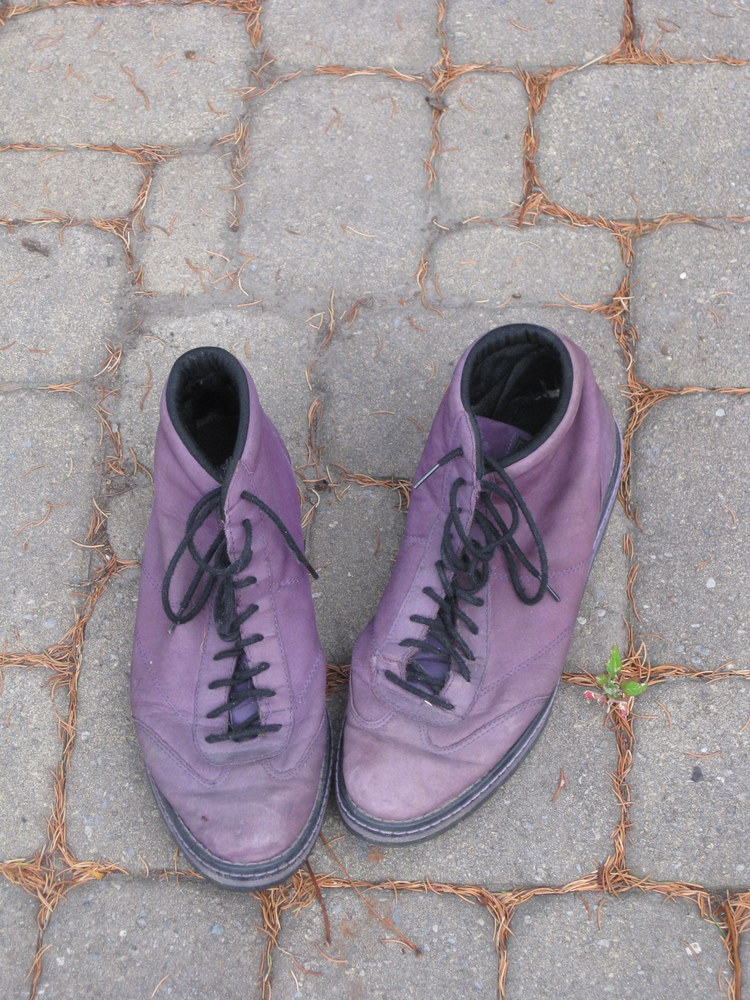
3) We found Mabel Murple’s shoes abandoned on the sidewalk!


November 4, 2010
Baking as Biography by Diane Tye
One of the best books I’ve read this year is Baking as Biography: A Life Story in Recipes by Diane Tye, which I reviewed for Quill & Quire. The weekend I was reading it, no one wanted to talk to me because I was so frightfully boring, starting all sentences with, “Did you know…?” and “Would you believe…?” and finishing with a fascinating fact from Tye’s book. Of which they were many, as Tye goes through her late mother’s recipe box to reconstruct her life and her times. The book beginning with the most fascinating fact of all– that this woman who baked and cooked for her family for decades once remarked that she didn’t even like baking. It took a few more decades for Tye to understand how interesting this was, and the resulting book explores the history of homemaking, feminism, family and eating, and the complex ways in which we understand all of these things. I loved this book. My review is here.






