March 11, 2011
After the third earthquake (2005)
After the third earthquake
I began to devise my own tremors
Cautious nerves alert
to pseudo seismic sensations
I fathomed near-death possibilities
via waves in a coffee pot.
Mistrustful of any stirring
You can be too in tune
with your house’s vibrato
Too inclined to begrudge men
who drill holes in the street for their living
For fear of what they might disturb
I could not take a step in case
of rattling plates threatening
killer tsunamic swampings
After the third earthquake
those beats pounding in my ears
made the room shake.
March 11, 2011
Subarashii kuni desu
 Today, thoughts are with Japan, a most wonderful country that was good enough to give us a home for a while.
March 10, 2011
I Think I Love You by Allison Pearson
 20 years late, as usual, I fancied David Cassidy in 1992 when The Partridge Family reruns were played on Much Music, and I am always happy to have “I Think I Love You” in my head. So that is one reason I wanted to read Allison Pearson’s latest novel, and also Michiko Kukatani liked it, and so did Maureen Corrigan. I’d never read Pearson’s first novel I Don’t Know How She Does It, but the premise of this one really appealed to me.
That premise is Petra, a thirteen year-old girl growing up with South Wales in the early ’70s, mad about David Cassidy with a passion only teenage girls are capable of. She and her friends collect his posters from The Essential David Cassidy Magazine (which come broken into pieces– there is a particularly disquieting scene involving Cassidy’s beheaded torso and unbuttoned jeans), kiss the posters with vasalined lips, practice writing their Mrs. David Cassidy signatures, and love their idol in an absolutely, utterly true way that Allison Pearson is insistent about taking seriously.
Meanwhile, we get alternating chapters from the point of view of Bill, fresh out of university and working as a rock journalist, or so he tells his girlfriend, when really he’s working for The Essential David Cassidy Magazine. Composing the monthly letters from David that Petra and her friends pore over hoping to find personal messages of undying love embedded between its lines.
Bill and Petra’s paths collide at a David Cassidy concert in London at which Petra’s friend Sharon nearly gets trampled. Twenty-five years later, they meet again, when Petra wins a chance to meet the former teen idol in Las Vegas in a concert sponsored by a magazine Bill runs. Petra is now a professional cellist, years away from the screaming girl in the crowd, but she’s just lost her mother and her marriage, and her daughter is on the cusp of teenagehood, which Petra finds completely terrifying. She can’t help but be immersed in a little nostalgia.
The first half of the novel is a bit awkward in the transitions between Bill and Petra’s stories, and Pearson writes Petra’s story so brilliantly that Bill’s part pales in comparison. Her portrayal of teenage girls is worthy of Judy Blume (and one character even seems lifted straight from Deenie), her respect for their feelings and intelligence makes these characters so compelling, and she nails it– the evil social dynamics, the insecurity, the desperation for everything the whole world seems to just be withholding. The second half with grown up Petra and Bill is basically a fairy tale and runs down a predictable road, but the characters remain so fresh, and Pearson is such a good writer that the whole book is a joy to read. In particular, her insights about mother/daughter relationships, and her ideas of teenage girlhood as expressed by Petra remembering her own adolescence and now contemplating her daughter’s.
I Think I Love You is a novel that manages to balance a little fun with a little subtext, and is well worth a read if you don’t mind the song stuck in your brain.
March 9, 2011
Wild libraries I have known: My School Libraries
 For some reason when I was in high school, they decided to do away with the library. In spite of all the books and the aura of shush, we had to call the library an Information Resource Centre, or something else just as unmemorable, whose exact name I, naturally, can’t remember. The librarian– and I think, somehow, she still managed to be a librarian– was quite adamant about the name change, refusing to tolerate any lapses in terminology. If you mentioned the library, she’d blink twice as though she didn’t understand what you could possibly be talking about, then offer correction like you were an idiot. I do remember that the pride and joy of the Information Resource Centre (and the reason for the name change) was a marvelous invention called a CD ROM Tower. I also remember that my friend Mike once got suspended from school for stealing a magazine (or so went the accusation, but really, it was all just a misunderstanding).
And so you can tell that high school (which was otherwise a pretty great place, and I was lucky enough to enjoy my time there) is not the library I’m talking about. No, I am talking about my elementary school libraries, of which I had two, and at the first one, I remember as venue for visits from Dennis Lee and Phoebe Gilman, among other writers. There was a story-telling competition, which I won more than once in spite of having a speech impediment, and the prize was that you got to be recorded on video tape, which was exciting even though we didn’t have a VCR. I remember molesting the paperback novels, discovering a heroine called Jo who I automatically loved because of associations with The Facts of Life. I remember our teacher librarian, who was called Mrs. Free, and that I coveted her affections. And that I dreamed of being old enough to be a library helper and undertake mysterious library tasks during recesses and at lunch hour.
I moved to another school before I had the chance, however, and was somewhat dismayed to find myself friendless and ridiculed. And so when I was finally able to become a library helper, the place was my sanctuary, a splendid alternative to recess outside and alone in the cold. I can’t remember what I did as a library helper, but the experience was one of the high points in a bleak little life. I remember revolving racks of paperbacks, discovering The Westing Game, wondering why they didn’t have any books by VC Andrews, being obsessed with novels about girls with anorexia (having by then outgrown my fascination with YA-friendly Holocaust fiction), date stamps and ink pads, call numbers typed on a typewriter and taped on paperback spines. I remember I once lied to my friends and said a boy had kissed me behind a copy of The Great Gilly Hopkins, and I am sure that none of my friends (by then, I had a few) believed me. I remember that at this school, the library was a room just like any other classroom, but that the books lining its walls and creating diversions in the floor plan had transformed it into another world.
School libraries are the wildest libraries out there, used by children high on ADHD, white-out and about-to-be raging hormones. Much more domestic spaces than the public library, somehow being at home brings out the worst in its patrons, and they come in twenty-five at a time, a single-filed massive, just like they own the place, because they do. It’s the most magical room in the school.
March 8, 2011
Now I'm dying to know what stroller she chose…
“Life with small children means you can’t be too picky or precious about how you read. I need solitude and silence to write but can read anywhere. My main concern, when buying a stroller, was finding one I could manoeuvre with one hand, so that I was able to push the sleeping baby and hold a book at the same time.” –Maggie O’Farrell, on mixing reading with domestic drudgery (which is the story of my happy life, incidentally).
March 8, 2011
The Tortoise and the Hare by Elizabeth Jenkins
 That it took a bit of time for me to really get into Elizabeth Jenkins’ novel The Tortoise and Hare might be chalked up to my post-vacation stupor, or my struggle to believe in a manly man who is called Evelyn, but regardless, I overcame it, and surely this is a book entirely worthy of its gorgeous cover. Though on second thought, I do wonder if the trouble wasn’t all mine– this is a strange book that takes time to find its story, digresses away from the main point of view in jarring ways, and is rife with unclear pronouns, all of which, when compounded with jet-lag, hindered me a bit. But I got over it, I did, about a third of the way in, and then I was sucked into the story which took me exactly where I knew that it would go, but managed to surprise and horrify me all the same. As though I didn’t want to find out what would happen next, I couldn’t stop reading either, one thing after another in a display of terrifying inevitability.
What strikes me most about the story is how its main players don’t conform to type. Beautiful, elegant Imogen isn’t troubled when her husband Evelyn (!) strikes up a close friendship with their neighbour, Blanche Silcox. Blanche and Evelyn have much in common, but dumpy Blanche in her hideous hats poses no threat to Imogen, which is not to say that all is well in Imogen’s marriage, of course. Her relationship is founded on her being the object of her husband’s affections (which she is unable to properly return in a physical fashion) and has come to seem groundless now that her husband’s affections have waned, and there is the question of their horrible son, Gavin, who has about as much respect for his mother as his father does (which isn’t any). But surely this is the way that marriage goes, though she does allow herself to hope for resurrection of happiness now past.
So the two have grown apart, and there is the question of how much they were ever together, and as the novel progresses, Blanche begins to creep further and further into the relationship (and altogether deliberately, Imogen notes, though Evelyn doesn’t see this) until she finally comes between them. Through being everything that Imogen isn’t, Blanche somehow managed to make herself the unlikely but perfect companion for Evelyn– sensible, adoring, smart, rugged, and capable.
The true power of the novel, however, is that Imogen isn’t simply the opposite of these things. She is an avid reader (and there is some wonderful bookishness here), she takes an interest in her husband’s affairs, she is absolutely capable in her own way, but her confidence and countenance are flatly undermined by Evelyn’s disdain for her intelligence and sensibilities. Silcox’s opposite, however, is shown in Zenobia, a gorgeous, ostentatious, idiotic woman who, Imogen one day suddenly realizes, is the type of woman she herself becoming by continuing (and failing) to be the kind of woman she imagines men like Evelyn want to be in love with– Imogen’s moment of recognition is the novel’s finest moment.
The subtlety here isn’t Pymian, the kind where a character brews a pot of tea and manages to articulate the entire British class system, but rather the subtlety is in the plot, which unfolds with such unruffled swiftness that it’s barely noticeable, and absolutely unstoppable. Agonizing, and perfect, and I would have preferred to see Blanche Silcox hit by a bus in the end, or impaled on a fence rail (because the woman is pure evil, no bones about it), I have no doubt there will be justice somewhere beyond Jenkins’ final page, and I am convinced that it’s really Imogen who comes out of it all in triumph.
March 6, 2011
Below stairs
 My Anglophilia is really curious when you consider that if I’d lived in England back when times were really merrie, I would have worked six days a week in a cotton mill and my husband would have been killed in a coalmine, because truly, this is the stock we descend from. If I was in a Barbara Pym novel, I would probably be the charwoman. Virgina Woolf would have kept me safely below-stairs. Class is such a funny thing, easy to overlook when we’re reading Rachel Cusk back home in Canada, but while reading her during the few days we spent in Windsor, I realized that I’m not the kind of woman Rachel Cusk writes about at all. I have never seen such well-dressed women as those I saw pushing expensive prams up and down Windsor’s cobblestone streets, whose accents were so cultivated I could scarcely understand them, which didn’t matter because they weren’t talking to me anyway. These women made me terribly ashamed of my shoes, perhaps for good reason.
 Nevertheless, it is my great fortune to be a Canadian married to an Englishman, because it means my English indulgences also fulfill familial obligation, but moreover that said family puts us up in the spare-room and entertains the baby. It means that I get to call myself middle-class, and that Kate Middleton is also middle-class, even though her parents are millionaires and she has nice shoes. It means that I can go rural-England crazy again (too much Midsomer Murders) and start lusting after a floral-printed garden spade with matching Wellington boots. I start raiding farm shops for delectable sausage. It is a good thing we get to come home from England, because I’m so annoying when I’m there, and my husband would probably divorce me if we stayed too long.
Last week, I bought a gorgeous new string of bunting from a woman who has survived the 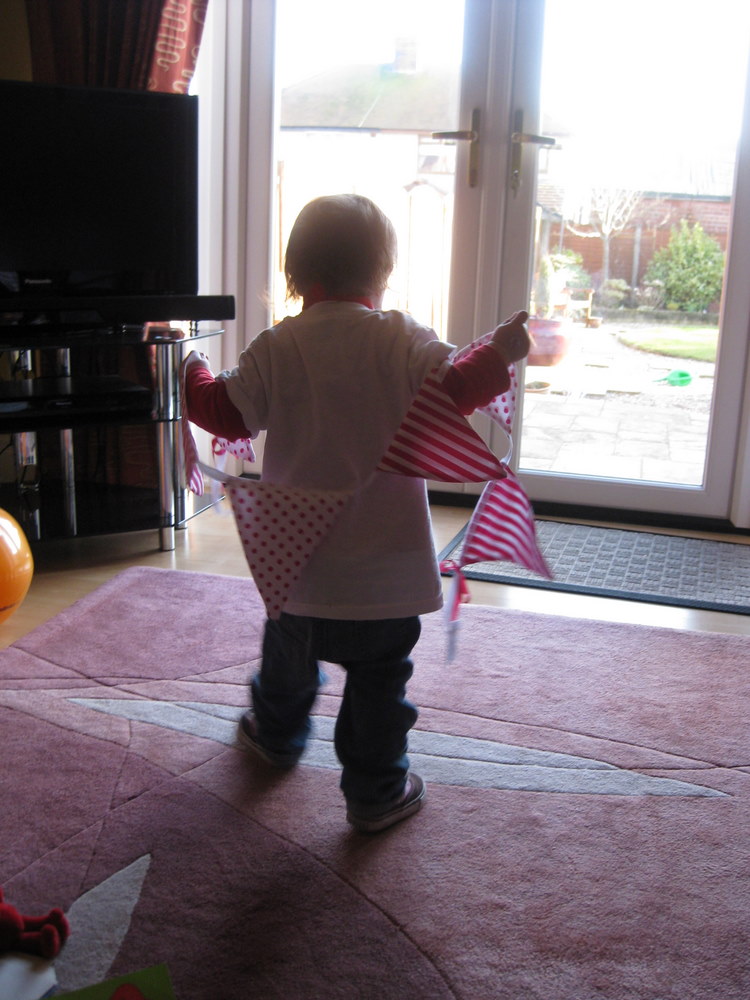 recession by going into the bunting biz. It seems the English are stringing a lot of the stuff these days, while stiffening their upper lips, and it’s kind of admirable. So many empty store-fronts– it’s devastating, really, in a way we barely fathom over here. And maybe it’s just spring time, but things do seem to be beginning to make a turn for the better. The tulips are up, and there are buds on the trees. Here, there is just fresh snow.
We had the most wonderful trip. I bought all kinds of books, but managed to read almost all of them en route, so it’s like I didn’t buy any books at all (very frugal). Stay tuned for an upcoming post about our literary escapades. In fact, stay tuned for upcoming posts galore, but only about our trip, because I can’t think of anything else right now. Real life will come back quickly, I’m sure, but we’re still not finished our washing, I’m still not finished reading my new English books, and there is a bar of Dairy Milk still to be devoured (but not much longer).

February 28, 2011
We love Ilkley. Thank you, Jackson Brodie.
 Today Harriet stayed home with her grandparents, and Stuart and I drove to Ilkley in Yorkshire (which is very close to Burley Cross country). I wanted to go to a Bettys Tea Room after reading Starting Early Took My Dog (which should probably receive a commission for our visit). Jackson Brodie certainly did not mislead us: if the Bettys girls ran the government, indeed, there
 would not have been recent economic disasters, or disasters of any kind. Tea was completely delicious, definitely the best we’d had since Saturday, and I was particularly in love with the woman having her breakfast at the table across from ours’ (“Anything else for ye, Vera?” they asked as she was preparing to go, as she tied a kerchief around her hair).
We had fun exploring the town afterwards, visiting the best butcher in Britain, and the Grove Bookshop, a fabulous independent bookshop whose business was booming. We got a steak and kidney pie at the former, and at the bookshop, I got a Penguin 75 tote bag, and Old Filth by Jane Gardam (which I’ve had out of the library twice, but have always had to return before I’ve had a chance to read it).
February 27, 2011
Can Lit?
 I br0ught a few Canadian novels with me, but have actually forgotten that Canada was ever such a place, so they’ve remained unopened in my suitcase. Instead, I’ve delighted in three epistolary novels in a row. The first was Daddy Long Legs by Jean Webster, which wasn’t remotely English, except for the umbrellas on the cover, and that was enough– I really liked it. Next was Burley Cross Postbox Theft, which was absolutely brilliant– I loved the ending. And on Friday, I read Felicity and Barbara Pym by Harrison Solow, which was even stranger than Nicola Barker’s novel, if such a thing was possible, but I adored it. The novel consists of correpondance from an
  academic to a student undertaking the study of liberal arts at an American university who is about to begin a seminar on Barbara Pym. Who is unclear about why she should bother to read Barbara Pym, and the academic is unscathing in her criticism of the student’s point of view, of her limitations. Unbashedly snobbish (but not in all respects. She recommends Miss Read and Jilly Cooper’s Class in order to understand Pym’s world), as she takes down the student for her own provincialism and then proceeds to outline why we should bother reading Barbara Pym, as well as how we should approach the liberal arts, which is by drawing a connection between impeccable literary analysis and the wider world. Connections between the insular nature of Pym’s village life and ideas of the earth-centred universe, and the island mentality of the English anyway. Absolutely fascinating, and though I appreciated Barbara Pym before I read it, I picked up her Less Than Angels next, of course, and I am a better reader now.
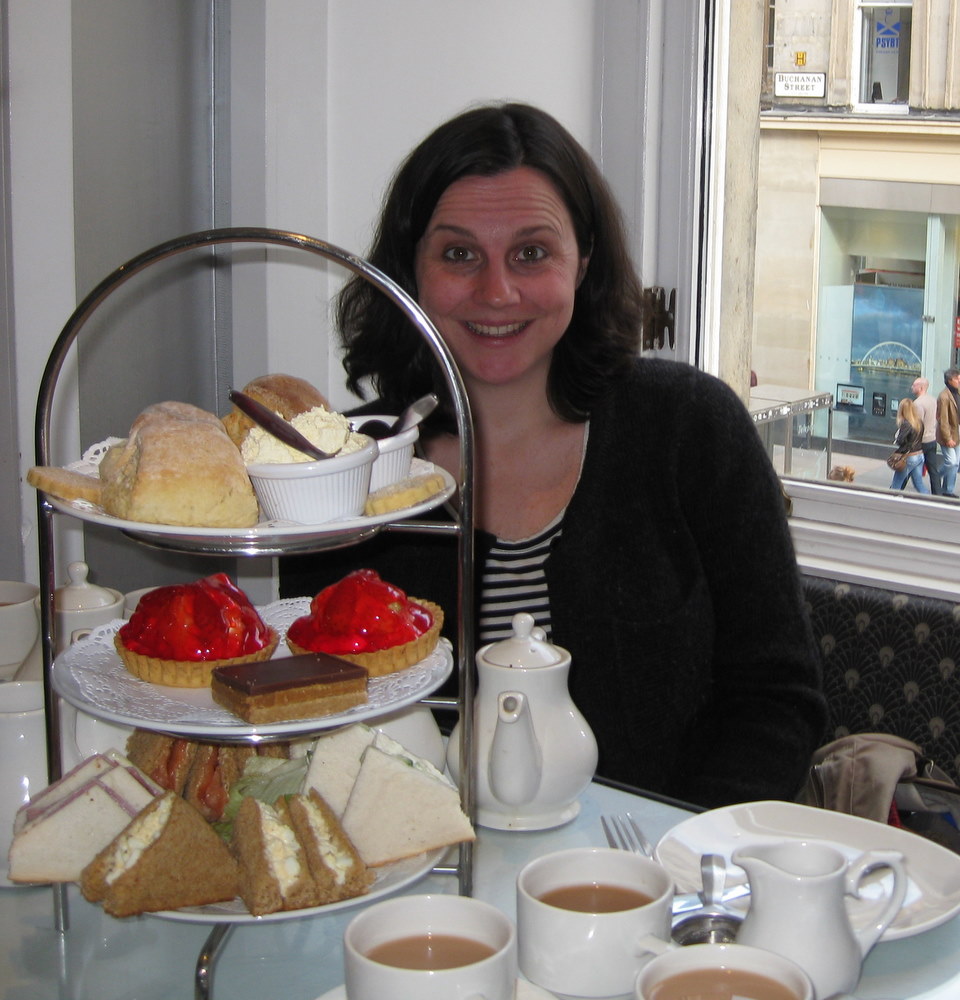 This weekend, we had a wonderful time in Glasgow with good friends (two of whom hopped over from Ireland for the occasion). The drive was lovely, the city was so vibrant and beautiful, and the sun shone and shone and we haven’t paid for it yet. Plus, we had afternoon tea at the Willow Tea Rooms, and had the kind of fun last night that is only possible in the company of the Scottish and the Irish. Tomorrow, to Yorkshire, and then a drive down South, then a day in London, and a day in Windsor, and before we know it, we’ll be home again, home again (and happy to be there. Though apparently, there is snow?).






