April 5, 2011
The Bronwen Wallace Award for Emerging Writers
 Patricia Storms asked me to accompany her to the Writers’ Trust of Canada’s RBC Bronwen Wallace Awards for Emerging Writers tonight, and I was happy to accept for various reasons, not all of which regarded drinks and hor doovras. It was a lovely event, and so great to listen to the three finalists read from their work. The winner was Garth Martens, who won me over with his absolutely perfect acceptance speech. I had to skip out before the mingling got out of hand, but I was so pleased to be there and watch goodness enacted.
And if you haven’t read Bronwen Wallace yet, do so. Here’s why.
April 5, 2011
Wild libaries I have known: The Himeji International Exchange Center
 It was one of the very best times of my life, the year and a bit we spent in Japan. The sakura bloomed every day, we bullet-trained our way towards various adventures, lived in a city with a castle at its centre, found our employment immensely gratifying, made lifelong friends, and decided we’d get married. (Not all of this is actually true, though the castle is, and so are the friends, and other things. It was much better in retrospect than it was at the time, but even at the time I knew that we’d treasure it for ever, it was all so thresholdy, and I have never been so young.)
We’d been prepared for culture shock, though that was about as useful as being prepared to have a baby. What I hadn’t been remotely prepared for was the experience of becoming illiterate, of having print disappear from my life. And of having books suddenly be rare. Japan is home to some of the best bookstores I have ever seen, stocked with books so gorgeous you want to stroke them, and I couldn’t read a single one. It baffled me. I kept going into the bookshops anyway, examining these books as though were bound up in a code I might crack– I never did.
I came to Japan after spending two years in England, where I’d buy 3 for 2s at Waterstones on my lunch break multiple times a week. In England, I got books free by buying hearty cereals and using a code printed on the inside of the box. I basically smelled like a charity bookshop, and that was fine with me. And then all of a sudden, I couldn’t read anymore, and it was like the time I was in Austria and the only book I could find was The Assassination of Marilyn Monroe, except this time, I wasn’t just passing through.
Which brings me to the Himeji International Exchange Centre (which I think was called the Himeji International Association when I lived there, just to be pedantic). It wasn’t very wild, actually, and it wasn’t even a library, though it was hush hush, all the time. But it had a library, with an English section that wasn’t particularly large, and it was a treasure to behold. And once again, I don’t remember the books I borrowed from there (except for Orientalism, and Amrita by Banana Yoshimoto, and Underground by Haruki Murakami; okay, I do remember a few), but I remember the joy of the selection, and how much more I valued books and reading when the experiences weren’t so readily available.
It was a same thing with the pile of books at the top of the stairs outside at staff room at the school we taught at. You’d add your pile of books to it when you left the country (unless you were me, in which case you’d spend hundreds of dollars sending battered Penguins home by sea). I remember reading Hope in the Desperate Hour by David Adams Richards (“a bit depressing”, my friend warned me), and Camille Paglia’s Sex, Art and American Culture.
I would have read anything, and I mostly did. (We also bought English books from amazon.jp, and trekked into Wantage Books in Kobe to buy another Margaret Drabble). I read trash, I read Manga, I read nonfiction, I read books I didn’t understand, and ones that lulled me to sleep in their predictability. Any book was always, always better than no book, which is a really interesting lesson to learn, but I am really most grateful for these libraries for keeping me from having to learn it the hard way.
Further:
- Once a really terrible thing happened to me at the Himeji International Association.
- Have you downloaded my book Spring Comes Suddenly and supported Japanese relief efforts?
April 4, 2011
Sarah Selecky is coming to visit
 Hey! Sarah Selecky is coming to visit on April 16th as part of her This Cake is for the Party e-tour. Get involved in the discussion, and be entered for a chance to win an e-reader, or get involved anyway even if you’d rather not win an e-reader. Her other stops are:
Open Book Toronto – April 5
Book Fridge– April 8
Dana Deathe – April 9
Grace O’Connell – April 23 &
That Shakespearean Rag – April 30.
April 3, 2011
V is for Variety Store

Location: Harbord Street and Roxton Road
We’ve decided that it might be fun to create our own version of Allan Moak’s A Big City Alphabet over the next year, taking photographs in imitation of the pictures in the book (with the addition of a Harriet, of course, which Moak so foolishly forgot to include). Some of the letters will be simpler to recreate than others (I is for Island Ferry vs. H is for Horses), Y is for Yuletide and O is for October will rely on time of year, and it also means we’re going to have to visit the Science Centre and the Zoo. It should be a fun way to make a connection between Harriet, books, and this city we’re so lucky to live in. Today we took our very first shot, which was particularly easy to come by: V is for Variety Store.
April 3, 2011
A good list
 I am currently reading Must You Go? My life with Harold Pinter by Antonia Fraser, even though to me, Harold Pinter belongs to that subcatagory of Unknown Literary Harolds (a diverse assortment inc. Robbins and Bloom) and I don’t know who Antonia Fraser is either. I’m enjoying the book, however, and reading it because it was cited in a feature in the Globe and Mail on New Years Eve, “My Books of the Year: The Literati Name Names“. I read that article with my laptop open to the Toronto Public Library’s requests page, and added one book after another that had caught my attention. It’s the reason I read Charlene Diehl’s Out of Grief, Singing (upon the recommendation of Alison Pick) and why I’m still waiting on Bring on the Books for Everybody: How Literary Culture Became Popular Culture by Jim Collins (which had been Kate Pullinger’s selection).
April 3, 2011
Daughters-in-Law by Joanna Trollope
In her very strange book Felicity and Barbara Pym, Harrison Solow notes that Barbara Pym doesn’t so much write a lot about tea as  that English novelists fixate on tea in general. Solow also writes that one hoping to learn more about the Pymmian universe could do with reading Joanna Trollope, which is the reason I decided to pick up Trollope’s new novel Daughters-in-Law. In which cups of tea are poured throughout, the ceremony never illustrated as quotably as it is by Pym, but how could it be? But yes, still, the tea at all signals perfect Englishness and is absolutely delightful.
Though Trollope writes of Pymmian class concerns, her work lacks the undercurrents that make Barbara Pym so subtly literary. This, however, also means that to read Daughters-in-Law this week was to escape into a world where plot dominates, and it was entirely easy to becoming altogether lost, which was a treat considering the week that I’d had. A double treat, actually, because I’ve had such a problem with commercial fiction since becoming a more demanding reader– is it too much to ask for accessible but not bad? And as I read through Daughters-in-Law, I kept coming up to intersections where lesser writers would turn off onto cliched avenues, but Joanna Trollope missed them every time.
Cliched characters are avoided too (for the most part) by Trollope presenting her story from multiple points of view, and so we see the impulsive, self-centred mother-in-law Rachel from her own perspective and gain sympathy for her situation. That she has devoted her life to her family, to making her home the centre of her family’s life, a rambling bohemian nest in Suffolk where her husband paints birds in his studio, and she conducts cooking classes in her kitchen. Her position as the family’s centre has never been challenged, even with her two elder sons married, as one has married a woman whose family is abroad, and the other has no family at all. When her youngest marries a girl whose centre is eternally fixed on the self, however, friction is inevitable and explosions ensue.
Trollope writes with assurance of modern life– Pymmian and “old fashioned” aren’t necessarily synonyms, and I don’t think a curate turns up once. The youngest son Luke is forced to kick his cocaine habit before Charlotte will go out with him, however. And though Rachel and her husband Anthony live without a care on their inherited wealth, their children are all slightly constrained by housing prices. Trollope also writes matter-of-factly of one character’s experience with post-partum depression, which is incidental to the plot, life having gone on since the occurrence (as life often tends to do).
She also doesn’t have to rely on adultery for this novel about marriage and family relationships to progress, which is not to say that adultery itself is a cliche, but it usually is as portrayed in fiction. To write an an entire novel so compelling about people who (for the most part) behave quite decently is no small feat. And also, for that matter, Pymmish. It abounds!
April 1, 2011
A teapot for Harriet
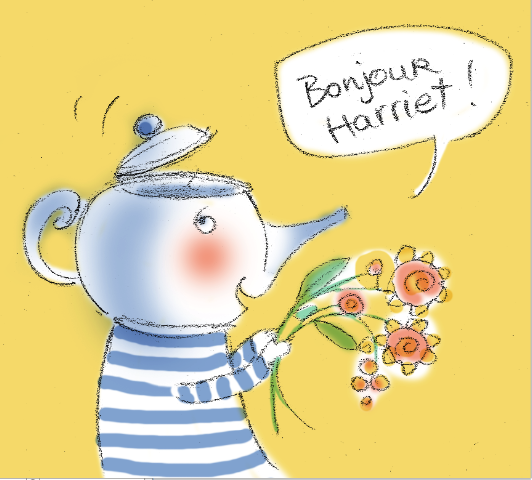 Our friend Genevieve Côté sent us this picture today, to satisfy Harriet’s love of teapots. (Harriet is a teapot tyrant. She will hand you a crayon and say, “Teapot, happy” and you have no choice but to comply, to draw that teapot, and don’t even try to forget the happy smile.)
We were excited to see Genevieve’s new book yesterday at Book City. Without You is the sequel to her acclaimed 2009 book Me and You, and I will be buying it for Harriet for her birthday. Genevieve has a thing for teapots too, and Harriet loves finding them in her gorgeous illustrations.
April 1, 2011
Finding the Words , edited by Jared Bland
 I once changed my entire life on account of an essay from the PEN Canada Anthology Writing Away, and I simply adored the most recent, Writing Life. So you can say that I’ve got a strong attachment to these anthologies, and so accordingly have been wondering what one would be were it not edited by the late Constance Rooke. In the latest, Finding the Words, I have my answer: it’s a different kind of creature, but still packed with inspiring, provocative writing, and proceeds of the books sales go to the same great cause.
My favourite essay was “How to Swim in a Sea of Shit” by Karen Connelly, about how the novel still matters. She writes with humour, and a light touch, and then her piece shifts effortlessly to the lessons she has learned from “writers in countries where writing words is an essential act of courage”. I loved Emma Donoghue’s “Finding Jack’s Voice”, with reflections on the processes through which children find their way to language; Lee Henderson’s “On Tuition Row” about corporate English, and how instead he tries “to ride the old roads of English”; Stephanie Nolen about the women in the Congo who gave her their words about their experiences as rape survivors in that war-wracked country; Michael Winter on the veil that falls and renders fiction as fact, or vice versa. Elizabeth Hay, Annabel Lyon and Lisa Moore write about finding their way into new novels. David Chariandy writes about not being at home at home, a theme of exile also touched upon by Rawi Hage. In “Affricates”, Richard Poplak asks, assuming land has a mother tongue, what language does the northern part of South Africa speak?
The book’s theme was too vague for the anthology to be cohesive. It’s the separate riffs on a concrete idea that I’ve always liked about the best anthologies, the PEN ones in particular, but this riffing on an idea that really didn’t mean anything in the first place kept the essays from banging together and illuminating one another, creating those fascinating intersections I love so much. So Finding the Words is a book that’s not necessarily more than the sum of its parts, but the sum still manages to be outstanding.
March 31, 2011
Something happens
“That is why I have ignored email and the Internet long enough to write and, as importantly — perhaps more importantly — to read. To read and read books, more books, beautiful books that smell of old paper and sometimes mildew and ink. Crisp new strangely confident books. I know that a good novel can change a life. Books changed my life. But as importantly, they have given me so much pleasure. Something happens when the right pages are opened at the right time; that invisible liquid lifts, flows up off the page, and the enters the reader’s mind and heart.” –from Karen Connelly’s essay “How to Swim in a Sea of Shit” from Finding the Words
March 30, 2011
A perfect book
I don’t know that I have ever read a perfect book. Sure, some books have had me under their spells: I remember the experience of finishing Elizabeth Hay’s Late Night’s on Air, and writing my review of it immediately after, pouring out my amazement at the wonder of the book. Others called the book overrated; I reread the book a few years later, and got a better sense of their arguments, though I still loved the book. But no, it wasn’t perfect, even if it had convinced me it was (but surely, that it did is a mark of success?).
I am thinking about this because I’ve been thinking about how to talk about books. What they mean to the people who write them and release them out into the world, and what they mean to readers who devour them, and critics who dissect them. What is it to read a book properly? What is necessary, for anybody, to experience a book?
I recently had a writer tell me that she never trusts a review unless it contains a hint of criticism, and my obligatory, nurturing response should have been something along the lines of, “That’s ridiculous! Don’t let the haters win! You are an endless ray of shining light, and let it shine, let it shine, let it shine.” The writer isn’t full of crap, however, and neither am I, so I had to admit that she had a point. The reader who sees your inevitable flaws while appreciating the book as a whole is probably a better reader than one who sings praises only. And I’ll admit that there are reviews in which I sing praises only, but for me it only means that the goodness so overrides the problems that the latter isn’t worth speaking about. (Or that the book managed to convince me it was perfect, even if only for a little while).
Is finding what’s wrong with a book a necessary part of reading it? For me it is, though I’m not sure if that was always the case. I think that blogging about books has made me look more critically at the books I read, which means that I have to examine how the books work. And figuring out how a book works requires an understanding of the ways it doesn’t. And here my mechanistic metaphor breaks down, because no book is ever just one book to its readers, of course. How a book works for me will be very different from how it works for another reader (and from how it will work for me the next time I read it, even). But anyway, sometimes that’s why reading a book too critically spoils the fun, because it breaks the spell that a really good book casts. Sometimes I think that a really good critic has to take into account the spell casting as much as the construction of the book itself. Sometimes I think that a book’s construction is also as subjective as the spell is.
It surprises me that any writer might imagine he’s written a perfect book. Not only because I’ve never read a perfect book, but also because I’ve never written anything that I have ever considered perfect. (And whether this is a mark upon my writing is a perfectly respectable rebuttal to my point, but let’s save it for another day.) I know there are writers for whom it is said that every single word is considered, deliberate, though that kind of criticism is as wishy-washy as any, really. I know that I don’t read books like this very often though, and that when I do, they were usually written sixty years ago. (Perhaps the book closest to perfect that I’ve read lately is Alexander MacLeod’s Light Lifting, but if you really pressed me, I could come up with something ever-s0-slightly wrong with it, but then I’d really rather you didn’t).
A book is never a finished product. (But then I also think that a book is never a product.) When a reader begins to read a book, it starts a brand new process, not just of merely unpacking what the author created, but also of the reader creating her own experience of the book through reading it. I suppose that act of creation is as subjective as every other subjective thing I’ve already written about here, but for me, finding the weakness in the book’s construction is a fundamental part of understanding the book entire. It doesn’t mean that the author left something unfinished, or even that he necessarily did anything wrong (although sometimes it does. God knows, sometimes it really, really does…), and one reader’s weakness is another reader’s strength (as we have discovered at every single meeting of The Vicious Book Club).
So I wonder what really constitutes a positive review. If I love a book, and write effusively about why this is so, but note that a character was not well drawn, or that a point in plotting was implausible, what does the writer take away from that? I know what other readers take away from it, of course, and they’re basically who I’m writing for, but when the writer reads my review (and no doubt, no one will read it with as much care as the writer will), will they understand how I can love a book and critique it at once? Or, even, will they understand that I am allowed not to like their book? And really, I’m even allowed not to “get” the book, if that’s the problem. That sometimes the not getting is a reading experience as worth exploring as any.
The reviewer doesn’t always get off so easily, of course. There are so many ways a reviewer can go wrong– my personal unfavourite is the reviewer who uses a review of a book about a dead baby on the prairie to further her personal vendetta against books about dead babies on prairies. Or the reviewer who hates Margaret Drabble reviewing Margaret Drabble’s new novel and getting the protagonist’s name wrong. Etc. etc. The reviewer doesn’t and shouldn’t have total license.
But neither does an author have license to determine just how a book gets read. The best books, however imperfect, will be perfectly able to take it.