April 28, 2011
Barbara Pym Barbara Pym Barbara Pym!
 I don’t know if I ever mentioned that Harriet and I were featured in the most recent issue of Green Leaves, the official newsletter of the Barbara Pym Society, along with the other guests from our local Barbara Pym gathering back in August. Some people have to wait their whole lives to get into Green Leaves, and so it was thrilling to be a part of things at the tender age of 31.
It’s also nice that my love of all things Pym has become a bit contagious, as attested to by Melanie’s blog post and its subsequent comments. (Seriously though, try it. You’ll like it.)
And finally, a heads up to the Pym-curious in Hamilton, Ontario– a Barbara Pym night is taking place at the Westdale Library on May 25th, organized by Pymmite Judy Smith. Email me if you’re interested, and I’ll put you in touch with her. Sounds like the event is going to be fun.
Oh, and another exciting thing. After I wrote my “How to woo a Barbara Pym heroine” blog post, I complained to my husband that never once in my whole life had I gone viral. He suggested that topics such as “How to woo a Barbara Pym heroine” were perhaps the reason for my obscurity. And then ten minutes later, the post went viral (in that understated way that such posts do, but there was still a surge, links by strangers, and on The Daily Pym [yeah, baby!] and Facebook and the post was featured on Stumble-upon). See, the world is hungry for Pym. I knew it.
April 28, 2011
Royal Wedding Tea Caddy
 My mom is nice because even though I refuse to lend her my books (and actually, I refuse to lend my books to anybody), she’d give me anything of hers that I wanted. On this weekend, the anything of hers I wanted was the Royal Wedding tea caddy that her friend had brought her back from England. I am not sure why I didn’t bring Royal Wedding tat back from England myself– I don’t think we ventured into shops that much except for bookshops, and if I’m not mistaken, the tat wasn’t out in full force two months ago anyway. But it did get to be a problem as the big day got closer and closer, and I found myself without a Royal Wedding commemorative anything. And all the Royal Wedding tea towels are are sold out. India Knight has reported bunting shortages all over London. This is terrible! I hardly need this, in addition to the stress of needing to learn to bake battenberg cake by Saturday afternoon, which is when my Royal Wedding Tea party begins (a bit after the fact, I know, but the wedding was never the point anyway. The cake was). So thank goodness for my mom, and for my Royal Wedding tea caddy. Which of course I will cherish now for all the rest of my days.
April 27, 2011
S is for Science Centre

Location: Ontario Science Centre
Very exciting to venture out to Toronto’s inner suburbs today and visit The Ontario Science Centre. Partly because we get to mark off another letter in our Big City ABC project, of course. Though, sadly, Allan Moak’s illustration cannot be re-created because they’ve stopped letting kids touch that electrifying silver ball that makes your hair stand on end and maybe causes cardiac arrest. Silver ball has been replaced with the most fantastic kids play area I’ve ever seen, however, and Harriet and her friend Finn loved everything they came across (the water play area in particular) and eventually had to be removed screaming from the facility because they weren’t finished with the fun yet, but, alas, we had to get them home for nap time.
April 27, 2011
The Vicious Circle reads: Anthills of the Savannah by Chinua Achebe
 We were concerned that Chinua Achebe’s Anthills of the Savannah might have broken The Vicious Circle Book Club. We speculated at links between the book’s difficulty, our historically low turn-out, and that the majority of us present hadn’t managed to get to the end. “I made the mistake,” said one of us, “of judging the book by its page count.” 216 pages had seemed like a breeze to those of us who read as easily as we walk, until we tried to actually read them. Things Fall Apart this book was not: the text was dense, full of rambling parables, conversations in which speakers were not located, narration that shifted between characters’ points of view and omniscience, the plot (and there really was one) was obfuscated, and those of us who’d finished the book were still confused.
But of course Chinua Achebe is not in the habit of writing bad books, and we reasoned that there was method in his method. How do we approach it? Were we failing to give the novel credit for its roots in an oral tradition? Were we slighting the novel for failing to impose the narrative shape dictated by the Western canon? Also, we reasoned, this was probably just not a great book club book– not to be read once breezily and discussed over wine (and here we discover a book club’s limitation, we imagine). What were we ever do with it?
Things we discussed: that page 40 really was the gateway to the book’s readability; that Elewa’s miraculous sexual position was implausible (or perhaps Elewa was particularly spry); that we liked the characters a lot; we cleared up what had happened between Beatrice and Sam at the party; that we liked the scene at the public execution; and we really liked Beatrice’s character. We spoiled the ending too. And suspected that the book’s haphazard structure is a statement about the perilous nature of any political structure in a dictatorship. We talked how this book corresponds with current events in North Africa and the Middle East. We compared Sam to Hosni Mubarak. The ideas of dictatorships– one characters statement that if Kangan had at least been a real dictatorship, then things actually might have got done. And the inevitability of what befalls the main characters in the end– that they were tragic heroes. But then the obfuscated plot plays out strangely against that inevitability of fate. In another form, this book could have been a John LaCarre novel.
Then we talked about how the book outwardly suggested that race was no longer an issue in the nation of Kangan, but inwardly was saying otherwise– that the post-colonial government had merely appropriated colonial structures. That the powerful characters were all powerful due to their colonial ties and Western education. That the book is also about class, religion, and sex. About the way that women are left to pick up the pieces in the end, Ikem’s revelation about women being the last resort, but how the last resort is always too late. (And his ideas about an embracing of contradiction being the beginning of true strength). And inevitability again– women are left to pick up the pieces here, but there are signs of change. The new baby who is named not by the patriarch, and who is given a boy’s name even though she is a girl. And then how everybody celebrates by singing the maid’s religious song, which none of us got our heads around, but alas.
So we were relieved to discover that The Vicious Circle wasn’t broken after all, and that there is a lot a book club can do with a book like this. That all of us came away with a deeper understanding of the novel due to insights from other readers, with this puzzle of a book closer to being solved. And then we drank more wine, and ate more lasagna, and some of us today are sorry that we didn’t help ourselves to a second slice of chocolate cake.
April 25, 2011
Still mired
 Forgive me. Still mired in the fat books, and then got doubly mired in a book that was thin but oh so dense– Chinua Achebe’s The Anthills of the Savannah for my book club meeting tomorrow night. So now I’m back in the Cheever (and oh, I love this book. I’m not far in yet, but these stories a wonderful to read. A bit bleak, yes, particularly with the Didion the week before, and he’s not afraid to break a child’s neck, but you’ve got to admire that). And then will return to any programming at all.
In other news, have I told you about my new gig at Canadian Bookshelf? Plans are afoot and they’re wonderful. Or that Heather Jessup came over to my house last week to deliver a jar of pickles (which, by the way, is the precise recipe for making me fall in love with you [oh, and Heather has a book coming out this fall with Gaspereau Press, and I’m very excited to read it])? Or that we’ve un-baby-proofed our apartment, and I have a desk again (with a couch right beside, so I have the option of typing whilst reclined, which is usually my preference). Or that we had a really lovely Easter weekend, and it was nice to drive home from visiting my parents and have it not be in a snowstorm. I also watched the Alfred Hitchcock film Beyond the Shadow of a Doubt, which was marvelously bookish and self-referential in a way that Scream thought was original fifty years later.
Anyway, as we don’t do blog posts about why we’re not writing blog posts, less of this, and then to bed, to bed, to bed.
April 20, 2011
Best book launch ever
 We had the best time ever at the launch for Jessica Westhead’s story collection And Also Sharks. Jessica does most things as well as she writes stories, including throw parties, though she didn’t have anything to do with what, for us, was the evening’s best bit: a babysitter! But because of that babysitter, we got to indulge in fabulous company, drinks, an atmosphere redolent with popcorn and shark films as a backdrop. Jessica showed two awesome book trailers (you can see one here, from one of my favourite stories in the collection, which is also significant because it’s the only story I know that takes its form from blog comments), and read from her story Coconut. And then as a souvenir, Jessica’s husband turned us all into paperdolls.
April 20, 2011
Keep Toronto Reading video!
In which I make funny faces, over-enunciate and (quite obviously) talk without actually having prepared what to say. Hooray to Jen Knoch for once agan Keeping Toronto Reading over at the KIRBC. This year’s Keep Toronto Reading theme is books that have transformed you, and I chose Bronwen Wallace’s People You’d Trust Your Life To because it transformed me into a Bronwen Wallace devotee (and it did. I haven’t shut about this book since I read it). I know it will transform you similarly, and we’ll all be better for it.
April 19, 2011
Best Books About Bunnies
It’s that time of year again, when all the serious thinkers in the world start compiling lists of best books about bunnies. We’re still secular fundamentalists over here, but our inner pagans have happily appropriated Easter and all its spring-time loveliness (inc. Cadbury’s contributions to it). Plus we love rabbits–me: Miffy. Harriet: rabbits in general, which are “bunnies” always. Hate real rabbits though. Nasty creatures… But that’s another story. In the meantime, here are our favourite rabbits at the moment from the land of picture books.
 Moon Rabbit/Brown Rabbit in the City by Natalie Russell. We have these books out of the library all the time, which give a laporine twist on the country mouse/city mouse scenario. The pictures are gorgeous, a bit retro, decorated with collagey patterned touches, and feature delightful things like teapots, guitars, and a double-decker bus. Moon Rabbit (which Harriet calls Moon Bunny) is about a city dwelling rabbit who looks out at the big moon and wonders if there is anyone else in the world like her. When she inadvertently wanders off into the outskirts of town, she meets a guitar-playing brown rabbit whose music makes her happy. They have fun together, until she begins to long for home, so she returns even though she’ll miss her friend, but he makes plans to see her soon. His visit is the subject of the second book, which is just as lovely.
Roslyn Rutabaga and the Biggest Hole on Earth by Marie Louise Gay. The illustrations here are vibrant, textured, and leap right 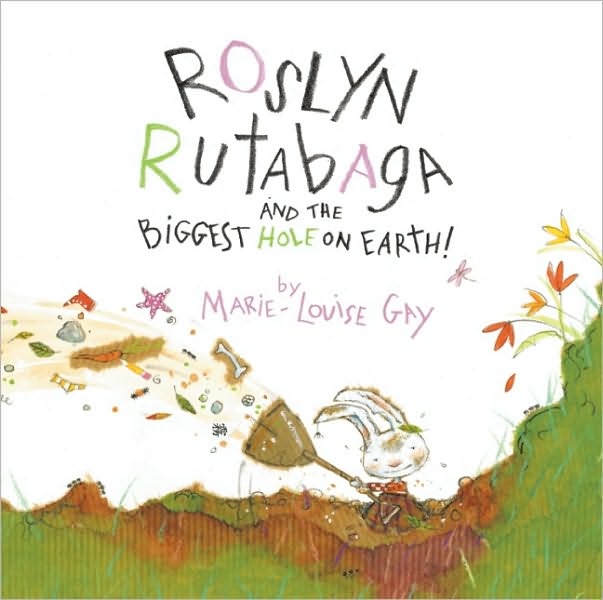 off the page. Roslyn is a bouncy bunny with long ears and big dreams: she’s determined to dig the biggest hole on earth (and maybe even meet a penguin when she gets to the South Pole). She’s not sure where to dig the hole, however, and then once she determines where to start, she discovers she’s digging in a worm’s front yard, in mole’s living room, and in a dog’s bone storage area. Clearly underground is less barren than she ever imagined (and if I were preposterous, I would suppose that this story actually an allegory about European colonization). She’s just about discouraged when her dad comes outside and makes her realize (but in a most unsentimental fashion) that she can dig the biggest hole on earth in her imagination. And then they eat lunch.
 Without You (and Me and You) by Genevieve Cote. We love, love, love Genevieve, who draws the best teapots, and this is the book that Harriet will receive as a gift on Sunday morning. This latest book is the story of two best friends (pig and rabbit) who have learned to celebrate their differences in theory, but find that day-to-day realities make the practice more difficult than they’d supposed. After an argument, they decide they don’t need one another anyway, but quickly discover that life is way less fun and interesting without a best friend to share it with. Not an allegory about European colonization, but a sweet and simple story that’s familiar to anyone and (spoiler alert) has a beautiful, happy ending.
The Velveteen Rabbit (Abridged) by Margery Williams, illustrated by Don Daily. My mom gave this to  Harriet for Easter last year, and of course, it’s well known, but I highlight it here because the abridgement is great. For kids a bit too small to appreciate the full story, here is the story stripped down but not in a way that takes away from the plot or the prose.
 The Quiet Book by Deborah Underwood, illustrated byRenata Liwska. Bunnies are just one of the creatures that features in this weird, wonderful book about the various kinds of quiet (“swimming under water quiet”, “Right before you yell “Surprise!” quiet”, “Trying not to hiccup quiet”). Not simply a list of quiets, a plot can be detected by the action in the pictures, but not entirely–for example, why was the little moose colouring on the wall? And we’re still trying to figure out how the little bear swimming underwater ended up with an injured tail. But I love that– picture books with as much subtext as a novel, and how the best ones are those you’ll never be altogether finished reading.
April 18, 2011
I have lost control
 Harriet has now mastered the art of climbing up onto a chair in order to turn on the kitchen stereo, to turn up its volume (if necessary), and mostly to turn off The Current and replace it with something musical. Which means, basically, that it’ s all “Hippo in the Bathtub” all the time around here lately. I think that this is going to become a problem…
April 18, 2011
We read Room Magazine 34.1
 I wasn’t planning to make a project of this, but I encountered so many wonderful things as I read through the latest issue of Room Magazine that I really had to share them. The cover, first of all, whose colours go so perfectly with the title, and this eye for detail is reflected in the design of the magazine all the way through. And it’s the case with every issue of Room, which is a feminist magazine run by a volunteer collective of women in Vancouver (and used to be called A Room of One’s Own, but decided to open up onto the world more).
Issue 34.1 is themed “Momentous”, and it’s their contest winners’ issue too. Though it reads more cohesively than you’d expect from that, and I forgot about the contest until I finished reading the magazine and reread the cover. I enjoyed Amy Kenny’s story “Chocolate Season” about a woman in an East Coast tourist town carrying on the family business after her father’s death. The full text of Chantal Gibson’s “The Mountain Pine Beetle Suite” is available to read, and it’s great, brutal, subtle and scary. And “The Goddess of Light & Dark”, which won the creative non-fiction category and one of the best things I’ve read lately, full stop, about the education that comes when the author becomes a clinical teaching associate at BC Women’s Hospital, a model and guide for students learning how to do pelvic exams: “Maybe revolutions are about knowledge”.
Sigal Samuel’s “Love and Other Irregular Verbs” is by a woman whose father has seen the women he’s loved as a portal to new languages, and how she learns these languages to erase the distance between them. I enjoyed the interview with Cathleen With about how her experiences teaching in Northern Canada have influenced her fiction, and the ethics of the decisions she’s made: “It’s about bearing witness; because there are many potential storytellers up there, and yet a lot of these kids are too busy being in it to sit down and write about it.”And I liked Wendy Marcus’s “Just John” about a mysterious neighbour and his legacy of plum trees.
I tried to read Nalo Hopkinson’s “Chance” but just couldn’t. I mention this only because Nalo Hopkinson has enough readers that she won’t even notice this one missing, but more because I am fascinated with my inability to read science fiction. I have so little patience with unpacking these stories, when I can find it for so many other works/genres. It is like the fantastical elements of these stories construct a barrier between me and the meat of the story, and I just can’t be bothered scrambling over it. Part of this is definitely my fault, but it’s also that there are some kinds of readers we were never meant to be.
The issue ends with several pieces that resonated with me: Laurie D. Graham’s poem “Say Here, Here”, about words, place and the depths beneath your feet; Christy Ann Conlin’s “Album”, which whisks its reader across decades and a continent; and “Six Reasons I Miss Being Pregnant” by Anne Panning and not just the “A free pass–however briefly– to wear giant corduory overalls”. And then Room’s backpages, which I always enjoy, which gives me the sense that as a Room reader, I am most certainly part of a wider community.






