October 14, 2012
On Barbara Gowdy, cut-out cookies, and other decapitations
 Over the weekend, I read Barbara Gowdy’s We So Seldom Look on Love, which readers and writers I admire have been talking about for years. In a collection full of devastating stories, I was most devastated by “Lizards”, in which a woman’s very tall lover decapitates her baby daughter by carrying her on his shoulders and walking too close to a ceiling fan. For some reason, I thought this was an essential plot point to share with my family, including those among us who are 3.
Harriet, whom I’ve accidentally given a fascination for all things macabre, couldn’t get enough of this story. “What happened next?” she asked. “Well,” I said. “The baby died. Her head fell off.” And no, it couldn’t have been put back on. Harriet eventually suggested that they should probably get a cutting board and cut off its arms and legs for good measure. And then we decided it would be an excellent idea to bake some gingerbread men.
Well, not gingerbread, exactly. We made “chewy oatmeal” cut-out cookies, but we call them gingerbread men anyway. Even the women. Their chewiness was part of their appeal, but it also meant that the men were partial to losing limbs and that the day’s focus on decapitation continued. Stuart and I surreptitiously gobbled up the casualties, which meant that by the time the cookies were all decorated and Harriet was permitted to have her “just one”, we were about ready to be sick.
Incidentally, this version of The Gingerbread Man story is our favourite. As with Gowdy, its author doesn’t shy away from darkness, but points out that a cookie getting eaten is far from the worst way a story could end.
October 9, 2012
Swimming Home by Deborah Levy
 It’s difficult upon first encounter to discern exactly the depth of Deborah Levy’s novel Swimming Home, which has been shortlisted for the Man Booker Prize. The book is slim, just 168 pages, with passages that would almost wash over you were it not for the strange lines of prose that trip you up, and the peculiar repetition of words, lines and symbols whose effect is dizzy, disorienting. I wasn’t done even once I’d come to the end, and so I had to read it again, that time backwards, mostly. And it’s not even until my third reading that I feel I’ve got a handle on the thing, which means it’s fortunate that the book is slim. It’s the kind of book you really have to dive into over and over.
Upon first encounter, Swimming Home is a story we’ve all read before. Miscoupled marrieds arrive at a rented villa in France, and have to contend with a misfit in their midst. The misfit is Kitty Finch, a botonist, an apparent poet, an enchantress and, according to the neighbouring Englishwoman whose balcony overlooks the villa’s swimming pool, also deranged. For reasons unfathomable to everyone, Kitty is invited to stay by the woman of the house, Isabel, a war correspondent who has never been at home while she’s at home. She’s invited Kitty to stay–Kitty who is first discovered swimming naked in the pool– even though she’s clearly got eyes for Isabel’s husband, the celebrated poet Josef whose betrayals stack as tall as his literary successes.
It comes as not surprise to Joe to discover that Kitty has a poem she wants to show him. “Young women who followed him about and wanted him to read their poetry, and he was now convinced that she was one of them, always started by telling him they’d written a poem about something extraordinary.” She has all his books, and tells his wife that, “Joe’s poetry is more like a conversation with me than anything else… We are in nerve contact.”
She’s projecting, we think, this beautiful, naked, swimming girl who is unhinged, but in the depths of the book, nothing is quite what it seems. Less a projector than a receptor, Kitty Finch becomes the tabula rasa upon which the other characters transmit their own fantasies, dreams and nightmares. Less a misfit than a lightning rod, the spine of this disturbing, strange novel, and we find that her grasp of reality is truer than anyone supposes, that she knows each of the people around her better than anybody else does or even better than they themselves do. Tragedy becomes inevitable, but probably not the way you think it is.
At its murky depths (which become illuminated, as are those of the swimming pool which is the novel’s central image), the trick isn’t to underline just what is significant in the text, but instead to understand that everything is. Nothing here is incidental. Which doesn’t make for an immediately satisfying read, because you’ll never be finished with this one, but it’s a delight to encounter a novel that doesn’t hesitate to challenge either its reader or the limits of what a novel can do.
October 9, 2012
Wild Writers in Waterloo, November 2-3
 I’m looking forward to the Wild Writers Literary Festival next month in Waterloo, where I will be running a class called “The Art of Blogging”. Other excellent events are scheduled throughout the festival, featuring readers including Terry Fallis, Merilyn Simonds, Alison Pick, Miranda Hill, Carrie Snyder, Diane Schoemperlen, Helen Humphreys, Alexander Macleod, Elizabeth Hay, Michael Redhill. and Michael Crummey. You can check out the full schedule here. Hope to see you there!
October 7, 2012
On mothering and books
“I don’t really feel I have to analyse my own motives in wanting children… It’s like (to me) asking why you want to write. Who cares? You have to, and that’s that. But the kids, like the writing, belong ultimately to themselves, and not to you. In fact, they’re very like the writing. A gift, given to you by life, undeserved like all grace is undeserved by its very nature, and not to be owned….” -Margaret Laurence in a 1971 letter to Margaret Atwood, from A Very Large Soul: Selected Letters from Margaret Laurence to Canadian Writers (ed. J.A. Wainwright).
“There was babbling I forgot to do, stimulation they never got, foods I meant to introduce and never got around to introducing. If a black-and-white mobile really increases depth perception and early exposure to classical music increases the likelihood of perfect pitch, I blew it. The books said to be relaxed and I was often tense, matter-of-fact and I was sometimes over the top. And look how it all turned out. I wound up with the three people I like best in the world, who have done more than anyone to excavate my essential humanity. That’s what the books never told me. I was bound and determined to learn from the experts. It just took me a while to figure out who the experts were.” -Anna Quindlen, “Goodbye, Dr. Spock”
October 4, 2012
The Vicious Circle reads Incendiary by Chris Cleave
 We met in the Annex on the last day of September, over scones and triangle sandwiches. Two of us had read the book previously and loved it, one of us so much that she couldn’t bear to read it again and mar the experience. We’d all enjoyed the book, except for one of us who found it ridiculous, but then noted that she’d still got through it easily. It’s that kind of book. One of us read most of it on a plane journey with a toddler. It’s a book you can read with a lot going on in the background.
It wasn’t quite what we’d expected. Primed for a “heartbreaking novel about loss and grief”, we were surprised to be immediately captured by the narrator’s voice, which isn’t the kind of voice that turns up in the Ian McEweny books set in London that we usually read. We were surprised by her biting wit, her fierce intelligence, that although the character is damaged from the outset, she is not a caricature of such things. We appreciated this presentation of a working class character, and how much of the novel is about class after all (and quite up front about this). We disagreed over the upper-class characters, who seemed so unreal that some of us had supposed they weren’t actually meant to be real, in a Fight Club set up, but it seemed that they were. “I don’t know,” said a few of us who knew what she was talking about when it comes to toffs, “they seemed pretty real to me.”
We wondered why the narrator was so detached from the world around her, even before the tragedy that claimed the lives of her husband and son. Though insights into her background provided clues to a sordid world she might be grateful to be detached from. By the end of the novel, she is clearly unhinged (though how unhinged is not altogether apparent– a fair amount of ambiguity is at work here), but we wondered how sane she was when the book started. She displays symptoms of OCD from the beginning, though we note that Chris Cleave doesn’t do this stereotypically.
We love the part where she throws up on Prince William’s shoes. How she is able to look at Prince William with a broken Britain all around him, and think, with sympathy, “You are going to be the king of… this.” She has an understanding of everybody around her, which is what allows her to step into other people’s roles, into men’s hearts and fantasies. We thought that the novel had some weak plot points, but one of us supposed that we were coming to this book with different expectations when we were meant to. That this book was written in a world in which a terrorist attack on London was thought to be a dark fantasy. And, as the story goes that is always attached to Incendiary, the 7/7 attacks were launched the very day this book was published. So now readers approach this book expecting the verisimilitude promised by happenstance, but it was never meant to be a documentary. What happens to London at the end of this novel is more dystopian than anything else, and perhaps we’re not to measure it against the world we know.
In the readers’ notes at the back of the book, Cleave refutes allegations that he wrongly predicted the outcome of terror attacks on London. The chaos and horror portrayed in the novel failed to emerge in reality, but Cleave says that the parallels are not so off. They’re just more subtle: civil liberties curtailed, entrenched racism, a war abroad whose cost is bankrupting British society. To which one of us argues that Cleave is wrong, not because the others are right, but because the “changes” he outlines in his argument have always been part of England. That the terror attacks, if anything, had only brought to the surface what was there all along.
Incendiary was an absorbing, undemanding novel, more interesting than it was good. We note that all of Cleave’s books have been ambitious and well tuned into the zeitgeist, but as literature, they’re lacking. That those of us who loved the book and were encountering it again were probably wise to have abstained from a second read.
October 3, 2012
Sussex Drive by Linda Svendsen
 There is something distinctly un-Canadian about Sussex Drive, the new satire by Linda Svendsen, a funny, impolitic novel written in the tradition of Joe Klein’s Primary Colours and Curtis Sittenfeld’s American Wife. Sussex Drive doesn’t quite probe the depths of the latter, with its confined chronology and a relationship to reality more along the lines of the TV show Spitting Image, but it is certainly entertaining. Sussex Drive examines the 2008 proroguement of Canadian parliament through the relationship between the Prime Minister’s dynamic blonde wife and the exotic, unlikely Governor General who lives with her own family just across the street.

But it’s not exactly that PM’s wife, and that Governor General. Svendsen’s novel takes place in an alternate reality, which we know because Queen Elizabeth has not so recently stepped down from the throne and her son Charles is now King. The Prime Minister of Canada is Greg Leggatt, hard-right politician from the Yukon, and his GG (a legacy from the previous government) is Lise Lavoie, an immigrant from the (fictional) African nation of St. Bertrand, the removal of whose first democratically-elected president Canada had been complicit. She was a renowned charity fundraiser, her first husband a First Nations environmental crusader who’d been mysteriously drowned, and her second-husband a Quebecois movie star (whose lead role in the TV movie Jeune Levesque would come back to haunt him).
Becky Leggatt supports her husband, so much so that she walks around 24 Sussex singing, “Ma-jor-itty!” (to the tune of “I Feel Pretty”). She uses her own covert manipulations to play GG Lise Lavoie right into her hand. However, when she discovers that her eldest daughter has become pregnant after a relationship with a member of her husband’s RCMP security team (a veteran of the war in Afghanistan who’d lost part of his leg), she realizes that her household is not running as smoothly as she might have imagined.
Meanwhile, Lise is on to Becky, but Lise is too distracted by multiple demands on her attention to properly fend her off. Lise is wily, but the Leggatt political machine is even more so. Lise tries to balance the roles of wife, mother, international peace ambassador, head of state, but the routine becomes overwhelming and soon standing up for her principles and the honour of her position is no longer possible. Eventually, she is fearing for her own life as it becomes clear that the increasingly terrifying Canadian Prime Minister will let nothing stand between him and the power he lusts for– not even the members of his own family.
Sussex Drive is a silly novel, but also an important one, an effective satire which asks important questions about our political system, all the while it thoroughly entertains.
October 2, 2012
On awards lists, malarky and various apes
 The Giller shortlist was announced yesterday, the nominees for the Governor General’s Awards announced today. Writers Trust last week too, and in general, I’m not so grumpy anymore. I love that The Juliet Stories is getting props. I don’t love that Malarky still isn’t, but I’m confident that it’s a book that will hold its own. Its enthusiastic readers will do its propping for it. I look forward to reading some of the other nominees.
Last week I read the Giller longlisted My Life Among the Apes by Cary Fagan, which I enjoyed a lot. Also was pleased to interview Fagan on 49thShelf, and I hope you’ll check it out because I’m really proud of this one. I’ve also been inspired to create a list of books with monkeys on their cover–a most worthwhile endeavour, I think.
Check out also recent #Fest2Fest interviews with writers Andrew Larsen and Sarah Tsiang.
September 30, 2012
Block Letters
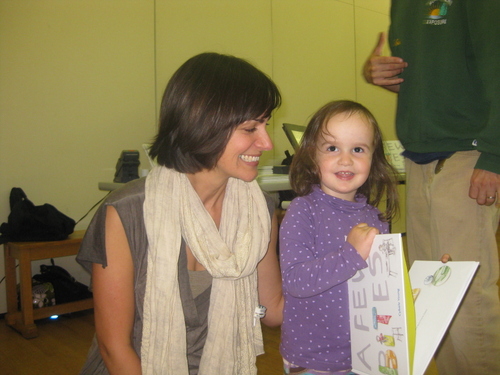
 Yesterday we dared to skip nap to attend the Block Letters event at the Lillian H. Smith Library, as part of Culture Days. The show began with Cybele Young reading from her book A Few Blocks, which we’ve been fans of for a while, as well as from Ten Birds, and from her latest book, A Few Bites, which we were happy to purchase for ourselves.
 After the reading, the kids were given a map of the neighbourhood, and we all left the library to go for a walk together. Not just any walk, however. It was an ordinary walk bursting with stories and imagination, similar to the one partaken by Ferdie and Viola in Cybele Young’s books. A little bit of imagination transforms an ordinary walk into an extraordinary adventure. We found a shoe, an empty lake, a strange tower with “Danger No Admittance” on its door. Where did the shoe come from? Why was the lake empty? What was inside the tower? (For the last, the kids came up with a hypothesis involving diamonds, a princess and the British King.)
We explored the alleys and strange pathways of the UofT campus, wondered where all the big rocks along Huron Street had come from, found a secret forest whose trees were sleeping monsters (who turned into rhinos if awakened), and began noticing small, wonderful things we might not have paid attention to before. What’s going on down in the sewer? The sound of streetcars passing? We discovered that everywhere is steeped in wonderment in you only stretch your mind enough to note it.
 Returning to the library (its own wondrous destination, with gryphons guarding its doorway), kids were equipped with markers and crayons, plus their own storybook with Cybele Young’s drawings inside and enough blank spaces for them to collaborate and tell their own stories of neighbourhood walk. Harriet dictated her tale, and drew some scrawly pictures in Harriet styly. Stuart and I helped her out so it became a bit of a family project.
There was popcorn, fun and plenty of inspiration. More than anyone could ask for from a Saturday afternoon.
September 27, 2012
Our Western Whirlwind
 Whew, speaking of roadtrips. We had a wonderful, crazy, whirlwind trip to the mountains this week. We arrived in Calgary on Thursday and drove to Banff where we met up with my family and my sister’s friends for a bbq at my sister’s house. The next morning, we hung out in Banff and were delighted to discover a new independent bookstore in town, the lovely Mooseprint Books. (So wonderfully curated! They had Native Trees of Canada with their nature books, and Above All Things in with the mountain guides.)
It was especially exciting because I was able to see all kinds of West-centric books for the first time that we’ve been featuring on 49thShelf, including Foodshelf: An Edible Alberta Alphabet by dee Hobsbawn-Smith. I’ll admit that Albertan food was not exactly a passion of mine, but: I have been mad about this book’s cover design since the first time I saw it, and I LOVE alphabet books, which rarely cater to my reading level and so I had to own this. I was not sorry. It turns out that reading about Alberta’s food culture is the most splendid way to learn about Alberta proper– its demographics, culture, topography, geography, climate, politics, and environment. It was an extraordinary education, and wholly engaging to read.
 On Friday, we drove to Golden BC to have lunch and a browse at Bacchus Books. Harriet got Kitten’s First Full Moon and Stuart (who’s on a David Mitchell kick) got Number9Dream. We arrived at the wedding site on the banks of Kicking Horse River and got ready for two days of wedding fun. The wedding was complete with friendly, fun guests, and hosts who went to the ends of the earth to ensure that fun was had by all. It was. Such a stunning backdrop for the party too. Harriet was a dancing queen, and everybody was thrilled and honoured to be there.
 We spent most of Sunday in Banff, when we weren’t on the road, riding a Gondola up to the mountain top and going to buy more books at Moose Print. (Harriet got Big Bear Hug as a Rocky Mountains souvenir). Dinner was had at our favourite Canmore joint, the wondrous Rocky Mountain Flatbread. And then on Monday morning we drove to Calgary. (It was also at this point that it occurred to us that we’d gone to too many places, and Harriet was confused about sleeping in a different bed every night.)
Oh, we learned that Calgarians are most hospitable. We were treated to lunch by Melanie and her family, and it was so nice to finally meet. Our children had a wonderful time playing together, and the pie was delicious. Afterwards, we drove out to stay with Melissa and her family, who had decided to put us up as house guests event though six people lived in their house already and Melissa hadn’t seen me in 17 years. Harriet was enchanted by the big kids, and we were made to feel as though we were home. On Tuesday, we met up with my friend Sue who I hadn’t seen in 7 years, and once again, Harriet had wonderful kids to play with. We visited a farm and braved a toddlerific restaurant meal, and then Harriet had a nap in their spare room.
 We decided it would be important to see some part of Calgary that wasn’t a suburb, however splendid were its inhabitants, so we ventured downtownish in the evening. Naturally, our pilgrimage would be to Pages on Kensingston, which was as wonderful as I’d been hoping it would be. Stuart and Harriet settled in to read stories while I browsed. I picked up the new Nicola Barker novel, The Yips (so good!), The Book of Marvels as a gift for our hostess, and Harriet was quite insistent upon owning a copy of The Obstinate Pen (good choice!). Then we went to a toy store where Stuart caused trouble, and went walking along the Bow River and crossed a pedestrian bridge or two. The aspens were beautiful!
Flight home was uneventful, or if it wasn’t, I didn’t notice because I was too busy reading Nicola Barker. We arrived home last night and are so glad to be back, as glad as we are exhausted, and the memories of the fun we had are as golden as the trees were.







