September 3, 2014
Interference by Michelle Berry
 Edgewood Drive is a leafy street, the kind of place where one could rake all day, and there’d still be leaves all around. Which is where Michelle Berry begins her novel, Interference, in the fall, neighbours with reason to be out of doors, waving to one another across driveways, while the faces of their houses—all windows and doors—reveal nothing at all. The scrape of their metal rakes on sidewalks just the one thing about the scene that is a little bit “off”, until a strange man appears, a scar right down the middle of his face revealing everything, or at least some kind of brutal tragedy in his past. He’s looking for work, and there’s more than enough leaves to go around. The man helps out, bagging leaves, though there is something particular about the way he looks at the children, and then he disappears without waiting to be paid. And this is only the first of a series of disquieting events that occur to the residents of Edgewood Drive, imbruing everything that follows with a slightly sinister edge.
Sinister coupled with comedy though—not everything in the book is dark. Interference is a novel comprising short stories, and in between them appears correspondence from the school principal, the ladies’ hockey league coordinator, email exchanges. The everyday absurdity of these messages gives the novel an additional layer of ambiguity: is modern life, with its stranger-danger warnings, just one giant farce? Are we to laugh at the residents of Edgewood Drive, with their silly preoccupations and neuroses, for playing into it all? Or are we to actually feel for them?
Claire. who’s countering cancer with a ferocious anger; Dayton, who has fled her cheating husband but not before stealing his money, is aware the past is going to catch up with her soon; Trish, who’s on the verge of a breakdown, her custom-teddy-bear company being services from a big-bear-conglomerate; their husbands, and their children; all of these lives weaving together and apart over the course of a fall, and winter, and into spring. The usual domestic upsets countered with darker things, reverberations from the appearance of the man with the scar—men lurking about school yards, news of a local child porn/pedophile ring; a strange little man who speaks with a peculiar tic who keeps turning up in odd places and upsetting people with lurid images in the pamphlets he displays.
As a native of Peterborough, I enjoyed Michelle Berry’s thinly veiled portrayal of my hometown, with its hockey culture, small town principles, and strange characters. The connections between her character are surprising and illuminating, rounding out the book into a convincing whole. Berry shows that the domestic setting is one worth examining, that home is not always a safe place, that the tangles of family and neighbourly relationships are unfailingly interesting, particularly in a plot so charged with suspense. Though there were times when the drama verged on melodrama, and each chapter seemed to end with a revelation, which felt a little pat. The characters were all so passive too, necessitating the addition of the underlying plot, which seemed manufactured. They were all such great characters—I kept waiting for them to do something.
But the passiveness was deliberate to the construction of the novel, that these are characters for whom life comes along to do some interfering with, best laid plans interrupted. And still the seasons go on changing, as though none of it matters at all. The one thing anyone can count on: that the world will go on; there will be leaves to rake again.
September 3, 2014
Lottie Dolls and the Holiday Adventure Story Writing Competition
 I have changed my mind about a lot of things I was quite sure when I first became a mother, but one principle I’ve been quite unbending about is the matter of my children’s toys. We don’t spend a lot of money; I like good, solid toys that last; we live in a small apartment; I don’t like crap that’s on the fast track to being landfill; I have strong feelings about the representation of women and girls in children’s play.
Another principle I’m pretty sure of: I don’t use my blog as a platform to flog commercial goods.
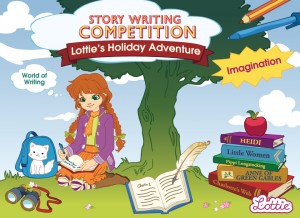
But when I received a PR pitch from Lottie dolls last week, I was really intrigued. Lottie is a doll made to look like a child, whose wardrobe doesn’t include fishnets and heels. The line from the promotional material that had me hooked was, “She can stand on her own two feet (always a useful life skill for all girls, big and small).” Lottie models include lighthouse keeper, karate student, pirate queen, robot scientist and butterfly protector, among others. She’s designed to stimulate creative play, to encourage girls not to grow up too fast. Her tagline is, “Be bold, be brave, be you.”
 More than that, the pitch was about a Lottie story writing competition. Accompanying the competition is the Great Books for Girls list, books with strong female role-models. The whole thing was right up my alley, but I’d never heard of Lottie. For the sake of research (!), I ordered two dolls from an online toy retailer (and another appealing aspect of Lottie is that she sells for $19.99, a reasonable price).
The dolls arrived, and my children were immediately hooked. At first glance, the dolls aren’t so revolutionary, though this helps them to fill that Barbie-shaped void in my children’s toy box—and pivotally, the dolls aren’t Barbie-shaped. The dolls are also available in hair colours other than yellow (with dark-skinned ones too). They don’t stand up quite as well as I’d hoped, but Harriet wasn’t interested in leaving them unattended anyway. She was excited to play with them immediately, her Snow Queen Lottie engaged with elaborate plots of Autumn Leaves Lottie (whom I selected because I liked her tights). My only complaint is that the doll clothes are bit fiddly for tiny fingers, and that the fastening bead on Snow Queen’s fur cape needs re-sewing already.
We’re already quite besotted with our Lotties, and I have no doubt that Harriet will be able to come up with exciting Lottie tale to enter in the story competition, which closes September 12. The prize is ten titles from the Great Books for Girls list, which sounds good to me!
Find out more about the contest at the Lottie Facebook Page.


September 1, 2014
This is a bad idea
 Just a little over two years ago, we took Harriet to Centre Island, and watched her go around on the little boat ride, ringing the bell and looking happy enough, but sitting alone in her little boat, while the other boats were filled with pairs of siblings. It was a pivotal moment, watching her ride by herself, one that cemented the fact that we were probably going to go forth and have another baby. For Harriet’s sake as much as ours, because Stuart and I are both so glad we have sisters, and we wanted to give Harriet a similar relationship. Because we wanted her to have someone to ride the rides with.
Never mind the absurdity that sometimes things really do work out so neatly—we were grateful that nature delivered us the baby we’d planned on. A healthy happy baby too, and also that Iris and Harriet already have such a close relationship. (I’d considered the irony of possibly delivering Harriet a sister who she’d hate, or who might destroy her life, in addition to just pulling her hair. I read too much literary fiction…) I will never cease to be amazed at the fact of getting what I wanted, and so it meant something to have travelled though all these weeks and months and come back to the island this weekend. Harriet and Iris rode around in their little boat together, and was hugely significant. The first ride of many.
But of course, that’s not the whole story. I haven’t told you the funny part. We were lined up for the ride and both Stuart and I sensing that this was really not the smartest plan. Iris can walk, which means that technically she’d be permitted on the ride, but Iris is only 15 months old, and is small so she looks younger than she is, so the attendant looked wary when Stuart led Iris and Harriet through the turnstile.
“I think she’s too young,” she told Stuart, about Iris.
 And Stuart became even less characteristically un-English than usual, throwing caution to the wind and standing up to carnival authority (although he had stood patiently in the queue.)
“Nope,” he said, “she’ll be fine.” He put her on the ride anyway. He is not sure why he did this exactly, except that he had a vague sense that I’d be angry if Iris didn’t get to ride the ride as I’d envisioned. We’d travelled over 700 days to get here after all. It would be terrible not to have a photo to show for it.
So Iris was in the boat, and the attendant told Harriet to make sure she stayed seated. The ride began, and it was good for a round or two. Iris rang the bell, spun the steering wheel, and was thoroughly enjoying herself. I snapped the photos. They could have been the whole story. Until it became apparent to Iris that she was untethered. She stood up. “Iris, sit down,” said Harriet, shoving her back into her seat. They go by us again. We wave. Iris stands up again. “Sit down, Iris,” Harriet is shouting now, and trying to get Iris in a headlock. Iris starts to cry. We’re still waving. Everybody is looking at our children. Who pass the remainder of the ride with Iris crying as they turned round and round, Harriet shouting, “This is a bad idea! This is a very bad idea!”
September 1, 2014
The Vacationers
 Shockingly, it was three whole long weekends ago (July 1!) that I spent a morning in bed drinking tea and reading The Vacationers by Emma Straub, which I enjoyed very much. If I remember correctly, I’d barely slept at all the night before that, thanks to Bad Iris, and this is not one bit shocking. But still, how fast the summer has gone by. I wasn’t sure what I was getting into when I constructed a salad out of marshmallows and Jello back in June, but this summer has been completely wonderful. Even the cool weather didn’t faze us—I sleep in an un-air-conditioned attic, after all. We had a week at our cottage, a long weekend camping, and a weekend away at my parents’, which was fun. We watched an outdoor movie. We finally managed a trip to the Toronto Islands, slipping in under the wire on Saturday. We went to the CNE today. There was plenty of ice cream all summer long, of course. Soccer and bike rides. Harriet was enrolled in two weeks of an afternoon art camp, and one week of full day camp, which made us never tire of the days we spent together. Even with the imperfect weather, we went swimming at the Christie Pits pool, and Harriet has acquired the requisite number of freckles on her nose.
I feel very lucky to be able to spend the summer with my children. Here is why I really feel lucky though—when Iris goes to sleep in the afternoons, Harriet sits down to watch a movie, and I lie down to write. And I did. At the end of June, I embarked upon a Summer Writing Marathon, which I didn’t have time for, but I never will have time, so why wait? I resolved to write 1000 words a day, and I did it (save for vacations). On Friday, I logged in at 50,000 words. I’m on my way to writing a novel whose first draft will be completed by the end of September. And you might think that this is exciting, except, of course, this is the fifth time I’ve written a novel. But this is a first time I’ve written a novel that might be interesting, and also the first time that the process has been so exhilarating. So this has certainly been a summer highlight.
Harriet spent July watching Frozen, and then took up an obsession with Annie that has yet to abate. She has watched it near daily for the last month, which pleases me immensely, because it’s one of my all-time favourite films. I never get tired of it, and am pleased to have someone to sing all the songs with. She also talks about it incessantly, which has led to me thinking more deeply about Miss Hannigan, for example, than I ever thought I would. I am going to write a post about this one of these days…
Because of my writing marathon, I had to do all my other work in the evenings, which meant I didn’t read this summer as much as I would have liked (except for when we went away, and I read six books in seven days). And what I read, I didn’t write much about. I read Anthony de Sa’s Kicking the Sky, which I liked for its depiction of Toronto and for being not what I expected, but didn’t appreciate as much as I thought I would. I read Jane Rule’s Deserts of the Heart, whose depiction of a lesbian relationship in the 1960s was groundbreaking. I read Life Among the Savages by Shirley Jackson for my book club, which I didn’t love as much I thought I would, but led to such interesting discussion. And I read Letters to Omar by Rachel Wyatt, and we did an interview, which will be up here in a couple of weeks. There were a few others too (all good!), which I read for reviews that will be published elsewhere in the next while.
Harriet doesn’t start school until Thursday, so we have a couple more days of summer left. And I’m going to miss her when she goes, though I’m not going to tell her so, because when I did last year, she cried, so that definitely wasn’t my smoothest move.
August 28, 2014
In which we fall in love with Zita the Space Girl

 While it’s true that the summer of 2014 will be remembered (by us) for all sorts of things—the summer we listened to the Frozen soundtrack every time we went in the car; the summer we read Farmer Boy and were bowled over by the force of Almanzo Wilder’s appetite; the summer Harriet watched Annie every day for weeks and weeks; the summer we once ate 36 Creamsicles in six days—it all really comes down to that this is the summer we fell in love with Zita the Spacegirl. Whom we discovered when I was stopping into Bakka Phoenix Books (because we are still spoiled for bookstore choice in this neighbourhood, even after the closing of my beloved Book City) to pick up a copy of Jo Walton’s My Real Children to give to my mom for my birthday (and you already know how much I love this book, right?).
 There was a fetching comic book displayed at the cash, and it caught my eye and Harriet’s. “That’s Zita,” we were told. “She’s wonderful.”** And so we came back a few weeks later to buy a copy of the first book in the trilogy. We’re already mad for comic books, and space travel is cool, plus she’s a female superhero—nothing could be more perfect. And the books turned out to be as great as we were promised, with vivid colour illustrations, great writing, delightful and surprising characters, enough robots and aliens to keep things interesting, and the indomitable Zita herself, who is so brave, honourable, fallible, spunky and real. She is a champion of so many things, but first and foremost, a champion of friendship. I love that.
 In the first book, Zita and her friend, Joseph, are playing around and discover a strange device with a bright red button. Being Zita, she presses it, opening a portal to space into which Joseph is taken. After some despairing at what she’s done to her friend, Zita goes in after him, and sets about saving her friend, who’s been captured on this strange planet which is due to be hit with a meteor in due course. She makes unlikely friends, fights foes, and is mistakenly given credit for saving the planet, becoming celebrated as a hero. She manages to get Joseph back to earth, but is not able to get back herself, which she’s not entirely unhappy about, looking forward to adventure as she gets ready to “take the long way home.”
The next two books are just as terrific, Zita getting herself out of difficult situations, standing up for justice and the downtrodden, overcoming odds, and staying loyal to her pals. Things settle down nicely by the end of the third book, though it’s just open-ended enough for us to dare to hope that we’ve not seen the last of Zita yet.
Though even if we have, her creator, Ben Hatke, is up to cool things. His latest project is the picture book, Julia’s Home for Lost Creatures, which is out next month. We ordered our copy today.
**And please note that this is the magic of bookstores, such connections happening. No algorithm could have ever ever done that.
August 27, 2014
Big Shoes
 The last few days have been huge for Iris, who is just a week shy of being 15 months old. She spent about four days straight sleeping until at least 4am (and one day until 6:00, which was massive, but then we had to contend with being up at 6:00. At least when she wakes up at 4:00, I can bring her to bed until the alarm goes off…) and, most dramatically, after 8 months of only ever wanting to read Little You by Richard Van Camp (and hey, if you’re going to read 1 book 948 times this year, let this one be the one…), she’s become obsessed with I Want My Hat Back by Jon Klassen—she likes his illustrations of the bear. Lately. she’s also really into Jack and the Box by Art Speigelman, which she thinks is terribly funny, and she’s right. So Iris is proving herself to be quite discerning in her literary tastes, never mind her affinity for any bookish translation of The Wheels on the Bus.
It is exciting to see her own tastes developing. Though we’ve known for a long time that she loves the CD Throw a Penny In the Wishing Well by Jennifer Gasoi, because she started dancing the first time she heard it, which was also the first time we learned that she knew how to dance, but now she listens to the song, “Happy”, and sings along, and then walks around the house saying, “Hap-pee. Hap-pee.” One of the few words she knows—though she added another tonight at the Farmer’s Market when she exclaimed, “Cheese,” in pursuit of a sample. She got one.
She doesn’t know that she’s a baby. She thinks that she can read, and opens books, thumbing through them and muttering as the flips through the pages, or maybe she thinks that we think she can read, and we’ll let her think that. Her dignity is very important. She also insists on china plates and cutlery for all her meals, and she wields a fork like a champion. It’s a bit eerie to be in her company, because she seems to be watching us too carefully—whenever I fiddle with my hair, she does the same with the fluff on her skull. She watched her dad dry his hair the other morning, and then grabbed a hand towel and dried hers too. She has new shoes (see photo), and insists on wearing them everywhere, and fetching them before we go somewhere is her favourite part of any outing, I think. When we arrive back home, she sits down to take them off, and nobody ever taught her to do that. In fact, nobody has ever taught her anything, but she keeps knowing new things all the time, blowing her own mind, and our minds, every single day.


August 25, 2014
The Long Way Home by Louise Penny
 It was almost exactly a year ago that Louise Penny’s How the Light Gets In came out, a book I was so excited about that I purchased it the day of its release. And I loved it—it was one of my favourite books of the year. All the usual suspense and emotion and I’ve learned to expect from a Louise Penny novel, and then she goes and pulls this literary sleight of hand that was so exciting and perfect. The novel concluded the plot of police corruption that had been building since Penny’s Inspector Gamache series began, and it was with some sadness that I concluded that the series was probably finished, retired along with the Chief Inspector. What a way to go though–it was an absolutely terrific novel.
So I was surprised and pleased to discover earlier this year that there was more Gamache on the horizon. The Long Way Home finds Gamache retired to Three Pines, looking for a break from homicide (though Three Pines really is the last place I’d ever go to find such a thing). He’s uneasy, a bit restless, watchful of his protege (who is also now his son-in-law), concerned that Jean-Guy might slip back into addiction. Concerned for his own mental health too, as is his loving wife, Reine-Marie, who knows that Armand has not yet found the peace he so desperately requires. So she’s unsurprised but also worried when their neighbour and friend, Clara Morrows, comes to him with yet another mystery to solve.
Clara’s husband Peter is missing. They’d agreed upon a year’s separation, after her surprise success in the art world caused friction in the dynamic of their marriage, and on the set date, he didn’t materialize. She hasn’t heard from him at all, which wasn’t like him, and she is fearing for his safety. Having lived in Three Pines long enough, Clara is well aware that no mystery brings with it a simple solution, and that murder lies at the heart of most things, so she’s concerned. As is Armand, and Reine-Marie, and all their other friends, who band together to find Peter. They trace his travels across Europe, to a strange place in Scotland called the Garden of Cosmic Speculation, to Toronto, Quebec City, and then into the wilds of the province. Going on instinct, vague clues, discerning locations from Peter’s paintings, and interviews with people who’d seen him during the past year, they’re able to piece together Peter’s own story, which seems more and more suspicious the closer they get to finding him. Their sense that Peter is in danger turns out to be well-based, and it becomes clear that time is of the essence.
It was always going to be difficult to follow up Where the Light Gets In, which tied up so many loose ends and came together so majestically. The Long Way Home seems to be much less organic in its construction, requiring suspension of disbelief from the reader for the plot to make sense, and the plot itself cobbled together of pieces rather than woven into a whole. Part of the problem is that for much of the book, the mystery that needs solving is less than pressing—the whodunnit is more like, “Who done what?” There’s not even a murder until quite late in the book, which for Three Pines is all-time record, and quite unfathomable. And that the residents of Three Pines would have the resources (time and money) to devote to finding their friend, whose imperilled state is not really apparent, seems unlikely. It’s the kind of book that when you start to read to closely all sort of falls apart.
But. If you’re a fan of the Gamache novels, there’s no way you’re going to miss this one. The place seems so realized, and it’s people familiar—how could you not want to know what happens next? And while the pieces don’t come together terribly well, the pieces themselves are fascinating, revealing remarkable corners of its author’s mind, her preoccupations. If you’re new to the series, then definitely go back to the beginning, and don’t read this one before How the Light Gets In. Which was always going to be a book so hard to follow up.
August 24, 2014
Discover The Art of Blogging at UofT
 It has been ages since I taught The Art of Blogging at the University of Toronto’s School of Continuing Studies, but I’m so pleased that the course is being offered this fall. Online is such a fast world that blogging has changed a lot since I last taught the course, and so has some of my thinking about blogging. Moreover, teaching small blogging workshops (like at the Wild Writers Festival in Waterloo!) has taught me a lot about the best way to present this kind of material and get students engaged. And so all of this will really culminate in a fresh and exciting class, I think. I’ve revised the course outline significantly (you can view it here!). We’re going to focus on learning to love the unpolished nature of the blogging, and embrace its work-in-progress-ness, and there will be lots of writing exercises to get students used to blogging efficiently. We’re going to explore using blogging in a way that fits neatly into your life, and even how blogging can make you live your life a bit better. I look forward to good discussion, sharing of experiences, lots of inspiring blog reading, and delving into the history of this fascinating medium as we all move forward as part of its future.
August 21, 2014
Family Happiness
 I reread Laurie Colwin last week, the novel, Family Happiness. And I am still thinking about “chicklit” (a term I dislike, because I’d never actually call a human person a “chick”) and how I’ve changed my mind about it. The problem with chicklit, I used to think, was that so much of it was shallow and silly and that important books kept being undermined by being shushed away into that category. I used to agree with authors who’d protest that any book about women and relationships was automatically written off as “chicklit”, and also that it was a travesty how women’s fiction was always pushed to the margins. I wrote an entire essay about this, which referenced the line from Woolf’s A Room of One’s Own: “This is an important book, the critic assumes, because it deals with war. This is an insignificant book because it deals with women in a drawing-room. A scene in a battlefield is more important than a scene in a shop – everywhere and much more subtly the difference of value persists.”
I still think that it’s true that women’s fiction gets pushed to the margins, but I’ve recently realized that this has nothing to do with chicklit. I have recently determined, in the past few weeks as I’ve reread To the Lighthouse, and Family Happiness, and as I’m reading Caroline Adderson’s new novel, Ellen in Pieces, right this very minute* (nearly) that there is indeed a way to write about women and relations, to write women’s fiction (for I emphatically believe that there is such a thing, and that literature is all the better for it) that will never be confused for chicklit ever.
The key, of course, is to subvert readers’ expectations, to resist the formula from which chicklit is concocted. I’m thinking about Laurie Colwin, especially, whose subversion is oh-so-subtle that undiscerning readers might miss it, but it’s there. It’s not to resist happy endings, necessarily, but to acknowledge that happiness is complicated, and endings are only relative. Colwin’s writing doesn’t hinge on “issues” or crises to propel her plots, and some might protest that Laurie Colwin doesn’t plot at all (just as Jennifer Weiner** took down Claire Messud’s The Woman Upstairs for not having a driving plot, for failing to conform to chicklit’s basic requirements, as if that somehow makes it less of a book). Indeed, her books are full of upper-middle-class women sitting on lush sofas wearing exquisite worn cardigans and turning their minds over and over again. There is pages of this. And I love it. There are no villains. Everybody is just conflicted and deeply flawed, and when they run into one another, things happen (and those things are often further conversations).
Colwin walks this narrow line between light and substance, and I think the effect of lightness comes from so much visual light—illumination, brightness, joy—and this is far from the same thing as shallow. She has been compared to Jane Austen, which I agree with, but I’m not nuts about Jane Austen, so I’m conflicted. I have this suspicion that if I came at it the other way though—reading Jane Austen with a view to her being a bit like Laurie Colwin—I could come to a new appreciation. Either way, Laurie Colwin isn’t chicklit, even though her characters are neurotic and wear specific shoes. They’re books without a template, my vague Austen references aside. Immediately readable, but as with Woolf and Adderson (though on a more subtle level), Colwin is trying to push the novel to be something more, beyond its own limits, to get life to fit inside.
How do you tell a story about the many sides of happiness? Of love?
There is a place for formulaic books, and they certainly have their legions of readers, though I no longer count myself among them. (This isn’t true. I love detective fiction. But maybe the difference is that the very formula for detective fiction is to surprise its readers. As with the best of literary fiction, you rarely known who’s going to come around the next corner.) I just don’t have the patience anymore for a book that’s going to turn out exactly as I expect. I read that book already. I want the unfamiliar, which can be breezy (Maria Semple, Laurie Colwin) or more dense (Adderson, Woolf), or a thousand other things, but it isn’t chicklit, which reduces women and their lives to types and tropes. Whose very trademarks are endings that are always going to be tidy.
“I just have a very hard time seeing entertainment as a bad thing,” said Jennifer Weiner in her interview with Rebecca Mead. But just because something isn’t a bad thing doesn’t make it literature.
*This sentence was true on Saturday, when I wrote it.
**It occurs to me now that the two books by Jennifer Weiner I enjoyed most were Fly Away Home and Goodnight Nobody, both of which were probably her most formula defiant. And maybe her point is that nobody noticed these distinctions, so she gave up even trying, which is why “[i]n later novels, she decided to ‘give my characters the thing that none of us get, which is the promise that it’s going to be O.K.’”
*** Also, speaking of worn-out templates, I basically wrote about this exact same thing two years ago. I am not sure why I can’t just get over it, but then again, I’m not the only one.