June 24, 2014
A Good Day
Look what I got! Happy Birthday to me, indeed. I also received a new string of bunting, which means we may have reached Peak Bunting in our apartment. An ideal state, as far as I’m concerned.

June 23, 2014
One Kind Word: Women Share Their Abortion Stories
“I had an abortion.” This is not a confession, but instead is the phrase with which my essay, “Doubleness Clarifies” (which was published in The M Word and online this spring) has been received by readers, more than any other, or at least it seems as such from my point of view. And these readers are not confessing either, but rather are stating a fact of their lives, a fact they seem eager to share. Like me, I suppose they’ve spent a long time feeling as though abortion stories were not to be shared, and they were grateful finally to have an excuse to talk about this fact of their lives, a fact which has been perhaps sad, complicated, maybe neither, but undeniably important.
 It’s not shame that keeps women from talking about their abortions, but rather fear of seeming impolite. It’s funny that in a society in which 1/3 of adult women have had abortions and most people understand the procedure to be a necessary part of women’s health, that we kowtow to the sensibility of a minority whose vocal stance allows them to set the tone on the issue. That abortion is unseemly, dead babies, something that marks us, something which we have to hide at all costs.
All costs? The huge cost of hiding our abortion stories, of course, is that the vocal minority gets to tell us everything we know about abortions, much of which is wrong. (Increased breast cancer risks, post traumatic symptoms and regret, photos of aforementioned dead babies.) They get to influence the people who make the legislation, because the rest of us are too polite to speak up. They get to tell us everything we know about the women who have abortions too, which is that there is a type of woman this happens to and that her experiences are uniform.
With the new book, One Kind Word: Women Share Their Abortion Stories, edited by Kathryn Palmateer and Martha Solomon, with a foreword by Judy Rebick, we learn that everything they told us about abortions, and the women who have them, is wrong. In striking portraits—photographs accompanied by short first-person essays—we learn that women who have had abortions are women of all ages, backgrounds, and experiences. We learn than many of them are mothers. Others never wanted to be mothers, and it’s that certainty that made the decision to have an abortion quite an easy one to make. Some women look back on their abortions with mixed emotions, or sadness, grief or relief. And most of them look back and are grateful that the choice was theirs to make.
As I wrote in my essay in The M Word, reproductive freedom remains a revolutionary thing for a woman to get away with. Not because we don’t get away with it, but because when we do, we don’t talk about it. Which leaves a woman contemplating abortion or who’s had an abortion feeling that she’s so alone, that no one has ever been where she’s going and come out fine on the other side. And so that’s why a book like One Kind Word is so hugely important, representative of the real experiences of so many women. Experience as depicted by those who’ve lived it rather than those for whom abortion is an abstract moral issue—this is so significant. The book is also important because it creates a space where women who’ve had abortions can see themselves reflected, and the book provides an occasion for women to speak up and say, “This is my story too.”
One Kind Word was an online portrait gallery before it was a book, the project gaining huge momentum and inspiring so many women to be a part of it. (It also has a precedent with Jennifer Baumgardner’s Abortion and Life.) Many participants note that they felt as though they had an obligation to speak up in order to counter the abortion rhetoric which has been hijacked by patriarchal interests, to speak up for those countless other women who did not yet have the courage to represent.
This was not a book that told me anything I didn’t know already, instead confirming the fact that I exist. Which is not meant to be an honourable purpose for a book, literarily speaking, though anyone who’s ever told you this has probably been a man who sees his existence confirmed in his reflection in most everything he ever encounters.
The book’s editors write of their intention to have a copy of One Kind Word in every clinic waiting room across the country, and while this is a very good idea, I’d like to have it gracing coffee tables too. First, because it’s a book of beautiful images, good for flipping through, but also because it places our abortion stories right where they belong—firmly ensconced in the domestic ordinary of our various and remarkable lives.
One Kind Word launches tomorrow night (June 24) at Another Story Bookshop in Toronto.
June 22, 2014
Based on a True Story by Elizabeth Renzetti
 I make a point of reading everything Elizabeth Renzetti writes, her Globe and Mail column one of my Saturday morning go-to’s. So I was always going to read Based On a True Story, her first novel, which Renzetti describes as “an alcohol-soaked comedy of failure and revenge”. I was thinking Kate Christensen’s In the Drink, Lucky Jim, and “Absolutely Fabulous meets The Devil Wears Prada,“as its back cover tells us, a blazing pink cover with lips, a lurid green type. The green is referential, the same lurid green as the book in the book, a book also called Based on a True Story, which is a surprise bestselling memoir was washed-up soap star and notorious drunk, Augusta Price. I was thinking also that Renzetti’s novel would be a send-up of tabloid culture and the current state of journalism (especially post phone-hacking scandal) in the style of Annalena McAfee’s 2011 novel The Spoiler, which had a similar set-up, but Renzetti has her tabloid journalist (young Frances in her cardigan) sacked not far into the story (which I suppose is a reflection on the current state of journalism in itself), so the narrative turned into something different. Something more like another novel about a woman called Augusta, Graham Greene’s Travels With My Aunt, mainly in that there are many many madcap shenanigans.
After far too many silly novels trying oh so hard to be smart, it was really refreshing to discover a smart novel that wasn’t afraid or ashamed to be silly.
The writing is as sharp and skilful as you would expect if you’d ever read a Renzetti column, with snappy dialogue and perfect cultural references. Augusta Pierce is a fantastic character, and another notable literary bolter, her complete lack of maternal instinct and similar lack of compunction for such a lack refreshing to encounter. Her self-destructive tendencies too—such a smooth slide down the spiral. And she’s got charisma, which explains her hangers-on—old friend and saviour Alma Partridge, one-time paramour Kenneth Deller (who now makes his living as “Mr. Romance,” host of a radio call-in show for the lovelorn) and pines for her across the world, and Frances the sacked journalist who agrees to ghost-write Augusta’s next book, but not before accompanying her on a journey to California to stop Kenneth Deller from writing his tell-all book first.
Augusta goes to great lengths to assert that her own book is just a version of the truth, the version she chose to share, though the excerpts from it that we’re privy to attest to its being a compelling read all the same, or perhaps because of this. (You really can’t always say this about excerpts from fictional books either. I will admit to skipping all the italicized parts of Possession.) And Augusta herself, with her sordid history, her mountains of baggage and disappointments, comes to be such a multi-dimensional character that it’s too bad that she’s given such a two-dimensional world to live in, that the narrative Renzetti constructs is less plot than scaffold. Material this good seems deserving of more.
Still, Based on a Truth Story is a worthy novel based on its insights, if not its plotting. Renzetti resists cliche in more than a few places, but in particular with her conclusion and its dose of sober realism (or unsober realism, as the case may be). “We have work to do,” says Augusta Pierce in the novel’s final line, and so too does Renzetti, and I hope she’s prepared to get hard at it one of these days, because her second book is going to be wonderful.
June 19, 2014
The M Word at Parent Books
Update: So pleased that Nathalie Foy took excellent notes and recapped last night’s conversation about mothers in children’s books. You can read all about it here.
One last event for The M Word to cap off a wonderful spring of excellent indie book shops. Oh, it’s been fun, a whirlwind. And this was the perfect way to finish, an intimate gathering at the bookshop just around the corner from my house. The sun poured in the windows as evening rolled in, and we had a really good time talking moms in children’s books–dead moms, overbearing moms, harassed moms, and moms with lives of their own. Reading books, talking books, and buying books. Terrific fun. Thanks to Parent Books for hosting such a fun event, and to the excellent women of The M Word for turning out and being fabulous. It has been such a pleasure to work with all of you.

The Book Table

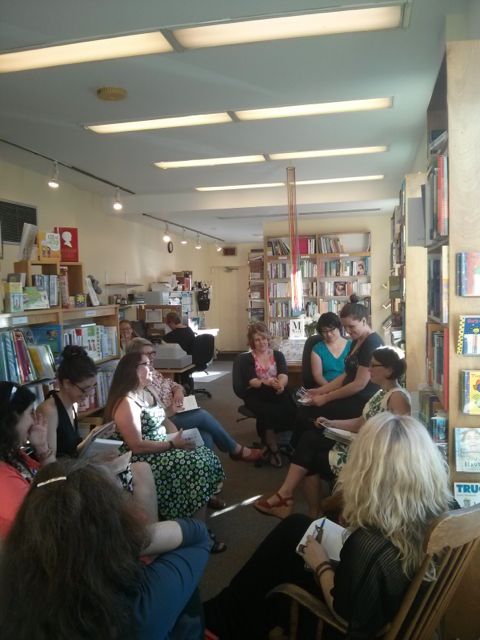

Ransacked book table at the end of the night. The BEST!

June 18, 2014
All My Loving by Beth Kaplan
 Nine years ago today, I got married, and about ten years ago, when this date was selected, what first occurred to me was, “How cool! Paul McCartney’s birthday.” Because to me, June 18th has always been Paul McCartney’s birthday first, at least since I was a Beatles-obsessed 13 year old and organized a Paul McCartney Birthday Bash in my dorm room during our Grade 8 year-end trip to Ottawa. (It was not a wild bash. I recall jumping on a bed, and turning the volume all the way up on my Sony Sports Walkman so we could listen to The Beatles’ 1967-70 through the headphones.)
As I did to a lot of things, I came to The Beatles late, about 20-some years late. Being a Beatles-obsessed 13 year-old in 1992 was a curious thing. It involved feeling inordinate, impossible pain at John Lennon’s murder; trying to be a vegetarian because of Linda; scouring the TV guide every week in order to schedule tapings of Paul McCartney on Saturday Night Live or showings of John Lennon Imagine on Much Music. I even kept a scrapbook, comprising clippings of Paul McCartney’s son’s surfing mishap, various Beatles’ legal troubles, and a cut-out of the “Be My Yoko Ono” lyrics from my Barenaked Ladies’ “Gordon” cassette tape liner notes. I made Beatles posters in my Grade 8 art class–they weren’t very good. I bought Beatles’ biographies written by Geoffrey Giuliano and Hunter Davies. I built a Beatles shrine in my Design and Technology class, specially designed to store my cassette tapes and biographies. I was forbidden to talk about them at the dinner table. I listened to their music over and over (and learned to play their songs on the guitar). I remember listening to Hey Jude for the first time when I was about 11 years old, sitting in my backyard with a red battery-powered cassette player, and it was as though I’d discovered for the meaning of life. The meaning of my life. For a few years, it really was.
So I was eager to read Beth Kaplan’s memoir, All My Loving: Coming of Age With Paul McCartney in Paris. Kaplan was fortunate enough to fall in love with the Beatles at just the right time, on the cusp of her own adolescence and the Beatles’ fame. The memoir is based on her own diaries, scrapbooks and short stories (in which she fantasized about being Paul McCartney’s wife and/or [gasp!] his lover). In a fun and breezy fashion, she puts her reader in the mindset of a 13 year old girl who is as confused by the world as she is by her terrifying range of emotions, and who is also in thrall with The Beatles. Like many of her peers, her identity as a “Beatlemaniac” was one of her first acts of self-definition, a small rebellion against her conservative parents. Though they’re not so conservative–the book begins with young Beth ecstatic at the news that her parents are attending a Ban the Bomb demonstration, and therefore she is free to turn the radio dial and hear “She Loves You” for the very first time, and I love the way she describes her visceral reaction to the music, the way she’s transformed by it and so is the world around her.
 Kaplan outlines a complicated relationship with her parents, even more complicated than the average teenage love/hate, and while she alludes to her own parents’ experience (her father experiencing anti-semitism as a professor at Dalhousie University; or the time her mother reported of The Feminine Mystique, “I took one look at Betty Friedan and put the book down”) and she is indeed chronicling a cultural phenomenon, there is a lot in the book that is particular also. But the particularity is not always explained, instead the reader receiving the unfiltered thoughts of a solipsistic teen girl and all the contradictions that entails. (One of the many times I laughed out loud was when her list of “hates” included The Dave Clark Five and “intolerance.”) This approach makes sense in the grand scheme of the project, but it also leaves the reader with a lot of questions.
But then, the Beatles are the focus, as they were for 13 year old Beth, her parents’ own dramas firmly in the background. Or perhaps the Beatles were her escape? And Paul McCartney in particular, her chosen Beatle, the proxy by which she explores notions of love and lust and sex and longing. During the time she recounts in the memoir, she moves with her family to Paris for her father’s sabbatical year, and the Beatles are a consolation of her loneliness during this time, and also a bridge between her and her French classmates.
I was especially amused by her friend in France who had learned to speak English through Beatles lyrics, and so only spoke as such, expressing her gratitude with, “Thank you girl” and other such phrases. And it made me think about how those of us who learned about life through the Beatles are similarly equipped, not so literally, but still, to us, the world is all Strawberry Fields, A Day in the Life, Help and Penny Lane, etc. I knew these songs before I knew the world, is what I mean, and in a way, these songs are still my foundation, fundamental to my vocabulary. (Longing for love meant longing for someone to get high when they see me go by. My oh my). It is probable that Beatles songs have affected the shape of my brain.
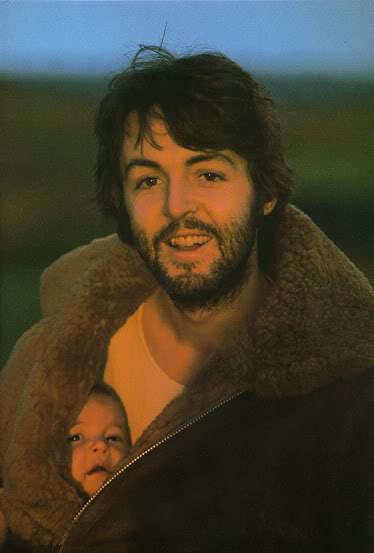 I went to see Paul McCartney at Exhibition Stadium on June 6 1992 on his Live in the New World Tour. It still stands out as one of the most extraordinary days of my life, and I will never forget the excitement, but also the sadness at my realization that I was just one tiny person is a sea of people that night, that he couldn’t see me at all. That indeed, he’d been the subject of “All My Loving” (for I too was a Paul girl, even though he was not far away from being 64 at the time) but to him, I didn’t even exist. That all my loving was only a drop in the ocean… and it was heartbreaking. Such is the pain of being a 13 year old girl.
And even though she did it at the right time, a few decades before me, Beth Kaplan’s memoir brought the whole thing back. The roller coaster ride, the battles, and the unbelievable excitement of being on the edge of something huge–such confidence too that in just another year or two, surely we’re going to have the whole world figured out.
June 17, 2014
Hipster Picture Books
 By “Hipster Picture Books”, of course, I mean books with a focus on design over content, I mean the board book as status symbol. The kind of book a child might not necessarily choose on her own, but her parent will buy it for her as sort of an aspirational thing. To aspire to have a child who lusts for a Pantone colour book. And the great thing about these books’ smart design and vibrant colours is the child will like it after all, will eventually be seen at Brunch clutching said book, and then you get to be the kind of parent you always always dreamed of being. Post it on Facebook, and rest on your laurels after that. Undoubtedly, a Sunday well spent.
I am only half-kidding.
I bought Iris Pantone: Colors for her birthday, and she likes it. It’s visually appealing, and I appreciate its overall message–that there are many shades of grey, and red, and green, and every colour, for that matter. We live in a complicated world, but it’s beautiful. Facing each page of shades is an object in said colour–red wagon, brown teddy bear, blue teapot etc. And then at the end, we’re faced with a rainbow of objects, and this page is an exercise in naming–pickle, monster, kangaroo, bow tie.
 I am also pretty in love with Work: An Occupational ABC by Kellen Hatanaka (out in August). The minimalist illustrations still reveal vital details and are smart and dynamic. I love the way that each letter of the alphabet is embedded into the illustrations in clever ways (i.e. I is for “Ice Cream Vendor” the ice cream is being vended from the I itself’; the A in “Aviator” is part of the mountain range; the P for “Postal Worker” is a cumbrous package on the postie’s back). Points for some very cool jobs I wouldn’t have considered: O is for Oceanographer, N is for Naval Architect (none of them thriving industries, I am sure, but still…). And then an amusing glossary of terms at the end: “Zookeeping might be the only job that encourages monkey business.” Fun.
 The exuberance of 100 Hungry Monkeys doesn’t really qualify it as a hipster picture book (hipsters are not allowed to get excited, except about drinking Pabst Blue Ribbon on a park bench, or riding a unicycle, but in either case, would never show it). But its visual appeal puts this book in the mix, and it is definitely a good one. Author-illustrator Masayuki Sebe has created a fun story about the concept of the number 100, one whose prompts urge readers to examine the illustration for details and clues in a Where’s Waldo fashion. This is another run one for early readers and their parents to read together, reminding both that books and reading are fun.
 And finally, Monsters Under Bridges by Rachel Roellke Coddington and Jolby is not really a hipster picture book, but it is geographically situated in the Pacific Northwest, so there you go. It is a concept I wasn’t entirely sure about at first–a travel guide featuring notable bridges and describing the fabled creatures who live under them, their lives and habits. Perhaps its a regional thing, I wondered? But then Harriet, who has never once been to Seattle, loved this book, and had me reading it to her over and over again, her mind expanded by the crazy creatures imagined within. And through her (which happens often), I discovered just what this book was all about. BONUS CANCON: Ronoh who lives under the Ironworkers Memorial Bridge in Vancouver BC, who smells like seaweed and wisdom. Plus Margot the Maripolo, beneath the Capilano Suspension Bridge and Sherman who lives under North Arm Bridge in Richmond BC (who likes to strap himself to the front of the SkyTrain).
June 15, 2014
Bookish Sunday in the Sun
 For Father’s Day, we gave Stuart posh coffee, Jo Walton’s Small Change series (which is probably a gift for both of us), and Tigana by Guy Gavriel Kay (because of this recommendation in 49th Shelf’s Shelf Talkers series). Iris has become a full-fledged biped, and it’s no coincidence that her sleep habits have also become transformed in the past week. She has finally started napping in her crib, taking her naps later, and staying asleep for a couple of hours. Her nighttime sleep has also improved, which meant that we’re feeling a little less tired than usual this weekend. It also means that Iris has become a lot less portable, and we’re not going to sacrifice her proper nap for anything. So we went out for a Father’s Day brunch this morning, and then came home so Iris could sleep while Harriet watched innumerable episodes of The Riders of Berk. I drank tea and read my book, and it was bliss.
 It meant, however, that it was nearly 2pm by the time we departed for Trinity Bellwoods Park and the Luminato Literary Picnic. We had a splendid walk there, Harriet scootering, walking or being piggy-backed, while Iris was chauffeured in the stroller. We ate gourmet popsicles, and then Harriet went to play in the playground, while Iris and I checked out literary fare. I heard a few writers here and there, but the only writer whose whole presentation I caught was KD Miller’s. She was fantastic, and no surprise–her book got a rave review in Macleans this week, and Vicki Ziegler had been sharing Angie Abdou’s great review in Quill & Quire.
 So I was pleased to hear her read, and then to have her arrive at the sale table just as I was about to buy her book, so she could sign it for me. Reviewers have stressed that indeed, a writer can situate interesting stories within the walls of an Anglican Church (the book’s title, All Saints, refers to said church), but seeing as I am a card-carrying member of the Barbara Pym Society, they’d be preaching to the (church) choir.
 After that, we hit the bookmobile, which is always an amazing adventure: a bus full of books! A library on wheels! The bookmobile will never cease to be remarkable. We got a book for Iris and Harriet each, and then Harriet wanted to get a comic too. She sorted through the stacks and selected The Wonderful World of Lisa Simpson #1. I think she picked it because Lisa is riding a pink unicorn on the cover, because Harriet has never heard of the Simpsons. But that was the point of the cover I think, and now Harriet has heard of the Simpsons and we had a good time reading the comic together. (It was strange having to introduce someone to Bart Simpson. I also like that it’s a cool comic geared to young girls, whose writers and artists are women.) The best: in the final story, Lisa opens her own Little Free Library to disastrous results. A comic about a lending library? It was dying and going to book nerd heaven.
 After that, I went across the street to visit Type Books and pick up some of the books on my list. I got The Vacationers by Emma Straub, which had been included in Chatelaine’s Summer Reading Guide. And I got Based on a True Story by Elizabeth Renzetti, which had an amazing review in The Globe yesterday. And then we walked home along Queen Street and up Bathurst, stopping en-route at Yogurtys because we really hadn’t had enough dessert. Plus, they were giving away free fro-yo for dads, so that was spectacular all around.
June 15, 2014
Blanche Howard
 I was sad today to hear the news of Blanche Howard’s death at the age of 90. I knew Howard best through her extraordinary collection of letters with Carol Shields, which I read for the first time in a hammock in 2007, and a second time a few years later. I’d also read her novel, Penelope’s Way, and Celibate Season, the collaborative novel she published with Shields in the 1990s. When she and Shields began corresponding in the 1970s, it was actually Howard who’d been the most experienced writer of the two, generously providing the novice Shields with advice as the latter embarked upon the publication of her first book. An extraordinary friendship would grow between the two of them, and Howard’s characteristic generosity continued as she shared their letters with readers in A Memoir of Friendship. (Generosity was a trait both friends had in common.) The letters are a remarkable documentation of the course of women’s lives–the joys and trials of motherhood, the better and worse of marriage, the pains and injustice of aging. Their discussions of feminism and politics were illuminating and important. And so too their stories of the writing life.
Shields was a very special writer, and entirely deserving of her good fortune, but she did strike literary gold with The Stone Diaries, which took the world by storm and everything she touched ever after seemed to turn to gold. This was not necessarily always going to be her destiny (though, as a reader of the letters will note, her success did not seem to change her a bit). Howard, on the other hand, had more of a struggle, starting off strong with her novels in the 1970s, then her books went out of print, and while she never stopped writing, it would be years before her next book was published (in addition to A Celibate Season). She self-published an e-book in 2010.
This is a far more typical story than Shields’, a familiar trajectory for most writers who do not go on to win the Pulitzer. Howard’s story was a lesson in endurance, persistence, and optimism. In writing for the love of it. In growing old but staying sharp, learning and growing all the while. (It’s a lesson in courage too–Howard bore loss of her husband after years of Alzheimer’s Disease and the demands of his caregiving.) In our society, we’re not always interested in hearing from women later in their lives, as Howard’s failure to secure a publishing contract would attest. It’s a difficult world out there, but it’s even harder for a woman with grey hair. Hard work is not always necessarily rewarded.
And yet, there is something in the struggle, which is what I learned from Howard. This is what life is after all. To reach but never quite make it. The striving is an achievement though, and it shapes a life, makes it rich with experience and vision. It is certainly not an ordinary life. Hers was a way of truly being in the world, and I so admire that. It’s so important for us to have these kind of examples of the kind of women we might grow to be, women with strength, and dignity. A life rich in friendship. Truly, she made a mark on the world, and her loss will be felt by her readers and the people who knew her.
(Thanks to Allyson Latta who shared the news of Howard’s death, as well as an essay she’d written called The Stories We Tell.)
June 15, 2014
The Difference a Year Makes

We have come very far since Father’s Day last year.

Which makes me think of this song, which seems fitting for Father’s Day since Mad Men, actually.






