March 23, 2015
Where I Find the Time to Read
 I read a lot. I read for a living, and I read to save my life, and, “Where do you find the time to read?” is a question that continues to baffle me. It’s like being asked where I find the air to breathe. The time, like the air, is out there in abundance, and having children hasn’t changed that. It just means I have to be creative in finding a way to make that time my own.
The following is a list of ordinary occurrences disguising excellent opportunities to steal a moment with a book.
- Extended Breastfeeding: Of the many benefits of breastfeeding, the time to read in is paramount. Once you’ve mastered holding a book open with one hand, it’s effortless, and oh so efficient—nourish a baby and your mind in a single shot. When my first daughter finally weaned at age 2 ½, I so mourned the loss of reading time that I had to have another baby.
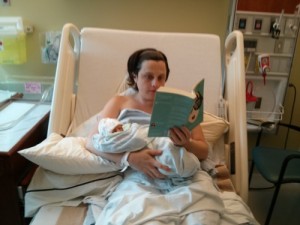 Before Bed: Every night, there is a window of sometimes up to ten minutes between the moment my head hits the pillow and when the baby awakes, and so I read then. And when the baby does awake, I breastfeed her. (See previous point.)

- Weekend lie-ins: Obviously, I don’t get out of bed in the mornings. Would you? On Saturday and Sunday mornings, there is always time to get a chapter in before I return to the vertical life, and if I stay in bed long enough, somebody probably will bring me a cup of tea. And then I don’t have to get up until I’ve drunk it.
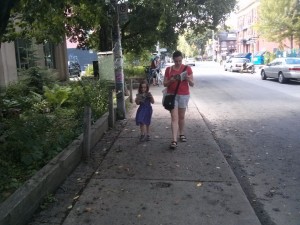 Walking: Walking while reading is walking the one risky behaviour I indulge in on a regular basis. Doing it while pushing a stroller is even more reckless, I realize, but sometimes one has to live on the edge. Also, I could make it to kindergarten and back with my eyes shut, so there’s no harm in doing with text in front of my face.

- At the playground: I will argue that reading at the playground is not entirely the opposite of being present for my children, mostly because there are only so many mud-pies I can pretend to gleefully devour. Also, every time they look up at the bench and see me reading there, I’m increasing their own chances of being readers by setting a good example. Everybody wins.
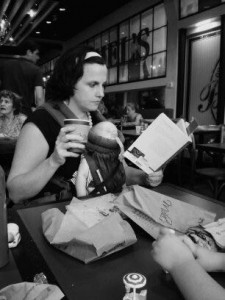 During interruptions: Basically, I find the time to read by always having a book in my bag. Sometimes two. And this means that when my husband takes the kids to the bathroom after a restaurant meal, I can finish a chapter along with the dregs of my tea.

- Sitting alone in restaurants by myself: And other times, I forfeit the husband and kids altogether, and take myself out for a chai latte and oversized cookie, or even an entire lunch, and read the entire time. Cultivate your own company, is what I mean, and you will get so much reading done.
- In waiting rooms: As a parent with a book in her bag, there is nothing more luxurious than having to wait for appointments while the children are asleep in their strollers or in the care of somebody else. I’ve spent some of the best afternoons of my life in recent years reading for solid blocks of time at the passport office, my doctor’s, or the dentist.
- While flossing: Regarding the dentist, I have never before been so attentive to dental hygiene. I’ve become a vigilant flosser since I learned to floss and read, which is a skill involving holding open a book with my feet. I do this daily. For ten to twenty minutes at a time.
- In the bathroom: Also, for ten to twenty minutes at a time. My digestive system is getting a bad reputation. But there is a door that locks and a stack of books nearby—why would I ever leave?
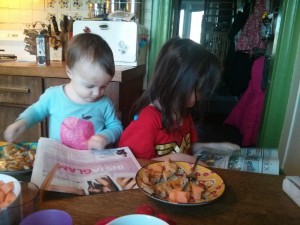 Pancakes: I don’t spend all my time avoiding my family, however. Every Sunday, I make whole-wheat banana pancakes from scratch, which sounds selfless and well-meaning until I explain that once the batter is mixed, I pull out what’s left of the Saturday paper, flipping the pancakes between articles. (“Go away. Mommy is cooking.”)

- But not at the table. Unless it’s breakfast or lunch…We don’t permit reading at the table at our house, because meals are a time for togetherness. We bend the rules for breakfast and lunch though, because bendy rules are useful for teaching flexibility. And because tables are so useful for having the Saturday paper spread across.
March 19, 2015
The Bus Ride by Marianne Dubuc
 We’re becoming big fans of Marianne Dubuc’s books at our house, having enjoyed In Front of My House and Animal Masquerade. You will recall that picking up the latter title resulted in our entire family eventually assembling on the couch, gathering together captured by the book’s magic, and laughing hysterically at the surprises and absurdity. Dubuc’s latest book, The Bus Ride, similarly engages and surprises, and while it’s is very loosely based on the Little Red Riding Hood narrative, a more fitting descriptive for the story would be “curiouser and curiouser.”
The Bus Ride is the story of a little girl’s first ride along on a city bus to visit her grandmother’s house. Her mother sees her off at the bus stop, ensuring she’s got a snack and a sweater in case she gets cold. And from there the rest of the story is of the bus ride, the bus’s interior each two-page spread. Passengers embark at the front doors and alight through the back. The little girl narrates what she sees in a sentence or two, although the real story is happening in Dubuc’s illustrations. A cat is knitting a scarf that grows ever-longer, a mouse is reading a tiny book, a family of rambunctious moles (I think?) climbs on board and end up swinging from the overhead bars (and one chews on a piece of gum he finds on the floor). A family of wolves boards the bus and the little girl makes friends with the wolf-boy who’s about her age—they share her cookies. A sleepy sloth snoozes the ride away. Someone’s hiding behind a newspaper whose headlines are ever-changing and reference what’s going on the pictures. I admired in the stolid bear in his big blue boats.
 They pass through the forest, through a tunnel. Children run amuck. The fox keeps sleeping. The owl woman in the hat seems quite uncomfortable, and characters keep turning up in different places. The turtle gets nervous and hides in his shell. A wannabe pickpocket—a fox, of course—boards the bus, and and the little girl helps to divert a crime. And what is the beaver carrying inside his really big box?
While The Bus Ride is first a story of one girl’s first independent journey into the world, it’s fundamentally a story of how interesting the world is and how fascinating it is to be in the midst of it all. At the end of the bus ride, the little girl reflects on all the stories she has to tell her grandmother now. Hers is an apprenticeship in narrative, but it is for the reader as well, who assembles her own story based on the curious scenes depicted in Dubuc’s illustrations, which are detailed and accessible, appealingly rendered in pencil crayon. And like all the very best picture books, it’s completely different with every encounter.
March 19, 2015
A sign of spring
 I love the springs that arrive like this, like an unexpected gift instead of something long overdue. Spring is not quite here yet, but it’s making itself known, the way the green of a crocus appears like a dot in the dirt (and the way a tooth first appears, a dot of white on a baby’s gum—this is my metaphor lately). There are no leaves on the trees and the air still has a chill, but look how the sky is blue, the snow is gone, and our household’s sheets are drying on the line.
Though the surest sign that it isn’t spring (yet) is how cold were my hands after hanging out the sheets. Soon though…
 I was inspired to hang out the sheets from Sarah’s blog post about hanging out her washing (and her comments on the magical high-up washing lines with pulleys that need to be hauled in and out—I dream of these, though they terrify me also. What if something comes loose and my pillowcase falls down six stories, lost forever). It strikes me what a literary thing is clothes on the line—indeed, as I was hanging the sheets this morning, the “Grandma hanging washing on the clotheslines to be dried” line kept bouncing through my head from Peepo.
For more on literary washing, do read Anita Lahey’s blog post, “Oh, let there be nothing on earth but laundry.” (Lahey had a poem included in the anthology, Washing Lines, a collection of poetry of laundry and washing.) And see also Matilda Magtree (Carin Makuz) with “Pinning, Pining and Penning,” about repairing clothespins and other essential acts.
March 17, 2015
After Birth by Elisa Albert
 1.
1.
No, listen, she says, the problem is no one cares about babies. I mean, they care about babies like “oh look at the cute baby” or “oh, ha ha, funny looking baby with an old man voice-over,” but no one actually cares about babies. I mean the details, it’s boring.
So let’s imagine that the ideas this book is concerned with do not matter. Let’s discuss it as a piece of literature, divorced from its subject(s). Elisa Albert’s third novel, After Birth, is an angry, passionate, gnarly and perfect mess of a novel that echoes Charlotte Perkins Gilman’s The Yellow Wallpaper in style and tone (and exclamation marks!), and also Sylvia Plath’s The Bell Jar, and more recently Claire Messud’s The Woman Upstairs for the force of its rage. Its narrator, Ari, at one point references her favourite Grace Paley story (“Wants”). Which is to say that this is a novel constructed on a strong literary tradition. Its short clipped sentences are notes and dispatches from a place of confusion, attempts to reconcile life itself with one’s expectations of it, and other realities including people’s Facebook profiles and feminist theory. The notes and dispatches do not comprise a plot so much as a circling round of a fact, a record of a winter of inertia. So what moves the book forward then? Well, voice, first—Ari’s is distinct, disturbing, unnerving, frustrating, funny and smart. Second is her vision of the world, which is peculiar and her remarkable articulation of it. And third is curiosity—something’s gotta give. Will she be broken? Will her rage be quashed? And are these two questions actually one and the same? Albert’s first-person address is so solid, so realized, that it gives the impression of having been carved out of something larger, chiseled, rather than built up from the ground. Nothing is incidental or extraneous in her prose. The book and its narrator are exhausting to encounter, frustrating, untameable, and brilliant.
2.
No, listen, though, the problem is with books, with novels about motherhood. Or even worse, those novels that purport to finally pull back the veil and “tell the truth about motherhood.” The problem, in addition to the fact that nobody cares about babies, is that a book about motherhood is rarely read (if it is read at all) as a book about a mother. Instead, it’s a manifesto. Read as a statement on an institution instead of a literary work about a fictional character. A story. We have a hard time grasping that there can be more than one story about motherhood, or if there is more than one, there’s just two then, always diametrically opposed. Two gals facing down on the cover of a magazine. One is always carrying a briefcase. When in reality, there are so many stories, and each of those stories comprise so many stories in themselves, the same way that a single day can hold more than one kind of weather.
“The buildings are amazing in this shitbox town,” is the first line of After Birth, which isn’t nuanced, but it kind of is. And readers and reviewers rarely know what to do with that.
3.
No listen, the problem is that there are the early days of motherhood, and then there is what happens a while after that, when you’ve finally got it figured out, and you feel obligated to go out and deliver everybody else from the darkness. This was the point at which I sent my cousin a completely revised version of her baby registry, when I would start to hyperventilate at the idea of a friend choosing not to co-sleep, when I wanted to chase desperate looking women down who were pushing strollers down the street and put my arms around them, promise them everything was going to be okay. Which was surely the last thing these sorry people needed. And some of them weren’t even sorry. It took me a long time to understand that.
“In the cafe where I never work on my dissertation is the woman I’ve seen at the co-op with her brand-new baby. We smile./ Do you ever feel like you’re completely losing your mind?/ Her smile fades./ It’s okay if you do. It’s perfectly normal.”
4.
No, listen, the problem is women. How we look at other women as mirrors, desperate for affirmation. But it’s always slightly unnerving to look in a mirror, and the reflection is inevitably backwards. Albert’s novel references a 1990s third-wave feminist utopia, Ani DiFranco. Dar Williams singing, “I will not be afraid of women.” But even when we’re not afraid, women are not always good to each other. Like people in general, women are like that. Perhaps more so because of the way in which we’re set up for failure in our engagement, taught to see others as opponents. Ari’s stepmother is an evil feminine archetype, her cousin becomes Bridezilla, and she herself occupied a nasty role as “the other woman” before she married her husband (though she’s not self-aware enough to interrogate this idea. Or is too much so.) She documents her history with female roommates at university, at a private girls high school, at Jewish summer camp, with not one but two moms’ groups. Women are ever disappointing.
Women are ever disappointing for a variety of reasons, both women in the book and women in the world, but part of the problem is that we’re forever looking for that mirror, for affirmation.
“Do you ever feel like you’re completely losing your mind?/ Her smile fades./ It’s okay if you do. It’s perfectly normal.”
“I’m v happy to see women engaging and disagreeing. Most necessary. Interrogation is essential,” wrote my friend Anakana Schofield in a tweet last week, in response to Jessa Crispin on Leslie Jamison’s The Empathy Exams and being tired of female pain (and I’d noted that Jamison was tired of people who were tired of it.)
I think that this is a very good point. We need to know how to look at other women without looking for our own reflection. We need to learn to disagree and not end up shattering glass.
5.
“Two hundred years ago—hell, one hundred years ago—you’d have a child surrounded by other women: your mother, her mother, sisters, cousins, sisters-in-law, mother-in-law. And you’d be a teenager too, too young to have had any kind of life yourself. You’d share childcare with a raft of women. They’d help you, keep you company, show you how.”
No, listen, the problem is we have no rafts of women. With After Birth, as with so many other books about mothers, the problem is not motherhood itself, but instead a motherhood that puts a woman apart from the world, both in practical terms (Ari is removed from familiar surroundings in a new town, isolated while her husband is oblivious and busy with his work) and theoretical ones (remember? No one cares about babies. Ari’s concerns are nobody else’s, her’s alone). Her own mother is dead (and Ari’s memories of her are rife with anger at her mother’s anger—interestingly, it doesn’t seem to occur to her to wonder what her mother was so angry about) and she has no sister. She’s estranged from her Aunt, and her from her heritage (it seems) but marrying a man who isn’t Jewish.
“Here’s the problem: we are taught nothing. / How to sew, grow food, preserve food, build things, fix things, make fires, birth babies, care for babies, feed babies, move through time, grow old, die, grieve, change, sit still, be quiet.”
Here’s another problem though: was there ever really a raft of women?
Two hundred years ago, I thought as I read this, you probably would have died.
Moreover, while Ari craves the idea of this raft of women, she has spent much of her own life setting herself adrift from any semblance of one. She doesn’t wish to be anything like her own mother, or be the same kind of mother. She sees her baby as the chance for a fresh start. She wants a natural birth, to breastfeed, to eschew all things toxic and synthetic—her mothering to be nothing like the way her own generation was mothered. She wants a link that’s wholly illusory.
 6.
6.
After Birth is a fascinating companion to Eula Biss’s On Immunity. I couldn’t help but wonder what Ari would have done had she met a woman like Biss in one of her moms’ groups, a woman who in her book thanks the mothers with whom she’d shared the conversations and preoccupations of early motherhood: “These mothers helped me understand how expansive the questions raised by mothering really are… I am writing to and from the women who complicated the matter of immunization for me…In a culture that relishes pitting women against each other in ‘mommy wars,’ I feel compelled to leave some traces on the page of another kind of argument. This is a productive, necessary argument—an argument that does not reduce us, as the diminutive mommy implies, and does not resemble war.”
Albert too demonstrates how expansive the questions raised by mothering really are. This isn’t really a book “about” motherhood at all, but instead, motherhood is its starting point.
Like many of the women in Biss’s book, Ari feels, and indeed has been, failed by the medical establishment. Her unhappiness in motherhood she puts down to the trauma of her c-section. When her friend acknowledges the experience as a kind of rape, Ari feels gratified for just a moment. And perhaps this is the link to her maternal lineage, Ari’s own particular raft of women: her own mother died from cancer caused by drugs her grandmother had taken in pregnancy to avert miscarriage. Those same drugs had left her mother with mutilated reproductive organs so that Ari herself was only conceived and born by remarkable chance. The rape too—her grandmother was raped by Nazi soldiers during the Holocaust. Survived only, Ari tells us, by having sex with them.
Naturally, the idea of witches appeals to her, of women back in history who banded together, who possessed the wisdom of how to deliver babies and cure illness (and even vaccinate, as Biss tells us). She rescues a new friend, Mina, from the throes of early motherhood by nursing her baby, an age-old practice. The two of them set up a raft of their own, and for a time, this is everything.
(I was once so angry at having had a c-section that I was given a pamphlet for a support group that helps women heal from and grieve their c-section experiences. “What kind of bullshit is this?” I was exclaiming and my terrible husband with an evil glint in his eye said, “I think you should go.” I protested and he shrugged calmly: “You’ve been grieving your c-section for four years,” he said. My fist shook at the ceiling. “I am allowed,” I told him, “to grieve my c-section and find c-section support groups totally stupid.” You can see how Ari was someone for whom I had great empathy.)
7.
No, listen, the problem is that no one ever talks about this stuff. Or maybe that when they do talk, nobody listens. See point one: Nobody cares about babies.
“Adrienne Rich had it right. No one gives a crap about motherhood unless they can profit off it. Women are expendable and the work of childbearing, done fully, done consciously, is all-consuming. So who’s going to write about it if everyone doing it is lost forever within it?”
(Or perhaps it’s that even those who are listening have no context. [“Could it be true that one has to experience in order to understand? I have always denied this idea, and yet of motherhood, for me at least, it seems to be the case.”—Rachel Cusk, A Life’s Work].)
Here is something I love about After Birth: Albert doesn’t think that a novel about new motherhood need read like the catalogue for a hipster baby boutique. The stuff is not the stuff, she knows. Stuff is lazy shorthand. It’s a way of getting away from the point.
There is so much I love about how Albert captures the crisis of new motherhood in After Birth. (Her non-fiction piece on this in the Guardian is one of the best things I have ever read about this topic.)
“The baby books said nothing about this. Days became nights became days because nights.” And, “So the dissertation thing is pretty much a lie. But you need an identity, some interest and occupation outside having a kid, you just do. Otherwise the kid will be your sole interest and occupation, and we all know how that works out for everyone.”
And, “I did not understand how there could be no break. No rest. There was just no end to it. It went on and on and on.”
And, “When I see pregnant women, I want to take them by their shoulders and shake. I mean shake. Are you ready?”
And, “I nurse while she pumps to encourage supply. She says something about it being difficult to get out when the weather’s so shitty and I say something like yeah, winter’s a shitty time to have a baby and she says something like it’s always kind of a shitty time to have a baby though isn’t it?”
7.
The problem, sweetheart, is you.
This is a line delivered by the ghost of Ari’s bitch mother near the end of novel when Ari finally confesses, “Fine, I do hate women… They’re so obedient, traitorous. Descendants of the ones who gave up other women as witches.”
Her mother’s line is important because it’s kind of true, in particular as suggested by the novel’s final sentence. The problem is Ari, because she is a specific literary character and not a statement on womankind or motherhood (and many a commenter on Goodreads seems to have difficulty understanding this distinction). She’s a fascinating, messed-up, smart and self-destructive literary character. She doesn’t affirm anything. You will think she is wrong about a lot of things. But this doesn’t mean she’s not worth reading. In some ways, it makes her so much more worth reading than any literary character whose story can be tied up in a perfect bow.
The line is also important as a statement on motherhood though, an idea I’m still teasing out. That while indeed the problem is that women are all too isolated in early motherhood (and they are), it’s not just that other women don’t save us, but that they can’t. That every woman has to discover her own way through. Naomi Stadlen writes about this in a book called What Mothers Do that I found troubling for its simplistic notions and failure to understand maternal ambivalence, but the following passage in one of the smartest I’ve ever encountered on the subject:
“If she feels disoriented, this is not a problem requiring bookshelves of literature to put right. No, it is exactly the right state of mind for the teach-yourself process that lies ahead of her. Every time a woman has a baby she has something to learn, partly from her culture but also from her baby. If she really considered herself an expert, or if her ideas were set, she would find it very hard to adapt to her individual baby. Even after her first baby, she cannot sit back as an expert on all babies. Each child will be a little different and teach her something new. She needs to feel uncertain in order to be flexible. So, although it can feel so alarming, the ‘all-at-sea’ feeling is appropriate. Uncertainty is a good starting point for a mother. Through uncertainty, she can begin to learn.”
8.
And she does learn—this is the thing. Perhaps even Ari will. And not long after the end of the first year (which for me was when storm had ceased, I could see the shapes of things, but trauma was still so recent, and I wrote this) those early days begin to fade. Motherhood itself becomes less all-consuming (literally and figuratively), one’s rage at having a c-section or not becomes less potent, the baby becomes a human, breastfeeding is no longer such a preoccupation, sharing parental duties becomes easier, you sleep more, and it’s all less boring and shattering.
Which is to say that Elisa Albert has documented a very particular moment in motherhood in After Birth, instead of motherhood in general. And that this insistence upon specificity—in spite of her narrator’s generalized wailing in collective pronouns (which is what trips less-careful readers up, I think), in spite of the moments in which our identification with her is visceral—is the novel’s greatest strength. Specificity is what turns a political statement (and oh, this is one) into literature.
March 16, 2015
My review in CNQ 92
 I’m very pleased to have a book review in Issue 92 of Canadian Notes & Queries, which should be on newsstands now or soon. I’m pleased first because it’s a neat issue—my friend Rebecca Rosenblum wrote a wonderful essay about the role played by levelled readers in early literacy, and I loved JC Sutcliffe’s piece on Innu and Inuit translation (including of Sanaaq), and lots of other intriguing pieces I have yet to explore in their entirety, including Alex Good’s talked-about take-down on “Canlit’s ruling gerontocracy“.
 But I am really pleased about my review in the issue because it’s of Mireille Silcoff’s Chez L’arabe, which was a really great book, one of my favourite reads of last year. And because my review is one of the best I’ve ever written, I think. I worked really hard on it and I’m really proud of it as a testament to Silcoff’s work and as a piece of writing in its own rite.
“In Illness as Metaphor, Susan Sontag writes, “the most truthful way of regarding illness… is one purified of…metaphoric thinking.” Albeit from an angle less concerned with truth than fiction, celebrated journalist Mireille Silcoff, in her debut story collection, Chez L’arabe, also situates illness as a point at which metaphor fails. At the centre of the book is a character suffering from a condition in which the spinal cord develops holes and begins leaking fluid until there is “no cushion around [the] brain, soft brain knocking against hard skull, no buffer, and every car ride felt like a prelude to an aneurysm.”
 And what is the reader to do with that?
Metaphorically speaking, this affliction is a universal one, particularly in literature. Has there ever been a book that was not about metaphoric bumps in the metaphoric road that makes minds hurt (metaphorically)?
But no, the metaphor is too obvious, too awful. Particularly when we’re presented with a character walking to the car with her tripod cane, who then must lie face down across the backseat with her nose pressed into a cushion. “[P]lease be very careful on the potholes,” she tells her taxi driver. There is nothing metaphoric about that.
Sometimes, as both Silcoff and Sontag show, a thing is just a thing, and thus it is materiality with which Chez L’arabe is preoccupied.”
Buy the magazine, and read the whole thing. And then read the book. Read everything!
March 16, 2015
Best Book of the Library Haul: March Break Edition
 Our March Break plans are modest ones: museum, art gallery, library, visits with friends in the morning, and then Iris nap times in the afternoons while Harriet watches movies and I work. Unlike the previous years, Stuart doesn’t have the week off too, and I’m less interested in adventuring without him. Though tomorrow I am taking Iris on the streetcar untethered, with only Harriet for support, moral or otherwise, which might be more adventure than I’m bargaining for. Other good things about March Break are that spring temperatures are here and it’s glorious, and also that it’s the first March Break ever during which I’m not awaiting biopsy results—that was always really poor scheduling on my part.
 Another good thing is that we got a fantastic library haul last week, which has meant it’s March Break, and the reading is splendid. And the best of the bunch is The Worst Princess by Anna Kemp and Sara Ogilvie. I’ve been championing anti-princess princess books for awhile now, but this one really takes the tiara. It’s in rhyming couplets, first, which is my definition of a picture book to die for. And tea and teacups and teapots recur throughout the narrative, which happens in most of my favourite books, and the children delight in pointing them out.
 The Worst Princess is Sue, whose been waiting around for her life to begin, reading up on all the stories to find out just how one goes about landing a princess. She’s grown her hair to extraordinary lengths, kissed frogs, slept on peas, all for naught. She is lonely and terrifically bored, and then delighted when her prince finally comes. Except that he’s built her a tower and expects her to stay in it locked away from the world—it seems that the prince has read all the books too. But Princess Sue has no truck with that. When not long after, she spies a dragon in the distance, she flags him and down and makes a deal (over a cup of tea, of course). He blows down her tower, sets the prince’s pants on fire, and then Sue and Dragon take off on a series of adventures, “making mischief left and right/ for royal twits and naughty knights.”
March 15, 2015
Higher Ed by Tessa McWatt
 There seems to now be a tradition of me beginning reviews of novels by Tessa McWatt—Vital Signs in 2011 and Step Closer in 2009—with a comment upon their strangeness, and now it would just seem wrong if I didn’t. Part of might be their author’s point of view—Guyanese-Canadian-turned-Londoner— which is a rare one in CanLit, and her sentences, with their particular rhythm and cadence, how the prose seems inflected by the beats and thrums of everyday life, how actual people think and speak. And also McWatt’s preoccupations, with theories and ideas instead of the minutia of plot. Her characters, while they talk like actual people, don’t quite move about in the world like actual people. They exist to prove a higher point, which is kind of a criticism, but not really. It’s more to note that to read a Tessa McWatt novel is to read a little differently, and that we’re not reading for realism anymore.
Which is not to say that McWatt doesn’t engage with reality, particularly here in Higher Ed, her sixth novel. It takes place in London a few years ago on the verge of economic meltdown against the backdrop of a polytechnic-turned-university facing the inevitable funding cuts. Jobs are on the line—film professor Robin knows this doesn’t bode well for him as the most junior in his department and a theorist who doesn’t impart skills that translate into employability; administrator Francine, an American ex-pat, is also expecting to be sacked, as she had been not long ago by her boyfriend, therefore finding herself in her 50s without much of a foundation to stand on; Katrin, a Polish emigre (with a degree in economics), is trying to keep her menial job in a cafe but she keeps being tripped up; and then Ed, who works for the Council making final arrangements for those who have no one else to do it for them. One of the last vestiges of that society that Margaret Thatcher was so determined to prove didn’t—or needn’t—exist.
And then there is Olivia, an idealist, a law student. Biracial, she’s grown up with her white mother and her racist granddad (“He’s the kind of geezer who fools you, who is clever and doesn’t raise his voice except at the telly, talks like he has schooling, talks like he reads books, but deep down Granddad’s ignorance is as deep as his unknowing of his own soul.”). All she’s ever really known about her dad is that he left her, but when she stumbles upon him—he is Ed who works for the Council—while researching a project on paupers’ graves, she learns there is more to her story than she thought. Determined to save her father’s job—because her mother is hardly going to take him back if he’s unemployed, right?—she ropes Robin the film prof into coming up with a plan to celebrate the poetry of Ed’s work, to perhaps highlight the necessity of a job like his in a world that has any hope of being decent.
But Robin is not the right guy for the task, really, and he’s got concerns of his own—he’s fallen in love with Katrin from the cafe just as his ex-girlfriend has told him she is pregnant. Meanwhile, Katrin is calculating how she’s going to have her mother come live with her in London, how she’s going to be able to afford a flat that’s bigger than her bedsit. These people walk the same halls as Francine, who’s been traumatized by witnessing a man killed in a motorcycle accident (whose belongings in the home where he was a lodger will be eventually secured by his family in Italy, thanks to Ed) and is walking on the edge of something that’s going to change her life—for better or for worse.
The diversity of voices in the novel is impressive, McWatt convincingly infusing each character’s narrative with the appropriate vocabulary and syntax based upon the character’s background. Each character’s story comes with its own richness, which is enhanced by the opportunity to see these people from another’s point of view. How exactly their lives overlap seems forced seemed forced times, but these instances were forgivable—these lives were compelling enough no matter their trajectory. But I’m still a bit confused by the effect of all their lives together—what do all these pieces mean? My lapse in understanding partly due to my own failings—if I’d read the work of philosopher Gilles Deleuze, would it all have been clearer? And so I’m as puzzled as I ever was, but confident in McWatt’s project, that—as her character suggests in Step Closer—“There is an order here, awkward and quiet, even now, if you look carefully.” Which you could say about the world—or at least its cities—, I suppose, and McWatt’s achievement is a novel that’s a microcosm of such a thing.
March 12, 2015
Sidewalk Flowers by Jon Arno Lawson and Sydney Smith
 It’s from picture books that I’ve learned that the best books have to be read at least 10 times before you really get a handle on them. Case in point: Sidewalk Flowers by JonArno Lawson and Sydney Smith. A wordless picture book (though a wordless book with an author, take note!) can slip past one pretty quickly. The first time I read it, I thought it was okay. A bit weird. The next few times, I still wasn’t sure. It’s the story of a young girl walking through the city with her father, her red-hoodie one of the few spots of colour on the page for much of the book. The other colour comes from the flowers she encounters on her journey, flowers which are actually weeds, which is the kind of distinction only adults make. In their ubiquity, we forget to note how remarkable it is that a dandelion—a living thing—can grow between cracks in the sidewalk. That a wild thing can be so determined to live, and how wildness continually thwarts a city’s attempt to tame.
 And the flowers grow, and the child finds them, picks them. She’s the only one who notices these bits of wild colour on the urban scene, but they’re not all she’s noticing. (This novel’s grasp of the child’s eye view makes it an interesting companion to the award-winning The Man With the Violin). As her father talks away on his cell-phone, and the people around her conduct their business, she sees other things, other colours—the orange of citrus fruit for sale at a greengrocers, the warm yellow of a taxi-cab, a woman in a floral dress who is reading a book at a bus stop. She’s gathering her wild bouquet, part of which she, calling no attention to herself in the process, offers to a dead bird she walks by on the sidewalk, then to a man who is a asleep on a park bench, and to a neighbour’s dog. And as she leaves her flowers, something remarkable is happening to the world all around her—bit by bit, the city becomes rich with colour. Leaves appear on the trees and the sky turns blue. Through the girl’s small acts, the world is transformed.
It all happens so subtly, it takes until around the 10th read that it begins to be clear. And even then, the reader is still uncovering new details in Smith’s illustrations—the lion in Chinatown, a cat in the window, the streetcar coming around the corner (which is red!). The images are made interesting and complicated by shadows and reflections, adding extra texture to the story. Smith is depicting an any-city, though the savvy among us will see Toronto with its distinctive architecture and peculiar topography suggested by houses situated up flights up steps on steep hills.
Sidewalk Flowers is a book with mystery at its core, a book that is a manifestation of its theme of generosity, for it has given me something new every time I have encountered it. A wordless book too is an important tool for literacy, for it allows parent and child to remember the reason we open books at all. For them to approach a story for once on the very same level—a whole world to be explored together.
March 11, 2015
Intolerable: A Memoir of Extremes, by Kamal Al-Solaylee
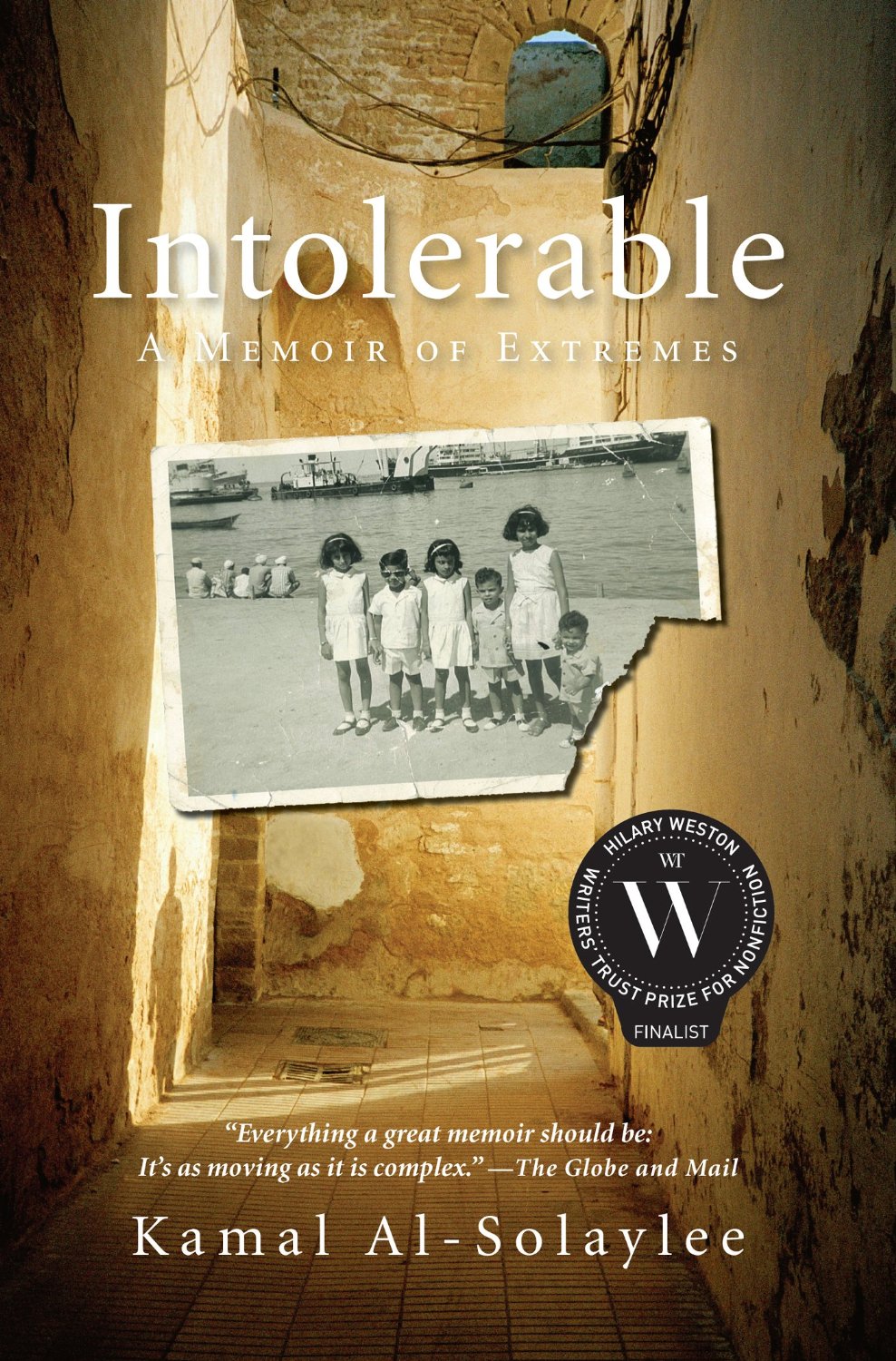 Kamal Al-Solaylee’s Intolerable: A Memoir of Extremes is the final book of my 2015 Canada Reads selections, and an interesting way to finish them off having started with Thomas King’s The Inconvenient Indian. Both are non-fiction and work to complicate perceptions of people some of us best know from stereotypes. Both also reframe history to present their people—King with Canada’s First Nations and Al-Soylaylee with Muslims in the Middle East—as victims of a capitalism. For Al-Soylaylee, this is only a small part of the narrative, but it’s an important one—he sees the move toward extremism in Egypt being fundamentally linked to Anwar Sadat’s open-market policies and free-market capitalism in the 1970s, which drove Egyptians into poverty and situated the state as an enemy of the people. Politicized Islam filled the gaps. Al-Solaylee states, “And because Egypt exerted huge cultural and moral influence on other Arab countries, the shift towards a more politicized and economics-driven notion of Islam quickly spread to other parts of the region.”
How does it connect to the other Canada Reads books? Like Ru, this is the story of an immigrant’s journey to Canada and place to call home, and the narrator’s starry-eyed idealism never wavers. Like When Everything Feels Like the Movies, it’s a story of growing up gay and seeking a place where one can belong—although the characters’ journeys are very different, partly because we don’t have the same access to Al-Solaylee’s isolation that we do Raziel Reid’s Jude’s. Al-Soylayee’s narrative strikes me as similar to the image on the cover—a writer moving from darkness to light but he’s so focussed on that momentum that the dark corners are left unexamined. They’re alluded to—he writes of falling into a years-long depression after a trip to Yemen in the 2000s, years after leaving. But most of the story merely skims the surface on the road from there to here.
Which is not entirely mere—it’s a fascinating road. His own family’s from affluence to poverty; from enlightened liberal ideals to religious extremism; from Yemen to Beirut, to Cairo, and back to Yemen again. It’s a movement that’s emblematic of transformations in the Middle East in general. While Al-Solaylee’s had a different trajectory—to get OUT, whatever it takes. Living as a gay man in Yemen, in his own family, would be impossible. Could be punishable by death. And so he plots his path—to England to study, and then to Canada. By the time he’s made his success in Canada as a journalist and cultural critic, the gulf between his world and his family’s is nearly impossible to bridge. He doesn’t even want to try. He writes of his terror at border crossings still—his fear at being forced back to the world he’s escaped. By the time his mother dies, he’s just about given up on remaining connected with his family. He has spent years turning his back on his Arabness—the language, the culture, the geography. And was this selfishness or self-preservation? He’s not entirely sure of this. But then with the 2011 Arab Spring and war and unrest in Yemen, Al-Solaylee finally realizes that he can’t entirely disown the places—and the people—he comes from. And it’s this transformation that to me is the most compelling journey in the book.
Intolerable is the link between the three Canada Reads books I’ve already noted, and the fourth, Jocelyn Saucier’s And the Birds Rained Down. Because it’s also a book that’s all about choice, except that it’s mostly about what happens to people who don’t have any. Al-Soylaylee notes that he took the freedom to pursue his dreams in Canada, while his sisters—educated and once-liberated women—retreated to Islam. They tell him they find comfort there, but he’s not sure they would have been permitted comfort anywhere else. And even his brothers, whose hard-line points of view were pivotal to eventually wearing down their sisters’ resistance to religious infringement upon their lifestyle, are given a bit of leeway. What else did these men have? It’s true, Al-Soylaylee notes, that his brother became more devout the worse he did at school, but even if he had been successful, what opportunities could a country like Yemen have offered him? Over and over again we see that poverty and economic stagnation is a hole that radical Islam rushes to fill.
While not as structurally innovative as the other Canada Reads books, there is a whole lot going on here, but, as I’ve said, it’s happening far beneath the surface. I found the prose confusing at times, sentence after sentence beginning with conjunctions to show disagreement—even, but, although, however, though. To the point where Al-Solaylee is not debating between sides but moving in circles, suggesting his own discomfort with his history, with his take on it, and that he’s still not sure how to hold it. While this detracts from the subject matter a bit, keeping the writing from going as deep as I’d like, it’s also interesting to consider, and typical of something that promises “a memoir of extremes”. That while where we’re talking about breaking barriers, life is complicated, not necessarily two-sided simple, and that some barriers are not easily broken.
March 10, 2015
An Artist Lives Here
As you know, I love Carson Ellis’s new picture book, Home, and one of its chief delights is the final image, “An artist lives here.” It’s a glimpse into the book’s creation, and a fascinating self-portrait.

It reminded me of another book that we’ve been enjoying, Any Questions by Marie-Louise Gay.

But where is the artist who lives here? Here she is!

And surely, I thought, there must be other examples? It all seemed quite familiar, vivid in my mind’s eye. But when I thought about it, I came up with nothing. Except for Virginia Lee Burton’s Life Story, which isn’t of an artist in her studio (because her studio, as the book tells us, is in the barn behind the house). But there she is down in the lefthand corner painting a picture of the entire scene, finding inspiration in her own surroundings just like Carson Ellis and Marie-Louise Gay.

There must be more though. What other picture books can you think of in which the artist includes an image of the artist herself at home (which is to say, at work)?






