June 30, 2015
Summer Plans
 There was a while this weekend when summer plans weren’t looking good. On Saturday I made a soup that featured the uncanny flavour of actual dirt, which was devastating. And it rained and rained all day, and even the next day, so our plans to go for a hike were ruined. All melodrama heaped on by the fact I was premenstrual. We decided to go to the board game cafe instead of the hike, but when we got there, there was a sign on the door explaining that they were closed due to flooding. We ended up going out for schnitzel instead, which was kind of consoling, but the weekend was mostly disappointing all around, and the children reached a state of maximum solid gold 100 karat bonkers. By Sunday evening, Stuart had stopped telling me that he was jealous that I was the one who got to stay home with them all summer.
Fortunately when Monday arrived, it delivered the sun. We went to the park and built castles, moats and fortifying walls, which Iris wrecked and we tried not to get annoyed about. And then the girls practiced climbing, drawing on their inner-monkeys, all the while satisfying my agenda which was basically to get these children as exhausted as possible. Fresh air and physical exercise! Scurry up the play structure. Faster, faster, go! Which might turn out to be the theme of the summer entire, except for the afternoons when Iris naps, Harriet watches movies, and I get my work done. Everything slows right down at nap, and the challenge then is to strike a balance between the two. Between go and stop, between fun and relaxation, between doing stuff and doing nothing.
 This summer, as with all summers, I become busier than usual just as my time disappears to the children being home and weekend getaways. And so the days are full, full, full, and I need to stop adding to the fullness by baking strawberry pies at 10pm because I end up staying up too late and the pie turns out looking like a bloodbath (even though it was very delicious). This summer is going to have to be about the store-bought pies, and hotdogs for supper, no more dirt soups and choosing my priorities. Which include meeting my deadlines, doing well at my work, not ignoring my children to the point of neglect, and hanging out with my husband (which is hard to do when the prime time of one’s workday begins at 9pm). To help with this, I’ve hired a babysitter one morning a week, and look forward to that solid block of three hours to work, which will feel positively luxurious as it goes by so fast.
But it won’t go by as fast as the summer itself will seem to, which is the lesson I learned last year. I really do like being home with my kids, providing I get ample time to do my own thing during our days, and I feel really lucky that my home and professional lives merge so seamlessly. When the children (both of them! I know!) head off to school in September, I will miss them dreadfully…even as I begin to delight working in the daytime and the possibility of evenings of leisure (a stretch, perhaps).
So in the meantime, we’ll be visiting the library, reading books together, hanging out with friends, going to visit my parents, frequenting local cafes, Harriet will be doing a few daycamps, Iris will be taking long naps (I hope!), and I will be doing my darnedest to tire them out so that bedtime occurs before 9pm. We’ll be spending a week away at a cottage, a long weekend camping, and we’re looking forward to fun weekend adventures in the city too. Plus spitting watermelon seeds, wading in local pools, forgetting to put on sunscreen, and gathering our freckles while we may.
- See Rebecca Woolf’s “Surviving Summer as a Work-From-Homer Part 2: LOL Boogaloo“
June 28, 2015
How You Were Born by Kate Cayley

When I was away last weekend, Kate Cayley’s story collection, How You Were Born, was an ideal literary companion. Slimish, perfectly packaged, each story its own realized vision. Its effect more muted and subtle than Rhonda Douglas’s Welcome to the Circus, another short story collection I’ve loved lately, but still—so very good. Which is important when one is away from home and hoping for reading as excellent as one’s surroundings—the kind of thing you mustn’t get wrong. When our mini-break was over, I could underline its success by the fact that I’d managed to nearly get a whole book read, and I am glad that it was this one.
Kate Cayley is a playwright, poet, prize-winning YA author, and now, with How You Were Born, recipient of the Trillium Book Award. The day the book took the prize, I received my copy in the mail from All Lit Up, which technically means that I liked this book before it was so extraordinary lauded (and therefore am cool and a tastemaker), but one might have expected as much from Cayley. Though it’s worth noting that How You Were Born beat out novels by Margaret Atwood and Thomas King for the prize. Perhaps they should put that on a sticker and slap it on the cover.
It has been interesting to read these stories, many of which are about Queer family life, sandwiched between Maggie Nelson’s The Argonauts and Ann-Marie MacDonald’s Adult Onset, which tell of the same. In Cayley’s first story, “Resemblance,” two women and their daughter travel to visit the mother of the girl’s biological father, who is recently deceased. The ending is quiet, ambiguous and uncomfortable as these people consider the weight and meaning of their connections. “The Summer the Neighbours Were Nazis” is spun from the most marvellous beginning: “My brother Richard was odd. By the time he was twelve my mother yearned for a diagnosis, but he was just odd.” A brother and sister spend their days high up in the backyard birch tree observing their eccentric neighbours, and the sister comes in sight of her own mother’s struggles and powerlessness: “My mother…was more like Richard than she knew.”
In “Stain,” a man attending a wedding weekend meets up with a woman he’d briefly encountered years ago in 2001 at the anti-capitalist protests in Quebec City. In “Midway, Midgets and Giants, Photograph 1914,” a two-feet-seven-inch tall circus performer reads of the legendary romance between Tom Thumb and Lavinia Warren, their wedding presided over by PT Barnum, and scans the crowds looking for her true love in the stands. And then a different turn altogether with “Fetch,” in which a man who supposes that his double has moved in next door, a harbinger of death, and responds as rationally as you might expect. “Acrobat” has a similar tone to “The Summer the Neighbours Were Nazis”, about a lonely girl who is new in town and partakes in an informal acrobatic circus, and learns something fundamental truth about herself in the story’s final moment.
In “Long Term Care,” things get complicated when an elderly father is moved into an assisted living unit, and his daughter fears that he is imagining himself back in Buchenwald, where he was traumatized in his youth. The blind protagonist of “Blind Poet” has a fleeting affair with an artist, the story tied up on classical allusion. “Young Hennerly” is a story and also the title of a creepy song sung to a folklorist collecting stories of residents of the mountains of West Virginia who finds the borders between life and myth begin to blur. In the Alice Munrovian “Boys,” a man finds himself responsible for his cousin who has always been a bit different, and whose own behaviour with young boys skirts the line between innocent and otherwise. And in the title story, a woman tells her child, about the sides and allegiances of motherhood, and of daring the “gamble” of bringing a child into the world.
June 26, 2015
My Favourite Things and Ah-ha to Zig-Zag by Maira Kalman
In 15 years of blogging, I am not sure there’s a post I’m more proud of than the one I wrote last fall about my accidental discovery of the artist Maira Kalman (and of how that led to cake). Coming to Maira Kalman was a curious experience rich with signs and wonders, like the United Pickle label on the back of The Principals of Uncertainty, and the title of the book at all because I would have purchased any volume called such a thing. Not to mention that hers are picture books for grown-ups, which I so completely delight in, and so I was thrilled to receive for my birthday yesterday a copy of her book, My Favourite Things.

“Isn’t that the only way to CURATE A LIFE? To live among things that make you GASP with delight?” Kalman writes, which is just one of the many points at which this book had me nodding and gesturing emphatically. And yes, GASPing with delight.

My Favourite Things is as random as its title suggests, art and writing about various objects. Part 1 is “There Was a Simple and Grader Life,” which explores Kalman’s family history through items including a grey suit belonging to her father, a grater for making potato pancakes, and her aunt’s bathtub in which fish would swim “waiting to become Friday Night dinner.” Part 3 is called “Coda: or some other things the author collects and/or likes” (including “bathtubs, buttons and books”) and the middle section of the book was born from Kalman’s experience curating an exhibit of her favourite items from The Cooper-Hewitt Smithsonian Design Museum.

My children were excited to realize that they recognized many parts of the second section of my new book, because I’d bought them a copy of Kalman’s children’s book Ah-hA to Zig-Zag last December.

It was a book they had some trouble with at first because Kalman’s zaniness is a bit lost on the childhood mind which is so often looking for things to make sense and for books to have stories. But Kalman’s unorthodox A-Z (which, like My Favourite Things, is also a tour though objects from her exhibit at the Cooper Hewitt ) grew on them, and they can appreciate its strangeness now that it’s familiar (and they like the image of the cutest dog on earth, as well as the picture of the toilet in the middle of the alphabet—”Now might be a good time to go to the bathroom. No worries. We will wait for you. Not a problem.”—as a bathroom visit is essential to any museum experience [although it’s curious that she never makes it to the cafe.])

(As a notorious imperfectionist, I am also partial to O.)

Not only do Kalman’s books celebrate the marvellousness of things, the books themselves are marvellous things in their own right. They’re things that (literally) speak to you (Ah-hA! There you are. Are you ready to read the Alphabet?…), and unless I’m particularly singular (unlikely) you too will find that Kalman’s curated collections will speak to you in other ways too, connecting with your experience in an uncanny manner, making you suspect that Kalman’s been eavesdropping on your soul.
The only trouble with the overlap between Ah-Ha! and My Favourite Things is that my youngest daughter keeps getting frustrated by being unable to find the toilet in the latter, though that is just another example of how these beautiful puzzling books are so wholly engaging. Having a few of them lying around the house is not a bad to curate a life after all.
June 24, 2015
Mini Review: In the Unlikely Event by Judy Blume
 In this book about a teenage girl growing up in the ’50s in Elizabeth, New Jersey, I was kind of hoping for the sequel to Starring Sally J. Freedman as Herself, which Judy Blume has called her most autobiographical work and which has dark and deep undertones more so than even a book like Tiger Eyes. In some ways though In the Unlikely Event feels less deep than Sally, though it deals with a situation particular and tragic. In 1951 and 1952, three planes crashed in three months in Elizabeth, something Blume herself lived through and reimagines in her new novel, her first for adults since Summer Sisters. The novel is told from a slew of perspectives, some of them just a few paragraphs long each, and also in fictional newspaper accounts. The centre of the book is the character Miri who is just 15 and embarking upon her first romance when she and those around her bear witness to the destruction and devastation of the crashing planes. PTSD wasn’t something anybody imagined at the time, and so Miri and her friends and family (and other characters on the periphery of their lives) are urged to just get on with things, their trauma manifesting in various ways. And while Blume attempts an allegory in which the plane crashes stand in for the more recent terrorist attacks on the World Trade Centre in 2001, more than anything the novel is a soap opera. The tragedies cast characters’ lives in new lights and they’re driven to impulsive acts outside their usual frames of experiences, which makes for interesting reading for the most part, if it dwells on junior high school drama a bit too much (as well as a curious bit in which a character is possessed by the spirit of a dancer who died in the first crash). If you’re complaining about too much junior high drama though, perhaps you shouldn’t be reading Judy Blume, which is fair enough, but then the adult story-lines were so interesting and (SPOILERS!) what happened on page 320 had me gasping in horror—more of that please! More than anything though, a new book by Judy Blume is an event, and I’m glad to have been part of it. We’re now upon the season such books were made for after all. But while the novel tied up tidily, it left me a little unsatisfied and I don’t think I’m going to feel better until I’ve gone back and read Sally again.

June 23, 2015
Blooms
 Harriet has two days left of kindergarten, and we’re excited for the summer that lies ahead. And then after that: Grade One. A whole new door and a new way of life, in that her class won’t have a sand table or a drama centre. Really, is this blog not just a record of my heart breaking over and over again? And parenthood in general. How they just keep growing, going. And I remember nearly two years ago when Harriet started kindergarten and for an entire month cried every day at drop-off, and it was all really terrible. We had a new baby and Stuart had just gone back to work, which was part of the problem, and then Harriet used to cry after school because her teacher wasn’t as good as Daddy, and I hadn’t expected these bumps in the road. “She’ll be okay,” all the parents told me when I left her in the morning and I was crying too, my tiny sleeping baby strapped to my chest. I wasn’t sure, but they were right, and kindergarten has since been a wonderful ride. Since Christmas in particular, Harriet seems to have found her stride socially too, plus she has learned to read and she can write, and she’s happy, which is most important. I feel lucky that it’s all been so smooth, and part of that is that her teachers this year have been incredible.
One of them is her same teacher from last year, when she was in junior kindergarten half-days. A fantastic teacher who turned out to be almost as good as Daddy after all, just in his own way. He has taught her more than I could ever quantify, and the most fundamental things. Their class planted marigolds at the end of last year and Harriet’s grew in a pot in our garden over the summer, blooms upon blooms. We decided to save the seeds, which we’d never done before, and we planted them this spring, offspring of the plant before. Three of those seeds managed not to be dug up by squirrels and actually grew, and we took one of them to school in its own pot today to present to her teacher. A symbol of what he does every day, every year, planting seeds that take root and grow, and yield seeds of their own, and new things grow of that and on it goes forever and ever. He only ever sees the smallest part of the effect he has.
I love teachers. Part of this is basically my religion—there is no single more important job in the world—but it’s also because the ones we’ve had so far have been fantastic. And we’re going to miss Mr. Gillis so much. Nothing ever would have flowered without him.
June 22, 2015
A Pitying of Doves by Steve Burrows
 Steve Burrows’ first Birder Murder Mystery, A Siege of Bitterns, was one of my favourite reads of 2014, a smart and absorbing novel that introduced the enigmatic Chief Inspector Dominic Jejeune, reluctant police superstar, avid birder and expat Canadian on the Norfolk coast. I loved the premise, was drawn in by the character, and admired the intelligence and fun of Burrows’ writing—and that the mystery’s solution hung on a point of grammar. So ever since I’ve been looking forward to the second book in series, A Pitying of Doves.
And I was not disappointed. Book two finds more bird-related murder and mayhem in Norfolk (and really, how can Jejeune ever doubt that he’s where he’s meant to be, a place with not one but two murders in which his ornithological background is useful). The book begins with a rather gruesome scene at a bird sanctuary where a researcher is found dead beside the body of a Mexican consular official. The powers that be are eager to have the diplomat found innocent of all wrongdoing in the interesting of international relations, but nothing is that simple. Is the case connected to two missing Turtle Doves from a local private aviary whose Mexican owner mysteriously vanished years ago? And what about the bird carver whom neither Jejeune nor his girlfriend Lindy trust completely? Meanwhile, Jejeune’s partner, Danny Maik, is obvious to love right in front of him, and he’s grappling with his own problems. With twists, turns, and plenty of peril (including a dramatic scene on a cliff face), Burrows plots his way to the finish and Jejeune triumphs again. But does the triumph even matter to him? And what’s with the apprehension by officials in St. Lucia? What ghosts are our birding hero still running from?
Burrows is beginning to fill out Jejeune’s backstory, which was tantalizingly alluded to in A Siege of Bitterns. I feel as though this is a series just begging for a prequel. And while the novel requires a certain suspension of belief—a few twists were the result of very convenient coincidences, and does it really seem possible that everything relates back to birding—it was a fun, smart and satisfying read just like its predecessor. Its a novel with a sense of humour too—the birding motif is tongue-in-cheek when it needs to be. But with enough depth and intrigue via great characterization that the story is as meaningful as it is a pleasure.
June 21, 2015
Where books go to die
 In monumental news, we spent a night away from our children this weekend for the first time in three years on the occasion of our 10th anniversary. They stayed with my mom while we embarked upon a getaway to a nearby resort with an unpretentious rustic feel. We had a wonderful time and it was not so rustic and unpretentious that I didn’t get to drink wine a jacuzzi tub, but the bookishness was extraordinary in its awfulness. There were books everywhere, and it was like they’d cleared out the dregs of every church basement book sale ever. There was a book called How to Get Things Cheap in Toronto that was published in 1977. I was pleased to find a Sidney Sheldon paperback in our room, because he was one of my formative novelists. So many hideous hardbacks. We also had two books by a novelist called Susan Howatch whose garish dust-jackets intrigued me, and I might have read them if not for the must and that I was happily away with The Argonauts by Maggie Nelson and How You Were Born by Kate Cayley (which is so very good). I was also impressed by the Scottish Terrier bookends. And I’m not even kidding.
 I’m really not. Not being snarky either. I love book collections like this, shelves packed with books that almost nobody wants to read. Where else in the world are you going to find a John Diefenbaker memoir beside a book called Gerald Ford and the Future of the Presidency? There’s nowhere else in the world anymore where such books belong. They’re kind of there for the decor really, but so unpretentiously, attractively faded like the armchairs. Somebody’s fancy, perhaps, but probably not. And I love that nobody even cares about that. I love how far such a collection would force you to read outside the lines, were you to arrive there otherwise bookless. And I think we’ve completely found the place where old books go to die, but it’s such a nice place. What an afterlife. Today’s literary wunderkinds could only hope for such a fate.
June 19, 2015
Butterfly Park by Elly Mackay
I bought Butterfly Park because Sara O’Leary named it as a hypothetical Sadie Summer Read in our 49th Shelf interview, and then I saw it featured on the wonderful children’s literature website, kinderlit. When I finally laid eyes on on the actual book, it was inevitable that we’d own it. It’s beautiful, magical, and infused with the same sense of wonder that is so compelling about This is Sadie.

The story is simple, and not really ground-breaking: a young girl moves from the lush countryside to a dank and dirty town. The one spot of hope is a park beside her house with an elaborate gate and a sign reading, “Butterfly Park.”

But when the girl goes inside, there is not a butterfly to be found. With the help of other children in the neighbourhood, however, the girl embarks upon a quest to make Butterfly Park live up to its name, and the whole community is awakened in the process.

While the story is pretty basic, the book’s depth comes from its illustrations—literal dept and otherwise. Mackay’s images are extraordinary, paper cut-outs painted and assembled in three dimensional scenes in a wooden frame, and then photographed. There is a an old-fashioned Victorian postcard feel to the children she has painted, except that her children show diversity in their skin colours, which is wonderful. And it’s remarkable to consider that her exquisite detail has been rendered in paper cut-outs—I’m especially fond of her clotheslines, garden gnomes, and all the other perfect little things in the corners of her scenes.

My favourite thing about Butterfly Park is MacKay’s rich and warm use of light, which indicate the passage of time and time of day. Her glowing oranges and yellow are beautiful to behold and add event more texture to this images, if such a thing is possible.

I also appreciate how my daughter’s response to reading the book was a very This is Sadie-like move to go out and make something. “Mom, I need the scissors,” she said, and got to work cutting out bits of paper in a way she hadn’t done since she was three (which, if you are a parent, you will know is most children’s peak cutting-out-bits-of-paper period). I also love how the book’s conclusion underlines things I’ve been thinking about lately about gardening as community building.

Plants need roots to grow, indeed.
June 17, 2015
Nobody ever believes in love
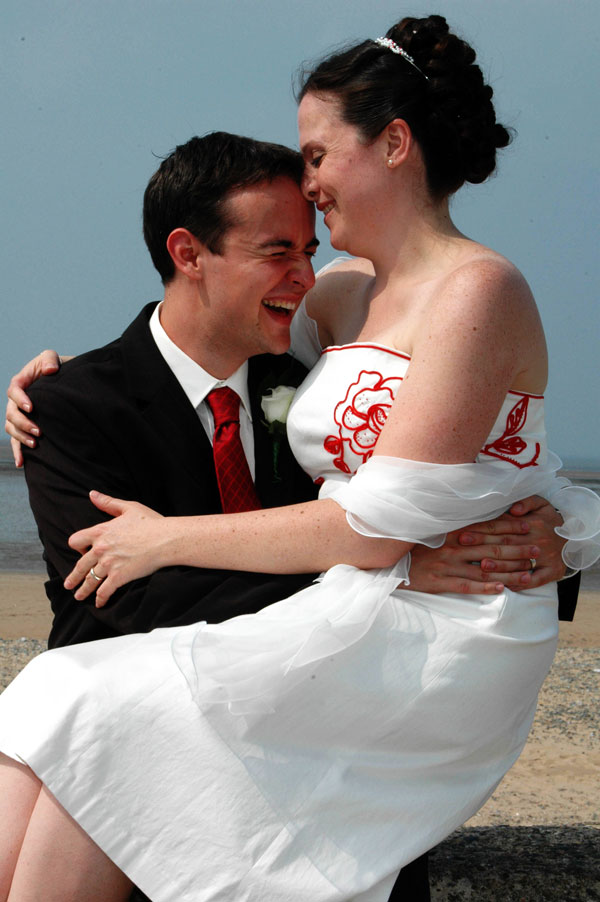 Nobody ever believes in love. I certainly didn’t. Ten years ago right now, the day before my wedding, when my husband-to-be and his mum were running errands in their town, they ended up waiting for ages at the bank. I was at home waiting for them to come back, and when they didn’t, I started to feel sick to my stomach. It was terrible. I was convinced that halfway there they’d had a heart-to-heart, and Stuart had confessed he didn’t want to go through it all, and now they were driving around in circles trying to come up with the kindest way to let me down. I was convinced of this not because I lacked faith in Stuart or in our relationship, but because it just seemed too easy, too simple, too lucky, that our wedding, our marriage would transpire. Because there were no flies in the ointment (except that we were both of us unemployable, and neither descended from moneyed stock, sadly).
“Marry a good man,” answered Anne Enright in this weekend’s Globe and Mail Books to the question, “What the best advice you’ve ever received?” And I did. Ten years on, it only becomes more clear.
I still don’t believe it totally. Perhaps the problem is that I’ve spent my life reading fiction. It occurred to me as I contemplated writing this post that it would be very novel-like (i.e. the way that life goes) if three days from now by husband told me he didn’t love me anymore and was leaving me for somebody whose forehead wasn’t perma-wrinkled and rashy, maybe some whose abs were less rippled than mine (by which I mean rippling in the breeze, of course). Years ago, I read a line from an article about divorce—”‘Barring some catastrophe,’ Bonnie says, placing a hand on her husband’s khaki-clad knee. ‘We are going to have a successful lifelong marriage.'”—and it turned out I knew of Bonnie, though by the time I came across the article, she was already divorced. I don’t know if there was any catastrophe. But still. I am so fascinated by declarations of undying love and gratitude in the acknowledgements pages of backlist books by authors whom I know to be no longer attached. “To Pablo, my everything. It begins and ends with you.”
So I don’t know. But here is what I do know: ten years ago I married a good man, and I love him more and more all the time. And more than that, I like him. He is my choicest companion for any endeavour, from the Valentines we spent in the hospital ER while our three-year-old had an enema to dreamy vacations far across the sea. He is kind and patient and fun, smart and interesting. Everything good that I have ever made has been co-conspired by him. He is supportive, hilarious, imaginative, good, hard-working, generous, and adorable. I am absolutely nuts for him, and really, I could adjectivise him all day. And he loves me back. He doesn’t just say it, but he shows it. Simple, easy, lucky. Can you see why I’m not sure?
I worry about writing down these things in case I come across as more irritatingly smug than I usually do, if such a thing is possible. But in not writing it down, a different kind of narrative takes hold. The kind that presumes that it is not possible to be married to someone for ten years and to love them more and more all the time. That marriage is a sham, it doesn’t work, that everyone is cheating, or longing to. Which is so far from my experience, in which my marriage is the bedrock of my entire life. Solid ground, I think. The surest thing I know.
Or do I? I think so. But it’s a kind of faith, marriage, believing in somebody else, believing in oneself even. That’s all it is, but then it’s everything. It’s all we’ve got, but then there’s all we’ve got—with a focus on the muchness. Ten years ago, we had no idea. We were two weeks away from moving to Canada, making a start here, I was embarking on graduate school, Stuart applying for permanent residency. The year we got married and the year after that, we lived on groceries from No Frills, $50 a week, mostly chickpeas because we couldn’t afford meat, and things made from soup mixes because we didn’t know how to cook. But we learned. It was such a long time ago.
 But things started to happen, the way they do when you start leaving your twenties behind. We figured out what we wanted to do and how to do it. We decided what our priorities were going be. It wasn’t all uphill—there were job losses, plenty of failure and disappointment, stupidity, illness, and mistakes. But all these things are better weathered together, and we’re better for them. Better for having kids too, our amazing daughters who are even harder to believe in than love is, because how can the world really be capable of such miracles as that? Life begetting life, first principles, but I don’t get it at all. All this extraordinary amazement at the most ordinary things, and when I look back on the last decade it overwhelms me. It makes me think there is no such thing as ordinary after all.
You never know what’s around the corner, though I think that’s a blessing far more than a curse. “To me, the grounds for hope are simply that we don’t know what will happen next,” writes Rebecca Solnit in her essay, “Woolf’s Darkness,” which is also an epigraph of my novel. (The other epigraph is from Harriet the Spy.) And while I could never have forecasted the past ten years in my wildest dreams, I think I would have hoped for them, if I’d dared to. For our incredible fortune, by which I mean Stuart and me, and that we found each other at all in a world so big and swarming with other people.






