November 10, 2025
A Stack of Pym
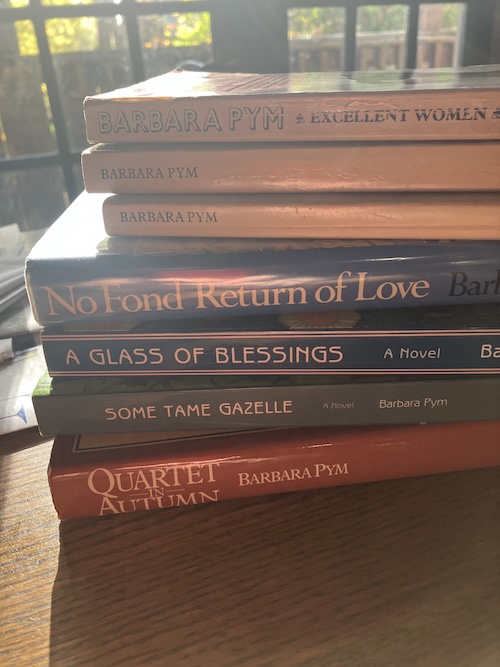
Did you know my forthcoming novel, DEFINITELY THRIVING, began with my intention to write a Barbara Pym story, but in a contemporary setting? Which means that my book indeed features a tea brewed with water boiled on a hot plate, church committees, considerations about what it means to be an unmarried woman without children, unsuitable attachments, some questions of indexing, a jumble sale, and many more wondrous things, including a protagonist with a name like Clemence Lathbury.
Rereading all of Barbara Pym has been one of my many 2025 reading projects, one I’m not going to complete before the year is out, but luckily most reading projects don’t have a deadline, and I’d actually be disappointed if I were finished. I’ve finally read up to Quartet in Autumn, her first novel published after 16 years in the literary wilderness and her discovery via recommendations of her by Phillip Larkin and David Cecil as one of the most underrated authors of the 20th century. I’ve never read her in sequence before and it’s interesting to consider what a different book this is than those that came before it—but the continuities as well, the things that make a novel a Barbara Pym novel (nosy people looking up clergymen in Crockford Clerical Directory for certain, a forerunner of Google!) and all the complexity that lies beneath these books’ deceptively simple surfaces.
November 6, 2025
Cover Story, by Mhairi McFarlane
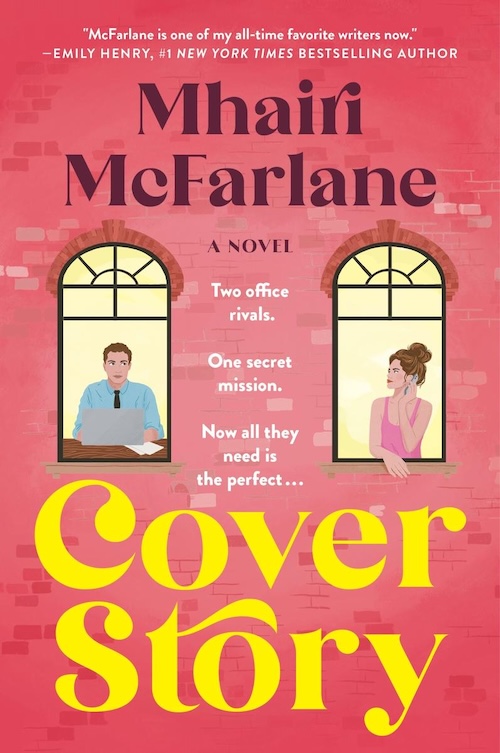
I don’t consider myself a romance reader per se, not because I don’t read romance (I do!), but because there is a culture to romance fandom that I just don’t understand, catalogues of tropes and subgenres, and a fervour along the lines of “Name five songs” demands, and I probably can’t. I don’t know. My most shameful secret is that I used to read romance novels and think that these books would be really great if they weren’t so formulaic, not understanding that for so many readers the formula is most of the draw. I get it now, even if I still don’t get it entirely, but still. And of all the romance writers in the land, Mhairi McFarlane is my favourite.
Her latest is Cover Story, about Bel, an investigative journalist in Manchester, UK, whose new intern turns out to be surprisingly handsome…and her age? But he’s snooty and arrogant, and she’s too busy following up on a lead that may out the city’s mayor as a predatory creep. Which Bel knows something about, having just fled a bad situation with a former colleague who refuses to leave her alone. She’s got things on her mind, but then so does the intern, Connor, who is not remotely as put together as he seems at first. But when he stumbles upon Bel in a bar on an undercover mission, the two are forced to pretend to overcome their mutual dislike and pretend to a couple (this is a trope! I know that much. Take THAT, romance aficionados!) and you’re not going to BELIEVE what happens next. Okay, just kidding, but you will be so thrilled when it does.
An ode to feisty fearless journalists and the taking down predatory powerful men? What is not to love? All this AND happily ever after.
November 4, 2025
Wanting It All
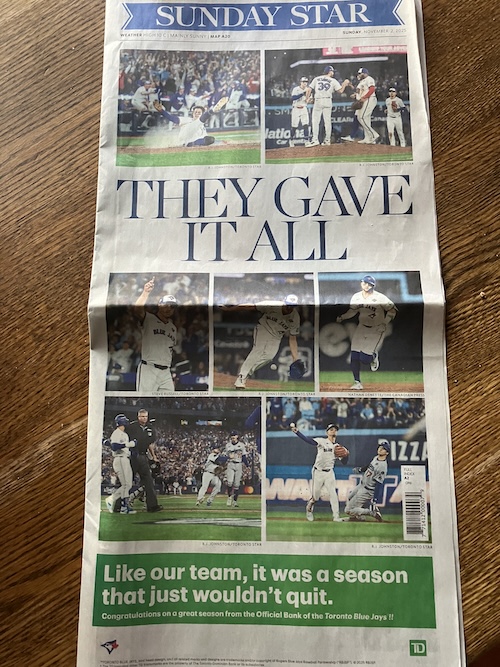
It feels good to be part of a beautiful story, which was a chief appeal of jumping on the Blue Jays post-season bandwagon this year. The bandwagon has been an experience that echoed last year’s of Tay-ronto, when the Taylor Swift Eras tour arrived in our city and the vibes were so electric that one was even able to be a functional human being in spite of an American election outcome concurrently that was just devastating. Both of these collective experiences were so restorative for me, and when I’m called on to articulate why, the image comes to mind of boarded up windows across downtown Toronto in June of 2020 in the wake of the George Floyd protests after we’d just lived through a season of lockdown, the insult and injury of all that ugly plywood, and then eventual weekly “convoy” protests just blocks from my house that were loud, mean, and as antisocial as they were stupid. It’s been a hard five years, a hard ten years, and things are still hard, and scary, so much of what we feared at those election results last year having come to pass, and then some. And along the way I’d lost my faith and trust in community, and in any certainty I’d had about what our story was and just where we were going.
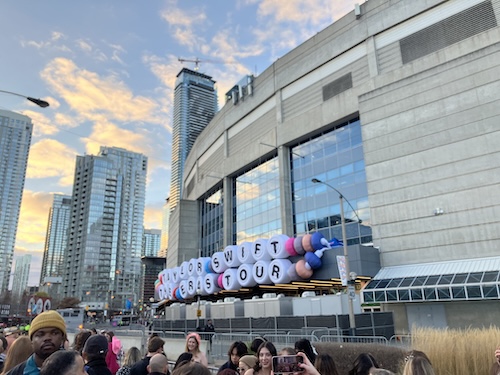
It’s been a long time since I’d dared to #WantitAll. Or even dared “to live for the hope of it all.” To provide some context, when I had a mental breakdown nearly four years ago, we’d known something was up when I was expressing secret desire “to just be put into a coma for a few months,” which I thought sounded perfectly reasonable at the time. As recently as last April, I was having conversations with my therapist about how I might manage to avoid the gutting disappointment of yet another electoral result that felt like somebody was stomping on my face, wondering if there was any way I could just cease feeling altogether—until I realized how ridiculous that sounded, and remembered the central tenet of therapy, which is that feeling things is unavoidable (I KNOW, SO UNFAIR).

And so spending the last month cheering for the Blue Jays has been kind of a wild experience, daring to hope, daring to want. Taking part in the collective joy in loving the team as well, as the wonderful example these players have set for what healthy masculinity is all about, including teamwork, and friendship. Sitting with the uncertainty of what baseball offers us—oh, those last few innings Saturday night were just agonizing, the worst. But also the best. So exciting.
As Gillian Deacon writes: I’m going to go so far as to call this wild ride of the Blue Jays’ post-season a love affair with the unknown. The stakes are a lot lower for the viewer in a ball game than in much of the rest of life, but it bears pointing out that the very thing that draws us to watch the World Series—or any other sporting match—is uncertainty. It’s the not-knowing that draws us in; it’s the possibility of what may or may not come that makes our hearts soar (and makes sports betting scandals so offensive). This exciting few weeks in Major League Baseball has been a great reminder that we have not just the skills for handling uncertainty, but an appetite for it.
And I’ve needed that reminder. I’ve spent the days since listening to “Didn’t We Almost Have It All,” by Whitney Houston (along with “Centre Field,” by John Fogerty), and relishing the line, “The ride we took was worth the fall, my friend.” Yes, I’m being dramatic, but it really was. And I’d forgotten that was even possible.
It feels really good (and hopeful) to remember.
November 4, 2025
John Candy: A Life in Comedy, by Paul Myers
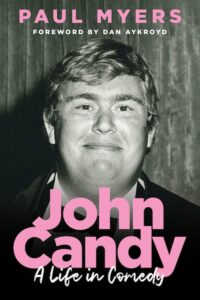
I read John Candy: A Life in Comedy, by Paul Myers, during my TPC readathon last Sunday (thanks to everyone who helped me reach my goal!) and it was just a pleasure to learn more about this actor whose work—from SCTV to The Great Outdoors to the Camp Candy Saturday morning cartoon, and more—was such a big part of my childhood, and whose generous heart seems to have been as important to his legacy as film and TV roles. Myers’ biography is a big picture view of a remarkable life that ended too soon, and its focus is primarily his creative projects and the partnerships that served as these projects’ foundations. Candy was a complicated man who faced his own demons, but Myers keeps such analysis at a distance and minds his own business about the details of Candy’s personal life—though most of these details are that Candy was a faithful husband and a loving father anyway, so it’s not like we’re missing a lot of dirt. I learned about aspects of Candy’s personality I’d not been aware of before—his strong sense of justice, how he’d stick up for others, that everyone who talks about him speaks to his excellent character, that beneath his cuddly comedian persona were some serious acting chops. His acting career from the ’70s to his death in 1993 was a whirlwind, full of highs and lows, an unstoppable machine that might have been part of Candy’s downfall—he suffered stress and anxiety, he worried about providing for his family, every crowning glory would deliver the challenge of surpassing or even just sustaining it. There was a never enoughness to Candy’s creative pursuits, a sense that he too was never enough, much of this coming from the trauma he carried from his own father’s early death and the pain of that experience that he never really was able to process. Time was something else that Candy felt he didn’t have enough of as well, and it would turn out he was right. Myers’ compelling biography, however, shows that he filled up every moment he had and then some, and gave this world his all. We’re lucky for it!
November 3, 2025
First Time, Long Time, by Amy Silverberg
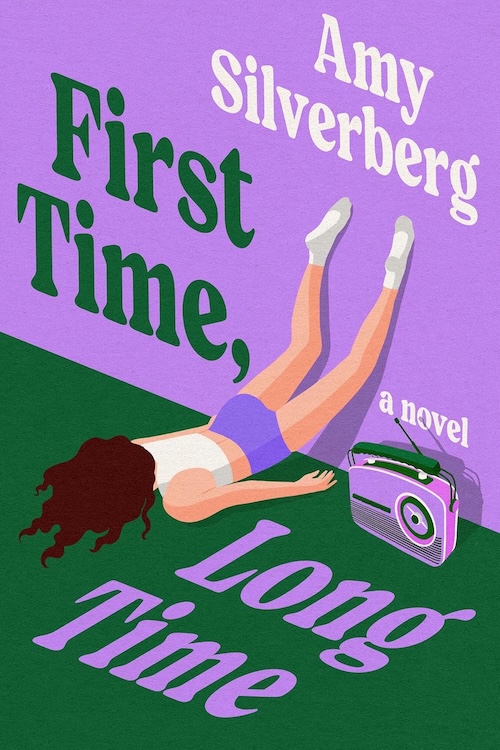
I picked up Amy Silverberg’s debut novel after Maris Kreizman called it “this year’s Margot’s Got Money Troubles, a book that poses big questions with both confidence and a breeziness and that will keep you wanting to turn the pages.” And First Time, Long Time, did not let down, though I wasn’t entire sure about it as I was reading, sure of what all the pieces would add up to. Because indeed this a novel comprised of fragments, just as protagonist Allison’s entire life is. She works various jobs—hosting book clubs for rich ladies, and teaching junior college among them—while living in a studio apartment in Los Angeles where she’s trying to launch her writing career and make a fresh start after the death of brother, which looms large in her mind, all the while her divorced parents continue to torment her in their own ways. And one night when she’s out at a bar, she meets a man she at first pretends not to know, but knows him, she does. He’s Reid Steinman, a famous radio DJ whose voice haunted her childhood from when her father was a fan. Inspired by Howard Stern, Steinman is a similarly complicated character who contains multitudes, as Allison learns for herself once they get together and begin a relationship, the daddy issues only multiplying once Allison also gets somewhat involved with Steinman’s 20-something daughter.
“Wait, did you just give away the whole plot?” asked a friend in my group chat where I’d been recommending this book, and I replied that I sure hadn’t. Silverberg, who is also a comedian, turns out to the a master of the set-up, one I’d spent the novel wondering about even as I was breezily turning the pages as Kreizman predicted. Where could this novel of twisted, broken and mirrored family ties, and unsatiated appetites possibly be leading, I’d wondered, but oh, just you wait. The climax is unforgettable, impeccable, perfect, and it leads to the most wonderful final paragraph I’ve encountered in any novel ever.
October 31, 2025
Monster Reads for Halloween
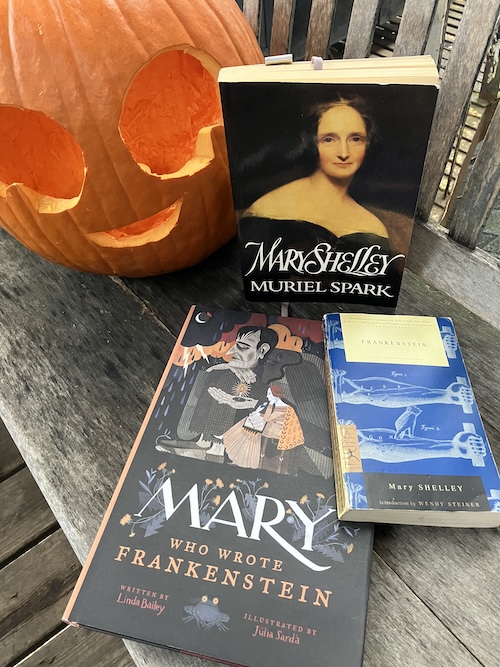
I read Frankenstein with my family this year, and we liked it a lot (unlike, say, The Iliad, which you might recall we ditched for Anastasia Krupnik, by Lois Lowry, which went over much better). And because the only biography of Mary Shelley I’d read until now has been the picture book Mary Who Wrote Frankenstein, by Linda Bailey, gorgeously illustrated by Julia Sarda, I was excited to find a copy of a Mary Shelley bio by none other than Muriel Spark at the Victoria College book sale last month to fill in the gaps in my Mary Shelley knowledge—although Spark’s book was a source for Bailey’s and you’d be surprised at how much she managed to cover with a pretty minimal word count.
Bailey didn’t include what a rat bastard Lord Byron was, however—impregnating Mary’s stepsister and then stealing the child away to live in a convent because he didn’t want his child raised by athiests, and then the baby died. Oh my god, so many babies died, Mary losing three of her children. And Percy Shelley died in a shipwreck. Meanwhile, Lord Byron was telling everybody that Shelley had knocked up their maid, which wasn’t even true, and Byron fought against Mary’s attempts to clear her husband’s name because those attempts would have outed him a vicious gossip. 200 year old scandal is more fascinating than I thought it would be, and reading it as filtered through Spark’s lens (she doesn’t think much of these people’s godless ways!)
The biography is divided into two parts, and I’m near the end of the biographical details. The next part is a critical assessment of her literary work. Maybe it’s time I read something by Mary Shelley other than Frankenstein…
October 31, 2025
Dead Books
Happy Halloween! Seems like a good day to talk about DEAD BOOKS.
I went to see Lily King at the Toronto Public Library this week, which was a great experience, although it made me realize I’d been overthinking things a bit when I wrote my October essay about King’s latest, Heart the Lover, but I stand by all my exuberance. (What can I say. I’d just finished my period. It’s always a wild ride.) And one of the parts of King’s conversation with Claire Cameron that I particularly enjoyed was when she mentioned her “dead books,” in particular the novel she’d been writing in 2020 before Heart the Lover walked in and stole the show. It was a book about a dead senator, and it opened with a body, and she’d really loved writing about that dead body…until she didn’t anymore. And she says that there are people who ask her about this book now, “Aren’t you sad?” That she’d put all this work into a project that never went anywhere, a book that will never see the light of the day.
And she said that she wasn’t sad at all. In fact, she was thrilled, because she didn’t want to work on that novel anymore, and this reminded me of the relief I felt at the beginning of this month, having just completed a marathon in September to nearly double the length of my manuscript, writing 2000 words a day. Reaching 70,000 words total, and all I could think when I was finished was, “Oh, wow! I never need to work on that story again.” Which seems a bit foolish, I know, to have spent all that time in September working on the book, but if I hadn’t, I might never have known. And I needed to know. Even though I think I knew already, but I really had to know for sure.
I started writing a new book last week—it’s 1462 words right now. (See more about my mountain here.) And while it’s early days (and early words), and while that word count does seem paltry compared to 70,000, I’m so happy to be writing it, and I’ve got no qualms about the dead book behind me. Which might be resurrected one day when I’m finally ready to write it properly, but it doesn’t have to be. I know that I will learned a thing or two from writing/failing to write that dead book. I know too that I wasn’t in a position to write the book I’m writing now (the fun book, the living book) until I’d spent time going through the final edits of Definitely Thriving, which put me deep into that book and made me realize just how much I want to write another set in the same universe.
Our dead books don’t have to haunt us, is what I’m really saying here. And when they don’t, that only underlines how much they were never meant to be.
October 29, 2025
6:40 to Montreal, by Eva Jurczyk
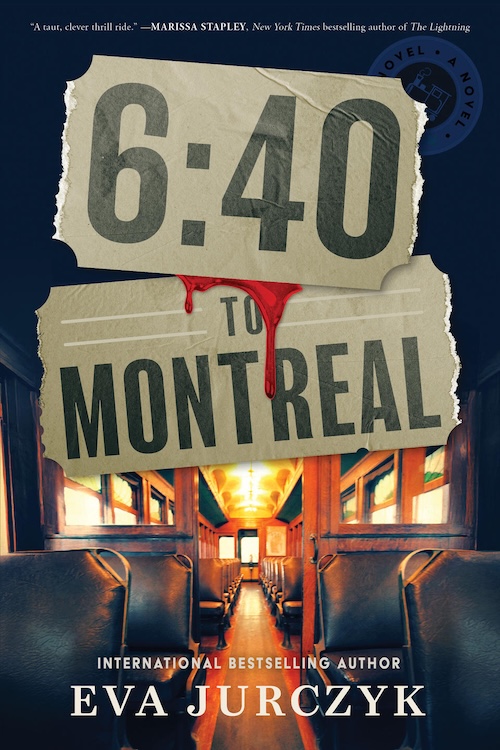
After establishing herself writing thrillers set in libraries (she’s a librarian by day!), Eva Jurczyk leaves the stacks behind in her third novel, 6:40 to Montreal, a locked room mystery set on a train that comes by its literary allusions honestly—the protagonist is a novelist called Agatha, a character is the first literary Dorcas I’ve encountered since reading The Affair at Styles, the setting of a stopped train during a terrible winter storm has Murder on the Orient Express as its precedent. But don’t think that all this means that Jurczyk’s novel is in any way derivative—instead, it’s a deeply layered work that manages to be dark and twisty, strange and absurd, gross and bloody, and also richly poignant and hilarious at the very same time.
The layers are peeled back over the course of a day that novelist Agatha St. John was supposed to spend sans WiFi on the train from Toronto to Montreal travelling in first class, a writing retreat on wheels that’s a gift from her husband who knows that she’s been struggling to write the follow-up to the runaway bestseller that changed her life. But when a terrible storm strands the train in the wilds outside Cobourg, Ontario, as the snow piles up, and then a passenger dies, Agatha and everybody else in first class—including an unflappable customer service agent, a man who appears to be a lumberjack, a doting mother and the young man who’s her son, and finally Cyanne, the wannabe yoga influencer obsessively stalking Agatha since her book came out who’s convinced that Agatha stole her life for fiction, which she’s not entirely wrong about—is confined to the car with the body and no phone signal, a situation that sends every one of them over the edge, and not all of them are going to get out alive.
And it turns out that Agatha too has something to hide, the plan for her arrival in Montreal not remotely what her husband had in mind, and also that her writer’s block has been courtesy of a harrowing diagnosis that’s sent an current of dread through every aspect of her—in particular her relationship to her young son. And what does it mean that she’s using the carnage around her now for creative fodder? Is Agatha actually the thief that Cyanne accuses her of being, stealing other people’s stories to claim as her own?
6:40 to Montreal is a rollicking ride, wild and a bit nuts, all the while weighted with real emotional heft, and sprinkled with the most wicked and wonderful humour (Blundstones fans, leave your feelings at the door). In a genre too wedded to templates and tropes, Jurczyk’s thrillers read as off-kilter in the very best way, and this latest is no exception.
October 28, 2025
Reading Habits
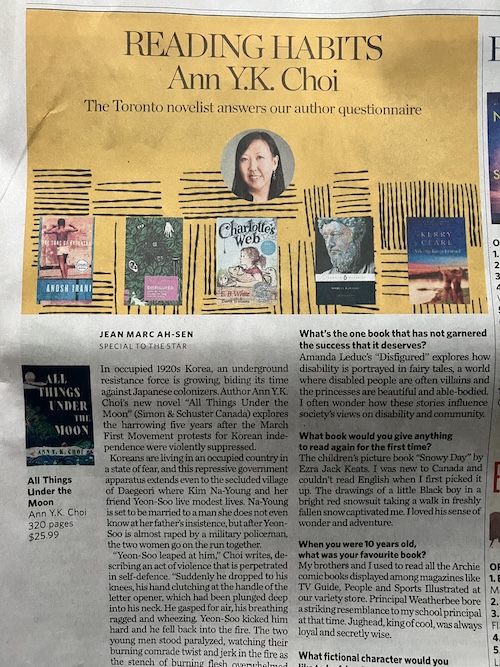
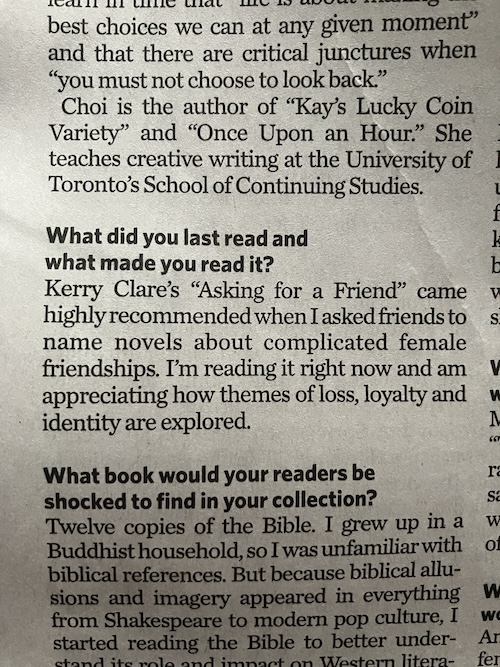
Saturday happiness is plenty of books coverage in my Toronto Star, and even happier happiness is my own book (WHAT??) mentioned in formidable company—along with 12 copies of the Bible and Archie comics!—as Ann Y.K. Choi shares her reading habits and celebrates the release of her new novel, ALL THINGS UNDER THE MOON. Thanks to Ann for saying lovely things about ASKING FOR A FRIEND and including it in your round-up. And if you know Ann, you’ll know that this kindness and generosity is most characteristic. I’m so looking forward to reading her book!
Read the whole piece here (gift link).
October 24, 2025
The Longest Night, by Lauren Carter
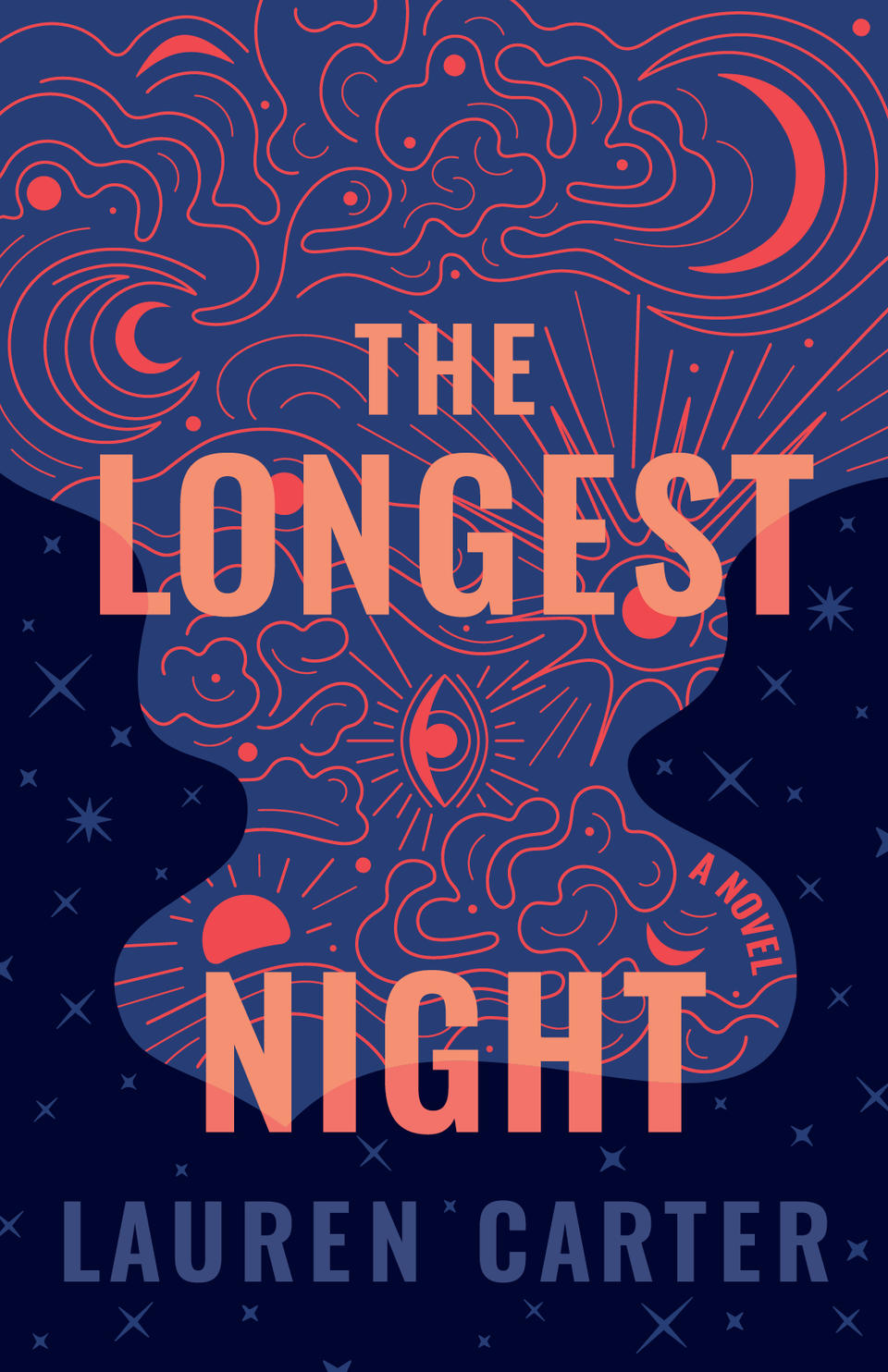
Okay, this book was totally bananas. And also made me very uncomfortable, and disoriented, and I had no idea what trajectory the narrative was going to take, which put me in league with the protagonist, but I also could not put it down, and it was all so fascinatingly mind-bending and satisfying that I think I actually loved it. Lauren Carter’s The Longest Night begins in Minnesota on the winter solstice in 2021 when Ash Hayes finds herself locked out in the frigid cold after escaping another one of her parents’ fights the night before her best friend’s father’s funeral. She’s left her phone inside, her frantic knocking brings no response, and she’s not dressed for the elements, frostbite already setting in, and so it seems like her only choice is to make it to a distant neighbour’s place, and the next thing she knows, she’s waking up in the strangest place.
It’s a house like something out of a time warp, no modern technology, the kitchen appliances are olive green. There are boxes and boxes of stuff, the windows are sealed, her clothes are gone, her hand is bandaged, and the only thing she can find to keep warm is fur stole still with its fox’s head. And it’s here where she meets Lucille and the doctor, the curious people who seem to be holding Ash hostage with especially nefarious intentions that won’t become clear for some time and will culminate in a horrifying act of sexual abuse.
When Ash manages to escape their clutches (although not for long—they’ll come and bring her back again) she discovers that the weird house and its inhabitants are only the beginning of bizarre happenings, for it seems that every time she ventures outside, it’s the morning of September 11, 2001, a day of great importance for the entire world, but for Ash’s life in particular—it’s a day that set events in motion that would lead not only to the death of the baby brother Ash never got to meet (she was born in June of the following year), but also to the death of Ash’s best friend’s father, Frank, who would take his own life after years of PTSD following tours of duty in Afghanistan and Iraq after 9-11. So is here her chance to alter fate and save the people she loves? But what about the laws of time travel, which Ash is aware of after years of watching TV with her grandmother, not to mention the beginning of her university studies in astrophysics? Should she adhere to those rules and try not to change future? How does the future still manage to seem so random and unknown even when you have an idea of what happens next? And how did Ash get herself into this time loop? Is there any way that she’ll be able to defeat the evil doctor with his omnipotent powers and get back to her time?
There is tough stuff in this novel, parts of the abuse which Ash is subject to that is difficult to read, and yet Carter balances this with the real love and warmth in her life from her best friend and her grandmother, and also with fascinating questions about fate and destiny, borrowing all kinds of fun time travel tropes from popular culture. (At one point, Lucille and the doctor show up at Ash’s parents’ place with a photo of her, asking, “Has anybody seen this girl?”) At a certain point I was fully invested, buckled in for the wild ride, and I just really hoped that Carter would find a satisfying way to resolve this bonkers story of time loops and quantum leaps—which she absolutely does.






