August 28, 2012
Swimming Studies by Leanne Shapton
 It occurs to me that I could write a swimming memoir too. I was never, ever a competitive swimmer, but my life has been punctuated by pools, shores and bathing suits. There was the pool in Bangkok in 2004, with my husband, who was my boyfriend, when we were marooned in the city after missing a flight and we went swimming together for the first time in our two years together and discovered a whole new level on which we connected, that we both adored the water. There were the turquoise rectangles and kidneys that dotted the backyards of my childhood suburban landscape, the yards you’d calculate to be invited into on the very hottest days.
I learned to swim at Iroquois Park in Whitby Ontario, and then at the Allan Marshall Pool at Trent University after my family moved to Peterborough. I met my best friend at the Trent pool, at swimming lessons when we were both 13, and seven years later we’d be swimming together at a reservoir when someone pulled a body out of the water.
There were hotel and motel pools with my sister when our family was on vacations. Our backyard pool during my teenage years. The Hart House Pool at UofT, which I swam every day when I was pregnant (which was the same time at which I’d become obsessed with reading books about swimming). And also the Turkish bath in Budapest, where I once went swimming a long time ago when I was pregnant but did not want to be.
And this is the impact that Leanne Shapton’s beautiful books always have on me, her own experiences or her imagined ones leaving me awash in my own thoughts, memories and questions– see my posts on Native Trees of Canada and Important Artifacts. For me, her books point away from themselves, even in their remarkableness and their beauty as objects. (Shapton is a book designer, as well as an author and illustrator.) Which is not to say that her latest, Swimming Studies, is not an incredible book, one of the best I’ve read this year. In her curious collection of sketches-cum-memoir, Shapton teases out the connections between her past as an Olympic swimmer and her present day experiences as an artist in New York City. How did she get from there to here? How do her two selves inform each other? Are they really so separate after all? How does the discipline required for athleticism inform an artist’s life?
Swimming Studies is an exercise in nostalgia, a love letter to places where we no longer belong. I was never, ever a competitive swimmer, but I remember the kids in my class who always smelled like chlorine, which made their skin flake and their hair turn green. I remember their t-shirts that said, “No Pain No Spain.” I remember Victor Davis and Alex Baumann, and in 1984 I was in the crowd at an Anne Ottenbrite Parade, celebrating her gold medal, the very first parade I’d ever seen that didn’t end with reindeer. I found it all fascinating and strange.
But I remember too having strong feelings about the logos on my sweatshirts. Shapton writes, “When I follow a trend (plastic bracelets, neon lycra), I get nervous. Mosquitos and wasps are attracted to my fluorescent-yellow sweatshirt. I spent an unhappy year in seventh grade trying to look preppy with the wrong ingredients…” She writes of her older brother, “I was always watching Derek for signs of what was possible, how to make decisions, what to like and how to tell. I knew he wanted to lose me, and I tried to keep my distance, but I wore the same Converse All Stars as he did, the same jeans…” One chapter begins, “My first visit to Ottawa was with my sixth-grade class…” I know these reference points, Phil Collins playing on the car radio. Watching through windows for your mom’s headlights, for her car to pull into the lot to take you home.
Swimming Studies is a difficult book to explain, and I’m glad that I get to review it in my blog so that I don’t necessarily have to. That I can simply say that the whole thing just works, for no reason I can really fathom. Leanne Shapton writes about ponds and pools she has known– the Hampstead Heath Ladies Pond, the pool at the Chateau Laurier, the baths in Bath, and so many others. She writes about morning practice: “Ever present is the smell of chlorine, and the drifting of snow in the dark.” A many-page spread displays her extensive bathing suit collection. She includes drawings of her teenage swim teammates, with brief biographies for each: “I’m not crazy about Stacy since noticing that she copied onto her own shoes the piano keys I drew on the inside of my sneakers.” About quitting swimming twice, and how the swimmer inside her cannot be shaken, and how she’s had to learn to live with her. Paintings of pools, of figures in the water. A chapter on her obsession with Jaws, with Jaws as metaphor. Her fascination with athletics, with athletes who aren’t champions: “Their swims, games, marches aren’t redemptive. Their trajectories don’t set up victory.”
It works, and maybe you have to understand the lost world that she’s conjuring in order to really get it, or maybe you just have to understand the nature of lost worlds at all.
**
 I bought my copy of Swimming Studies on Saturday on the way home from a splendid afternoon at the Christie Pits pool, the pool that this wonderful hot summer has given us many occasions to appreciate. Our visit was particularly notable because the water slide was on, and also because it was the debut of my brand new bathing suit which I’ve been waiting all summer for. It’s my mail-order bathing suit, an idea that was always going to turn into a saga. It’s the Esther Williams Class Sheath, which I purchased after seeing it endorsed by trusted bloggers at Making It Lovely and Girl’s Gone Child. It arrived too late for our vacation, but actually fit (albeit snugly, requiring me to do a funny little dance in order to get into it). And it’s lovely, so I was happy to have an opportunity to wear it when summer came back to us this weekend. We didn’t bring our camera when we went to Christie Pits, so I decided to wear my suit again the next day at the wading pool, just so you can see how excellent it is. No ordinary bathing suit would drive me to post a photo of me wearing it on the internet, let me tell you. So maybe this is the beginning of a new internet meme called Book Bloggers in Bathing Suits? Like all proper book bloggers, however, with our sensitive skin and lack of propensity for pin-up-ness, I’ve had to delay this big reveal for a week or two because I was waiting for a rash to go away.
August 23, 2009
Swimming by Nicola Keegan
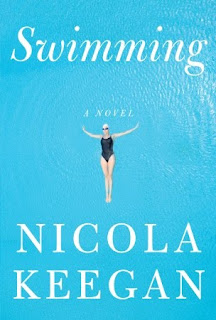 Swimming begins, “I’m a problematic infant, but everything seems okay to me.” Narrator Philomena, draped in rolls of baby fat, goes on, “I live simply; when something doesn’t seem okay, I scream until it is again… I am nine months old and the longest I’ve slept at one time is one hour and forty three minutes.” Poised on the edge of the pool before her first aqua babies class, she is slipped into the water and finds herself “liberated from my fleshly prison of gravity.” Philomena swims and she swims, kicking and rolling, amazing all those poolside, and when pulled from the water, she spits up, pees on her father, and then falls asleep for fourteen hours.
Her parents keep checking on her after: “It is an unspoken fact that they can finally love me now that I’m out cold. They bask in this love, as waves of breath ebb and flow, causing the dome of my stomach to stink, then swell. The silence of the household has opened a space for hope.”
I elaborate this first chapter in such detail in order to explain that Swimming isn’t what it sounds like. The journey of a girl from a small Kansas town swimming to Olympic stardom, an American-type story. Interestingly, however, Keegan turns out not to be American at all, and it shows in her writing. Her narrative reminiscent of Kate Atkinson’s in Behind the Scenes at the Museum, both books dark and hilarious in turns, eccentric family histories beginning with the narrator’s birth, except in the case of Philomena, this birth actually takes place that moment she first gets in the pool.
Only in this first chapter, however, do we get a sense of Philomena in the pool– how it feels to kick, to float, to duck underwater. Though swimming remains her passion throughout her life, “passion” isn’t the right word exactly, because swimming is more a means to an end, which is survival. Sink or swim? She chooses the latter, so that instead of swimming as the main exploration of the narrative, the sport is a metaphor for how Philomena lives her life. Tracing it back it to its very origins, she says, we all start out swimming anyway.
Despite her aptitude for all things aquatic, Philomena receives little encouragement from her parents regarding swimming. Once again, this won’t be the expected tale– of prodigies worked to the bone, of childhood lost. Her preparation for her olympic career isn’t years and years of practice and determination, but rather an eccentric family to start with, compounded by tragedy. In her mid-teens, Philomena starts swimming to save herself from nothingness, to avert her mind from traumatic memories, and her natural ability is still apparent. So that she catches up fast and she begins to win. Winning itself the object, the race, ripping through the water instead of focusing on what’s around her. She becomes the omniscient narrator of her own life, with all the distance that might imply, and her friends and family she renders brutal caricatures, because this is how life is bearable.
Swimming is Keegan’s first novel, which is obvious at times. Not that the book reads like a novice effort, but instead it’s clear that Keegan has poured into Swimming absolutely everything she’s got. The shape of the book is not quite perfect, but its substance is something remarkable. So that I hope that Keegan has not exhausted her store, and I look forward to seeing where her talent takes her.
June 21, 2009
A different kind of swim lit
The story is tragic, and I don’t wish to undermine that, but I am so absolutely intrigued by this part: “As her family told The Globe in a lengthy letter responding to an interview request, ‘She even combined her two passions for reading and fitness by figuring out how to read a book while swimming laps.’” I can’t even begin to imagine how this could be accomplished. A book enclosed in plastic wrap? A page skimmed at the end of every lap? An audio book and a waterproof Sony sports walkman? Regardless, I am impressed.
May 11, 2009
Thought You Were Dead and Quickening by Terry Griggs
 The timing was quite fortuitous in my discovery of Terry Griggs. (My discovery of her for myself, I mean, for Griggs is already well recognized, having published five books, including two novels, two children’s novels, and the Governor General’s Award-nominated short story collection Quickening. She was awarded the Marian Engel Award in 2003). I read her short fiction first in Canadian Notes and Queries 76, which was the infamous Salon Des Refuses issue, and then in The New Quarterly 108. I found that Griggs’ narrative voice had the force of a hurricane, the fortuitousness being that when I wanted more of it, I had not long to wait. Her new novel Thought You Were Dead was released earlier this month with Biblioasis, and her 1990 collection Quickening has been reprinted as part of the Biblioasis Renditions series.
Thought You Were Dead takes the crime novel formula and turns it on its head with such a literary consciousness that book reviewer becomes uncomfortable using such cliches as “turns it on its head.” Literary consciousness is not to mean hoity-toity here, however, or obnoxiously academic, seeing as Detective Chellis Beith only possesses one half of an English degree. Rather that this is a novel very conscious of itself as a book, written by an in author in full possession of her tools at work (which are words). With its tongue in its cheek, sending up the genre– Chellis Beith isn’t even a detective, though he’s frequently accused of being one. Instead, however, he is a literary researcher, formerly a grocery store stock boy, snatched up by a best-selling author one day in the ValuMart “along with the gherkins and the Melba toast.”
 We find the body on page 1, and that this body is fictional, the work of Chellis’s employer Athena Havlock makes no difference at all. Griggs makes no firm distinction between fact and fiction, between the literal and metaphoric, and these distinctions become even more incidental when Athena Havlock disappears. Second body turns up on page 145– a live one in the form of a supposed long-lost sister. And then Chellis is forced to start putting the pieces together, to fill out the details in life as he’s so often done in story. He employs his best friend and old frame in a quest to uncover the truth, applying the same level of initiative he applies to everything (which, suffice it to say, is very little.)
Griggs’ fiction is as demanding as it is rewarding, pulling no punches at all. The reader is plunged rather than eased into the story, whose language must be untangled, unraveled in order to work out the plot. Chellis Beith may be a slacker, but Terry Griggs is no such thing, her tangling and raveling deliberate and intricate, sending up crime fiction, small-town culture, and the literary life. And so much more, this becoming clear with every rereading, with every sentence picked apart, with every one closely read. What a richly textured lark is this, how substantial is Terry Grigg’s concept of whimsy.
With Quickening, which is a very different kind of book, stories that were written a long time ago, it becomes clear that textured larks and substantial whimsy have always been Griggs’ way. These stories of island life are various, but linked by their connections to water (swim lit, however darkly, much to my delight), to vanishings, unlikely points of views (by babies, dogs, and fetuses). These are short stories with limits that are elastic, stretching to accommodate narrative shapes that are “tetrahedral in complexity”. Which isn’t easy. But in her foreword to this reprinting, Griggs notes just what she demands of her readers: “If the gist of any particular effort here seems overly elusive, a reader might need to venture in like a beater and drive out the game.” What a novel challenge to have posed, and we’re better readers for it.
*UPDATE: Terry Griggs has penned today’s Tuesday Essay in The Globe & Mail.
March 31, 2009
More Swim-Lit
I was expecting to enjoy Lauren Groff’s collection of short stories Delicate Edible Birds, but I had no idea that here was another work of swim-lit. Like Groff’s first novel, the marvelous The Monsters of Templeton, these stories take place around bodies of water, and they’re also much concerned with swimming and swimmers. (I’ve not finished the book yet, but I’ve just started reading one story about a deep-sea diver). I realized that I’d read the story L. Debard and Aliette before, in the 2006 Atlantic Fiction Issue, and remember it quite vividly these years later– turned out I liked Lauren Groff before I even knew Lauren Groff. It’s an amazing story of poolside sensuality. The stories linked by these swimming references in a way that intrigues me, and certainly satisfies by latest literary fixation. How positively timely.
March 19, 2009
In addition
I’m now reading The Believers by Zoe Heller, who I’ve loved a long long time. On the weekend I read Anne Fleming’s Pool-Hopping, which, in addition to being swim-lit, was a stellar collection of stories. In light of her latest book Life Sentences, the remarkable Laura Lippman’s top ten memorable memoirs. Today I was sent a link to Based On Books, an interesting review site of books-based films. The Flying Troutmans is named to The Orange Prize longlist. Charlotte Ashley’s Tangential to a History of Reading points to significant flaws in Sydney Henderson’s literary character. And on literature and returning soldiers.
February 25, 2009
Swim-Lit
 I’ve been swimming five days a week for the past six months, and it’s become such an important part of my life. So much though that I think I’m addicted, but then there are worse things. But I crave it, the way I can stretch into each stroke, the rhythm, the sounds the world makes under water. Though I shower afterwards, I spend the rest of the day smelling of chlorine, but I love it. Pushing off from the wall, arms sweeping the surface, even shaking the water out of my ear. There is something meditative about it, though not wholly because I certainly never spend my lengths thinking of anything very interesting or productive. But it’s the quiet, the echo, feeling all the the way spent when I’m done, yet as invigorated as if I’ve just napped. Drying off and the water drops that remain there, each one singular, stuck fast to my skin.
Via Kate S., I was referred to Swim: A Novel by Marianne Apostolides. I’ve ordered it, and am looking forward to its arrival. An entire novel in lengths– dive in metaphors are too easy, but I’m longing for immersion. I also plan to read Swimming by Nicola Keegan, which is out this summer. And if you’re a publisher looking to peddle anything further in the realm of swim-lit, I’m pretty sure I’m your man.