September 12, 2011
Mini Reviews: White Stone: The Alice Poems and The Wings of the Dove
 Last night at this time, I kept thinking to myself, “By tomorrow, I won’t be reading The Wings of the Dove anymore!” Partly because I’ve got so much going on at the moment that spending a week and a half reading a single book is kind of ridiculous (because it now means that I have five books to read by next Tuesday). And also because reading The Wings of the Dove is an all-consuming occupation that drives one cross-eyed if they work at it too long.
I really liked the book, though some bits I found so very tedious– Milly “I might be dying, but I’m probably not, and let’s live like I’m not, but yes, I’m probably dying. Don’t treat me any different for it, but let’s keep having this conversation” Theale in particular. I know she was magnificent, but I never really got it. I thought she was drippy. I thought everyone who worshipped her was a bit drippy vicariously. Everything going on around her, however, the Kate Croy/Merton Densher alliance against Aunt Maud (and also against themselves), and Kate’s background, and her bad father– I loved this. I loved Densher, with all those “And there you are”s, when it suddenly occurs to him that he’s never been in so many places at once. Kate’s point about the things people say about their enemies, but what really gets her is what people say about their friends. I’m fascinated by Kate’s coldness, and how James made her intentions and true nature so elusive. The story told me more about the story that wasn’t in the story than the story itself. But yes, it will be a sweet relief to next open a book and find it not written by Henry James, but rather, Lynn Coady….
Reading Henry James, however, this past week or so, I’ve found that poetry has been the perfect accompaniment. I read Stephanie  Bolster’s collection White Stone: The Alice Poems, and absolutely fell in love with it. It kept me up at night, because I couldn’t find a good place to stop reading and put it down. The poems are accessible, rich, full of story and history, and expand on myths that are familiar to so many. In these poems, The Poet imagines herself observing Charles Dodgson’s (Lewis Carroll’s) infatuation with the real Alice, Alice Liddell. She imagines herself present when Dodgson took his photos of the girl over many years, a stange enduring fly on the wall. And then Dodgson falls away, Bolster considers the actual history of Alice the woman, then she spirits the fictional Alice out into many additional incarnations (Alice with Persephone, Alice with Elvis, Alice with Christopher Robin). By the end of the book, as she had been with Lewis Carroll, Alice is a self-indulgent flight of fancy, but she’s wonderful, the book is so wonderful, and it’s no surprise that White Stone won the Governor General’s Award for Poetry back in 1998. Only realy question is why it’s taken me so long to discover it and read it. (But thanks to Nathalie Foy for finally taking care of this.)
September 11, 2011
Ten Years Later
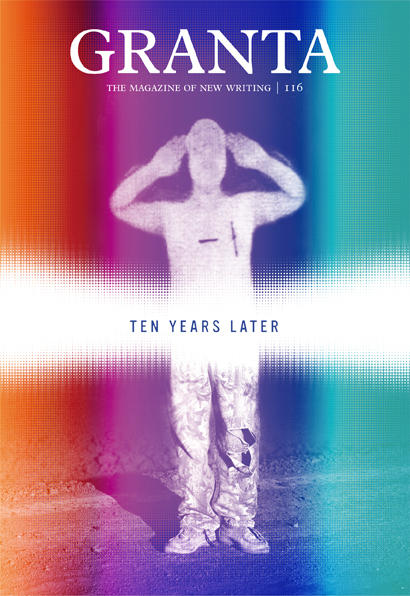 Like many people, I don’t require an anniversary to allow for reflection about what happened in New York City and around the world on September 11, 2001. So much that has happened since has seemed to spin out of those strange few hours on that blue, blue morning– ours was the same sky, and it was beautiful. But, also like so many people, this tenth anniversary has me reflecting on my own proximity to the tragedy, and remembering that it was the first day of my final year of university, how I heard the news of a plane crash on my pink clock radio and how I turned on our tiny TV, and saw the second tower fall. How the CN Tower was dark that night, and watching CNN on the TV at KOS at College and Bathurst where I ate french fries with my friends. It seemed like the end of something, of the world, of innocence, of the old world order, and that would have been bad enough (and perhaps even good, in a sense), but what that day turned out to be instead was the beginning of something, and that something would only get worse. We’ve come of age in a world I never would have imagined on September 10, 2001, that night I sat on my rooftop balcony and pretended I smoked, and longed for something to happen.
Where we are now is reflected in Granta 116: Ten Years Later, my second foray into this magnificent magazine. (Events are being held around the world in connection with the launch of this issue. I attended on last Wednesday, with readings and discussions.) With all the memorializing, self-indulgent weeping (mine, I mean) and discussions of my pink clock radio, what’s missing, of course, is context, and here we find it in abundance. Here is the kind of memorial that matters, not so much reliving that terrible day but looking around and seeing where it’s taken us. Though theme is loose– “Why this story? Why this issue?” asked Kathryn Kuitenbrouwer, whose short story “Laikas 1” appears here, last Wednesday at the event at Type Books. The connections are not immediately clear, and sometimes they don’t come clear at all, but that’s sort of the way it is with this sort of thing, with how did we get from here there to here. The trajectory is rarely straightforward.
Phil Klay’s “Deployment” is deeply affecting story of a soldier home from Iraq who’s on the verge of breakdown as he struggles to make sense of what he saw there and the things he did there, and the strange connections (or disconnections) between these and the civilian life he’s meant to live again. In “A Tale of Two Martyrs”, we learn of the human stories behind the events that sparked The Arab Spring. In “Crossbones”, a man searches for his son who has disappeared to Somalia to join an Al Queda faction. There are two stories (on fiction, one not) of men who were wrongly sold by Afghan warlords to the Americans for the $5000 reward they were paying for terrorists.
A strange, wonderful story of a North Korean spy aboard a derelict fishing boat, Libyan graffiti artists, photos of Libyan refugees in a camp on the Libyan border. Elliot Woods writes about a variety of perspectives of American serviceman, underlined by his own wretched experiences. Declan Walsh’s phenomenal “Jihad Redux” tells the story of foreign intervention in the Afghan tribal regions over the last 100 years– the same old story, except it’s not, and understanding why is important. Kathryn’s “Laikas 1” is so terribly funny, and gruesome, and its connections to the rest of the issue exalt the issue entire– this story of the TTC and High Park coyotes so belongs here. Then Anthony Shahid’s “American Age, Iraq” about a Jesuit college in Baghdad that thrived from the ‘thirties to the ‘sixties, and about what “America” represented to the rest of the world before it began to mean “boots on the ground.”
Clearly then, there is a world beyond that long ago view from my balcony (though Kathryn’s story affirms that my Toronto view was there), and here we look forwards and backwards to discover it. Posing questions without answers, and challenging the answers I always figured were obvious, and if you really want to retrace the route from there to here, I’d say Granta 116 would be a essential volume to bring on the journey.
August 31, 2011
Natural Order by Brian Francis
 Whereas Brian Francis’ novel Fruit (which should have won and nearly did win Canada Reads 2009) was a hilarious little story with an undercurrent of sadness, his second book Natural Order is a sad huge story with an undercurrent of hilarity. Fruit ended with Peter Paddington on the cusp of his teenage years, his dawning awareness of his homosexuality, of a darkness on the horizon. The darkness was so subtle you might have missed it in this deceivingly light novel, and it is this darkness that Francis tackles in this latest book.
The book begins with a death notice from 1984, John Sparks dead of a sudden illness at the age of 31. He is survived by his parents, aunts and uncles, and cousins. And then in the first chapter, we meet his mother Joyce years later, living out the final years of her life in an old age home. Her husband has died, she had no other family, and hers is a lonely life that has caused her to grow a brittle shell. Her one diversion is visits from a volunteer called Timothy, a young man who is gay, and though she at first resists his attempts at connection, she warms to him because he reminds her of her son.
Times run together for the elderly, blurred borders between yesterday and today, and so accordingly, Joyce’s narrative reaches out in a variety of directions. In her youth, she’d developed a crush on a flamboyant co-worker who later commits suicide; we meet Joyce as a young mother delighting in her son; years later, she is dealing with the distance of a son whose true life she refuses to acknowledge (which makes his death, from AIDS, all the more painful. Not that she learns from this– she tells everyone he’s died of cancer). A major componant of the plot involves Joyce as a widow, still living in her home but becoming aware that her days there are numbered, and a discovery she makes that forces her to acknowledge her shortcomings as a mother and a wife.
The delights of this novel are many– Francis writes with a steady hand, creating believable characters who talk and act like people do. I particularly loved Joyce’s friends and neighbours– her single friend Fern in the red sequinned shirt, and her neighbour Mr. Sparrow who calls her to warm her about a strange man prowling around her house, who he’s since invited in for a coffee. Also, jokes about United Church Women who can whip up “a salmon loaf standing on [their] head[s] in thirty seconds”. Though my favourite joke is when Joyce goes over to visit a friend whose father had years before fallen off the roof during a lightning storm: “Stay off the roof,” my father said.
At times, Joyce seems too aware of her role in the story (“But the only way I could control things was if John went to the college here and stayed at home”), but for the most part, Francis has done a stunning job of getting into this character’s mind and creating sympathy for her. He shows Joyce’s overbearing nature as the result of a mother’s efforts to protect a boy who always had a hard time fitting in and faced persecution at school, and her refusal to acknowledge just how exactly he was different as a product of her time and culture.
I’m not crazy about the cover of this book– the whole point of Joyce is her unworldliness, and that she spent her whole life quite sure that the world in her backyard was the world as it was, and what I mean is that she never took her son to the seaside. But her stubbornness in clinging to her own view in the world is what makes her such a compelling narrator. At the end of a life of deception, she becomes quite adept at unflinching truths. She is wry, funny, and far more observant of others’ true nature than perhaps she ever wanted to be.
Brian Francis’ prose is wonderfully readable, he has a talent for perfect detail, though perhaps the novel’s greatest strength lies in how the many different story-lines and time-lines are woven together seamlessly. His generosity with happy endings is measured out just enough to be believable, but also for the novel to be uplifting, and Joyce Sparks is certainly a worthy addition to the canon of Hagar Shipley, Georgia Danforth Whitely, Daisy Stone Goodwill etc.: “I am not at peace.”
August 28, 2011
This Will Be Difficult to Explain and Other Stories by Johanna Skibsrud
 It’s not quite what you’d explect, This Will Be Difficult to Explain and Other Stories, Johanna Skibsrud’s first collection of short fiction. Though what we’re meant to expect from Skibsrud is hard to tell exactly– she’s the author who published her novel with an artisanal small press then won the Giller Prize, the recent overnight success with (now) four books under her belt, the poet whose novel concludes with a court transcript. Johanna Skibsrud appears to exist in order to defy our expectations, and so perhaps it’s smart to just abandon them altogether, and take the stories as they come.
The book is slim, and the stories are diverse– presumably, the collection itself has been quickly assembled on the tail of Skibsrud’s Giller fame. Nothing hasty about the assembly of the stories themselves, however, which display the precision some readers found lacking from The Sentimentalists. There are links between a few of them, and each one portrays a character who is “caught at exact point of intersection between impossibility and desire”. Each one demonstrates, as described in the story Fat Man and Little Boy, “that things happen, not at any particular or recordable time, but at an indeterminate midpoint. Somewhere, that is, between the verifiable and measurable tick and the ensuing and otherwise unremarkable, tock… in that incalculable interval of both space and time.”
The collection reminded me of Mavis Gallant’s Home Truths, with its stories of expats, continent-hopping themes, and also the ability of the narrative to telescope in and out of time. In many of the stories, young Canadian or American protagonists are bumbling their way through France, though they’re never aware of the bumbling until after the fact. Skibsrud is good at “after the fact”, her stories full of deft reveals and fitted with fantastic endings.
In “The Electric Man”, a young woman reveals herself to a mysterious man who reveals nothing of himself; in “The Limit”, a single father struggles to connect with his daughter and clings to a landscape which makes his own limits clear; in “French Lessons”, which deals with the struggles of translation, Martha (who we’ll see again in other stories) receives a startling glimpse into an old woman’s loneliness, hears the message on the wrong beat, and responds with inappropriate laughter; “Clarence” is the story of a young local newspaper reporter who inadvertently interviews a corpse (and this ending was my favourite, I think); in “Signac’s Boats”, we meet Martha again, who’s struggling with the immovable limits of her perspective (but then “limits are real”), even as she puts herself out in the world, and then she’s stunned to realize that love is a new kind of limit, “that it simplified her, when she’d thought it would have made her more integral, more complex.”
“Cleats” was my favourite story, I think, the one that really had me thinking about Mavis Gallant (and not just because of Paris). This long, wonderful novel in a story hinges over and over on sudden shifts of perspective, on carpets pulled out from underneath you. A mother’s complicated relationship with a grown daughter as the mother struggles to make her way in the world after leaving her marriage. Another mother-child relationship is sharply depicted in “Angus’s Bull”, another mother who notices with unease that her child “notices everything”. And then “Fat Man and Little Boy” is the story of Martha’s friend Ginny who goes to Japan to visit an old friend, and finds herself strangely moved and unmoved by the Peace Museum at Hiroshima, by thoughts of her own uncle who worked at Los Alamos and is now dying of cancer, by the fact that nothing is ever one thing, that each singular moment contains the entire world.
Skibsrud’s preoccupations become evident throughout this excellent collection– with limits, and how we fixate on them and/or reject them, with where we come from and where we go, with who are parents are and how we fixate on them and/or reject them, with history and the impossibility of fully inhabiting just one single moment. Clearly Johanna Skibsrud is as at home in the short story form as she is throughout the rest of them, and my expectations have been more than met. I’m more intrigued by this author than ever before, and convinced that Ali Smith was onto something after all.
August 25, 2011
The Best of Everything by Rona Jaffe
 I still haven’t watched the fourth season of Mad Men— I’d like to fix the world in order to have Mad Men perpetually before me. We recently rewatched Season 1 though, and got so much out of it– partly because we watched it first time around when Harriet was still so small, so concentration was limited, plus somehow we missed the pivotal “Babylon” episode, so no wonder I felt the narrative was a little out of sync. It’s an extraordinarily good show, no doubt about it now. Though I have feelings for Don Draper in a way that I haven’t harbored for any imaginary person since Dylan McKay in the early 1990s.
My Mad Men reading also continues– I’m still making my way through The  Collected Stories of John Cheever. For literary illumination into Betty Draper, I had the pleasure of The Torontonians last winter. And I’ve just finished reading The Best of Everything by Rona Jaffe, which is a little bit Peggy Olson, a little bit Joan Holloway, not to mention a book that Don Draper himself was seen reading once in bed. (He looks at Betty. “This is fascinating.”)
The Best of Everything is the story of a group of women working at a publishing company in New York City during the early 1950s. Their lives are not especially intertwined, the narrative follows them separately, but they each begin in the same place, working in the typing pool. Smart, beautiful Caroline Bender has been recently jilted by her fiance and is looking for a way to direct her life without him– she has her sights on becoming an editor, but her boss Miss Farrow knows it and is determined to keep Caroline from succeeding (because there is only so much success for women to go around, of course.)
 April Morrison is a gorgeous girl from Colorado with no such ambition. She just wants to fit in, and she does after a while. Once she figures out how to reject the advances of her lecherous boss, that is, and reinvents herself with a stylish haircut and new clothes paid for on her charge card. When she lands herself a rich boyfriend, she figures she’s got it made, and it takes her a long time (and an abortion) to realize that he’s been stringing her along. Ever the optimist, however, she starts sleeping with every other boy who comes along in home that one of them will fall in love and make her the wife she yearns to be.
Caroline’s roommate Gregg only lasts at the publishing company a short time. She’s an actress, and she has promise, and she also has a prized contact in David Wilder Savage, the theatre director who becomes her boyfriend. Or he’s kind of her boyfriend– when they show up at the same parties, he always brings her home, but she can never stay. She longs to sew curtains for his bare kitchen windows, and in spite of the openness, there’s always more going on in his life than she is privy to. Eventually, he puts her at a distance and that begins to make do some crazy things.
Then there’s Barbara Lemont, who’s divorced and relies on her job to support her little daughter. When someone finally falls in love with her, every single thing is right about him except that he is married. And there’s Brenda, who’s getting married, and Mary Agnes the office gossip, who is getting married too, and for those two, the job is a stop-gap. But then it never is entirely: “It’s funny, she thought, that before she had ever had a job she had always thought of an office as a place where people came to work, but now it seemed as if it was a place where they also brought their private lives for everyone else to look at, paw over, comment on and enjoy.”
It’s all a bit of a soap opera, and the endings are too easy, but it all culminates into something more than that, and the book becomes utterly absorbing. Fascinating too that these are the women John Cheever’s characters leave behind when they take the train to Westchester at the end of the day, the kind of women that Betty Draper and Karen Whitney wonder about, when Betty and Karen are the women these women long to be. Almost. And it reminds me of the thing I keep forgetting whenever I think about 20th century history, which was that people were having sex in the 1950s, and willy-nilly to boot. That the more things change, the more they stay the same, and why do stories of beautiful people with terrible lives always seem so incredibly appealing?
August 16, 2011
Never Knowing by Chevy Stevens
 I’m really not a snob, I’ve just got a problem with bad books, and this is why I struggle so much when I try to read popular fiction. Which is why I’m always so elated when I discover a book that proves that bad books and popular fiction are not synonymous, that finally I too get to be swept away by a thriller that holds me right to the end. And in this case, the book was Never Knowing by Chevy Stevens, a book I love with the same part of me that loves loves Laura Lippman (and also with the part that really loved Scream.)
Sara Gallagher has always believed that discovering the identity of her birth mother would bring her some closure, to fill in the missing pieces of the background of a life that has turned out pretty well. She runs a successful business, is well-loved by her young daughter, is engaged to be married to a man who she loves. But Julia, her birth mother, is cold and hostile when she finally meets her, and Sara senses there is more to the story than what she’s been told. With a little prying, Sara discovers that her birth mother is the only surviving victim of the notorious Campsite Killer, and that the Campsite Killer is her father.
When Sara and Julia’s identities are leaked onto an online crime forum, suddenly the whole world discovers the story, including Sara’s own parents who are angry that she never told them she was searching for the truth about her past. Even worse, however, the Campsite Killer himself, still on the loose and killing after all these years, finds out that he has a daughter, and is determined to make a connection. Sara is forced into a complicated situation as she must satisfy her own curiosity about the father she never knew, reconcile that she’s the product of a monster, assist the police in their investigation by forging a relationship with the killer, and also not let her self or her family come into danger. Sara is being used by the police and by the killer for their own ends, and the situation strains Sara’s own relationship with her daughter and fiance as her wedding date approaches.
With Stevens’ previous novel Still Missing, Never Knowing is structured in first person narrative, with Sara talking with her psychiatrist. The structure works, carefully controlling how the tension builds throughout the novel, and the narration never suffers from unnecessary exposition– it all unfolds quite naturally. Sara’s voice is strong and it makes her character clear. Stevens complicates the plot with domestic drama– Sarah has never seen eye-to-eye with her domineering father, she can’t stand one of her sisters, her fiance is jealous of the police officer who’s working closely with Sara on the case. Her daughter is acting out in response to all the attention Sara is paying elsewhere, and her daughter’s behaviour, as well as Sara’s own impulsiveness have her considering the possibilities of her genetic inheritance.
What I loved about this book is that Sara’s were responses were that of a real person, rather than a plot device. She keeps those around her informed of what’s going on, we don’t have to tell her, “Don’t go down into the basement!” because she knows better. She’s a smart woman whose wits are being tested, but she’s got her self-preservation instincts in tact, and her first priority is protecting her daughter. Which becomes more and more difficult as the Campsite Killer gets closer, and though it’s clearly never going to end well, Sara’s adamant that she’s going to end it nevertheless.
August 14, 2011
This Beautiful Life by Helen Schulman
 Helen Schulman’s This Beautiful Life was a curious read from the start for me, because the life never seemed remotely beautiful. Liz Bergamot is miserable in the new life she’s been delivered to after her family relocates from Ithaca to New York City in order for her husband Richard to continue on a career path to glory. Though the new life is entrancing in turns– as the book begins, she’s chaperoning her daughter to a birthday party in a suite at the Plaza Hotel. But she regrets giving up her career, she laments her teenage son’s distance, her husband’s becoming a stranger, all she seems to do is run errands, and she keeps getting stoned in the bathroom, blowing smoke out the window so nobody knows.
So it’s a house of cards, yes, that comes crashing, but I sort of thought such a house was supposed to have the illusion of stability. Nevertheless, when Liz’s teenage son Jake receives a pornographic video from Daisy, a young schoolmate, forwards it to his friends, and it goes viral, every crack in the foundation becomes startlingly clear. Liz’s social exclusion is exacerbated, Jake is thrown out of school and becomes depressed, Richard’s job is threatened, and six-year-old Coco is lost in the shuffle and begins to act out in disturbing ways.
That the novel is told from the perspective of Liz, Richard and Jake only underlines the distance between each them– we can see that they are scarcely known to one another at all. Jake’s voice is less successfully executed than the others– Schulman has made him precocious, but his preoccupations seemed more the author’s than his own, and I don’t think most teenage boys deliver lines like, “Goddamn it, I’m sorry! But you’re just way too young.” The novel’s other flaw is that far too much is spelled out for us: “Richard does not even genuinely know himself.” Or just in case we don’t get the Daisy/glass house/careless people reference, Jake is reading The Great Gatsby at school.
Of course, Daisy is not Daisy, and here is where the novel gets interesting (and curious). Just who are the careless people here? A family like the Bergamots with the money and clout to make such problems go away? Parents like Daisy’s who deliver their daughter material goods in lieu of love? Kids in general? How has the internet affected the old adage that kids will be kids? That boys will be boys? What does it mean when you have a teenage son watching porn online, and a six year old daughter who is already learning that she is sexual? Schulman touches on the erotic edges of parental love, the hypocrisy of parents condemning young people’s sexuality, and she blurs boundaries in thought-provoking places.
There is no moral to This Beautiful Life, except time marches forward, people move on, and these things go away, or they almost do. Daisy is the blank space at the centre of the story and we don’t enter her consciousness until the very end, when she is grown and nearly moved, but there is an aching sadness at her core that Schulman can’t even begin to address, and that silence is utterly effective. The rest of the novel is cacophonous, a tangled narrative knot at times, but it’s intriguing, provocative, and, like all good fiction, raises more questions than answers.
August 11, 2011
I'm a Registered Nurse Not a Whore by Anne Perdue
 Anne Perdue’s collection of short stories I’m a Registered Nurse Not a Whore is the answer to the question, “What should I read after the brilliance of Alexander MacLeod’s Light Lifting?” Like MacLeod, her stories venture into darkness, their plots take you places, her characters offer a remarkable range of humanity– the alcoholic would-be dry-waller who lives in a rooming house, a teenage dishwasher, a single woman daring to get pregnant on her own, a newlywed couple overwhelmed by the pressures of home ownership. Perdue is funnier though, with a sharp dialogue reminiscent of Jessica Westhead’s, and her stories also had these moments I’ve come to think of as John Cheever moments– the vat of wax! The barbecue! These incidents of horrid absurdity in the midst of the everyday. My husband had to ask me to stop gasping as I read this book, and I really haven’t been able to think about a barbecue properly since.
I love this book, absolutely devoured it, which is fitting for a collection whose stories are larger than bite-sized. These are longer-than-short stories, with twists and turns and plenty of room for depth, and they’re so well-paced, they read up fast. The first story hung me up a little bit with points of view that didn’t seem consistent, but the rest were a smoother ride, the kind of short stories I’d recommend to people who might not know that they like short stories yet.
In “The Escapists”, a couple at an all-inclusive Mexican resort display their complete lack of social graces, and receive awkward glimpses into the true nature of the bond between them. “Inheritance” makes clear the weak foundations on which suburban idylls are constructed, as a husband and father drives himself mad trying to live up to his own expectations. “Ca-Na-Da” is a novel in 45 pages, the story of a woman whose son is a stranger to her, and who finally has to face the consequences of a lifetime of not facing the world, or being honest with it (or herself). In “Pooey”, a middle-aged woman whose family takes dysfunction to a new level decides to go against every rational instinct, take a leap of faith, and have a family of her own.
“I Serve” says the button on the book’s cover, which was gorgeously designed by Anne Perdue herself. And her characters do serve, in the jobs that they do, and in the places that they’ve assumed for themselves in society. Yet there are moments, if only in their minds, –and some are impossibly small but still vivid– in which these character break free of the confines of those places, and dare to serve themselves. Here we the readers become the gasping champions of their glorious liberation.
July 28, 2011
The Astral by Kate Christensen
 Kate Christensen’s Trouble was the first novel I reviewed on my blog after Harriet was born, and the novel was disappointing. (Less disappointing was the review I wrote–I can’t quite believe how lucid it reads. Perhaps I secretly paid someone to write it while I was busy lying on the carpet sobbing.) Being a novel by Kate Christensen, however, Trouble was still well worth the read and better than most of the other books out there. So you can imagine how much it thrills me to declare that Christensen’s latest, The Astral, is her best book yet, and the finest book I’ve read in ages.
The Astral is the story of a man at the end of his marriage: Luz, Harry Quirk’s wife of thirty years, has just thrown them out of their home in The Astral, an apartment (which actually exists!) in Brooklyn’s Greenpoint neighbourhood. She’s come across his latest manuscript of poems, love sonnets, and she’s convinced he’s written them for another woman. Refusing to indulge his insistance that the poems are the product of his imagination only, she destroys the manuscript and banishes Harry from their marital home. Harry finds refuge with his good friend Marion, a recent widow, which only serves to anger Luz further because she’s convinced he’s been sleeping with Marion for years. Though he hasn’t been, not for years or for ever. Harry had had one indiscretion twelve years ago, but other than that, he’s been an pointedly loyal husband.
The Astral follows the months after Harry’s banishment, its effect on his children, and he and Luz’s wider group of friends. As with most of Christensen’s work, the narrative is fixed solidly within the perspective of an unlikeable protagonist, though she invests Harry with a certain charm– I think she tends to go easier on her men than her women. Charm meaning that he’s convincing though, almost, but there are certain moments when it becomes clear that he’s wholely devoid of self-knowledge. A line like, “I’d never had a drivers’ license myself, but I knew bad driving when I see it.” But he brings you around, Harry, and it’s not such a bad place, being in his head. Everything he does is usually justifiable, he knows everybody else’s problems. and then there’s the incredible scene when he storms his wife’s therapist’s office and threatens to maim her, then she proceeds to reduce him to a psychological pulp using his own tricks (but better). Suddenly, it’s not clear what is what anymore.
And what is what is never quite resolved. Like Lionel Shriver at her best, Christensen writes a veritable keleidoscope of relative perspectives, and the effect is as unsure and perilous as reality. Like Shriver too, Christensen is hilarious, though her caustic is far less caustic and her work is more palatable. The two writers are similar also in that their novels are driven more by ideas than characters (or even plot) so that we can see the seams sometimes, the work of an author trying too hard to make her people go where she wants them to go. We also get some woodenness, some terrible dialogue– Harry answers a question regarding his son’s wellbeing with, “Karina and I were just out there. He’s immersed in this cult, he’s marrying the leader, and they think he’s the Messiah.” But there is a self-awareness there, one gets the sense that Christensen is winking. At one point during a too-earnest conversation, somebody asks, “Who’s writing this dialogue?”
And the answer is Kate Christensen, who clings to metaphor as much her protagonist does. Marriage is poetry: “I believe in rhyme and rhythm. But my adherence to form is loony. I make it much harder for myself than it has to be. I follow arcane rules that went out of business a hundred years ago.” Marriage is also a kind of cult like the one that has sucked in Harry’s son, and though this plotline has the air of the ridiculous, it’s never exploited and works within the bigger picture. Everything in the book is really working for a higher purpose, which makes the pay-off worthwhile because you get this book in the end. A story of the disparate selves within one man and within one marriage, and the reconciliation of the former that comes when the marriage is finally dissolved.
(If you’re thinking you might be interested in this book, read Kate Christensen’s Book Notes at Largehearted Boy, and then there will be no doubt left in your mind.)
July 22, 2011
The Vicious Circle reads Hotel World by Ali Smith
 It did not bode well f0r a fantastic meeting of The Vicious Circle. It had been hottest July 21 ever, and everyone was either away or unwilling to take on Ali Smith’s Hotel World, so there would be just three of us. But what a three we were! Each of doing our part to eat much cheese and cake and make up for the others’ absences, and there was so much conversation, bookish love and Ali Smith illumination.
I picked this book. I found it in a box on a curb ages ago, and it’s been kicking around ever since. Book club finally gave me a the push to actually read it, and as I did so, there were parts I loved. I was more forgiving with this flawed book than I have been with the other flawed first novels our book club has read recently, first because I’ve read Ali Smith’s second novel The Accidental and it’s wonderful, so it’s easy to forgive any novel that grew into that. And also because she’s Ali Smith– her talent abounds. Even if I hadn’t read The Accidental, it would be clear to me that this is an author whose talent is going to take her somewhere great.
But Hotel World? Not so great. One of us had barely been able to stomach it, and then the entire chapter without punctuation just proved to much. And the other of us began to read it only to realize that she’d already read it about five years ago but had no recollection, which is never a good sign. It’s an experimental novel, and it’s not quite pulled off– its fragments are too fragmented, and in places they come together in artificial ways, and there were so many things we just didn’t get. The book would probably demand a second reading, but none of us had come away with the inclination to go there.
But then we started talking about what we liked about the book, and the talk kept coming. The punctuation-free section that had so frustrated one of us had delighted another– finally, plot! It gave us so many answers to the questions the other sections had posed. We liked the humour, the absurdity. We thought about how Smith is like Nicola Barker, and also Kate Atkinson, though the latter is much more mainstream. Also, Hilary Mantel. We noted the morbid streak, the play with language, that language is not merely employed but is the story, that these writers know their tools. We wondered why all the British writers writing like this happened to be female. We wondered why nobody writes like this in Canada. It occurs to us that in Canada, no big publisher would take a writer like Ali Smith on. If there is a Canadian Ali Smith, she’s being publishing by a small press we’ve never heard of. We want to send out an alert to the big publishers in Canada– Ali Smith is what happens when you push a weird and wonderful writer who challenges her readers. People actually buy her! She becomes mainstream because her work is out there, and is therefore commercially successful. We realize that someone will answer that British publishing has such a wider readership that they can afford to push weightier writers. We will answer them that we don’t care. Ahem.
One of us brings out Ali Smith’s story collection The Whole Story and Other Stories, which two of us swear is her best, and we see that it is dedicated to Kate Atkinson, so the connection is definitely there. We think a bit about Muriel Spark, and remember that Smith wrote the forward to The Comforters, which we read last year. We spend a lot of time talking about the ambiguous parts of the novel that each of us had interpreted differently. None of us are entirely sure what to make of the final section. We all like this book much better than any of us did going in, and we’re so happy we read it, that we made the trek in this heat. We just decide not to discuss how much cake has been eaten between the three of us, but we’re not sorry about the quantity at all.






