May 8, 2012
Almost There by Curtis Gillespie
 “Happy families are not the most fertile writerly soil, for as Tolstoy so famously wrote in Anna Karenina, ‘Happy families are all alike; every unhappy family is unhappy in its own way.’ But if I can be so presumptuous as to reframe Tolstoy’s words, I would say that every happy family will vacation in its own unique way, whereas unhappy families are all alike on vacation.” –Curtis Gillespie
There was the trip to the east coast when I was ten, when the floor of the backseat was so packed with toys that we could only sit cross-legged. Memories include the jellyfish sting in New Brunswick, being buried in the sand in Ingonish, lobster dinners, the Sandspit Amusement Park in Cavendish, too much mini-golf, and winning a free supper someplace with my rendition of “Free to be you and me.” The west coast was six years later, and I remember less because by then I was a sullen teen scouring small towns for payphones from which I could call my boyfriend, but I remember Banff with my sister (who would, a decade later, decide to call the place home), disgusting roadside bathrooms, swimming in the freezing cold Alice Lake, how beautiful was Victoria, and goats on a rooftop on Nanaimo. And before and after and in between, there were summers at the cottage, drives to Florida, boat rides through the Thousand Islands, road trips all over Ontario, and unfortunate March Break when money was a bit short and we resorted to making Kitchener our destination.
So yes, I agreed with Gillespie’s thesis entirely in Almost There: The Family Vacation Then and Now that our family vacations are the means by we get a sense of who we are as a family, of what “family” is. He writes, “The family vacation is a way to bank family memories, to colour in what might otherwise be broad outlines.” His book is a mix of those memories, of his childhood family vacations and vacations now with a family of his own, with broader historical and sociological research in regards to the family vacation. Which, academically speaking, remains an unexamined field of study– the family vacation itself is a very modern institution.
It begins, Gillespie tells us, with the advent of leisure time, to paid holidays and weekends. And, he notes in his first chapter, with the widespread use of the automobile that suddenly made “getting there” not only an attainable goal, but also part of the adventure. From the history of the road trip, he moves on to camping and cottaging: “Returning to a favoured place, owned or not, is a key and appealing aspect of the cottage ritual, and therefore becomes a central part of our memory making… The ritualized and repetitive nature of such holidays becomes a measuring tool…” His observations regarding camping– that we’re looking for a manufactured form of adventure– become even more pertinent in his chapter on cruises, then Disney destinations, and RVs. (Gillespie writes, “But it seems to me that if the point of having a luxury RV is to take your home with you, then why don’t you just stay home?”). And what is the future of the vacation? Gillespie fears that our children are being entertained to death, losing the vital skill of being able to pass hours on a car journey whilst staring at the window, which is the kind of experience that opens the mind up so wide (and what vacations are about in the first place).
Gillespie’s anecdotes throughout the book are funny, the first and final ones horrifyingly so. His parents and five siblings took advantage of their station wagon’s jump-seats and partook in an epic drive from Alberta to Mexico City whose highlights are the highlight of this book also. Later on, the family got serious and bought themselves a converted bus, which they eventually decided to sell due to its dubious propane stove. He recounts also a harrowing trip down a hill in Australia behind the wheel of an RV, his terrified family behind him, also how they all barely survived a hot air balloon ride, and the time his daughter tried to take off his pants at a public reading during the summer they spent in France.
It must have broken Gillespie’s heart to discover that the very best title ever for a book like this was already taken– Are We There Yet? was published in 2008. And though he demonstrates that he’s familiar with that book and others in the same field, even though his research in general was impressively extensive, I came away with a sense that his material was still unprocessed. The anecdotes were hilarious, the trivia was fascinating, but what it culminated in failed to leave a great impression. At times, even Gillespie seemed aware of the lack of momentum in his narrative, as ideas kept being rephrased and re-framed, as he would backtrack to undermine his own points or ideas, many instances or “as I’ve already said” or “…but we’ll get to that in a moment.”
Though in a way it’s a fitting structure for a book about the vacation, the journey being the point after all, and the diversions, the surprises. For a book that calls itself Almost There, and so it is, but the trip is still memorable.
May 1, 2012
Mennonites Don't Dance by Darcie Friesen Hossack
 I overcame my fear of prairie fiction to pick up Darcie Friesen Hossack’s Mennonites Don’t Dance, which was nominated for the 2011 Commonwealth Writers Prize for First Book, was also a 2011 Globe and Mail Best First Fiction Selection, and nominated for the Danuta Gleed Literary Award. And I came away from this book hungry. Hossack’s bio lists her as a long-time food writer, and her cred comes through in this collection with its evocative descriptions of Mennonite fare– rollkuchen, varenyky, fresh baked bread, and pies, even the thin ones. (“No wonder we’re all as fat cheese,” a character at one point says.)
Mennonites may not dance, but through these stories Hossack shows that their lives take place on the full spectrum of human experience. Demons are fought, temptations succumbed to, secrets are kept and revealed, a cache of dandelion wine hidden, and characters carry history like an awkward burden that refuses to be shed. The great strength of these stories is the complexity of their people, who struggle between impulses and are most human in their tendencies to choose the path of least resistance. So that the mother or father who has every intention of learning from their own parents’ mistakes finds his or herself falling into the same old patterns worn like grooves in a dusty road.
The stories fall down in their dialogue, however, which never flows as naturally as the rest of the prose, and seems stilted and obvious delivered from characters who are shown to have such rich inner lives. It’s the one indication that this book is a first book, because otherwise, the reader can get entirely lost in the remarkable textures of these stories. In “Luna”, Hossack telescopes time, showing Jonah from boy to man, struggling to be a better man than his father was but finding it easier to forget the lessons his childhood taught him, to carry on a family legacy of anger and bitterness, casting off the reasons he was always sure he wouldn’t. In “Ashes”, a daughter-in-law’s miscarriage opens a mother’s old wound, and fosters a connection between the women for the very first time. In the story “Little Lamb”, which was shortlisted for the Journey Prize, a sensitive boy is toughened up for farm life, steeled with the same hardness we see other characters carry through their lives and how much it is a construction. This story is impressively narrated by the boy’s older brother who has seen it all before. “Dandelion Wine” and “Loft” are also told from the perspective of siblings acting as an awkward juncture between a parent and child’s fraught relationship, pulled by dividing loyalties.
The long story “Mennonites Don’t Dance” shows the disconnect between generations and family members. When Lizbeth’s brother is murdered by redneck neighbours, she views her parents’ passivity in the face of the tragedy as a failure and begins a retreat away from history and tradition, but one so far that she becomes stranded. She is saved by her mother, however, which puts this story apart from others in which parents (burdened by the same hardness as necessitated in “Little Lamb”) are unable and unwilling to catch their children when fall, and also who persist in pushing their children away from them. And I like how the generational breaks here are a two-way street– Hossack’s parent characters are, like all her characters, complicated, difficult, and so are their feelings towards their children.
From “Poor Nella Pea”: “My mother lifted her hand as though she was about to slap me. In one movement though, she lowered her hand and closed the space between us, wrapped me up in her arms. When I tried to pull away, she only held on tighter.”
Hossack’s stories are structured around that push and pull, the tension that life and love is.
April 24, 2012
What We Talk About When We Talk About War by Noah Richler
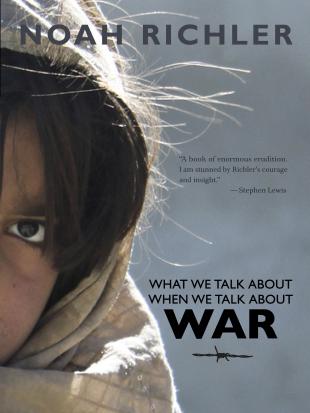 Noah Richler’s new book What We Talk About When We Talk About War comes with a warning label of a blurb with Margaret MacMillan’s “You don’t have to agree with everything Noah Richler says — I don’t — but you must take him seriously.” Which is is the first sign that we’re dealing with a polemic that exists to complicate the idea of polemicism. (It is also helpful a helpful blurb if you’re part of the choir Richler is preaching to– to keep an open mind is the very point.) The second sign that we’re dealing with such a polemic is Richler’s explanation of his book’s title, which comes from the Raymond Carver story whose full sentence is, “It ought to make us feel ashamed when we talk like we know what we’re talking about when we’re talking about love.” And so it should with war, according to Richler, in particular for those who’ve been in charge of our “strategy” in Afghanistan since 2001 and so clearly didn’t.
Most of my impressions of war were formed from the perspectives of my grandfathers who served in the Canadian Navy during World War Two and never had anything to say about war other than that it was awful. There was also the letters long saved that my father’s father had written home to his wife and children during the many years he had to spend away from them. And a story about the body of a dead German, my grandfather’s long lasting impression that inside that man’s wallet there would have been photos of a family much like his own. Which is not to say that my grandfathers did not take pride in their years of service– I spent many a Remembrance Day watching my grandfather march in parade, his medals displayed. I’ve spent more time than you would imagine at the old Naval Club on Hayden Street. But I mostly remember listening to the lists of the ships that were lost in the fighting. I remember being told over and over that the reason they had fought was so that war could be obliterated. Back when I was learning what I know about war, they kept telling us, “Never again.”
Peacekeeping was invented by men who’d learned too much about war, and forgotten by men who’d never known it at all. In the years since my days at the Naval Club, Remembrance Day has been hijacked, the story of “peacekeeping” has been denigrated, and our country has been at war for a decade. And Richler shows that none of this just came about, but was instead the result of a deliberate campaign to shift public thinking, and build up the Canadian military in order to underline the presence of Canada on the international stage. At heart, the shift was rhetorical– we understand ourselves and our lives in terms of stories, and that story has moved in the last ten years from the complex shape of the novel with humanity at its core, to the simplistic epic tale with easy-to-grasp binaries of good and evil.
Richler outlines the circuity of the rhetorical arrangements– the government, think-tanks, the Canadian military has been successful at militarizing the Canadian mind-set by keeping Canadians so at a remove from war itself (which has not been difficult– Afghanistan is far away). That the media has been complicit in the game because war is news, it makes reporters feel useful and excited. That the liberal hippy-dippy platitudes of peacekeeping and love your brother are as empty as the troop-supporting sentiments expressed by ardent war-mongers like Don Cherry or Christie Blatchford (“The time we take to pay dues to war’s brutality… is an ersatz moral act that excuses actually having to do anything more proactive about a subject that is innately horrific.”) That the Afghanistan mission (which only turned into a “mission” once the war itself had become a little bit stale) became less about “war-making” and more about peacekeeping (and school building!) as the conflict wore on, the very approach that “top soldiers” had resisted in the beginning. That the military and government were able to turn instances of public mourning into public relations opportunities. Richler writes, “Ritual works, brilliantly. What chance does dissidence have when monolithic acclamation is the order of the day?”
Our notions of heroics have been hollowed out to exalt those in uniform to extents that are absurd. Women are exempt from this narrative unless they’re requiring rescue, Richler comparing responses to the deaths of photojournalist Tim Hetherington and Calgary Herald reporter Michelle Lang. Our language has been obfuscated, imbued with euphemism– torture is “enhanced interrogation,” a mission is war. The tragic disaster that was the Battle of Vimy Ridge is now a story of glory. People who dare to complicate the dictum of “Support Our Troops” are met with hateful vitriol.
“This is what passes for think-tank work in Canada, which is remarkable but what we have to put up with until others speak up,” writes Richler of a somewhat blathering blog post in which Canadian historian Jack Granatstein once again attempts to lay to rest the myth of the Canadian peacekeeper. In his book, Richler shows how these others have been silenced by rhetoric, and speaks up himself with an erudite text packed with wide-ranging references from Greek myth to modern video games, resisting all accusations of loftiness with a his very constructive final chapter, “What is to be Done?” (and there is plenty).
And while Richler’s message would have been better conveyed in particular to those beyond his choir with a bit more clarity and conciseness (as well as further editing. This text is a mess, though is promised to be cleaned up by next printing), it will be a relief to those of us who feel the same that someone is speaking up finally.
April 18, 2012
Mini Review: Brief Lives by Anita Brookner
 “There is no charm to Anita Brookner”, I wrote last year when I read her novel Look At Me. Like Barbara Pym with just the lonely bits. The book was slow and depressing, and while I appreciated what was good about it, I didn’t like it. I probably would never have picked up an Anita Brookner novel again except that I found this one in a cardboard box on the curb in January. We had a ridiculously mild winter this year, a cardboard box of free books on the curb in January was an even surer sign than lack of snow that something was askew climatologically speaking. But it was the only such box I’d seen in months so I picked through it, took this one home and I read it over the last couple of days.
And that I read it over a couple of days suggests that pace-wise it was better-going than my last Brookner. Though it features the same kind of self-effacing narrator whose unreliability is never affirmed, only subtly suggested (and how does she do that subtlety? The narrator who ever so subtly is not really so subtle). With all tell and very little show, Brookner tells the story of Fay Langdon, a singer who gives up her career when she marries Owen whose business brings her into contact with the magnificent and obnoxious Julia. Fay asserts continually that she and Julia have little in common beyond their husbands’ relationship, that each exists on the other’s periphery, but the careful reader will discern otherwise.Who is the true victim here, and who is the villainess? What are the limits to Fay’s extraordinary self-denial?
Still not much in the way of charm, even better this was really good. A compelling and enjoyable read.
April 16, 2012
Malarky by Anakana Schofield
 If Hagar Shipley met Stella Gibbons, the end result might be Anakana Schofield’s Malarky, but then again, it probably wouldn’t be, because Malarky refuses to be what you think it is. And moreover, it probably wouldn’t be because the book is meant to be chock-a-block with allusions to James Joyce and Thomas Hardy. Don’t tell anybody, but I still haven’t read Ulysses (and hence the Gibbons instead of the primary sources), but I have read Malarky, and it was brilliant, which I know for certain even with the burden of my literary ignorance. And that I can pronounce a book as wonderful even whilst unable to access its higher planes of greatness is certainly saying something for the book itself, which is mostly, “You’ll like it too.”
Schofield’s heroine, Our Woman, if she can be summed up at all, will be summed up with the explanation she gives for the period of despair she suffered after the birth of her first child: “Then I had a cup of tea and six weeks later, I felt better.” There is so much that goes unspoken of, silences to be filled with the rudiments of life as a farming wife, of motherhood, of friendship with her gang of local women (“…not a day passed when several of them didn’t meet. They were like tight ligaments in each other’s life, contracting, extending and sustaining the muscle of each other, house to house, tongue to ear”).
The bottom falls out, however, when she discovers her son up to unmentionable things with the neighbour’s boy. Our Woman’s stress is compounded by a woman she meets in town who confesses to her that she’s been doing unmentionable things with Our Woman’s husband. In response, Our Woman goes out into the world determined to do a few unmentionable things of her own to learn a thing or two, but the situation becomes more complicated– her son takes off to join the US army and local rumour has it that he did it to get away from her, and also her obsession with what she saw him doing becomes a kind of fascination, a desire to be close to him in an impossible way that suggests local rumours could be true.
But it’s hard to tell. Malarky is very much of the world– the Irish economy, wars in Iraq and Afghanistan, the plight of immigrants, mental illness, grief– and yet, its interiority is impermeable. When Our Woman spies her son shirtless in the barn, she notes, “He must have been freezing, his pale body bleary and quivering, trousers at his ankles.” However perversely, she is ever a mother, urging on a sweater. But she’s not just a comic figure; Schofield evokes Our Women with remarkable sympathy: “Mainly she had wanted to hit him about the head and shout these aren’t the things I have planned for you.” Malarky is a journey beyond the limits of love, an equally sad and hilarious portrait of motherhood.
“Malarky is like nothing else, and what everything should be,” is something I wrote down this weekend. First, because it’s as funny as it’s dark, and also because it dares readers to be brave enough to follow along an unconventional narrative. Though the winding path is only deceptively tricky– Our Woman’s voice is instantly familiar, and the shifting perspectives remain so intimate and immediate that the reader follows. Consenting to be led, of course, which is the magic of Malarky. This is a book that will leave you demanding more of everything else you read.
April 11, 2012
Can Any Mother Help Me? by Jenna Bailey
 I think it was an error that led to this beautiful hardback ending up on sale for $1 in the bargain bin at the shop around the corner from my house. Or perhaps it was fate, and this book was always meant to be mine. Jenna Bailey’s Can Any Mother Help Me? is the story of the Cooperative Correspondence Club, born in England in the 1930s when a young woman wrote a letter to the magazine Nursery World:
“Can any mother help me? I live a very lonely life as I have no near neighbours. I cannot afford to buy a wireless. I adore reading, but with no library am very limited with books… I know it is bad to brood and breed hard thoughts and resentments. Can any reader suggest an occupation that will intrigue me and exclude ‘thinking’ and cost nothing!”
Readers wrote back suggesting a collaborative magazine which was organized amongst a membership of around 25. For the next 45 years, the magazine was circulated every month, with each contributor sending her piece to the magazine’s editor. The editor compiled the pieces and bound them within an embroidered cover, and then one-by-one each woman would receive the copy, read it (adding annotations and footnotes where she saw fit) and pass it on to the next woman on the list. Basically, it was an early paper version of a blog, and the CCC’s back-issues are now held with the Mass Observation Archive at the University of Sussex.
Historian Jenna Bailey faced the daunting task of whittling down the CCC into book size. She chose to include those articles which were most remarkable and emblematic of the rest of the collection, in a semi-chronological order. The book’s sections include those on motherhood, WW2, marriage, work and growing old. They show the diversity of voices within the CCC (and the club was careful to keep itself as such, choosing members from different religious backgrounds, political affiliations, and social classes). Though most of the women were educated, and all of those highlighted in Bailey’s book show tremendous writing ability. The articles are provocative, surprisingly contemporary in tone, amusing and moving when required to be. Members wrote about their discontentment with domestic work (and many of them had been forced to leave their jobs upon marriage, as was the custom), trouble with marriages, address adultery and divorce, sex and orgasms, recount anecdotes from everyday life. They wrote with pseudonyms, though Bailey includes biographies of members throughout the book, revealing how many of them did great work in their extra-CCC lives (most remarkably Elaine Morgan, one of the best known proponents of the aquatic ape theory).
The book’s title is a little bit misleading, for the CCC seems to be as much about womanhood as it ever was about motherhood (though it’s true that members were required to have children). To me, the book’s chief appeal is its testament to women’s friendship, its Chloe liked Olivia-ness. Bailey shows that for so many women in the CCC, its other members were the great loves of their lives.
April 9, 2012
Stray Love by Kyo Maclear
 Kyo Maclear’s novels are quiet, muted, about lonely characters at a remove from the world around them. And as you read these novels, you might be underwhelmed, wondering at the quietness, at the slow. They have a depth that works differently than depth does– you don’t necessarily drill down into subtext; the prose here is doing what it’s doing, but the thing is that it keeps going once the story is done. I have been thinking about The Letter Opener for four years now. And similarly, having just finished her latest Stray Love, I’m still going over the story in my mind (to a soundtrack that is Waterloo Sunset).
Maclear’s narrator is Marcel, an artist living in London whose precarious balance is disrupted when an old friend asks him to temporarily care for her eleven-year old daughter, Iris. The girl’s arrival disturbs Marcel’s quiet containment, their burgeoning relationship stirring up memories of his own troubled childhood. In a parallel storyline that becomes the novel’s centre, we learn that Marcel was abandoned by his mother shortly after his birth and raised by Oliver, his adoptive father who was a war correspondent in Africa as the British Empire dissolved in the 1950s and in Asia in the early ’60s. Oliver’s distance wasn’t always geographic either– he’d endured his own trauma, losing his parents in the London Blitz and being raised himself as a “stray” by an adoptive family. Oliver didn’t always manage to be present for Marcel, even when he was. Though not biologically related, both Oliver and Marcel have the same ways of coping, shutting away disturbing memories in suitcases deep in the back of closets though not so far enough away that they’d ever forget what was there.
The story moves from Marcel’s present with Iris (whose circumstances might supposed her character to be analogous to Oliver’s and Marcel’s, but instead she is a departure in a way that begins to change Marcel’s mind about the way his life is going) to the past, to his childhood in London, longing for his mother and waiting for Oliver to come home, and also to the time he spent with Oliver in Saigon in the early ‘sixties lead-up to the Vietnam War. The end of the novel also brings revelations about the more recent past, revelations that re-cast the rest of the book in an entirely different light (and I think that this is where Maclear’s lingering effect comes from).
“There are so many ways of mapping the world,” Marcel notes at one point as he traces his adoptive father’s travels on a map on the wall with push-pins, and then begins to plot points according to his own desires. And in Stray Love, Maclear has shown us another way, how to use fiction to map time and history and place, across continents, historical periods, culture and race.
April 1, 2012
Sweet Devilry by Yi-Mei Tsaing
 Sarah Yi-Mei Tsaing is author of the picture book A Flock of Shoes which we’ve adored for ages, and I’ve wanted to read her book of poetry Sweet Devilry ever since I read her poem “How to dress a two year old” (which begins “Practice by stuffing jello into pants./ Angry jello.) As A Flock of Shoes has autobiographical elements (the story’s main character has the same name as Tsaing’s daughter), there is some delightful overlap between it and Sweet Devilry, though they’re directed at different audiences. I love in particular the reference to Abby’s shoes flying high in the sky in the book’s final poem (though there’s no mention as to whether they sent her postcards).
I’ve added Sweet Devilry to my list of essential Motherhood books. The first poem begins, “On the morning of your birth…” and contains the wonderful line, “Learn a good latch, kiddo–/ it pays to hold on/ to someone you love.” And from then on, the book was unputdownable– I read it walking away from the bookstore all the way to the subway, even though my hands were cold. The first section includes poems about ultrasounds, various perspectives of pregnancy tests, poems about two year olds, tantrums and starting daycare.
The next section riffs on other texts, namely government-issued household manuals from the 1920s and well-known fairy tales, to reinvest familiar tropes with narrative. Section 3 is a long poem reworking The Little Mermaid. And finally, Section 4 explores the various corners of contemporary family life, including the joys of home-ownership in a “transitional neighbourhood” (“We find a pair of shat-on men’s underwear/ sitting at the back of our yard,/ casually, as though it’s always been there,/ as if it’s not embarrassed by its own/ telling state”). The rest are poems about loss (in particular of a parent), and how elements of loss and tragedy co-exist with ordinary life, and about the painful fact that love itself is always about letting go.
March 25, 2012
Impact by Billeh Nickerson
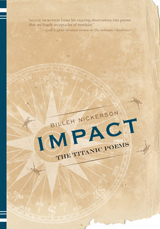 I started reading Billeh Nickerson’s latest book Impact: The Titanic Poems last week in preparation for a feature next month on 49thShelf. I’d picked up the book before I went to bed, and certainly hadn’t planned on what happened next: that I wouldn’t be able to turn out my light until I’d read the book entire, and that the book would make me cry. I had figured that my capacity for crying about the Titanic had been exhausted in 1998 with my teenage melodrama, and also Kate, Leo and Celine. As though by its gigantic cinematic rendering, the tragedy of the Titanic had ceased to be real or have meaning, but it turns out that one hundred years later, poetry was what was required– the opposite of gigantic– to re-instill the story with solidity.
Though what is solid is surprising. The ship itself is a ghost from the start, with rumours of a worker lost in its construction, and in “The Clothesline” the Titanic is an absence, the great ship launched and a Belfast housewife noting the space where it had been, how she’d grown it accustomed to watching it as she hung out her laundry. In four different poems, however, Nickerson describes the riveting process,the rivets themselves,and the teams of men required and their particular skills that put the ship together.
The book’s sections follow the ship from “Construction” to “Maiden Voyage”, in which we learn that the Titanic had 40,000 eggs in her provisions, 800 bundles of asparagus, that the ship’s iconic fourth smokestack functioned solely as ventilation from the First Class smoking room. Nickerson’s poems originate from photographs, official record, anecdotes. He is as much curator as poet, his items unadorned, which seemingly mask the craft at work behind them, but such subtlety is an art itself, the way he lets his items speak. The asparagus stands for itself, for instance, and Captain Smith’s beard, and the photograph of the boy with the spinning top.
And with the next section, “Impact”, it’s the people who speak, the woman being lowered into the lifeboat, the man who must deliver news to the captain of the damage below, the piano player whose instrument couldn’t be carried on deck and whose fingers imagine ghostly keys as the rest of the band played on. With “Voices”, a series of eyewitness accounts from survivors. And then “Impact” again, but this time emotional. Nickerson’s poem “Carpathia” tells of the ship that happened to receive the Titanic’s distress signals and rushed to the rescue to discover the shock of the same emptiness first glimpsed by the housewife in Belfast. The mother recounting her sons being torn away from her body, the carver who’d handcrafted the First Class staircases, various explanations for a dead man’s watch being stopped ten minutes after all the others, and the piece of wood found floating amidst the wreckage which sanded down to become a rolling pin, solidity’s essence.
And then finally, “Discovery”, the ship found and explored in the 1980s, the legacy of its Halifax cemetery, and poem called “The Last Survivor”. In which Nickerson writes, “how strange that the last survivor/ is the Titanic herself.”
March 20, 2012
Among Others by Jo Walton
 Jo Walton’s Among Others begins with a story that is already over. Twin sisters in South Wales who can see and communicate with fairies were brought to battle with their mother who used magic for ill. One sister was killed and the other was injured, left with a maimed leg, the fragments of her life, and only the books she could carry. Readers are dropped into the story abruptly, right in the middle of a conversation between the surviving sister, Mor, and her aunts. Since the accident, we’re told, she’s run away, spent time in a children’s home, then was given up to the guardianship of her estranged father. And now she’s been enrolled in an English boarding school where her vow to cease practicing magic should be easy to keep as there is little magic there to come by.
Here is a story with its own mythology, though the background is not laid out for us. As the novel is structured as Mor’s diary, she feels no need to illuminate facts and details, and so much of what’s gone on is hazy, vague. There is also the question of Mor’s own reliability– approaching this book from a literary angle, the sense is that she is so steeped in the tradition of science fiction that she’s ceased to understand what is impossible in reality. Except then there come these moments where the magic is undeniable, and genres are blurred: science fiction and English boarding school lit (and of *course* Jo Walton has read Charlotte Sometimes), realism and fantasy, children’s stories and adult novels. The magic is undeniable, yes, but the story itself is also so absolutely rooted in the world that I was as hooked as everybody said I would be.
It is books that save Mor from her dismal life (and oh, how Walton illuminates this, the pain of what she’s lost), and also the friendships she discovers through books and reading. She is pleased to learn that her father is also a Sci-Fi fan and he lets her borrow from his library– this becomes the one connection between them. An outcast at school, she’s excluded from games due to her disability, and spends hours in the school library where she appreciates the warmth of the school librarian. She’s also asked to join a Sci-Fi book club at the bookshop in town, where she finds friendship, intellectual stimulation, and even love. The perfection of this happy ending is perhaps the most fantastic element of all, but it’s everything we hope for her.
The straightforwardness of this narrative is complicated by Mor’s own insistance that good things have only come her way because she’s conjured them, however. She notes that so much of her recent fortune is too good to be true and puts it down to a spell she’d cast when she was most lonely. Of course, this can be read as a typical teenage approach to reality– that the universe exists to serve you only, that there’s doubt that other people even exist except in terms of their relationship to you. Is her reality any less real though because she believes it’s magic? Does it really matter if the result is the same?
To Mor, lines are blurred between worlds real and imaginary, which is fitting for someone who quite literally lives in a book, I suppose. Tolkien’s universe is as real to her as her own is– she’s convinced he saw the fairies too– and so are countless other literary worlds referenced that I was less familiar with. To those who know these worlds well, Among Others will be a pleasure, and to those (like me) who are absorbed by books, are grateful for their company, or even for those who just appreciate a good story, the novel will also ring true.
(Also, my favourite line in the novel was, “They weren’t evil after all, they were just odd in a very English way.”)






