October 16, 2011
Not Being on a Boat by Esme Claire Keith
 There was so much right about Esme Claire Keith’s novel Not Being on a Boat that I was planning to review it here anyway, even though there was one thing quite wrong. The one thing being its length, of course, and that being trapped in the mind of her Mr. Rutledge for 350 pages was just too much, but that it was so thoroughly too much was because her Mr. Rutledge was so spotlessly executed. A divorced retiree jacked up on the force of his own consumer power, he has bid farewell to the world and boarded the good ship Mariola to sail off into the sunset. Equipped with two tuxedos and a taste for the finer things in life, he’s expecting good value for his money and some fine conversation with the other passengers in the Captain’s Mess.
 The devil is in the details, however, all of which Rutledge notices, astute businessman (and borderline autistic) that he is, forever on the lookout for number one. But such details and this perspective doesn’t make for great reading, not 350 pages of it, as we learn about the ship’s laundry procedures, and what’s available on the menu, and the historical facts even Rutledge fast tires of as delivered by guides giving tours at the ship’s ports of call. The flawlessness of Keith’s narrative makes reading really hard-going, though things outside Rutledge’s head are certainly interesting: we receive glimpses of the distopian civilization that Rutledge has left behind him, and the problems come aboard the Mariola when one day a group of passengers and some crew fail to return from a port of call. Suddenly, the ship’s standards begin slipping, supplies are getting low, communications are shut down from the outside world, and the problems of the outside world are creeping in through the portholes.
The novel concludes with an end-of-days scenario that had me furious: 350 pages for this? But as the fury wore off, I decided to write about the book anyway because Keith’s control of her project was so impeccable, and also because I’m not sure there was any other way she could have ended it. Not Being on a Boat is a marvelous satire of consumer culture and luxury tourism, so smart and funny, deadpan and sharp. (It is also beautifully designed by kisscut book design, including the map of the boat I discovered under the back flap). And sometimes a flawed book really can still portend the debut of a really great writer, so though “less is more” would really go a long way here, I’d say Keith is one to keep an eye on, and I’d check out what she comes up with next.
October 12, 2011
The Big Dream by Rebecca Rosenblum
 Though I am far too close to Rebeccca Rosenblum to be able to give an unbiased assessment of her new short story collection The Big Dream, I’m going to let my bias fly and tell you that this is a wonderful book. A collection of linked stories about employees at the struggling publishing company Dream Inc., The Big Dream begins with tech support staff scurrying underfoot like rodents and then moves up the corporate food chain– call centre staff anticipating lay-offs, a cafeteria worker who can’t get it together, a new-hire who casts the jadedness of the design staff in terrible perspective, the retired CEO who can’t accept that it’s over, a lusty encounter between the CFO and Senior Marketing Manager, tension between the top execs, and the final story, “This Weather I’m Under” about a VP charged with firing an entire department as her mother lays dying in the hospital.
The entire collection reminded me of a line from Rona Jaffe’s The Best of Everything: “It’s funny, she thought, that before she had ever had a job she had always thought of an office as a place where people came to work, but now it seemed as if it was a place where they also brought their private lives for everyone else to look at, paw over, comment on and enjoy.” Though there’s not a lot of enjoyment going on in The Big Dream, but certainly, Rosenblum shows that our lives are what we bring to work every day. It’s the personal calls we take at our desks, the way decorate our cubes, what’s in our lunch bags, and hidden in our drawers, and in our coats, and tights, shoes that pinch, and our dental emergencies too. It’s in the camaraderie between office-mates, the shared language, inside jokes, and institutions.

Me interviewing Rebecca at her book launch last month.
My favourite story is “Research”, a story of libreation about a woman who shows up to work one day to discover her entire department has been laid-off and is suddenly left to her own devices. She devotes her research to discovering her office building– its incredibly topography (which is always changing– cubes go up, cubes come down), and the floors above and below her own that she’s never seen before– the modern office has never been seen through such eyes before, and with such reverence. I love the sex scenes in “Loneliness”, which are so perfect. I’m uncomfortable with the Russian boy who masturbates into a sock in “Complimentary Yoga”, but only because I’m a prude, and I’m amazed by how thoroughly he’s been created. “How to Keep Your Day Job” is a wonderful story in second person, the exhausting tale of a fall down a flight of stairs. I love the ending of “After the Meeting”, in which a group of co-workers assemble after their entire department has been dismissed, and they have to consider what they really have in common anymore. I know the predicament of the tech support guy with an abscessed tooth who dreams of dental coverage and is even entitled to it, except that he’s not been given his three-month review and the company really has no intention of making him permanent staff.
The backdrop is bleak, but the conversation is funny. In this fascinating look at the cogs that really run the corporate machine, Rebecca has written a book that’s even better than her much-praised first collection Once. A must to check out for any cubicle dweller, and also for any reader who likes to marvel at the amazing things the short story can do.
October 5, 2011
Vital Signs by Tessa McWatt
 Tessa McWatt writes the strangest novels. I’d read Step Closer in 2009, and found it utterly puzzling; not perfect, but so unlike anything else I was reading at the time that it struck a chord and stayed with me, the way she experimented with narrative and form to challenge the limits of fiction and story. Her latest novel Vital Signs is just as odd, and just as much a puzzle. It begins with a husband whose wife is wearing an electrode cap, having her brain scanned, and it dawns on him that he is not worthy of her. And we are to take from this that the idea has never occurred to him before the novel’s first sentence, that in all the years underlying this novel’s relatively brief time span, that he’d never considered this dynamic. But it’s hard to take him at his word, because he’s a narrator who doesn’t even know his own story, let alone his own self.
Michael is the kind of husband who’s always loved his wife best at a kind of distance. (I’d mentioned that McWatt’s previous book reminded me of Emily Perkins’ Novel About My Wife. It ain’t got nothing on how this one does.) He’s attracted by the darkness of her skin when he first meets her, and waits for weeks to discover where she actually comes from, because he prefers the allure of mystery. An allure that is all but extinguished when his exotic wife is transferred to a domestic setting, and sets to work keeping his house and rearing his children. Michael’s disappointment is only added to when his design career doesn’t take off as he expected, and though he does well enough, so many dreams remain unrealized. His desperation for more finds an outlet in a cliched affair with a young colleague, which ends after too many years of her wanting more than he can give.
When Michael’s wife Anna is diagnosed with an aneurysm, the history of his marriage becomes stirred up in the present. He knows there is a chance his wife could die, and he is anxious to confess his sins to her. But this is complicated by Anna’s medical problems, which have left her with a mangled, near-indecipherable way of communicating. The words themselves are clear, but put together, they are nonsense, or else they are stories of things she believes are true that have actually never happened.
And yet, Michael feels there is secret meaning to what she says, that she knows more than she lets on. He begins to find himself communicating with her better than he has in years, and he uses his own skills in designing pictograms to tell her things he’s never been able to put into words. The reader finds, however, that he’s really just slipping into the same old patterns, lusting after his wife when she is away from him, exoticizing her character. He imagines the dressings that will be wrapped around her head after brain surgery: “[the nurse] will wrap it once, twice, more times around Anna’s head, and my wife will resemble an Egyptian nomad.”
Puzzles aside (and there are plenty. McWatt is attempting to answer the question, “What is a mind?” after all. The novel contains actual representations of Michael’s pictograms, and I confess to poring over the novel’s ending and still not really understanding what happened. Though perhaps this is the point– that Anna gets it, and this is all that matters), this is a novel about marriage and family. A decidedly bleak novel about marriage and family, and Michael’s ambivalence toward his wife and children pointedly demonstrates the desperate underside of love.
October 2, 2011
Outside the Box by Maria Meindl
 My friend Maria Meindl has written one of the best books I’ve read this year in Outside the Box: The Life and Legacy of Writer Mona Gould, The Grandmother I Thought I Knew, and it’s a book that proves fascinating on all different kinds of levels. First, Meindl’s book is a history of magazines and radio broadcasting in Canada during the mid-2oth century, demonstrated by the experiences of Mona Gould who made her entire career as a freelancer in poetry, copy-writing, feature-writing, radio broadcasting, and column-writing between the 1930s and the 1960s. She wrote for publications including Saturday Night and Chatelaine, worked as a publicist for the Red Cross during WWII, was affected by the split between commercial and literary writing that took place during the 1950s, published two books of poetry, and her most famous poem “That Was My Brother” in included in anthologies and textbooks to this day. In her radio broadcasts, she’d have to find subtle ways to work word of her program’s sponsor into her scripts. At times, Gould was published in the same periodicals as poets as notable as PK Page and Margaret Avison, but never achieved the same prominence herself, and from this failure to remarkably ascend, her story has a great deal more to tell about the wider world of publishing and broadcasting in her time than those of those whose experiences were so singular.
Which is not to say that Mona Gould was not remarkable or singular. At her best and worst, there was no one else quite like her, and Meindl has done a tremendous job of portraying such a complicated woman and the ambivalence involved in family relationships. Though she certainly had the resources at her disposal– Outside the Box is not just Mona’s story, but is also the story of Maria’s years-long efforts to catalogue Mona’s archives for the Thomas Fisher Library at the University of Toronto. Boxes upon boxes she’d inherited after her grandmother’s death, and she writes about how the boxes were conspicuous in the archives– everything slung into boxes willy-nilly, the boxes themselves tatted and from anywhere, and the papers within covered with dust and cat-hair, and she’d discover open tubs of vaseline, and on the back of one pile of of papers was stuck a colostomy bag. The boxes were a mess, and cataloguing them often appeared an impossible task. More burden than gift, as her grandmother had so often seemed to be to Maria. And yet there was richness to be found, and a Mona Gould to be discovered who was distinct from the alcoholic, mean-spirited woman she remembered as having come between her parents in their marriage. Letters written to lifelong friends, papers that demonstrated that Mona had worked hard for her success and it had not simply appeared to her, as she sometimes spun it. That this woman who put herself above feminism and craved approval from men had battled discrimination throughout her career. Maria had been aware that her grandmother had been something of a liar, but the truth behind these stories is often more fascinating than she’d ever imagined.
The book also has much to say to a society so fixated on the cult of personality, celebrity, which Meindl shows is not an altogether modern phenomenon. It is likely that Mona Gould worked as hard on cultivating her “brand” as she did her writing (though, obviously, she would not have put it that way), craving attention and admiration, and in the end, she’d prove a victim of society’s fickleness, and to the changingness of fashion.
Ultimately, however, Outside the Box is a story of inheritance, of coming to terms with where we’ve come from and who we are. In exquisite prose and with a fascinating mastery of chronology, Meindl makes this her own story as much as Mona’s, the story of how becoming settled in her own life and happiness required her to make peace with her family’s past, to unpack the metaphoric baggage that was as heavy as all those boxes and boxes her grandmother had left her.
September 27, 2011
Suitable Precautions by Laura Boudreau
 There was a period in which Laura Boudreau and I were both enrolled in the same creative writing program at UofT, though due to me being a hermit, we never met up that often. So I must say that I know the stories of Laura Boudreau considerably better than I know Laura Boudreau herself– I remember reading “Strange Pilgrims” in The New Quarterly, the strange sad story of love with a mailman, and there was her Journey Prize-nominated story “The Dead Dad Game”, which I described as “a young person’s perspective on a broken world, and that world is realized with such humour, poignancy and quirky charm.”
So I thought I knew what to expect with Boudreau’s first book, the story collection Suitable Precautions, but it seems that Laura Boudreau writes to thwart expectations. Which I discovered when I read her book whose stories refused to be pinned down and be any one thing. Yes, we have “The Dead Dad Game”, which is just as good upon rereading, just your standard tale of two half-siblings lying on their father’s grave seeking out good vibrations (as the urging of the siblings’ one surviving parent), after which the creepy neighbour’s pot-bellied pig is maimed in a collision so that the siblings have to create apologetic chalk drawings.
For the first time here, I read her story “The Vosmak Geneology”, about the daughter of the daughter of alleged immigrants, whose mother becomes brain injured by a falling picnic table, loses the capacity for abstract thought or imaginings, then eventually creates a phenomenally popular series of children’s books, factually based upon the life of our narrator who spends her time doing homework in the window of a gypsy’s. “The Meteorite Hunter” about a divorced father who doesn’t quite rue his sorry past, but certainly ruminates upon it as he drives with his stranger daughter to visit a man who’s reported to be able to detect meteorites where they fall (and of course, what father and daughter find that their destination is not what they’d expected).
So what I mean by this is that Laura Boudreau’s stories are not “about” just any one thing, but rather they’re about story, about narrative, about the way a writer starts in one place and ends up in another. I mean, speaking of destinations not expected, that none of these stories will take you where you think you’re on your way to, that these are wild sprawling narratives, and yet Boudreau’s writing is so absolutely controlled. There is a tightness, a deliberateness to the way that she makes the jump from even once sentence to another a determined leap like, “I remember seeing a man in a paper gown masturbating in the hallway. We stayed for lunch.”
In terms of tightness, deliberateness, there is nothing else like Boudreau’s command of the first person voice, however. She does young people so well, in “The Dead Dad Game”, and also in “Poses”, which manages to be a story about a young girl posing for an internet pornographer but also be hilarious. I think my favourite story of the collection is “The D&D Report”, which is another of Boudreau’s stories that start somewhere and end up somewhere else, and manages to have years pass effortlessly as its narrator goes from slacker-lifeguard with a yearning for med. school to a doctor with a husband whose whole life is built on uncertain foundations.
Suitable Precautions is a curious book, the kind of book I had to talk about with somebody else as I read it, because there was so much to say. It’s the kind of collection that might appeal to another short story writer, Carolyn Black, who remarked in her interview with me, “For me, now, writing that explains everything requires a good deal of patience, if only because I’ve read so much of it; writing that resists explication seems beautiful and true.”
September 27, 2011
Mini Review: Come Up and See Me Sometime by Erika Krouse
 I feel a bit sorry for any book that was published in 2001– that day in September, scores of brand new books would have been made dated immediately, becoming relics of a different time. Perhaps this is part of the reason that Erika Krouse hasn’t published another book since her debut collection Come Up and See Me Sometime, which I bought discarded from the library for a quarter (see? the story of this book was always going to be a tragedy). Her book came into the world when “chick lit” was not so ubiquitous, and still had the potential to be an interesting genre. Her book contained a story called “Too Big To Float” in which a pilot says to his girlfriend, “Go to Aruba with me. I’m flying there tomorrow. It’ll be free. You can sit in the cockpit and see how it’s all done.” A product of another time indeed.
Come Up and See Me Sometime is constructed on a gimmick– each of these stories is preceded by a quote from Mae West. Though I’m no Mae West devotee, the gimmick is superfluous to the stories’ appeal, and I bought this book because it’s about women who choose not to get married, who choose not to have children. It’s about women who make these choices but also don’t necessarily live like adolescents, and I found this approach intriguing. My own reading is drenched in stories of domesticity, and I wanted to broaden my literary horizons a bit.
One never expects to really enjoy a book that was got for a quarter, but it turned out that I received a very good deal. Krouse’s stories are darkly funny, edgy and wise. Impersonators contains the passage, “On Anna’s eighteenth birthday, one of her friends had given her edible underwear. She didn’t go on a single date for over a year. Anna said that eventually she got tired of waiting and ate them herself.” Which is sort of the story of my life.
In “My Weddings” (West quote: “I’m single because I was born that way), a character recounts the weddings she’s attended in her life, and ends with “relief and fear tangled together, like the hands of women clutching in the air for a falling bouquet of something.” In “No Universe”, a woman considers her choice not to have children, and finishes with the most stunning ending, baby with a crackpipe. Romance with an addict is dealt with in “Drugs and You”, in “Other People’s Mothers”, the protagonist gauges her relationship with her mother against the relationships she has had with mothers of friends and boyfriends, in “Impersonators”, a love triangle gone askew involves two office temps who are both so realized.
Come Up and See Me Sometime was a great read, so completely full of promise, and I’d love to know what Erika Krouse, if she’s come out of the cockpit, so to speak, and what her characters would make of this sad new world we’re in today.
September 19, 2011
Cinderella Ate My Daughter by Peggy Orenstein
 The bad news about Peggy Orenstein’s Cinderella Ate My Daughter is that she’s preaching to the choir here. My husband and I both read this book, and came away more than ever firmly entrenched that girlie/princess culture is bad news for little girls. And not just because of the limited nature of the princess narrative and her identity, but because underneath it lies the trap of rampant consumerism. The great news, however, is that we can’t afford to join that culture anyway, which also comes with its own parenting challenges, but will make so many other things easier.
Orenstein does a great job of showing that “princess culture” is such a recent phenomenon, and that signing up is just to play into corporate hands (and to get those hands into your pockets). That these companies are not simply giving consumers what they want, but are also intentionally coercing children into wanting consumer products that are expensive, and detrimental to the development of their self-image. She shows that companies are out to make a buck by gendering children’s toys (thereby ensuring that parents will have to buy two of everything), and also by inventing stages from toddler to tween to “pre-tween” so that nothing ever lasts more than a season.
Orenstein’s writing is funny, engaging, and self-deprecating as she draws on her own experiences as a mother negotiating the labyrinth of princess-dom. She doesn’t take cheap shots, most notably in her chapter on the child beauty pageant circuits. Many of her subjects are really easy targets, but Orenstein writes about them with sympathy, and also shows how their preposterousness is only a magnified version of most parents’ experiences with princess consumer culture, echoing those same old excuses: “But we’re only giving her what she wants” and “It’s doing no harm.” From reading this book, it becomes decidedly clear that neither of these statements are true.
Anyway, what’s strangest to me is that the choir Orenstein is preaching to isn’t all that big. I guess if it was, we’d all have nothing much to sing about. For me, one of the biggest surprises of parenthood all along has been that common sense is such a relative thing. It reminds me of when writer Carrie Snyder wrote about no-gift birthday parties in her parenting column (an idea we’ve since stolen), and got the most cruel (anonymous) responses, similar to those received by Orenstein herself when, as she writes, she first dared to suggest that princess-dom might not be doing our daughters a lot of good. Both mothers were accused of deprivation, which is not so unbelievable, I guess, when you consider that so many people think shoe shopping is exercising our democratic freedom (not to mention, how to be a feminist). Anyway, I guess what I mean is that these are the people who should be reading this book, but they won’t be, and that’s depressing.
September 15, 2011
The Antagonist by Lynn Coady
 The jocks in my classes at university were always kind of fascinating. Mostly because one didn’t encounter them very often– I went to Uof T whose sports programs were notoriously poor-perfoming. But also because their academic skills always came as a kind of surprise, and because some of them were so big that they couldn’t fit into those chairs that had the desks attached, and had to sort of get wedged in, and I remember how completely uncomfortable these guys looked, how they rendered the world lilliputian, but somehow they were the freaks.
The jock, Rank, was only one of the many characters in Lynn Coady’s The Antagonist who I recognized so completely, who made me think, “I know these people.” Like Rank, I was also “born in a small town”, and so I recognized his father also, a guy called Gord who starts every sentence with, “That little fucker…” And the deadbeat, and his fat friend, and then the middle class versions of these guys who Rank encounters when he gets out of that small town and goes to university (and tries and fails to wedge himself into one of those impossible desks).
Or maybe what I mean is that Coady’s book had me realizing that I didn’t know any of these people at all, actually, and that my recognition of these type had no real connection with these characters’ inner workings, the circumstances of their lives. Coady has taken all kinds of familiar tropes here– foundling child grows up to be Paul Bunyan, to have the strength of Superman, local boy does bad and local boy does good, and local boy does everything he can to escape being created by a father who didn’t create him after all, or at least not biologically-speaking, and by the time Coady is through, these tropes are as unrecognizable as the types are, and here we’ve got a startlingly original novel with incredible depth and devourability.
Not that this is a novel without precedent. Coady’s last novel, 2006’s Mean Boy was a hilarious satire of university creative writing programs, and it had many of the same metafictional elements as The Antagonist (which is, in its own way, also a campus send-up). It even had an antecedent to protagonist/antagonist Rank, a big strapping drunk guy who’s prone to homicidal rages.
Rank is the whole story here, however, it’s his fingers at the keyboard tapping out a message to ghost from deep in his past. Or perhaps the ghost is himself, his younger self, who he’s just encountered in fictional form in a novel written by a former friend. A big strapping drunk guy who’s prone to homicidal rages, and Rank has recognized himself in his old friend’s story. Coady’s novel is Rank’s response to this recognition, a letter to the author to set the record straight.
Coady handles the structure (an email) so elegantly, with flourish (“Consider this the first chapter”), but eventually the structure fades away for the reader and the story runs the show. Rank (whose name is actually Gordon Rankin, Jr. He notes the moment of his uncomfortable awakening that he’s spent most of his life instructing people to call him “Stinky”) goes back to his childhood and adolescence to get to the root of his true story, the awkwardness of being a fifteen year old boy in a giant man’s body, and the expectations this body has foisted upon him. Which are mainly his father’s, that he’ll take care of any punks hanging around their family business, and with his outsized strength, this gets him into serious trouble.
Stories of a subsequent court case are woven around a later plot-line involving Rank and his friends at university (which he attends after achieving an unlikely hockey scholarship), and the inevitability of Rank once again conforming to type. The plot gestures toward this second story culminating in another act of violence, and there is also mystery surrounding what exactly happened to Rank’s mom, both of which make for compelling reading, even more-so because of the immediacy of Rank’s own voice, and the urgency of his message as he types the story home. He’s incredibly likable, but he’s terrifying, and there are these moments at which he undermines himself, and others where the story does it for him. He’s also a narcissist who can’t bear to look in the mirror, so convincingly embodying all of these contradictions, and the result is one of the most fascinating fictional creations I’ve encountered in a very long time.
And what’s even more fascinating, of course, is that he’s his own creation here, competing with someone else’s version of him, which opens up all kinds of questions about story and character, and the execution of both in real life. Embodying even more contradictions: Rank writes, “Even now, speaking to me from twenty years ago, you had me pegged./ Which makes no sense when I think about your book. How could it you could have me so nailed down and still get everything wrong?”
Lynn Coady has arrived with this amazing novel which combines its depth with broad appeal, and her trademark humour is also on display to balance out the story’s heaviness. She also manages to finally bring together the various plotlines in such a satisfying way, though this didn’t mean, of course, that I was any less devastated to have to stop reading because the story was over. (I was. I was. This is a novel that casts a spell.)
September 12, 2011
Mini Reviews: White Stone: The Alice Poems and The Wings of the Dove
 Last night at this time, I kept thinking to myself, “By tomorrow, I won’t be reading The Wings of the Dove anymore!” Partly because I’ve got so much going on at the moment that spending a week and a half reading a single book is kind of ridiculous (because it now means that I have five books to read by next Tuesday). And also because reading The Wings of the Dove is an all-consuming occupation that drives one cross-eyed if they work at it too long.
I really liked the book, though some bits I found so very tedious– Milly “I might be dying, but I’m probably not, and let’s live like I’m not, but yes, I’m probably dying. Don’t treat me any different for it, but let’s keep having this conversation” Theale in particular. I know she was magnificent, but I never really got it. I thought she was drippy. I thought everyone who worshipped her was a bit drippy vicariously. Everything going on around her, however, the Kate Croy/Merton Densher alliance against Aunt Maud (and also against themselves), and Kate’s background, and her bad father– I loved this. I loved Densher, with all those “And there you are”s, when it suddenly occurs to him that he’s never been in so many places at once. Kate’s point about the things people say about their enemies, but what really gets her is what people say about their friends. I’m fascinated by Kate’s coldness, and how James made her intentions and true nature so elusive. The story told me more about the story that wasn’t in the story than the story itself. But yes, it will be a sweet relief to next open a book and find it not written by Henry James, but rather, Lynn Coady….
Reading Henry James, however, this past week or so, I’ve found that poetry has been the perfect accompaniment. I read Stephanie  Bolster’s collection White Stone: The Alice Poems, and absolutely fell in love with it. It kept me up at night, because I couldn’t find a good place to stop reading and put it down. The poems are accessible, rich, full of story and history, and expand on myths that are familiar to so many. In these poems, The Poet imagines herself observing Charles Dodgson’s (Lewis Carroll’s) infatuation with the real Alice, Alice Liddell. She imagines herself present when Dodgson took his photos of the girl over many years, a stange enduring fly on the wall. And then Dodgson falls away, Bolster considers the actual history of Alice the woman, then she spirits the fictional Alice out into many additional incarnations (Alice with Persephone, Alice with Elvis, Alice with Christopher Robin). By the end of the book, as she had been with Lewis Carroll, Alice is a self-indulgent flight of fancy, but she’s wonderful, the book is so wonderful, and it’s no surprise that White Stone won the Governor General’s Award for Poetry back in 1998. Only realy question is why it’s taken me so long to discover it and read it. (But thanks to Nathalie Foy for finally taking care of this.)
September 11, 2011
Ten Years Later
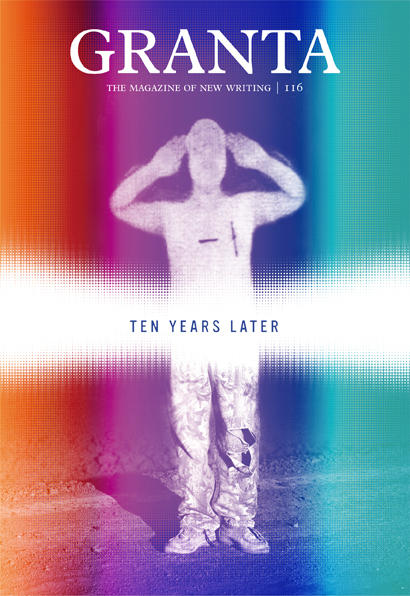 Like many people, I don’t require an anniversary to allow for reflection about what happened in New York City and around the world on September 11, 2001. So much that has happened since has seemed to spin out of those strange few hours on that blue, blue morning– ours was the same sky, and it was beautiful. But, also like so many people, this tenth anniversary has me reflecting on my own proximity to the tragedy, and remembering that it was the first day of my final year of university, how I heard the news of a plane crash on my pink clock radio and how I turned on our tiny TV, and saw the second tower fall. How the CN Tower was dark that night, and watching CNN on the TV at KOS at College and Bathurst where I ate french fries with my friends. It seemed like the end of something, of the world, of innocence, of the old world order, and that would have been bad enough (and perhaps even good, in a sense), but what that day turned out to be instead was the beginning of something, and that something would only get worse. We’ve come of age in a world I never would have imagined on September 10, 2001, that night I sat on my rooftop balcony and pretended I smoked, and longed for something to happen.
Where we are now is reflected in Granta 116: Ten Years Later, my second foray into this magnificent magazine. (Events are being held around the world in connection with the launch of this issue. I attended on last Wednesday, with readings and discussions.) With all the memorializing, self-indulgent weeping (mine, I mean) and discussions of my pink clock radio, what’s missing, of course, is context, and here we find it in abundance. Here is the kind of memorial that matters, not so much reliving that terrible day but looking around and seeing where it’s taken us. Though theme is loose– “Why this story? Why this issue?” asked Kathryn Kuitenbrouwer, whose short story “Laikas 1” appears here, last Wednesday at the event at Type Books. The connections are not immediately clear, and sometimes they don’t come clear at all, but that’s sort of the way it is with this sort of thing, with how did we get from here there to here. The trajectory is rarely straightforward.
Phil Klay’s “Deployment” is deeply affecting story of a soldier home from Iraq who’s on the verge of breakdown as he struggles to make sense of what he saw there and the things he did there, and the strange connections (or disconnections) between these and the civilian life he’s meant to live again. In “A Tale of Two Martyrs”, we learn of the human stories behind the events that sparked The Arab Spring. In “Crossbones”, a man searches for his son who has disappeared to Somalia to join an Al Queda faction. There are two stories (on fiction, one not) of men who were wrongly sold by Afghan warlords to the Americans for the $5000 reward they were paying for terrorists.
A strange, wonderful story of a North Korean spy aboard a derelict fishing boat, Libyan graffiti artists, photos of Libyan refugees in a camp on the Libyan border. Elliot Woods writes about a variety of perspectives of American serviceman, underlined by his own wretched experiences. Declan Walsh’s phenomenal “Jihad Redux” tells the story of foreign intervention in the Afghan tribal regions over the last 100 years– the same old story, except it’s not, and understanding why is important. Kathryn’s “Laikas 1” is so terribly funny, and gruesome, and its connections to the rest of the issue exalt the issue entire– this story of the TTC and High Park coyotes so belongs here. Then Anthony Shahid’s “American Age, Iraq” about a Jesuit college in Baghdad that thrived from the ‘thirties to the ‘sixties, and about what “America” represented to the rest of the world before it began to mean “boots on the ground.”
Clearly then, there is a world beyond that long ago view from my balcony (though Kathryn’s story affirms that my Toronto view was there), and here we look forwards and backwards to discover it. Posing questions without answers, and challenging the answers I always figured were obvious, and if you really want to retrace the route from there to here, I’d say Granta 116 would be a essential volume to bring on the journey.






