September 14, 2012
NW by Zadie Smith
 I don’t remember exactly where or when I purchased White Teeth by Zadie Smith, but I know that it was sometime during that wonderful summer of 2001, when I worked on King Street East and spent my lunch hours in Little York Books and Nicholas Hoare. When I spent the money I was supposed to be saving for my tuition on books instead, stacks and stacks. I bought White Teeth in paperback, and I don’t remember how I heard about it, but I know that it changed my life, my relationship to literature. For the first time, I realized that literature existed beyond survey course syllabi, that great books were being written in the here and now, and by people not much older than I was.
Ever after, a new Zadie Smith book has been an event, except perhaps The Autograph Man, which I don’t remember. A Zadie Smith book is one that I have to get in hardback, and so it was with great pleasure that I handed over 30 plus dollars last week at Book City for a copy of her latest, NW. Her first novel since On Beauty from 2005, her first book since the essay collection Changing My Mind in 2010.
From that book, the essay “Rereading Barthes and Nabokov”: “The house rules of a novel, the laying down of the author’s particular terms–all of this is what interests me. This is where my pleasure is.”
The house rules of NW are difficult to discern upon first encounter. This author’s terms are particularly demanding. And yet, when I had to reread the novel’s rather Woolfish first section “Visitation” in an effort to orient myself to Smith’s geography, it was with pleasure, to immerse myself in the text again to understand how Smith has “record[ed] the atoms as they fall upon the mind in the order in which they fall” (so said Woolf herself). A deep, tangled, engaging book, NW has a surface accessibility, streets smooth enough to glide along, but then think too hard and you’re tripped up, pulled down into the Underground. So much going on here (most of it, actually) underneath the surface.
The first section of the book is structured conventionally, a first chapter followed by a second. The narrative itself is loose and elastic, unstuck, unhinged, words played with and pushed into shapes (both literal and figurative). It’s the story of Leah Hanwell who is lying in a hammock in her back garden in North-West London, a nice garden with an apple tree, but it’s still a council flat and not far from the troubled housing estate where Leah had been raised. She hears a phrase on the radio, “I am the sole author of the dictionary that defines me,” and thinks about writing it on the back of her magazine. Her reverie is interrupted by a knock at the door, a manic young woman in a headscarf who’s clutching a utility bill; “I live here,” the girl says, around the corner. She says her mother has been taken to the hospital and she needs money for a cab to get there. She and Leah share a cup of tea in the kitchen, not such a collision of worlds after all. The girl remembers Leah from high school, came through a few years later. Leah gives her 30 pounds and sees her off.
The girl reappears throughout the rest of the section, by chance (because they’re neighbours after all), but Leah becomes obsessed with her. The girl who never paid back the money, who ripped off Leah just as her husband had predicted. Leah, the ginger-haired girl of Irish origin is married to Michel, French by way of Africa, who is determined to progress in his new country, to make his way trading stocks on the internet in the evening. He wants a better life for his children, the children Leah doesn’t want to have. When she discovers she is pregnant, she has an abortion, and Michel has no idea. “Why must love ‘move forward’? Which way is forward?”
The way forward is clear for Felix Cooper in the novel’s second section, its chapters labelled by postcode. Geography is central to Felix’s experience (on the Tube, “Felix established a private space of his own, opening his legs wide and slouching”), the world is not his for the taking and so he has to define his territory. As he moves through the city, his identity is fluid, based on the perceptions of others. Things are looking good for Felix– he has moved away from the estate where he grew up, he’s got work apprenticing with a mechanics, and he’s got a girl who convinces him that anything is possible. He wants a hot car to impress her. He wants to cut ties his past, his mother, his brother, his struggles with addiction, and bad relationships, including one with a creepy Miss Havisham type he just can’t seem to quit. It becomes apparent, however, that however much Felix desires to change his life, he’s forever turning in circles, living out the same scenes and postcodes over and over again.
Next, we meet Natalie Blake, whom we’ve encountered already in the book’s first section, Leah’s friend since childhood. Natalie’s section comprises 185 short paragraphs, numbered. The way forward for Natalie is focussed, fast, propelling her out of the community she came from to academic success in university, a law degree, a successful career, lots of money and marriage and motherhood. We’ve seen Natalie and her husband Frank in their back garden through the eyes of Leah, a world away, barely human in all their polish. And here we are shown beneath the sheen, that Natalie is even more dissatisfied with her own life than Leah is, that her social mobility has left her foundationless, with a life built on aspirations. There is a cost to being the sole author of the dictionary that defines one, or maybe the point is that for some authorship is only an illusory purpose, and how much is missed by years spent becoming rather than simply being.
The pieces of this novel do not fit together neatly, and its characters’ lives are similarly chaotic, sordid, their emotions messy and complex. While I have outlined various pieces of the novel’s plot, to focus on plot too much is to miss the point. NW is a story about city life, about people in proximity and lives rubbing up against one another, roughly and otherwise. It is a novel of impressions, falling atoms and all that, rather than plot. It will also most likely be an entirely different novel each time you read it, as frustrating and challenging as it is illuminating and rich. Noise and melody. And yes, a novel that’s tearing down the house and remaking all the rules.
The pleasure was all mine.
September 14, 2012
It goes on and on.
 My review of Cordelia Strube’s new novel Milosz appears in the National Post this weekend. As I wrote, “At its heart, which is huge, Milosz is about progeny, about what tethers us to the world and to each other. ” You can the review in its entirety here.
September 9, 2012
Sweet Tooth by Ian McEwan
 I kept getting lost in Ian McEwan’s latest novel Sweet Tooth, and not necessarily in a good way. It is 1972, and after obtaining a substandard degree in mathematics from Cambridge, Serena Frome is recruited to MI5. Her pretty blonde head is just skimming the glass ceiling as she sits down to undertake her entry-level job, mainly filing. At one point, she and a colleague are assigned an undercover job posing as cleaning ladies in order to be… actual cleaning ladies, tidying up a safe house. McEwan shows the systemic discrimination against women in the civil service at the time, and also paints a broad picture of the social and political background– miners’ strikes, coal shortages, political strife, violence in Ireland and terrorism at home.
The two things about Serena Frome are that she is pretty and she likes to read. She reads novels, nothing too challenging or avant-garde. “And I suppose I was, in my mindless way, looking for something, a version of myself, a heroine I could slip inside as one might a pair of old shoes.” She tells us, “Novels without female characters were a lifeless desert.” Her favourite authors are also my own, Margaret Drabble, Elizabeth Bowen. She read Doris Lessing, Iris Murdoch, speedily, skimming surfaces, absorbing whole paragraphs in a glance.
Serena’s good looks and knowledge of contemporary literature are put to use when she’s taken off her desk and assigned to Sweet Tooth, a secret project designed to foster literature that’s anti-communist in its nature. Serena is sent to Brighton to meet a promising young writer called Tom Haley and to sign him on, though he’s made to think his funding is coming from an unremarkable arts body instead of MI5. Naturally, the two fall in love, and Serena is forced to keep up the plot, though she’s not sure how long she’ll be able to perpetuate her story. Amidst all this is paragraph-upon-paragraph of indecipherable spy business, as well as huge chunks of Haley’s stories, which make reading the novel disorienting and frustrating at times.
Doubly frustrating was the character of Serena, who was drawn as such an idiot that I wondered if and why McEwan was so determined to insult his female readers (or just the ones who read like she and I do). What kind of narrator begins a sentence with, “With a pearly pink painted nail I tapped lightly on the door…”? Solopsistic to the point of blindness, frivolous and stupid, Serena was most uncompelling. So too was the novel’s plot which hinged on implausibilities and unbelievable conclusions. Several times, I wasn’t really sure if Sweet Tooth was worth sticking with.
Sweet Tooth has received widely mixed reviews, and your own take will probably depend on how you interpret the novel’s final chapter which reveals a whole new layer of depth to the narrative (and the sort of trickery McEwan displayed at the end of Atonement). On one level, the trickery is slightly annoying, and yet suddenly the reader understands why Serena Frome is such a lacklustre, two-dimensional character, and why the novel twists and turns with such amateurism. The whole project suddenly makes sense, and that’s interesting, even redeeming, but it doesn’t change the fact that the reader had to endure such a crummy book to get the point.
I read once that a reader’s first Ian McEwen novel is always her best, and that’s been the case with me. I will never forget how captivated I was by Saturday, how I had to skip ahead to the end to discover how it all turned out because otherwise, I might have gone into cardiac arrest. I’ve enjoyed others since, but there’s always been something lacking, as was the case here. There is so much to like about Sweet Tooth, the parallels between espionage and fiction-writing (“In this work, the line between what people imagine and what’s actually the case can get very blurred. You imagine things– and you can make them come true”), its insights on story-building, depiction of a post-swinging London, and a marvelous character called Shirley Shilling (“whose alliterative name in the dependable old currency caught something of her plump lop-sided smile and old-fashioned taste for fun”).
In the end, I am glad I persevered with the novel, but this was a book too clever for its boots. I do wish Ian McEwan could pull off a more substantial literary feat than the old, “Look Ma, no hands!”.
September 5, 2012
All the Anxious Girls on Earth by Zsuzsi Gartner
 Last week, I couldn’t focus, and suffered that “couldn’t get into it” reading affliction that you hear about so often. I don’t know if the problem was the books’ or mine, but regardless, there was no hope until I turned to my to-be-read/not-new-releases shelf and picked up All the Anxious Girls on Earth by Zsuzsi Gartner (whose Better Living Through Plastic Explosives had been so admired by both me and Giller Prize judges last year). And suddenly, the world was steady again.
Except, of course, that it most definitely wasn’t. As with her second, Gartner’s first book of short stories is rife with explosions, decay and unsteady earth beneath our feet. It’s that same dystopian Vancouver which looks suspiciously like reality (and sometimes it’s also Toronto). There is weirdness (a woman swims in her mother’s womb with a fetus who’s a brother long ago stillborn) , and humour (another woman programs a film festival and has to content with terrible would-be filmmakers showing up at her door– “I made that film about the dude who goes through all this bad shit and then wakes up and finds out it was all just a dream… Just watch it backwards.”), and violence (when the woman who threatens to set herself on fire if her film isn’t programmed [“Her eyes were a living room of despair, full of mismatched furniture and candles stuck in Chianti bottles, dripping all over the place, a syringe under the wicker chair, a Ouija board on the coffee table.”] follows through with her threat).
It’s possible that short stories were just what I needed, albeit good ones meticulously curated into a seamless collection. A book to sink in and out of, which was about all the attention I could muster at the time. And the vision, the writing! “Lewis worked in a place that looked like a cheese shop but sold soap. A cosmetic deli.” Sentences that jumped off the page, treasures themselves. I also appreciated the many connections between All the Anxious Girls and Better Living, the evolution of Gartner’s preoccupations, how the latter is an extension of the former and they illuminate each other. I’m fascinated in particular with Gartner’s treatment of terrorism, an idea whose definition took on radically new proportions in the time between her books. How has a changing world changed what she’s writing about?
Yesterday, the Giller Prize longlist was revealed, and though people are careful to be polite about these things, the list bowled me over with its unremarkableness. And yes, excellence means different things to different people, and what this prize is all about will change every year depending on the jury in question. But I was disappointed by this list because it’s been a stunning year for Canadian literature and not one of the books I’ve loved best made it into the spotlight. There are a few exceptions, but for the most part, I’ll never read any of the nominated books, and no amount of acclaim will ever change that. How glad I am that I know my own mind (and the terrible books that knowledge will same me from!). Though it occurs to me, as it did last year, that perhaps I live too deeply in my own bookish bubble to pay much attention to prize lists anyway. I’m buying books all the time, so I’m not who Giller is trying to woo. Further, I’ve got so many books to be read that I’d be reading into the next year or two with what’s lined up already, so in a way, prize lists are just a distraction. Perhaps it’s a blessing that a list like this is so incredibly easy to tune out.
The point of all this being that there is such tremendous pressure to keep on top of new releases, to read even the books that don’t interest one much. And that tuning out from that buzz can be such a liberation. If any of the Giller longlisted titles are truly for the ages, then I look forward to getting around to them in a decade or so, when it will be like the discovery of something quite precious.
- Check out my Anxious Girls reading list here.
August 28, 2012
Swimming Studies by Leanne Shapton
 It occurs to me that I could write a swimming memoir too. I was never, ever a competitive swimmer, but my life has been punctuated by pools, shores and bathing suits. There was the pool in Bangkok in 2004, with my husband, who was my boyfriend, when we were marooned in the city after missing a flight and we went swimming together for the first time in our two years together and discovered a whole new level on which we connected, that we both adored the water. There were the turquoise rectangles and kidneys that dotted the backyards of my childhood suburban landscape, the yards you’d calculate to be invited into on the very hottest days.
I learned to swim at Iroquois Park in Whitby Ontario, and then at the Allan Marshall Pool at Trent University after my family moved to Peterborough. I met my best friend at the Trent pool, at swimming lessons when we were both 13, and seven years later we’d be swimming together at a reservoir when someone pulled a body out of the water.
There were hotel and motel pools with my sister when our family was on vacations. Our backyard pool during my teenage years. The Hart House Pool at UofT, which I swam every day when I was pregnant (which was the same time at which I’d become obsessed with reading books about swimming). And also the Turkish bath in Budapest, where I once went swimming a long time ago when I was pregnant but did not want to be.
And this is the impact that Leanne Shapton’s beautiful books always have on me, her own experiences or her imagined ones leaving me awash in my own thoughts, memories and questions– see my posts on Native Trees of Canada and Important Artifacts. For me, her books point away from themselves, even in their remarkableness and their beauty as objects. (Shapton is a book designer, as well as an author and illustrator.) Which is not to say that her latest, Swimming Studies, is not an incredible book, one of the best I’ve read this year. In her curious collection of sketches-cum-memoir, Shapton teases out the connections between her past as an Olympic swimmer and her present day experiences as an artist in New York City. How did she get from there to here? How do her two selves inform each other? Are they really so separate after all? How does the discipline required for athleticism inform an artist’s life?
Swimming Studies is an exercise in nostalgia, a love letter to places where we no longer belong. I was never, ever a competitive swimmer, but I remember the kids in my class who always smelled like chlorine, which made their skin flake and their hair turn green. I remember their t-shirts that said, “No Pain No Spain.” I remember Victor Davis and Alex Baumann, and in 1984 I was in the crowd at an Anne Ottenbrite Parade, celebrating her gold medal, the very first parade I’d ever seen that didn’t end with reindeer. I found it all fascinating and strange.
But I remember too having strong feelings about the logos on my sweatshirts. Shapton writes, “When I follow a trend (plastic bracelets, neon lycra), I get nervous. Mosquitos and wasps are attracted to my fluorescent-yellow sweatshirt. I spent an unhappy year in seventh grade trying to look preppy with the wrong ingredients…” She writes of her older brother, “I was always watching Derek for signs of what was possible, how to make decisions, what to like and how to tell. I knew he wanted to lose me, and I tried to keep my distance, but I wore the same Converse All Stars as he did, the same jeans…” One chapter begins, “My first visit to Ottawa was with my sixth-grade class…” I know these reference points, Phil Collins playing on the car radio. Watching through windows for your mom’s headlights, for her car to pull into the lot to take you home.
Swimming Studies is a difficult book to explain, and I’m glad that I get to review it in my blog so that I don’t necessarily have to. That I can simply say that the whole thing just works, for no reason I can really fathom. Leanne Shapton writes about ponds and pools she has known– the Hampstead Heath Ladies Pond, the pool at the Chateau Laurier, the baths in Bath, and so many others. She writes about morning practice: “Ever present is the smell of chlorine, and the drifting of snow in the dark.” A many-page spread displays her extensive bathing suit collection. She includes drawings of her teenage swim teammates, with brief biographies for each: “I’m not crazy about Stacy since noticing that she copied onto her own shoes the piano keys I drew on the inside of my sneakers.” About quitting swimming twice, and how the swimmer inside her cannot be shaken, and how she’s had to learn to live with her. Paintings of pools, of figures in the water. A chapter on her obsession with Jaws, with Jaws as metaphor. Her fascination with athletics, with athletes who aren’t champions: “Their swims, games, marches aren’t redemptive. Their trajectories don’t set up victory.”
It works, and maybe you have to understand the lost world that she’s conjuring in order to really get it, or maybe you just have to understand the nature of lost worlds at all.
**
 I bought my copy of Swimming Studies on Saturday on the way home from a splendid afternoon at the Christie Pits pool, the pool that this wonderful hot summer has given us many occasions to appreciate. Our visit was particularly notable because the water slide was on, and also because it was the debut of my brand new bathing suit which I’ve been waiting all summer for. It’s my mail-order bathing suit, an idea that was always going to turn into a saga. It’s the Esther Williams Class Sheath, which I purchased after seeing it endorsed by trusted bloggers at Making It Lovely and Girl’s Gone Child. It arrived too late for our vacation, but actually fit (albeit snugly, requiring me to do a funny little dance in order to get into it). And it’s lovely, so I was happy to have an opportunity to wear it when summer came back to us this weekend. We didn’t bring our camera when we went to Christie Pits, so I decided to wear my suit again the next day at the wading pool, just so you can see how excellent it is. No ordinary bathing suit would drive me to post a photo of me wearing it on the internet, let me tell you. So maybe this is the beginning of a new internet meme called Book Bloggers in Bathing Suits? Like all proper book bloggers, however, with our sensitive skin and lack of propensity for pin-up-ness, I’ve had to delay this big reveal for a week or two because I was waiting for a rash to go away.
August 26, 2012
Suspicion by Rachel Wyatt
 Of course, there’s been that one book that everyone’s been talking about this summer, but in more discerning circles, that one book has been Gillian Flynn’s Gone Girl. I was sold on it by buzzing from reliable sources, as well as back cover blurbs by Kate Atkinson, Laura Lippman and Kate Christensen, which is some kind of pedigree. I devoured Gone Girl the first day of my vacation last month, and adored how Flynn sent-up and played with tropes of the mystery and thriller genres in her smart, funny, and very contemporary novel. It was a “whodunnit” in which we (thought we) knew “who”, but the “it” remained the question, compelling us through a whirligig of twists and turns.
In her new novel Suspicion, Rachel Wyatt has given us a Canadian version of Gillian Flynn’s summer sensation. Similarly, a woman has gone missing, and suspicion falls upon her husband. The backdrop to the story is a troubled economy that might drive anyone’s desparation, and it turns out that few people in the supposedly close-knit community of Ghills Lake know their neighbours quite as well as they should. And that those who do know a little too much…
The twist in Suspicion, however, is that the “it” in “whodunnit” is precisely nothing, and the “who” is no one. Candace Wilson is missing, not because her husband did her in to get sympathy for his unpopular development project that threatens to mar the waterfront in their BC interior community, and not because her ex-lover’s wife killed her out of spite (and besides, how could she from her wheelchair?) and not because her resentful sister had finally had enough. No, as Wyatt makes clear from the start, Candace has stumbled into a deep hole hidden in the ground (not metaphorical) and she has broken her leg. She is trapped in the hole with no hope of rescue, what with everyone being all-consumed by far more dramatic theories involving murder, kidnapping, and scandalous trysts.
As with Flynn’s book, the characters in Suspicion find themselves unwitting players in a plot well-recognized from books, movies and TV. Against all their instincts and best intentions, they find themselves playing to type, the suspicious husband looking even more suspicious after he gets arrested for driving drunk, acts strange in police interviews and sleeps with his sister-in-law. The sister-in-law too is pulled between her own suspicions, her feelings for her sister’s husband, and her shameful feelings of relief about her sister being gone.
Other characters begin to manipulate the story for their own purposes, the wheelchair-bound wife of Candace’s ex-lover sharing her own theories on the internet forum where she commands authority, Candace’s sister’s husband finding himself overwhelmed by visions of Candace’s whereabouts which he employs in his mediocre art, and a journalist who’s turned up in town searching for some local colour is spinning her own impossible version of events. The police chase up one hopeless lead after another, all the while Candace is lying underground, cold and hungry and losing consciousness.
Suspicion is a literary trick masquerading as a great suspense novel, a story with meta-elements in which characters must reconcile the fact that they’ve become characters. Some resist, others revel, and we are shown how story, plot and drama are born in ordinary places, in ordinary lives. The only problem with this approach, of course, is that Wyatt’s characters acting as stock-characters can begin to seem a little too much like stock-characters, at times more to due sloppy plotting than a literary sleight-of-hand. There are a few too many scenes with hysterical women fleeing rooms in tears, with men struggling to contain inexpressible rage, smarmy types too eager to capitalize on Candace’s misfortune. There is a fine line between those characters who think they’re people on a page, and the people on a page after all. Even if they’re actually people on a page (and here is where my argument begins to look like the girl on the Borax box who’s holding a Borax box on into infinity).
But for the most part, Wyatt has drawn this line well, and ultimately, Suspicion is successful. Like Gone Girl, it’s a book very much of its time and place, very evocotively “there and now”. And while readers will come for the promises of gripping suspense, they’ll stay for the literary play, and the novel’s reflections on modern life, and love and marriage.
August 20, 2012
The Book of Marvels by Lorna Crozier
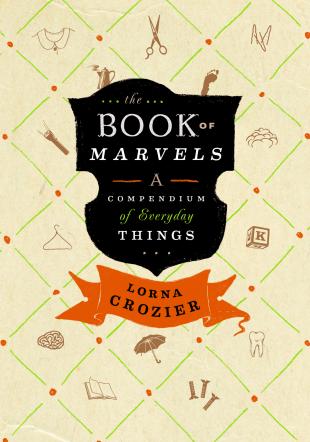 The most disappointing book I ever received was a book of household tips containing such wisdom as how to clean decanters and select bathroom soaps, and poet Lorna Crozier’s new book The Book of Marvels: A Compendium of Everday Things is that disappointing book’s most polar opposite. Fitting for a book that renders ordinary objects extraordinary, Crozier’s book itself is an extraordinary object, one of the few books I’ve ever encountered that dazzles you when its dust jacket falls off: the book is argyle. Its design is splendid, and the contents will not disappoint, guaranteed to appeal to anyone who loves words, and stories, and the thingy-ness of things.
Arranged in alphabetical order, The Book of Marvels is a dictionary of sorts, each definition illuminating the extraordinary lives of objects that we rarely look at twice. Sometimes Crozier will regard a familiar object from an unusual point of view (“Bed: Solid. Immovable. It does little more than take up space in the room it gives its name to, but at night the bed could be any kind of boat…”), use it to tell a story (“The shoe the old dog dropped on the step at dusk… It’s a man’s shoe, black, with a built up sole, as if the owner is a 1950s’ child of polio. Perhaps he’s not lame, just short, and the partner of this show is also heightened…”), invent mythologies (“The first rake was a hand. The older the better, rachitic fingers permanently bent, a scraping tool of bone and flesh…”),or uncover the hidden life within (“All doorknobs are twins, joined at the centre by a bolt narrow as a pencil, inflexible, unvertabraed. Though they move as one, they never get to see each other. They are like siblings separated at birth by a war, by a wall of stone and razor wire”).
I can tell you that I delighted in reading this book on the bus last week, in being the woman seen reading an argyle book called The Book of Marvels, in nearly falling down every time the bus lurched because I’d let go of the hanging strap in order to frantically underline all the best bits. Sometimes the underlines were because the idea was so right, so perfect: “Flashlight: It feels neglected. Too often it’s merely a case for carrying dead batteries.”Or: “The mop lacks the mystery of the broom. No one thinks of it steering through the stars.”
Or the writing: “Shovel:… You’d swear it is a noun but it’s a verb, in stasis, waiting in the shed for a shift of circumstance or season.” And there is this: “Snail: It sails without sails in the garden, so slow, if it were a ship, there’d be no wind.”
The one I went around reading to everybody on Friday was from Fork: “It’s the only kitchen noun, turned adjective, attached to lightning.”
And oh, how I loved: “Whatever it’s called, its country of origin, in a past life the umbrella must have harmed the wind–the wind, without doubt, plots its undoing.”
The Book of Marvels was the title of Marco Polo’s travel writings, and also those of traveller/adventurer Richard Halliburton, and is a title that would set up high expectations for any book, even without the allusions. Lorna Crozier not only meets these expectations, however, she exceeds them, in her excellent argyle book which affirms with delectable language that the world’s wonders are all around us.
August 14, 2012
The Blondes by Emily Schultz
 I appreciated Emily M. Keeler’s piece about pre-natal narratives and connections between Emily Schultz’s The Blondes and The Handmaid’s Tale, but it was actually Atwood’s The Robber Bride that The Blondes had me thinking of. Because while The Blondes certainly has a post-apocalyptic feel (as have so many other books this year, books as different as Gillian Flynn’s Gone Girl and Lauren Groff’s Arcadia), fundamentally, The Blondes is a novel about how women betray one another. From the first page: “For women, power comes by subtle degrees. I could write a thesis on such women–and I nearly did.”
The narrator is Hazel Hayes, and she is addressing her unborn child, mostly because she has no one else to talk to and nothing else to do. Also because she wants to put the pieces of her story back together, to understand the story for herself. She has been a graduate student in New York City, studying “aesthetology”, the study of looking. Her work has been unfocused, mainly because she’s just run away from an affair with her (married) professor in Toronto, Professor Karl Mann (born Karl Diclicker, and many of Schultz’ name-choices are so delightfully Dickensian– in New York, Hazel’s made her home at the Dunn Inn, Hazel’s own name with its ambiguous colouring and haziness, the woman who she appeals to for saving is called Grace). Things become even more complicated when Hazel discovers that she’s pregnant, and her attempts to get home to deal with the problem are stymied by the effects of a mysterious plague.
The plague is “Blonde Fury”, the media label applied with alacrity, as instances of fair-haired women acting out murderous fits of rage begin to take hold in New York and quickly spread through the world. And this premise was all I really knew about this novel before I read it, imagining the book as some kind of fashionable zombie romp, but I’d got it all wrong. First, because the plague itself is very much of this world, complete with scientific explanations involving melanin and double-X chromosomes. And second, because the plague itself functions just as effectively as metaphor as it does plot-driver, compelling the reader to rush through the pages (and I’ll put it to you like this: this was a 380 page novel that I read in a single weekend when I was out of town) and then to go back to the beginning and re-experience the story again in all its depth.
Just as in her studies (and in her life), Hazel imagines herself to be at a remove from womanhood, she situates herself on the periphery of the plague as well, consumed as she is by her personal problems. However, she is actually a witness to the first known attack, when a blond woman throws a teenage girl onto the subway tracks. When Hazel tries to back to Canada not long after, she’s injured when a pack of flight attendants go on a rampage at the airport. When she later tries to cross the border in a rental car, she’s detained and kept under quarantine, and though she seems to go unaffected by the virus, it’s unknown whether her own hair color actually makes her more susceptible–although Hazel has long dyed her hair an unremarkable brown, her natural colour is red. (“What was orange, but a variation on gold? Red-gold. A thing ablaze.”)
She also displays some of the symptoms of blonde fury herself– panic attacks, feelings of rage, depression. Which isn’t so surprising really, considering how general the symptoms are. “The threat becomes abstract, and the fear is almost as intense as the disease itself.” The public is urged to avoid contact with the apparently afflicted: “The thing about the disease is that it’s based on connection.” And so women turn on women in futile attempts to protect themselves.
But this is nothing new, of course, this idea that women are manipulated in order to undermine their power as a mass. Even before the plague, we see that Hazel’s study of female beauty is personal, that she admits to a fear of beautiful women, that she sees these women as “others”. In her affair with her Professor “Mann”, she has set herself in opposition to his wife. She smiles apologetically to men being harassed by women in the street. When she finds herself pregnant, she admits, “The academic feminist part of me felt defeated: devastated by biology, I had run out to get by hair done as a balm.”
Hazel’s few friendships and alliances with women are shattered as individuals try to navigate their respective ways to safety. When Hazel is put into quarantine, she leaves a friend at the border; she takes advantage of her oldest friend; she leaves vulnerable women stranded so as not to put herself in harm’s way. “Power comes in subtle degrees.” “If you come from very little, why give up privilege?” But Hazel ultimately finds herself entirely powerless to her biological destiny and to patriarchal tyranny when the plague and its circumstances make impossible her choice to terminate her unwanted pregnancy. Schultz shows how change creeps in little by little so that to a feminist academic, lack of access to abortion can become almost remarkable.
The Blondes is powerful and solid, gripping and scary. And if it had a soundtrack, I”ve no doubt that this song would be on it.
August 13, 2012
The Beautiful Mystery by Louise Penny
 Louise Penny’s latest Chief Inspector Gamache novel The Beautiful Mystery was a present I gave myself, the nicest way to come down after returning home from a perfect holiday. My second Louise Penny, after A Trick of the Light, but this time far removed from Quebec’s Eastern Townships. When a murder occurs at the remote Saint-Gilbert-Entre-les-Loups monastery, the cloistered monks are forced to break their vow of silence and open their doors to outsiders, because the murder has been committed by one of their own.
The entire novel takes place over just two days, during which Armand Gamache and Jean-Guy Beauvoir have been stolen away from their domestic arrangements in Montreal to take the case on. The separation is particularly significant for Jean-Guy who has just made solid his relationship with Gamache’s daughter Annie, though they’ve not yet told the world of their plans. Unable to access the internet or get a phone signal at the monastery, Annie and Jean-Guy send missives of love via Blackberry messenger.
It’s a challenge Penny has set for herself, to situate a detective story in such a closed community in such a short period of time. All suspects present and accounted for, all identically clad and, until recently, silent. The challenge is heightened for Gamache and Beauvoir as well–the monks know their own world better than anyone, rarely betray themselves with errant words, and are adept interpreters of the police officers’ own gestures and facial expressions, skills learned from years of silent community. They’re a tough lot to crack.
The Beautiful Mystery of which the book’s title speaks is the effect of the monks’ Gregorian chanting, recordings of which had made their way into the world and made the reclusive order world-famous. In different ways, Gamache and Beauvoir fall under the spell of the chanting as they conduct their investigation. The chants themselves also take on significance as it’s the choir director who has been murdered. Could the chants themselves be key to understanding what stirred one of the monks to murder? And what of the mysterious music notation the choir director had been clutching in his hands when he died?
The investigation is further complicated by the unexpected arrival of Gamache’s superior, who’s determined to cause trouble in Gamache’s relationship with Beauvoir. What are his motives? Will the still vulnerable Beauvoir remain loyal to his boss? Are Gamache’s own motivations as innocent as they seem? In the other-worldly Saint-Gilbert-Entre-les-Loups, it’s hard to tell who is friend or foe.
Penny’s distinctly stilted prose can be’ difficult to warm to, though it flows easily once the reader gets a sense of her rhythm. The novel is peppered with Gamache’s literary allusions and with pop culture references also, which add extra texture to her already substantial story. Its characteristically strong sense of place and connections to current events drive this point home even further, so that yes, as it begs to be said, Louise Penny has crafted another “beautiful mystery” of her own.
August 7, 2012
Above All Things by Tanis Rideout
 Ever since I started thinking about these things, the question has occurred to me: what is this literary reflex triggered by books so far away from here and now that convince us that said books are great? Even though some of our best writers write books with titles like Small Ceremonies and or depict parents picking nits from each others’ heads, why are Canadian readers (and awards juries) so swept away by sweeping, by largeness, by grandeur?
And it doesn’t come any bigger than the the Mount Everest in Tanis Rideout’s first novel Above All Things. The second-biggest topic she tackles is the British Empire and its crumbling. There is a mention of Toronto in the novel, guaranteed to get us all a little giddy, but then George Mallory really doesn’t think much of the place: “Cold. Even after Everest. And grey and dark. The cold there pinned up down.”
That Rideout’s book and its inevitable acclaim will serve as fodder for brand new versions of the “Is Canadian writing un-Canadian?” argument, however, should not undermine the fact that the novel is actually quite extraordinary, really wonderful. Smartly designed with an arts and crafts font, a cover image meant for mass-appeal, marketed as “The Paris Wife meets Into Thin Air“, but yet there is a singularity to this novel. As I read it, I kept thinking, “If every book was as good as this, maybe publishing wouldn’t be in trouble after all.” It’s an ambitious task she takes on, what with empires and mountains, but Tanis Rideout pulls it off, takes the summit. I’ve been disappointed by so many novels lately whose mechanics have been evident beneath their surfaces, whose writer’s stretching has been all too clear, but Above All Things is so perfectly formed, not only a novel to get lost in but one whose literary-ness will surely take you higher.
Above All Things comprises the parallel stories of Ruth Mallory, and her husband George, the latter the mountaineer whose infamous ill-fated Everest attempt makes the novel’s outcome clear from the start. There are several links to Virginia Woolf– the novel’s opening chapter is titled “The Voyage Out”; Woolf herself appears as a character in the book, a contemporary of the Mallorys, well-known thanks to George’s Bloomsbury connections; and Ruth’s own story is told in a Mrs. Dalloway fashion, the hours in the day of a woman with a party to plan, who will buy the flowers herself.
Though it’s not a party she wants to have, necessarily, but she’s having it anyway to put a brave face to the world, to attempt to distract herself from her husband’s absence. It’s his second Everest attempt, though he’d promised he wouldn’t try it again. There is also the time he spent on tour in America, and the years he spent away at war, and so Ruth is accustomed to his absence, but it doesn’t make it easier. It doesn’t make her less resentful either, or less angry, as she meditates on all he’s chosen over her again and again, what it is to come second to a mountain.
Meanwhile George’s own story is told in alternating chapters, taking place over months where Ruth’s is in a single day. His pace furious, the stakes high, and he’s able to avoid meditation for the most part. Rideout goes into considerable detail about the practicalities of an Everest climb in 1924, the minutiae necessary to complete the task, and we begin to see that the boundaries between domestic and wild, between men’s stories and women’s, are not as solid as they seem. George’s single-mindedness means another point of view is required to complete his sections, and Rideout uses that of Sandy Irvine, a young climber only too eager to follow in George Mallory’s footsteps.
Above All Things is a love story, and also a puzzle– is it Mallory’s love for Everest or the love of his marriage that the title refers to? What is a love story whose trajectory is two people moving further and further apart? Rideout writes of her inspiration from the real life letters that George and Ruth wrote to one another, and of how she used the letters as a jumping-off point to change these historical characters to fictional people. She subverts notions of marriage to show it as a many-textured thing, rife with compromise and betrayals upon which love itself doesn’t necessarily hinge. The story also has contemporary resonance in our time in which men are still being urged towards a “duty” that involves dying for their country, in which we’re still learning how to be in a world whose corners are nearly all explored.
So what does it mean then, that I’ve been swept away again? Impressed that this Canadian writer has imagined her way into these historical lives, imagined her way to the top of the world? I’m getting savvier though, and I can tell you this: sometimes the same old arguments have nothing to do with the matter, and I also know a really good book when I see it.






