June 18, 2014
All My Loving by Beth Kaplan
 Nine years ago today, I got married, and about ten years ago, when this date was selected, what first occurred to me was, “How cool! Paul McCartney’s birthday.” Because to me, June 18th has always been Paul McCartney’s birthday first, at least since I was a Beatles-obsessed 13 year old and organized a Paul McCartney Birthday Bash in my dorm room during our Grade 8 year-end trip to Ottawa. (It was not a wild bash. I recall jumping on a bed, and turning the volume all the way up on my Sony Sports Walkman so we could listen to The Beatles’ 1967-70 through the headphones.)
As I did to a lot of things, I came to The Beatles late, about 20-some years late. Being a Beatles-obsessed 13 year-old in 1992 was a curious thing. It involved feeling inordinate, impossible pain at John Lennon’s murder; trying to be a vegetarian because of Linda; scouring the TV guide every week in order to schedule tapings of Paul McCartney on Saturday Night Live or showings of John Lennon Imagine on Much Music. I even kept a scrapbook, comprising clippings of Paul McCartney’s son’s surfing mishap, various Beatles’ legal troubles, and a cut-out of the “Be My Yoko Ono” lyrics from my Barenaked Ladies’ “Gordon” cassette tape liner notes. I made Beatles posters in my Grade 8 art class–they weren’t very good. I bought Beatles’ biographies written by Geoffrey Giuliano and Hunter Davies. I built a Beatles shrine in my Design and Technology class, specially designed to store my cassette tapes and biographies. I was forbidden to talk about them at the dinner table. I listened to their music over and over (and learned to play their songs on the guitar). I remember listening to Hey Jude for the first time when I was about 11 years old, sitting in my backyard with a red battery-powered cassette player, and it was as though I’d discovered for the meaning of life. The meaning of my life. For a few years, it really was.
So I was eager to read Beth Kaplan’s memoir, All My Loving: Coming of Age With Paul McCartney in Paris. Kaplan was fortunate enough to fall in love with the Beatles at just the right time, on the cusp of her own adolescence and the Beatles’ fame. The memoir is based on her own diaries, scrapbooks and short stories (in which she fantasized about being Paul McCartney’s wife and/or [gasp!] his lover). In a fun and breezy fashion, she puts her reader in the mindset of a 13 year old girl who is as confused by the world as she is by her terrifying range of emotions, and who is also in thrall with The Beatles. Like many of her peers, her identity as a “Beatlemaniac” was one of her first acts of self-definition, a small rebellion against her conservative parents. Though they’re not so conservative–the book begins with young Beth ecstatic at the news that her parents are attending a Ban the Bomb demonstration, and therefore she is free to turn the radio dial and hear “She Loves You” for the very first time, and I love the way she describes her visceral reaction to the music, the way she’s transformed by it and so is the world around her.
 Kaplan outlines a complicated relationship with her parents, even more complicated than the average teenage love/hate, and while she alludes to her own parents’ experience (her father experiencing anti-semitism as a professor at Dalhousie University; or the time her mother reported of The Feminine Mystique, “I took one look at Betty Friedan and put the book down”) and she is indeed chronicling a cultural phenomenon, there is a lot in the book that is particular also. But the particularity is not always explained, instead the reader receiving the unfiltered thoughts of a solipsistic teen girl and all the contradictions that entails. (One of the many times I laughed out loud was when her list of “hates” included The Dave Clark Five and “intolerance.”) This approach makes sense in the grand scheme of the project, but it also leaves the reader with a lot of questions.
But then, the Beatles are the focus, as they were for 13 year old Beth, her parents’ own dramas firmly in the background. Or perhaps the Beatles were her escape? And Paul McCartney in particular, her chosen Beatle, the proxy by which she explores notions of love and lust and sex and longing. During the time she recounts in the memoir, she moves with her family to Paris for her father’s sabbatical year, and the Beatles are a consolation of her loneliness during this time, and also a bridge between her and her French classmates.
I was especially amused by her friend in France who had learned to speak English through Beatles lyrics, and so only spoke as such, expressing her gratitude with, “Thank you girl” and other such phrases. And it made me think about how those of us who learned about life through the Beatles are similarly equipped, not so literally, but still, to us, the world is all Strawberry Fields, A Day in the Life, Help and Penny Lane, etc. I knew these songs before I knew the world, is what I mean, and in a way, these songs are still my foundation, fundamental to my vocabulary. (Longing for love meant longing for someone to get high when they see me go by. My oh my). It is probable that Beatles songs have affected the shape of my brain.
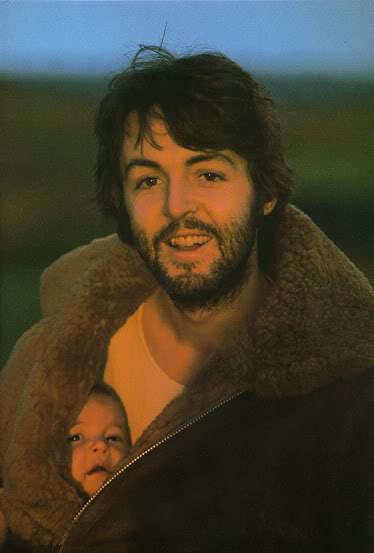 I went to see Paul McCartney at Exhibition Stadium on June 6 1992 on his Live in the New World Tour. It still stands out as one of the most extraordinary days of my life, and I will never forget the excitement, but also the sadness at my realization that I was just one tiny person is a sea of people that night, that he couldn’t see me at all. That indeed, he’d been the subject of “All My Loving” (for I too was a Paul girl, even though he was not far away from being 64 at the time) but to him, I didn’t even exist. That all my loving was only a drop in the ocean… and it was heartbreaking. Such is the pain of being a 13 year old girl.
And even though she did it at the right time, a few decades before me, Beth Kaplan’s memoir brought the whole thing back. The roller coaster ride, the battles, and the unbelievable excitement of being on the edge of something huge–such confidence too that in just another year or two, surely we’re going to have the whole world figured out.
June 12, 2014
Viviane by Julia Deck and Linda Coverdale, trans
 Viviane by Julia Deck, translated by Linda Coverdale, is a spectacularly deceptive novel in a variety of ways. A small book, at just 149 pages, I figured it would be a quick read, but it wasn’t because I read it twice, and then skimmed it again. Deceptive too because I thought I knew what I was getting into, but I didn’t. I’d recently read The Dinner by Herman Koch, and Viviane was comparable—a narrative voice whose grasp of reality is hard to gauge, is she the problem or is it the world? But while Koch’s unhinged narrative comes at his story with a terrifyingly cold sense of control, Deck’s Viviane has lost control and scarcely even realizes.
She knows something is amiss though–“You are not entirely sure, but it seems to you that four or five hours ago, you did something that you shouldn’t have.” (The narrative moves between first, second and third person, employing also the informal second-person that would be clear in the novel’s original French, and the first person collective–this movement signifies Viviane’s tenuous hold on her own self and her story.) She seems to think that she’s just killed her therapist, cold blooded murder, but then she’s torn between hiding her crime and going back to the scene to find out exactly what had happened. Throughout all this, she’s caring for her 12 week old infant daughter on her own, having just left her husband and a disastrous marriage. She’s been on maternity leave from her job as a communications executive at a cement company, and she’s terrified that she’s being edged out of her job just as she was forced from the marriage.
It’s a disorienting novel. Viviane dashes around Paris, stashing her infant wherever she can manage. She tracks the other figures in the murdered therapist’s life, scours the papers for details, haunts her ex-husband and maintains a complicated relationship with her mother who may or may not be dead. It is never clear whether her reports are accurate–she starts one day twice, seemingly with no memory of the other. Her grasp of time and place is clinging and desperate. The baby herself is not a convincing presence, though nor is she for Viviane herself, or any mother of a newborn:
“There’s this child in our hands and we wonder how it happened. The babysitter handed her over without a fuss, pretending to believe she was our legitimate property. We sneak off with her… Once safely in the sixth-floor apartment, we settle into the rocking chair and observe the child for a very long time, waiting for a response, a revelation.”
Viviane is deceptive also because it’s rife with mysteries that are never solved. What went wrong in the marriage? Is she experiencing postpartum psychosis? Is the child in danger? How much can we believe of what she tells us, particularly since she doesn’t really believe any of it herself. And yet even without answers, Deck weaves an intriguing web of possibilities.
Viviane made a huge impact on the French literary scene when it was published in 2012, winning the French Voices Award, and Nominated for the Prix Femina, the Prix France Inter, and the Prix du Premier Roman for a first novel.
June 8, 2014
They Left Us Everything by Plum Johnson
 When Plum Johnson’s mother died, as eldest daughter, she was charged with the task of packing up the contents of the family home. This would be no easy task for anyone, but particularly not for Johnson whose parents’ lakefront house on Oakville Ontario was both enormous and stuffed with the materials of decades and decades of family life (including ancient receipts, her father’s impeccable financial records, antique cans of soup, books and more books, and a wasp’s nest). Johnson left her own home in Toronto and moved into her parents’ house, figuring the task before her would take six weeks or so, but she ended up staying for over a year, an experience she recounts in her memoir, They Left Us Everything.
In some ways, Johnson’s is the kind of story that many readers will relate to–a tale of years of demanding elder care, about the peculiar grief of losing one’s parents and the complicated and surprising emotions which accompany this, about coming to terms with who our parents were and the people we wished them to be. But in others, her family’s story is more, well, storied (so much so that her mother has an entire shelf in their home related to books published by or about members of their family). Her family’s interesting background remains peripheral in this memoir, but informs the fascinating lives of the characters who populate it. We learn about her mother’s privileged upbringing in the American South, her father’s war exploits, the early years of her parents’ marriage in Asia, and their eventual settlement in Canada (which was a compromise between their respective heritages). Not everyone has a huge house on the shores of Lake Ontario to come home to for years and years, and there is a hint of exotic to Johnson’s family’s everyday life that makes for a compelling read. Also compelling is the terrific bond between Johnson and her siblings.
Johnson does a specular job of weaving the personal with the universal here, of making her parents so present in a story about their loss, of untangling the difficult legacy of inheritance—all this stuff, but then it’s everything that’s left of her parents in the world. And so Johnson delves into it all and discovers that she never really knew her parents after all. Her approach is similar to two other books that I enjoyed so much—Baking as Biography by Diane Tye and Outside the Box by Maria Meindl, in which women’s lives are discovered through unlikely archives.
In the end, They Left Us Everything is a literary mishmash just as much as the cupboards in Johnson’s parents house were repositories for every kind of thing. It’s a tale of grief, but also a record of fantastic stories, memorable characters, of family life in the mid-20th century, a scrapbook of fascinating objects, a portrait of family ties, and what it means to be a daughter and a mother. It’s an artfully crafted memoir, and a really wonderful read.
June 2, 2014
An Untamed State by Roxane Gay
 For about two-thirds of An Untamed State by Roxane Gay, I wasn’t sure what to think. The book begins with the most majestically-crafted sentence (“Once upon a time, in a far-off land, I was kidnapped by a gang of fearless yet terrified young men with so much impossible hope beating inside their bodies it burned their very skin and strengthened their will right through their bones.”) but then that huge and generous perspective disappears and we’re left with a narrative that moves narrowly between the Before-and-After lives of Mireille Duval Jameson.
Before, ensconced in a fairy tale, confident of her wit and wiles, American born and raised but returned to Haiti, the land of her parents’ birth, her family’s opulent lifestyle conspicuous against the nation’s wider poverty, but this was the only life she knew. And then After, ripped away from her husband and child to be held captive for 14 days and subjected to rape and sadistic violence. From a bubble to a prison then, and while the novel was compelling, there was a flatness to the narrative, its dialogue, and I wanted more in exchange for the violence to which this book’s reader must bear witness—though I will note that the violence is described sparingly, more gestured toward than elaborated upon. Disturbing, yes, but not gratuitous. But still.
And then Mireille is freed (which is not a spoiler) and suddenly, the whole project comes together in the most mesmerizing way and the book became difficult to stop reading. In An Untamed State, the plot is not the point, but rather the point is psychology. First, the psychology of one who is suffering from post-traumatic stress and trauma, as well as the brutal revelation that there is so such thing as safety in the world, not truly. She leaves captivity disconnected from herself—she had to make herself into nothing in order to survive what was inflicted upon her, so how can she get back to the woman was, a wife and mother? Gay’s narrative enacts the processes that Karyn L. Freedman (necessarily, this being non-fiction) more cooly explains in her stunning memoir, One Hour in Paris: A True Story of Rape and Recovery. Both books show that trauma is not something one can move on from, but rather that it must be managed and treated on an ongoing basis, like a chronic condition. Which is both heartbreaking, that one never gets over this, but also hopeful—that there is a process at all, and life in the aftermath.
What is most compelling about An Untamed State are the family dynamics that run like fault lines through the entire text. When Mireille is kidnapped, her father refuses to negotiate with them, sacrificing his daughter with his unwillingness to abandon his principles. When she is freed, Mireille has to account for her father’s role in what happened to her, and Gay does a terrific job in making her father a fully-developed, complicated character whose actions are (almost?) understandable, instead of the far more convenient tyrant he could have been. Similarly, her mother’s compliance with her father’s point of view is troubling for her, and even the dynamic she has created with her own husband—she’s hardheaded and hotheaded, prone to running away in hopes of being found, and this time when her husband is unable to find her, the balance between them is upset, perhaps forever. It is remarkable how consistent the characters’ behaviour and actions are throughout the entire novel, and how these actions resonate so very differently in the context of Before and After.
Gay’s allusions to myth and fairy tale add marvellous texture to the novel, and perhaps go some way toward explaining the flatness I was initially confronted with as I read it. There is a deceptive simplicity to the novel that belies its remarkable originality, as does the fact that it’s a really good read. It’s that rare thing—a page-turner whose pages you’ll still be turning in your head long after the book is done.
May 23, 2014
Pluck by Laisha Rosnau, and a giveaway!
 Having finally learned to read poetry has been the greatest revelation. And so I’ve been reading Laisha Rosnau’s Pluck for the last six weeks or so, living with the book, dipping in and out of it, carrying it in my bag. One day after reading it in the sandbox at the park (as you do), I opened it again while in bed and sand poured out of the pages, all over my duvet, which was definitely inconvenient but perfectly fitting too. Because Pluck is gritty, about nature and domesticity, about the spaces where they overlap, sometimes comfortably and sometimes otherwise. It’s about the spaces where our selves overlap too, the people we are and who we used to be, and who we hope to be, and what we might become.
The first poem I read aloud at the table was “Accumulation,” a poem that plays with language to illustrate the way that stuff builds up around us, particularly when you add children to the mix: laundry and plastic. And the heartbreaking, wonderful, so perfect ending, “Please me, you please, what pleases us, pleases them, again and again–yet/ how can we please each other, do each other justice, just us/ we and us and you and me and all we’ve collected, accumulated/ amassed, a mess, amen–”
These are poems about the chaos of family life, about what we have to prove to ourselves and each other. And this chaos is juxtaposed against a more natural order, a world outside where birds fly into windows and injured fawns show up on the lawn (and even inside the house, above the marriage bed, paintings of great horned owls hang on the wall). There are secrets and compromises in these tidy lives we have made, most strongly expressed in “The Music Class”, formally a variation on the villanelle (I think, though this variation may be its own form) in which a woman takes her child to a music class to discover the child and wife of a man who’d raped her years before: “Out children go to music class/ at the same school I went to as a girl./ We make up a life… then, he kept the radio on and I caught notes/ in my throat when he forced himself in my mouth./ We make up a life,/ Sometimes on instinct. I kicked open the door/ instead of biting down though, if I had, perhaps/ our children wouldn’t go to music class…”
The poems in Pluck are about the desire to create–our own lives, new lives, poetry–and about the way these desires are complementary and otherwise. I loved “Late” about a woman perusing obituaries critically (and I’ve been there–so fascinating): “The women, their lives canned and quilted, baked/ into the memories of their children, and I wonder;/ Really? Is that all that those left behind chose to record?/ I love a canned peach but, good Lord, if anyone mentions/ mine when I am dead, my time was not well spent.”
Pluck is a curious, surprising and absorbing collection, rife with familiar points and then shifts to keep one from getting too comfortable within. It’s a book that interrogates language just as it asks questions of the world, nudges into dark and dusty corners, and illuminates the complicated many-sidedness of love and life.
I was looking forward to this book, and it definitely lived up to my expectations. And so it is to my great joy that I can share the goodness. The publisher was kind enough to send me a review copy of Pluck, but I’d already bought a copy in the store (of course!) so I have an extra copy to giveaway. If you’d like a chance to win it, leave a comment below and I’ll make the draw on June 1st.
May 21, 2014
A Siege of Bitterns by Steve Burrows
 From the start, I liked the premise: a birder murder. Though I am not a birder myself, I am fascinated with the species (the hobbyists, I mean), and take a great deal of comfort from the fact that they exist in the world. I also like a murder mystery, particularly those set in the English countryside, so when I stumbled across Steve Burrows’ book launch for A Siege of Bitterns at Blue Heron Books in Uxbridge not long ago, I was more than happy to buy the book. But would the book itself live up to the promise? Well, after a delicious weekend devouring it, I am happy to tell you: yes.
For some reason, television comparisons spring to mind. My beloved Midsomer Murders for one, with its semi-satirical and slightly absurd look at English society, and then also Broadchurch, in which the damaged, alluring, flawed detective genius rolls into town with a whole lot of baggage, and a high profile case is not the introduction to the job that he had in mind. The genius here is Domenic Jejeune, Canadian ex-pat and apparently a media darling, though we’re told very little about either why he’s admired or the past that he is fleeing from. He’s just as much an enigma to his readers as he is to his new colleagues in the Norfolk town of Saltmarsh.
From the television references, however, one is not to think that part of A Siege of Bitterns’ appeal is not its language. It’s a book that will appeal to those of us who covet collective nouns, and apparently it’s meant to be the start of a whole series (A Murder of Crows, A Charm of Goldfinches, etc). One of the book’s greatest charms is Domenic Jejeaune’s girlfriend, Lindy, a journalist, for whom grammar and editorial style is a preoccupation, which proves convenient to Jejeune as these semantical details turn out to be upon which the whole case rests. Birds and words: this is such a book for nerds! And I absolutely loved it.
The case is the murder of celebrity ecologist Cameron Brae, and the suspects begin lining up not long after his body is discovered hanging from a willow bough. Is it his unlikely second wife, a former Spice Girl-esque rockstar with a penchant for Motown music and a yearning to be her husband’s intellectual equal? Or was it Brae’s son whose cravings for his father’s attention lead to involvement with a radical environmental group? Is this about wind turbines, the fragile climate of the salt marshes, landowners with no regard for conservation, or does it all come down to a fierce rivalry among birders to get to 400 species sightings, which Brae was unbelievably close to? What of the note Jejeune finds scrawled in Brae’s study referencing the American Bittern? Could a man be murdered because of a bird?
Burrows’ background includes extensive birdwatching experience around the world, and editorships at the Hong Kong Bird Watching Society Magazine and Asian Geographic, which I assume have led to the deftness with which he writes about ecology and ornithology, applying these ideas to the mystery genre in a way that doesn’t feel like a stretch. I was a bit concerned in the book’s opening when Jejeune’s own background as a birder gives him special insight into a suspect’s false alibi–it was a bit to convenient. But after that, the birding didn’t seem conspicuous in the novel, and it was the mystery itself that had me so absorbed, as well as the complex and interesting characters that Burrows has created–Jejeune and Lindy, and Jejeune’s Sergeant Maik.
It’s obvious we’re being set up for a series here–Burrows has deliberately left so many ends wide open, and I can’t wait to find out where they lead. A Siege of Bitterns signals an original, well-crafted, clever and exciting new series on the scene, and it’s a really terrific read.
May 19, 2014
This One Summer by Mariko Tamaki and Jillian Tamaki
 It’s a toss-up, the question of my favourite line from This One Summer by Mariko Tamaki and Jillian Tamaki. It’s either, “That’s the problem with being adopted. I have no idea how big my boobs are going to be.” or, “You can’t get herpes from a flip-flop.” And it’s remarkable that the lines stand out in a graphic novel, a books whose visuals are so overwhelming. A book whose graphics’ simple blue only emphasizes the detail of the drawings, the clutter in the corners. There are some graphic novels you are breeze through in one sitting, but this isn’t one of them. The illustrations are a marvellous mix of old-school comic style, complete with text to imply sound and movement, and images inspired by scientific drawings of birds, plants and stars. And then full-page spreads with surprising perspectives and you could read this book over and over and discover something new each time.
Summer is fitting for comics, the season allowing plenty of time for pleasure reading, summer cottages perhaps having stacks of old comics on hand. And also for the way that summer is so fleeting–just a few panels in the book of a year. So much of life goes on outside it, and yet these summer memories, these ephemeral experiences of jumping off docks and sitting in sand, are what our minds return to over and over again. Summer brings us to the same old places but we’re a different person each time that we come, as Rose is beginning to discover in the Tamaki cousins’ tale.
And they get the details just right–cottage-country traffic, the winding roads and the posts mounted with family names pointing in their cottages’ directions. When Rose’s family arrives, she goes to find her friend Windy, her cottage friend since age 5. They visit the general store to buy candy, ride their bikes, lounge on the beach, wonder about the local kids and their teenage dramas, contemplate the summer romances they’re still too young for, get bored, get into trouble, wait out the rain.
Outside this chronology of hours, how summer days can stretch so long, there is much more happening, so much that cannot be articulated, which is why this story is such a great fit for a graphic novel. Rose’s parents’ relationship has fractured, her mother seems to be suffering from depression, their family going through their familiar routines but not meaning much of it. The reader also infers that in subsequent summers the differences in Rose and Windy’s ages will start to matter more, that the friends will grow apart, which will be heartbreaking and complicated. But that is a summer still to come.
In the meantime, the girls are on a threshold, having not put away childish things, but beginning to glimpse an adult world before them whose puzzles they just can’t decipher. They still think the puzzles are decipherable, however, so they’re still young yet, looking on in fascination and fear at the possibilities before them, feelings best expressed in an awe-filled silence. And to fill that silence in the meantime, they talk, Mariko Tamaki’s dialogue ringing true. Riding bikes, slouched on porches and bobbing in inner-tubes, doing and talking about everything, and nothing at all.
May 11, 2014
Pat Barker’s Union Street and Just Pretending by Lisa Bird-Wilson
 Books are another thing that happen when you’re making other plans. My friend, Maria Meindl, recently recommended I read Union Street, Pat Barker’s first novel. On Maria’s blog, she writes, “When I read The M Word, I thought of the at-times agonizing intimacy of Barker’s book. She portrays the women in a working class neighbourhood in northern England. At first read, I pegged it as taking place just after World War Two, a grittier version of Call the Midwife; then it became disturbingly clear that this was the 1970s. The women’s choices are severely limited, and not surprisingly, the key moments, the defining dramas of their lives are played out on the stage of motherhood.”
So I tracked down a copy, even though it was the worst edition ever, and read it last week while were in Winnipeg. And I’m so grateful to Maria for recommending this book, which is a collection of linked short stories whose different characters (ranging from an 11 year old girl to a Hagar Shipley-ish character not far from death) mark the progression of a woman’s life. The book is gritty, effortlessly daring, disturbing, and ever-surprising. Barker’s women feature levels of complexity not often seen in fiction, and while “the key moments [of] the defining dramas of their lives” are events that we have encountered before, we’ve never encountered them from Barker’s particular angle in which these characters with so little agency are allotted a complicated breadth. These women are not just victims, but they are whole, complicated, flawed and brilliant beings. Their lives are depicted in agonizing detail, what it is to inhabit these bodies which birth, miscarry, are beaten, stand for hours on a factory line (and its a cake factory–the most magnificent detail), which are raped, fucked, rarely loved (but sometimes), tired and weary. But not just bodies–these are people. It’s a truly extraordinary book.
 The book I turned to next, presuming no connection, was Just Pretending, a short story by Lisa Bird-Wilson, who is a Metis writer from Saskatchewan whose stories have been widely published in prominent Canadian literary journals. Just Pretending had been on my radar for a while, but I took special notice when it recently took multiple prizes at the Saskatchewan Book Awards, including University of Regina Book of the Year. And it soon became clear to me as I started to read that Barker and Bird-Wilson’s books are similar projects, portraying the wholeness of marginalized women’s experiences, experiences which hinge on maternity, on motherhood and daughterhood, and on what happens when these connections are broken.
Many of these stories centre on characters who have been divorced from their heritage. In the first story, “blood memory”, a woman about to give birth to her first child imagines what her birth mother must have experienced at her own birth, and anticipates the awesome, surreal experience of meeting a blood relation for the first time in her life. In “the nirvana principle”, a young girl whose trauma from abandonment is compounded after a difficult experience attempts to outsmart-aleck her psychiatrist. A father in “deedee” visits a bar in a strip-mall, anticipating a reunion with the daughter he hasn’t seen for years, but she never shows and he gets lost to his old demons. In “Julia and Joe”, a young woman is about to give birth to her first child and and navigating complicated terrain as she lives with the father of the boyfriend who has taken off and left her. A woman’s dream of a happy blended family in “oldest sons” is tainted by the disappearance of her stepson. In “Just Pretending”, a teenage girl who is adopted contemplates her “real family”, which hangs her entire present situation in a state of “pretend”, enabling her to take risks with a charismatic older boy which leads to tragic consequences.
In so many of these stories, pregnancies are miscarried, babies stillborn, symbolizing the perpetuation of the disconnection between the future and the past, and also characters’ lack of agency in their own circumstances. Not to mention reflecting reality. Characters also struggle with addiction–a particularly strong story is “drinking wine spo dee o dee”, in which a down-and-out character drinks in a bus station parking lot in Winnipeg. His girlfriend has taken off to Toronto to find the child she gave up for adoption years ago, and he tells his story as testament to her: “Sadie liked me telling stories. ‘It’s how we know who we are,’ she was always saying,” but he points out that his stories were different from hers, which were “ancestors and shit like that. Mine are just life stories. Jokes and life stories.” Just as powerful though.
This story is followed by “hungry”, about a young girl whose abused and deprived experiences in the care of her mother lead to uprootings and trouble in foster care. Desperate for love, for something to call her own, she puts up with the attention of male classmates who end up raping her, and she becomes pregnant. It’s a harrowing but illuminating story, how one thing leads to another, how there is a light inside Bird-Wilson’s Lucy Wingfeather that no amount of trauma can extinguish. It is a story of perpetuating cycles, and then there is a powerful conclusion of connection finally, in which the mother/daughter connection is finally completed, which parallels a similar conclusion in Pat Barker’s story of a woman whose painful existence as an abused wife leaves her despairing at having brought a daughter (another woman) into the world to continue the struggle, and then finally, she recognizes her daughter and there is some kind of catharsis (we hope).
And we do hope. We cling to the moments of light in these stories, the powerful longing and love to cancel out all that gets lost. There is also humour here, both situational and also in the voices which Bird-Wilson evokes to bring her characters to life. There is a real mix of stories in the collection, and my only criticism of the book is that I’d have preferred more careful creation, perhaps fewer stories with the connections between them made implicit. While Bird-Wilson’s considerable talent is clear here, it would have been better highlighted with more selectivity, a nod to the book itself in addition to its stories.
But the stories are strong. It’s true that our stories are how we know who we are, but they’re also how others can know us, how the experiences of other people can be known. So I am glad that Lisa Bird-Wilson and Just Pretending are receiving such deserved attention. These are life stories, and there is is nothing “just” about it. Pun intended.
May 4, 2014
One Hour in Paris by Karyn L. Freedman
 If there is any justice, Karyn L Freedman’s memoir, One Hour in Paris: A True Story of Rape and Recovery, will be widely celebrated one of the best Canadian nonfiction titles of 2014. In the book’s first chapter, Freedman, a philosopher and professor at the University of Guelph, tells the story of her own experience with rape at knifepoint in Paris while backpacking through Europe during the summer after her first year in university in 1990. In the rest of the book, she goes on to illustrate her own trauma in the aftermath, her futile attempts to move on from the experiences she suffers from PTSD, how through work with a therapist she learns to finally process what happened to her years after the fact, and eventually applies a philosophical framework to her understanding of her rape and being a rape survivor and to sexual violence against women in a wider and global context.
Freedman is an skilled writer, her prose measured and precise, she is a composer of beautiful sentences, and her mastery of the narrative—which weaves the personal, sociological and philosophical—is impressive. Though I can sense resistance from those readers for whom the book is not directly intended (“I wrote this book for you”, Freedman writes in her prologue to fellow rape-survivors.) So why else might you want to read this book?
To this point, I return to the book that has become my own personal touchstone in terms of memoir, Wave by Sonali Deraniyagala. As I wrote of that book: “To be stirred then, to have our quiet disturbed. Perhaps this is why we should read this, or any book.” Like Wave, One Hour in Paris is a harrowing memoir, difficult to read but even harder to put down. The violence and rape are actually easier to read about than Freedman’s emotional fragility in the years that follow. She recounts what happened to her in a manner that is direct and factual; her intention is not that we relive her experiences—I don’t think she’d wish this on anybody. But more important to Freedman is that her readers understand what it is to live with these experiences, and also to understand the fascinating workings of our brains, how they process or fail to process traumatic events in our lives.
I started reading the book late in the evening and knew this wouldn’t be a casual reading experience. One can’t stop reading in the middle of the first chapter—there is a need to see the story through to the end, just so we know that it ends. The end of the chapter was devastating, but not entirely, mostly because Freedman’s narrative voice is so authoritative and compelling that I wanted to stick with her. And so I did, glad this dark book about the City of Light was so compact because I carried it in my purse the next day, holding it on one hand while used my other to push my baby in the swing.
And it was there in the playground where I read Freedman’s convincing arguments for speaking out about her rape. Her parents, who emerge along with Freedman herself (and her therapist) as this story’s heroes, wanted to shield her from any more pain or trauma after she came home from Paris. They made up a story about her unexpected homecoming, and were complicit in her attempts to leave the incident in her past, but Freedman comes to see that this decision was not only a misstep in her own recovery, but also how it perpetuates myths about sexual violence. The world, she tells us with two decades of perspective in addition to her own violent rape, is a dangerous place for women, as statistics demonstrate in places as close as our own neighbourhoods and as far away as the war-wracked Congo. But nobody talks about these experiences, suggesting that such incidents are rare, suggesting to those lucky enough to not know better that sexual violence is a crime of circumstance, that it’s something most of us should be able to sidestep. It’s why newspaper columnists suggest that if a young woman refrains from drinking to excess, she might not get raped, and if she is raped, she should have known better. Thereby perpetuating victim’s sense of her own complicity in the crime against her, ensuring her silence, and so the cycle continues.
What was most remarkable about One Hour in Paris was not just the good writing, or how Freedman offers access to her own experience (though this is something), but how much I learned, about sexual violence and the history of trauma and mental disorders, and the nature of these as well. Freedman comes to see her trauma as a chronic illness, the violent experience having changed the physiology of her brain, and so she much learn to manage her symptoms rather than hope to get beyond them. Even so, her own recovery would offer hope to other survivors that there is life beyond the trauma, that they certainly aren’t alone in what happened to them.
While I do think that while there may not be justice, Freedman’s book does have a chance of doing well with Canadian nonfiction prizes because of the way in which she takes her narrative beyond the personal to discuss sexual violence in general, and also internationally in the context of war crimes. And while I dislike this—the idea that a personal narrative is unworthy of note and one can’t write serious nonfiction without war being part of the mix—I appreciate that Freedman has broadened her approach not just to set up her story of one of grave importance, but because she can’t not do it. Her book avoids the inflammatory phrase “rape culture”, but is a document of its very point. She can’t help but tell her story in a broad context because sexual violence is everywhere, insidious and pervasive all around the world, and until the problem is stated plain, stared in the face as Freedman does, things are never going to be any different.
May 1, 2014
Hideout Hotel by Janine Alyson Young
 There is a lot to appreciate about Hideout Hotel, the debut short story collection by Janine Alyson Young. The first story, “Bushfire”, is full of violence, drink, and danger, and begins with its main character throwing up out a window. The book’s cover is appropriate–these are domestic tales, but the couch is hideous, threadbare, and sitting on the porch. There’s nothing cozy about these homes, which in the case of “Bushfire” is a trailer in an isolated Australian mining community. It’s where Gina lives with her pregnant sister, their parents finally leaving town, a town with nothing much except the hotel to drink, where Gina drowns her sorrows and is taken to bed by one man after another. She doesn’t imagine she’s happy, but supposes she could be, and looks forward to creating a cozy home with her sister, raising the baby together. But the eponymous fire in the distance suggests that Gina’s dream won’t come true, plus we begin to see that Gina’s handle on her fate is even more tenuous that she knows. This was a strong story, a story that surprised me, whose violence was not gratuitous, and is indicative of Young’s talent.
The story sets a tone which is echoed in the others. These are stories of young women who are trapped on the edge of nowhere, without agency or ambition. In “Greyhound Special”, a lead singer ditches her band and flees to Whitehorse where she pitches a crappy tent and looks to the universe of a sign of what next. In “Once It Breaks”, a young mother considers her loveless marriage. And then “Sung Spit Part One” and “Sung Spit Part Two”, which constitute half the book and together are two fragments of a novella, in which a young woman watches her teenage cousin carouse toward self-destruction, mesmerized by the girl’s charisma, her untouchability, how she refuses to be held. Meanwhile, the girl herself is pregnant, not going anyway, unsure of how to properly rebel against her hippie mother. We meet her a few years later in part two, a little older but still not over her cousin and the events that transpired the summer her cousin went away.
Of her older boyfriend, she explains, “I annoy him, I think, because I’m young and wasting my youth. I’m not excelling in anything, but more than that, I’m not fucking up either. I never get atrociously drunk or high, but I also haven’t applied for law school. It seems there’s no middle ground with youth. You’re supposed to be making the most of it by either getting somewhere or else destroying yourself one hilarious night at a time and I can’t seem to do either with much gusto.”
My problem though is that she doesn’t do much of anything at all, and neither do any of the women at the centre of these stories. The settings are interesting, the situations are interesting, and some really wonderful dynamics transpire–the relationship between the cousins in Sung Spit, or how when the girl visits her mother and sees her mother’s effort in relating to her, the idea of this is terrifying—but I wanted these girls to stop drifting. I was more interested in secondary characters, the mothers and mother-figures who seemed more fully formed by their experiences, but whose perspectives never come into play. Maybe the point is that I am old…
Hideout Hotel is a book with promise, and it holds the seeds of a great book to come.






