April 27, 2015
Welcome to the Circus, by Rhonda Douglas
 Rhonda Douglas doesn’t miss a beat in her fiction debut, the short story collection, Welcome to the Circus. It’s a collection to be admired right down to its basic components—the sentences. “…our three hearts open and close like the mouths of tiny birds,” in “Nous and René Lévesque.” Later in the same story, “The future seems to yawn open, becomes something far less certain, all of plans swinging on their hinges.” In “Humanitarian Relief,” “Henry Jeans amasses flesh about his bones with the single-minded focus of a NASCAR driver eating up track.” Ten stories, each one based around a tantalizing premise: a fresh take on Two Solitudes and adolescence, inspired by a high school core-French teacher in rural Newfoundland; a story of three veteran humanitarian aid workers in a Kenyan refugee camp; a series of letters to one’s eighth grade self; a collection of documents based on the case of executed dancer and spy, Mata Hari, curated by a man whose father may have been among her paramours; “Still Life With Book” about a teenage boy who partakes to carve the works of John Donne into his flesh, inspiring his therapist to reinvigorate his sex life. In “Sounds of our Paleolithic Past,” a curator at the Royal Tyrrell Museum in Alberta mixes business with pleasure as she develops a complex relationship with a Neandertal discovered in the badlands; in the next story, a daughter considers her legacy working in the family porn business as she faces threats of violence and estrangement from her sister; in “Welcome to the Circus, Sooky Baby,” a grieving teenage girl finds solace in surprising places—including the company of an elephant; and finally, “Cancer Oratorio,” structured as a series of choral/orchestral movements from the collective perspective of a choir facing the loss of a member from cancer. But not before “God Explains the Collapse of the Cod Fishery,” which I’d previously loved in The New Quarterly, a sad and beautiful story of wonder and violence which does exactly what the title says, and contains this stunning passage:
“Sunrise is a ritual for beginnings, for re-creating, for starting over, for once more and this time with emphasis people! We all need renewal, or at least I do, and so I’ve worked a few details in here and there: bean sprouts, infants for all species, sincere apologies, and so on. Sure, there are design flaws, but sunrise isn’t one of them.”
If these stories weren’t so wondrously crafted, we’d probably say they were “quirky”, but as it is, they impress the reader with being so convincingly real, of this world, even when their premises are far outside of it. And it is this solidity too that holds together a collection of such different styles of stories, so that even if the reader never knows what she’ll encounter around the next page, she knows it’s going to be excellent. These are bright and shiny stories with an edge, like a knife-blade, in the manner of Zsuzsi Gartner, whom many of them put me in mind of—which is high praise. This is a fabulous, enthralling, exuberant book, and I think you should read it.
April 8, 2015
Born to Walk by Dan Rubinstein
 I thought I’d already read the book on walking. Rebecca Solnit’s Wanderlust: A History of Walking is one of the most fascinating books I’ve ever read, a book that opened my eyes to the wonders of rambling and tramping, and to how amazing is the ordinary world around us all the time. How extraordinary is the act of a single step, let alone one after another.
However extraordinary though, we are talking about walking. After Wanderlust, what else needs to be said? So I wasn’t entirely sold on Dan Rubinstein’s Born to Walk: The Transformative Power of a Pedestrian Act—not at least until I opened the book. I saw that Rebecca Solnit was his epigraph (“Perhaps walking is best imagined as an ‘indicator species’ to use an ecologist’s term…”). And realized that the journey, delightfully, continues on.
Whereas Solnit’s book was a history of walking, Rubinstein spreads his net wide and attempts to capture walking right now. What does it mean? How is walking changing lives and places? The book is divided into eight sections—Body, Mind, Society, Economy, Politics, Creativity, Spirit and Family—each one inspired by a central walking narrative with plenty of room for diversions. Rubsinstein, an award-winning journalist, blends memoir, sociology, psychology, cultural commentary and reporting to show how walking connects us to our fundamental selves and also to the natural world.
In “Body”, he journeys with a team led by Dr. Stanley Vollant, an Innu surgeon whose days-long hikes through the remote wilderness reconnects First Nations people with the lives their ancestors led before communities in Northern Canada became settled, hikes that are tests of physical and spiritual strength. (Aside: a quietly groundbreaking study published in 1953 asserting that “regular physical exercise could be one of the ‘ways of life’ that promote health.” More asides: modern labs which study how and why people fall, attempting to create safer stairs—”In Canada, the social and health-care cost of accidents on stairs alone is estimated at $8.8 billion a year.” An exoskeleton that enables paralyzed people to walk. So many asides: this is a text rich and enlivened by desire lines…)
In “Mind,” Rubinstein considers “The Glasgow Effect”—Glasgow has the lowest life expectancy in Western Europe, increased circumstances of psychiatric disorders—and examines programs to counter this effect including neighbourhood walks and connecting people with natural places. This chapter also uses examples of war veterans with PTSD, and the effect of hikes upon their wellbeing. In “Society,” Rubinstein travels the streets of Philadelphia with Police Officers on foot patrol, invokes Jane Jacobs, and demonstrates how different one’s experience of a city is when lived through a car window, or as part of the sidewalk ballet.
 My adoration for Born to Walk was cemented with the chapter on “Economy,” which begins with a Canada Post letter carrier making her rounds in Ottawa. What do these kind of individuals offer Jacobs’ sidewalk ballet? And are people who walk for a living happier and healthier than the rest of us? Canada Post is phasing out home delivery, although they made a profit last year and their parcel delivery service is robust due to online retailers such as Amazon. Amazon, not yet fully automated—pickers at their warehouses walk 7 to 15 miles a day, Rubinstein tells us, shifting then to ask what a lack of walking costs us economically, what might be gained by created walking and cycling infrastructure. And what about the possibilities of walking and business? He addresses the walk-around management style, and the idea of walking-meetings. He also interviews two owners of a small dog-walking business. “It pays well and it’s only a half day, so I can also work on other things that I’m interested in… And yeah, the walking. That’s probably the best part.”
In “Politics,” Rubinstein walks with Rory Stewart, a British MP who got to know his constituents by hiking around Northwestern England, going door to door, the same way he’d got to know Afghanistan in 2002, after leaving behind his job in the Foreign Service. (His journeys through Afghanistan culminated in his book, The Places in Between.) The chapter invokes Thoreau, Gandhi, marches on Washington for woman’s suffrage and for civil rights, and First Nations walks in protest in Canada.
In “Creativity,” he takes part in walking as performance art in Brooklyn, considers artists for whom walking as served as muse or medium, and learns about the role of walking in creative cognition. In “Spirit,” he partakes in a hike through Wales, and writes about famous pilgrimages including El Camino in Spain, the Hajj in Mecca and the Kumbh Mela in northern India. He writes about what it means to finish a pilgrimage…and what it means to quit. And the final chapter is “Family,” in which he writes about walking to school with his children—particularly after they were mowed down by an SUV (and it’s always an SUV, isn’t it?) at their local crosswalk. What can we do to make streets safer for children to walk to school, for everyone to walk safely? He cites surprising benefits to walking to school—not just time for conversation and physical fitness, but studies showing that children who walk to school are more deeply connected to their communities geographically and psychologically. And he writes about walking with his children, hikes through nature—how this has always been part of their experience as a family. What it gives them: time, the moment, right now.
And that’s the thing about walking—these vast ramifications, but it often comes down to a little hand in yours, always ordinary until it comes to a tiny person’s miraculous first step.
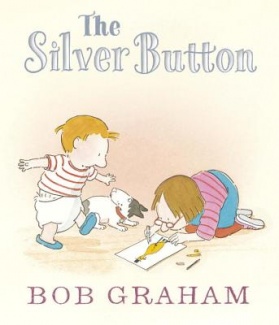
In our family, we don’t have a car, and so the decision to walk to school isn’t one we ever have to think about. A few times a year, they have a “Walk to School Day” at the school, and we think this is funny, the same way I thought it was funny when someone declared 2014 the year to read women writers. Last year when I wrote about the Rebecca Solnit book (and its companion—the picture book The Silver Button by Bob Graham), Harriet was only 4 and finding the walk to school a bit of a struggle, whereas her legs are longer now and she’s used to it—particularly when she’s unencumbered by snow pants, the walk is not a slog at all. “I was born to walk,” she told me this morning, because she is impressionable, and can read book jackets now, and I’ve been talking a lot about this one. It’s a book whose connections to the world are so multitudinous that you keep putting it down as you’re reading to share something fascinating, and then when the book is done, you go out walking down the street, and the connections all come back to the other way.
Iris, who is not quite 2, is a different creature than her sister was, bipedally speaking. She wants to walk everywhere, shouting “Walkie! Walkie!” if we dare constrain her in her stroller, and she doesn’t just want to walk—she does walk. Last Tuesday, she walked down Bloor Street from Spadina to Bay. It’s her favourite thing in the world—she seems to know everything in Rubinstein’s book innately—to be motoring on her own steam, and so completely free.
April 5, 2015
Circle of Stones by Suzanne Alyssa Andrew
 Suzanne Alyssa Andrew’s Circle of Stones is a novel in fragments, the story passed like a baton from one character to another, each one adding something essential to the overarching plot in addition to the peculiarity of their own perspective. It’s a tenuous arrangement, but it holds because of the solidness of Andrew’s prose, the rootedness of her characters, and her deftness at creating mystery and suspense by arranging the puzzle pieces of her novel just so.
The overarching plot involves a pair of star-crossed lovers. Nik, a talented art student, is drawn to the enigmatic Jennifer, painting her features over and over in order to hold her in a way he knows he never can. Though he tries. When she disappears from his apartment in Vancouver, taking her dance bag but nothing else, leaving her cell-phone behind, he decides to go after her, against everybody’s advice—except for his grandmother, who’d urged him to be the one good man in their family and take care of the people he cares about. But Nik’s good intentions are thwarted by a violent thug who also appears to be on Jennifer’s trail. He quickly loses control of the plot altogether.
The plot is then taken up by Nik’s former roommate months later in Toronto, trying to sort out the broken pieces of his life (and here, Andrew underlines that the spaces between us are what connect us after all). Aaron has RCMP officers appearing on his doorstep asking questions about Nik, plus he’s struck by a meeting with his English professor, an annotated copy of The English Patient. Next up is the Prof herself, distracted by updates from her estranged sister about their dying mother. And then the story is taken up by a Nurse at the dying mother’s long-term care, Tina preoccupied by her Lhia, troubled teenage daughter, and something strange going on amidst the staff at work. The following chapter is from Lhia’s perspective as she negotiates her independence and sense of self as she goes into the world. On the streets of Ottawa, she meets up with Nik, who’s been on the run for awhile. And we’ve been catching glimpses of him and Jennifer in the periphery of the previous chapters, and have been able to piece together their separate trajectories, filling in the blanks.
Next is George, teenage Lhia’s uncle, a gay civil servant trying to live the good life on contract, trying to keep ahead of the place he came from but living paycheque to paycheque (when the paycheques even arrive). And then his friend, Lucy, whose story I’d read years ago as “Extreme Ironing” in Taddle Creek magazine. Suffering through grief at the death of her mother, determined to fill in the gap of her loss by taking care of her father, having his shirts sent across the country so she can iron them (on the Montreal subway no less, a guerrilla manoeuvre). I will admit that by the time we get to Tim, Lucy’s brother, a documentary filmmaker, the story seems to have circled a bit too beyond its point of origin, so it’s with relief that we find, in the following chapter, the circle narrowing again.
While the Nik and Jennifer storyline is what ties the pieces of the story together, for me they weren’t the most interesting part of the novel. They were always just a little bit too outside the frame (even intentionally so), their characters airily constructed. Some of this is deliberate—there is a scene in which Jennifer lights match after match, a vision only in the most fleeting light. But they were both a bit too ethereal to be true, whereas the other characters carrying the novel are startlingly realized in vivid, stark lines. To the point where the reader is overwhelmed, amazed that all these people—teenagers to octogenarians, men and women, gay and straight, parents, widows, the lonely and loved—have all been born from just one writer’s pen. And that there is nothing facile about what connects them—this kind of network is a simulacrum of the world.
Full disclosure requires that I note that Suzanne is a friend of mine, which only means that I was particularly pleased to like her novel so much. And it’s a demonstration of her talent that such a diversity of voices, experiences and points of view are so convincingly depicted, and that they are hung together, with mystery and intrigue, as something so remarkably whole.
March 31, 2015
The Big Swim by Carrie Saxifrage
 Books come from trees, and I’ve got this theory they never entirely shake their wild origins. I think this every time I’m reading outside in the spring and blossoms rain down on my book’s pages, or when a tiny midge appears and sits down at the end of a sentence. The poetry book Decomp by Stephen Collis and Jordan Scott was created from what remained of copies of Origin of Species that had been left in five distinct ecosystems to decay for a year, and I love that idea: of books and reading being so firmly embedded in nature, like they belong there. And in her extraordinary book of essays, The Big Swim, Carrie Saxifrage underlines this point, with references to literary pumpkins (Linus’s, Cinderella’s, and Peter Pumpkin Eater’s wife’s) in her essay on growing a 300 lb. squash; by recounting her grand awakening to the perils of climate change that came with reading—a series of articles by Elizabeth Kolbert; by explaining that she writes about climate change because it’s the one thing that relieves her heartbreak about understanding what we’re doing to our planet; and finally by making the natural world come alive for her reader, capturing the wonderfulness and wondrousness of nature in sparking, evocative prose.
The next best thing to a tree for a tree to be, I’d say, would be any single page in this extraordinary book.
Rachel Carson’s Silent Spring meets Annie Dillard’s Pilgrim at Tinker Creek meets Elizabeth Gilbert’s Eat Pray Love, with a healthy dose of Barbara Kingsolver—perhaps Animal Vegetable Miracle, a book that woke me up to the wonders of eating by the season, local food movements, and that potato have greens—who knew? In 12 absorbing, funny, and thoughtful essays, Carrie Saxifrage connects the personal with the universal and the scientific to the spiritual to celebrate her love for the world and confront her anxiety about its fate.
It’s a perfect book for spring, I think. Partly because bunnies turn up twice. The first time in “Hare,” when Saxifrage writes about tensions between “tree-huggers and rednecks” on her home of Cortes Island, BC. A friend whose family has ties to the local logging industry dares to bridge the gap between the two groups, but it all gets very complicated. (There is a blockade at one point, and Saxifrage offers muffins to everyone on sides, and I do so like that she appreciates the value of the muffin as a political tool.) A long story and good intentions lead to Saxifrage dressing up as “The Easter Hare” (not the bunny, no, this is the pagan symbol for springtime fertility) for the Volunteer Firefighter’s Easter Brunch, but things go wrong as best intentions always do, and our heroine ends up locked in a bathroom with terrifying children threatening to break down the door. In the end, Saxifrage resolves to get on side with her friend’s family by “non-controversial public service” in the future. Hopefully there still can be muffins.
In “Lagomorphic Resonance,” Saxifrage is hiking alone in Washington State, the same places she’d visited years before with a friend who’d later died: “It still felt like some remnant of Paul and me, as we had been, remained in the place itself.” And she’s there to see the pikas, mouselike creatures who are cousins of rabbits and live high up on mountains, who “seem like one of the many improbable details of the world’s enormous diversity.” The essay is partly about rumours of the pika’s endangerment, threats to its habitat by rising temperatures due to climate change, partly about her anxiety as mother of a teenager (and this anxiety hangs over a lot of the text in a really interesting way), about loss and memory, and the tremendous glory of being alone in quiet places.
The essays aren’t so much about what they’re about as they’re about narrative, and so many facts, anecdotes, sidelines adding layers of meaning to the reading experience. In the title essay, Saxifrage swims five miles in the cold ocean between Cortes Island and Quadra Island, capturing the unsexy details of such an endeavour (her entire body covered in lanolin to protect against the cold) and the thrilling ones, about the pleasures of swimming and its movements, of immersion, the challenges of endurance. It’s one of the best bits of swim-lit I’ve ever read: “Romantically speaking, I’m part ocean mammal. I spend time thinking about how real mermaids would actually swim… I’m strongly related to the marine branch of the family tree.” And why does she she partake in the splendid agony of these five mile swims? Because they permit her to “belong…to a vast, cold world where brilliant seaweed banners wave in exultation.”
(So yes, my love of this book also isn’t just because of what the essays are about, but because of how the writing is so incredibly good.)
In “Pumpkin People,” Saxifrage attempts to make her way into the community on Cortes Island where she has arrived as a homesteader (and one who was previously an American lawyer, no less…) by participating in the annual ritual of growing outsized gourds; in “Hail Mary, Shining Sea” she is awakened to the reality of climate change and its threats to the planet, this idea mingling with notions of “goodness”; pursuing a low-carbon lifestyle, she and her husband eventually stop flying, and so it’s by Greyhound bus that she makes her way to Mexico for adventure and Spanish lessons and to be part of a shining sea in a metaphoric way. “Deep Blueberry Gestalt” is Saxifrage hiking through Vancouver’s Strathcona Park alone while reading Arne Naess’s ideas about “possibilism”: “that we must decisively come up with our view of life and find meaning in it, yet remember that more things are possible than we can imagine.”
In “The Oolichan and the Snake,” she attempts to understand First Nations opposition to the proposed Northern Gateway Pipeline by taking the Greyhound for 20 hours to Kitimat in Northern BC to listen to First Nation testimony. “A lot of people don’t understand how industrious our people really were,” explains Gerald Amos, an elder of the Haisla Nation. “On this river alone, we estimate that our people harvested 600 tonnes of oolichan in the springtime. This went on for untold generations. We’ve made our living here for thousands and thousands of years without destroying it.”
“Nectar” is a beautiful story of Saxifrage’s mother’s final days, and contains one of the loveliest lines I’ve ever read: “Maybe when you love someone…you are preparing for a moment you don’t even realize will come.” “Falling into Place” is about a confluence of her mother’s death with the discovery of an ancient human jawbone on their property. “Journey to Numen Land” I loved because Saxifrage decides that sleeping a lot is radical, and she attempts to draw connections between her sleeping and waking life to fascinating ends. She returns to the water in “River Creatures,” rafting through the Grand Canyon and swimming (of course!) part way, making connections between her mother, the fossilized creatures in the canyon walls and river guides who’d gone before her: “None of them got to preserve for all time what they loved, or even completely determine their own course. Like me, they had the opportunity to study the rapids, choose their path, and find joy in the river’s firm embrace.”
March 25, 2015
A Year of Days by Myrl Coulter
 The title and premise of Myrl Coulter’s essay collection, A Year of Days, bring to mind the quote by Annie Dillard: “How we spend our days is how we spend our lives.” But considering its inverse, Coulter’s essays examining the shapes of our lives by the days a life comprises, the singular days upon which time hangs its hat, and that become our markers from year to year to year. February, birthdays, the August long weekend, Thanksgiving, Halloween. In a life forever changing, it’s these days that are ever constant, to be counted on, and the seasons too, cycles returning every year, and it’s only you who has become so different. Our connections to these days are visceral—sometimes in anticipation, or anxiety, or happiness, or grief. And it’s this viscerality (a word she coins) as well as the days themselves that are points of departure for the essays in this book. New Years Day, for the first essay, a calm day, the chance to start again. All the while she’s mourning the death of her mother, irrevocably lost.
“As soon as she was gone from this earth, I felt an overwhelming need for more of her. I had to find her again. But how do you find someone after they’re gone for good? That’s where viscerality comes in handy. My viscerality took me on a trek into the years my mother and I had spent on the planet, both together and apart.”
Like many of my favourite essay collections though, the thematic here link is tangential. Even the essays themselves embark upon wild twists and diversions. Coulter’s essays fit Susan Olding’s definition of the genre, in which she writes, “Partaking of the story, the poem, and the philosophical investigation in equal measure, the essay unsettles our accustomed ideas and takes us places we hadn’t expected to go… We start out learning about embroidery stitches and pages later find ourselves knee-deep in somebody’s grave.” And with the book as a whole, you start out expecting a book that’s a kind of calendar, only to find that Myrl Coulter has cast her net so very wide.
And what has she captured? The magnificent frigate bird swooping over the sea, seen from the hotel where Coulter partakes in a Mexican sojourn. How does one capture a sunset? Winter as an analogy for her mother’s dementia, casting their family into a season of darkness. An essay on Valentines, and hearts real and metaphoric, and perforated hearts, and the difficulty of cutting while left-handed with right-handed scissors. On Easter, and Easter Island, and Easter Bunnies, and the lies we tell our children for the sake of magic. I love this essay’s ending: “Nostalgia lives in the impossible notion that we can start again… I suppose that makes nostalgia a little like repentance.”
I loved the essay, “Gym Interrupted, Again,” in which Coulter contemplates the work-out clothing she’s acquired over decades, considering her high school PE uniforms, ’80s aerobic sweatbands, expensive running shoes, bagging jogging pants, running tights, and all the changing fashions of fitness and its attire, and the body, the one constant (though in itself, ever changing). “But one relationship we have that isn’t interrupted, at least until the day it ends forever, is the one we have with our bodies. They are the houses we live in.”
She writes about her discomfort with Mother’s Day and Father’s Day, built on idealized notions that often please no one. About the May long weekend, and her surprise that golfing has become part of her life, articulating what she loves about the sport in a way I found fascinating. “Lakes I Have Known” is summer and swimming and floating free. “Cornocopia Soup,” sort of about Thanksgiving, but essentially a recipe for making Chicken Soup over two days, about loneliness and soup-making as therapy, and it made me so hungry. “Survival Gear,” which riffs on Halloween and costumes, and our selves as costumed beings, and ends with, “Words and pictures—survival gear for our stories.”
“Wearing Black” on funerals and mourning, and the surprising “Music on the Hill” about the ins-and-outs of the Edmonton Folk Music Festival, and its peculiar and particular rituals recurring year after year, and she writes about these experiences while numbed by grief, after her mother’s death, of “my distraction year” when “my inner music stopped.” The collection ends with the weird and wonderful “Current Crossings” about Edmonton’s High Level Bridge and its various modes of crossing. Back and forth, back and forth, the traffic flowing like time is, and bridges are metaphors for so many things—for the possibility of connection, for how here we are between one thing and another, or the bridge itself as a year and every journey across it is so very different.
If Myrl Coulter’s name sounds familiar, it may be because she was a contributor to The M Word, her essay actually an excerpt from her phenomenal book, The House With the Broken Two. While Coulter’s complex relationship with her mother is an important aspect of her memoir, it’s considered more obliquely here. A Year of Days is not so much a book about grief as a book that’s haunted by Coulter’s mother’s spirit. As the whole world might seem to be after a loss, I’d suppose, the collection creating some order from the pieces that are left.
March 17, 2015
After Birth by Elisa Albert
 1.
1.
No, listen, she says, the problem is no one cares about babies. I mean, they care about babies like “oh look at the cute baby” or “oh, ha ha, funny looking baby with an old man voice-over,” but no one actually cares about babies. I mean the details, it’s boring.
So let’s imagine that the ideas this book is concerned with do not matter. Let’s discuss it as a piece of literature, divorced from its subject(s). Elisa Albert’s third novel, After Birth, is an angry, passionate, gnarly and perfect mess of a novel that echoes Charlotte Perkins Gilman’s The Yellow Wallpaper in style and tone (and exclamation marks!), and also Sylvia Plath’s The Bell Jar, and more recently Claire Messud’s The Woman Upstairs for the force of its rage. Its narrator, Ari, at one point references her favourite Grace Paley story (“Wants”). Which is to say that this is a novel constructed on a strong literary tradition. Its short clipped sentences are notes and dispatches from a place of confusion, attempts to reconcile life itself with one’s expectations of it, and other realities including people’s Facebook profiles and feminist theory. The notes and dispatches do not comprise a plot so much as a circling round of a fact, a record of a winter of inertia. So what moves the book forward then? Well, voice, first—Ari’s is distinct, disturbing, unnerving, frustrating, funny and smart. Second is her vision of the world, which is peculiar and her remarkable articulation of it. And third is curiosity—something’s gotta give. Will she be broken? Will her rage be quashed? And are these two questions actually one and the same? Albert’s first-person address is so solid, so realized, that it gives the impression of having been carved out of something larger, chiseled, rather than built up from the ground. Nothing is incidental or extraneous in her prose. The book and its narrator are exhausting to encounter, frustrating, untameable, and brilliant.
2.
No, listen, though, the problem is with books, with novels about motherhood. Or even worse, those novels that purport to finally pull back the veil and “tell the truth about motherhood.” The problem, in addition to the fact that nobody cares about babies, is that a book about motherhood is rarely read (if it is read at all) as a book about a mother. Instead, it’s a manifesto. Read as a statement on an institution instead of a literary work about a fictional character. A story. We have a hard time grasping that there can be more than one story about motherhood, or if there is more than one, there’s just two then, always diametrically opposed. Two gals facing down on the cover of a magazine. One is always carrying a briefcase. When in reality, there are so many stories, and each of those stories comprise so many stories in themselves, the same way that a single day can hold more than one kind of weather.
“The buildings are amazing in this shitbox town,” is the first line of After Birth, which isn’t nuanced, but it kind of is. And readers and reviewers rarely know what to do with that.
3.
No listen, the problem is that there are the early days of motherhood, and then there is what happens a while after that, when you’ve finally got it figured out, and you feel obligated to go out and deliver everybody else from the darkness. This was the point at which I sent my cousin a completely revised version of her baby registry, when I would start to hyperventilate at the idea of a friend choosing not to co-sleep, when I wanted to chase desperate looking women down who were pushing strollers down the street and put my arms around them, promise them everything was going to be okay. Which was surely the last thing these sorry people needed. And some of them weren’t even sorry. It took me a long time to understand that.
“In the cafe where I never work on my dissertation is the woman I’ve seen at the co-op with her brand-new baby. We smile./ Do you ever feel like you’re completely losing your mind?/ Her smile fades./ It’s okay if you do. It’s perfectly normal.”
4.
No, listen, the problem is women. How we look at other women as mirrors, desperate for affirmation. But it’s always slightly unnerving to look in a mirror, and the reflection is inevitably backwards. Albert’s novel references a 1990s third-wave feminist utopia, Ani DiFranco. Dar Williams singing, “I will not be afraid of women.” But even when we’re not afraid, women are not always good to each other. Like people in general, women are like that. Perhaps more so because of the way in which we’re set up for failure in our engagement, taught to see others as opponents. Ari’s stepmother is an evil feminine archetype, her cousin becomes Bridezilla, and she herself occupied a nasty role as “the other woman” before she married her husband (though she’s not self-aware enough to interrogate this idea. Or is too much so.) She documents her history with female roommates at university, at a private girls high school, at Jewish summer camp, with not one but two moms’ groups. Women are ever disappointing.
Women are ever disappointing for a variety of reasons, both women in the book and women in the world, but part of the problem is that we’re forever looking for that mirror, for affirmation.
“Do you ever feel like you’re completely losing your mind?/ Her smile fades./ It’s okay if you do. It’s perfectly normal.”
“I’m v happy to see women engaging and disagreeing. Most necessary. Interrogation is essential,” wrote my friend Anakana Schofield in a tweet last week, in response to Jessa Crispin on Leslie Jamison’s The Empathy Exams and being tired of female pain (and I’d noted that Jamison was tired of people who were tired of it.)
I think that this is a very good point. We need to know how to look at other women without looking for our own reflection. We need to learn to disagree and not end up shattering glass.
5.
“Two hundred years ago—hell, one hundred years ago—you’d have a child surrounded by other women: your mother, her mother, sisters, cousins, sisters-in-law, mother-in-law. And you’d be a teenager too, too young to have had any kind of life yourself. You’d share childcare with a raft of women. They’d help you, keep you company, show you how.”
No, listen, the problem is we have no rafts of women. With After Birth, as with so many other books about mothers, the problem is not motherhood itself, but instead a motherhood that puts a woman apart from the world, both in practical terms (Ari is removed from familiar surroundings in a new town, isolated while her husband is oblivious and busy with his work) and theoretical ones (remember? No one cares about babies. Ari’s concerns are nobody else’s, her’s alone). Her own mother is dead (and Ari’s memories of her are rife with anger at her mother’s anger—interestingly, it doesn’t seem to occur to her to wonder what her mother was so angry about) and she has no sister. She’s estranged from her Aunt, and her from her heritage (it seems) but marrying a man who isn’t Jewish.
“Here’s the problem: we are taught nothing. / How to sew, grow food, preserve food, build things, fix things, make fires, birth babies, care for babies, feed babies, move through time, grow old, die, grieve, change, sit still, be quiet.”
Here’s another problem though: was there ever really a raft of women?
Two hundred years ago, I thought as I read this, you probably would have died.
Moreover, while Ari craves the idea of this raft of women, she has spent much of her own life setting herself adrift from any semblance of one. She doesn’t wish to be anything like her own mother, or be the same kind of mother. She sees her baby as the chance for a fresh start. She wants a natural birth, to breastfeed, to eschew all things toxic and synthetic—her mothering to be nothing like the way her own generation was mothered. She wants a link that’s wholly illusory.
 6.
6.
After Birth is a fascinating companion to Eula Biss’s On Immunity. I couldn’t help but wonder what Ari would have done had she met a woman like Biss in one of her moms’ groups, a woman who in her book thanks the mothers with whom she’d shared the conversations and preoccupations of early motherhood: “These mothers helped me understand how expansive the questions raised by mothering really are… I am writing to and from the women who complicated the matter of immunization for me…In a culture that relishes pitting women against each other in ‘mommy wars,’ I feel compelled to leave some traces on the page of another kind of argument. This is a productive, necessary argument—an argument that does not reduce us, as the diminutive mommy implies, and does not resemble war.”
Albert too demonstrates how expansive the questions raised by mothering really are. This isn’t really a book “about” motherhood at all, but instead, motherhood is its starting point.
Like many of the women in Biss’s book, Ari feels, and indeed has been, failed by the medical establishment. Her unhappiness in motherhood she puts down to the trauma of her c-section. When her friend acknowledges the experience as a kind of rape, Ari feels gratified for just a moment. And perhaps this is the link to her maternal lineage, Ari’s own particular raft of women: her own mother died from cancer caused by drugs her grandmother had taken in pregnancy to avert miscarriage. Those same drugs had left her mother with mutilated reproductive organs so that Ari herself was only conceived and born by remarkable chance. The rape too—her grandmother was raped by Nazi soldiers during the Holocaust. Survived only, Ari tells us, by having sex with them.
Naturally, the idea of witches appeals to her, of women back in history who banded together, who possessed the wisdom of how to deliver babies and cure illness (and even vaccinate, as Biss tells us). She rescues a new friend, Mina, from the throes of early motherhood by nursing her baby, an age-old practice. The two of them set up a raft of their own, and for a time, this is everything.
(I was once so angry at having had a c-section that I was given a pamphlet for a support group that helps women heal from and grieve their c-section experiences. “What kind of bullshit is this?” I was exclaiming and my terrible husband with an evil glint in his eye said, “I think you should go.” I protested and he shrugged calmly: “You’ve been grieving your c-section for four years,” he said. My fist shook at the ceiling. “I am allowed,” I told him, “to grieve my c-section and find c-section support groups totally stupid.” You can see how Ari was someone for whom I had great empathy.)
7.
No, listen, the problem is that no one ever talks about this stuff. Or maybe that when they do talk, nobody listens. See point one: Nobody cares about babies.
“Adrienne Rich had it right. No one gives a crap about motherhood unless they can profit off it. Women are expendable and the work of childbearing, done fully, done consciously, is all-consuming. So who’s going to write about it if everyone doing it is lost forever within it?”
(Or perhaps it’s that even those who are listening have no context. [“Could it be true that one has to experience in order to understand? I have always denied this idea, and yet of motherhood, for me at least, it seems to be the case.”—Rachel Cusk, A Life’s Work].)
Here is something I love about After Birth: Albert doesn’t think that a novel about new motherhood need read like the catalogue for a hipster baby boutique. The stuff is not the stuff, she knows. Stuff is lazy shorthand. It’s a way of getting away from the point.
There is so much I love about how Albert captures the crisis of new motherhood in After Birth. (Her non-fiction piece on this in the Guardian is one of the best things I have ever read about this topic.)
“The baby books said nothing about this. Days became nights became days because nights.” And, “So the dissertation thing is pretty much a lie. But you need an identity, some interest and occupation outside having a kid, you just do. Otherwise the kid will be your sole interest and occupation, and we all know how that works out for everyone.”
And, “I did not understand how there could be no break. No rest. There was just no end to it. It went on and on and on.”
And, “When I see pregnant women, I want to take them by their shoulders and shake. I mean shake. Are you ready?”
And, “I nurse while she pumps to encourage supply. She says something about it being difficult to get out when the weather’s so shitty and I say something like yeah, winter’s a shitty time to have a baby and she says something like it’s always kind of a shitty time to have a baby though isn’t it?”
7.
The problem, sweetheart, is you.
This is a line delivered by the ghost of Ari’s bitch mother near the end of novel when Ari finally confesses, “Fine, I do hate women… They’re so obedient, traitorous. Descendants of the ones who gave up other women as witches.”
Her mother’s line is important because it’s kind of true, in particular as suggested by the novel’s final sentence. The problem is Ari, because she is a specific literary character and not a statement on womankind or motherhood (and many a commenter on Goodreads seems to have difficulty understanding this distinction). She’s a fascinating, messed-up, smart and self-destructive literary character. She doesn’t affirm anything. You will think she is wrong about a lot of things. But this doesn’t mean she’s not worth reading. In some ways, it makes her so much more worth reading than any literary character whose story can be tied up in a perfect bow.
The line is also important as a statement on motherhood though, an idea I’m still teasing out. That while indeed the problem is that women are all too isolated in early motherhood (and they are), it’s not just that other women don’t save us, but that they can’t. That every woman has to discover her own way through. Naomi Stadlen writes about this in a book called What Mothers Do that I found troubling for its simplistic notions and failure to understand maternal ambivalence, but the following passage in one of the smartest I’ve ever encountered on the subject:
“If she feels disoriented, this is not a problem requiring bookshelves of literature to put right. No, it is exactly the right state of mind for the teach-yourself process that lies ahead of her. Every time a woman has a baby she has something to learn, partly from her culture but also from her baby. If she really considered herself an expert, or if her ideas were set, she would find it very hard to adapt to her individual baby. Even after her first baby, she cannot sit back as an expert on all babies. Each child will be a little different and teach her something new. She needs to feel uncertain in order to be flexible. So, although it can feel so alarming, the ‘all-at-sea’ feeling is appropriate. Uncertainty is a good starting point for a mother. Through uncertainty, she can begin to learn.”
8.
And she does learn—this is the thing. Perhaps even Ari will. And not long after the end of the first year (which for me was when storm had ceased, I could see the shapes of things, but trauma was still so recent, and I wrote this) those early days begin to fade. Motherhood itself becomes less all-consuming (literally and figuratively), one’s rage at having a c-section or not becomes less potent, the baby becomes a human, breastfeeding is no longer such a preoccupation, sharing parental duties becomes easier, you sleep more, and it’s all less boring and shattering.
Which is to say that Elisa Albert has documented a very particular moment in motherhood in After Birth, instead of motherhood in general. And that this insistence upon specificity—in spite of her narrator’s generalized wailing in collective pronouns (which is what trips less-careful readers up, I think), in spite of the moments in which our identification with her is visceral—is the novel’s greatest strength. Specificity is what turns a political statement (and oh, this is one) into literature.
March 15, 2015
Higher Ed by Tessa McWatt
 There seems to now be a tradition of me beginning reviews of novels by Tessa McWatt—Vital Signs in 2011 and Step Closer in 2009—with a comment upon their strangeness, and now it would just seem wrong if I didn’t. Part of might be their author’s point of view—Guyanese-Canadian-turned-Londoner— which is a rare one in CanLit, and her sentences, with their particular rhythm and cadence, how the prose seems inflected by the beats and thrums of everyday life, how actual people think and speak. And also McWatt’s preoccupations, with theories and ideas instead of the minutia of plot. Her characters, while they talk like actual people, don’t quite move about in the world like actual people. They exist to prove a higher point, which is kind of a criticism, but not really. It’s more to note that to read a Tessa McWatt novel is to read a little differently, and that we’re not reading for realism anymore.
Which is not to say that McWatt doesn’t engage with reality, particularly here in Higher Ed, her sixth novel. It takes place in London a few years ago on the verge of economic meltdown against the backdrop of a polytechnic-turned-university facing the inevitable funding cuts. Jobs are on the line—film professor Robin knows this doesn’t bode well for him as the most junior in his department and a theorist who doesn’t impart skills that translate into employability; administrator Francine, an American ex-pat, is also expecting to be sacked, as she had been not long ago by her boyfriend, therefore finding herself in her 50s without much of a foundation to stand on; Katrin, a Polish emigre (with a degree in economics), is trying to keep her menial job in a cafe but she keeps being tripped up; and then Ed, who works for the Council making final arrangements for those who have no one else to do it for them. One of the last vestiges of that society that Margaret Thatcher was so determined to prove didn’t—or needn’t—exist.
And then there is Olivia, an idealist, a law student. Biracial, she’s grown up with her white mother and her racist granddad (“He’s the kind of geezer who fools you, who is clever and doesn’t raise his voice except at the telly, talks like he has schooling, talks like he reads books, but deep down Granddad’s ignorance is as deep as his unknowing of his own soul.”). All she’s ever really known about her dad is that he left her, but when she stumbles upon him—he is Ed who works for the Council—while researching a project on paupers’ graves, she learns there is more to her story than she thought. Determined to save her father’s job—because her mother is hardly going to take him back if he’s unemployed, right?—she ropes Robin the film prof into coming up with a plan to celebrate the poetry of Ed’s work, to perhaps highlight the necessity of a job like his in a world that has any hope of being decent.
But Robin is not the right guy for the task, really, and he’s got concerns of his own—he’s fallen in love with Katrin from the cafe just as his ex-girlfriend has told him she is pregnant. Meanwhile, Katrin is calculating how she’s going to have her mother come live with her in London, how she’s going to be able to afford a flat that’s bigger than her bedsit. These people walk the same halls as Francine, who’s been traumatized by witnessing a man killed in a motorcycle accident (whose belongings in the home where he was a lodger will be eventually secured by his family in Italy, thanks to Ed) and is walking on the edge of something that’s going to change her life—for better or for worse.
The diversity of voices in the novel is impressive, McWatt convincingly infusing each character’s narrative with the appropriate vocabulary and syntax based upon the character’s background. Each character’s story comes with its own richness, which is enhanced by the opportunity to see these people from another’s point of view. How exactly their lives overlap seems forced seemed forced times, but these instances were forgivable—these lives were compelling enough no matter their trajectory. But I’m still a bit confused by the effect of all their lives together—what do all these pieces mean? My lapse in understanding partly due to my own failings—if I’d read the work of philosopher Gilles Deleuze, would it all have been clearer? And so I’m as puzzled as I ever was, but confident in McWatt’s project, that—as her character suggests in Step Closer—“There is an order here, awkward and quiet, even now, if you look carefully.” Which you could say about the world—or at least its cities—, I suppose, and McWatt’s achievement is a novel that’s a microcosm of such a thing.
March 11, 2015
Intolerable: A Memoir of Extremes, by Kamal Al-Solaylee
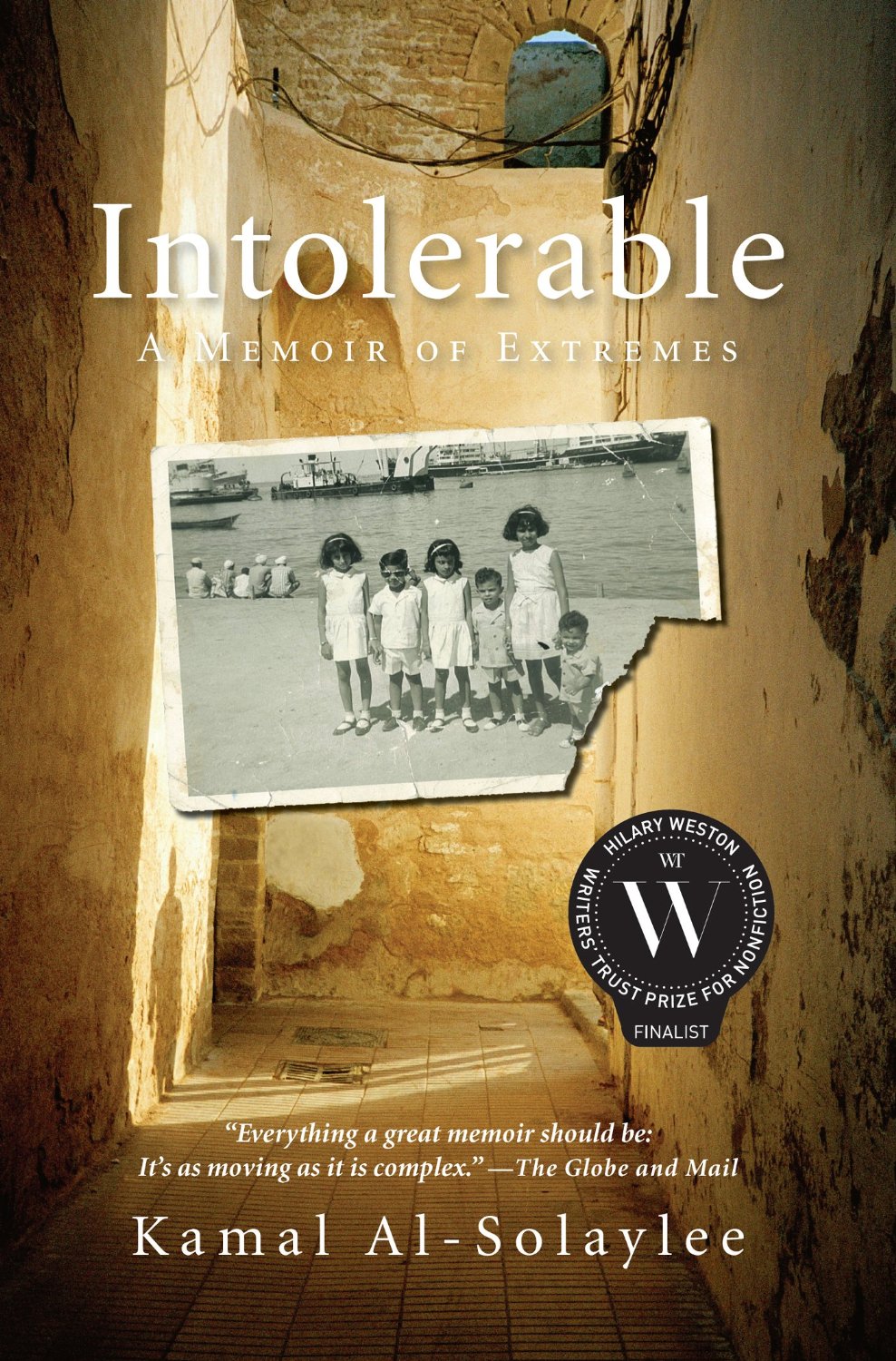 Kamal Al-Solaylee’s Intolerable: A Memoir of Extremes is the final book of my 2015 Canada Reads selections, and an interesting way to finish them off having started with Thomas King’s The Inconvenient Indian. Both are non-fiction and work to complicate perceptions of people some of us best know from stereotypes. Both also reframe history to present their people—King with Canada’s First Nations and Al-Soylaylee with Muslims in the Middle East—as victims of a capitalism. For Al-Soylaylee, this is only a small part of the narrative, but it’s an important one—he sees the move toward extremism in Egypt being fundamentally linked to Anwar Sadat’s open-market policies and free-market capitalism in the 1970s, which drove Egyptians into poverty and situated the state as an enemy of the people. Politicized Islam filled the gaps. Al-Solaylee states, “And because Egypt exerted huge cultural and moral influence on other Arab countries, the shift towards a more politicized and economics-driven notion of Islam quickly spread to other parts of the region.”
How does it connect to the other Canada Reads books? Like Ru, this is the story of an immigrant’s journey to Canada and place to call home, and the narrator’s starry-eyed idealism never wavers. Like When Everything Feels Like the Movies, it’s a story of growing up gay and seeking a place where one can belong—although the characters’ journeys are very different, partly because we don’t have the same access to Al-Solaylee’s isolation that we do Raziel Reid’s Jude’s. Al-Soylayee’s narrative strikes me as similar to the image on the cover—a writer moving from darkness to light but he’s so focussed on that momentum that the dark corners are left unexamined. They’re alluded to—he writes of falling into a years-long depression after a trip to Yemen in the 2000s, years after leaving. But most of the story merely skims the surface on the road from there to here.
Which is not entirely mere—it’s a fascinating road. His own family’s from affluence to poverty; from enlightened liberal ideals to religious extremism; from Yemen to Beirut, to Cairo, and back to Yemen again. It’s a movement that’s emblematic of transformations in the Middle East in general. While Al-Solaylee’s had a different trajectory—to get OUT, whatever it takes. Living as a gay man in Yemen, in his own family, would be impossible. Could be punishable by death. And so he plots his path—to England to study, and then to Canada. By the time he’s made his success in Canada as a journalist and cultural critic, the gulf between his world and his family’s is nearly impossible to bridge. He doesn’t even want to try. He writes of his terror at border crossings still—his fear at being forced back to the world he’s escaped. By the time his mother dies, he’s just about given up on remaining connected with his family. He has spent years turning his back on his Arabness—the language, the culture, the geography. And was this selfishness or self-preservation? He’s not entirely sure of this. But then with the 2011 Arab Spring and war and unrest in Yemen, Al-Solaylee finally realizes that he can’t entirely disown the places—and the people—he comes from. And it’s this transformation that to me is the most compelling journey in the book.
Intolerable is the link between the three Canada Reads books I’ve already noted, and the fourth, Jocelyn Saucier’s And the Birds Rained Down. Because it’s also a book that’s all about choice, except that it’s mostly about what happens to people who don’t have any. Al-Soylaylee notes that he took the freedom to pursue his dreams in Canada, while his sisters—educated and once-liberated women—retreated to Islam. They tell him they find comfort there, but he’s not sure they would have been permitted comfort anywhere else. And even his brothers, whose hard-line points of view were pivotal to eventually wearing down their sisters’ resistance to religious infringement upon their lifestyle, are given a bit of leeway. What else did these men have? It’s true, Al-Soylaylee notes, that his brother became more devout the worse he did at school, but even if he had been successful, what opportunities could a country like Yemen have offered him? Over and over again we see that poverty and economic stagnation is a hole that radical Islam rushes to fill.
While not as structurally innovative as the other Canada Reads books, there is a whole lot going on here, but, as I’ve said, it’s happening far beneath the surface. I found the prose confusing at times, sentence after sentence beginning with conjunctions to show disagreement—even, but, although, however, though. To the point where Al-Solaylee is not debating between sides but moving in circles, suggesting his own discomfort with his history, with his take on it, and that he’s still not sure how to hold it. While this detracts from the subject matter a bit, keeping the writing from going as deep as I’d like, it’s also interesting to consider, and typical of something that promises “a memoir of extremes”. That while where we’re talking about breaking barriers, life is complicated, not necessarily two-sided simple, and that some barriers are not easily broken.
March 9, 2015
On Immunity by Eula Biss
I will admit it: until recently, I was one of those parents whose children weren’t vaccinated due to my concerns about a number of toxic ingredients found in vaccines. But then when people started sharing vitriolic and expletive-filled Facebook statuses and tweets about “fucking anti-vaxxers” whose children deserved to die of smallpox, they really convinced me, and I finally came around and saw the error of my ways.
Okay, none of the above is true. First, because my children received their vaccines on schedule. But mostly because the described scenario doesn’t exist—no one’s going to change her mind in this climate. The rhetoric surrounding the vaccine “debate” is so inflamed and divisive that as it stands that there is no hope of reconciliation. I also have some sympathy for parents who doubt the safety or necessity of vaccines. While I have absolute trust in my doctor and her advice, and in the importance of vaccines for public health, I was one of the many people who put down that fear-mongering story in The Toronto Star last month on the HPV vaccine and said, “My kids are never going to get that.” And then the whole furor blew up, and I saw how we’d been played.
Which is the point at which I decided to read On Immunity by Eula Biss. Biss, poet and award-winning essayist, wades into the vaccine issue, not to seek a middle-ground—because she acknowledges that there isn’t one; the science is conclusive; her own child is vaccinated—but to seek context, to create something richer than a polemic. More than a book on “issues”, even, this is a book on language and metaphor, about how both frame the way we understand our bodies and our world, and about vaccinations and immunity might serve as a metaphor for America and the world today. “And it has vampires in it,” so notes the blurb on the back by Rebecca Solnit. Because, yes, this book is blurbed by Rebecca Solnit AND Anne Fadiman, which makes it basically a non-fiction holy book. And it is oh so very good.
Biss begins with the myths and fairytales, those stories in which “parents…have a maddening habit of getting tricked into making bad gambles with their children’s lives.” Including the myth of Achilles whose mother seeks his immortality. Biss writes, “Immunity is a myth, these stories suggest, and no mortal can ever be made invulnerable,” and considers the desperate ways in which parents seek to protect their children from their fates.
Her son was born as H1N1 panic spread across the world, around the same time my elder daughter was. I remember lining up for hours at Metro Hall downtown for the flu vaccines we were eligible for because we resided with a member of the vulnerable segment of the population. “It was not a good season for trust,” Biss writes, as financial markets were crumbling and many people were considering the response to the H1N1 panic to be overblown, a plot by big-pharma, the vaccine’s components considering dubious by many in the chattering-mother set.
Biss invokes Bram Stroker’s Dracula, a story that serves as a metaphor for disease. “What makes Dracula particularly terrifying, and what takes the plot of the story so long to resolve, is that he is a monster whose monstrosity is contagious.” And the story, she continues, is as much about the problem of evidence and truth as it is about vampires. How do we ever know what we know?
Public health, Biss notes, is rarely seen by members of the middle class as intended for “people like us.” She uses the example of prominent anti-vaccine campaigner Dr. Bob Sears who writes of the hep B vaccines, “This is an important vaccine from a public health standpoint, but it’s not as critical from an individual point of view.” Biss explains, “In order for this to make sense, one must believe that individuals are not part of the public.” But such a limited perspective is hardly novel, Biss shows shows, with historical epidemics thought to be the scourge of foreigners and outsiders (like Dracula!), and poor black people forced at gunpoint to be vaccinated in Kentucky a century ago. Historically, vaccination of those living in poverty would have benefited the wealthy, whereas the tables have now turned—the vaccination of children who live in privilege now serves to protect the vulnerable (in terms of income level and health). Biss extends her examination of this switch: “If it was meaningful for the poor [historically] to assert were not purely dangerous, I suspect it might be just as meaningful now for the rest of us to accept that we are not purely vulnerable. The middle class may be ‘threatened’, but we are still, just by virtue of having bodies, dangerous.”
But we feel threatened, we do. Here, Biss returns to poor season for trust, and explains how risk perception has more to do with fear than quantifiable risk. “Perhaps what matters,” Biss quotes the scholar Cass Sunstein has saying, “is not whether people are right on the facts but whether they are frightened.” And we certainly live in a culture of fear, which is ever heightened. Which has recently manifested in a paranoia against chemicals, countered with a strange faith that nature itself is benevolent. But vaccines, note Biss, reside where between the two: “vaccines are of that liminal place between humans and nature—a mowed field.” She further complicates the issue by using the example of the Americas’ native populations, decimated by disease after the arrival of Europeans: “Considering this course of events ‘natural’ favours the perspective of the people who subsequently colonized the land, but it fails to satisfy the ‘not made or caused by humankind’ definition of the term.”
Nothing is straightforward, and science writing, and misperceptions of science writing, skews things. Did you know that there is no causal link between DDT and cancers? I didn’t. I read Rachel Carson’s Silent Spring, her book that sparked a revolution by suggesting there is no boundary between the human body and its environment, and while this is indeed the case, and while spraying DDT from airplanes over towns and vast tracts of farmland is indeed dangerous and does irreparable damage to ecosystems, Silent Spring‘s greatest legacy, as noted by journalist Tina Rosenberg, is that it’s “killing African children because of its persistence in the public mind.” Malaria has resurged in countries where DDT is no longer used against mosquitos. While Carson recognized the utility of DDT for disease prevention, Biss writes, “the enduring power of her book owes less to its nuances than its capacity to induce horror…. Like the plot of Dracula, the drama of Silent Spring depends on emblematic oppositions.”
Biss traces the origins of vaccines to folk medicine, practiced by women until they were pushed out of their positions of power in their communities by the medical establishment (men who pushed women into unsanitary hospitals to have their babies, many of whom would die there because these doctors didn’t know to wash their hands). Biss notes the strange relationship between anti-vaccine mothers and vaccination itself, both born out of the same anti-establishment systems that seek/sought to undermine women and their intuitive knowledge vs. scientific fact. This is certainly not a story about emblematic oppositions after all. But still, not a reason to turn away from science altogether. We need science, notes Biss, via Donna Harraway. “Where it is not built on social domination, science can be liberating.”
My very favourite part of this book, whose every bit I appreciated so much, was the end-note to page 8 (and it’s a testament to the goodness of On Immunity that I read its notes in entirety. I didn’t want the book to end). Biss writes something that reads like an echo of my introduction to The M Word, about motherhood being one’s occupation and preoccupation in the early days, about all those conversations about motherhood between new mothers making sense of their world, which is also the world. And this is what I find so exciting about this book, that such a work of literature can be from those “productive and necessary” conversations.
Biss notes:
“These mothers helped me understand how expansive the questions raised by mothering really are… I am writing to and from the women who complicated the matter of immunization for me…In a culture that relishes pitting women against each other in ‘mommy wars,’ I feel compelled to leave some traces on the page of another kind of argument. This is a productive, necessary argument—an argument that does not reduce us, as the diminutive mommy implies, and does not resemble war.”
March 1, 2015
The Girl on the Train by Paula Hawkins
 Here is a secret: sometimes when we say that a protagonist is unlikeable, what we really mean is that she is boring, or at least her plot is, or that as a character the protagonist fails to get up off the page, live in more than two dimensions. Which is to say that the whole “unlikeable protagonist” thing is not quite the problem that we might think it to be. It’s a shorthand for, I couldn’t be compelled to care about this person. Which is sometimes the fault of the reader, sometimes the fault of the writer. Not every book is for everyone.
Though it seems that The Girl on the Train, by Paula Hawkins, is for an awful lot of people. Bestseller, huge hit, the latest novel to be christened “The Next Gone Girl,” which is something. I read it this weekend, and I loved it, which pleases me the way I like that I can still love hot-dogs, even though I’ve come to frequent the organic butchers. That I can still appreciate this novel, while I see plenty that’s wrong with it—some sloppy prose, a narrative structure that makes no sense, a plot that hinges on a character having a blackout. It’s no Gone Girl, which was a really solid book. But it’s just as gripping, and one thing it does better is that its unlikable protagonist is sympathetic. Gillian Flynn’s Amy was a monster, but while Paula Hawkins’ Rachel is a mess and heading fast down the stupid spiral, she’s incredibly human. We can see how she got to where she is. And its in her humanness (too much so) and not her unlikeability (because she’s that too) that being in her literary presence can be totally unbearable. But the reader persists because there’s a story here that begs to be unravelled.
Rachel travels to and from London every day from her home in the suburbs, the train stopping for a moment by a row of houses into whose back gardens she has a perfect view. She’s become fixated on one particular couple whom she sees drinking wine on their terrace, having breakfast in their kitchen, and she dreams up a whole life for them—her obsession with these people not unrelated to the fact that she’s desperately lonely and that their house is just doors away from the home she’d shared with her ex-husband until he’d dumped her for another woman with whom he now shares the house along with their baby daughter. Rachel’s marriage had broken down on account her drinking, and since her divorce, her drinking problem has escalated, plus she’s lost her job and is about to be thrown out by her flatmate.
Which means she’s not considered the most reliable witness when the woman in her fantasy couple goes missing. Rachel had spied the missing woman with another man the day before she disappears, and she feels this information must be relevant to the case. But there’s also the fact of her increasing attraction to the missing woman’s husband, plus her own ex-husband and his wife who are fast growing tired of her lurking presence outside their door.
While The Girl on the Train is worthy of the hype, in terms of being a fun read, I’d offer that Harriet Lane’s novel Her is a so much better example of the “domestic sinister” genre and more deserving of such hype. And that Lane’s novel, as well as the best parts of Hawkins’, made me think about Emily Perkins’ 2008 Novel About My Wife, which I’ve read twice and want to visit again. Wild women with mysterious pasts (where trauma lurks), disinterested husbands, suburban ennui, the perils of real estate, violence and danger. The likability of a protagonist doesn’t even register. It just matters that you care what happens next.






