October 4, 2015
Ledger of the Open Hand, by Leslie Vrydenhoek

“Great civilizations aren’t remembered for their tax policies.” —Marsha Lederman, The Globe and Mail.
I thought of Ledger of the Open Hand, by Leslie Vryenhoek, when I read the quote above, from a story about the failure of politicians in our federal election to grapple with issues deeper than budgets and surpluses, to talk about anything except money. Because Vryenhoek’s novel is about a character just like these uninspired (and uninspiring) politicians, Meriel-Claire Elgin who sees the world in terms of debits and credits, who conflates value with values, and the novel is also about how limited is such a worldview.
Though it’s an easy trap to fall into, this obsession with fiscal responsibility and thinking of thrift as a moral virtue. Raised in a small prairie town by parents of modest means, Meriel-Claire is determined to prove herself responsible as she begins university in the city, working in the summers and part-time to supplement her parents financial support. Though she quickly sees her experience in contrast with that of her sophisticated roommate, Daneen, who takes her family’s wealth for granted. Their respective financial situations seem to demarcate their places in the world, Meriel-Claire decides, imagining herself as the hard-working ant while her grasshopper friend devotes herself to shallow and frivolous concerns. Unconsciously seeing the fable analogy to its end, Meriel-Claire envisions a day when there will be justice, when her hard-work and prudence will be rewarded and Daneen will meet her inevitable downfall.
But of course, life is not this simple, structured like a ledger sheet (which, cleverly, is suggested in the novel’s cover image), and neither is the novel. Interestingly, the story of the ant and the grasshopper has alternate versions in which it’s the grasshopper who is actually the virtuous one, and The Ledger of the Open Hand (like life itself) permits plenty of space for such ambiguity. The novel is broad in its scope, taking place over three decades, and showing the changes in the life of Meriel-Claire (and in her family’s) as she moves from her twenties to her forties. And because all of this is presented from Meriel-Claire’s point of view, everything is about money—she starts off as a bookkeeper and eventually becomes a debt counsellor; with colleagues and family, she gains a fierce (and justified) reputation as a tightwad. Though Meriel-Claire doesn’t see it quite that way herself, and Vryenhoek gives us real sympathy for her situation and how she got there, and the truth is that so much about being in the world is about money after all. It’s just simpler for people like Daneen who don’t have to worry about it. Of course it’s easy not to think about money all the time when you have no need to.
Written in short chapters that whisk the reader through the years, we follow Meriel-Claire through her first jobs, home-ownership, through failed investments and unexpected windfalls. We see her parents sell their business and begin to enjoy their retirement, and live a life that seems at odds with Meriel-Claire’s memories of her modest upbringing. Their distance from their daughter is augmented by tragedy in their lives, tragedy that none of them is really ever able to account for. And looking on through all of this is Daneen, who grows close to the family and eventually becomes a successful author whose stories seem a bit too familiar to Meriel-Claire, raising issues of just how much borrowing is permitted in matters of story as well as money, and also of how adept is anybody at seeing a reflection of her own self?
While all too present on the political stump, issues of finance are curiously absent from so much of literature, whose bills seems to get paid almost by magic (unless it’s a book about the farm and foreclosure). Vryenhoek manages to weave a deep and engaging novel out of money matters, though she makes it about more than that. While at times Meriel-Claire is a bit robotic in her approach to the world and Daneen can verge on caricature, Mariel-Claire’s parents are rich, complex and fascinating characters, and the connections between all these people over the decades yield surprising insights and remarkable depth, culminating in a really wonderful story. Vryenhoak’s prose is bright and accessible, the novel fast-paced and compelling, and there is a startling originality to all of it.
September 29, 2015
Sir John’s Table, by Lindy Mechefske
 I could never be a food blogger for all kinds of reasons, one of which is that all my pots and serving dishes are indelibly stained and my kitchen is old and grubby (and poorly lit). The other important reason is that I tend to interpret recipes as general guidelines instead of instructions, but in the case of the new book, Sir John’s Table, by Lindy Mechefske, this turned out to be an advantage. It meant I was unafraid to take on the recipe for Sir John A’s Pudding from a cookbook from the 1880s, a recipe named in honour of the first Prime Minister of Canada, whose instructions included “size of an egg” for butter portioning, no word on what vessel to cook it in, and vague baking instructions as follows: “Bake in oven for a few minutes.”
We really weren’t sure. “This is an experiment,” I kept telling my family, and then asking them, “Isn’t living with me a glorious adventure?” No one answered. They were all a bit irritated that our main course had been roast cauliflower. “I bet none of your friends are having pudding tonight in honour of Canada’s first Prime Minister,” I told Harriet. She looked at me funny: “Mom, do we have any ice cream?”
 Sir John A’s Pudding is from Dora’s Cook Book, by Dora E. Fairfield, published in 1888—one known copy is still publicly available. It is a bread pudding, the bottom made with bread crumbs, egg yolks and lots of milk. Spread on top are stiff egg whites and sugar. I baked the whole thing in the oven for much longer than a few minutes (though I can’t remember how long now—I am as bad as Dora). When it came out of the oven, the topping was nicely browned but the pudding still seemed a little gloopy (“But gloopy means delicious, right?” I asked. Nobody cheered.) However once it had been resting for a little while the pudding was set, and now it was finally time to dish it up and assess the damage.

Guess what: it was totally divine. And everyone conceded that living with me was an adventure after all, a most delicious one. I did my I’m always right dance. I always mostly am.
Though not, admittedly, with my immediate assessment of Mechefske’s book. Sir John’s Table: A Culinary Life and Times of Canada’s First Prime Minister as a concept did not seem at first compelling to me, but then I opened it up and started reading. And what I found was an engaging, light and fun and informative text. So engaging, yes, that it led me to attempt archaic heritage recipes, plus the book is also a really interesting biography of Canada’s first Prime Minister.
 Since we’re going all Full Disclosure in this post, I will reveal to you that I’ve not watched any political debates during this current federal election. As these debates fail the Bechtel Test on every discernible level, are intellectually stupefying AND we don’t have TV, I’ve felt more comfortable getting my political information from newspapers instead. There is something about the absence of women’s voices and the general feeling that anything concerning women’s experiences is mere frippery that renders most politics (and political biographies) null and void to me. It’s grown-ups acting out playground games, and taking themselves far too seriously. It’s just inherently uninteresting.
Which is not to say that political biographies must necessarily contain a recipe for bread pudding, or that the domestic is anymore inherently a female purlieu, but it certainly was in the 19th century. Which means that “culinary life and times” of Sir John A. Macdonald is going to give special attention to the women in his life and the personal and political roles they played: his mother, his wives, his lifelong friend who was also a pub owner. We learn about the food (bannock!) his mother brought to feed her family on the long voyage from Scotland to Canada. Also about Macdonald’s favourite childhood desserts, how traditional British foods were adapted to North America, wedding cakes from the 1860s, mourning rituals (after the death of his first wife), how the picnics at which he made his famous stump speeches would have been catered (by Mrs. Beeton, at least), and just how a roast duck dinner managed to save the Dominion after all.
For a light book, Mechefske manages to be rigorous about colonial atrocities, juxtaposing a lavish Toronto dinner with Metis and First Nations people starving on the plains at the same time. Her story of the triumph of Sir John A’s railroad also includes a legacy of racism and exploitation of the Chinese workers who built it. She manages to balance her portrayal of the generous and charismatic Macdonald with the dark side of his legacy—also his own propensity for problems with drink: “He joined the Temperance Society again,” is a sentence that pops up more than once.
My one criticism is that the recipes have not been adapted for modern cooks, and so are more a curiosity than something the reader can use. Although there is value too in these heritage recipes reprinted as they were, for what they tell us about how 19th century cooks did their work, how ingredients, measurements and cooking methods were different, and also the peculiar stylistic quirks of their writers. And my own experience certainly shows (who knew?!) that the intrepid 21st century cook can have success with these recipes all the same.
September 27, 2015
Fishbowl, by Bradley Somer
 It’s true what you might have heard about Bradley Somer’s Fishbowl being a novel that actually chronicles a goldfish’s plummet from the twenty-seventh floor balcony of a high rise apartment building. (I heard my first raves about this book from the Parnassus Books blog.) And yes, the goldfish parts of the novel are actually from the fish’s point of view: at one point, one eye is skyward, and the other is focussed on the ground—what must the world look like like that?; his brain is too limited for a train of thought—it’s more like a handcar. Yes, the fish’s name is name is Ian. And it’s also true what you might have heard about Fishbowl if the thing you’ve heard is that it’s great.
The structure of fishbowl is similar to the apartment building that is its setting, each unit home to its own story, stories stacked on top of stories. Common spaces are spare, unremarkable. Nobody lingers there. For each character it’s easy to imagine that he or she is alone in the world, to disregard the sound of footsteps overhead. But one day when the elevator breaks down, the illusion is shattered. Suddenly lives are intersecting in curious, irrevocable ways. A baby is about to be born. An old man has died. A cheating lover is about to meet his comeuppance. A lonely burly crossdressing construction worker is about to feel more beautiful than he’s ever felt before. And Ian the goldfish is about to be launched upon the ride of his life.
Eschewing a linear narrative for something more like a fish’s grasp of eternity, the novel takes place over a half hour or so, moving back and forth within that span of time (and sometime telescoping omnisciently into a distant future) to examine the period from a variety of points of view. For those ascending the building’s staircase—the elevator is broken, remember—time moves in slow motion, ploddingly, exhaustingly. For the lying cheat upstairs who is hurriedly ridding his bachelor suite of all signs of debauchery, time moves much too fast, not enough of it to allow him to clear away the evidence. For the woman whose baby is coming, everything is happening much too quickly, but also taking forever. And when she finally manages to reach her boyfriend at the pub, he tells her that he’ll be there—after one more round.
Fishbowl is a novel about relativity and relationships, and infinite interconnectedness of things. It’s also funny, absorbing, poignant, rich with twists and surprises, smartly plotted, deep and intelligent. And heartwarming—if you’re into that kind of thing. Underlining that although a person might be lonely, she is never really alone.
September 20, 2015
Fates and Furies by Lauren Groff
 “…consider sacrificing surprise, the lowest form of literary pleasure, for the much richer satisfaction the first half of this novel can deliver when read in light of the second,” writes Laura Miller in her review of Lauren Groff’s new novel, Fates and Furies, in which spoilers are revealed. A line I delighted in when I first came upon it; that a good book can’t be spoiled is something I’ve long insisted on. But like all good rules, there are exceptions, and I got to thinking about them after reading Miller’s review. There are books—one of my favourite books, We Need to Talk About Kevin is one; a more recent example is Karma Brown’s debut, Come Away With Me; also Kate Atkinson’s wonder A God in Ruins—in which the element of surprise is an integral part of the reading experience. In which the reader gets to the twist, puts the book down and asks, “How did she do that?” When we aren’t even aware that a twist is coming. And then the reader goes on to pick the book up again in order to discover the answer to how did she do that, compelled by the crafting that goes into the kind of book that will never be read the same way twice. Whereas other compelling books—Gone Girl, The Girl on the Train—fail to similarly necessitate another reading. The twists are all. These are books—gripping, great and fun, but still—that can be spoiled merely by being read.
Fates and Furies is not quite either kind of book, but that is not surprising. I still vividly remember reading Groff’s debut, The Monsters of Templeton, for the very first time, and being bowled over by the book’s audacity, by the author’s talent. And with each subsequent book—the story collection, Delicate Edible Birds, and the acclaimed novel, Arcadia—Groff has surpassed all expectations. She’s a writer of huge ambition and even larger canvases, unabashedly literary, unabashedly story, traditional in her approach to crafting fiction, except that she seems to be reinventing the novel every time, pressing at its limits. I’ve spent the last week reading Fates and Furies and being particularly annoyed that anybody imagines Jonathan Franzen to be “a greatest living novelist” (?) when: Lauren Groff. Lauren Groff. Lauren Groff.
(If she were a man and a giant asshole, however, she’d definitely be discussed in those terms.)
There is not a twist in Fates and Furies, per se, but instead a shift. At one point, its shape is described as an X, an intersection. It’s the story of a marriage, but as Robin Black’s review on The New York Times explains, it’s (mercifully!) not so much about the institution of marriage as one marriage specifically, the individuals entwined within. The first half of the book (Fates) is concerned with Lancelot Satterwhite, known as Lotto, destined for greatness from birth. His story a whirlwind, taking us from his childhood growing up wealthy in Florida, his father’s death, his mother’s descent into mental illness, teenage delinquency headed off at the pass via prep school, and the college. And at the end of his four years there, on a cusp (he hopes) of a career as an actor, he meets Mathilde. They marry after a two week courtship, and for the next two decades she supports him through lean times and periods of great success as he finds fame and fortune as a playwright. The reader is party to their healthy sex life, chatter at their popular parties, their quiet moments and their public ones, as well as scenes from some of Lotto’s plays. Mathilda silent in the background, “a saint,” Lotto calls her, as well as a “pathological truth-teller.” The quintessential caregiver, wife.
I wasn’t sure… This is what I reported as I was reading through the novel initially, sometimes finding Groff’s prose overwritten, while at the same time fragmented in a way that was off-putting. The story so male, centred on the penis. Literally and otherwise. It wasn’t overwhelmingly interesting. And yet, I knew there was something. I wasn’t sure what because (uncharacteristically) I’d been avoiding spoilers, but I’d read the headline of Ron Charles’ review in the Washington Post which contained the word “masterful,” and the I’d read the first sentence: “Even from her impossibly high starting point, Lauren Groff just keeps getting better and better.” So I had faith, and I certainly wasn’t bored, just baffled, and it was just that my expectations were oh so high.
And as usual, Lauren Groff met them and then some.
There is not a twist in Fates and Furies, per se, but instead a shift. Midway through the book, the perspective moves to Mathilde’s, and we learn that nothing has been what it seems. And while Lotto’s story is indeed one of fate and luck and fortune, Mathilde has been the true orchestrator of their shared life, pulling strings Lotto never glimpsed (though as we note them dangling when we’re impelled to go back and reread). Mathilde’s story is the Furies of the title, beginning with a tragic childhood and, as Laura Miller writes, “Mathilde’s story contains more outlandishly fictional twists than those of David Copperfield, The Goldfinch’s Theo Decker, and Becky Sharp combined.” It’s all a bit nuts, but fascinating in its intersections with Lotto’s story, how the two parts complement each other. A bit of a relief too.
And fascinating for what the novel says about women’s lives and women’s stories, about the role of the wife, which is nothing like Lotto envisaged. In her acknowledgements, Groff credits the work of Jane Gardam for helping to inspire Fates and Furies, and the reader can see how she was inspired by Old Filth and The Man in the Wooden Hat in her construction of separate universes within a single marriage, all the ways in which we are infinitely unknowable to each other.
Fates and Furies also suggests that men’s stories automatically take precedent in the literary canon. That Lotto’s story comes first is as symbolic as it is for literary emphasis. It would be easy for the reader to miss that Mathilde is a writer as well (and not just in her role as actual co-author of Lotto’s plays, manipulating his work as she did their entire life, perhaps this ensuring success). She’s a little bit Judith Shakespeare, albeit actually writing, but nobody reads it.
Anger’s my meat; I sup upon myself
And so shall starve with feeding.
Volumnia says this in Shakespeare’s Coriolanus. She—steeling, controlling—is far more interesting than Coriolanus.
Alas, nobody would go to see a play called Volumnia.
(Later we learn that Mathilde writes a play called Volumnia. Nobody goes to see it.)
If there is a twist in Fates and Furies, it occurs in the novel’s final five pages, in which the book’s two sections are woven together in the most beautiful, heartbreakingly lovely manner. In which we realize that this isn’t just about two solitudes and deception, but that even with secrets, misunderstandings and mysteries never solved, there is such a thing as love after all. That the novel is not point and counterpoint, illusion and reality. That like all the great polarities, the truth is somewhere in the middle.
September 14, 2015
Martin John, by Anakana Schofield
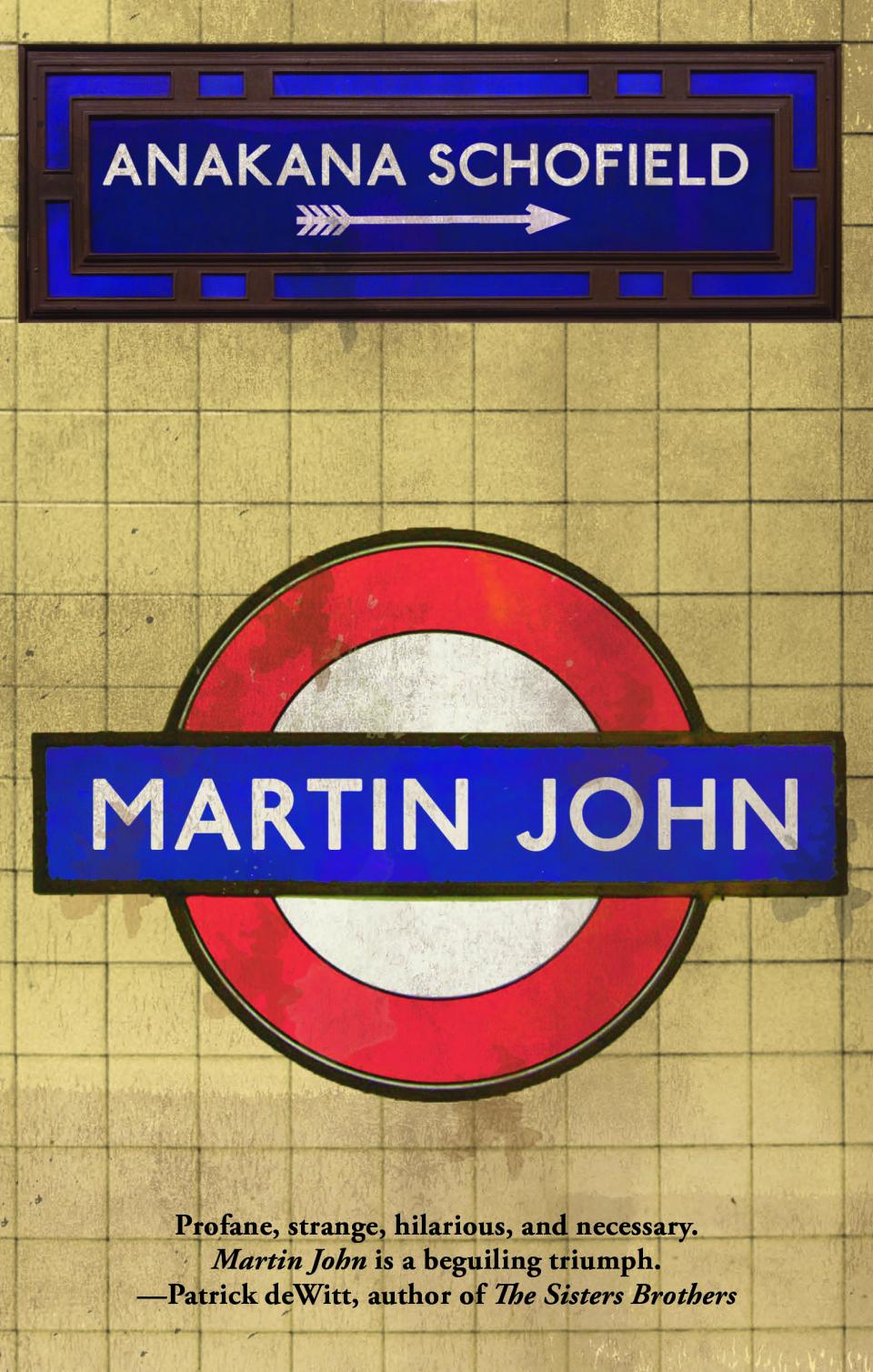 “That’s aggressive, but you see this hasn’t been an easy book for any of us.”
Anakana Schofield’s Martin John, a novel about a sexual deviant and the follow-up to her award-winning Malarky, is primarily a book about language. It’s about sexual violence is able to happen because of words and ideas that are never articulated or defined, and how these ellipses in our understanding go on to create further damage and harm. “It was a time when people didn’t ask as many questions. That’s the time it was.”
And so in order to fill in the blank, to ask the questions, to define the it, Schofield has to reinvent the shape of a novel. Eschewing chronology, point-of-view, objectivity, artifice itself for something that more resembles a case study, a long-form incident report. Just the latest for Martin John, the reader supposes, who has been in and out of the care of psychologists, social workers and other medical professionals for much of his life. Though he makes a point to stay out of their way—meddlers—and to keep to his routines, essential. He’s holding down a job as a security guard, lives in a nondescript shabby house in London (albeit one cluttered with the detritus of his media habits), visits his Aunt Noanie on Wednesdays, under specific instruction of his mother back in Ireland. (D’ya hear me, Martin John?) But it’s clear that, no matter his circuits and refrains, this centre (a precarious arrangement orchestrated by the mother) simply cannot hold.
The Mother. Martin John’s mother is a spiritual sister to Our Woman from Malarky, who does make an appearance in this latest book, encountering Martin John in a psychiatric ward. (You might remember him as “Beirut”.) Both women are undone by motherhood, wielding teapots as weapons, this action underlining their powerlessness. And yet. Are they really powerless? Are they bad mothers? Do they do what they do out of love? Or what? Do we blame the mother? Does it even matter? Does being a mother somehow put a woman beyond reproach?
Do we blame the mother? The collective address here is not rhetorical. I’m talking to you, and Schofield’s narrator is talking to all of us:
“She did not the idea she had a role in it.
You would not like the idea you had a role in it.
Did she have a role in it?
Have you had a role in it?
Do you have a role in this?”
Martin John forces the reader to be held accountable for some of the violence contained therein, for that time it was in which people didn’t ask as many questions is happening right now. “A thesaurus of vagueness for remembering,” Schofield writes. Think of a now-infamous CBC presenter, hmm? All this making for a discomforting read, made even more so, remarkably, by the reading not being so discomforting at all.
For a novel about a sexual deviant, Martin John is positively breezy. It’s humorous in places, fast-paced, its momentum spurred on by the arrows separating the text’s sections, part of the book’s overall transit motif. A motif that’s important to understanding the book as a whole, notions of underground and close proximity, of public, that these are people who live among us—they are us. And what are to do about that? The idea of transit and transit maps connecting to Martin John’s behaviour too, his loops and circuits. A sense of inevitability. The way that one thing leads to another: “Strange. Estranged. Estuary ranged.” It all comes back to words again, connections, missed or otherwise.
As Anakana Schofield is a friend of mine, I perhaps cannot be relied for a wholly objective review of her work, those it pleases me immensely that I don’t have to be. Read a rave review (one of many) from the Globe and Mail this weekend, and celebrate Martin John’s deserved appearance on the Scotiabank Giller longlist.
September 9, 2015
Light Years, by Caroline Woodward
 Caroline Woodward is author of Singing Away the Dark, which is one of my favourite picture books of all time, a book in rhyming couplets with just a few hundred words that has actually given me great strength more than once at times when I needed it. It’s based on Woodward’s own rural childhood: “When I was six, and went to school, I walked a long, long way…” and recounts her journey in the dark through the woods to meet her school bus each day, facing down fears, shadows, and actual cows. And so her latest book, Light Years: Memoirs of a Modern Lighthouse Keeper, is not such a departure, another book about lighting the darkness, being audacious and daring, and about the deep and complex relationship a person can have with place.
From the back of the book: The very TRUE STORY of a WRITER who always chose ADVENTURE over security, LOVE over logic, and who (naturally) quit her best job ever to go off with her equally peripatetic husband to LIVE at a LIGHTHOUSE and WRITE all the stories she always wanted to write, including THIS ONE.
(I don’t usually include descriptions from the back of books, but I particularly love that one.)
Woodward’s memoir is as meandering as her life has been, and I mean that in the best way. I mean that instead of a straightforward narrative about days in and days out as a lighthouse keeper (days that begin at 4am for the first weather report), we’re permitted to a broader story about how she and her husband came to live “on the lights” (after previous careers as booksellers and Woodward’s time spent working as a publishing sales rep up and down Vancouver Island, and throughout all of this wanting to make space for writing in her life), her own childhood spent homesteading in Northern British Columbia, in-depth lessons on meteorological geekery, about baking in a lighthouse kitchen (with enough cookies to feed the Coast Guard at Christmas), about how not to be decapitated by a helicopter propeller-blade, and gardening in challenging climates, and how lighthouse keepers cast their votes (Elections Canada officials arrive by helicopter!). It’s also a fervent defence of manned lighthouses, which are always under threat of budget cuts, and the role the lighthouse keepers play in keeping boaters safe, rescuing lost hikers, monitoring weather conditions and documenting the composition of sea-water for scientific data.
Somewhat incongruously, this book about remote and lonely places is not about loneliness at all, but about one finally finding her place in the world after decades of searching. And it’s a love story, Woodward and her husband’s devotion to each other a constant throughout and one of the chief delights of the memoir. They both work as relief lighthouse keepers, this involving separation for weeks or months at a time, and they find ways to stay connected through these periods. When they’re home, however, they live together at the Lennard Island Lightstation on the West coast of Vancouver Island, and Woodward knows she is privileged to live this remarkable life.
At the end of the book, she writes, “Remember this, memorize the pitch and rise and fall of these sounds because you will not hear them once you are far away from this life, this wonderful, amazing adventure.” And the reader is lucky to be journeying alongside for awhile.
September 5, 2015
Come Away With Me, by Karma Brown
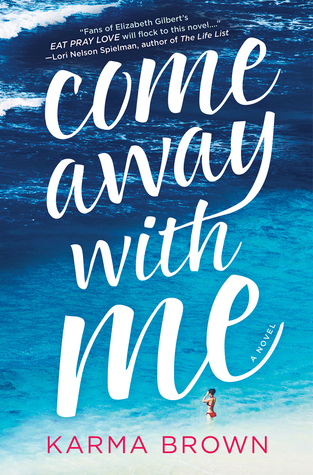 I am intrigued by questions of how people survive the seemingly unsurvivable, which was the reason I picked up Come Away With Me, Canadian writer Karma Brown’s debut novel. It’s the story of Tegan Lawson who had everything she’d ever wanted—an amazing husband and a baby on the way—when the dream is shattered by a horrific accident. Five months after the tragedy, her husband implores her to pick up the pieces of their life (and perhaps begin to forgive him for the accident, as he was driving the night it happened) by embarking on the trip of a lifetime to Thailand, Italy and Hawaii. Reluctantly, she goes, though she is not sure she’s ready (and neither are their families). And the trip itself does not prove to be the salve it might have been in a lesser novel, all of their troubles simply melting away—Tegan’s not taking her anti-depressants, she’s regularly still overcome with despair, her anger toward her husband seems impossible to let go of. And here we begin to see that this dream getaway is not the end of Tegan’s story but it’s the beginning of new one that’s vastly different than the life she’d planned on and dreamed of.
I read this book with pleasure, appreciating its light touch in particularly after spending a week carrying around the Joan Didion bio. Though it’s essential to note that my full appreciation of its remarkable structure and craft was not clear until close to the end. Until that point, I’d been putting some hollow characterization and a bit of narrative strangeness down to the fact that this was a(n otherwise capable) first novel. “I like this book, but…” I was saying to my husband yesterday. Not supposing that all this was part of an authorial sleight of hand that was so absolutely mind-blowing. By which I mean that the discerning reader should be encouraged to bear with this book: rewards will be forthcoming. You’ll see what I mean.
By rights, this book should be terrifically sad, and while I was discovered in a puddle of tears this morning by my concerned family (who wondered why I was taking even longer than usual to get out of bed), Come Away With Me leaves its reader buoyed and full of hope. In the best ways, it reminded me of Sonali Deraniyagala’s Wave and also Laurie Colwin’s Shine On Bright and Dangerous Object (which I reread this summer and absolutely adored). It’s an impressive and memorable novel celebrating life and love and the possibilities of survival.
August 26, 2015
Fake Paul, by Kimmy Beach
 There are some of us, a kind of tribe, I think, who know certain things, like the significance of the address, 20 Forthlin Road, without even Google or the aid of a map. We are indeed the same people who have visited the Beatles Museum at Albert Dock, and can properly visualize the brick wall outside Paul McCartney’s house at 7 Cavendish Avenue London. (We are probably the same people who know that John Lennon lived with Aunt Mimi at Mendips on Menlove Avenue, in the box room above the door where the acoustics were particularly good. And that Paul McCartney has allegedly claimed to have lost his virginity to his babysitter. And how his brother changed his name from McCartney to McGear.)
We are the kind of people them who buy Kimmy Beach’s poetry collection, Fake Paul, on a Wednesday afternoon, and have the whole thing read by Thursday morning. A fantastic tale of obsession and Beatlemania, fan fiction at its very best. Beginning with a woman who is conceived the night the Beatles make their North American debut on the Ed Sullivan Show, her stars inextricably linked to those of Paul McCartney in particular. A childhood infatuation in the 1970s leading to a pilgrimage to England and all the Beatles sites, a stolen head from a wax museum, and becoming troublingly devoted to the Paul (the eponymous Fake Paul) from a Beatles tribute band in Edmonton, Alberta.
I am not suggested that only those of us in the tribe can appreciate Beach’s book, but instead insisting that those us in the tribe should. A playful and more than slightly crazed narrative that somehow manages to articulate my experience of longing and infatuation. And yes, who could ever fault a poetry collection that one can devour in a day.
I loved this book.
August 25, 2015
The Nature of the Beast, by Louise Penny
 If you’re like me, you’ve always thought the one thing missing from the bucolic idyll of Three Pines in Quebec’s Eastern Townships (apart from a cell phone signal) was arms dealers and old Cold War conspiracies. Or maybe you never knew that you were missing these, but while their arrival into Louise Penny’s fictional village initially seems a bit incongruous, you will quickly suspend disbelief and just settle into her latest title, The Nature of the Beast, enjoying the ride.
After finding her previous release underwhelming (and it was always going to be a challenge to follow up the amazing How the Light Gets In—interestingly, too, her books set in Three Pines [no matter how unfathomably!] always seem to be her most compelling), I was so pleased to be swept away by a new Chief Inspector Gamache novel. Although in this one, Gamache is Monsieur instead of Chief, retired from the Sûreté du Québec and living with his wife in Three Pines. Which should really be the last place a homicide inspector goes to retire. It means he’s still in the centre of things when the body of a young boy prone to telling tall tales is found in woods, that horror yielding another more deadly discovery.
Gamache remains a part of the murder investigation, but the dynamics are different now as Isabelle Lacoste has taken his place as Chief Inspector, Gamache’s son-in-law Jean-Guy Beauvoir her second-in-command. The interpersonal relations are one of the most compelling aspects of the narrative, the web widening to include all the residents of Three Pines we’ve become familiar with over the past decade, and a few we haven’t met before. Matters complicated by the arrival of CSIS agents, a mysterious physics professor from McGill University, and old stories about arms deals to the Soviets and Saddam Hussein, a draft-dodger who wrote folk songs with appalling lyrics, and a serial killer whose evil continues to haunt Gamache to this day. Plus a Neil Young soundtrack, references to classical literature and the Book of Revelations, and a wonderful line, an allusion to Marilynne Robinson’s Gilead, in which Gamache tells Jean-Guy that he “is a brave man in a brave country.”
Weapons of mass destruction in Three Pines? It’s all a bit nuts, as are the connections between plot points, but the characters are so realized and convincing in their actions and motivations that it works. As do the arguments about good and evil and courage and bravery that Penny and her characters have been grappling with through the entire series. And it’s a relief to find, as the novel suggests, with Gamache making plans for his future, that they’re not finished yet.
August 17, 2015
A Really Good Brown Girl, by Marilyn Dumont
 I hadn’t budgeted for books at The Stop Farmers’ Market at Artscape Wychwood Barns a few weeks back, but it turned out that Pedlar Press and Brick Books were vendors (and I met Kate Cayley, whose How You Were Born I loved so much!) so I couldn’t help but pick up something. And I am so glad that the something I got turned out to be the deluxe redesign of Marilyn Dumont’s Gerald Lampert-winning debut collection, A Really Good Brown Girl. A book I read in days, which is rare for me and poetry, but I was captivated by the narrative, the language, the brute force of these poems, as well as their sense of humour, their cheek. “Squaw Poems,” about growing up Metis on the prairies, a household surrounded by “The White Judges” who waited to pounce. And never really went away. But then—
“I am in a university classroom, an English professor corrects my spoken/ English in front of the class. I say, “really good.” He say, “You mean/ really well, don’t you?” I glare at him and say emphatically, “No I/ mean really good.”
This line giving the book its title, a double as so many of the poems show the Metis girl who hears, “You are not good enough, not good enough, obviously not good enough/ The chorus is never loud or conspicuous,/ just there.” And also connecting Dumont not just to her literal foremothers (the women raising Blue Ribbon children with the White Judges looming ) but her literary foremothers too—in her Afterword she writes of the African-American women writers who inspired her, and other Indigenous writers from all around the world. She writes of another really good brown girl in “Helen Betty Osborne”:
Betty, if I set out to write this poem about you/ it might turn out instead/to be about me.
Another poem, “Letter to Sir John A. MacDonald”:
Dear John: I’m still here and halfbreed,/ after all these years/ you’re dead, funny thing… / because you know as well as I/ that we were railroaded/ by some steel tracks that didn’t last/ and some settlers who would settle/ and it’s funny we’re still here and callin’ ourselves halfbreed.
The poems are their own context, but in this new edition they are complemented by Dumont’s Afterword, as well as with an introduction by Lee Maracle:
“No other book so exonerates us, elevates us and at the same time indicts Canada in language so eloquent it almost hurts to hear it.”
I’m so glad I finally read it.






