February 28, 2019
The Homecoming, by Andrew Pyper

What I’ve always loved best about Andrew Pyper’s novels isn’t necessarily their plots, the super suspense, or the scary scenes that have literally kept me up at night. Although all these things are what make his books compelling, of course, and why I’ve been a fan of his work ever since I read The Killing Circle more than ten years ago. But for me the biggest attraction of an Andrew Pyper novel are the human connections, the relationships that make the stakes of the suspense plot so much higher—the father/son relationship in The Killing Circle, the brother and sister in The Damned, and another set of siblings in his latest book, The Homecoming.
Which is a weird book, and it’s obvious from the novel’s opening that something is a little askew. The Quinlan family isn’t quite normal, even beyond the ways in which they know they’re not normal—their father has just died, a figure who was always distant and often absent, and who has invited all of them together to receive their inheritance whose terms require that they spend 30 days at a remote lodge deep in a forest in the Pacific Northwest. And they agree to it, Aaron, a doctor; his sister Franny, a recovering addict grieving the death of her young child; their mother; and their fourteen year old sister Bridge, the person to whom Aaron is closer than anyone else in the world. They agree to it in hopes that the experience will give them answers to the questions they’ve had for years about the man their father/husband was, because what could be worse than so much not knowing?
Turns out: a lot. Other surprise guests arrive at the lodge, it becomes clear they’re all even more isolated than they thought, the woods are haunted, there’s an abandoned Christian summer camp with Satanic graffiti, and someone’s skulking about with a hatchet. Beyond the confines of the forest is a world that might be described as dystopian were it not for its resemblance to the present day, with militarized power, civil strife, and racial divides, all of which makes the action happening at the lodge seem that much more pressing, dire and claustrophobic.
I have to confess to having read a lot of books lately in which a character realizes that “Everything he knows about his life is wrong!” but this one pretty much takes the cake. Indeed there’s a twist, and it’s a wild one, but not a cheap one, and it works, and not least of all because Pyper has creative a huge emotional investment in the relationship between Aaron and his sister Bridge. Their connection makes the twists matter so much more, and underlines the poignance of the novel’s ending. The Homecoming didn’t frighten me as much as it thrilled me and moved me, which is a pretty remarkable combination. I liked this book a lot.
February 27, 2019
Happy Parents, Happy Kids, by Ann Douglas
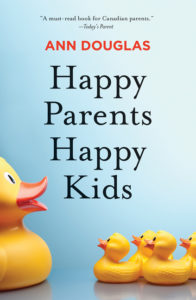
Early on in my career in motherhood, friends would recommend Ann Douglas’s parenting books to me on the basis that she wasn’t an ideologue. “She recognizes that there’s not just one way to do things,” I remember people explaining, because she recognized that there was not just one kind of child, or one one of family, or just one simple way to make a baby fall asleep at night. It’s a kind of pragmatism that can be rare in the parental guidance industry, and which has endeared her to a generation of readers looking for advice applicable for the world we live in as opposed to an ideal one. (Douglas’s most recent book before her latest was Parenting Through the Storm, advice for parents whose children are living with mental illness.)
Her new release is Happy Parents, Happy Kids, built on the premise that in order to make positive change in family life and the life of a child, a parent should start with herself, with her own wellbeing. A suggestion that is more important than it has ever been, perhaps, because parenthood itself has never been harder. Fashioned into a verb, made into a competitive sport on display with social media, complicated by differing philosophies and an insistence that the stakes are high for everything. Because what does the future hold? Douglas’s first chapter is called “Parenting in an Age of Anxiety,” and she goes on to illuminate how parents are challenged by questions of work/life balance, why it’s easy to always feel distracted, and how it’s too easy to lose focus on the parts of having children that are wonderful and rewarding.
Her advice on avoiding distracted parenting is really terrific (the only social media I have on my phone is Instagram, but since reading Happy Parents… I have removed the app from my phone’s main screen and turned off notifications, and my life is better for it), and she has similar suggestions, backed up with research, for connecting with your children, with your partner, for figuring out what is important to you and what your priorities are in your family life, for living with stress and hardship, overcoming past trauma, choosing calm over “stressed,” the benefits of being your authentic self as a parent, and how to resist a goal-oriented approach to being a parent: “Parenting is endlessly inefficient—and that’s okay.” Implicit in every part of this book is an understanding that families come in all shapes and sizes, with a wide variety of challenges and every kind of normal. There is a lot to work with here, and not all of it is applicable to my life at the moment, but I can foresee moments where all of it might be. This is the kind of book that would be good to keep close at hand, to dip in and out of, because you know (as the book knows) that the only sure thing have having children is that everything is changing all the time.
While “Be the change you want to see in the world” (or “Be the happy you want to see in your family”) is worthwhile and really practical advice, however, it’s only the beginning of the story, and what I love about Happy Parents, Happy Kids is that Douglas knows that. “Recognize that many of the problems that we are grappling with as parents are too big to solve on our own,” she writes in the book’s first chapter. “Systemic problems require systemic solutions, after all. So look for opportunities to join forces with other people who share your desire to create a world that’s kinder and friendlier to parents and kids.” She couples her individual-based approach to self-improvement with an awareness that society itself also needs to change, and that part of the reason that having children can be so overwhelming is because the system is stacked against us. And it’s only when we join forces and work together that things can begin to change.
The book’s final section is all about the necessity of building a village—we featured an excerpt on 49thShelf last month about the challenges and opportunities of online community. And this chapter sums up what underlines the entire book—that we can only do this all together. (I’ve also been signed up for Douglas’s newsletter, The Villager, for the last few months, with her thoughts and ideas about creating community and finding common group in an ever-shifting world, and I love every instalment.)
She writes, “The issues we’re grasping with are so much bigger than any of us, which makes them all the more challenging to resolve. The fact, it’s going to take all of us pulling together to make the situation significantly better by making changes at the personal, political, and cultural level. It may start with you, but it can’t end with you…” It’s about building a better world for the people we’re raising, and raising the kind of people that world needs.
February 21, 2019
Hard to Love: Essays and Confessions, by Briallen Hopper

Of all the surprising realities I’ve lately found myself facing, none is more surprising than this one: On Tuesday night I stayed up long past my bedtime because I couldn’t stop reading an essay on Cheers. Right? The essay was “Everything You’ve Got,” from Briallen Hopper’s brand new essay collection Hard to Love: Essays and Confessions, about the joys of rewatching the show on Netflix and how it bridges her reality as an academic with working-class origins. It’s been a long time since I thought this hard about Sam and Diane, and the last time I did I was eleven years old or thereabouts, so the thinking has become a bit more deep and nuanced, but the essay was terrific writing about making your way in the world whilst in your ’30s, whatever you get up to when your dreams of Major League baseball stardom are all done.
Cheers, of course, is a show about friends, and so are most of the essays in Hopper’s collection, which I read over a weekend now named in our province “Family Day” in honour of the statutory holiday. Hard to Love serving as an appropriate balance, the idea that family needn’t be based in biology or marriage, but can be based in friendships instead, which Hopper doesn’t even make a case for because her experience demonstrates it plain as a fact can. The book’s opening essay is “Lean On: A Declaration of Dependence,” which you can read online here, and I loved it, a story about how there is nothing wrong with leaning on each other. “I’ll never stop singing along with Bill Withers. I believe we all need somebody to lean on. But sometimes it seems like there are two American creeds, self-reliance and marriage, and neither of them is mine.”
This book is a collection of so many of my own fascinations: “Pandora in Blue Jeans” is all about Grace Metalious’s author photo, which is followed by an essay on Shirley Jackson and domesticity. Barbara Pym is referenced more than once, and then “Tending My Oven” and there are recipes. She writes beautifully about her complicated relationship with her brother through the lens of “Franny and Zooey.” “Coasting” is about the network that emerged as she and a few others become caregivers for a friend with cancer. In “The Foundling Museum” and “Moby-Dick,” she writes about her desire to have a child, and how her chosen family have supported her in this choice and process. The final essay “Girls of a Golden Age” about her community in New Haven, and plans to put down roots and purchase her apartment building along with friends—but then along comes a job offer in New York. Goodbye to all that. And also, hello.
It turns out that Hard to Love just isn’t, and never more than when matters are messy and complicated. These are essays, beautifully written, rich and generous with twists and turns, and insight.
February 19, 2019
The Young Unicorns, by Madeleine L’Engle
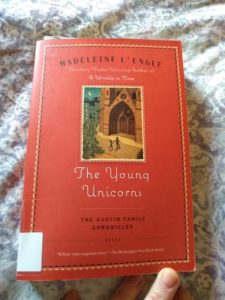
My Madeleine L’Engle/Austins project continued this weekend when I read The Young Unicorns, the third book in the Austins series. A series that is all-over-the-place in the most interesting way, in terms of genre in particular. Because this book (whose narrative does not, in fact, include a single unicorn, in case you were curious) is a dark and plot-driven mystery, very different from the previous two novels which were episodic. It’s also narrated in the third-person and comprises points of view from the entire Austin family. And I don’t remember if I ever picked this book up when I was a child, but I can understand why the Austin series as a whole confused me. Each book is a very different creature, this one set in a gritty and crime-ridden New York City where gang violence and corruption are endemic, where the Austin family has recently relocated to while Dr. Austin, a country doctor, takes up the opportunity to study surgical lasers at a prestigious research lab.
A surprising detail I learned while reading posts and other articles on this book (this one in particular!) was that not only did L’Engle write her books in set two different systems of time (chronos and kairos), but some of the series themselves were written out of sequence. So that The Arm of the Starfish (which I’ve never read) about Meg Murry’s daughter Polly was published in 1965, before either of the two books that immediately followed A Wrinkle In Time sequentially—which surely posed narrative challenges for their author. As I’ve been reading the Austin books I’ve also found it really illuminating to consider each novel in its own historical context—The Moon By Night (1963) informed by the Cuban Missile Crisis and fears of a nuclear holocaust, and now The Young Unicorns, which was published in 1968 and certainly informed by race riots and social unrest of the late-1960s, which is directly referenced in the text—although in her author’s note, L’Engle explains that her story takes place “not in the present but in that time in the future when many changes only projected today may have become actualities.”
Which is significant, because of how timely so many of historical concerns of The Young Unicorns seem for a reader in 2019, just as the previous book’s did. (When I was young, I thought it would be cool to live through the 1960s. Having now lived through the 1960s redux, I’ve changed my mind.) This novel is asking questions about responding to social unrest, about who to trust, whether we can trust anyone, or if trust itself is a fool’s game. It’s also an exploration of the nature of freedom, in particular to how it pertains to religion. Is obedience freedom? Is disobeying freedom, and when isn’t it? What does it mean to have peace if freedom is undermined to achieve it? (And this is where the title comes in, in reference to a quotation about unicorns that cannot be caught by the hunter but instead “can only be tamed of his own free will.”)
One could say the following of all of L’Engle’s books, but it’s especially relevant here: It’s so weird. Country Doctor Austin has been transformed into a scientist (basically Meg Murry’s dad), and Rob Austin is Charles-Wallace reborn, innocent and purely good, and they even have a reliable hound with uncanny awareness of the presence of evil. The Austins have rented the upper floors of an old mansion on Riverside Drive whose lower levels belong to a scholar and his musical prodigy daughter, Emily, who has been blind since a mysterious attack a few years before. Emily takes piano lessons from the eccentric Dr. Theo, and is helped in her studies and all around by Josiah “Dave” Davidson, a former gang member who was even more formerly than that a chorister at the Cathedral Church of St. John the Divine, which looms large in this novel, its catacombs leading through tunnels to abandoned subway stations and there is even a genie who mysteriously appears when the Austin children rub a lamp in an antique shop.
Dave is Black, and we meet him in the novel’s first sentence, and it’s significant, I think, that nowhere in the novel is his race explicitly stated, but we’re meant to infer it because he’s an “ex-hood” who lives in a Harlem tenement. (Race is stated a few times elsewhere in the book—the Cathedral’s Dean is Puerto Rican, and also an “ex-hood;” also, the two scientists who performed Dr. Austin’s job before him are Chinese and Indian, and a character makes a racist statement about their Asian-ness, at one point, but this character is also literally an arch-villain, so this might be the point.)
That race is otherwise absent from the novel is significant though, especially based on its 1968 publication year and its references to riots, mobs run amok. But this was also the heart of the Civil Rights Movement, and to remove race from the story of rioting and social unrest in northern American cities in 1968 is disingenuous. There is a suggestion too that the rioting and violence is thoughtless and rootless, violence for the sake of violence. But maybe this is what happens when you’re the type of person who doesn’t see colour or write colour, and the definition of progressivism in 1968 for many is that the Austin family regularly had a Black boy sit with them at their table, never mind that his Blackness is never delineated.
While a compelling and gripping read, I also found the novel a bit difficult and disorienting. Part of that is the nature of a book that is all about puzzles, tricks, and mystery, but I’m not sure that was it entirely. There is a dinner party scene where Dr. Austin is discussing his work with the Micro-Ray laser with the visiting Canon Tallis, and then the children leave the table, conversation shifts, and then two pages later, Canon Tallis asks, “Just what is your work, Doctor?” And Dr. Austin replies, “I design and make a small surgical instrument known as the Micro-Ray.” “This is on the principle of the laser?” Canon Tallis asks, and I want to yell at him, “Weren’t you even listening when you were talking about this two pages ago????”
So was it a mistake? But then strange to find a mistake in a brand new edition of the book first published fifty years ago, no? Elsewhere, there is also a reference to the revolutionary work of Dr. Calvin O’Keefe on starfish regeneration, which wonderfully blurs the lines between L’Engle’s series, but then in the previous Austin book, set just six months before, Vicky Austin had referenced A Wrinkle in Time as a literary work as she wishes her family could “tesser” across America just like Meg and Charles Wallace Murry. An inconsistency too or something more interesting than that, and I do love the idea that the Austin’s realism is not quite what it seems.
Calvin O’Keefe’s starfish work is from 1965’s The Arm of the Starfish (ostensibly the sixth book after Wrinkle…), which this reviewer found similar to The Young Unicorns but more problematic and less compelling. And in her review she also lays out the problem of Meg Murry, fierce and brave heroine of A Wrinkle In Time, but one who is forever playing second fiddle to a brilliant male character, whether it be her husband or her brother. I have always loved A Swiftly Tilting Planet, the third book in the series, and I’d always hoped that the reason Meg Murry O’Keefe is sitting in her parents’ kitchen while her husband is out saving the world from nuclear annihilation is because she’s nine-months-pregnant with their first child. But if Starfish is any indication, Meg Murry retired from being a feminist icon as soon as she comes of age: “Always called Mrs. O’Keefe, she is calm, reassuring, intent, focused on mothering her children, a near clone of Mrs. Austin in the Austin books, serene and capable. And all wrong for Meg Murry.”
As with the line, “Daddy doesn’t like women who wear pants,” in The Moon By Night, Mrs. Austin in The Young Unicorns is happy enough to uphold the patriarchal status quo. As her daughter Suzy explains of how Mrs. Austin gave up a fledging music career to become a doctor’s wife, “Well, she’s just Mother. She decided she didn’t want to be something, didn’t she?” And it’s interesting that we see L’Engle seemingly unable to write a woman character who balances her creative passions (whether they be art or science) with marriage and family life, especially since she herself managed to do so. Although one could speculate how successful L’Engle actually felt she was in this balancing seeing as she wrote these idealized self-denying maternal figures over and over again.
“I think the closest we ever come in this naughty world to realizing unity in diversity is around a family table,” Canon Tallis comments after spending time with the Austin family, and questions of family, connection ,and disconnection recur throughout the text. For the first time, the Austin family themselves feel estranged from each other, and there are also questions of how they can possibly imagine themselves as an island of peace and calm in a world so dangerous and broken. In their own small town, it was easier to suppose it, but living in the city it becomes undeniable that all things are connected. “And it’s all about what Grandfather’s always saying, how we can’t love each other if we separate ourselves from anybody, anybody at all, and how anything that happens to anybody in the world really happens to everybody.”
February 13, 2019
Mini Reviews: Three Books on Family

The Last Romantics, by Tara Conklin: The summary on the jacket flap of Tara Conklin’s new novel The Last Romantics tells you that this is a story that begins in a yellow house, with a funeral, an iron poker…”a free and feral summer in a middle-class Connecticut town.” And while all this is true, it doesn’t begin to tell the reader what this book is about, a book that takes place over a century and actually begins in an auditorium in a dystopian future, a world wracked by climate chaos, where 102-year-old Fiona Skinner is asked to explain the story behind her most famous poem. And I’m amused by the challenge this novel must have created for marketers, who prefer novels to ones that can summed up in a sentence, and this one definitely isn’t one of those. A clue to what’s actually going on here lies in a blurb on the back by Meg Wolitzer, whose two most recent books have been similarly ambitious in their reach, not explicitly about anything either except the story itself, about the characters within and how time changes and complicates their connections. The story is the sweep, and so it is here, although it’s not always completely convincing as it is in Wolitzer’s more masterful work (though I will admit this is a high bar).
There are narrative strands in this novel that don’t go anywhere, and while one could argue that life itself is a bit like that, the reader gets the impression that this novel was once a more larger and more unruly manuscript and much got cut in the taming, and now there are several parts of the novel that don’t know what to do with themselves. There are also a few plot points that hinge on characters doing unfathomable things, which was annoying. But, most fundamentally: this novel was never not interesting, and I found it thoroughly engaging. The shifts between point of view (no small feat with a first-person narrator) was beautiful crafted, and provide moments of real illumination. The Last Romantics is a curious beast, and I can think of worse things for a novel to be.
*

Reproduction, by Ian Williams: This debut novel by award-winning poet Williams is another curious beast, but more deliberately so than with Conklin’s book. Williams brings a poet’s attention to form, always pushing at the novel’s limits, making it hold more, do more, be more—and it mostly absolutely works. Beyond form, this is always a family story like none I’ve ever read before—two people meet in a Toronto hospital room in the late 1970s and their mothers are dying. One is Felicia, a teenage girl from an unnamed Caribbean island, and the other is Edgar, adult son of a wealthy German immigrant family. One thing leads to another, and after a time they end up having a child together, though Edgar leaves the scene, and Felicia ends up raising her son, Armistice, in the basement apartment of a suburban Brampton side-split where Oliver lives, and we find them all next in the 1990s and Oliver’s two children have arrived for the summer from their home with his ex-wife, and one thing leads to another, and another child is born. Which all sounds more straightforward than it really is, because there are tricks with language, details, timelines and lineage. I loved the specificity of the story, it’s strangeness, but its utter plausibility, how it’s not a sensible story, but it makes perfect sense. This is another book that is never not interesting, but it’s also a demanding read—so when I finished Reproduction, I made a point of picking up a novel that was in a different gear. And this is my favourite thing about books, that there’s not just a single kind…
*

Her One Mistake, by Heidi Perks: The opposite of a book that’s unlike any I’ve ever read before is Her One Mistake. a psychological thriller with an unreliable narrator Gone Girlish vibeWhich certainly has been overdone in recent years, and has its pale imitators, but I thought Heidi Perks’ novel was really terrific—and reminiscent of the TV series Broadchurch, and not just because of the setting in Dorset, UK. This one starts when Charlotte agrees to take her friend Harriet’s young daughter, Alice, to a school fair, but then Alice goes missing, and Charlotte’s negligence is seemingly to blame. But as always, the real story is more complicated, and there are twists and turns to find out what really happened to Alice. My only criticism would be that Harriet’s husband is way too absolutely evil to be a realistic human character, but then a) if I’ve learned anything in recent years it’s that some men’s capacity for abusiveness is beyond my wildest imaginings and b) none of the novel’s twists hang on the possibility of his character being anything than what he is, so there’s nothing cheap happening here. I really loved this book, and its ending was gripping and explosive and had me shouting at the page.
February 5, 2019
Small Game Hunting at the Local Coward Gun Club, by Megan Gail Coles
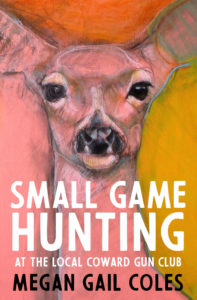
If you hang a pistol in your novel’s title, law dictates that it’s going to go off before the book is over, even if your gun is a metaphoric one. And if the title of Small Game Hunting at the Local Coward Gun Club is not indication enough that this book is not going to be completely painless, its author, Megan Gail Coles even includes a warning: “This might hurt a little. Be brave.” But yes, be brave. Venture forth into this book, where the weather is extreme and feet are freezing, and nobody is holding your hand. Where the atoms fall like snowflakes in a blizzard, instead of orderly, in a straight line, one thing after another, as you’d expect from a more linear text. There are moments when you’ll find yourself lost in the storm, zero-visibility. But just keep going. Be brave.
There are sentences in Coles’ first book, Eating Habits of the Chronically Lonesome, that I have never forgotten, more than four years after I read them first. “The reason Garry did these things was ’cause he couldn’t afford any better. Half of what he earned over at Pretty Paws was carted off to Newfoundland. Child support for an autistic kid he had with Slutty Marie down Gilbert Street, this the result of a one night stand./ Have you ever heard a sadder story, Dame? I mean, really? I barely poked her.” Not a comfort read, you know what I am saying? Unforgettable, dark, slyly humorous, meticulously crafted sentences. I have been looking forward to Megan Gail Coles’ debut novel for a long time, and while it hurt a little, it also did not disappoint.
Ostensibly, Small Game Hunting... is the story of a trendy restaurant in St. John’s over the course of a single day in February while outside a snowstorm is raging. The chef has been sleeping with the hostess who is serving his wife’s father (whose money funds the establishment) as he has lunch with the city’s mayor. The bartender is in love with the hostess. The server is hungover. And the woman who’s been waiting in the doorway, without her boots on and cold and wet and aching feet, has ties to the hostess, as they grew up together in rural Newfoundland, and to one of the restaurant’s customers, who not long ago caused her irreparable harm in an act of violence. And all of these characters have parents and sisters and ex-best friends who now hate them for justifiable reasons. “Sometimes John looks around the restaurant and wonders who is in the most trouble.”
It’s not an easy book. There is violence and there is trauma and there is an attention to language that requires the reader’s full investment, and while that investment pays off big time, the demand might also try some readers’ patience. Because Megan Gail Coles is asking a lot of her readers here, but she more than pays it back—not least of all letting plot be a huge incentive to keep on turning the pages. The tension is enormous in this web of emotions, ties and betrayals, and that proverbial gun is due to go off at any moment. The chef is fucking the hostess in the kitchen as his wife is coming down the street—you get the idea. The novel moving between each character’s point of view to add layer upon layer of meaning, and each character’s section has also its own voice, specific diction, preoccupations. It is a dizzying experience indeed to reside in so many minds at once.
But it’s also so rich, and we gain sympathy for even the most hapless characters, because nearly everyone in this book has done despicable things. And we see too the way that certain characters are imminently more forgivable than others, how they get away with everything, and by “certain characters,” I mean white men. “The defences of their choices would be vicious.”
In a recent profile, Coles described her novel as “a declaration of war on misogyny,” which is such a perfect articulation. Small Game Hunting at the Local Coward Gun Club is about the nonchalance with which men do harm to women, which is also a microcosm for an economic and political system that renders certain kinds of people disposable. Characters in the novel are robbed of opportunity, are played by institutions they trusted, are wracked by debt and addiction and systemic oppression. There’s a Gatsbyesque arc to the inevitability of their fates. And the men who cheat? Those reckless, careless characters? The bullet was never going to hit them. One way or another, they’re always going to be fine.
January 24, 2019
One Strong Girl, by Lesley Buxton

“It’s not the violence [of murder mysteries] I’m attracted to. It’s the grief. These mysteries offer me the truest reflections of my own feelings. Unlike ‘based-on-true-life’ stories about children who die, there are no grand epiphanies, no resolution all beautifully wrapped up. In mysteries the characters mourn unapologetically, their lives narrow. I’m comfortable in this milieu. Here nobody ever says, ‘It all happened for a reason’ or asks of the mother to be thankful her child is no longer in pain. Here everybody recognizes that it was better before.”
As I finished reading Lesley Buxton’s memoir, One Strong Girl, last night, I started thinking about birth stories, and how many of these I’ve read over the years. And about the parallels between these stories and the one Buxton shared in the section of her memoir called “So Eden Sank,” the story of the end of her teenage daughter India’s life. Beginning with arrival at the hospital (after six years of India’s illness, which baffled doctors at every turn), and then a move to a hospice where the family settles into their room there, and people come and go, and time moves at the most peculiar pace, and it seems like nothing and everything is happening at the same time as they all move toward a moment that will shatter the universe forever.
But mothers are not encouraged to share the stories of their children’s deaths as they are to share the birth stories, because most of us would prefer to go on imagining that such stories rarely happen. “Nobody wants to visit the place where I live,” writes Buxton, but she’s telling her story anyway so we can at least peek inside the windows. And she’s telling it to put the pieces together to make something of so much loss, I suppose. To give other grieving parents a sense of the path that lies before them, and as a testament to the spirit that was India—and Buxton’s abundant love for her daughter infuses every single word in this beautiful book.
Mother is both a verb and noun, and how do you do either once your child has died? This question is one that Buxton writes her way toward an answer to in One Strong Girl, a raw and heart-wrenching memoir of the kind of loss about which most of us would declare, “I just can’t imagine.” But we can, and Buxton invites us to. It’s not a linear narrative, but then it would not be real if it was. Beginning with a journey to Japan, which had been India’s fascination, and Buxton and her husband are bringing beads that hold India’s cremated remains, beads that they’ve been leaving behind at various locations that would have meant something to their daughter.
The next section outlines the beginning of India’s symptoms at age 10, mysterious falls and small seizures. In “Motherland,” Buxton writes about her own relationship to motherhood, and how complicated it is now that her daughter has died. (Read an adapted excerpt from this section at Todays Parent.) In “A Culture of Illness,” she goes through the 513 pages of India’s medical records, and tells the story through that lens, and how those records accord with her own memories of the experiences of the records track.
The next section is about how India’s illness and death changed Buxton’s relationship with her sense of home, and with her home itself. She writes about her teenage daughter’s bedroom, which is the most incredible kind of eulogy, and provides the reader with a strong sense of the person that India was. She continues with sections on India’s increasing decline, of her death, of where she and her husband are now—though all these sections keep circling backwards, looking behind, as you would too if the alternative was envisioning a future without your child.
It’s a finely wrought and beautiful book whose only flaw is that some of its rawness extends to its copy editing. But I really do love the rawness of he form itself, Buxton’s generosity and candour in sharing these terrible, painful, beautiful moments—all that love. As much a story of life as all the others we tell about our children are, and wholly deserving of a place in the parenthood canon.
January 21, 2019
Bowlaway, Elizabeth McCracken
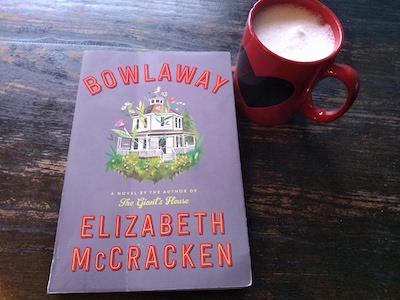
There is a house in Elizabeth McCracken’s new novel, Bowlaway, that defies all the rules of conventional architecture. It’s got eight sides and a cupola, a spiral staircase up the middle. “The walls were filled with lime and gravel and ground rice, and stuccoed with a combination of plaster and coal dust.” And in terms of narrative architecture, McCracken has similarly tossed out the rulebook for this, her sixth book and third novel. (Her two most recent books are the short story collection Thunderstruck and Other Stories, and a memoir, An Exact Replica of a Figment of My Imagination.)
The unconventional house is not actually the novel’s central edifice, however, although they’re both commanded by the same character, a woman we meet in Bowlaway’s very first sentence: “They found a body in the Salford Cemetary, but aboveground and alive.” This is Bertha Truitt, of the gapped teeth and enormous bosom, who claims to be the inventor of candlepin bowling and is utterly uninterested in delineating the story of where she came from. (For the most part, so is Bowlaway itself.) Like everything McCracken writes—sentences, paragraphs, characters, action scenes—Bertha Truitt is vivid. The heart and soul of the book, one would think, or at least its foundation or supporting beam, if we’re back to architecture. But forget the rules, remember? Because Bertha Truitt is deceased by page 78 (and no, this is not “a spoiler.” Bowlaway is a book that could not be possibly be spoiled), swept away to her death in the Great Molasses Flood, Boston, 1919.
I will admit that at first I was unsure of my footing as a reader in this narrative, because it really is one in which the bottom can fall out at any time. Because I’d arrived at Bowlaway with fixed ideas about the way a narrative should go, ie the protagonist should not necessarily drown in molasses on page 78. Because this novel isn’t easy, and it’s full of tricks and play, and ghosts, and babies who die before they’re born, and sons who are actually ex-husbands. It’s not an simple read, and the reader has to pay attention, but the rewards of that attention are considerable, immense. Her previous novel, Niagara Falls All Over Again, which I loved, was about two vaudeville performers, and Bowlaway is similarly larger than life (McCracken is also author of a novel called The Giant’s House), a spectacle.
But instead of a stage, the setting is a bowling alley, Bertha Truitt’s candlepin alley, Truitt’s, later named Bowlaway two generations following (although the family tree is complicated). Scene of one spontaneous combustion, as well as a murder, and home to a ghost, McCracken follows the alley and its regulars through three-quarters of the twentieth century in a novel that is unlike any other book you’ve read before, as rare as an eight-sided house inhabited by extinct avian species. With sentences and imagery that are shocking in their freshness and perfection—the mother who gives out love in homeopathic doses, say. There is no other writer who writes like Elizabeth McCracken, and I’ve never read a book quite like Bowlaway.
January 17, 2019
This Keeps Happening, by H.B. Hogan

Don’t get too comfortable with the stories in H.B. Hogan’s debut, This Keeps Happening. Although even if you wanted to, you couldn’t, because you’ll only end up with eviscerated squirrels and a woman whose mother’s gross boyfriend has shit running down his legs, and where’s the comfort in that? But even still, it’s hard to look away, and each of these stories are really compelling, although the first couple conclude on notes that aren’t as illuminating as they’d like to be. By “A Fare for Francis,” about a cab driver in Thunder Bay whose fare doesn’t take his racist bait the wait he intends, however, I was locked in to this collection and read the entire thing on Sunday evening while soaking in the tub.
Hogan’s characters are shackled, all of them, whether by poverty and low expectations or else suburban lot lines, and if the alternative to the former is the latter, then one can see where the problems arise. In “The Babysitter,” a ten-year-old girl risks an encounter with a precocious teenage neighbour. In “The Princess is Dead,” a man despairs of his life while his wife sits in their house weeping over the death of Princess Diana. In “Empties,” a teenage girl longs for freedom and opportunity as she and her friend walk across Oshawa in an attempt to make six bucks returning bottles to The Beer Store. A conflict resolution class gets difficult in “Louis Remembers.” In “Esteem,” Alison’s middle-class dreams get trounced on and she ends up lying on the pavement. And then, “The Mouths of Babes,” which was so gross and horrifying that I had to tell my small children about it, and the darkness underlining, the mother stirring Kool-Aid, that reminded me of Margaret Atwood’s Cat’s Eye.
This is a book that grew on me, and a collection whose stories, characters and geographies I’ve been thinking about in the days since I read it. The opposite of being comfortable, this is a book that—in the best ways—gets under the skin.
January 14, 2019
Ghost Wall, by Sarah Moss
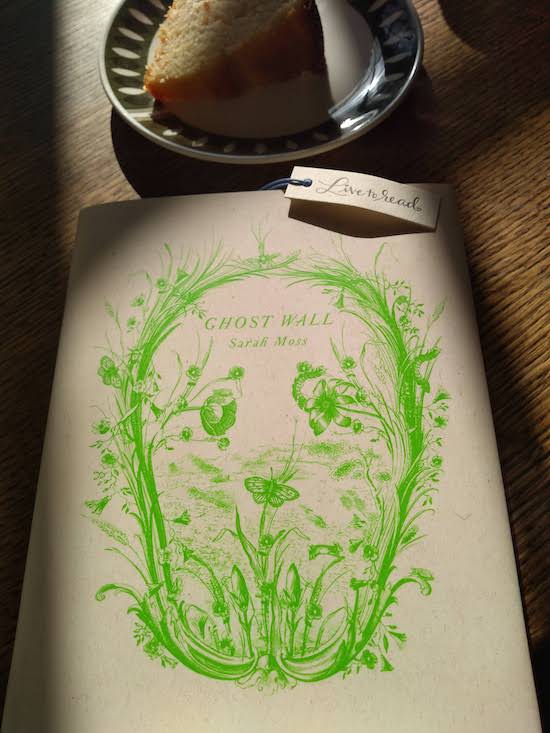
I’ve been avoiding bookshops lately (except for a trip to Type Books’ new location in The Junction in December!) with a focus on reducing the overwhelming number of books on my to-be-read shelf. Which I’ve been pretty successful at with a huge tower of reading completed over the holidays, and also a clear-out of more than a few books that I decided to finally accept that I would never read. And when I finished reading Did You Ever Have a Family, by Bill Clegg, on Saturday morning (acquired from a Little Free Library; has been sitting on my shelf for months; is so incredible but also very sad) and we had no further plans for the day, I decided that what I really, really needed was a bookshop venture, and my family was kind enough to accompany me, obviously with the promise of snacks.
And what a wonderful thing, for me at least, although probably not my family, to arrive at the bookshop without an idea of what I was looking for. Something more uplifting than Did You Ever Have a Family, was my premise, though I wasn’t exactly successful on that front, but then a book need not be uplifting when it is brilliant, original and completely affecting. The book was Sarah Moss’s new novel, Ghost Wall, which only just came out (super exciting—I tend to be either six months or decades behind on all the newest things) and I’d read the review in the Toronto Star that morning. Beginning my Sarah Moss discovery, which I’ve been longing to embark upon on reading Rohan Maitzen’s reviews of her other books, which sound as intriguing as they are wide-ranging.
It’s a slim little novel whose design (in Canada, at least) is delicate and exquisite, a book made up of all kinds of competing tensions. Silvie is a teenager from Northern England whose bus driver father is an Iron Age enthusiast in his spare time, and she’s been raised on his rambles and fascinations of ancient Britons, and therefore knows how to forage for bilberries, which makes her an object of fascination for the university students her family is spending her dad’s annual leave with on their experiential archeology course. The professor and Silvie’s dad couple their skills and knowledge, leaving Silvie with the students, just a few years older than she is, worldly in a way she’s never been able to fathom. Her time with them is a brief reprieve from her father’s rigid control, but then she’s defensive around them, knowing they’re judging her parents’ accents and background. She also knows that aligning them too much will provoke her father’s wrath, whose force and dangerousness gradually becomes more apparent as the narrative progresses and underlines the novel’s idyllic setting and celebration of the natural world with something much more sinister.
Unabashedly feminist, Ghost Wall dares to question what people are really reaching for when they’re yearning for a simpler time, for an authentic kind of culture, or whiteness, or Britishness. Just what is fundamental about who we are and where we come from, and who gets to be in charge of that? It’s sharp, fast-paced, and disturbing, an exercise in minimalism and subtly. I loved it.