March 27, 2023
My Boots Match My Book
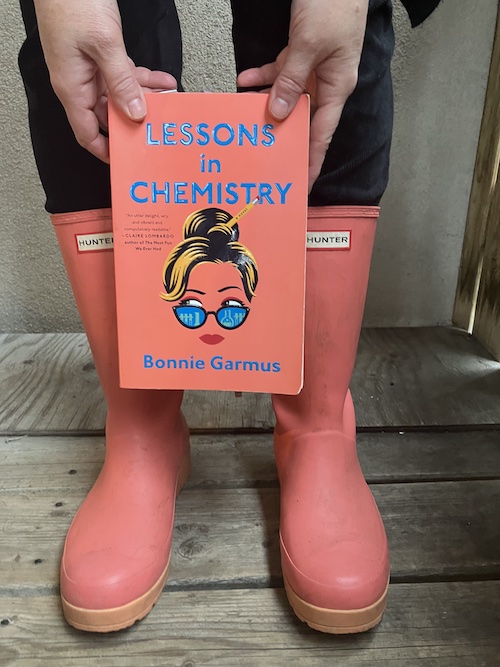
I made up a thing called International Match Your Book to Your Boots Day on the occasion of my wellies being broken out for spring at the same time I’m finally reading Bonnie Garmus’s Lessons in Chemistry, which I started reading yesterday evening and am already more than halfway through. It’s so good—it sparkles. This evening I am aiming to put dinner on the table as early as possible so that I can put on my pyjamas as soon as I can and retire to bed to read the rest of it.
March 23, 2023
Bleed, by Tracey L. Lindeman
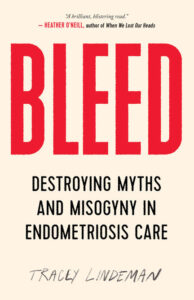
The first time I heard about this book was last fall while I was drinking tea in Jennifer Knoch’s garden and asked her about amazing books she’d edited that were coming down the pipeline, and she talked about BLEED so passionately and made clear that this was a book that everyone should read, not just people with experience suffering with endometriosis.
And then two more people I deeply admire—@aborshpod’s Rachel Cairns and @yellowmanteau (Julie L. Lalonde)—started posting about it on Instagram, weaving its threads into the stories they tell online about reproductive justice and feminism/violence against women respectively—and showing too that all these stories are connected, for worse (because such tangles makes everything so much more *complicated* and difficult to resolve) and also for better (improving healthcare for people with endometriosis means better outcomes for *everyone*).
In BLEED, Lindeman uses a mix of memoir and reporting to show how her brutal and painful experiences with endometriosis since age 11 is representative of the suffering of so many other people, and also how the lack of care endo patients receive highlights sexism, racism, classism, anti-fatness within the medical system. Most doctors aren’t aware of how to diagnose endometriosis, let alone how to treat it—thanks to the influence of pharmaceutical companies, patients are usually given pills before surgery, pills that are ineffectual at best, harmful at worst.
Those who ask for surgery receive push-back from doctors who wish to preserve patients’ fertility, even when patients are adamant that they do not want children. Patients are caught in a catch 22 where they’re able to mask their symptoms and remain high functioning, which comes to undermine their complaints, or else they’re overwhelmed by the physical and mental toll of endometriosis and dismissed as just hysterical.
It was interesting to read BLEED in the context of another book I’ve recently read, Felicia Kornbluh’s A WOMAN’S LIFE IS A HUMAN LIFE about the parallel battles for abortion access (by white middle class feminists) and against forced sterilization (by working class activists of colour). At first glance, these two through-lines seem entire separate, even opposed, from each other, let alone Lindeman’s narrative. In a politics of either/or, black and white, this is certainly the case—but life is not like that. And—as Kornbluh’s book made clear—insisting that it is undermines justice and progress for everybody.
Lindeman’s narrative overlaps with Kornbluh’s when she writes about how birth control drugs were tested on people in Puerto Rico…and then ultimately dispensed in huge amounts to the general public in what purported to be a kind of liberation, but perhaps at a cost that most people don’t like to talk about, mostly because the people who are talking already are religious zealots seeking to control women and also because who wants to be opposed to liberty?
This narrative is messy and demands attention to nuance, and it also challenges me as someone who has mostly been served by the medical establishment so far throughout my life, never meeting with the roadblocks and suffering that becomes standard for Lindeman and others with endometriosis (and PCOS, and a litany of other chronic illnesses, and also [the much feminized and therefore maligned] chronic pain). It’s also a narrative that doesn’t come with neat and tidy ending, for the patients themselves or the system at large. The end of BLEED is just the beginning, after all, of—hopefully—a powerful reset and reimagining of how our medical systems are structured, and what reproductive justice/’my body my choice’ really means.
March 17, 2023
I Have Some Questions for You, by Rebecca Makkai
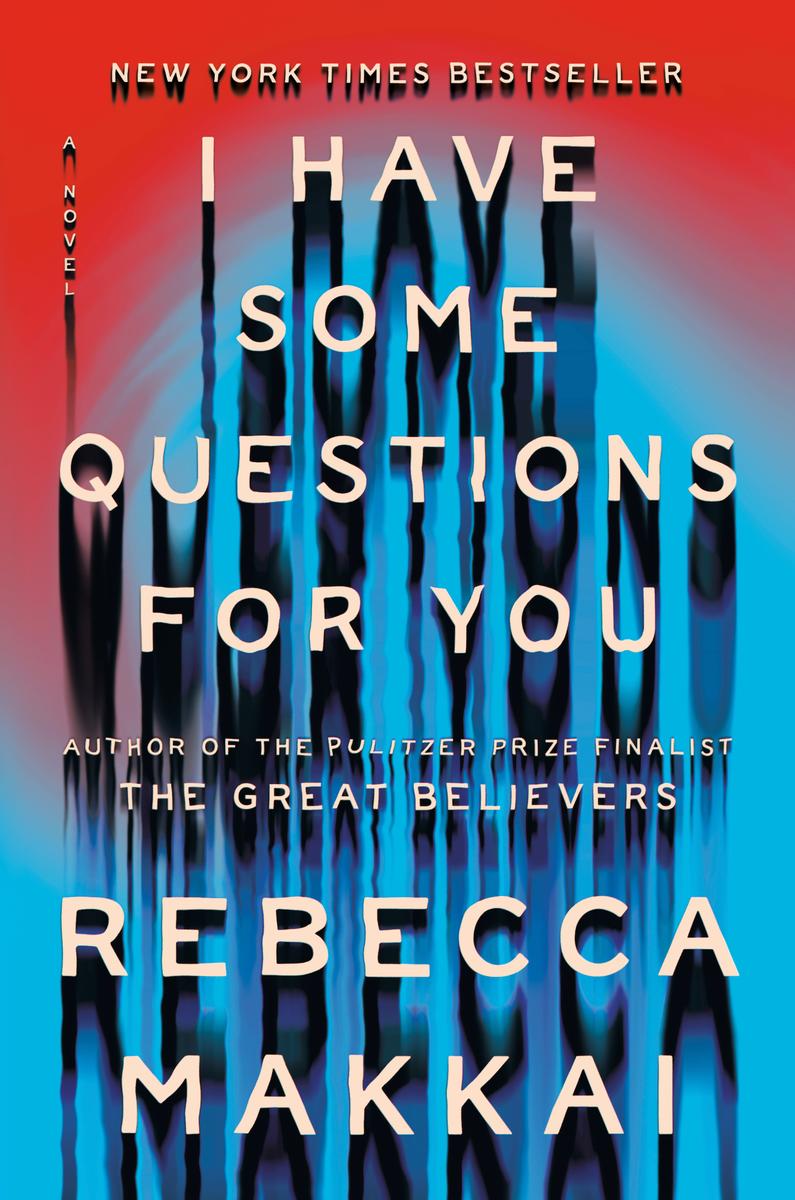
There were some moments in which I felt, reading I Have Some Questions for You, that perhaps Rebcca Makkai was trying to squeeze too much into this book. A novel 400+ pages long, a campus novel, murder mystery, #MeToo/cancel culture moral reckoning, Anti-Black racism and how the justice system is far from just for people of colour. Plus a treatise on true crime podcasts, because Mekkai’s narrator Bodie Kane is a podcaster too, in addition to being a film professor, and she casually rattles off old crime cases: “Wasn’t it the one where she was stabbed in—no. The one where she got in a cab with—different girl. There one where she went to the frat party, the one where he used a stick, the one where he used a hammer…” A story that’s specific and unspecific at once, positively amorpheous.
The specific part of the story is about Bodie returning to the scene of the crime in 2018, which is to say high school, which was, in her case, a mid-grade New Hampshire boarding school she’d been sent to in the 1990s by a benefactor after horrific tragedy had befallen her family in Indiana. Those years were, as high school always is, complicated, Bodie conscious of herself as an outsider, and then, in her senior year, her roommate from the year before is murdered. The school’s athletic assistant was found guilty, and he also happened to be one of the few Black people on campus. By 2018 and deeply steeped in true crime podcasts, Bodie is already mildly obsessed the case as she comes back to Granby to teach seminars on podcasting and film history.
At the same time, her husband (they’re separated; he lives next door/ they get along fine) is being cancelled on Twitter by a somewhat insufferable performance artist, and Bodie is slowly being undone by the complexity of these matters: what is the distance between what her ex is alleged to have done and other instances the prompted us all to #BelieveWomen, plus the absolute bullshit she and her peers had to put up with with in high school from male teachers, and even from each other as rumours spread (but then some of these rumours are what protected students from abusers—how do you ever know what/which women to believe?).
It’s been a busy week and I’ve not had as much time to read this book as I would have liked, to give it the focus it really deserved, so that I could get lost in it, but last night I sat down for a couple of hours to finish it and finally everything clicked, the over-stuffedness, the real answer to whodunnit:
“My point is, you were part of the machine… You drove the getaway car. You threw bricks through the window and someone else grabbed the jewelry. You distracted the feds while the spies got away You held her down while someone else beat her. You shot the deer and wounded it; when the second hunter came along, the deer could no longer run.”
What a marvelous, absorbing, complicated world of a book this is, a literary mystery, and a mirror.
March 6, 2023
Rereading Lucy Barton
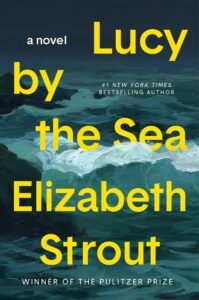
This is a post about a lot of things. It’s about being wrong, and dismissing certain ideas and ways of being, and the question of how one knows what’s good, all of which are actually themes of Elizabeth Strout’s Lucy Barton books, which begins with My Name is Lucy Barton, and continues with the story collection Anything is Possible, Oh, William, and, finally, Lucy By the Sea.
I first read My Name is Lucy Barton in 2016 and, if you’ll recall, I did not like it. I wrote, “I bought the book in hardback, paid $30+ for it and felt I’d paid a lot of money for something slight and unfinished. Which was inherent to the project, I supposed, but I was never able to quite figure out how, or what the point was, or why this wasn’t a novel proper.” At the time, I’d also noted that the book was short enough, however, that maybe I’d go back and read it again…but I didn’t. Even with the subsequent books, I was willing to let Lucy Barton go. But then the books started to be awfully celebrated, appearing on book lists, readers I admire a great deal declaring their love for them, and so this winter I decided to try them again. (No big chore either, they’re all very short!)
And I’ve got to tell you that everything I thought was weird and slight about the Lucy Barton novels is still right there. The downright unfashionableness of the project too, the quiet, the earnestnes, so many exclamation marks!! (!!). Telling, not showing. She’s breaking all the rules I know of how to write a novel well, and it’s my immediate instinct to dismiss these books again. I’m only considering them again because other people are telling me that they’re good, instead of me knowing that in my bones. And isn’t that everything we’re advised against as readers, as critics, as humans? Of following the crowd, reading like sheep?
I fervently believe that so much of what we regard as literary criticism is actually a matter of taste, and I also know that it takes all sorts, and books would be very boring if there were only one kind of book. Other people love books I loathe, and vice versa, and that’s precisely what gives books, and life, and the world, its flavour.
But still, to remain open. This is the object, I think. To stay curious. To look backwards and wonder if there is something you might have missed, some part of the puzzle you might have failed to understand.
What I missed about the Lucy Barton books in the first place is that I don’t think Strout was trying to write the novel as I know it anyway. (Similarly in her celebrated Olive Kitteridge, which was less a collection of linked stories [though it was also that] than an attempt to show the multitudinous of humanity and the universe, and the fundamental unknowability of another human being.) Strout’s books are less an exercise in narrative than one of character, and its variable layers, and the connections between them, and between places, ideas, and things,
Such as that Bob Burgess, who Lucy Barton meets Lucy By the Sea, has his own book, Strout’s 2013 novel The Burgess Boys, which I’ve just put on hold at the library. Or that Olive Kitteridge herself shows up, secondhand, in Lucy By the Sea, in conversations Lucy has with the cleaner from Olive’s apartment building. Or even just the way that one paragraph leads to another, leaping back and forth across time, between focusses and ideas, almost a randomness to their pattern—which had been my impression when I first read My Name is… back in 2016. When I hadn’t known enough to trust that I was in the literary hands of somebody I could trust.
“One of the reasons I believe this memory to be true is, first of all, it was so strange.” —Lucy by the Sea
It is the strangeness, and seeming randomness, of the Lucy Barton books that has me having real difficulty understanding it as fiction, has me struggling to believe that it is not true. Because the strangeness is so lifelike, as opposed to the constructedness of a literary narrative, the sense that a fictional world has to make, or so I assume—and Elizabeth Strout does no such thing.
I had a hard time with with Lucy by the Sea, a novel beginning in March 2020 and set against the unfolding pandemic, which is to say that it got into my head and tapped into my own pandemic (small t) trauma in such a visceral way. I also loved it and found it riveting, because any work of art that can so effectively tap into one’s nervous system is a wondrous thing, but it was upsetting to live that story again, to recall the fear and uncertainty, how dire things were, which is easy to forget now that we’re so much farther down the road.
It’s a novel (like all the others, and Olive too) about relatability, about what happens when we think we know when we don’t, about the limits (maybe?) of understanding people whose life experiences have been different from our own. Or about the ways that knowing and being known can be a burden—Lucy’s relationship to her sister, or even her own daughters, who—she realizes—remain at a remove from her because their own sadness affects her too much.
Books like the Lucy Barton books are never finished, there is no THE END. As Lauren Leblanc writes, “Like in any relationship, there are times in reading these books when certain stories demand attention, and there are times when personal moments are concealed or suppressed. There is inherent pleasure in that mystery. Her books read like familiar friends: complicated, timeless, achingly human, and compassionate.”
Elizabeth Strout doesn’t write novels so much as chart constellations, connecting points of light, moments of grace.
February 28, 2023
Strange Loops, by Liz Harmer
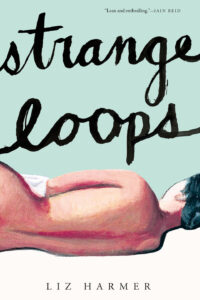
Exquisite and propulsive are the first two words that spring to mind when I think about Liz Harmer’s latest novel, Strange Loops, which I read this weekend and found virtually unputdownable. It’s the story of Francine, a high school teacher involved in an inappropriate relationship with a former student, who is now 18, the power dynamics at play inversely reminiscent of a relationship Francine had during her own teen years with a charismatic pastor at the church Francine’s twin brother Philip had started attending, a church that Francine had followed him to, though she was never the believer that he was, perhaps the reason he’s been angry at her for decades.
The novel moves between three timelines with Philip and Francine’s respective points of view: high school era, present day when both are married with children in their thirties, and a cataclysmic family vacation five years before that during which a storm blew in and everything the twins had been repressing for decades finally exploded to the surface. Are the “strange loops” the two are caught in destined to repeat forever? Does Philip know about Francine’s relationship with her former student? Will he tell her husband? And how does their mother’s own history factor into all this, a small but essential question whose answer is vital to this novel’s tremendous power?
Last summer a Canadian journalist published a misguided memoir that became more than a bit notorious after the fact, a strange and unthoughtful work of revenge, the kind of memoir one might more often encounter in torrid fiction than real life, a book that was mostly remarkable for the questions it posed instead of any of the conclusions it came to. And if that strange memoir had been an excellent novel, it could have been this one, an unsettling story of doubleness, the messiness and irresolvability of power dynamics, and what it means to be a woman who wants, who desires.
February 23, 2023
This is the House That Luke Built, by Violet Browne
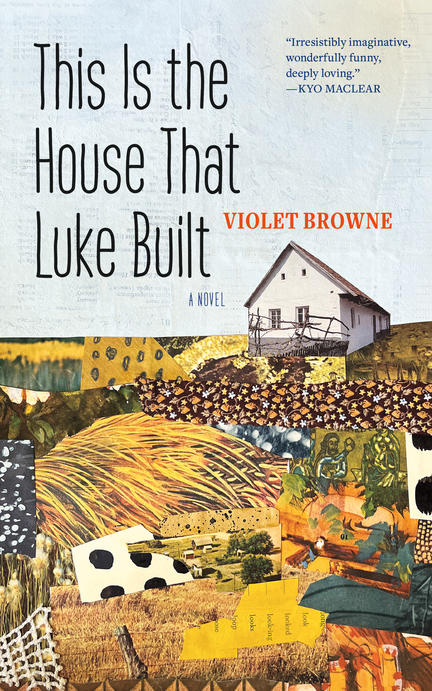
I don’t really know where to start with this book, this brutal, gorgeous, funny, strange and loving story of loss and living, though there is an obvious comparison in terms with subject matter with Lisa Moore’s February, but Violet Browne’s This is the House That Luke Built—fiction born of the author’s own experience—is something altogether its own. Something that, I must confess, I don’t *get* in its entirety, but I’m going to speculate that this is the point, that there are element of Rose’s experience of loss and widowhood that are unfathomable to me, the same way that, I suppose, I once read Rachel Cusk’s A Life’s Work before I’d had children and missed the point altogether.
The novel is told in a series of vignettes moving back and forth through time, showing Rose early in her relationship with Luke as, with her two children and his son, they come together and make a family, baby Emily arriving not long after. We see Emily in 2013: “Every since her father vanished when she was fifty-three days old, Emily’s body has been gripped by a vibration at the molecular level,” an urgency she tries to satiate with tattoos, piercings, as she tries to settle with what was lost to her. 1994, as Luke’s boat goes down in a storm. 1980 with Rose in her father’s boat as a child, in Plancentia, NL.
Mostly though, these vignettes tell the story of Rose trying (and often failing) to pick up the pieces of her family life after Luke’s death, how time marches on, how her parents and her sister keep her going, as do her children, with their own needs and particular wounds that become clearer over time. But she ends up eking out some kind of a deal with the fates, that every year on the anniversary of Luke’s death, Rose gets to walk through the wall of the house he’d built for their family and find him waiting there for her, though it’s a deal she must pay dearly for—in exchange, she’s aging faster, losing years of her life, her teeth decaying, her skin losing its definition. Until eventually she’s asked for too much…
I love this book, just as heartbreaking as it is hilarious, full of gorgeous prose, and gutsy women, and so much love, even in the face of so much loss, maybe especially. Rose’s struggles to raise her kids and make a better life for herself are harrowing and awesome, and the flame that continues to burn for the husband she lost is sustaining, transformative, unforgettable.
February 21, 2023
Blackwater Falls, by Ausma Zehanat Khan
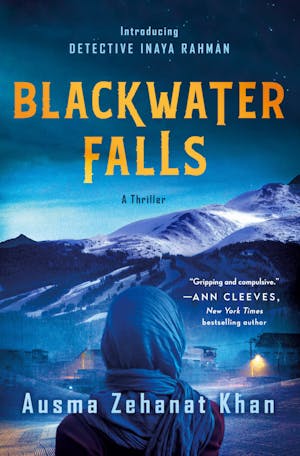
Blackwater Falls launches a new mystery series by Ausma Zehanat Khan, whose Esa Khattak/Rachel Getty books I enjoyed very much, this new series set in Colorado, where British-born Canadian Khan now makes her home, and with Detective Inaya Rahman at the helm. This is a novel very aware of itself as a police procedural post-2020, just as Rahman herself is aware of her complicity as part of a system that neither serves nor protects people of colour.
And it’s not just (B)lack and white, literally, or otherwise. Detective Rahman, a member of the police’s Community Response Team, is brought in after the body of a teenage girl, Razan, a Syrian refugee, is found murdered and bizarrely displayed at the entrance to her mosque in the rural town of Blackwater Falls, CO. A gang of menacing bikers linked to the local Evangelical church lend an aura of menace to the case, plus a local Black activist is furious that this one murdered teen is garnering so much attention, while two other cases of Muslim teens missing from the local Somali community have not even warranted an investigation, have been shrugged off as merely runaways.
Detective Rahman has to gain the trust of local Muslim communities, work toward finding Razan’s killer, tiptoe around the local Sheriff with white supremacist leanings, and also make sense of her superior, Detective Waqa Seif, who keeps obstructing her investigation in curious ways—is he working for the Sheriff, perhaps, or is there some other secret that he’s hiding?
Meanwhile, Detective Rahman is still dealing with PTSD from a violent assault by her police colleagues at her previous job in Chicago, a retaliation for her efforts to hold an officer to account for the killing of a Black man at a traffic stop. And Khan’s depiction of this assault, told through a flashback, was one of the most devastating, affecting bits of fiction I’ve encountered in a book lately—some readers may want to take care.
This novel by Khan—who holds a PhD in international human rights law—is very much a story of our time, from white supremacy, police brutality, Black Lives Matter, border policy, refugee struggles and more, right down to the inhumane working conditions in meatpacking plants that has resulted in so much death due to Covid-19 over the last three years. And yet this isn’t a book that gets bogged down in the issues, perhaps because Khan goes out of her way to have her story show the interconnectedness of all of these ideas and the way they affect people’s lives and communities. The stakes—both in the novel and in reality—are huge.
February 6, 2023
What Remains of Elsie Jane, by Chelsea Wakelyn
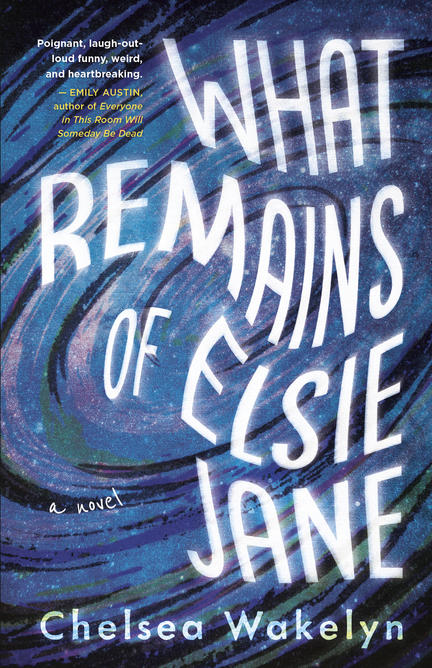
Chelsea Wakelyn’s debut novel WHAT REMAINS OF ELSIE-JANE reads a bit like Joan Didion’s THE YEAR OF MAGICAL THINKING, but narrated by someone who is not a cool customer, instead a human being wracked with pain and grief and lust and longing after the death of a partner from drug poisoning, a loss that has left Elsie Jane with a backyard full of weeds, an addiction to dating apps, and two small children who need feeding and caring day-after-day, and Elsie Jane is hanging on, just barely. Or not really at all…but then she decides to contact a space-time wizard via Craigslist who can help her return to the dimension where Sam lives and Elsie Jane’s life was still whole and functioning, and her biggest struggles were with Sam’s drinking and also the grief she carried from the deaths of her parents, back when she thought that constituted “the worst.”
This novel about death just pulses with life, with a force as compelling as the one that kept me turning the pages. It reminded me a lot of Rebecca Woolf’s memoir ALL OF THIS, about a complicated widowhood, brutally honest and beautifully human. I absolutely adored it.
February 2, 2023
Brotherless Night, by V.V. Ganeshanathan
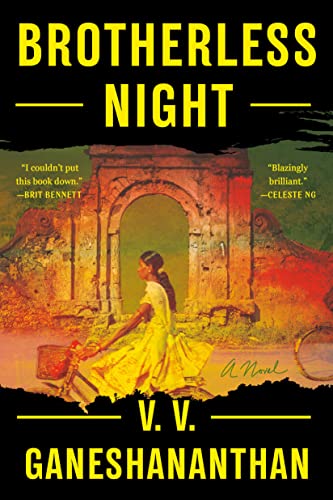
In her novel Brotherless Night, V.V. Ganeshananthan writes about the way that Tamil fighters would take over ordinary homes in 1980s’ Sri Lanka, during that country’s brutal, decades-long civil war, and how, when they were finished with these spaces, they’d leave them laden with traps and mines, which seems like an appropriate metaphor for what such tumult, violence and devastation from civil war does to the notion of home in general. Though I suspect Ganeshananthan’s protagonist, Sashi, would have something to say about my employment of metaphor at all, about my liberty to have one thing stand for another, war being, for me, an abstract concept, which is something Sashi doesn’t take for granted in her telling: “Imagine the places you grew up, the places you studied, places that belonged to your people, burned. But I should stop pretending that I know you. Perhaps you do not have to imagine. Perhaps your library, too, went up in smoke.”
I learned so much from Brotherless Night, a story whose title comes from Sashi’s loss of her revered elder brothers to violence and also from how even those with loyalty to the cause of Tamil freedom were used and made to suffer in its name. And while the specifics of the political events, between 1980 and 1989, were new to me, the overall narrative is a familiar one—of people yearning for liberation, about noble causes hijacked by ego and violence, and how women are always collateral damage in war, the ways in which their suffering, by some, is simply expected.
When the story begins, Sashi is dreaming of becoming a doctor, following her elder brother in this dream, and her greatest hardship is that her father has forbidden her and her brothers to ride their bicycles against the backdrop of political tension. And as the tension builds and violence and ensuing traumas begin to rob Sashi of her innocence and her youth, ordinary life proceeds as best it can—when most electricity is no longer functioning in Jaffna, Sashi and her medical school colleagues gather by the hospital with their school books to study under the outdoor lights there.
Eventually Sashi takes a job working in a Tigers field hospital, dismayed by what their cause has done to the boys she’s grown up with, including her own brothers, but also feeling obligated to offer care to any person who needs it. All the while, however, she works with her charismatic feminist professor to keep an apolitical record of atrocities committed by all sides in this complicated conflict, which means that eventually her protection by the Tigers is compromised.
As much as Sashi’s story itself was fascinating and illuminating for me, however, it’s the way she tells it that is the most compelling aspect of the narrative, instances of direct address (such as the passage about the burning library above), her evasions, her unwillingness to choose definitiveness, and also her acknowledge of how language and translation complicates and obscures—the nuances of Tamil that cannot be conveyed in English, all those parts of this story that those of us reading from a distance will never actually understand.
Beautiful, devastating, brutal and meticulous at once, Brotherless Night is a read that’s unforgettable.
January 27, 2023
Small World, by Laura Zigman
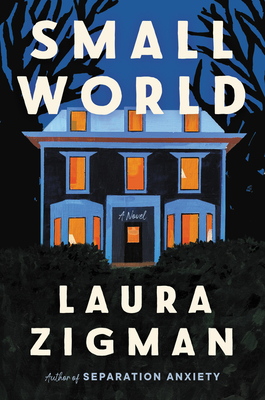
I’ve never read Laura Zigman before so I don’t really know what I was expecting with her new novel, Small World, which is weird, because I’d read her interview with Lauren LeBlanc, what turned me onto the novel in the first place, so I knew that this was a story of a divorcee on the cusp of 50 whose sister moves in with her after many years of a continent between them, and that their coming together again prompts a reevaluation of a childhood spent in the shadow of their sister Eleanor, who was born in between them and lived with disabilities until her death which led to the end of their parents’ marriage and their mother’s fervid mix of despair at this loss and years of activism in a fight for disability inclusion.
But I didn’t know how such a book could turn out to be so funny, how sisters Joyce and Lydia could turn out to be both be so difficult (with each other, and the world in general) in such different ways, and how this story that weaves back and forth between the sisters’ childhood and the present day could be so perfectly complemented by the inclusion of found prose poems Joyce has taken from posts on a Neighbourhood app called Small World, similar to Nextdoor:
INCONSIDERATE NOISE
I’ve lived on what used to be
a quiet street in
West Cambridge
I say “used to” because
recently
two families with young children
moved in
and destroyed the peacefulness of the street…
The tension between Joyce and Lydia remains unaddressed until the arrival of new upstairs neighbours operating a yoga studio/wellness centre above their living room forces things to a head, Joyce frustrated by the neighbours’ lack of adherence to rules and general decency, and by Lydia’s lack of support as she tries to resist their friendly overtures, and things between them get even weirder and uncomfortable, but their childhoods made for weird and uncomfortable, for them, a most familiar terrain, and it’s here where they finally begin to understand how much they lost and also never really realized they had during the years they had Eleanor and afterwards.
This is a novel about inclusion on all kinds of levels, about how both sisters felt removed from their mother’s connection to Eleanor, and from the family life that had Eleanor’s care at the centre, and about what community means and what family means and the impossible standards people (mothers in particular) are forced to live up to, and those miraculous people who see us, who save us.






