November 12, 2006
The Emperor's Children by Claire Messud
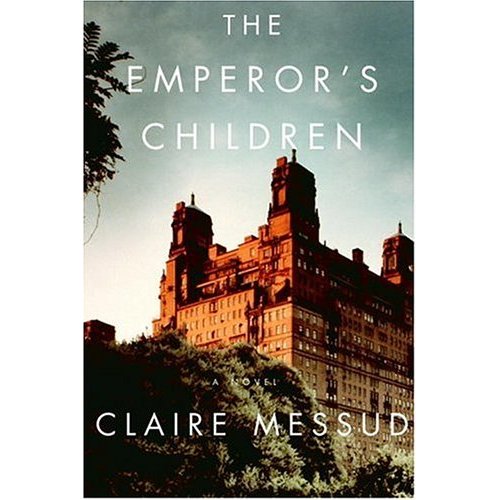 When I said that I read novels cheaply, what I meant was that I am usually more concerned with how it was to read a book than what the book stands up for once it’s done. I don’t mean that the latter is unimportant, or that I haven’t worked through my share of difficult novels in my time, but for me the optimum reading experience is for a book to be a pleasure. And really, The Emperor’s Children was.
I chose to read this book after reading this profile of Messud, whose work I’d never come across before. As I said previously, at 430 pages this book is not insubstantial, and I found it difficult to get into initially. Messud introduces each character and every room with an itemized description, which is disconcerting. If she’d been more brief, I could have filled in the blanks, but the paragraph-long listings of facial composition etc. I tended to gloss over. I said ick initally, or at least yawn. Encountering the main characters: three college friends now age thirty, pulling their lives together in New York City during the Spring of 2001. And I don’t know if Messud’s writing relaxed, or if I did, but I was hooked by page 100 and devastated that page 431 was blank.
What Messud manages to do so skillfully is demonstrate the sheer stupidity that was the summer of 2001. I remember: there was an environmental summit, and Chandra Levy. Messud’s character Danielle is producing a documentary about botched plastic surgery. Like Ian McEwan’s Saturday, Messud creates an incredible suspense from the quotidian, though of course in this book we know exactly which inevitable doom is headed. “Nobody could have foreseen this” someone comments, after September 11th and the twin towers have fallen. But of course as readers, we have foreseen it from the start.
A funny, satirical and intelligent novel that seems an encapsulation of the 1990s and a bit of a love letter to New York. Messud’s characters surprised me with their flaws and complexity, and also identifiability. I wanted to issue them a warning all the way through (“It’s behind you!”). Messud handles the terrorists attacks and their aftermath in a way that is neither overdone nor restrained. This is the first time I’ve encountered 9/11 in fiction, which was an eerie experience, and distanced the events from real life in a sense. Something I watched on real time (albeit on TV) stuck in a novel, which sort of made me feel like I’d just imagined it. But not really, of course, and this is a wonderful novel. Please note that it didn’t surprise me to learn that Messud considers Portrait of a Lady a formative read.
November 3, 2006
Moral Disorder by Margaret Atwood

1) In 2006, the prolific Margaret Atwood has released three books: The Penelopiad which reworks the Ulysses myth from Penelope’s point of view; The Tent, a collection of fable-like stories and poems; and Moral Disorder, a collection of connected short stories. I’ve read them all. They were all excellent. Most people are lucky to publish three good books in a lifetime.
2) Last night, as we were lying in bed, I read my husband the story “Moral Disorder” from the book of the same name. My husband and I don’t usually read to one another; we’re just not that way inclined. Originally, I just wanted to read him a passage from the story but I couldn’t stop and he didn’t want me to, and by the end of the story we were laughing so hard, we were crying. The best bit was the haunted peacock. This is Margaret Atwood. Remember Margaret Atwood- the dark, bleak, feminist man-hater (as you no doubt learned when you read Handmaid’s Tale at school?) Margaret Atwood is a first class comedian.
3) At the end of her story “The Entities”, Margaret Atwood writes, “But what else could I do with all that? thinks Nell, wending her way back to her own house. All that anxiety and anger, those dubious good intentions, those tangled lives, that blood. I can tell about it or I can bury it. In the end, we’ll all become stories. Or else we’ll become entities. Maybe it’s the same.” I cite this passage, as Moral Disorder has been remarked on profusely for being quite autobiographical in its content, and herein lies the clue. I don’t see this book as autobiographical, but it is clear thoughout Atwood’s oeuvre that she mines her own life for stuff. Not her own experiences particularly, although they do appear, but more objects and settings. Having just read Cat’s Eye, Moral Disorder, and now rereading Lady Oracle, this is quite apparent. And I think it’s really fascinating to understand the different ways authors use their own lives in their work, and rather than supplying us with the story of Atwood, Moral Disorder provides insight into this process.
4) In addition, I don’t think a story such as “Moral Disorder” could have been written unless it came from some experience, or combination of experience. That sort of story is too absurd to be imagined, and could only be captured by someone who has lived through it. I’m just guessing.
5) I think Moral Disorder is essentially a novel. The stories all could stand alone (and they do– I’d read two in previous Toronto Life Fiction Issues) but the links are essential, a chronology is present. This book is a novel in the way that Lives of Girls and Women is a novel, though I think as a novel Atwood’s book actually works better.
6) I have written this entry as a list, to reflect my confusion about short story collections and how they should be reviewed. I could treat this book like the novel I believe it is, and sum up the narrative trajectory, but somehow that feels cheap. And my automatic response to this work was indeed rent and chaptered, as you can see. So it’s not completely a novel, but I stress its novel-like tendencies so those of you who dislike short story collections will not be put off this most excellent reading experience.
7) I could say this. Some short stories are not meant for collection, and might be happier wandering free. The stories in Moral Disorder, on the other hand, belong together. They centre around a character called Nell, and begin with the story “Bad News” in a present day, which takes a page from The Tent in form and content, I thought. From the second story, we return to Nell’s childhood and the stories continue in first-person until about half-way through when I becomes Nell (and her house is possessed by a lovesick peacock). She grows up, falls in love, struggles with the realities of modern love ala David Bowie (well, no David Bowie but you know, it’s the seventies). The last two stories of the collection beautifully deal with the decline of Nell’s parents and her relationships with them, and contribute to the circular structure of this collection. A fascinating dynamic is apparent, as Nell is caring for the ailing parents and their roles are reversed, and yet she is more a child than she ever was, because this is how they know and remember her.
8) This was a deeply satisfying book.
October 29, 2006
Book Showers!
Goodbye Without Leaving was my favourite Laurie Colwin novel yet. I read it with delight, and it managed to talk about big things in a way that sat easily. Her writing is strong, and she writes narrators that confound me with their utter unclassifiability. You should read Laurie Colwin. I mean you. She’s pretty likeable. Finished Nixon in China, which was a fascinating reading. MacMillan is so clever that she gets to impart gossip and call it scholarship, but of course there is more than that. Apart from Nixon’s trip itself, I learned so many things about the history of Taiwan, Nixon and Kissenger, diplomacy in general (the word “obsequious” kept coming up), and appreciated the Asian lessons, especially considering how much the region has been in the news lately. Now reading Atwood’s Survival to fill that gap in my CanLit knowledge. It’s a delight, actually, and I’m out to embark on an Atwood kick for academic reasons, featuring (for nonacademic reasons) her latest Moral Disorder so stay tuned!
October 23, 2006
The Thirteenth Tale by Diane Setterfield

I think some of my insomnia last night could be attributed to the fact that I was on the cusp of finishing The Thirteenth Tale by Diane Setterfield, which I’ve just got to the bottom of now. Remarkable before anything else is how positively bookish is The Thirteenth Tale. It’s such a pretty book with a pile of books gorgeously illustrated on the dustjacket, and wonderful old-school patterned endpapers. Story starts in an antiquarian bookshop, narrated by a biographer about the life of a famous writer. Numerous 19th century novels are alluded to throughout, which would be especially charming to fans to such novels. And here we’ve also got a good old-fashioned mystery, with something a bit genre about it. So Setterfield is basically appealing to dorks the world over, but the mainstream will also approve, which is probably why she’s has got herself a flying-off-the-shelves bestseller.
Now The Thirteenth Tale is not a flawless novel. It’s Setterfield’s first book, which is sometimes written all over its pages, and the prose was clunky in places. I get the sense that its charm is its greatest appeal; I certainly loved it for its bookishness. Amateur biographer Margaret Lea, raised in a bookshop, is summoned to write the biography of Vita Winter, “this century’s Dickens”. Winter doesn’t get fast to the point, and by her story, we are led round in circles. This is a story of twinship, dilapitated manor houses, incest, madwomen stowed in various parts of houses, ghosts, murderers, wayward governesses and foundlings. Setterfield plays her fairly conventional material in new and surprising ways, with excellent control as the circles begin to tighten and we zero in on all unsaid. With the sort of plot that has been twisted time and time again, Setterfield manages to twist hers in a new way and I admit that I didn’t see it coming.
I am curious to see what Setterfield will do next. How will she fare with a more conventional form of literary fiction? Will she pull off something similar in her next book? In terms of novelty, she will be hardpressed to out-do The Thirteenth Tale, and she could possibly produce something absolutely awful in an effort to do so. Her story is interesting- read her profile in The Guardian. Of course, we judge her by what she’s done, not by what she’s yet to do. Setterfield might just be a flash in the pan, but The Thirteenth Tale is still a pretty entertaining read.
October 15, 2006
One Good Turn
I’ve raved about Kate Atkinson before, when I read Case Histories last summer and when I reread Behind The Scenes at the Museum in August. She writes with the social and historical awareness of Margaret Drabble, but with the dark edge of Hilary Mantel, though of course her works are also startlingly original (and challenge genres). Kate Atkinson has yet to fail me, and in her new novel One Good Turn, she has truly crafted what her subtitle suggests: “a jolly good mystery”.
Yes, indeed, a mystery. I have spoken to fans of early-Atkinson who’ve gone off her a bit since her characters took up sleuthing, but none of them had actually read the books in question (Case Histories, and now its companion One Good Turn [though the two books both stand up alone]). I am no mystery fan (my interest sort of waned with Nate the Great) but I’ll read anything by Kate Atkinson, and moreover Behind the Scenes… really had a mystery at its heart. The genre suits Atkinson well, and she writes with her signature wit and brilliance.
In One Good Turn, Atkinson expects her readers to hang on tight, because the ride goes so fast. Jackson Brodie from Case Histories has stumbled onto a whole new batch of mystery at the Edinburgh Festival, but he is just one character in an excellent ensemble which includes a suburban housewife with a trick up her sleeve, a ruthless Russian call-girl, a fourteen year-old shoplifter and has-been comedian. Atkinson’s tongue-in-cheek depiction of the publishing world is particularly humourous, as seen by a writer of a particularly bad mystery series, and the book’s subtle CSI references indicate that Atkinson is very aware of the world she’s writing in. The story itself is so tight, admirable considering how many pieces had to be tied together in the end. The pace is quick, twists are so surprising, the end was a stunner. One Good Turn was simply a delight.
October 13, 2006
Freaky
Got a terrible case of the lurgy; we’ve had snowstorms already and last night the power was out for six hours, so we went out to Mexitaco at Bloor and Shaw, which was fun, and then we came home and I had to read by candlelight, re-rereading actually- Away by Jane Urquhart (pour l’ecole).
Ne pas pour l’ecole, I just finished reading Blue Angel by Francine Prose, and it was incredible. Written in third-person, Prose gives an illusion of objectivity that duped me at times, and once I realized I’d been taken in, I felt sort of dirty. The narrative voice was an absolute feat, but moreover the book was funny, smart and twisted, and the writing workshop was priceless. The satire was complicated and many-edged, and left me feeling uneasy, which, coming from a bundle of paper, is a powerful impact.
October 6, 2006
The Creation
I suppose my interest in scientific literature had something to do with my husband’s B.Sc., but I mark the start of its development with the story “Miss Ormerod” by Virginia Woolf, from The Common Reader Vol. 1.. “Miss Ormerod” was 19th Century British entomologist Eleanor Ormerod and Woolf’s fictionalized biography demonstrated to me how well a passion for science translates into good literature. Fortuitously, I was signed up for a course called “Literature and the Environment” the next term, and I went on to read such works as Walden, Pilgrim at Tinker Creek, Servants of the Map, and last summer I read The Selfish Gene and Silent Spring. Last night I finished reading The Creation* by Edward O Wilson and it’s my favourite piece of SciLit yet.
The Creation is written as a letter to Southern Baptist Preacher, pleading not for common ground, but for a common cause: The Stewardship of Creation. The situation is dire, Wilson admits in gorgeous prose, but it is not too late, and he goes on to state his case in chapters including “Ascending to Nature”, “Exploration of a Little-Known Planet”, “How to Learn Biology and How to Teach it”, “How to Raise a Naturalist” and finally, “An Alliance for Life”.
Like Ormerod, Wilson is an entomologist and magnifies the amazing world of insects, this “microwilderness”. All living ants (there may be 10 thousand trillion) weigh as much as the Earth’s population of human beings. That there are more bacteria cells in our bodies than our own cells, and by some perspectives we could be seen as solely their vessals. He writes, “Each species is a small universe in itself, from its genetic code to its anatomy, behaviour, life cycle, and environmental role, and a self-perpetuating system created during an almost unimaginably complicated evolutionary history. Each species merits careers of scientific study and celebration by historians and poets. Nothing of that kind could be said for each proton or hydrogen atom. That, in a nutshell Pastor, is the compelling moral argument from science for saving Creation”. (123)
*Wilson is listed as “E Wilson” on the amazon listing, which means he is not linked to his myriad other works, which appear as authored by “Edward O Wilson”