December 15, 2006
Half of a Yellow Sun
 I can’t imagine what a writer must be fighting with when she sits down to write about a war. How do you fashion a narrative that is not simply an excuse for the backdrop? How can you have characters in all their multiplicity? How do you write about brutality and deprivation, and love, and beauty, all within the same book? In Half of a Yellow Sun, Chimamanda Ngozi Adichie has crafted an extraordinary tale, and craft is truly the word. This novel tells the story of Biafra, an independent state formed within Nigeria in 1967, and the civil war that followed before the Republic’s fall in 1970. I’d never heard of Biafra before, and the reason I will never forget it is Ugwu, Olanna and Richard, for this book is their story as much as it is Biafra’s. And this is Adichie’s feat, for it is their stories which awoke Biafra to my ignorant mind. The brutality within this book would have been unrelenting, were it not for broken chronology and alternating narrators with every chapter. The result is a structure which accomodates the vastness of this project, but also facilitates the reader’s engagement with the narrative and each character. What I found most incredible was Adichie’s capacity to generate sympathy for characters who did terrible things, which is essential, in that broken couples had to go on together, and that Biafrans and Nigerians had to learn to live together again once the war was over.
I come away from this book with a similar impression to that I had after reading Sweetness in the Belly— that I had gained an education as much as a story. I remain startlingly ignorant about Africa, and I don’t claim that a novel is any sort of tool toward substantial identification, but I still think that fiction is the best place to go for knowledge. It’s not about empathy, but it’s about learning. That this happened in the world, but I never knew. And thanks to Adichie, I don’t think I’ll ever forget.
December 11, 2006
Not the End of the World by Kate Atkinson
 After I had read just three of her novels, Kate Atkinson was added to my list of favourite writers, and I am currently exploring the rest of her work with glee. Her collection of short stories Not the End of the World(2003) was a brilliant read, fun and a bit mind-bending. My favourite thing about this collection was its collectionness. These stories belong together, linked through different characters’ relationships. A passing reference in one story might become the main character in another, which makes for an engaging reading process (and much rereading to understand the emphasis of what you might have passed over the first time). The stories are also link through a theme of “end of the worldness”, though this is interpreted in such various ways that the collection is entirely diverse and at times surprising. She is remarkably adept at portraying lost and loneliness, and she is so edgy, and yet humour ever-present. Some of the stories straddle a strange place in between magic and realist, but I soon found myself trusting Atkinson and her universe entirely. She is a distinctly literary writer, as evidenced by the numerous classical allusions woven throughout the text, but these stories are also heavy in terms of Buffy-content (the vampire slaying variety). These contrasts underline Kate Atkinson’s fundamental unclassifiability, and so we’ll just have to file her (and this book) under “wonderful”.
December 10, 2006
Heartburn/Not the End of the World
Reading Nora Ephron’s Heartburn was a treat. Like her essays, the novel straddles an “in-between space” that doesn’t quite fit into any genre, but she’s such a funny woman and the story is hilariously absurd. The novel is like candy, but really expensive well-made candy. And it’s one of many novels I’ve read lately that have made me wish I knew more Hebrew. So it goes. Now reading Not the End of the World by the brilliant Kate Atkinson and I expect it will be “bloody marvelous”.
December 7, 2006
The Remains of the Day
I just finished reading The Remains of the Day, which in its subtlety just snuck up on me and stole the ground. I’ve lately been thinking about negative capability, and I think this book answered so many questions. A most powerful whisper, and I’m not quite myself as a result of having overheard it.
December 3, 2006
Remarkable Voices
And so it continues. The papers are slowly getting marked, my essay is slowly getting written, and my creative work too. Everything is on schedule, plus I sent all my Christmas cards yesterday and my shopping is done except for Stuart, which is easy anyway. Today I am taking a lunch break and we’re going out for sushi with two lovely new friends we’re quite excited to see again. History of Love was magnificent, though the ending was not quite what I would have liked but the rest of the book was so amazing, I wasn’t really bothered. Oh, the voices she made. Quite remarkable, I think, and so remark I do. I’m starting The Remains of the Day and I’ve not idea what to expect. I am sorry that all of this is duller than even usual, but this is it at the moment.
November 30, 2006
The Uses of Enchantment
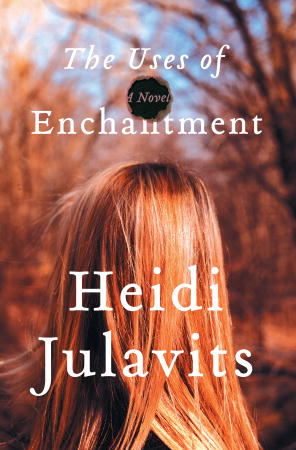 I don’t know what to do with Heidi Julavits’ The Uses of Enchantment. I mean, what a strange book. I’ve not read Julavits’ two previous novels, but the customer reviews I’ve read for them usually mention general weirdness and Julavits biting off more than she can chew. I get the sense that Julavits is chewing better now, but still, it’s quite a mouthful (this metaphor ends here, I say).
So, we’ve got the mysterious disappearence of a teenager, all right. Whose mysterious disappearence is repetitious of another teenager’s disappearence ten years before. Both girls obsessed with a seventeenth century story of a girl abducted by Indians, whose rescuer was subsequently hanged as a witch. And the first girl is apparently descended from a Salem witch. And she returns home fifteen years later after her mother’s funeral, in order to resolve what happened to her. And most of the narrative is played out through the rivalry of two psychotherapists with opposing missions. Incredibly intertextual, though the only text I was familar with was Dora. And that’s about it, I think. All in one book. It really doesn’t make sense until you read it.
And so I’m mystified, but I still enjoyed this book. There is a race to the end, and I think Julavits’ climax is worthy of the suspense she creates, and I found the ending satisfying. The main character (the derivatively disappeared girl, Mary Veal) is impossible to pin down, though this is created more by Julavits narrative than what the characters says or does. In fact, sometimes too much explanation is given and I wished the story had remained a bit more “enchanted”. Which is the problem. Julavits introduces so many fascinating avenues in her story, that of course many remain insufficiently explored. This isn’t completely annoying, because on a whole this book manages to function (I have no idea how though).
My confusion is somewhat akin to enchantment though. Whatever Heidi Julavits did, she did it right. I also like how when you remove the dust jacket of this book, in gold script on the black cover it simply says, “A Novel”. Indeed it is. Sort of.
November 28, 2006
Bloodletting & Miraculous Cures
 I’m not sure if it’s common to race to the end of a short story collection, but last night there I was, way up past bedtime reading Vincent Lam’s Bloodletting and Miraculous Cures (winner of this year’s Giller Prize). I wasn’t expecting to find this book enthralling; it had been pitched like an episode of ER. But Lam’s stories work, they really do, and they are connected in a way that provides this collection with a gripping narrative arc.
I’ve mentioned before that I find literature about science interesting, but the science wasn’t what hooked me here. I think more so, I appreciated a glimpse into the consciousness of a scientist, or more-interestingly, the aspiring scientist– the student desperate to get into med school. I knew people like this in university and Lam has provided good insight into their motivations and mindset with Ming’s character in the story “How to Get Into Medical School Part 1”. Her portrayal is so convincing, and at once sympathetic and awful, but this effectiveness is also the product of a well constructed short story. Similarly, in the story “Winston”, a patient’s mental health problems cast a mesmerizing spell and the twist at the end was shocking, particularly in the context of a dry and measured medical account. Purple birds do appear throughout this book in some of the most surprising places. I loved the SARS story “Contact Tracing”, which was full of action, suspense and human emotion. Not one story here could have been considered a dud, though a few did begin to drag a bit before they ended.
I had a problem with the didacticism of the text, however. Suggested by the book’s title and chapter titles beginning with “How to…”, but I didn’t take these clues all that seriously. Here we have a book of stories, I thought. I can read stories, and I did, and though it was about a world somewhat unfamiliar to me, I trusted my intelligence enough to fill in the blanks and get the gists. And then at the end of the book, I was gutted to find a “Glossary of Terms”. Seemed somehow patronizing, and unnecessary. I wasn’t reading this text as a tool, and I don’t think stories require indices usually. The stories should stand well enough on their own (and they do), but the inclusion of a glossary suggests Lam is second-guessing that they do, or he is second-guessing my own ability to read his stories without assistance.
I suspect, however, that the glossary is provided to emphasise this collection’s unique pigeonhole: from the point of view of an emergency room physician. Though it is notable that such an emphasis had previously led me to dismiss this book pre-reading as gimmicky and perhaps dull. And I was wrong. Here is a work of literature; they could be about the lives of doctors or dustbins, but these are stories and they’re good. Perhaps what was most disappointing about the “Glossary of Terms” was that I had figured I had a whole other story still ahead, and then was unhappy to find the book so suddenly done. Which does say something about the collection Lam has managed to create.
November 22, 2006
I Feel Bad About My Neck by Nora Ephron
 I think some of I Feel Bad About My Neck: And Other Thoughts on Being a Woman by Nora Ephron is lost on me. I don’t feel bad about my neck, I’ve got four grey hairs, and according to Ephron, I’m still in the heart of my bikini years, and so perhaps I miss what is most wise about her wisdom. I love her writing though, and I liked this book. It’s essential to note that I read it last evening in the bathtub. More essentially, however, I cared if it fell in. It didn’t and I think I’m going to lend it to my mother.
I read Ephron’s Collected Essays early this Fall, after reading her newest book being hyped by Heather Mallick and Jennifer Weiner. The new book is written in the same funny and conversational tone as the essays, with an emphasis on what it is to be a woman in her sixties. Obviously, Ephron feels bad about her neck. But she also reflects on marriage, parenthood, cooking, reading and living in New York. This book had a bit of the appeal of The Year of Magical Thinking, in that it is a glimpse into a pretty brilliant life (because I too want a five bedroom apartment in New York City).
Its lightness is deceptive, however, with an edge most apparent in the final essay “Considering the Alternative” about when your friends start dying and you stop skimping on bath oil. “On Maintenence” is an eye-opening treatise on beauty regimines. Ephron believes she was the only White House Intern JFK never made a pass at, and in fact during her tenure there, nobody even bothered to give her a chair. Oh, she’s funny and she’s got stories to tell. Sometimes I wish she’d tell them in a way that was less flip and throwaway, but such is the essay form we are working with here. I am looking forward to reading her novel and finding out how her voice translates into fiction, and I suspect I’ll come away satisfied.
November 19, 2006
After Words
Da Vinci Code was abandoned after thirty pages because it seemed too long and uncompelling to finish. If it were the last book on earth, however, I’d definitely read to the end. I am tired/hung over as to be incoherent. In this sort of mood, I giggle a lot and Stuart seems like a comedy genius. Because he is. We’ve had a brilliant whirlwind of a weekend and it was wonderful to be a part of it. Wedding was beautiful, bride was stunning, groom handsome, weather was fine, fun was had, company was nice, food was good, husband was danced with, party was excellent and indeed, the whole thing was a sweet dream and I’ll remember it for the rest of my life. There is nothing better than seeing your friend with somebody so perfect for her.
The only fairy tale element absent was the horse and buggy. Katie was forbidden one, because of P. Bernardo’s strictly early 90s wedding.
November 17, 2006
Bewilderment
From the wonderful Interpreter of Maladies: “While the astronauts, heroes forever, spent mere hours on the moon, I have remained in this new world for nearly thirty years. I know that my achievement is quite ordinary. I am not the only man to seek his fortune far from home, and certainly I am not the first. Still, there are times I am bewildered by each mile I have traveled, each meal I have eaten, each person I have known, each room in which I have slept. As ordinary as it all appears, there are times when it is beyond my imagination.”