February 13, 2014
Books for Family Day
Family Day: the statutory holiday that makes February almost endurable. Though as the holiday is still new and as a concept is sort of vague (beyond the “stay home from work and school” part), we’re all still defining what this day is all about. So how about: this is a day for settling your kids around you on the chesterfield as you read these excellent books that celebrate family ties.
The families in some of these picture books will be mirrors of your own, while others will provide a window onto a different kind of family life, which is just as important to encounter.
 Let’s Get a Pup, Said Kate by Bob Graham: Bob Graham’s books are all celebrations of families, families of all different colours, shapes, and sizes, but I highlight this one for its story of Kate, an only child whose place in her family has nothing of the “only” about it. Graham’s detailed illustrations (right down to clutter in the corners), Kate’s parents who are individual characters in their own right, and the never-in-doubt love between the members of this threesome make clear the richness of their family life.
 Never Let You Go by Patricia Storms: I chose this book already as one of my top books of 2013, but come back to it again because of its portrayal of family bonds. It’s never clear whether the Big Penguin is Mother or Father (or perhaps neither?), or whether there are any more members of this family than just these two, but it doesn’t matter. In its simplicity, this book shows that the definition of “family” is just as elastic as love is.
 A Baby Sister for Frances by Russell Hoban: Being a member of a family is often not fun, as Russell Hoban is smart enough to make clear in this true-to-life book about a new sibling. “Well, things aren’t very good around here anymore,” reports Frances the Badger, since the birth of Baby Gloria, whose needs have subsumed Frances’ own in the family hierarchy. The story has a happy ending, but not a sappy one, and I think plenty of older siblings will feel good about a book that reflects the complex experience of siblinghood, and validates their feelings.
 The Great Big Book of Families by Mary Hoffman and Ros Asquith: This book is a terrific introduction to the diversity of family life in terms of members, traditions, socioeconomic status and more. Facts of life such as homelessness and unhappy families are acknowledged for a nice dose of reality, complemented by funny, detailed illustrations, which bring levity and tell stories of their own.
 What a Family! By Rachel Isadora: Of the many exceptional things about this book, one is that it explains on its inside cover just what is the difference between first and second cousins, and cousins once removed—how useful! Isadora’s book provides the narrative for a complicated family tree, and shows what brothers, sisters and cousins across generations (and ethnic backgrounds) have in common, and what is different between them, celebrating both.
 The Hello Goodbye Window by Norton Juster and Chris Raschka: This is the first picture book by Juster, author of The Phantom Tollbooth, and it won a Caldecott Award in 2006 for Chris Raschka’s art, which mimics a child’s drawing style. It’s a lovely ode to extended family, and to the rituals that emerge from that precious part of life: visits to a grandparent’s house.
 Nala’s Magical Mitsiaq by Jennifer Noah and Qin Leng:
Recently published by Inhabit Media, an Inuit-run press out of Nunavut, this story puts open adoption in the context of Inuit tradition, where adoption between family members is common. Two little girls learn from their mother’s stories that indeed they are sisters, though they both came to the family in different ways.
 My Father Knows the Names of Things by Jane Yolen and Stephanie Jorisch: Fathers still remain conspicuously absent from so many picture books, and so My Father Knows the Names of Things makes for a nice change. Written as a memorial to her late husband, Yolen celebrates a father figure not for his ability to conform to prescribed gender roles, but for his wisdom, knowledge, and importance as a guiding force in his child’s life.
 So Much! By Trish Cooke and Helen Oxenbury: I never met a Helen Oxenbury book I didn’t love, but this one by Trish Cooke is particularly charming, and a winner of many prizes when it was published in 1998. Mama and Baby are home alone one day, not doing anything in particular, when the doorbell rings, and rings, grandparents, aunts, uncles and cousins arriving to hug that baby, to love that baby. Cooke’s prose is almost a song, and a joy to read, and readers will be particularly excited by the story’s surprise at the end.
 In Our Mothers’ House by Patricia Polacco: In our library, there are a variety of books about families with two mothers, and many of these live on a shelf called, “Issues,” along with books about dying grandparents and another called Julio’s Gluten-Free Birthday Party. What these books mostly have in common is not their family issues, but that they tend to be really terrible. Which is why Polacco’s book is allowed to live on the real shelf with the rest of the books, I think, because no matter how many moms it has, it’s a work of literature proper.
She celebrates a multi-cultural family with two mothers and three adopted children, showing the richness of their life together, and also hints at the discrimination they encounter along the way. But really, what I love most about this book is that it sets an example of the kind of mother I want to be, the kind of family I want to have. A warning though: my husband is incapable to getting through the book entire without starting to cry.
 Bumble Ardy by Maurice Sendak: I like the realities acknowledged in this, Maurice Sendak’s final picture book. That one’s biological parents can be a bit rubbish, for one, (so that when Bumble Ardy’s piggy parents gain weight and get ate, we all acknowledge that it’s not so much of a loss), and also that a caregiver (his Aunt Adeline) can become ferociously angry with you when you misbehave, and still love you all the same. Though this isn’t a feel-good story, of course—this is Sendak, after all. The family ties in this book are curious and unsettling, which contributes to the story’s strange appeal.
 Further Adventures of the Owl and Pussy Cat by Julia Donaldson and Charlotte Voake: Not just anyone should be allowed to write a sequel to Edward Lear’s “The Owl and the Pussycat”, which we love at our house through its edition by Kids Can Press’s Vision in Poetry Series, but I’m pleased that Julia Donaldson (famed for her Gruffalo and rhyming verse) was permitted to do so.
It’s the story of what happened to this mismatched pair after their honeymoon (where hand in hand by the edge of the sand, they danced by the light of the moon), when the wedding ring goes missing and they must embark to find it. The story is fun, and shows that family can emerge between the most unlikely candidates, and children need not be part of the equation at all.
February 5, 2014
On Truth, Justice, and Ramona Quimby: An Appreciation
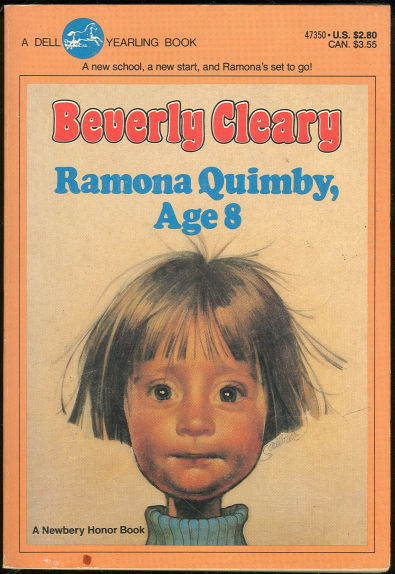 I have heard rumours here and there that to children raised on Hogwarts and Lemony Snicket, the adventures of Ramona Quimby come across as a little bit dull. Perhaps so, but then the domestic has always been my literary milieu, setting for plenty of magic in its own right. As a child, I was wild about Ramona, about her “wonderful, blunderful” self, as she was referred to at the end of Ramona Forever. In her blundering, I suppose she was a forerunner for chick-lit heroines on shoe-covered books in decades to come, and it’s part of the reason I identified with her, but here is a serious distinction: unlike Bridget Jones on the fireman’s pole, to give an example, Ramona never ever lost her dignity.
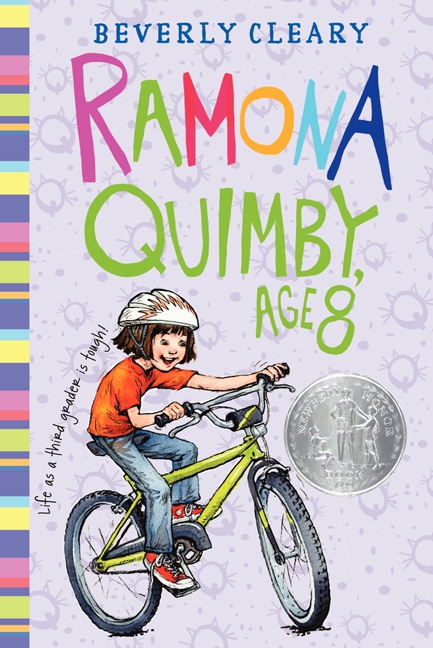
To be an adult encountering Ramona again has been absolutely fascinating. First, unlike Rowling, whose magic spells allow us to forgive literary missteps, Beverly Cleary never misses a beat. The pacing, characterization and dialogue in these novels is brilliant. Nothing clunks. These books are really not so dated–I only remember the line in Ramona the Brave, when Mrs. Quimby announces she is going back to work, and Beezus responds with, “Mother! You’re going to be liberated.” I note that on a newer edition of Ramona Quimby, Age 8, Ramona is depicted as wearing a bicycle helmet, which seems bafflingly incongruous (but then I have this theory that “safety” is a conspiracy theory, and that’s another story).
Reading these novels with my daughter, I see they are tremendously useful for educational purposes. For my education, that is, Cleary’s stories reminding me exactly of what it was like to be little in the world. I have forgotten this, the injustices of childhood, which Ramona calls attention to and battles at every turn. And injustice it truly is, to have no say in your comings and goings, to have the ground pulled out from under your feet on a regular basis, to have your fears and worries scoffed at, to be shushed and quieted, shooed away from underfoot. Reading the Ramona books provides with tremendous sympathy for how difficult it is for a child to be in the world. Reading the Ramona books, I think, makes me a better parent.
They’re also useful to my daughter though, not for morals and lessons, but for everything that’s going on in the background. That Ramona’s mother and father are depicted as real people, for one, their experiences providing a whole level of subtext to these stories that I wouldn’t have picked up on as a child, but which I zero in on now. I was reading aloud the Quimby parents’ argument from Ramona and Her Mother recently, and it was so pitch perfect and hilarious:
“Ramona, don’t just stand there,” said Mr. Quimby as he laid the bacon in a frying pan. “Get busy and set the table. As my grandmother used to say, ‘Every kettle must rest on its own bottom,’ so do your part.”
Ramona made a face as she reached for the place mats. “Daddy, I bet your grandmother didn’t really say all the things you say she said.”
“If she did, she must have been a dreadful bore,” said Mrs. Quimby, who was beating batter as if she were angry with it.
Mr. Quimby looked hurt. “You didn’t know my grandmother.”
“If she went around spouting wisdom all the time, I can’t say I’m sorry.” Mrs. Quimby was on her knees, dragging the griddle from behind the pots and pans in the bottom of the cupboard.
 It is remarkable how much economics factors into these books, much like how they do in our own family life. Though by no means poor, the Quimby family has to think about costs and expenses. A new bedroom is only built onto their house because Mrs. Quimby returns to work and they have the means to do so. Later, Mr. Quimby loses his job, and when he returns to work, it is to a position that makes him terribly unhappy. This leads to Ramona’s perpetual worrying, and her silent pleading with him via attempted thought control, “Daddy, please like your job. Please like your job.” Her concern as she listens from her bed to the timbre of her parents’ late night discussions in another room.
And don’t you remember that? Anxiety and fear over things of which you have no control? Only hearing patches of the conversation, parts of the story, and filling in the blanks with all your deepest fears? The dawning understanding that your family life is built on unsure foundations, as unsure as is anything I mean, and the terror of thinking it might all come apart?
That life isn’t fair is such a cliche, but in her stories, Cleary makes this idea endlessly interesting. Her situations are always sometimes unbearably true to life–the frustrations of trying to sew a pair of pants for a toy elephant, for example. Or the problems of a not-so-great teacher. Not a bad teacher, but just one generally lacking in appeal. There are teachers like this, and while in other novels, her student might discover her actual heart of gold, in Ramona, such teachers are trials to be borne. Because life is like that. Life is unfair. Sometimes your cat dies and you’ve got to bury it and you get blisters on your fingers.
But life is also rich in its smallest details—the squelch of boots in the mud, the appeal of a banana sticker, the sounds of kids riding bikes outside, a haircut that transforms you into a pixie for a while. That the foundation of family can be surer than you think. And that when you’re wonderful and blunderful, you’re a lot like life is. Which is something that’s good to know.
January 29, 2014
Big Picture Press: Mamoko and Maps

Harriet is (sort of) beginning to learn how to read, and as Harriet balks at any activity that is remotely challenging or involves learning by rote, I have to tread very carefully in my exuberance for her acquiring literacy. A book like Mamoko, by Aleksandra Mizielińska and Daniel Mizieliński, which I brought home from the library the other week, is a perfect reminder for both of us that books can be wonderful fun.
Think of Mamoko like Where’s Waldo, but for people who love stories. The book’s inside cover introduces us to a range of characters whose stories we will follow throughout the rest of the book in dynamic, busy, detailed, wordless illustrations. There are dramas experienced, mysteries to be solved, jokes shared, and something new discovered every time. You can pick a new character and “read” a new book in Mamoko over and over again, or else just pick peruse the illustrations for general entertainment. The stories in this book aren’t straightforward either, and we went back and forth a lot to try to understand what we missed, to figure out exactly what was going on. It was utterly engaging, the illustrations smart enough to make this very satisfying, and while we had lots of fun with this book together, it’s also nice to have a book that Harriet can “read” all by herself.

 Another book by the same press and same authors is Maps, which was one of (too) many books I’ve picked up at Book City lately (sob). I’ve got such a thing for maps and atlases (my prized one is Atlas of Remote Islands, and I so want to get my hands on Infinite City by Rebecca Solnit), so I was excited to get a kids’ atlas. There is a world map, and about 50 others of individual countries. And as with Mamoko, the creators of this book know that story is what compels someone to open a book over and over again. And so each country’s map includes an image of a little boy and girl who might live there, and we learn their names, which is how these countries become more than just a shape on a page for young readers. And then we learn about that country’s wildlife, famous exports, cultural figures (fictional and otherwise), different cultures, national food and drink, industry and agriculture, all though adorable cartoon illustrations.
Pick a page, any page, and Maps will take you on a journey.

January 9, 2014
The Silver Button and Wanderlust
 I have been besotted with Rebecca Solnit ever since reading The Faraway Nearby last fall, so I was very pleased to receive two more of her books for Christmas. I read Wanderlust: A History of Walking first as it was written before the other, and I loved once again being absorbed in a Solnitian world where the connections between books and place are so strong, and where one thing leads to another, just as one step does. (“One foot in front of the other,” is Harriet’s mantra as we embark on the 1.3 km walk to school every morning. It is a long walk if the walker is 4 years old, particular lately through snow and ice. ) And it is because one thing leads to another that one can’t sum up a Rebecca Solnit book properly, and I therefore must resort to ecstatic sharing. I loved learning about how closely the history of English garden design connects to the history of walking, about how the idea of walking being natural takes for granted civilization (i.e. law and order), and the gender politics of walking and (for women) the sexualization of the street—how different is the term “tramp” depending on to whom it is applied.
The first paragraph of Wanderlust:
Where does it start? Muscles tense. One leg a pillar, holding the body upright between the earth and sky. The other a pendulum, swinging from behind. Heel touches down. The whole weight of the body rolls forward onto the ball of the foot. The big toe pushes off, and the delicately balanced weight of the body shifts again. The legs reverse position. It starts with a step and then another step and then another that add up like taps on a drum to a rhythm, the rhythm of walking. The most obvious and the most obscure thing in the world, this walking that wanders so readily into religion, philosophy, landscape, urban policy, anatomy, allegory, and heartbreak.
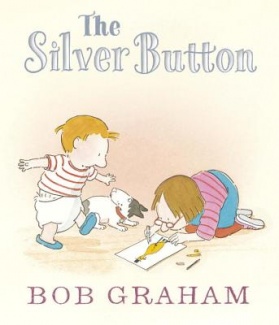 Which reminds me of the exquisite picture book that I bought Harriet/myself for Christmas this year. The Silver Button is a new book by Bob Graham, one of our favourite authors and the force behind the wonderful Oscar’s Half-Birthday. It’s a story that takes place within a single moment, illuminating the connections, the beauty and the perfections of the world. The perspective moves from a space on the floor in a single room to eventually comprise an entire city and beyond toward the global as Jodie puts the finishing touches on her drawing of a duck and her brother Jonathan rises to his feet to take his very first step. “He swayed, he frowned, he tilted forward, and took his first step. He took that step like he was going somewhere….”
These two books are an unlikely but absolutely perfect pair.
December 13, 2013
Top Picture Book Picks at Bunch

Over at Bunch Family, I’ve posted a list of some of my favourite picture books of 2013. Most of these will be familiar to anyone who is a regular reader here, but still might come in handy for your last-minute Christmas shopping needs.
December 5, 2013
New Kids’ Books Lately
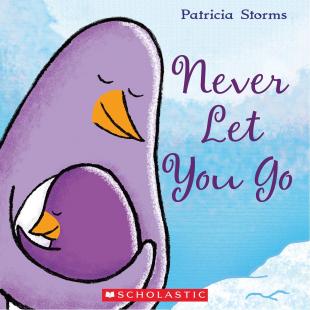 Never Let You Go by Patricia Storms: Patricia is a friend of mine, and I love her latest book, the story of a parent’s unconditional love. This Mommy or Daddy Penguin is never going to let the baby go… except, well, let’s not be ridiculous about the whole thing. Baby Penguin will be let go to go to the bathroom, of course (and she actually mentions bathroom=hilarity). And Baby Penguin will be let go for lunch, to play, to chase the stars (and here there is a gorgeous spread of Aurora Australis). But other that that, of course, “I will never let you go,” says Big Penguin, portraying the elasticity and infinitude of great parental love.
 Mr. King’s Castle by Genevieve Cote: I’ve got a bias for this book as well, because it’s got a pink owl in it who was named for my daughter. It’s the follow-up to Cote’s Mr King’s Things, and similarly presents an environmental theme. That crazy cat Mr. King starts building a castle out of the pieces of the world around him, and he wants a big castle. So he builds and builds and builds and the castle is amazing, but he’s oblivious to the fact that he has robbed his animal friends of their habitats. When he realizes, he and his friends go to make it right, and he learns something about environmental stewardship in the process.
 ABC of Toronto by Per-Henrik Gurth: I wasn’t sure how I would feel about this alphabet book, as Allan Moak’s A Big City ABC is the Toronto alphabet in my mind. But it turns out that Toronto is big enough for two ABCs. I love “D is for Dinosaur,” which shows my favourite dino skeleton from the ROM; “K is for Kensington Market;” and “P is for Picnic at Trinity Bellwoods Park.” Plus Union Station, Streetcars and “W is for Ward’s Island.” I love this book’s perfect specificity.
 Loula is Leaving for Africa by Anne Villeneuve: This brand new book is a little old-fashioned, recalling Eloise a bit (or perhaps that’s just the chauffeur). I like this book’s eccentric twists–Loula’s mother is an opera singer, her father a designer of moustaches (?). Neither is much concerned that Loula’s three brothers are making her crazy, and so she runs away from home, on a voyage of the imagination to “Africa”, in the company of her family’s chauffeur Gilbert. The story shows that one needn’t travel far to really get away, and that the most wonderful terrain to explore is in the mind.
 Shhh! Don’t Wake the Royal Baby! by Martha Mumford and Ada Grey: I picked up this one while we were in England, because Iris and the Royal Baby are contemporaries and it’s as good a souvenir as a tea-towel. It’s a funny story with smart illustrations about how the Royal Baby just can’t be put to sleep. My favourite part is when the Baby is almost down, and then Prince Phillip prances in kicking his heels and dancing, waking baby up again. I also like when Pippa and Prince Harry raise a ruckus planning a lavish party in Baby’s honour, with Pippa yelling, “More blinis! We need more blinis!” Of course, specific Royals (and their sister) are not named exactly, called “The Duchess” and “The Duke” (and oddly, Phillip gets to be The King, and Charles and Camilla don’t even factor, but let’s not complicate things).
November 15, 2013
Picture Book Inspiration: Get Excited and Make Things
(This one is cross-posted to Bunch Family!)
My favourite picture books are the ones whose stories escape their pages, books that live on in the imagination long after they’ve been returned to the shelf, books which inspire their readers to get excited and make things. And such books are perfect for these days when it’s a little too cold outside, and you’re looking for a fun diversion or two.
 How To by Julie Morstad: It’s been nominated for a 2013 Governor General’s Award for Children’s Literature Illustration, and no wonder. Morstad’s How To is a guide to life, albeit life lived whimsically, with a great deal of imagination and style. It doesn’t inspire a specific craft project, but instead is the launching pad for several (including chalk-drawings, stilts, butterfly wings) and also to a whole new way of looking at the world.

 The Imaginary Garden by Andrew Larsen and Irene Luxbacher: This is a really wonderful story about the connection between a young girl and her grandfather who has had to leave his garden behind to move into an apartment. Together, Theo and her grandfather create an imaginary garden to fill the void, a painted picture on a large piece of canvas. I love this book because there’s something going on beneath the surface–just what is the grandfather’s story, I wonder?–but I also love that just about every child who reads it is compelled to pick up some crayons and paper and make an imaginary garden of her own.

Jillian Jiggs by Phoebe Gilman: I memorized this book when I was seven years old, and now my daughter knows it too. And she has been inspired to play pirates by it, as well as to fashion a robot head out of tinfoil and a cardboard box. (“I’m mad about boxes! Boxes are fun! No one will guess who we are when it’s done.”) Jillian Jiggs’ imagination is quite contagious, and I also remember that its follow-up, The Wonderful Pigs of Jillian Jiggs, came with instructions for making little stuffed pigs of one’s own, with button noses and everything.
 The Stone Hatchlings by Sarah Tsiang and Qin Leng: This book is the follow-up to the acclaimed A Flock of Shoes, the story of a little girl who finds some eggs and decides she is going to hatch them into birds. Never mind that Abby’s mother tells her that the eggs are just stones–with the aid of some paint and a brush, Abby transforms those eggs into beautiful birds who are alive in her imagination. We’ve had three egg-shaped stones nesting in a pile of silk scarves ever since this book came into our lives, and I don’t doubt that they’ll hatch one day.
 Extra Yarn by Mac Barnett and Jon Klassen: My love for this book knows no bounds–it’s funny, features yarn-bombing, a brave heroin who defies an evil archduke, and it’s illustrated by Jon Klassen (who did I Want My Hat Back). Extra Yarn is the story of Annabel, who finds a box of yarn and starts knitting, and discovers that the length of yarn is infinite. So she knits sweaters for people, sweaters for pets, sweaters for trees and pickup trucks. Her creations fill her dreary little town with brilliant colour, and might just inspire a young reader to pick up a pair of needles.

 Chicken Pig and Cow by Ruth Ohi: Ruth Ohi’s series takes place amongst the residents of a popsicle-stick barn, the residents themselves being plasticize creations, all of whom have been built by Girl. The friends have adventures, misunderstandings, reconciliations and brave rescues. These books were the inspiration for the popsicle stick barn we’ve got at our house.

 The Paper Dolls by Julia Donaldson and Rebecca Cobb: I love this book by Julia Donaldson, who wrote The Gruffalo. In delightful rhyming verse, she tells the story of a string of paper dolls who went on to have many adventures, and even when their life was over, they lived on in the memory of the little girl who made them. When we made our own string of paper dolls, naturally, we too called them, “Ticky, and Tacky, and Jackie the Backy, and Jim with Two Noses and Jo with the Bow.”
You can get a Paper Dolls template here!
**
It occurs to me that each of these book features girls who are getting excited and making things, though the Morstad and Gilman do show boys in the mix. But what else am I missing? Are creative boys being left out of picture books? Or is my reading just a little too girl-centric? Please give me your recommendations in the comments.
October 24, 2013
Lois Lowry!
 Seven years ago, I sent Lois Lowry a fan-email to tell her how much her Anastasia Krupnik books had meant to be growing up, and she sent a kind and gracious reply. Three days ago, apropos of a conversation with Helen Spitzer on Twitter, I changed my profile picture to the cover of Anastasia Again! And then today, I discovered that Lois Lowry, Anastasia’s creator, was giving a lecture at the Osborne Collection of Early Children’s Books, mere blocks from my house. Today was also important, because it was Iris’s first time rolling off the couch, which was slightly traumatic, but not so much because she is my second baby. Also because she is my second baby: I can go out whenever I want, even if it’s for the third time in seven days, whereas with Harriet, I didn’t leave the house in the evening for nine months. So I went to the Lois Lowry lecture tonight.
(Yes, I am slightly wired. I don’t sleep much anyway, and then Jennica Harper’s new book turns up in the post, and it’s so good that I’m up late late on Monday reading it. And then yesterday, I discover that Margaret Drabble has a new novel, which is so fantastic that all I want to do is read, and that then today I get to be in the same room as Lois Lowry? Where do weeks like this one come from? [And yes, Iris is fine. Really. No injuries sustained. She actually landed on her bum, which was kind of weird because I looked down and she was just sitting on the floor, and I thought, “How did you get there?”])
Helen phoned me tonight to confirm I was going, and thought she’d stop by a bookstore en-route to pick up some Lowry and cram. What a fantastic idea, I thought, and calculated the unlikelihood of me finishing dinner, doing story-time, feeding Iris, and going to Book City in a twenty-five minute period, leaving enough time to get to the lecture. And then I started remembering Anastasia, and realized I’d never forgotten anything about her ever. I didn’t need to read up. And that she was incredibly important to who I wanted to be when I was young, and to who I am today.
Her parents, Myron and Kathryn Krupnik, and Myron’s old flame Annie, who turned out to be terrible. Anastasia who was in love with Washburn Cummings, who was black and always bouncing a basketball. How her father, a Harvard Professor, criticized her for using the word, “Weird,” which I still never write, because I hear Myron Krupnik saying, “Anastasia, you live in a house that’s full of books. Surely you can come up with a better word than that?” Her baby brother Sam, who was the weird one. One day she walked into a room and there he was, and he told her, “I am eating ice.” How she put her dad’s Billie Holiday albums on the radiator and they melted, and I didn’t know who Billie Holiday was (though I DID know what albums and radiators were), and got confused with Buddy Holly. How Anastasia got a job working for a rich lady called Mrs. Bellingham, and how, echoing her employer, Anastasia referred to residents of a public housing complex as “the great unwashed”, and her father blew a gasket. Her mother was an artist and always splattered with paint, wore jeans. Anastasia had the same reservations that I do about “the suburbs”, though I’d change my mind too if I ended up in a room with a tower. I love how her parents were so intelligent in their parenting, how they treated her like a person. I like how they were individuals in their own rights, with their own first names. These books introduced me to Freud (which was pronounced “Fraud”, I imagined), GertrudeStein (who was Anastasia’s next door neighbour, and she had a fish, I think, and a short-lived marriage with a man called Lloyd, who’d insisted the double L had a y sound). I remember Anastasia’s boyfriend, who was called Steve Harvey and wasn’t at all weird, and how he had no qualms about a girlfriend with glasses and intellectual leanings. Oh, and that other boy, with the briefcase, and how Anastasia had told him that her brother was disabled, which led to an enormous misunderstanding.
I remember buying Anastasia books at the World’s Biggest Bookstore on trips to Toronto, and we’ve forgotten how amazing that store seemed at the time. It was also there that I bought Pollyanna, with a foreword by Lois Lowry, which contained the phrase, “Goodness triumphs. I like that!” which I like very much too, except I misread it as, “Goodness turnips” and thought it a most peculiar expression.
I read her other books too–A Summer to Die, Find a Stranger Say Goodbye. I read The Giver just a few years ago, though it was not so much my thing. She told us tonight that her publisher asked her to stop writing Anastasia books, said her appeal had been exhausted, but never! What a spectacular heroine, smart and utterly herself. Which is what Lowry herself seemed like at the lecture, which was fascinating, funny, touching and wonderful. I left the house in a hurry and forgot to bring a pen and paper, so I didn’t take notes, but that was sort of nice, actually, because I got to just sit back and listen, and it was so enjoyable to do so.
She talked about being born into a family of readers, about being read it and learning to read. About the books that first impressed her, discovering how words worked, learning to tell stories through an elaborate lie she told to impress a counsellor at camp. She talked about her sister who’d died young, and about how, upon her death, she finally understood what a writing instructor had meant when he’d told her that she would need to suffer a loss before she could really write, and how she turned that experience into story. About how she lived in Japan as a child, riding her bike around post-war Tokyo, and the boy she knew but never spoke to, and how they met again on a stage years later when she won the Newbery Award and he was being awarded the Caldecott Medal for Grandfather’s Journey–he was the illustrator Allen Say. She showed us a still from a video of her playing on a Hawaiian beach in 1940 with her grandmother, and how eventually she realizes that it’s the USS Arizona in the background, which would be destroyed just over a year later, all the men on board killed. “And this is what literature is,” she told us. “The putting together of things.”
it was an extraordinary lecture, and something to behold: the actual sight of this woman whose books I’ve been reading for over 25 years now. I will be introducing Anastasia to my daughters, because apparently she’e just come back into print. But in the meantime, I bought Harriet one of Lowry’s books called Gooney Bird Greene, and tomorrow we will read it together.
October 21, 2013
Harriet and Sheree Fitch at Eden Mills
The most wonderful thing that ever happened was captured on video! Here is Harriet storming the stage to help the great Sheree Fitch read Mable Murple at the Eden Mills Writers’ Festival.
http://www.youtube.com/watch?v=EaOX6dValjY&feature=youtu.be
October 20, 2013
Animal Stories (including woolves!) at the Gardiner Museum

We went to the Gardiner Museum today to see the Animal Stories exhibit.
“Elephants, leopards, dogs, squirrels and dragons… From exotic creatures, household pets, urban wildlife to mythical beasts, animals have been an active part of human experience, an inexhaustible trigger of the imagination. Animal Stories presents the many tales of our encounters with the animal world, shedding light on how our social, symbolic, affectionate, scientific and utilitarian relationships with animals have been visualized through ceramics from the 17th century to our day.”

Fantastic events are scheduled as part of the exhibit, and today we were happy to catch the first of the Kids Can Press Reading Series, today with the lovely Kyo Maclear reading Virginia Wolf (with the assistance of her entire family). Afterwards, the kids got to make their own Virginia Wolf ears (which alternate as a big blue bow, depending on one’s mood).

Three readings are left in the series: Wallace Edwards on November 10, Eugenie Fernandes on December 8, and Nicholas Oldford on December 15. (And we got free passes for the museum through the Sun Life Museum and Arts Pass at the Toronto Public Library. Such a great deal!)