June 26, 2014
Peach Girl by Raymond Nakamura & Rebecca Bender
 I had the pleasure of reviewing Peach Girl by Raymond Nakamura and Rebecca Bender for Quill & Quire. It’s a story about a feisty girl that depicts the gorgeous countryside of Japan, a country that was once my home. I definitely recommend it.
“In his engaging debut, author Raymond Nakamura puts a feminist bent on the Japanese folk tale Momotaro (Peach Boy).
In Nakamura’s version, a young girl emerges from a giant peach discovered on the doorstep of an elderly couple (who are, notably, a farmer and her husband). Momoko, which translates as “Peach Girl,” is a feisty creature determined to make the world a better place, a mission that involves ridding it of a child-eating ogre. Gently shrugging off her adoptive parents’ concerns for her safety, Momoko embarks on her quest with peach-pit armour for protection, plus a bundle of peach dumplings to eat on the way.”
You can read the whole review here.
June 17, 2014
Hipster Picture Books
 By “Hipster Picture Books”, of course, I mean books with a focus on design over content, I mean the board book as status symbol. The kind of book a child might not necessarily choose on her own, but her parent will buy it for her as sort of an aspirational thing. To aspire to have a child who lusts for a Pantone colour book. And the great thing about these books’ smart design and vibrant colours is the child will like it after all, will eventually be seen at Brunch clutching said book, and then you get to be the kind of parent you always always dreamed of being. Post it on Facebook, and rest on your laurels after that. Undoubtedly, a Sunday well spent.
I am only half-kidding.
I bought Iris Pantone: Colors for her birthday, and she likes it. It’s visually appealing, and I appreciate its overall message–that there are many shades of grey, and red, and green, and every colour, for that matter. We live in a complicated world, but it’s beautiful. Facing each page of shades is an object in said colour–red wagon, brown teddy bear, blue teapot etc. And then at the end, we’re faced with a rainbow of objects, and this page is an exercise in naming–pickle, monster, kangaroo, bow tie.
 I am also pretty in love with Work: An Occupational ABC by Kellen Hatanaka (out in August). The minimalist illustrations still reveal vital details and are smart and dynamic. I love the way that each letter of the alphabet is embedded into the illustrations in clever ways (i.e. I is for “Ice Cream Vendor” the ice cream is being vended from the I itself’; the A in “Aviator” is part of the mountain range; the P for “Postal Worker” is a cumbrous package on the postie’s back). Points for some very cool jobs I wouldn’t have considered: O is for Oceanographer, N is for Naval Architect (none of them thriving industries, I am sure, but still…). And then an amusing glossary of terms at the end: “Zookeeping might be the only job that encourages monkey business.” Fun.
 The exuberance of 100 Hungry Monkeys doesn’t really qualify it as a hipster picture book (hipsters are not allowed to get excited, except about drinking Pabst Blue Ribbon on a park bench, or riding a unicycle, but in either case, would never show it). But its visual appeal puts this book in the mix, and it is definitely a good one. Author-illustrator Masayuki Sebe has created a fun story about the concept of the number 100, one whose prompts urge readers to examine the illustration for details and clues in a Where’s Waldo fashion. This is another run one for early readers and their parents to read together, reminding both that books and reading are fun.
 And finally, Monsters Under Bridges by Rachel Roellke Coddington and Jolby is not really a hipster picture book, but it is geographically situated in the Pacific Northwest, so there you go. It is a concept I wasn’t entirely sure about at first–a travel guide featuring notable bridges and describing the fabled creatures who live under them, their lives and habits. Perhaps its a regional thing, I wondered? But then Harriet, who has never once been to Seattle, loved this book, and had me reading it to her over and over again, her mind expanded by the crazy creatures imagined within. And through her (which happens often), I discovered just what this book was all about. BONUS CANCON: Ronoh who lives under the Ironworkers Memorial Bridge in Vancouver BC, who smells like seaweed and wisdom. Plus Margot the Maripolo, beneath the Capilano Suspension Bridge and Sherman who lives under North Arm Bridge in Richmond BC (who likes to strap himself to the front of the SkyTrain).

May 29, 2014
Kids Books We’ve Been Enjoying
 Chaucer’s Canterbury Tales by Marcia Williams: We received this book after Harriet’s classmate’s Knights and Castles birthday party. (This classmate happens to have a notoriously bookish Mum who seems to be making a serious return to book-blogging–yay!). Harriet is comics-mad, loves a good story about knights, plus she’d been told that there was lots of farting in these stories. With her richly illustrated panels, Marcia Williams has made the Canterbury Tales fun and accessible to modern readers, and they were as bawdy as promised. These adaptations serve as an excellent introduction to the original tales, and keep these timeless stories in our collective consciousness.
 Underworld: Exploring the Secret World Beneath Your Feet by Jane Price and James Gulliver Hancock: One day, Harriet and I spent ages lying on the carpet reading this book, whose every new page revealed something else to fascinate us. Egyptian tombs, Paris catacombs. the Tokyo subway, volcanoes, buried treasure, WW1 trenches, bomb shelters in the London Blitz, and underground cities in Turkey. Has a book ever so contained everything? It was pleasure to read a book from which both of us learned so much, and the design and illustrations of this one are really well done.
 When Emily Carr Met Woo by Monica Kulling and Dean Griffiths: The creative team behind Lumpito (a picture book about Pablo Picasso) gets together again for this story about the eccentric Canadian painter Carr and her messy, extraordinary life, a part of which was the monkey, Woo. There is a bit of peril when said monkey devours a tube of yellow paint, but (spoilers!) disasters are averted. This is a fun take on an unconventional and important life.
 Charlie Cook’s Favourite Book by Julia Donaldson and Axel Scheffler: On Monday when we were all sick on Harriet’s birthday, this gift arrived from Harriet’s great-aunt and it was such a bright spot in a difficult day. This book thrilled us first because no one ever gives us books–we are an intimidating prospect owning so many books already. But we’d never heard of this one, and we love Julia Donaldson, and this one is so so good–a story of a book reading a book about a boy who’s reading a book about a book who’s reading about a book about a… A book within a book within a book! So great! So it’s a bit like that, but even better.
 Today We Have No Plans by Jane Godwin and Anna Walker: I sometimes am so grateful that we don’t have a lot of extra money and no car because it means we’re ineligible for the hyper-scheduling that some families happily choose for themselves but which would never ever work for me. The one thing I’m glad to be rich in is time, and this book (which I bought at our playschool book sale for a dollar) celebrates such wealth, what it means after a busy week on the hamster wheel of piano lessons, carpooling, soccer practice, hurried breakfasts, rinse, repeat, etc, to be able to have a day with nothing in it (yet). To linger in your pjs over pancakes (and the paper). The very best days, plus it rhymes, so this book and I were always going to get along.
 The Goldilocks Variations by Allen Ahlberg and Jessica Ahlberg: This book is weird and wonderful and full of pop-ups and silly jokes–is there anything better? Ahlberg (with his daughter doing the illustrations) riffs on the familiar Goldilocks tale in true Ahlbergian style–plus, there’s a book within a book. Of course! See Goldlilocks as she steals into the 3 bears’ house, and then the 33 bears’ (really tall) house, and then into an alien spaceship, and the one where she is thwarted by the furniture and a sheet called James. (Why don’t more sheets have names?) Stuff and nonsense. We love it.
 There Was An Old Sailor by Claire Saxby and Cassandra Allen: Forget the old woman who swallowed a fly! This sailor ends up swallowing a whale, but not before a jellyfish, a squid, a krill. It’s a delightful twist on a familiar song, and perfectly complemented with vivid, striking illustrations that please the eye and give a modern twist to traditional maritime images. It ends with a belch, which will never not prove amusing, and then the reader will encounter some fun facts about the sea creatures in this book (like a squid has a beak–who knew?).
 Jack and the Box by Art Spiegelman: After reading Michael Barclay’s piece on Toon Books, I was inspired to read Jeet Heer’s biography of their founder and editor Francoise Mouly, and also to buy a copy of Jack and the Box. Mostly because I loved this panel. It’s a wacky, startling and funny story of a boy and his unconventional Jack in the Box. The silliness is the best part. There is also a physicality necessary to the story which the comic form so perfectly expresses.
 101 Things to Do With Baby by Jan Ormerod: Seriously, is there anything that can’t be expressed in a series of illustrated panels? Lately in our house, we think: no. Clearly, the folks at Groundwood Books agree, which is why they’ve reissued Ormerod’s classic after 30 years. And I love this book, whose first image of a mom reading to her small daughter while breastfeeding a new baby was pretty much how I spent my whole last summer. Showing the moments–funny, tender and mundane–which make up a day, Ormerod shows the trials and joys of being a big sister, and gives a wonderful child’s-eye view of the world.
May 8, 2014
Unexpected Mad Men read: Tales of a Fourth Grade Nothing
 I wasn’t expecting a Mad Men read when we started Tales of Fourth Grade Nothing a couple of weeks ago (which is significant for being Harriet’s first Judy Blume). I remembered the stories in the book so well, but I’d forgotten the details, or maybe I just hadn’t noticed at the time. Like how its backdrop was 1970s’ New York City, and how Peter is allowed to walk to Central Park alone to play with his friends when the weather is good, but he’s wary of muggers. “I’ve never been mugged. But sooner or later, I probably will be. My father’s told me what to do. Give the muggers what they want and try not to get hit on the head.” His parents are concerned about dope-smokers who hang out in the park. “But taking dope is even dumber than smoking, so nobody’s going to hook me!”
 Warren Hatcher is totally Don Draper, though I suspect not as dashing and probably not so lucky with the ladies. He works for an advertising agency and, like Don in his more domestic days, is expected to use his status as family man to further himself professionally and win accounts. Because of the antics of his youngest son, he ends up losing the Juicy-O account. When his wife goes out of town for a few days, he brings the kids to the office and leaves them in the care of his secretary, Janet, who seems fine with the amusement of small children being part of her job description. While at the office, Peter and Fudge stumble onto auditions for the Toddle Bike commercial, and Fudge captures the heart of the company’s president. As ever, disaster ensues, but Fudge gets to be on TV. The next day, Warren/Don takes the kids to the movies, even though Fudge is only just three, and he sits Fudge on the end of the row. Unsurprisingly, he goes missing. And even without the disaster, it would have been a very Don Draper parenting move.
He even makes omelettes, which I remember as a Don Draper speciality! His children can’t believe he knows how to cook at all, and he actually doesn’t, because the omelettes are inedible. We finished the book amused by the Don Draper-ness, but a bit disappointed in the gender roles reinforced in the book. But then it was first published in 1972, so what do you expect?
Except that we started reading Superfudge, and it seems that Don Draper is evolving. He’s taking a year’s leave from the agency to try writing a book about the history of advertising and its effect on the American people. The idea is especially appealing to him because he’s looking forward to staying home with his family, to experiencing his daughter’s babyhood when he’d been absent for the other two. He’s even started changing diapers! No word if he’s cut down on the smoking or the drinking though, or of what Roger Sterling thinks of the sea change.
April 22, 2014
#MakeSomething: The Most Magnificent Book
It is always a good day when we get a package in the mail from Kids Can Press. In particular, when that package has to do with a book that we’ve loved as much as we continue to love Ashley Spires The Most Magnificent Thing.

Remember that book? The book of which I wrote, “ It’s got everything. It’s got a dog, a girl who builds things, appealing illustrations that stand out against simple line drawings of an urban street-scape. It will appeal to both sexes. It’s got words, so many words, terrific verbs employed in the act of construction. It’s about coming up short, making mistakes and getting angry–the acknowledgement of such experiences is incredibly profound and has echoes of Sendak.”

So it was so cool to get this kit in the mail full of stuff for making, including a modified version of the book for us to “hack” and include in our creation. Harriet quickly set to work making blueprints, and was determined that her magnificent thing would be a monster.

The project came together fast. Harriet’s dad worked alongside her.

She cut, she stuck, she modified, she erred and tried again, and came up with something even better than her blueprints.
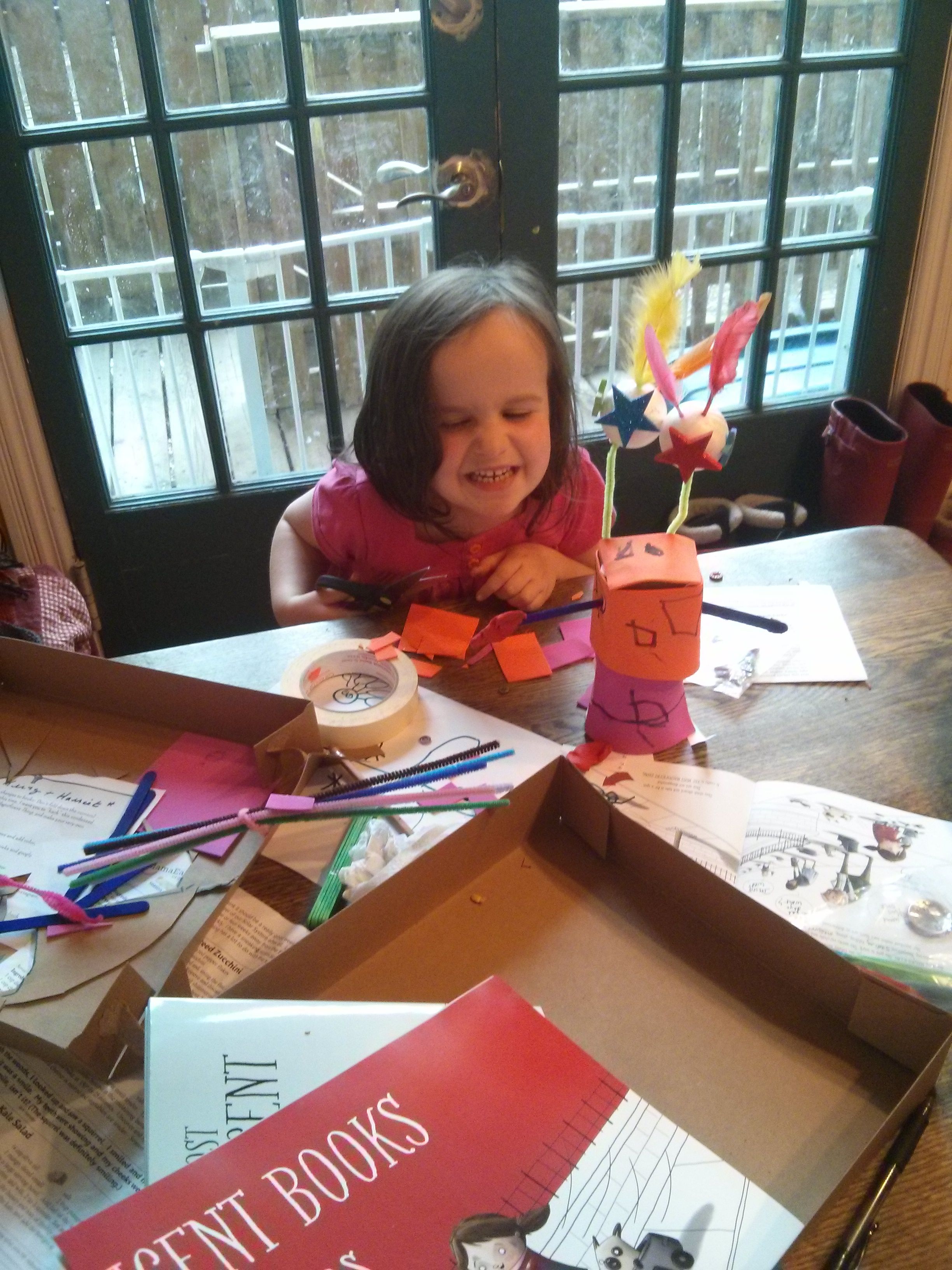
Like her mother, Harriet is blessed with not being a perfectionist, and so her final vision seemed more than satisfying. We hooked our guy up with the book, because monsters like reading just as much as anybody does.
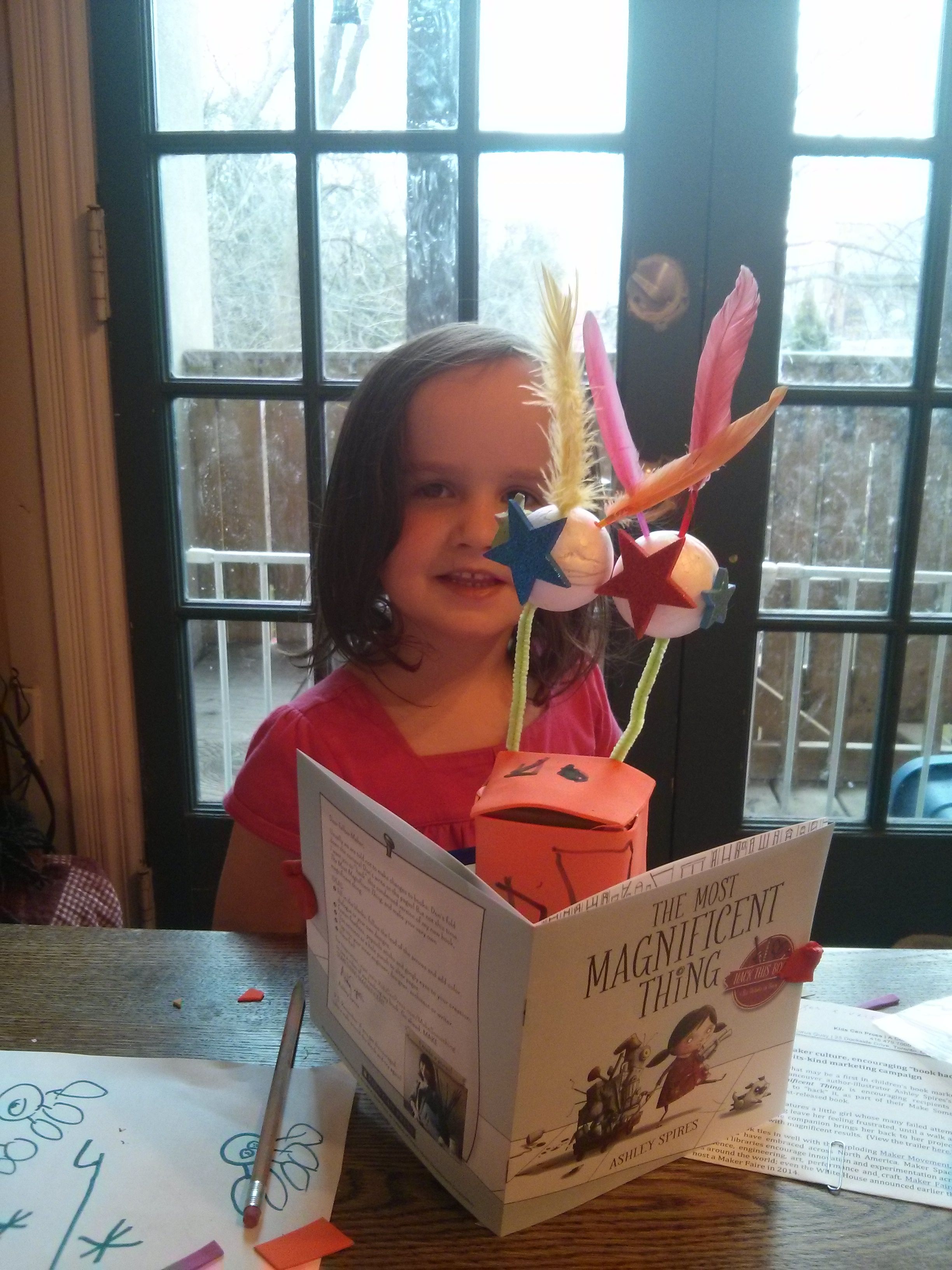
What fun fun fun, and just an example of the creativity this fantastic book will inspire. Thanks, Kids Can Press! So happy to spread the word about a book we love as much as this one.
March 25, 2014
How Little Lori Visited Times Square

The best thing about the Lillian H. Smith Library is that its collection was born out of the Toronto Library’s Boys and Girls House, which opened in 1923, and therefore a trip through the stacks reveals all kinds of vintage gems. Our favourite fruit of Saturday’s visit is How Little Lori Visited Times Square by Amos Vogel and illustrated my Maurice Sendak (which I came across whilst browsing for Viorst).
It’s a book with a warning label: “This is a very funny book and should not be read while drinking orange juice, or you will spill it!”

This is the only picture book by Vogel, who was known for his work in cinema and as author of the book, Film as a Subversive Art. Maurice Sendak is, of course, Maurice Sendak. And oh, this book is weird and terrific.

It’s about a little boy called Lori whose bedroom decor suggests a strong affinity for vehicles of all kinds. He decides one day to go to Times Square, but every route he takes brings him to somewhere different. This is a frustrating process for him–a helicopter delivers him to Idlewild Airport; the elevates subway to his Uncle’s house in Queens. The city in the background is a crowded place, populated by curious characters and decorated with billboards and signs whose words add a marvellous subtext and might be some kind of comment on consumerism but I can’t quite decide which. Potato Chip stores and Peanut butter stores, signs exclaiming, “Buy Now!”, and an ad on the side of the bus: “Don’t walk on the pigeons.”

He ends up crying on the 25th floor of Macy’s (after a trip up the elevator), but then is rescued by a slow-talking turtle who offers Lori a ride on his back. Lori agrees and off they go. But, um, that was four months ago.
“And nobody has heard from them since.”
The warning label is not unjustified then.
Another best thing? The book has been brought back into print where it remains. Because it’s totally totally brilliant.
March 19, 2014
New Kids’ Books We’re Loving
The Most Magnificent Thing by Ashley Spires: Harriet is big into Ashley Spires’ books, in particularly, Binky the Space Cat, which got her started saying, “Holy fuzzbutt!” But with this latest picture book offering, Spires has truly outdone herself. It’s got everything. It’s got a dog, a girl who builds things, appealing illustrations that stand out against simple line drawings of an urban street-scape. It will appeal to both sexes. It’s got words, so many words, terrific verbs employed in the act of construction. It’s about coming up short, making mistakes and getting angry–the acknowledgement of such experiences is incredibly profound and has echoes of Sendak. Perfect tongue-in-cheek humour too that kids and adults will get–Harriet likes to note that the girl’s “out of the way” workspace is in fact in the middle of the sidewalk. I love delivering the understated line, “It was not her finest moment,” when the girl finally loses it. And that wonderful image when she hammers her finger, Spires’ skill as an comics artist translating so perfectly into picture book form. What a truly wonderful picture book, coming quite close (dare I say it?) to perfection.
 The Tweedles Go Electric by Monica Kulling and Marie Lafrance: As a feminist and a troublemaker, I’ve long admired Kulling’s books for their subtle subversion of gender roles. She’s up to similar tricks in this one, her latest, which seems influenced by her experience as author of a series of picture book biographies of scientists. For this is a picture book about technology, the electric car at the dawn of the new century. The twentieth century, that is, the Tweedle family deciding to finally get with the times and joined the automotive race. But they don’t want a steam engine, or a car that runs on gasoline. It’s the electric car for them, a model which is smart, green and economical indeed. Young daughter Frances, however, is not so invested in her family’s new purchase, for “like most young girls”, her interests were more in the direction of higher education. She’s forever got her nose in a book, until she gets her chance behind the wheel and discovers that she has got a sense of adventure after all. Lafrance’s detailed drawings are delightful, and as humorous as the story itself. I do love that penny farthing!
March 13, 2014
Little You

Little You by Richard Van Camp and Julie Flett is the first book whose content interests Iris just as much as its flavour. This makes me happy because I love it too, and so delight in reading it over and over. The line, “You are mighty/ you are small” describes our littlest girl so perfectly. And then then next line, “You are ours after all,” and I love that too, because ours is what she’s always been, belonging to our whole family, and I’ve loved her even more for that.

At first glance, Julie Flett’s illustrations are simple, though they’re made interesting with different prints and patterns throughout, and I notice new details all the time. Like the Mother’s bright red tights in this in image as she dances with her baby.
And then I looked even closer upon my 180th read to see a hole in her big toe, which is pretty much the story of my life.
Just when I thought I couldn’t like this book any more…

It’s so absolutely perfect.
- Learn more about this book here, how it was inspired by Eddie Vedder, and how it was distributed across the Northwest Territories and published also in Cree, Chipewyan and South Slavey.
February 25, 2014
On Living With Harriet the Spy #Harriet50th
 (See Harriet the Spy Celebrates 50 Years of Sleuthing).
I never read Harriet the Spy when I was a child, and to be honest, I’m not sure I would have been sophisticated enough to appreciate it if I had. There are subtleties at work in the novel, a subversion I might not have been comfortable with. Instead, I loved The Long Secret, the lighter, sunnier Harriet novel. In The Long Secret, Harriet’s father is always home, and doesn’t say “rat fink” once. It’s Beth Ellen’s novel, the girl they call “Mouse”, and really, this novel is subversive too. I was just too stupid to know. Beth Ellen, like Harriet, can wield the power of the pen, but that’s the secret. I loved the map in the book, tracing my finger along its paths and roads. I never owned the book, but The Long Secret is one I borrowed from the school library over and over again. It acknowledged that people could be ugly, and I appreciated that. (Of course, I own a copy now.)
(See Lizzie Skurnick on The Long Secret)
I didn’t read Harriet the Spy until I was 28, and I couldn’t remember why I did, but a search through my blog archives reveals that it was the internet’s fault (and isn’t everything). In 2008, I found an article on Harriet the Spy (via Steph at Crooked House), and it was only then that I realized that Harriet had not been a girl-sleuth solving boring neighbourhood mysteries, but had in fact been a writer. So I finally met Harriet in her original form, and was besotted. The novel was a guide to life, a guide to how to write and be a writer, and guides to such things were important to me in 2008, when I was just a year out of grad school with my writing career going nowhere at all. And that character–she was everything I love about everyone that I love best. She was the best and worst parts of me as well, and I adored her unabashedness.
“When I have a daughter, I am going to call her Harriet.” I remember telling my husband this news in the waiting room at our dentist’s, and lucky for me, he likes most of my ideas, and this was no exception.
 Harriet was born in May 2009, and right away, I saw where I’d gone a bit wrong. All these spirited heroines are very nice to dream of, but to have to live with them is a whole other matter. To have to be the person whose job it is to teach Harriets civility, or at least enough to get by–can you believe that I signed up for that? But we’re figuring it out, and so is she, and she really is everything I dreamed of her being when I first dreamed of my own Harriet seven years ago. She loves books, has a vivid imagination, swears too much and is often rude, has a jam-smeared face and messy hair, makes up great stories, is full of faults, is absolutely perfect, and fierce as all get-out. She’s the kind of girl I want to see in the world. She’s worthy of being a Harriet namesake. It might have been easier to name her Beth Ellen, but would probably have been less fun.
Last summer we read Harriet the Spy. Our Harriet had just turned 4 and was much too young, but she was eager to read the book she’d been named for, and I wanted her to hear it too. And I think most of the book went over her head, but she never complained of being bored (and believe me, she would have if she were). As I read aloud, I noted to myself that this was the first book I’d ever read her that contained the word gestapo, and fortunately, she didn’t ask for clarification. I would have told her, but it might have interrupted the flow of the book.
As we were reading the book, Harriet found a notebook of her own, and took to going around scribbling in it. That she didn’t know how to write as much as her name at the time to my Harriet was no deterrent.
It’s a complicated legacy, Harriet the Spy. To give it to a daughter is to open a can of worms, and yet it also contains almost everything a daughter will ever need to know. About character: the sense of self and strength of conviction I wish for her, for one. I want her to know the power of her own voice. Harriet is a good way to learn how to be a woman. And yes, I want her to learn the lessons that Harriet learns too–that indeed, people can be ugly. People can be horrible, but you don’t have to tell them. That we go wrong when we always privilege the truth–sometimes you have to lie. People are rotten and sometimes you have to lie, but also the world is fascinating, full of things to be seen, and you just have to pay attention. Stories are everywhere. Stories are also everything, and happiness and freedom can only come when yours belongs to you.