November 15, 2010
My review of People Live Still in Cashtown Corners in today's G&M
 My review of Tony Burgess’ People Live Still in Cashtown Corners appears in today’s Globe and Mail. A disturbing story from the perspective of psychotic murderer, with a small dose of zombie close to the end. And, unbelievably, I liked it! Read my review here.
November 14, 2010
Talking About Detective Fiction by PD James
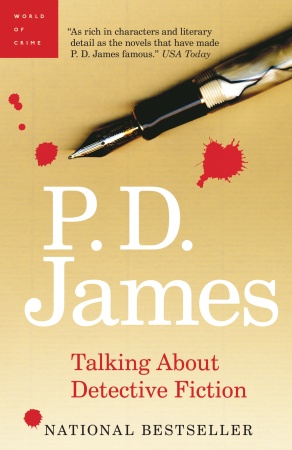 I am a detective fiction neophyte– I only read my second Dorothy L. Sayers last week. The book was Strong Poison, featuring Harriet Vane who’d been introduced to me in the marvelous Gaudy Night. And I thought it was fitting that I follow up Stong Poison with P.D. James’ nonfiction book, Talking About Detective Fiction.
It’s possible that I am exactly P.D. James’ intended audience here. Long prejudiced against genre fiction of any kind, though with a penchant from very young for smutty true crime books, but there you go. I found my way into detective fiction via Kate Atkinson, and her Jackson Brodie. I became addicted to television’s Midsomer Murders (which is based on the books by Caroline Graham). I also like Susan Hill, and recently enjoyed The Dead Politician’s Society by Robin Spano. I particularly adored Sayers’ Gaudy Night which, as James asserts, demonstrates that “it is possible to construct a credible and enthralling mystery and marry it successfully to a theme of psychological subtlety.”
But there is a lot I have to learn, such as that “crime fiction” is an umbrella under which detective fiction falls. The sacred rules of detective fiction, which all the best writers find ways to creatively skirt, including that the criminal must not be a character whose thoughts the reader follows, the detective should never know more than the reader does, no more than one secret room or passage, no intrusion by supernatural elements, no twin brothers or doubles unless the reader has been prepared. That there was no such thing as detective fiction before 1842, because there had been no detectives (or at least not in England– it was the year the Metropolitan Police came into being). The eternal allure of Sherlock Holmes (and one of the funniest parts of the texts is when James questions, at length, the reasons why H0lmes and Watson had continued to share a small flat from which Watson would have to retire to the bedroom when guests came around). James deals primarily with English detective fiction in the book, but devotes a chapter to the very different direction taken by the genre in America, with “hard-boiled” detective stories about Sam Spade and Philip Marlowe. I also particularly liked her chapter “Four Formidable Women”, which included Agatha Christie and Sayers.
I expect the true detective fiction devotee might not find a lot here that’s new, and moreover could even find plenty to quibble with, but all the same, James’ book is clever, funny and engaging, and manages to convey some of the suspense and characterization of her novels. For a reader like me, however, Talking About Detective Fiction is a delight, a fine celebration of a genre I’m looking to know better.
November 11, 2010
Black, White, and Read All Over
 I had the privilege of attending Black White and Read All Over event last night in support of Literature for Life. Keynote speaker was Terry O’Reilly, who talked to us about the power of storytelling. Underlining his message were presentations by three women who have participated in Literature for Life’s reading circles, and read us their poetry and spoke about their experiences as young mothers who were positively liberated by the power of reading and given direction in their lives. The whole evening was so inspiring, and it was thrilling to see such support for this wonderful organization.
Over the next few months, I’m going to be administering the Literature for Life blog, which has an interim home here while we set up the new website. Check out this post in particular to for a remarkable testimonial from a former participant. I’m also going to be working with CreateMeThis in the next few weeks to get the new website redesigned and up and going, and we’re very excited about what lies ahead.
November 11, 2010
"Love is a Let-Down"
 I spent the first six weeks of my daughter’s life amazed at her fabulousness, but also spectacularly miserable. It was really truly the worst time of my whole life, which was far from what I’d expected from my intro to motherhood, and I really thought that there I’d just gone and destroyed my entire life. I remember being terrified that my husband would leave me, which had never crossed my mind before, but in the awful stupor of that time, I couldn’t think of single reason why he’d stay. I remember crying with the windows open, with the hope that somebody might pass by and come in to take the baby away.
I maintain that I didn’t have post-partum depression, but just a bad case of the baby blues, but moreover that life with a newborn is generally awful. And though at the time I feared my bad introduction to motherhood might set the tone for everything that comes after, it didn’t. They were so right, those friends who told me that the first three months are all about survival, and they were so wrong, those other people who told me to make sure I “enjoyed every minute”. Ha.
Anyway, life got much much better, but I began to notice a pattern. Whenever anyone I know had a newborn, I’d speak to her around the one-week mark, and she’d tell me that things were going okay. She’d note that she was more than a little sleep deprived, and I’d recognize a slight waver in her voice. And then I’d confess that at the one-week mark, I was more unhappy than I’d ever been before or since, and the person I was speaking to would breathe a sigh of relief then, that she wasn’t the only one. That these feelings she was experiencing were more common than she’d thought. I’d assure her that things would get better, and she wouldn’t believe me at all, but as the weeks went by, she’d come to see that it was true, and soon she’d be out on the other side herself, and we’d even laugh about it.
I wrote my essay “Love is a Let-Down” this spring after a friend of mine had been suffering through the awful, and our conversations had brought up everything about new motherhood that I’d actually nearly forgotten. I entered it into The New Quarterly‘s Edna Staebler Personal Essay Contest, and was so happy to discover in August that it had placed as a runner-up. And I’m happy now to announce that my essay appears in TNQ 116, which is out now or soon, and will be available at your favourite bookstore. I urge you to pick up a copy, because it’s a piece that I am really proud of, that is terribly important to me, and I think has the potential to help somebody who’s where I was then.
Also because the fantastic issue contains work by some great writers, a disproportionate number of which have been interviewed on Pickle Me This: — Jessica Westhead, Rebecca Rosenblum and Kerry Ryan. I’m also looking forward to Sarah Selecky (of Giller fame!) and A.J. Somerset (of the Metcalf-Rooke award).
Update: A lovely post up about my essay at the Utne Reader Blog “Great Writing”. Which is definitely some nice feedback. And a nice blog.
November 10, 2010
The kind of mother I wanted to be
 I’ve read two really excellent pieces on mothering blogs lately, the first being “I was a better mom before I had kids…” and then Her Bad Mother’s “On Being a Good Mother In Spite of It All.” Both play with the expectations we set for ourselves before we become parents, and what the reality turns out to be, and I think these kinds of discussions are useful actually, to a point. HBM rounds out her piece with the idea that trying to be a certain kind of mother when your heart’s not in it isn’t going to be good for anyone– for example, baby-wearing because you think you should, but your back is killing you and you hate it, or quitting work to stay home with the baby when it makes you miserable. She was writing in response to a recent article by Erica Jong about the ridiculousness of attachment parenting (“On the Madness of Modern Motherhood”).
Now I am fortunate, because I came into parenting completely unaware that “attachment parenting” was even a thing. Or rather, I knew about it, but simply as one of the faddy things I learned about from reading Christina Hardyment’s Dream Babies (along with Baby Whispering, and airing your child in a cage suspended from an apartment window). So my idea of the kind of mother I wanted to be didn’t come with a doctrine. My parenting philosophy, if I have one (but I don’t) has kind of grown up with me– for example, I learned that strollers are awkward in narrow Bloor Street shops and many places have steps, so I became a Baby Trekker convert (and we’re at 28 lbs and still going). I learned that some nights the only way anyone in our house would get some sleep was if Harriet came to bed with me and so (I guess?) we became part-time co-sleepers. It has always been important to me to take responsibility for having brought a child into the world, thereby doing some extra laundry instead of contributing to landfill, so I am a bit of a cloth diaper fanatic. I still breastfeed, but was never able to pump, so Harriet had formula when I wasn’t around. I don’t buy plastic toys We don’t own a car or a television, and I don’t want to own either, and it has been important to me to learn how to be a parent without both of these things.
-
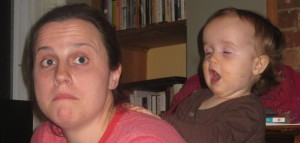
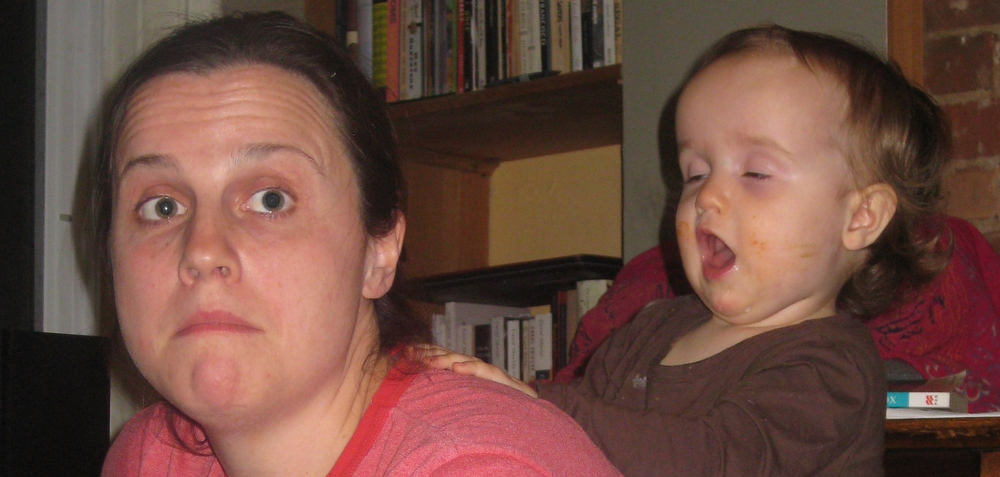
Believe it or not, this photo was not staged. We are this lovely naturally.
And so what I dislike about the discussions I noted is the way they descend into this bad-mother free-for-all. As if the very idea of using cloth diapers is laughable, or keeping small children away from television or limiting consumption . And I realize that a lot of this is very easy to say from the perspective of a mother of one, though I will point out that my belief in these ideas is part of the reason I am a mother of one (for now)– having one child is one of the reasons we’re able to make things work for us the way we want to. But I just feel that sometimes we’re all so busy congratulating ourselves for our honesty (like that a six month old got turned on to McDonalds. Really???) that we forget that some of these ideals are really sound ideas, and maybe the reason we feel guilty sometimes is that we should… Not because we let our children go out with dirty faces (see photo), or go out looking dumpy (also, see photo) of course, or lose our tempers etc. These are little things, they’re silly things. But there are bigger issues at hand, and somehow they get swept into the same catagory of impossible things. Like motherhood is just a slippery slope, and we’re all now looking up from the bottom.
I really am writing this now not to be a smug pain in the ass, but as reassurance for women who aren’t moms yet but who have an idea about the kind of mothers they want to be. If that idea comes from an authentic place within you, if you’re doing it because you want to and you believe in it (as opposed to the unsustainable arrangement derided by HBM of what you think you should be doing), then it’s totally possible. Of course, half the equation is your baby, and all bets are off as to what he or she will decide, but I want to assert that motherhood as an institution does not necessary push you to the bottom of that slippery slope. You’re exactly as indomitable as you feel.
November 10, 2010
The Carnivore by Mark Sinnett
 I first learned of The Carnivore when it was on the shortlist for the Toronto Book Award, and its author Mark Sinnett was reading an excerpt on the radio. The excerpt was intriguing, featuring a husband and wife meeting together on the shore of Lake Ontario as swimmer Marilyn Bell completed her crossing of the lake in 1954. The simple dynamic between the couple belied something darker and deeper, and the historical detail was inconspicuously well done. When The Carnivore ended up taking the prize, I knew that I had to read it.
When Ray Townes is in the final stages of emphysema, he and his wife Mary look back on the course of their marriage, and how their lives hinged on Hurricane Hazel, which ravaged Toronto in October 1954. The couple doesn’t look back together, however, the book consisting of alternating chapters from their two solitudes. The effect of this is interesting, as we learn that each of them has their own secrets about how much they know about the other and what they’ve chosen to withhold.
Ray is a police man who spent the hurricane rescuing citizens clinging to rooftops and washed out bridges. What the newspaper articles profiling his heroics fail to reveal, however, is that his courage that night stemmed from a mania that arose from a terrible act he’d committed, and that while he was supposed to be on duty, Ray had been driving around the city with his mistress. Mary is aware of all of this, however, which is why she resents the rehashing of events as the 50th anniversary of the hurricane approaches. She has never been able to forgive her husband for what he did and what he took from her, and now her own traumatic memories of the hurricane have been awakened– she was a nurse at St. Joseph’s Hospital, and witnessed horrific injuries that night she’d never been able to forget.
Sinnett’s depiction of the hurricane– the rushing rivers, the broken bodies in the hospital, the force of nature that tore its way through a city– are the most compelling aspect of the novel. They are riveting, illuminating and unflinching in their portrayal of a tragedy that seems to have been whitewashed by years of familiarity– like Hazel was somebody’s elderly aunt who came visiting once. Sinnett deftly uses detail in the story to describe the hurricane and the more general atmosphere of Toronto in 1954, his historical fiction not toned by sepia even though the book is structured as a reflection.
The back-and-forth in the narrative, and that the story is told to the reader rather than immediately experienced makes the plot read a little mechanically at times. Similarly the characters, who we’re permitting such a limited perspective of by their own voices and the partner’s perspective. Though some of the gaps Sinnett leaves in the character are interesting– we don’t get all the answers about why they’ve done the things they have, and that space to ponder is particularly engaging.
The Carnivore is a worthy recipient of The Toronto Book Award, a deserving book that will strike a chord with readers from Toronto and elsewhere. A book that uncovers another layer to a city we think we know.
November 10, 2010
Rare Giller Treat
 Look what Harriet found this morning! I look forward to reading it. If judges think it’s even better than Light Lifting, we’re really in for something brilliant.
November 9, 2010
Soap and Water
CBC Metro Morning was so delightfully bookish this morning, with pieces including an interview with Giller juror Michael Enright who had nearly read himself to death these last few months. And an interview with Dr. Alison McGeer about the decision to take magazines out of waiting rooms at Women’s College Hospital. Which was shocking for a few reasons, including 1) They still have waiting rooms at Women’s College Hospital? 2) But who will subscribe to Highlights for Children? 3) Who cares!? Doesn’t everybody have a novel in their purse already??
Since Harriet was born (which was nearly 1.5 years ago!), waiting rooms have offered me more uninterrupted reading opportunity than anywhere else. When she was about two months old, I waited for over two hours at a Passport Canada office while she slept in her stroller and I read (oddly enough), Between Interruptions: Thirty Women Tell the Truth About Motherhood (which was about thirty times more truth than I needed at that moment, by the way. Reading it was totally exhausting).
I had to go to the dermatologists early this summer and Harriet stayed home with my Aunt, while I got an entire subway journey there and back AND an extended waiting room round with Sarah Selecky’s marvelous This Cake is For the Party. There was a large screen TV in the waiting room too, which was blasting an episode of The View which made me very depressed about the state of the world, but Selecky’s stories really helped.
And then the legendary night this summer after Harriet poked me in the eye, and I waited in the walk-in clinic for six amazing hours reading Slouching Towards Bethlehem. It was also the middle of a heat wave, and the clinic was far more air-conditioned than my house was. I was almost disappointed when the doctor could see me then, though relieved to discover that I would not go blind.
All of this to say that I will not miss the old copies of Macleans then, or Shape, or Women’s Day, but then maybe I should have read them more, if only to absorb the diseases they’re apparently crawling with, so I’d get sick, go back to the doctor’s, then get to read some more.
November 9, 2010
www.patriciastorms.com
 Did I mention that my friend Patricia had got herself set up with a brand new website? A website that was created by my beloved CreateMeThis? And how lucky was good ol’ CreateMeThis to have Patricia’s spectacular images to work with, so that the result is splendid. Check it out.
November 8, 2010
On reading Anne Fadiman's Ex Libris
 I realize I’m being startlingly unoriginal in loving Anne Fadiman’s books of essays, not to mention about a decade late, but you see, I spent that decade entirely unaware that Anne Fadiman’s books were in the world, and I now see it as my duty to deliver any other readers from such similar darkness.
I first encountered Fadiman in August when I took her book At Large and At Small: Familiar Essays away with me on vacation. Tragically, its adorable front cover was marred when I used it to kill a mosquito against a log wall, and I was determined that a similar fate would not befall the even more adorable cover of Fadiman’s Ex Libris.
Ex Libris is a book of essays about books and reading, written with Fadiman’s signature exuberance. Though her book’s subtitle is an understatement; she is just about as “common” a reader as Virginia Woolf was. Fadiman’s bookish cred is serious: her parents are both writers, she grew up in an apartment with 7000 books, her husband is a writer and the progress of their relationship can be traced by the dedications on the fly leaves of books they’ve given each other over the years. One of her essays begins, “When I was four, I liked to build castles with my father’s pocket-sized, twenty-two volume set of Trollope.”
Still, however, there is common ground between her and us, which is partly aspirational thinking on our part, but also the result of Fadiman’s generous spirit. And she does have a knack of summing up experience just right: “I’d rather have a book, but in a pinch, I’ll settle for a book of Water Pik instructions”, she writes of her incessant need to always be reading something (which once a 1974 Toyota Corolla manual, twice, in an otherwise literature-barren motel room).
She writes hilariously about she and her husband eventually taking the plunge after some years of marriage, and finally deciding to merge their libraries, about the courtly and carnal approaches to how we mistreat our books, about gender and the evolution of language, compulsive copy-editing, and a wonderful essay about reading aloud with the perfect title: “Sharing the Mayhem.” Some of the book’s best bits feature her hapless husband, and her parents and brother who with her comprise a family like no other. A family that is an institution onto itself, with new word acquisition, literary references and allusions, and compulsive bookishness wholly integrated into everyday life– they are a fascinating window onto a world.
Anyway, I left this book on the kitchen table and something dripped on it, and there’s also now a rip on its upper right edge, but none of this makes Ex Libris less than perfect still, really. And how lucky was I this weekend to be discovering it for the very first time– delight and joy and wonder abound. My life is richer for it.






