May 15, 2013
Basements and Attics, Closets and Cyberspace: Explorations in Canadian Women’s Archives by Morra & Schagerl
 I am one of those readers who has bought into the romanticism of libraries and archives, Barbara Pym heroines and Maud Bailey in Possession. In 2001, I helped to unpack the Woolf Collection at the Pratt Library in its new sub-basement home, and it was one of the most remarkable things I’ve ever done. And even when it’s not romantic, archives are fascinating; one of my favourite books of recent years was Outside the Box by Maria Meindl about legacy of her grandmother’s archive, and unexpected questions: what do you do with a pile of papers covered on dust and cat hair, a colostomy bag stuck to the back? A question that probably wouldn’t faze most archival librarians, as Meindl discovers, and Susan McMaster too in her essay “Rat in the Box: Thoughts on Archiving My Stuff” from Basements and Attics, Closets and Cyberspace: Exploration in Canadian Women’s Archives (Linda M. Morra and Jessica Schagerl, eds). Her essay begins with a literary archivist asking for details, “Mouse turds or rat turds? A few mouse turds are nothing, they can be brushed off…”
The connections between the essays in Basements and Attics, Closets and Cyberspace are broad and strange, as befitting a book of “explorations”. Why “Women’s Archives” in particular? Because it’s a whole different game that requires in some cases a redefinition of what archives are. One can’t go looking in ordinary places for women’s history, because for so long there was no such thing, and different ethical questions are raised about public and personal stories. But what does it mean for the archive to change the definition of archive? What is expanded and what is undermined? The book is a fascinating exploration indeed, and while it’s published by an academic press and makes a fair number of references to Derrida, much of it was accessible to the likes of me, and was a really enjoyable read.
In “Of Mini-Ships and Archives”, Daphne Marlatt writes of language itself as an archive, and asks, “Does writing… inherently contain the possibility of going public?” based on her experiences in archives using personal stories to provide context for larger issues. Cecily Devereau posits eBay as an archive, discussing its advantages and limitations over tradition archives in the quest for “Indian Maiden” lore. “Faster Than a Speeding Thought” by Karis Schearer and Jessica Schagerl was of particular interest to me, examining poet Sina Queyras’ blog Lemon Hound, the blog as archive and ethical implications of this (there is no permanence; who do comments belong to?; can there be such a thing as a paperless archive?) and poses interesting questions about blogs in general: “Although, on the one hand, controlling the means of publication can be a powerful tool for shaping the literary field, on the other hand, it does have its own implications for women’s labour.” In “Archiving the Repertoire of Feminist Cabaret in Canada”, T.L. Cowan attempts to use anecdotes to recreate an event whose ephemera has been entirely lost, and discusses what kind of archive emerges from this exercise. Penn Kemp writes about archives from the point of view of the archivee, as does Sally Clark who discusses her own discomfort with archiving and the question it requires of her: “What are you worth?”
In “Keeping the Archive Door Open: Writing About Florence Carlyle”, Susan Butlin presents some of the unique challenges of researching Canadian women’s history, and the role of her own prejudices in the process (as she discovers the more commercial ventures of the artist Carlyle). Ruth Panofsky and Michael Moir’s “Halted by the Archive: The Impact of Excessive Archival Restrictions on Scholars” tells of Panofsky’s experiences with Adele Wiseman’s archives when Wiseman’s daughter suddenly made her mother’s archives inaccessible to scholars. The limits of traditional archives are further explored in Karina Vernon’s “Invisibility Exhibit: The Limits of Library and Archives Canada’s “Multicultural Mandate”. Katja Thieme uses letters to the Woman’s Page of Grain Grower’s Guide to show how the page function as an archive of rhetoric which underlines our understanding of the Canadian suffrage movement. Vanessa Brown and Benjamin Lefebvre discuss the archive of LM Montgomery and its role in their own work, as well as its inherent gaps and mysteries. Kathleen Venema uses an archive of her own–a collection of letters exchanged between her and her mother decades ago–to create a new archive and explore the limits of her mother’s memory as she becomes more and more afflicted with Alzheimer’s. In “Locking Up Letters”, Julia Creet questions what is she to do with her mother’s letters about her experiences during the Holocaust when the letters are of vast historical import but also recount experiences that her mother spent the rest of her life trying to flee from and hide.
Basements and Attics, Closets and Cyberspace is not a tidy book, but what exploration in an archive (or any one worth exploring) ever would be? Rather than putting away things in boxes, this book throws the boxes open wide, inviting more questions than answers, and demanding a broader point of view.
May 14, 2013
Baby Blankets and Mini Monsters
 We sure hope our baby doesn’t end up with jaundice because this blanket/cap combo really isn’t going to flatter if that happens. Blanket and cap are yellow as per Big Sister’s instructions, as yellow is the colour she most reveres, and basically the baby is welcome to be born at any time because Harriet has had her birthday party and the blanket is done. This is the Big Bad Baby Blanket, which I’ve knit many times before, and I made a little hat with the leftover wool. The blanket is pretty lovely with just enough errors that you’d know it was handmade if you went looking for problems, but none that stand out too much. Strange that it won’t be too long before we meet the wee person these knitted things are meant for. At this point, it’s still quite unbelievable to suppose that it’s really going to happen. It feels like these are ordinary days–who’d go and throw a newborn into the midst of that?
The little monster is Harriet’s gift for the baby. For months, she’s been determined that she was saving the money in her piggy bank to buy a present for the baby. A few weeks ago, we gathered funds (and were grateful to whomever had once given her a ten dollar bill) and went to the Intergalactic Travel Authority to purchase Maggie the Monster, Harriet’s chosen companion for her own Colin, and our baby’s future crib-mate. For all my deriding of consumption (book buying aside, naturally), it was quite adorable to watch Harriet make her first purchase in a shop. They told her the total and then she handed them a nickel and asked if it was enough. I had to help her with the rest, but was quite proud of her and the spirit of generosity behind the project. I really do think that Harriet is going to take to the Big Sister life with aplomb, and that our baby who is not yet even born is already incredibly lucky.
May 12, 2013
Arguments with the Lake by Tanis Rideout
 …Let’s step now to these gathering places./Name them–our birthright, strung like beads/ on northern shores. Let’s lay claim to the stories/ on this lake, the aquatic murmur of what’s past/ what’s to come.
Oh, it’s become a bit of a pattern, hasn’t it, me falling in love with poetry that give voice to obscure figures from the past. This time it’s Tanis Rideout’s poetry collection Arguments With the Lake, which imagines a friendship/rivalry between Marilyn Bell and Shirley Campbell, two women who as girls were determined to swim across Lake Ontario just two years apart. Bell made it and became a legend, while Campbell disappeared into obscurity after two failures to complete her swim. Rideout imagines the connections which bind these two girls, the force which drew them both to the lake’s edge and made them attempt to be a part of history. As the book’s exquisite cover suggests, there is 1950s’ bathing-beauty glamour going on here with a particular Toronto bent–Sunnyside Beach and the Palais Royale. The poems also examine the darker forces of friendship, of womanhood, of what inevitably follows girldom, stardom. The lake itself is Rideout’s main character though throughout the book, speaking back to each of the girls’ arguments, enduring but ever-changing. From “The Fear of Silence”: “The shoreline changes more than its citizens. The city/ has leeched into the lake. Front Street really was the Front./ Fisherman docked at the market’s doors. It is as though/ we want to live in that water–press into it, fill it up,/ like empty hours filled now with digital detritus”. I loved this book.
May 12, 2013
Every Day is Mother’s Day…
 …when one is self-absorbed and self-indulgent (hello! Over here! Waving!!). And every day is doubly Mother’s Day when one is 38.5 weeks pregnant, but today in particular. My own excellent mom was kind enough to let me lounge around at home and be the centre of the show with my little family (though we’re looking forward to seeing her next weekend). I was given tea and croissants in bed this morning, and a gift from said little family–the book Where’d You Go, Bernadette, which my clever husband had noticed me to eyeing in the bookstore last weekend. I think it will make an excellent post-baby read. And then I was left alone to reread the wonderful poetry collection Arguments With the Lake, which I’ll be reviewing later tonight. But that wasn’t all! Today, I was informed, we’d be having Afternoon Tea at Dessert Trends. And it was delightful, delicious and fun.
 Harriet was a bit challenged by the constraints of afternoon tea today, but she managed to hold it together, and we understood why she was not quite at her best. Yesterday had been her 4th birthday party (celebrated 2 weeks early due to baby’s imminent arrival) and perhaps an ice cream party and afternoon tea are too much for one weekend when you are just 206 weeks old. It is also possible that the fancy green tea eclairs weren’t entirely suited to her palate, though she found the scones and jam quite acceptable, mango tart as well. We were very happy to eat whatever she couldn’t manage.
 Her birthday party yesterday was a splendid success! It was held at The Big Chill Ice Cream Parlour, and attended by 12 of her marvelous friends who were surprisingly very enthusiastic about the game I’d entitled “Disappointing Pass the Parcel” in which the parcel was filled with citrus fruit. They were also very good at “Pin the Scoop on the Sundae”, and nobody mentioned that I am the world’s worst party-game planner. We had hot dogs, ice cream AND cupcakes, so all the food groups were met. Harriet was a spectacular birthday girl who made me very proud, and she had fun, which was the most important thing of all.
 Her friends and their families kindly contributed birthday gifts via Echoage, which puts half the gift toward a charitable donation (Harriet picked The Stop, and is quite excited that they’re getting a gift for her birthday) and the other half toward the purchase of her first bicycle. We went to buy the bike today, and were thrilled to get the Norco Rainbow bike. The weather today was disgusting, so she wasn’t able to ride it properly, but still mastered the art of pedaling via riding around up and down the hallway, which was very exciting. Can’t wait for the sun to come out again so we can hit the sidewalk!

May 9, 2013
The Woman Upstairs by Claire Messud
 Claire Messud’s latest novel The Women Upstairs is a book that rubs shoulders with so many others, in fact a veritable library which runs the gamut from Dostoevsky’s Notes from the Underground to Zoe Heller’s 2003 novel Notes on a Scandal. Although the latter novel is not referenced in Messud’s book, but rather by critics who haven’t read The Woman Upstairs yet and see implicit connections between these two novels about spinster schoolteachers with transgressing extracurricular connections, and who seemingly destroy their lonely lives with a subsuming obsession with another woman and her family. In Messud’s book, what is the scandal though? To which I answer that there isn’t one. Messud’s is a dark psychological fiction in which plot is not the point and not much really happens, but I dare you not to be captivated by her narrator’s voice, by this novel which begins in a fury: “How angry am I? You don’t want to know. Nobody wants to know about that.”
The voice belongs to Nora Eldridge, age 37, not incidentally the very same age as Marianne Faithfull’s Lucy Jordan when she realized she’d never ride through Paris in a sports car. And we are not to know until the novel’s conclusion just why she is so angry, assuming it’s mainly due to her dissatisfaction with her place in the world, her own invisibility the result of a life spent pleasing others. She doesn’t get to be “an Underground Woman” or even one of the mad-women in the attic (“they get lots of play, one way or another”), but instead she is “the woman upstairs”, “the quiet woman at the end of the third-floor hallway, whose trash is always tidy, who smiles brightly in the stairwell with a cheerful greeting, and who, from behind closed doors, never makes a sound.”
“Nobody would know me from my own description of myself,” Nora tells us, though it soon becomes clear that her own description of herself is the product of her imaginings, that she has little insight as to how she’s seen by the world, or perhaps she’s making a case for herself in this novel, that she’s taking full advantage of this opportunity to finally make a sound. When a new student arrives in her class, she’s immediately besotted with him, and swept up in the exotic world of his parents, his mother Sirena an Italian artist and his father a Lebanese professor. She admits that she finds their foreignness intriguing, though the reader wonders if its real appeal is that the couple is unable to place her as the outcast she is, and if in their role as outsiders, she’d projecting her own self upon them. And indeed it’s true that Nora does a lot of self-projecting. Metaphors of fun-houses and trick mirrors run throughout the novel, things not being what they seem (Sirena is busy at work creating an installation of Lewis Carroll’s Wonderland), but nothing is more tricky than Nora’s own narration, her fantastically unreliable point of view.
Messud’s novel is also structured as a fun-house, trap-doors and booby-traps springing up if the reader makes the mistake of taking Nora at her word. Which is a difficult mistake to avoid–Nora’s voice is so forceful, persuasive, she perpetually speaks in generalizations and second-person address designed to make us feel comfortable, familiar. “Don’t all women feel the same?” she asks, and you’d be hard-pressed not to respond with a nod, but then, no! There is no such thing as “all women” anyway, and besides, Nora Eldridge is clearly unhinged. On top of being an unreliable trickster of a narrator, she is also blatantly wrong, about so many things, but most notably in her insistence on regarding the world within the limits of gendered binary terms. In this way, the novel recalls Carol Shields’ Unless, another book in which an enraged female narrator stamps her ladylike foot at the systematic repression of womankind, institutionalized sexism which completely exists, but her singular focus upon this obscures a far more complicated reality. Which is not to say that Nora Eldrige’s or Reta Winter’s rage is misplaced, that either should cease their foot-stamping, but just that there is ever and will be ever more to the story.
Nora is threatened by her growing relationship with Sirena, her student’s mother whose thriving career as an artist challenges Nora’s own ideas about the limits placed on women by society. Nora is disappointed by the failure of her own artistic dreams, and Sirena‘s success suggests that this failure could fall more on the individual than on the society around her. But at the same time, Nora is also inspired and empowered by her connection to Sirena, by Sirena‘s attention to her. In their relationship, Nora finds herself as close as she’s ever been to the type of person she’s longed to be and the type of life she’s dreamed of living. Their connection is complicated, power ever-shifting between them, and it’s never entirely clear just who is being played.
The Woman Upstairs also reminded me of Lynn Coady’s The Antagonist, another novel whose foundation is a most remarkable voice, another novel that was sparked by rage and thirst for revenge. In terms of subject matter although not as complex as a fiction, it also had me thinking of The Interestings, which I read recently, another book about friendship, about what happens when different types of people dare to mingle. And even The Great Gatsby–these books in which ordinary people glimpse another, better world and have the nerve to imagine themselves a part of that scene.
But what happens when the scene shatters, when it reveals itself to be a mirror and the character suddenly realizes that she was outside all along? Claire Messud’s Nora’s suggestion is to pick up the pieces and sharpen the shards, though whether she actually will or if this will be just another example of her fruitless longing is just a whole other layer of complexity underlying this formidable book.
May 7, 2013
City Books for Spring
(This post is cross-posted over at Bunch)
Right now as spring arrives and family life moves back out of doors, it is a perfect time to share some books that connect readers to the local and which affirm the goodness of life in the city.
 In Lucia’s Neighbourhood by Pat Shewchuk and Marek Cole: This picture book based on the NFB film Montrose Avenue tells the story of “the ballet of the good city sidewalk” (as quoted by Jane Jacobs) in Toronto’s Little Portugal neighbourhood. The book opens with the epigraph by Jacobs, and then goes to render the urban visionary’s ideas in a way that a child can easily understand. A fabulous celebration of city life, In Lucia’s Neighbourhood is most remarkable for its illustrations which are so utterly Toronto: streetcars, three-panelled windows and wrought-iron porches. How wonderful to encounter one’s own world within the pages of a book.
 Maybelle the Cable Car by Virginia Lee Burton: This one’s not a Toronto book, but in some ways it may as well be. San Francisco’s iconic cable cars are under threat, as Big Bill the Bus explains to Maybelle: “I just heard the City Fathers say/ the cable cars must go…/ that you’re too old and out of date/ much too slow and can’t be safe/ and worst of all YOU DON’T MAKE MONEY./ What they want is Speed and Progress/ and E-CON-OMY…” San Franciscans don’t respond well to the potential loss of their cable cars, forming a citizen’s committee to save them. Petitions lead to a referendum, and the cable cars are preserved. “We, the people, are the City. Why can’t we decide?” And with that, your child’s political foundation is laid.
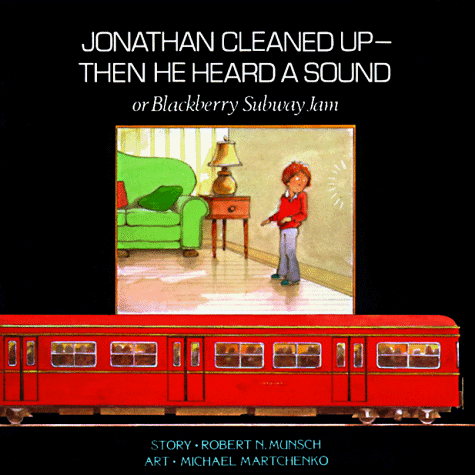 Jonathan Cleaned Up and Then He Heard a Sound by Robert Munsch and Michael Martchenko: Another book that seems eerily prescient of the current state of Toronto politics. “Subways, subways, subways!” indeed, and somehow a station has appeared in Jonathan’s house. “If the subway stops here, then it’s a subway station,” Jonathan is told by a TTC conductor who has a relaxed emphasis on customer service and instructs Jonathan to go to City Hall if he doesn’t like it. When Jonathan gets there, the Mayor has run out for lunch. Wandering the empty corridors of City Hall, he comes across an old man crying behind “an enormous computer machine.” Turns out the computer is broken and the poor man behind it is responsible for running the entire city. Jonathan gets him to move the subway station in exchange for four cases of blackberry jam, demonstrating that sometimes civic engagement (and bartering) is the only way to get things done.
 Jelly Belly by Dennis Lee: This one is not the most obvious contender for the list, but I happened to be reading it soon after reading Edward Keenan’s Some Great Idea, and noticed some parallels between the two books, absurdest story-telling aside. Lee gives us poems not only poems about garbage men and traffic jams, but also a reference to David Crombie in “The Tiny Perfect Mayor” and another poem called “William Lyon Mackenzie.”
 A Big City Alphabet by Allan Moak: I loved this book as a child, and now I love that my daughter is growing up in the very places Moak’s paintings illustrate. City kids will recognize their favourite parks, Kensington Market, the AGO, laneways, variety stores, and other familiar spots. (Hint: A gorgeous print of “I is for Island Ferry” is for sale for $5 at St. Lawrence Market’s Market Gallery, along with other prints from the city’s art collection).
 Who Goes to the Park by Warabe Aska: We picked up this book as a library discard, a most excellent find, as used copies are hard to come by. Fortunately, a few copies are still circulating in the library system. In his beautiful paintings which manage to perfectly meld realism and the ethereal (as all the best parks do, really), Aska tells the story of Toronto’s High Park throughout the four seasons, and of all the people and other creatures which are part of life there. (Image courtesy of the Osborne Collection’s online art exhibit).
 How to Build Your Own Country by Valerie Wyatt and Fred Rix: Older kids with an interest in politics and civic life will appreciate this multi-award-winning book from the Citizen Kid Series. It’s a step-by-step guide to building a nation from scratch, and also serves as a fantastic illustration of how our society and those of other countries are structured–however precariously.
 Watch This Space by Hadley Dyer and Marc Ngui: Another non-fiction book for older readers, this one about “designing, defending and sharing public spaces.” This one is a nice extension of In Lucia’s Neighbourhood, with references to Montrose Avenue and Jane Jacobs, even, but also takes on a global perspective and discusses how public space is used differently around the world. It”s a vibrant and engaging book with all kinds of suggestions about how to employ its many lessons out on the street.
May 6, 2013
Yard Sale Finds
 Yard sale season has begun in downtown Toronto! On Saturday, we picked up these three fine volumes, along with Michele Landsberg’s Guide to Children’s Books and Human Voices by Penelope Fitzgerald, for a remarkable $1.25. The Apple by Dick Bruna is as strange and visually appealing as anything Dick Bruna ever published; we love Sunshine by Jan Ormerod, which we’ve had out of the library a number of times (and I am particularly fond of the mother who sleeps/reads in bed until the last possible second, and then runs around the house getting ready in a frenzy. I feel as though I know her very well…); and The Little Steamroller by (the!) Graham Greene is amazing! A picture book this might be, but it’s absolutely Graham Greene, complete with a criminal gang smuggling gold from Africa and terrible English weather. Totally weird, but Harriet is so accustomed to weird picture books that she doesn’t bat an eye.