September 5, 2015
Come Away With Me, by Karma Brown
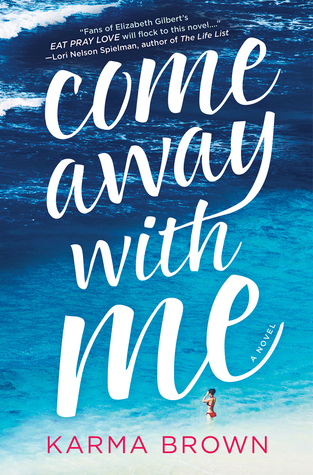 I am intrigued by questions of how people survive the seemingly unsurvivable, which was the reason I picked up Come Away With Me, Canadian writer Karma Brown’s debut novel. It’s the story of Tegan Lawson who had everything she’d ever wanted—an amazing husband and a baby on the way—when the dream is shattered by a horrific accident. Five months after the tragedy, her husband implores her to pick up the pieces of their life (and perhaps begin to forgive him for the accident, as he was driving the night it happened) by embarking on the trip of a lifetime to Thailand, Italy and Hawaii. Reluctantly, she goes, though she is not sure she’s ready (and neither are their families). And the trip itself does not prove to be the salve it might have been in a lesser novel, all of their troubles simply melting away—Tegan’s not taking her anti-depressants, she’s regularly still overcome with despair, her anger toward her husband seems impossible to let go of. And here we begin to see that this dream getaway is not the end of Tegan’s story but it’s the beginning of new one that’s vastly different than the life she’d planned on and dreamed of.
I read this book with pleasure, appreciating its light touch in particularly after spending a week carrying around the Joan Didion bio. Though it’s essential to note that my full appreciation of its remarkable structure and craft was not clear until close to the end. Until that point, I’d been putting some hollow characterization and a bit of narrative strangeness down to the fact that this was a(n otherwise capable) first novel. “I like this book, but…” I was saying to my husband yesterday. Not supposing that all this was part of an authorial sleight of hand that was so absolutely mind-blowing. By which I mean that the discerning reader should be encouraged to bear with this book: rewards will be forthcoming. You’ll see what I mean.
By rights, this book should be terrifically sad, and while I was discovered in a puddle of tears this morning by my concerned family (who wondered why I was taking even longer than usual to get out of bed), Come Away With Me leaves its reader buoyed and full of hope. In the best ways, it reminded me of Sonali Deraniyagala’s Wave and also Laurie Colwin’s Shine On Bright and Dangerous Object (which I reread this summer and absolutely adored). It’s an impressive and memorable novel celebrating life and love and the possibilities of survival.
September 4, 2015
Sometimes I Feel Like a Fox, by Danielle Daniel
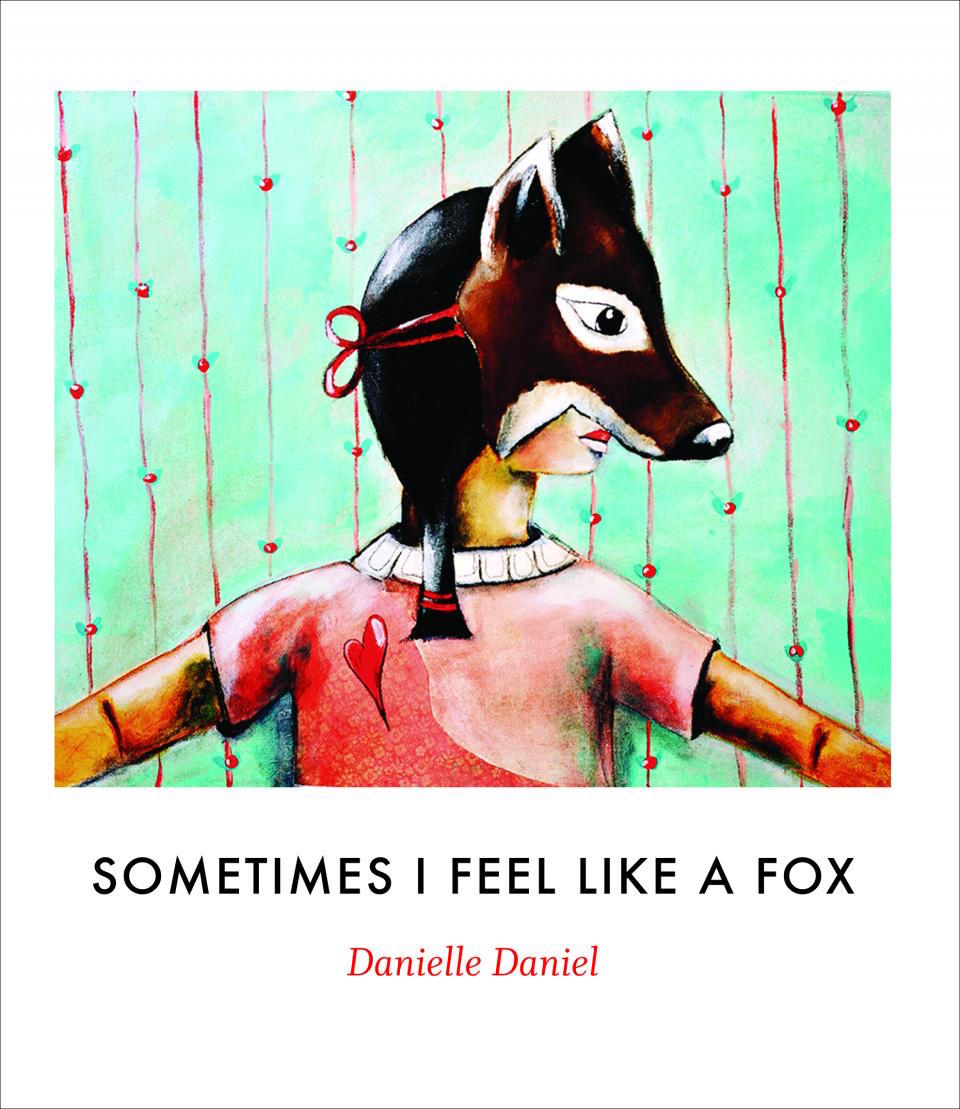
Today’s Picture Book Friday pick is Sometimes I Feel Like A Fox, by Danielle Daniel, a gorgeous book that my kids love whose meaning is made all the more poignant by its dedication: ““to the thousands of Metis and Aboriginal children who grew up never knowing their totem animal.” Our world is a very complicated place, but I continue to maintain that one very simple thing we can do toward reconciliation with our Metis and First Nations peoples is ensure that our children know their stories, and not just the stereotypes they encounter in so much of classic children’s lit or the “dead Indian” tropes that Thomas King presents in The Inconvenient Indian. And one thing we can do toward healing and ameliorating the status of Indigenous women in Canada is to buy their books, have their stories told. (See the list: Books by Canadian First Nations and Inuit Women.) And so to those ends, picking up a book like this is an important political act.
It’s also a most rewarding literary one.
Read my Q&A with Danielle Daniel at 49thShelf.
September 3, 2015
Meet Mitzi Bytes
 Oh, it has been so hard for me to keep this secret for more than two months now, that my novel, Mitzi Bytes, has found a home and will be published by Harpercollins Canada in Spring 2017. I have spent the summer working on revisions that have made a book I love even better, and I’m just so thrilled in general.
The news went out today: “Canadian rights to Kerry Clare’s debut novel MITZI BYTES, a grown-up Harriet the Spy for the digital age—a novel about the perils and pleasures of living a secret life online and the risk to friendships and family when that life is revealed—to Editorial Director Jennifer Lambert of HarperCollins Canada for early 2017 by Samantha Haywood at Transatlantic Agency.”
The timing is particularly meaningful to me. Ten years ago, I started the Creative Writing Masters program at the University of Toronto with the intention of writing (and publishing?) a novel. And while I did write a novel (and learn some things, and make some excellent friends that were worth the price of tuition), the novel was not a triumph. After getting some feelers from the universe, I determined that said novel was boring and plotless. So I decided to give up on it, which is the same as “moving on,” and it was the best decision that I ever made. Because the book really wasn’t good enough, and I’d rather publish no book than a crappy one. And while there was some frustration and sadness about this (and I felt a bit left behind by colleagues who went on to publish first and second books), there is plenty else in life (and in literature!) with which one can occupy oneself. So I did. I also wrote another novel and (guess what!) that one wasn’t good enough either. And I wasn’t sure fiction writing was ever going to be my scene.
And then last summer, this idea that had been rattling around in my brain (inspired by a point in previous abandoned novel even!) finally took hold. One evening at the end of last June, I was talking about the idea with my family over dinner and there was just something to it. (That something might well have been, wait for it, PLOT. Who knew?). And then I got out of washing-up duty and sat down to start writing. In hindsight, and in foresight even, it was a terrible time to start writing a book: Harriet was home for the summer, I had other stuff on the go. But when is ever not a terrible time to start writing a book?
Around the same time, I started jogging. “Just keep going. Just keep going,” was my mantra for both. And thankfully, jogging was the thing I eventually gave up on (moved on from?), after the day I burst into tears in Queen’s Park because I hated it so much. The story, on the other hand, kept going and growing. I met my goal of writing 1000 words a day. I hit a brick wall at the end of the summer, 70,000 words but I didn’t know how to tie it all up. I am not great at writing endings. So the book was put on hold throughout autumn as I was busy with teaching and other things, and then one day in December as I was walking down the street (of course!) it occurred to me how the story could end. And then it was done. It was done, and I loved it. This, THIS, is the novel I’ve been waiting for, the book that I was meant to write, and if you’d told me a decade ago that it would take so long, I would have been devastated. But from where I stand now, it couldn’t have been more perfect.
After expert feedback from awesome readers, I worked on my second draft throughout February and March—Sunday afternoons at Robarts Library as the campus outside turned into spring. And feedback from my editor, Jennifer Lambert, showed me the way toward draft three, which I am so ridiculously pleased with and got done because I had childcare one morning a week all summer long and made the most of it. (What a pleasure to be working on fiction for which one is contractually obliged to produce. That fiction writing is top priority—this was a new one for me.) And so here we are, and there will be lots of more work ahead, but I am so excited and pleased and feel very very lucky.
I can’t wait for you to read it!
September 1, 2015
The Last Love Song
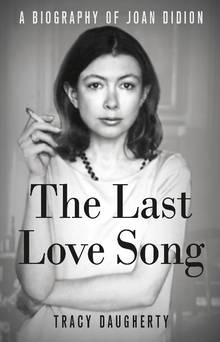 I’ve been reading The Last Love Song: A Biography of Joan Didion for nearly a week, a grand hulking book at 500+ pages. I spent Sunday afternoon in my hammock with it, and when I was finished, I’d never felt so languid. I do one day want to write an essay about Joan Didion, Mad Men, and longing. So I am inspired, even though The Last Love Song is not a particularly good biography—most of its source material is Didion’s autobiographical nonfiction, which I’ve read so many times that I know whole sentences by heart. So it’s not really illuminating. And Didion herself has made a career of being elusive, self-effacing. Also, if Didion’s brother-in-law Dominick Dunne had not been such a shameless name-dropper with a really big mouth, the author wouldn’t have much to go on. But it’s still interesting, because Didion herself is so compelling. The best parts of the book are when author Tracy Daugherty shows us how her writing works and why, dissecting her distinctive sentences. With Didion, it’s so easy to gloss over her polished surfaces and take everything at face-value that I hadn’t always read so closely. The worst parts of the book (not including the faux-Didion cadences and use of repetition and patterns) are when he tries to find autobiography in her writing itself, in which she’d always positioned herself so carefully. The mother-blaming for her daughter’s troubles is subtle but persistent, and troubling. There is nuance is Blue Nights that readers didn’t get, and I don’t think Daugherty gets it either. That Joan Didion couldn’t ever have been a mother except the mother she was. To suppose there is any other option is beside the point and not that interesting. But still, with its flaws, The Last Love Song is worthwhile and it’s good and heartening to see a female writer feted this way. Read Didion first though
August 31, 2015
The Art of Blogging starts October 5.
 My course, The Art of Blogging, starts October 5 at the University of Toronto School of Continuing Studies. Our last session was fun and inspiring, and I’m really excited about doing it again. You can learn more about my approach to teaching blogging here.
And the following is some of the feedback I received on my previous course evaluation, just to give you a sense of what you can expect from The Art of Blogging:
“I really enjoyed how Kerry tied the art of blogging to other art forms—literature, visual art, etc—and encouraged us to see blogging as part of a larger context. Was engaging and thought-provoking.”
“This course was exactly what I needed to get going with my blog.”
“A worthwhile course! I would recommend it to those who want to learn about blogging and all it encompasses.”
“Excellent! Very enjoyable learning experience.”
“I think Kerry did an excellent job of encouraging our individual voices and maintaining a respectful and productive learning environment. Loved the class—thanks, Kerry!”
August 30, 2015
Girls on the Go


Some might say that this blog has been lately suffering from a dearth of photos of my children, and so here they are, modelling the season’s latest fashions in Dufferin and Spadina Subway Stations (the latter at the Walmer Road exit). You will note that between the first and second photo, new shoes and crowns were acquired, so it was an all around excellent day. We’re hoping for a few more of these before they start school in a week and a bit, and yes, I am having my usual pre-September “I do not know what my new routine will be yet!!” anxiety. Hopefully, as in other years, it will all be fine.
August 27, 2015
Swan, by Laurel Snyder and Julie Morstad
 The thing about a book illustrated by Julie Morstad is that you’ve just got to buy it, because Julie Morstad books are an occasion, the occasions not at all diminished by the fact that she’s been very prolific lately and her books coming out every few months now. (Recently: Julia, Child; This is Sadie.) I’ve been particularly looking forward to her collaboration with Laurel Snyder, because I’ve been an admirer of Snyder (who is pretty prolific herself) since before she’d ever written a book, when I was an avid follower of her long-ago blog (except then we called ourselves readers and not followers). I even have a copy of her 2007 poetry collection (for grown-up people), The Myth of the Simple Machines, whose cover image is more than a little Julie Morstad-esque.
Morstad and Snyder’s collaboration, Swan, is a picture book biography of the ballerina, Anna Pavlova.

For anyone with a thing for laundry lines in literature (and there are many of us!), this book is for you. It’s the story of a young girl (born in 1881, as the note from the author at the end informs us) whose world is transformed when her mother takes her to see Sleeping Beauty at the ballet.
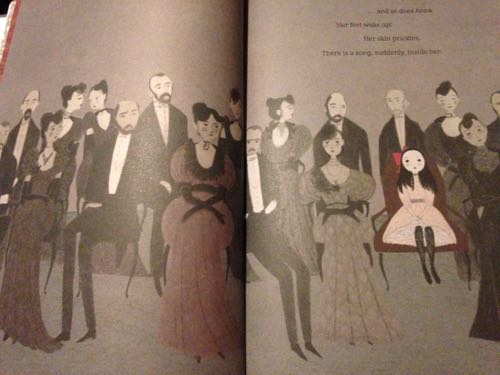
“Now Anna cannot sleep. Or sit still ever.” Even as she works with her laundress mother, she is thinking about dancing. “She can only sway, dip, and spin…”

The route to success is not so direct. Anna does not get into ballet school on her first try. Once she is admitted (“The work begins. The work? The work! Up and down and back and turn and on and on… Again! Again! Again!”), it is generally assumed that she does not have the right body type, too strange feet for ballet. But she flourishes. Five years into her career, she dances her most famous role: The Swan.

Swan reminded me of Barbara Cooney’s Miss Rumphius, the story of a young woman with fierce ambitions who also wishes to make the world more beautiful. Anna Pavlova does this not by planting lupines, but by bringing her art to people around the world who’d never before had access to the elite world of ballet. “Across bullrings and the warped boards of dance halls, she moves everyone. The sick and the poor come to meet her boats and trains, they cheer her, and are cheered.”

I love the fashion (that cloche hat!) in Morstad’s illustrations, and the gorgeous costumes. I also love the footsteps in the snow, which reminds me of Singing Away the Dark, by Caroline Woodward, one of my favourite Julie Morstad titles. Snyder’s prose is full of its own kind of music, sound and rhythm, repeating patterns, a contrast of soft and quiet tones, the reader wholly engaged in the narrative. It’s a book that begs to be read aloud: “There’s a swell of strings, a scurry of skirts. A hiss and a hum and… HUSH! It’s all beginning!”

Full disclosure necessitates that I tell you that Harriet isn’t quite as mad for this book as I am. She admires much about it, but says she finds the ending much too sad. While I really love the ending, how Anna Pavlova’s death is represented as another beautiful performance. (The author’s note explains that Pavlova was calling for her swan dress in her fever.) I appreciate that death is necessarily part of the story, and how gorgeously Snyder puts it: “Every day must end in night. Every bird must fold its wings. Every feather falls at last, and settles.”
“Can I still read it anyway?” I ask Harriet, and she says I can.
I have a feeling it’s going to grow on her.

August 26, 2015
Fake Paul, by Kimmy Beach
 There are some of us, a kind of tribe, I think, who know certain things, like the significance of the address, 20 Forthlin Road, without even Google or the aid of a map. We are indeed the same people who have visited the Beatles Museum at Albert Dock, and can properly visualize the brick wall outside Paul McCartney’s house at 7 Cavendish Avenue London. (We are probably the same people who know that John Lennon lived with Aunt Mimi at Mendips on Menlove Avenue, in the box room above the door where the acoustics were particularly good. And that Paul McCartney has allegedly claimed to have lost his virginity to his babysitter. And how his brother changed his name from McCartney to McGear.)
We are the kind of people them who buy Kimmy Beach’s poetry collection, Fake Paul, on a Wednesday afternoon, and have the whole thing read by Thursday morning. A fantastic tale of obsession and Beatlemania, fan fiction at its very best. Beginning with a woman who is conceived the night the Beatles make their North American debut on the Ed Sullivan Show, her stars inextricably linked to those of Paul McCartney in particular. A childhood infatuation in the 1970s leading to a pilgrimage to England and all the Beatles sites, a stolen head from a wax museum, and becoming troublingly devoted to the Paul (the eponymous Fake Paul) from a Beatles tribute band in Edmonton, Alberta.
I am not suggested that only those of us in the tribe can appreciate Beach’s book, but instead insisting that those us in the tribe should. A playful and more than slightly crazed narrative that somehow manages to articulate my experience of longing and infatuation. And yes, who could ever fault a poetry collection that one can devour in a day.
I loved this book.
August 25, 2015
The Nature of the Beast, by Louise Penny
 If you’re like me, you’ve always thought the one thing missing from the bucolic idyll of Three Pines in Quebec’s Eastern Townships (apart from a cell phone signal) was arms dealers and old Cold War conspiracies. Or maybe you never knew that you were missing these, but while their arrival into Louise Penny’s fictional village initially seems a bit incongruous, you will quickly suspend disbelief and just settle into her latest title, The Nature of the Beast, enjoying the ride.
After finding her previous release underwhelming (and it was always going to be a challenge to follow up the amazing How the Light Gets In—interestingly, too, her books set in Three Pines [no matter how unfathomably!] always seem to be her most compelling), I was so pleased to be swept away by a new Chief Inspector Gamache novel. Although in this one, Gamache is Monsieur instead of Chief, retired from the Sûreté du Québec and living with his wife in Three Pines. Which should really be the last place a homicide inspector goes to retire. It means he’s still in the centre of things when the body of a young boy prone to telling tall tales is found in woods, that horror yielding another more deadly discovery.
Gamache remains a part of the murder investigation, but the dynamics are different now as Isabelle Lacoste has taken his place as Chief Inspector, Gamache’s son-in-law Jean-Guy Beauvoir her second-in-command. The interpersonal relations are one of the most compelling aspects of the narrative, the web widening to include all the residents of Three Pines we’ve become familiar with over the past decade, and a few we haven’t met before. Matters complicated by the arrival of CSIS agents, a mysterious physics professor from McGill University, and old stories about arms deals to the Soviets and Saddam Hussein, a draft-dodger who wrote folk songs with appalling lyrics, and a serial killer whose evil continues to haunt Gamache to this day. Plus a Neil Young soundtrack, references to classical literature and the Book of Revelations, and a wonderful line, an allusion to Marilynne Robinson’s Gilead, in which Gamache tells Jean-Guy that he “is a brave man in a brave country.”
Weapons of mass destruction in Three Pines? It’s all a bit nuts, as are the connections between plot points, but the characters are so realized and convincing in their actions and motivations that it works. As do the arguments about good and evil and courage and bravery that Penny and her characters have been grappling with through the entire series. And it’s a relief to find, as the novel suggests, with Gamache making plans for his future, that they’re not finished yet.
August 23, 2015
Nature
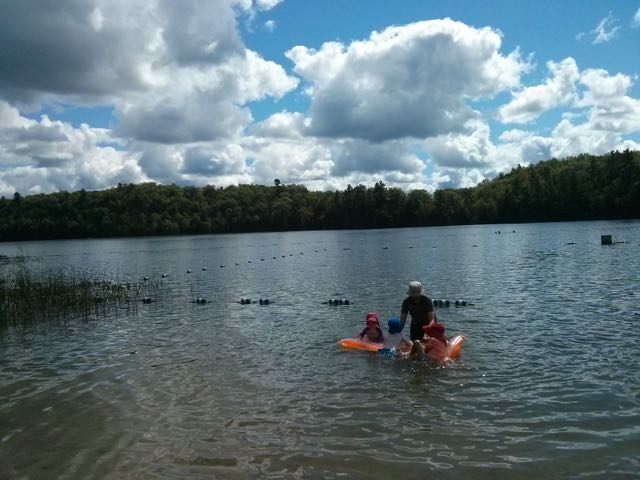
We went camping this weekend, and will need a few days to recover (and to do loads and loads of laundry). It was a beautiful, if exhausting weekend, and in addition to the company of my own family and that of my dear cousin’s people, I had the pleasure of Louise Penny’s and I’m now midway through her new one, The Nature of the Beast. It’s wonderful! (And must get this one read and then reread Joan Bodger’s How the Heather Looks before my book club meets on Wednesday.) Anyway, the Louise Penny was some consolation for the fact that I am now allergic to both lake water AND sunshine, and therefore had to spend our beach time hiding under an umbrella that kept blowing away. I was only 40% completely grumpy and annoyed about these circumstances, though some might estimate the percentage as a wee bit higher…







