November 30, 2015
Ten Things I Sort of Like About Being Sick
 Okay, I am going to do it, because I’ve done enough moaning for sure. My own version of Ten Things I Sort of Like About Being Sick.
- Not thinking about food all the time: It is true that I am usually preoccupied by planning my next meal. And conspiring to bake a cake. Plus I have to feed the people I live with, and have the shopping done, and make lunches, but in the last week I’ve not cared about any of this at all and it’s been kind of freeing.
- My bedroom. I like my bedroom a lot. It’s huge and quiet and has an en-suite bathroom. My bed is comfortable. This is not a terrible place in which to spend a lot of time.
- Doing nothing. Like nothing, nothing. For most of last week, I couldn’t even read. Sometimes I would close my eyes, and when I woke up, then whole afternoon had disappeared. I have spent hours staring into the middle distance. I don’t ever, ever do nothing. It’s kind of interesting to know I have the capacity.
- My husband. Not that I needed him to demonstrate that a) he loves me or b) that he’s a really really good partner. But as ever, he’s stepped up. Not so much that he hasn’t had moments of frustration, demonstrating that he’s human after all, but he’s an amazing human, taking our kids to school, making those meals I can’t be bothered with, keeping our house tidy, the children happy, and getting his work done.
- My mom. For coming and bringing us meals, and picking up my girls from school, and playing with them so they are not watching TV all the time. So profoundly grateful for what she does for us. She’s been a lifesaver this week.
- Popsicles. And smoothies. Okay, it’s possible that I’m still preoccupied with food.
- Christmas is doomed. Okay, fortunately, I’ve bought all my children’s presents, and I’ve even bought the presents that need to be send across the country and across an ocean…but they’re still sitting in their packaging. I think we’re running out of time. I also haven’t done any Christmas cards. All this is going amiss. And it’s just going to have to…
- That everything has stopped. It is true, this fall has been a perpetual motion machine. And for a few days I tried to outrun my illness, but it turned out to be faster than I am. I also kept reading articles about people who’d been put into medically induced comas after ignoring illnesses for long periods of time and then nearly dying. So I decided to give myself the rest I needed. Oh, okay, I didn’t decide, I had not choice. But everything has stopped. And that’s okay.
- My bedside table. I love it. It’s its own universe. It has a tea pot, an a telephone, and a water bottle, and books, and a smoothie, and kleenex, and painkillers, and a lamp. What else does one need in the world?
- Getting better. It’s starting to happen. I just have to be patient to win this game.
November 29, 2015
Nothing restful
 A photo like this suggests I’ve spent the day reading, which isn’t true. There was also all the time I spent staring at the ceiling, and when I slept from 1-4. The Long Secret is so good though. Yesterday I read The Westing Game. And things are progressing—yesterday I sat up in a chair for a few hours, but then I had to go and lie down. I’ve also started eating food, though less today than yesterday. Progress seems to be a trickly slow and very unsteady thing. So does my brain power. Basically I’ve had a fever for a week and when I close my eyes to sleep at night, my brain launches me into some bizarre narrative constructed of everything I’ve ever thought or seen, and there is nothing restful about it. It’s like playing a game whose rules are dictated by the whims of Harriet. Which is as close as I can come to putting these fever dreams into words.
November 26, 2015
Be. Sick.

I don’t think I knew the definition of giving in. Okay, now I really give in, getting in bed and staying in bed and someone else has to take the children to school, and never mind that I can’t even read, I can’t write, I can pretty much just take staring at the ceiling. This morning I laid in bed and experienced the bedsheets becoming drenched with my sweat. When I came home from the doctor, I was freezing and got tucked into bed whilst wearing a toque. The doctor says that I have is not the flu, and at least it’s not pneumonia or bronchitis, but instead a virus that will go in about 10 days from its start. Which is a while from now. Sometimes I feel better, but I mustn’t use this as an excuse to suppose I am better. I have to continue to stay in bed. And in a way, it’s a bit like pregnancy—everything is interesting. All the sweat, and shivers—new bodily functions—and I’ve become gaggingly sensitive to scents. But it’s terrible, which one is not really allowed to complain about because it’s temporary—there are people with worse lots. There is light at the end of the tunnel, but not tomorrow or the next day. Patience and faith. I need to relax. I need to be wait and be. Sick. Okay.
I tweeted this post yesterday, from the blogger Pip Lincolne: “Ten Things I Sort of Like About Being Sick.” I think some people thought I’d written it. I most definitely hadn’t, but I’d starting to think I could. Or something like it. So I will put my mind to it. Will proceed at a snail’s pace, of course,
November 24, 2015
I give in

Late Saturday night, illness arrived, packing a wallop. I was feverish, sore and achey, and my skin hurt. I felt better on Sunday, and put in a good show at the Draft Reading Series 10th Anniversary Celebration, reading from Mitzi Bytes for the first time and participating on a panel. But by the time we were home, I was sick again. So totally exhausted, and yet unable to sleep either, because my brain was totally loopy and not settled. Yesterday, I was too unwell to take the children to school. I was determined to fetch Iris at noon, which I did, but I was a terrible mess—hunched over because my stomach hurt, only able to take slow stilted steps. She ate Corn Pops for lunch out of a plastic cup. I had a nap when she did though, and woke up finally feeling better, and for the first time, it seemed like not cancelling my class that evening was not a terrible mistake. I was even able to finish Stuart’s birthday cake, fetch Harriet from school, taught my class respectably enough (albeit in jogging pants), and bought NyQuil on the way home. So that last night I finally slept, but I awoke this morning still feeling terrible, and as it seems I’m unable to outrun this cold-fluey ailment of mine (and I don’t have to make a presentation in front of a group of people today—thank goodness), I’ve decided to submit and spend the day in bed. The rarest luxury for a mother, I realize. Crossing my fingers that rest brings recovery. Being sick is terrible.
November 19, 2015
The Story of Snowflake and Inkdrop
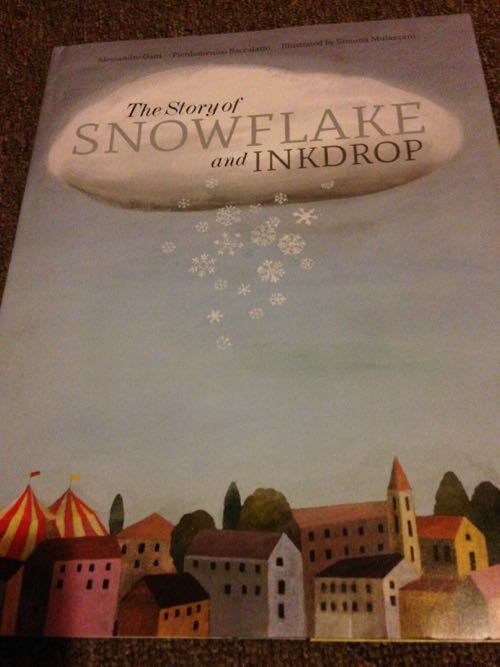 The Story of Snowflake and Inkdrop is written by Pierdomenico Baccalario and Alessandro Gatti, illustrated by Simona Mulazzani, and translated from Italian by Brenda Porster. It’s a gorgeously illustrated picture book about yearning, desire, and storytelling, with beautiful intricate die cuts that make it a book that might be better be kept up on a hight shelf, and perhaps best suited for grown-up picture book lovers. Although my children, with their grubby little fingers, like the book as much as I do, and are as adept at getting lost in the illustrations, and perhaps even better at picking out its perfect details, at noticing things. And there is a lot to notice here, in a book about tiny particles and what it means to be part of something larger than oneself. And also about what it means to see the world and want to be a part of it, and the amazing, serendipitous way that this (that love!?) can happen.

At first, this is the story of some wind and a snowflake drifting over the rooftops of a European town. The snowflake, we’re told, has been travelling for a long time. He feels, however, that he’s finally on the cusp of arriving somewhere, and the world below is glimpsed through the snowflake’s crystals, revealed altogether when the page is turned: we see a city street in one image, a circus in another, and then children playing in a park as the snow begins to accumulate.

In none of these scenes does the snowflake fall, however, and he begins to despair that he ever will… When he sees a tiny ink drop flying resolutely toward him, and the snowflake is overwhelmed by the desire to hug it tight. BUT WAIT!

Turning the book around and starting from the other side, we encounter that storm from an altogether new perspective. A single drop in a bottle of ink watching the wind rattling the world outside.

Although the Inkdrop has her own concerns—for days, she’s been waiting for her artist to finally carry her to one of his paintings. Her longing is intensified as a gust of wind from the window blows the paintings around the studio, so that they “flew up, dancing in front of Inkdrop like so many dreams.”

She sees each painting, and wishes deeply to be a part of the scene.
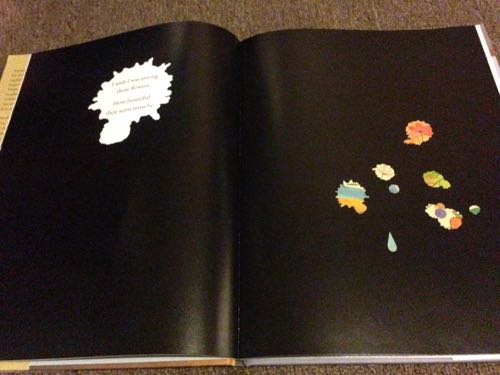
And yes, it is a picture of a teapot. Naturally, we are delighted. We see also a portrait, a bucolic scene. (Clearly this is an artist with a diverse set of approaches!)
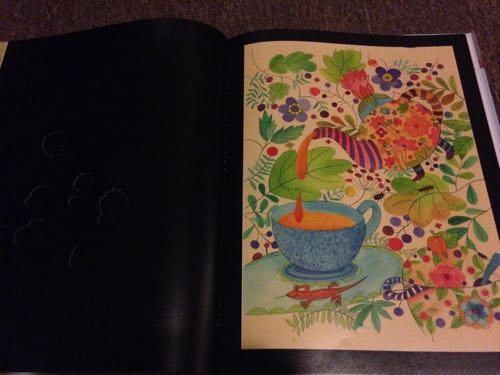
When the wind blows so strongly again, unleashing a chain reaction that sends the ink bottle tilting, Inkdrop herself flying out of the window. And then we’re back at the moment we’ve seen before, the ink drop and the snowflake heading for each other in a dazzling cataclysm.

And both books end in the same place, the two parts coming together to have their stories blend, this final image testament to the beauty of contrast.

Truthfully, I am not entirely ensure what the endings means, the snowflake and the inkdrop landing in an embrace “that lasted forever.” When one considers physics, it does not seem entirely plausible, and there is the matter of the inkdrop in the jar—what then of the rest of the ink? Where did one drop end and another begin? And why is the artist so scattered in his style—is he perhaps a forger, I wonder? (Although he looks quite innocent and rosy-cheeked when we spy him out buying a baguette.) One suspects, however, that physics aren’t quite the object of the book, except perhaps those involves in the die-cutting process. For The Story of Snowflake and the Inkdrop is to be looked at and admired and even roughed up a bit by those aforementioned grubby hands, and perhaps this one is the single way that the book should be torn apart at all.
November 19, 2015
My review of Split, by Libby Crewman
 My first professional book review was of Libby Crewman’s The Darren Effect in Canadian Notes & Queries in 2008. It was a good book, but a messy one, and I suspect my review probably achieved a similar effect, which sadly was not an aesthetic statement, but was just me figuring out my way. But it also meant that I was looking forward to Crewman’s follow-up, Split, which was published by Goose Lane Editions in September. I read the novel twice as summer turned into fall, and it’s a story that has stayed with me since, in its oddness and perplexities, its curious sideways appeal, but also in the vivid moments that Creelman so stunningly evokes.
A remarkable feature of Split, Libby Creelman’s second novel (after 2008’s The Darren Effect; she is also author of the acclaimed 2000 story collection, Walking in Paradise) is that it isn’t split. Whereas Creelman’s previous book was an impressive tangle of multiple storylines suggesting this short story writer was still finding her way into a different literary milieu, Split—for the most part taut, controlled and smartly plotted—signals Creelman’s arrival proper as a novelist. This new book is an ambitious, assured and most accomplished whole.
This wholeness is doubly (ha!) impressive considering the novel’s movement between two moments in time—2008 on the eve of both Barack Obama’s first election victory and widespread economic meltdown, and during the hot summer of 1975, the year after Nixon’s resignation and just months after the last American troops were removed from Vietnam. The former is the novel’s present day, during which Pilgrim Wheeler returns to her hometown in rural Massachusetts to find her childhood world drastically changed, and must finally reconcile with a tragedy that had wrenched her family apart decades before.
November 17, 2015
The Principles of Imperfectionism, and its Inherent Contradictions
 Truthfully, I have little patience with notions of perfectionism. Partly, this is because I’m so far from perfect that I’m envious of anyone who could purport to such an affliction, but also because most perfectionists aren’t enacting perfection in the slightest, but rather using it as an excuse for artistic paralysis. Which I always take as kind of a slight, like those people who’d write if they only had the time—”I’d like to do what you do, but I can’t because I have much higher standards for my artistic output than ordinary mortals.”
In my blogging course, I encourage my students to eschew perfectionism. There is no place for perfectionists in the blogosphere. Blogs are inherently raw, wild and unpolished. The important thing is to write the best you can, get to Publish, and then onto the next post. There will be spelling errors, and sloppy grammar, and things will be formatted weird. You’ll get facts wrong, and often you will change your mind. (Ideally, you should always be changing your mind—or at least entertaining the possibility. The resolute blogger will quickly learn that he is ridiculously low on material.) But no matter. For the blogger should not get hung up on these things, instead remaining forward-facing, putting one post in front of the other, ideally getting better and better at blogging all the time. The journey the very point, you see, because the blogger never ever arrives.
I mean this literally, in one sense. A blog, like a life, is inherently a work-in-progress. Being done is being dead. But also because blogging itself is not a path that leads to somewhere. Although it can be—we all know the examples of bloggers who’ve quit their day jobs and now live off the fruit of their blogging labours (although that’s a path with its own curious trajectories). Certainly blogging has delivered me tremendous rewards, not least of which are (recently) lupine seeds and other surprise parcels in the post from kind readers. And also contacts and experience that have led to professional gigs, and it’s true that I have blogging 100% to thank for your pretty solid writing career at the moment. But note this: my blog worked as a tool (a path to somewhere) because I wasn’t deliberately trying to make it so. I was blogging for blogging’s sake, rather than to write my way to somewhere better, and that I actually managed to get anywhere at all is kind of incidental. It’s the blog that I keep returning to anyway. Warts and all. It will never be perfect, and I will never be done.
 I’m comfortable with all this, so much so that I’m so looking forward to speaking on a panel about mistakes on Sunday at Draft 11.1. But then yesterday, while walking down the street, I had a devastating revelation. Which involves Rohan Maitzen’s review of Elizabeth Gilbert’s book, Big Magic. Now, keep in mind that I’m Elizabeth Gilbert-agnostic. I’ve never read a single thing she wrote, but I AM an avid Rohan Maitzen fan. And I loved her smart and thoughtful review of Gilbert’s book on creativity. She’s clear about the book’s strengths (“Gilbert’s advice to just get on with it, without excuses or apologies, is rousing”), its wackiness (the part where Ann Patchett steals her book idea by osmosis?), and, yes, its unrelenting banality. But the big problem Maitzen stumbles upon is Elizabeth Gilbert on the topic of perfectionism, which, she says, is just a manifestation of fear:
“Done is better than good,” [Gilbert] proclaims; “you may want your work to be perfect …. I just want mine to be finished.” Don’t bother interrupting what she proudly calls “the Song of the Disciplined Half-Ass” with cavils about aspiring to excellence: it turns out that along with the all-purpose permission slip she offers us comes an injunction against judgment or evaluation. And that’s where, for me, Gilbert loses her magic.
And this is what stopped me, as I was walking down the street. Because I too am a disciplined half-ass, although I haven’t written an actual song about it yet (and once I get around to it, the song will probably be a bit crap. And I won’t care). So am I basically Elizabeth Gilbert after all, but just not rich or successful, or generating Ann Patchett novel ideas? And the reason why this matters is because the very best part of Maitzen’s really excellent review is when she recalls recently reviewing Gilbert’s novel, The Signature of All Things. The novel that, Gilbert writes in Big Magic, is decidedly imperfect (including, in her words, “an unfortunately underdeveloped character”) but which she decided was “good enough.” The novel that Maitzen sat down, read, and spent an inordinate amount of time thinking about in order to write her review (which was, shall we say, mixed). Maitzen writes:
I suppose on balance, then, mine was one of the “bad reviews,” but I certainly didn’t toss off my opinions lightly before moving on. I assumed Gilbert had put everything she had into her novel and that it was my responsibility to take her writing seriously in return—to read and think as hard as I was capable of, and then to be scrupulous in reporting my conclusions. It never occurred to me to approach The Signature of All Things as a novel that wasn’t intended to be anything more than “good enough.” I’m not sure I know how—or even whether—to review work by a self-proclaimed “half-ass” … but here I am, doing it again.
Here is the flaw in that great liberator, imperfectionism, then: because do you know how many hours it takes to read a book? Moreover, do you know the value of a dollar, or twenty, or thirty of them? And so how dare to any of us expect a reader to make that investment if the work that you’ve produced is not the very best it could be. (This is my big complaint about self-published books too. The number of self-pub’d books I’ve read that aren’t conspicuously imperfect is less than a handful. This is even more the case with e-books, which can be put into the world so rapidly. It drives me crazy when I hear about authors rewriting/editing versions of their books after I’ve actually bought them and read them—could I have my time and my money back please?)
So here I’ve come full circle. And spent the hours since my revelation in the street trying to reconcile my philosophy of imperfectionism with my aversion to bad books. And my conclusion this: eschewing perfectionism is about getting out the draft. And it makes sense in blogging, because a blog is only ever just a draft—certainly, if you’re going back over your posts and ever polishing and changing, what you’re doing isn’t really blogging (which is raw and wild, remember?). Or sustainable. And this is why blogging is useful for a writer, because it’s practicing the habit of putting your ideas into words, one word after another, which is the same way you write a draft of a novel after all. A draft that is rarely going to be wonderful (although who hasn’t dreamed of the editor snapping up your first draft, saying, “There! You’re a genius. This is done.” So easy!). The draft is your chance to go wild, trip up, make a mess, and experiment. To see what happens next.
And after that is where the work comes in. Where the perfectionist’s tendencies come to be advantageous, and the best part is that no one even expects you to do it all on your own. When you get back to your manuscript, and—with the help of a few good editors—make it the most perfect book it can be. Which you’re always going to fail at, but you’re a blogger, well-versed at and most comfortable with imperfection anyway.
November 16, 2015
Me and Mitzi Bytes at Draft 11.1
 I’m very excited to let you know that I’m taking part in the 10th Anniversary Celebrations of the Draft Reading Series next Sunday, November 22 from 4pm-8pm at the Paintbox Bistro. The theme of the event is Process Product and Power: This is Not ‘So You Think You Can Write’. I’ll be reading from my draft (fittingly) of my forthcoming novel, Mitzi Bytes, my very first time airing her laundry in public, and also taking part in a panel discussion on mistakes, which, as a noted imperfectionist, I know quite a bit about. I’ll also be bringing copies of The M Word to sell. Other guests for the event include Karleen Pendleton Jiménez, Fides Krucker, Ron Edding, Bryan Ibeas, Mary Newberry, and Ewan Whyte. Hope to see you there!
November 15, 2015
Heyday, by Marnie Woodrow
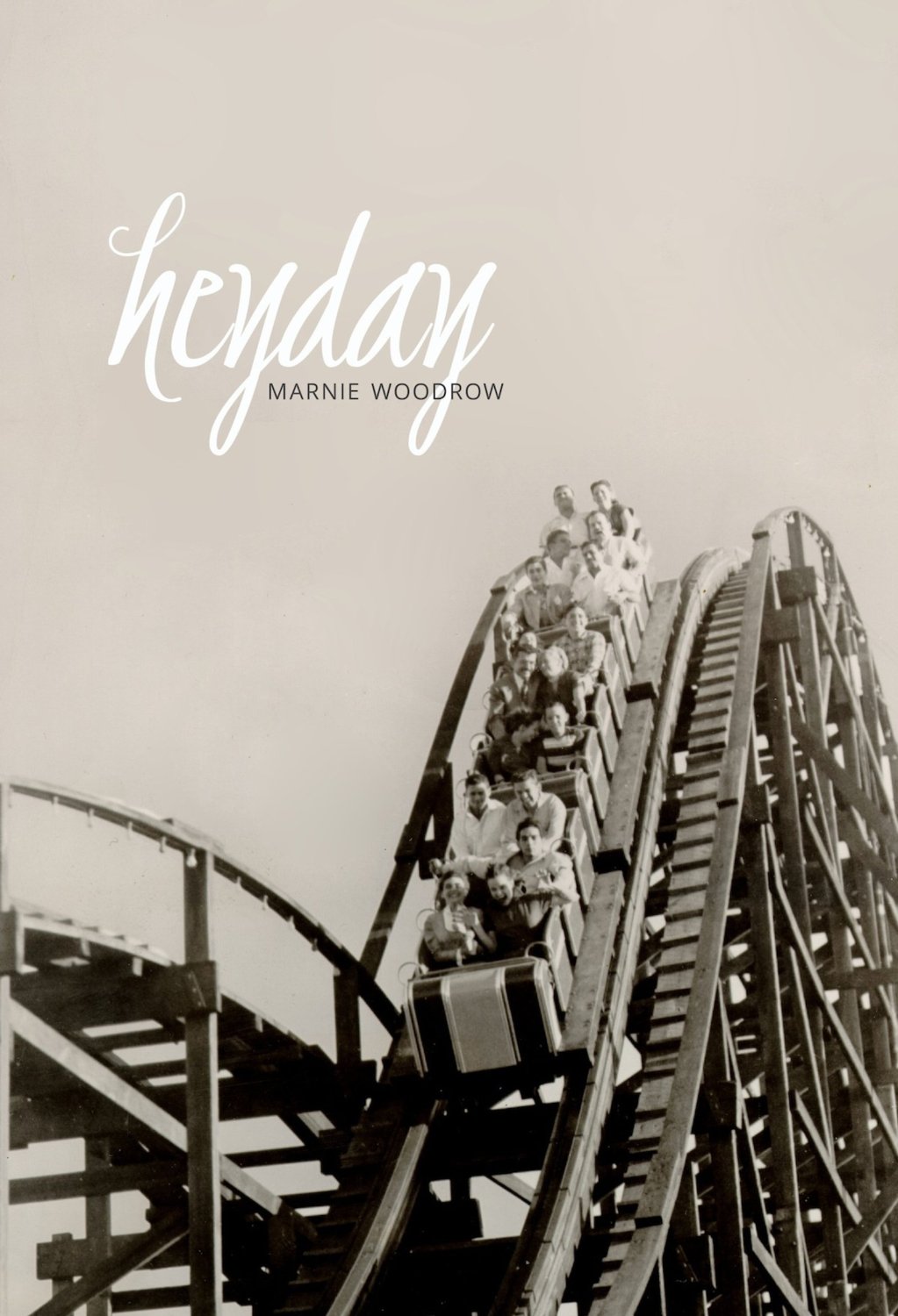 “It had something to do with Mary Pickford. With beauty. With the Figure 8 ride on a hot June day at just the right moment in time.”
Heyday is the first novel by Marnie Woodrow since the acclaimed Spelling Mississippi more than a decade ago. It’s a book that artfully weaves two stories, one in the present day as Joss mourns the loss of her longtime partner, Bianca, to whom she was never fully committed, and the other about two young women, Bette and Freddy, who meet one day on a roller coaster in 1909. And what connects these stories both is the Toronto Islands, peaceful Ward’s Island where Joss lives alone now but in her grief feels smothered by the attentions of the close-knit island community, and Hanlan’s Point on the other side, which in 1909 was a bustling amusement park, called “Canada’s Coney Island,” and where Freddy and Bette encounter each other for the very first time.
Bette is a single-rider, unnerved by the boy who takes the seat beside her as the roller coaster ride begins, and then intrigued as he whips off his hat to reveal a shock of blonde hair—the boy’s a girl after all. And a friendship begins between them, cultivated over a mutual love of swoops and turns, twists and plummets. Although the girls are worlds apart otherwise. Bette is the daughter of upper-class parents, her father an ardent spiritualist, her mother busy with campaigning for woman’s suffrage, and both parents too involved in their own affairs to pay sufficient attention to their youngest daughter who is mourning the recent loss of her beloved grandmother. Their lack of attention means that she’s able to escape from the confines of home during that summer, however, and make her way across the harbour to Hanlans, where she spends her time becoming utterly bewitched by the charismatic Freddy who works as a ticket-taker in the movie theatre. Although Freddy has secrets of her own, running from a dangerous past that is never far behind her. And as affection between the two girls grows—as they make plans for a future together, daring to consider running away together to New York City, to the actual Coney Island—it becomes clear to Freddy that their relationship might be putting Bette’s life in peril. But does she dare risk it? Or must she sacrifice their friendship to ensure her friend does not become snarled up in her own torrid past?
The novel’s historical detail is evocatively realized, and uncompromising in its sense of immediacy and richness of atmosphere. The sections of Heyday (from the respective perspectives of Bette, Freddy, and Joss) flow together naturally, the past and present timeline subtly connecting with small details. Though how the two sections relate beyond geography is not clear until the novel’s end when it becomes clear that one story might just be a figment of the other. But the spell Woodrow casts is so magnificently done that it doesn’t occur to the reader even to mind this.
November 13, 2015
A very good day?

This morning not long after 6:00, Harriet woke up coughing. Waking up her parents in the process, and as I adjusted to consciousness (and her much more morning-person father went downstairs to get her a glass of water), two thoughts occurred to me: 1) there was nobody left in my bed. Not a single person. Not a single person who is small and insists on sleeping whilst burrowing into my body, thrusting her little hands down my shirt, and kicking me in the abdomen, and lately has been joining me nightly around 2 or 3 am. And 2) I had had enough sleep. As in, I could open my eyes and sit up, get out of bed, open the curtains and begin my day, coherent sentences and all. I feel like this perhaps once a month, if I’m lucky. (See previous note about resident kicker in my bed.) It was extraordinary. My first premonition that this was going to be a very very good day.
It also meant we had two hours before we had to leave for school, instead of the usually scramble. (Most days, I am lucky to drag my sorry self out of bed by 7:45, and my husband does everything—breakfast making, bag-packing, children-dressing/brushing/etc. He is our resident Hero.) And because I make a point of being useful in wholly impractical ways, I decided that I would make us french toast for breakfast. It was to be sweet potato french toast from How to Feed a Family, but we were low on sweet-p’s, so I used acorn squash instead. And it was delicious. And then Stuart proceeded to do everything as usual while I sat at the table drinking tea and browsing twitter until it was 8:15, leaving me a quarter of an hour to shower and dress. We were out the door before the 8:30 news turned to sports, and ages before The Current started (which is always how we know we’re late).
Today was a PA Day so there was to be no grade 1, but I had a co-op shift at Iris’s playschool, and Harriet was coming with us. Along with a group of other children who partake in the playschool’s after-school program normally but needed full-day care today. So that the classroom was packed with kids of all ages, playing together and have such a good time, and it never got too crazy. It was a lot of fun having Harriet there, and it was a distinctly unboring co-op shift in which time flew by. And then home to leftover pizza for lunch, and I got dinner in the oven already (a chicken, leek and sweet potato casserole). Which means that we’ll be eating early, dinner finished before our super-babysitter arrives at 6pm (which is to be a new bi-weekly arrangement—early Friday night dates so that Stuart and I can go out together often but STILL go to bed early, which is best of both worlds). And we’re going to see Mavis! at the Bloor Cinema around the corner—getting home in time to catch an episode of Raised by Wolves before bed.
So it’s looking good. Just past the day’s midpoint, it’s still too early to say whether this qualifies as a very good day proper, but from where I’m standing now, the outlook seems pretty bright. Friday the 13th has a habit of working out for me—it was on another one, 12 years and eleven months ago exactly, in fact, that I met my excellent husband, after all.
Update: I had the feeling as I published this post that I was tempting fate, that I was sure to be struck and killed by a westbound bus sometime just before dinner. But the trouble turned out to be farther away and so much worse—not a very good day on the whole, for sure. Which made me thinking about a post like mine and about the point of blogging in general, and while surely my acorn-squash french toast doesn’t matter in the grand scheme of things, the darkest parts of the world are all the more reason to celebrate the those small and perfect moments of light. Thinking about Solnit and Woolf’s darkness as well: “To me, the grounds for hope are simply that we don’t know what will happen next…”






