December 16, 2015
When Santa Was a Baby
The only thing I like better than a bookshop in general is a bookshop in December, when the lines at the till are long, the floor is buzzing, and everybody’s walking around with arms full of books. Lying in bed these past few weeks as December began to eke out, day by day, it was holiday bookshops I was missing. I used to do all my Christmas shopping at Book City around the corner, and feel ridiculously smug for buying so locally that the distance could be measured out in metres, and while I miss Book City all the time, I do so particularly at this time of year—this will be our second Christmas without it. So yes, I’ve been feeling a dearth of bookshops, so when I went to the doctor on Monday to have my lungs examined (and receive the all-clear), I made a point of skipping across the road to the nearby Indigo, to purchase gift cards as end-of-year presents for Iris’s teachers, of course, but also to do some book buying.
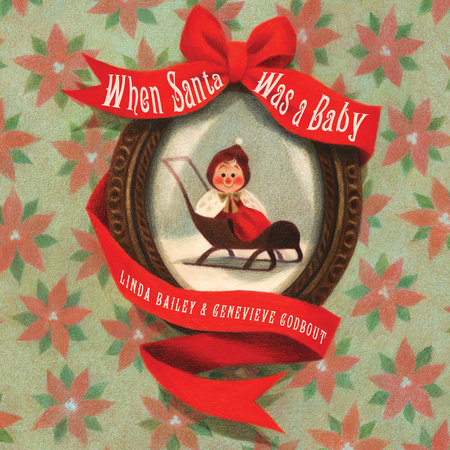
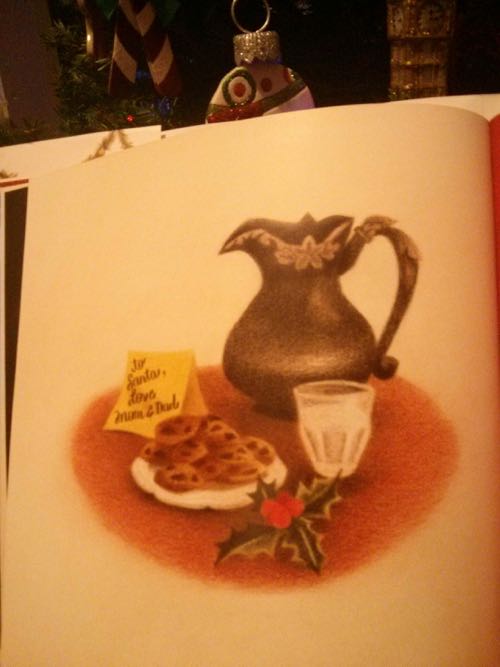
I bought two books, both of them “for my children” (ha ha) and I’ll be writing about both titles, the first one being the wonderful When Santa Was a Baby, by Linda Bailey, illustrated by Genevieve Godbout. Cheerfully illustrated with a delightful vintage vibe, it’s the story of a little baby who was unusual from the start:
“Look at those dimples,” said his dad. “How merry!”
“And his dear little nose,” said his mom. “Like a cherry!”
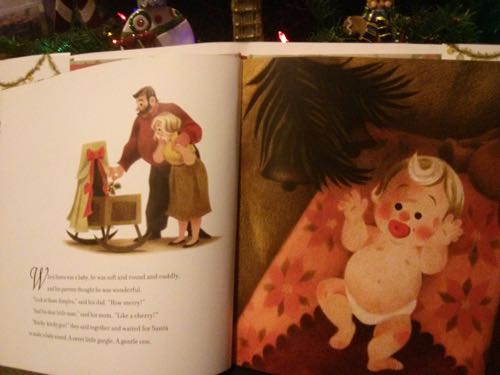
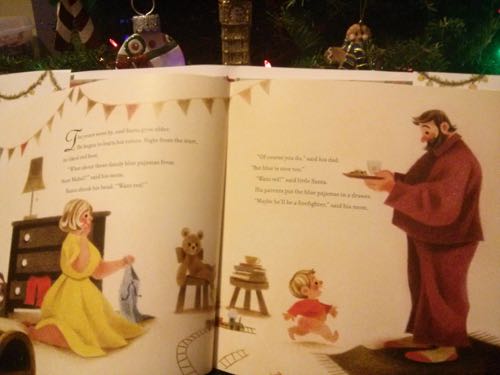
Instead of coo-ing, Baby Santa booms an enormous, “Ho, Ho, Ho!” He refuses to wear any colour but red.
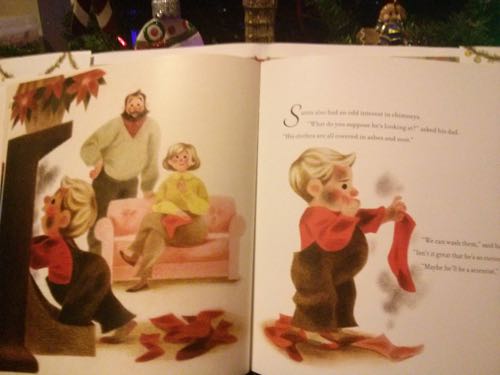
And he has a curious preoccupation with the chimney.
Santa’s parents never waver in their pride for their unusual son, even when he insists on standing naked in front of the refrigerator for a little chill to escape the summer heat, or when he gathers all his birthday presents into a big sack and goes about distributing them to neighbourhood children. They think their boy is pretty terrific, and so creative, and curious, and they’re willing to do whatever they can to make him happy.
Children will find the idea of a Baby Santa quite hilarious, with the bare bums and all, and it’s wonderfully novel to recast such a familiar cultural figure as a child. But for parents, it’s the unconditional, ever-elastic, infinite love of Santa’s mom and dad in the story that will so resonate—and quite possible inspire.
December 14, 2015
Emerging
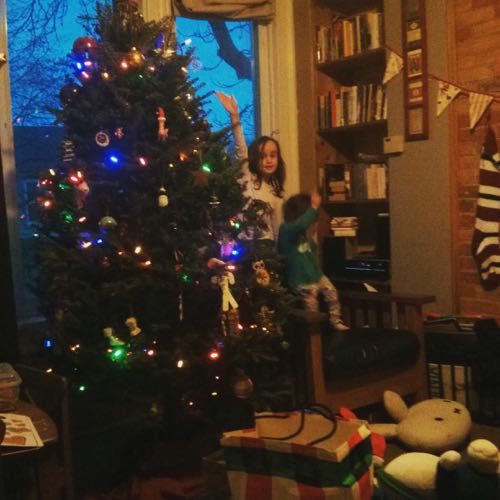
If there is a better time in the year than this to have to spend three weeks in bed, I can’t think of it. I’m finally feeling well, rested and relaxed, emerging back into the world again (…slowly, slowly….) to realize that it’s Christmas. I’ve come a long way since a week ago when I thought I was feeling well-er, but wasn’t. This weekend I didn’t leave the house, but was mostly out of bed, and we put up our tree on Saturday (which Stuart carried home from the store by himself) and decorated, and then did all the Christmas baking yesterday. (All has been extensively documented on Instagram.) Today I have a doctor’s appointment at 2pm, and I’m hoping she’s going to give my lungs the all-clear, and then I’m going to finish up my Christmas shopping at nearby shops. I’m even going to take the subway instead of a taxi, which is a sign of health for sure (and also, I am not a millionaire), except that I’m forbidden to exit Spadina Station at Walmer Road because when I tried to climb those steps three weeks ago (before I knew it was pneumonia) I almost died. Today it will be escalators all the way.
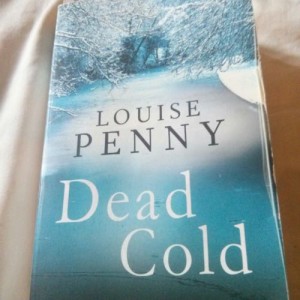 And oh, there has been reading. Holiday reading. Any new or notable book released lately, and the very intriguing ARCs that are beginning to arrive for Spring 2016 have all been set aside as I’m going through my shelves noting the not-new and un-noteable—a trend that began with Astonishing Splashes of Colour by Clare Morrall last week, which I liked so so much and might have lingered on the shelf forever had I not finally picked it up looking for an inconsequential read. After reading the compelling and very strange Girl in the Dark (and oh yes, are misery memoirs ever effective at making one feel better about everything in general), I picked up Dead Cold by Louise Penny—somehow we’ve ended up with a stack of Louise Penny UK editions; this one was released in North America as A Fatal Grace. And it turned out to be a cozy murder mystery that takes place over Christmas, which was perfect. It’s not dead cold here, but it was lovely to be back in Three Pines and over the holidays no less. I love Louise Penny’s Gamache series so much, but got into it quite late in the game, so am playing catch-up with some of the earlier novels.
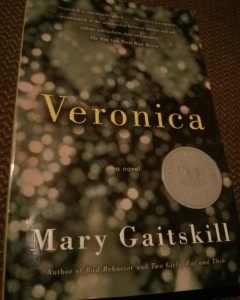 And then I started read Veronica by Mary Gaitskill. Her new book, Mare, is on several notable lists of 2015, but remember I’m doing un-noteable, and Veronica has been sitting on my shelf for sometime—another book I found in a box in the summer, I think. And I’m really enjoying it. It reminds me of Jennifer Egan, Good Squad and Look at Me, except I like it much more than I liked the latter. I read Gaitskill’s collection, Bad Behaviour, a while ago, and mostly remember it was conspicuously dated with references to obsolete technology. She is also a bit too gritty for me, and nobody is ever putting the kettle on or going to church (always a criticism in my books), but I am really enjoying Veronica, and this might be the perfect way to get to Mare. When I return to notable things.
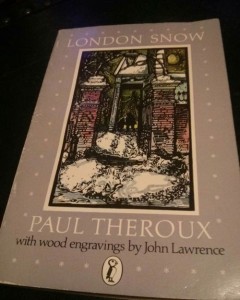 And finally, we finished reading The Horse and His Boy, and convinced Harriet to take a short Narnia break so we could try something else as our family read-aloud. Last Christmas, we were reading The Children of Green Knowe, and I’ve been looking forward to a similarly seasonal read. So I picked up London Snow, by Paul Theroux, which I know nothing about, except that it is a Christmas story and it was a gift from our friend, Zsuzsi. And while it doesn’t seem so seasonal—we have no snow, and temperatures have been in the double digits (which after two wintry, wintry Decembers I kind of feel is a reward I’ve worked for)—we are definitely under its spell. A strange story that takes place in a sweet shop, whose proprietor is called Mrs. Mutterance and keeps muttering and uttering odd phrases that none of us understand, and her adopted son Wallace sleeps in a hammock in the hall and she has to yell at him to stop pendulating. In the weirdest way, it reminds me of Graham Greene’s super-strange Christmas picture book, The Little Steamroller. Sinister things afoot, and all, and yes, because of snow in London.
I can’t wait to find out what happens next.
December 11, 2015
The Places I’ve Been
 The best news is that I’m finally getting better, and I’ve even been to a place lately that isn’t my bed—last night I ventured out to Harriet’s holiday concert to hear her sing in the Primary Choir. This weekend, we’re planning to hang up the Christmas bunting, and the plan is that by mid-next week, I might be up and about in the world again. But until then, and even after, we’ll be taking it slow. The nice thing about the Christmas holiday is that it’s a perfect time to have that happen.
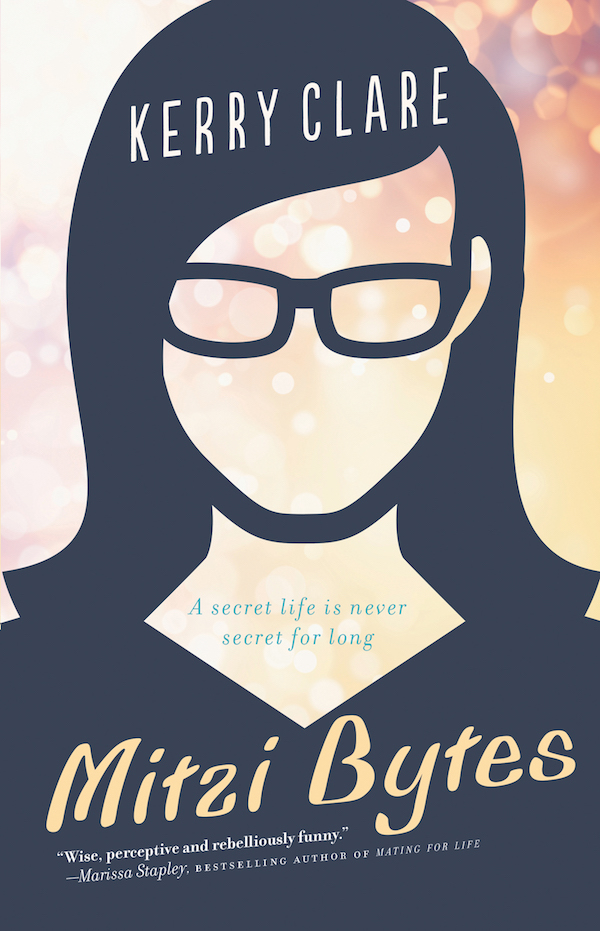
But other things have been happening as well, perhaps sustaining the illusion that I’ve been more active lately than I actually have been. First, the Winter 2016 issue of U of T Magazine is being mailed out soon, and it includes a short piece I wrote about the curious trajectory of my life in blogging. I wrote about how I started blogging at a point when blogs were poised to take over the world, which never quite happened, but for me (and for many others) blogging has played an enormous role in my career and evolution as a writer and a person, even. Blogging has sustained me during periods of high and lows, and through the throes of literary disappointment, and it’s now integral to my process—so much so that my forthcoming novel is about the secret life of a blogger. I was really grateful for the opportunity to write this article, and you can read it online here.
For Understorey Magazine, I got to be part of a conversation with Ali Bryan, Alice Burdick, Lorri Neilsen Glenn, Natalie Corbett Sampson, Natalie Meisner, Shalan Joudry, and Sylvia D. Hamilton about whether it’s possible to be both a mother and a writer at once. (Spoiler: I say YES). There’s lots of great advice, stories and wisdom from women who’ve been there, and I love the effect of so many voices together. I love this line from Sampson: “Shutting the world and your experience out in a ‘no diversion’ and ‘no intrusion’ approach leaves you open to missing things that can be shaped into stories. ” Naturally, I encourage women to let their children watch Annie all summer long in order to get that novel written, which worked for me. Read the whole thing here.
And finally, I took part in a very fun conversation with Corey Redekop about what happens when a wonderful writer turns out to be a terrible human being. Examining my own bookshelves, I really couldn’t find a single horrible human being among them. My authors are mainly crotchety old women, which many people construe with horrible human beinghood, but crotchetiness is these writers’ entitlement, I think. I love them better for it. Anyway, we talked about whether being an asshole was a male writer thing, I refer to Barbara Pym’s Nazi sympathies, we discuss what red lines are for us as readers (not Nazi sympathies, apparently…) and what if Rush Limbaugh was authoring the next The Phantom Tollbooth. You can read it all here.
See? I have been busy.
December 9, 2015
Reading Report from the Bedridden
 So there I was, reading The Diplomat: Lester Pearson and the Suez Crisis. A book I picked off my shelf after the Paris terror attacks last month, and as Canada stands on the cusp of returning to the international stage in terms of diplomacy. There aren’t any women in it, so it wasn’t completely my cup of tea, but it was relevant and really interesting. Further (and don’t tell anyone I said this, but) Lester “Mike” Pearson was sort of a bit womanly himself, in that he was a pragmatist with a sense of the universal, he was good at working with others, negotiating egos and orchestrating practical outcomes. He saw the value of a middle ground, nuance; his world wasn’t black and white. And I was learning so much about how decisions 90 years ago and ever since have set up the Middle East to be the bloody mess it is today. How much history matters to right now, but so few lawmakers seem to have that kind of vision (and also keep making the same mistakes over and over. Iraq in 2003, anyone?)
But then I got so so sick. The night my sickness arrived, I had a terrible fever and was staring at a photo of Anthony Eden in Ottawa in Feburary 1956 and he wasn’t wearing a scarf, and I was shivering inside my own terrible chill, and thinking, “Poor Anthony Eden. He was must have been so cold.” When I went to sleep, the fever continued, and I had weird, terrible Suez Crisis dreams all night.
The Diplomat is a very good book, but it’s a terrible book to be reading while one is ill. Though perhaps during that first week of illness, there is existed no book that would have suited. I kept falling asleep and staring at the ceiling, and Lester was kind of like my albatross—it was far too important a book to give up on (and perhaps I would never return to it) but I wanted light and Lester wasn’t it. Eventually though, as the fever abated and I persisted, I got to to the end. 340 pages of men doing men things, as my virus morphed into pneumonia, and I’m glad I didn’t give up. But it was also a relief when I was finished.
 The other terrible thing about being sick, speaking in terms of literary blogging, is that I never got a chance to talk about Penelope Fitzgerald’s The Blue Flower, which I was reading before The Diplomat. Penelope Fitzgerald, who I always struggle with anyway. Offshore is the book of hers I’ve most appreciated, and my desire to be more appreciative in general was underlined by the Hermione Lee bio. So I finally picked up The Blue Flower, which had historical fiction working against it. “You think that that you won’t like it, but you will,” is what everybody told me, and they were right. A fictionalization of the life of the eighteenth century German writer, Novalis, whom I’ve never ever heard of. So weird, but also perfectly realized. How did she do that? And, even more curiously, why? But yes, it turned out to be the most easily, immediately appreciable Penelope Fitzgerald ever. So glad I am persisting with her work. It helps, of course, that her books are short. I think a writer can make anything work if her books are short.
After The Diplomat, when I was still unwell, I spent a weekend rereading The Westing Game, by Ellen Raskin, and The Long Secret, by Louise Fitzhugh, which was perfect. Then Next to Nature, Art, by Penelope Lively, which was a bit lacklustre but also comforting and funny. And from there to The Story of a New Name, because there is no time like the pneumonic to finally get down to Elena Ferrante. And when that near-500 page epic was finished (but not an albatross), I read The Strange Library, by Haruki Murakami, whose UK edition is exquisite. So weird, but also short, and a beautiful book.
And now since I’ve been reading Astonishing Splashes of Colour, by Clare Morrall, which I found in a box on the street sometime last summer, I think, and I like it so much. 12 years late to the party, I know—it was nominated for the Booker Prize in 2003, a long-shot contender. But it’s a really weird, absorbing, surprising and beautiful book, if it is painfully sad as well. But it’s just so nice to be sick and stuck in bed, and loving a book at once. You never can tell the perfect book for the perfect time, can you?
Seasonally, I’m dipping in and out of Derek McCormack’s beautiful book, Christmas Days. It’s nice to have the time to do such a thing. And also enjoying my daily selection from the 2015 Short Story Advent Calendar—today’s author is Rosemary Nixon, who I love so much. When I’m very excited about one of these stories, I save them all day long for the sweet joy of anticipating. And next up is Girl in the Dark, by Anna Lyndsey, which my friend Janine gave me last summer when I developed my bizarre sun allergy. (She sent it with hope that it would not be my future, but perhaps something I would appreciate.) It just seems like the right thing, someone else’s trouble to outweigh my own, plus it seems readable and easy. And yes, short. Means a lot these days. Will report back as things transpire.
Anyway, the other bad thing about poor Lester is that he’s become my teapot coaster, and I keep pouring tea all over his steely-resolved head.
December 8, 2015
On Needing and Feeding

My friend Melanie, who has just been diagnosed with metastatic breast cancer, wrote the most terrific blog post last week on how women are so reluctant to ask for help when they need it and how particularly strange that is seeing as how we tend to be very good at responding to others’ needs when required. How particularly strange too because the help is there; people want to give it. We’ve just got to open ourselves to receiving it, which can be tricky because it involves admitting our limits, crossing personal boundaries; letting other people into our personal spaces; and other possible transgressions. It involves needing, which has so many negative connotations in our society that so prizes self-sufficiency, independence, and so much reserve. A society that finds it simpler, tidier, to imagine that “social network” is a theoretical thing that lives online. And yet.
Inspired by Melanie’s post, and by the fact that we were two weeks into an illness that was not abating and running my husband ragged with caring for me, the children, our household and everything, I put the call out. “Is there anything I can do,” people asked, to which I responded, “Bring us food.” Already, we were pretty supported. My mom had been coming into the city every other day to take care of Harriet and Iris, and so that Stuart could actually, you know, go to work. And she’d been bringing food. But then on Wednesday, our friend Denise brought over turkey pot pie. Our friend Andrew brought over vegetable stew and rice that I ate for lunch the next day. Rebecca came on Friday with a batch of cookies. Athena dropped off a batch of broth. Our next-door neighbours delivered soup. My friend Lexi brought over more soup, and a loaf of challah bread. Erin came on Sunday to play with the children and give Stuart a break, and she brought so much soup. Our downstairs neighbours delivered latkes. My dad and his partner dropped in yesterday while I was sleeping, with more food and also the most delicious cookies. I got home last night to find a container of chickpeas on the step, from our friend and neighbour, Kripa. There are rumours my aunt is dropping off a casserole. And just now, my dear friend Julia let herself into my kitchen to drop off an actual chicken. So I know what we’re having for dinner tonight. All week, we’ve known what we’re having for dinner tonight. And I don’t know if I can convey what a difference that’s made for us.
The point is this: that people are terrifically good at taking care of each other. This very salient fact gets lost in a world that fills our news feeds with violence and despair. It especially gets lost too because we’re so reluctant to ask for that care, to admit that we need it. That human connections are not just theoretical, but actual, and we’d be very lost without them. That these families we build too are fragile things, and everybody needs a hand sometime to keep the machine in motion. That nobody is alone. That nobody should be.
Families facing what Melanie and her family are dealing with need this kind of help in the long term—before I got sick, it never occurred to me how much this was true, how debilitating it can be to have a parent who is ill. And how important it is that people like us to keep on bringing the soup so that mothers like Melanie can face the vital business of being well and loving her children ferociously. That we help too by giving money to support metastatic breast cancer research so Melanie ends up eating so much soup for such a long time that she eventually gets tired of it and asks for the menu to be changed.
December 7, 2015
What if I’m just really lazy?
 In pneumonia news, I can breathe again, even huge lung-expanding breaths. Apart from being terrifically tired, I am feeling well enough, though not so well enough to get out of bed and go traipsing around like an actual person. But recovery is being complicated by the matter of Iris, whose own cough is fairly prolific, and of course I’m paranoid that she’s going to get pneumonia. Although she has no symptoms other than the cough, which only really affects her when she lies down to go to sleep, which means that she’s not actually been able to lie down and go to sleep for two days now. Or three? (Generally there is a scuffle around 10:30 and she ends up in our bed. Last night there was no room for me in our bed, so I had to sleep on the couch.) So Iris is generally under the weather, tired-gone-bonkers. We sent her to school today because I don’t know what we’d do with her at home. We’re hoping this was not a terrible decision.
Truth: lying in bed reading is my favourite thing, so having pneumonia is not all agony. But then I start to worry that perhaps I’m not sick, I’m just really really lazy…
Today I have a doctor’s appointment to see if I need another round of antibiotics, and then tonight I’m teaching the final session of my course. I am not quite sure how the latter is going to transpire. How does one teach a class straight out of lying in bed for two weeks? But needs must. I am sorry to be finishing a really great session on such a low note. I should have been wearing tap shoes and bringing in cupcakes, but I will be lucky to be showing up upright at all.
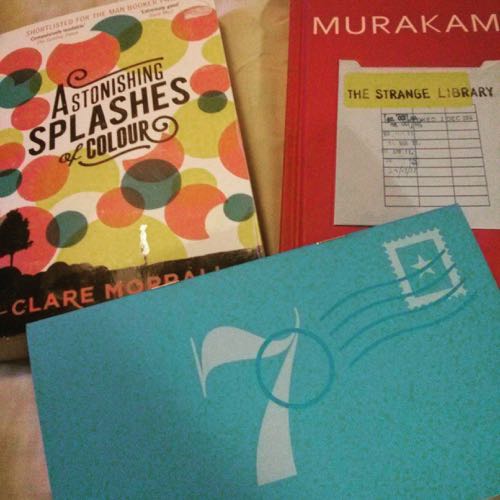
Other things: I finished the Elena Ferrante book, The Story of a New Name. My aversion to long books makes these a challenge for me, but I am certainly interested in them, very glad to be reading along with everybody else. Today I will be reading Astonishing Splashes of Colour, by Clare Morrall, which I remember from when it was nominated for the Booker years and years ago. Also reading Haruki Murakami’s The Strange Library, whose UK edition we bought in April and is so amazing. And today’s Short Story Advent Calendar selection is “Laplanders,” by Zsuzsi Gartner, which I’m so enjoying looking forward to reading that I kind of don’t even want to read it.
I am just fortunate that I’ve built myself a life which is very conductible from my bed. On Thursday morning, I did an interview for an article, and I don’t think the subject knew I was in my pyjamas and 12 hours into a pneumonia diagnosis. I’m also due to be starting edits on my novel soon, which is certainly an in-bed activity indeed. It’s just a shame that I can’t invite my blogging students up tonight and teach my course from a pile of pillows as well. And yes, there is the matter of raising the children, rousing myself to do the school run. I’m thinking about getting a portable bed, going a bit bed knobs and broomsticks, and whizzing up and down the sidewalks on four posters/four wheels. Now that would be something after all.
December 5, 2015
Making and unmaking: when does a fetus become a baby?
 The Planned Parenthood shootings in the US last week have brought the pro-life zealots back out of the online woodwork, which means that men have been explaining pregnancy and abortion to me on Twitter again. (At a fraction of the rate before, but still.) I’m still honestly just baffled about how somebody without a uterus could feel entitled enough to tell me anything at all on these topics; it would be like me purporting to teach the Canadian women’s hockey team how to win an Olympic gold. How does a person get to be that sure of himself? To be honest, I’m not sure I’d ever want to be. (From my essay, “Doubleness Clarifies”: “But I’d like such a person to shake their convictions for just a moment or two.”)
These are men who have definitive opinions on the question of when life begins. (And about sluts. And morality. And the right to have extensive collections of weaponry, oddly.) The question of when life begins, however, is one whose undefinitiveness I’m so comfortable with. And I would be, as a woman who has made a choice to end a pregnancy, and who so desperately valued the pregnancies I wanted.
It’s simple: when does a fetus become a baby?
When a woman decides it does.
Women make and unmake our children, not just in the biological sense, but in the ontological sense, too. The fetus is a fetus, and the child a child – only the woman knows. If we deny her the power to define her own pregnancy, we deny the power inherent in womanhood.
From my essay, “Doubleness Clarifies”:
With my second pregnancy, from the moment of my positive pregnancy test, everything was different. The fetus growing inside me was never anything but a baby. We’d been quietly dreaming of her for years, imagining the colour of her eyes, her hair, trying out a parade of hypothetical names. Five weeks into my pregnancy, I bought her a book and we started reading to her even though she hadn’t yet developed ears.
But of course, it’s not really simple. Sometimes I think you have to be a man who hasn’t lived much to ever imagine that anything is. What I find so fascinating and worthwhile about thinking about miscarriage and abortion together is not just the intersections between the two experiences (and that “a single thing can have two realities” after all) but that so many women I know have gone through both. Abortion and miscarriage are not experiences in opposition, but together are threads in the fabric of so many women’s lives, and, however uncomfortably, we learn to decipher, to determine even, the pattern of these threads, how and what it all means.
Women continue to be in control of the narrative, is what I’m saying, making and unmaking, and it’s this control—without which one’s bodily autonomy is impossible; Kimball’s “power inherent in womanhood” —that makes so many people so impossibly angry.
December 3, 2015
The Pickle Me This 2015 Best Books of the Year
It’s a bit arbitrary, our system for determining Pickle Me This’s 2015 Best Books of the Year. To begin, with “our” of which I speak is me, so it’s not as though choices have to be run through a committee. It’s mainly like this: if I liked a book well enough to read it and review it on my blog, that’s saying something about the book’s value. If the title seems like a stand-out to me, I add it to my Picks List, and then at the end of the year, I go through those picks to find which titles are still resonating with me after the book as been read. And this year, these are the books I came up with. PS I also really liked The Girl on the Train, but I think you’ve already heard about that one. So I am pleased to recommended any of the following instead.
**
 After Birth, by Elisa Albert
“No, listen, though, the problem is with books, with novels about motherhood. Or even worse, those novels that purport to finally pull back the veil and “tell the truth about motherhood.” The problem, in addition to the fact that nobody cares about babies, is that a book about motherhood is rarely read (if it is read at all) as a book about a mother. Instead, it’s a manifesto. Read as a statement on an institution instead of a literary work about a fictional character. A story. We have a hard time grasping that there can be more than one story about motherhood, or if there is more than one, there’s just two then, always diametrically opposed. Two gals facing down on the cover of a magazine. One is always carrying a briefcase. When in reality, there are so many stories, and each of those stories comprise so many stories in themselves, the same way that a single day can hold more than one kind of weather.”
Read my review of After Birth, from March.
**
 A God in Ruins, by Kate Atkinson
“Atkinson’s new novel, A God in Ruins, is not a sequel to Life After Life, she explains in her afterword, but “a companion novel.” It’s the life story of Ursula’s brother Teddy in a version of their family’s life that is slightly different than those portrayed in the first novel. Where Ursula died over and over again, Teddy shows a predilection toward survival, miraculously making it through a career as a WW2 bomber pilot. And it is the war upon which his story hinges—an experience both makes him and destroys him. An experiences that does not become less raw as the war itself fades into history, though those around put it away in the past. “You can only go forward,” is a line delivered again and again in the text, a winky joke at the premise of Life After Life, but also blatantly wrong in the matter of narrative because an author is free to put her story together anyway she likes—forward, backward, and round and round in circles. Posing the questions: what if history never entirely goes away? how does it change as we carry it with us? And how is a conventional existence not unlike Ursula’s in reality: “It felt as if he had lived many lifetimes,” Teddy remembers at one point, and who has not felt this way? What is the cumulation of these lives, these selves? What is the thing that connects them?”
Read my review of Life After Life, from May
**
 On Immunity, by Eula Biss
“…While I have absolute trust in my doctor and her advice, and in the importance of vaccines for public health, I was one of the many people who put down that fear-mongering story in The Toronto Star last month on the HPV vaccine and said, “My kids are never going to get that.” And then the whole furor blew up, and I saw how we’d been played.
Which is the point at which I decided to read On Immunity by Eula Biss. Biss, poet and award-winning essayist, wades into the vaccine issue, not to seek a middle-ground—because she acknowledges that there isn’t one; the science is conclusive; her own child is vaccinated—but to seek context, to create something richer than a polemic. More than a book on “issues”, even, this is a book on language and metaphor, about how both frame the way we understand our bodies and our world, and about vaccinations and immunity might serve as a metaphor for America and the world today. “And it has vampires in it,” so notes the blurb on the back by Rebecca Solnit. Because, yes, this book is blurbed by Rebecca Solnit AND Anne Fadiman, which makes it basically a non-fiction holy book. And it is oh so very good.”
Read my review of On Immunity, from March.
**
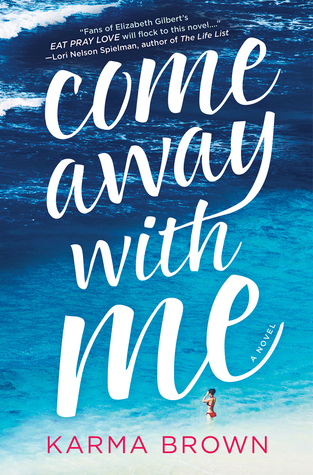 Come Away With Me, by Karma Brown
“I am intrigued by questions of how people survive the seemingly unsurvivable, which was the reason I picked up Come Away With Me, Canadian writer Karma Brown’s debut novel. It’s the story of Tegan Lawson who had everything she’d ever wanted—an amazing husband and a baby on the way—when the dream is shattered by a horrific accident. Five months after the tragedy, her husband implores her to pick up the pieces of their life (and perhaps begin to forgive him for the accident, as he was driving the night it happened) by embarking on the trip of a lifetime to Thailand, Italy and Hawaii. Reluctantly, she goes, though she is not sure she’s ready (and neither are their families). And the trip itself does not prove to be the salve it might have been in a lesser novel, all of their troubles simply melting away—Tegan’s not taking her anti-depressants, she’s regularly still overcome with despair, her anger toward her husband seems impossible to let go of. And here we begin to see that this dream getaway is not the end of Tegan’s story but it’s the beginning of new one that’s vastly different than the life she’d planned on and dreamed of.”
Read my review of Come Away With Me, from September
**
 The Devil You Know, by Elisabeth de Mariaffi
“The stakes were high for Elisabeth de Mariaffi’s The Devil You Know. On Wednesday morning, I walked 2km at -25 degrees to get a copy, because I’d been hearing such good things about it and it seemed like exactly the kind of book you want to hang out with curled up warm while the blizzard howls. A mystery, a thriller, a book set in Southern Ontario during the 1980s and early ’90s, during which a series of young girls were kidnapped and sometimes found murdered, otherwise their faces depicted on posters for years afterwards under the heading, “Missing.” Years later, “aged-enhanced” images of these children would be updated, but we’d still recognize them. I’ve noticed that reviewers have been responding to the book personally, viscerally. There’s a whole generation of us haunted by these missing girls—I could plot my own history by theirs, from Nicole Morin to Alicia Ross. (I was too young to know about the disappearance and murder of Sharin’ Morningstar Keenan in 1983, though she was taken the very playground where my children play.)”
Read my review of The Devil You Know, from January.
**
 Welcome to the Circus, by Rhonda Douglas
“Rhonda Douglas doesn’t miss a beat in her fiction debut, the short story collection, Welcome to the Circus. It’s a collection to be admired right down to its basic components—the sentences. “…our three hearts open and close like the mouths of tiny birds,” in “Nous and René Lévesque.” Later in the same story, “The future seems to yawn open, becomes something far less certain, all of plans swinging on their hinges.” In “Humanitarian Relief,” “Henry Jeans amasses flesh about his bones with the single-minded focus of a NASCAR driver eating up track.” Ten stories, each one based around a tantalizing premise: a fresh take on Two Solitudes and adolescence, inspired by a high school core-French teacher in rural Newfoundland; a story of three veteran humanitarian aid workers in a Kenyan refugee camp; a series of letters to one’s eighth grade self; a collection of documents based on the case of executed dancer and spy, Mata Hari, curated by a man whose father may have been among her paramours; “Still Life With Book” about a teenage boy who partakes to carve the works of John Donne into his flesh, inspiring his therapist to reinvigorate his sex life. In “Sounds of our Paleolithic Past,” a curator at the Royal Tyrrell Museum in Alberta mixes business with pleasure as she develops a complex relationship with a Neandertal discovered in the badlands; in the next story, a daughter considers her legacy working in the family porn business as she faces threats of violence and estrangement from her sister; in “Welcome to the Circus, Sooky Baby,” a grieving teenage girl finds solace in surprising places—including the company of an elephant; and finally, “Cancer Oratorio,” structured as a series of choral/orchestral movements from the collective perspective of a choir facing the loss of a member from cancer.”
Read my review of Welcome to the Circus, from April.
**
 A Really Good Brown Girl, by Marilyn Dumont
“I hadn’t budgeted for books at The Stop Farmers’ Market at Artscape Wychwood Barns a few weeks back, but it turned out that Pedlar Press and Brick Books were vendors (and I met Kate Cayley, whose How You Were Born I loved so much!) so I couldn’t help but pick up something. And I am so glad that the something I got turned out to be the deluxe redesign of Marilyn Dumont’s Gerald Lampert-winning debut collection, A Really Good Brown Girl. A book I read in days, which is rare for me and poetry, but I was captivated by the narrative, the language, the brute force of these poems, as well as their sense of humour, their cheek. “Squaw Poems,” about growing up Metis on the prairies, a household surrounded by “The White Judges” who waited to pounce. And never really went away. But then—
“I am in a university classroom, an English professor corrects my spoken/ English in front of the class. I say, “really good.” He say, “You mean/ really well, don’t you?” I glare at him and say emphatically, “No I/ mean really good.”
Read my review of A Really Good Brown Girl, from August
**
 Fates and Furies, by Lauren Groff
“I still vividly remember reading Groff’s debut, The Monsters of Templeton, for the very first time, and being bowled over by the book’s audacity, by the author’s talent. And with each subsequent book—the story collection, Delicate Edible Birds, and the acclaimed novel, Arcadia—Groff has surpassed all expectations. She’s a writer of huge ambition and even larger canvases, unabashedly literary, unabashedly story, traditional in her approach to crafting fiction, except that she seems to be reinventing the novel every time, pressing at its limits. I’ve spent the last week reading Fates and Furies and being particularly annoyed that anybody imagines Jonathan Franzen to be “a greatest living novelist” (?) when: Lauren Groff. Lauren Groff. Lauren Groff.
(If she were a man and a giant asshole, however, she’d definitely be discussed in those terms.)”
Read my review of Fates and Furies, from September.
**
 The Folded Clock, by Heidi Julavits
“The Folded Clock is a book about the puzzles and mysteries of an ordinary comfortable life. For me, one of those mysteries is the way that a book—an object wholly apart from my existence, until I bought it—can appear to be reading my mind, stealing my life. (I have this experience also when I am reading Rebecca Solnit.) Like Julavits’ whole chapter about Wasted: The Preppie Murder, by Linda Wolfe, and being three fucks away from Robert Chambers—not that I have ever been such a thing, but I have a thing about that book. Or about abortions as women’s work, about how the boyfriends are always informed but they’re never there—abortions are something that happen between friends. About the internet and desire, about conscious attempts to resist the google-ization of everything—which is interesting because there is at first glance something so bloggish about Julavits’ approach, and yet the construction of her entries is so counter to blogging’s immediacy. The Folded Clock is a bit of a throwback, a project decidedly analogue.”
Read my review of The Folded Clock, from July.
**
 I Take You, by Eliza Kennedy
“Within the first few pages it is clear that Lily drinks too much, swears religiously, and has no compunction about casual sex as long as the sex is excellent, and it was all so refreshing. That she was a bit silly, but not stupid. That she was empowered, interesting, and nobody’s victim. Which is not to say that she hasn’t herself in quite a pickle as the novel begins: Lily is engaged to Mr. Wonderful—it’s been a whirlwind—and she’s pretty sure she even loves him, but she still can’t kick her habit of picking up men in bars and in elevators, and, well, everywhere. Lily wants to marry Will, because he’s a smart choice and Lily is wise enough to be in the habit of making these. But she doesn’t seem ready to become domesticated—and now the wedding is just days away.
The thing about Lily Wilder is that she’s happy. In fact, she insists upon her happiness, her value, which is rare with comic heroines. She is not a problem to be solved, and she doesn’t want to be fixed. She just wants to have it both ways—but how?”
Read my review of I Take You, from July.
**
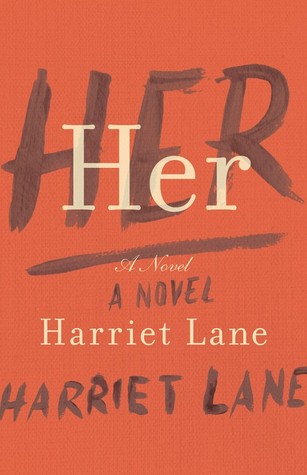 Her, by Harriet Lane
“Which makes Her so compelling, so beyond those other narratives which tire me whose only virtue is their honesty, is that the truths revealed about new motherhood are just the starting point. From here, Lane has created a psychological thriller so convincing in its reality, so ominous in its mundanity, so sippy-cup sinister in a manner I last recall reading in Emily Perkins’ excellent 2008 book, A Novel About My Wife.
Nina gets closer and closer to Emma, welcomed into her home, caring for her children, and while we know along she has nefarious intentions—presented in the alternating chapters which, like Emma’s, are written in first-person—we don’t know why she’s out to exact revenge from Emma, who doesn’t remember her at all. We don’t know either which form her revenge will take, though as the novel progresses, indicators emerge, signs and signals that are so terrifying, all hurtling towards the novel’s very end, which is completely and utterly devastating. Not to mention amazing. But don’t say I didn’t warn you.”
Read my review of Her, from January
**
 Rumi and the Red Handbag, by Shawn Lemay
“Rumi and the Red Handbag is a slim, heartbreaking and perfect read, rich with gorgeous prose, and depth and texture. Infused with allusions, explicit and otherwise, it’s a hushed and quiet celebration of women and their lives and their words and the secrets they carry. There is the Woolf, of course, and references to Clarice Lispector, who I’ve never read, but now I have to, and Charlotte Bronte, Jane Austen, Sylvia Plath. Plus vintage Harlequins—this is a book that permits great reverence to women’s stories and women’s spaces.”
Read my review of Rumi and the Red Handbag, from November
**
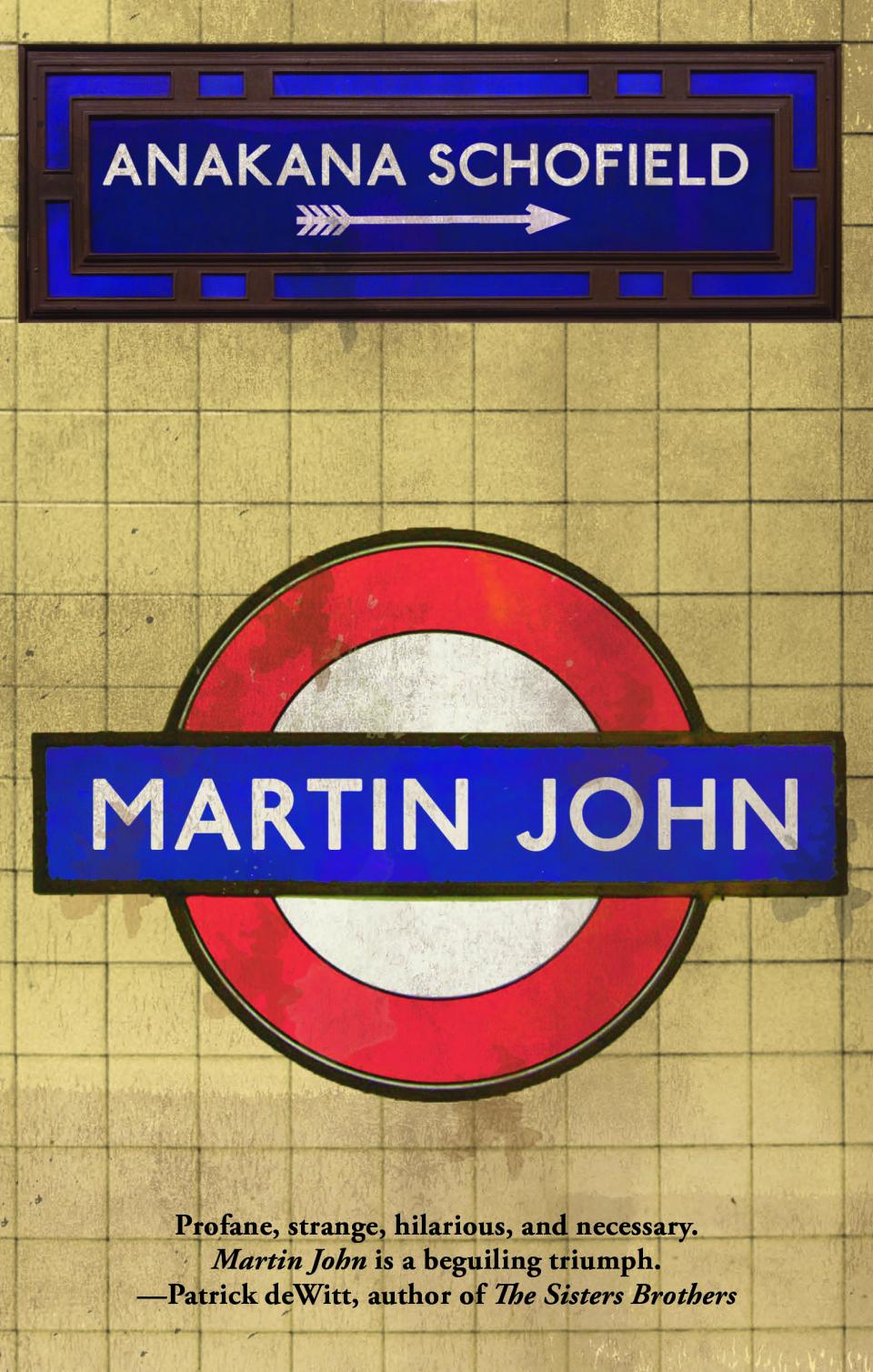 Martin John, by Anakana Schofield
“Anakana Schofield’s Martin John, a novel about a sexual deviant and the follow-up to her award-winning Malarky, is primarily a book about language. It’s about sexual violence is able to happen because of words and ideas that are never articulated or defined, and how these ellipses in our understanding go on to create further damage and harm. “It was a time when people didn’t ask as many questions. That’s the time it was.”
And so in order to fill in the blank, to ask the questions, to define the it, Schofield has to reinvent the shape of a novel. Eschewing chronology, point-of-view, objectivity, artifice itself for something that more resembles a case study, a long-form incident report. Just the latest for Martin John, the reader supposes, who has been in and out of the care of psychologists, social workers and other medical professionals for much of his life. Though he makes a point to stay out of their way—meddlers—and to keep to his routines, essential. He’s holding down a job as a security guard, lives in a nondescript shabby house in London (albeit one cluttered with the detritus of his media habits), visits his Aunt Noanie on Wednesdays, under specific instruction of his mother back in Ireland. (D’ya hear me, Martin John?) But it’s clear that, no matter his circuits and refrains, this centre (a precarious arrangement orchestrated by the mother) simply cannot hold.”
December 2, 2015
The thing on my chest
 Oh, it only gets better and better. That thing that’s been sitting on my chest for the last twenty-four hours has turned out to be pneumonia. Which has certainly undermined our plans to have me all up and repaired by tomorrow at the latest. But it’s also a relief—hooray for pneumonia, because finally it’s a non-vague diagnosis AND it has antibiotics. But no one has responded to the news by sending me platform shoes and a gong to bang. Apparently pneumonia is no fun? Oh boy. But I have started reading Elena Ferrante’s The Story of a New Name. I read My Brilliant Friend when we were away in the spring, and while I liked it well enough, I wasn’t nuts for it. It’s possible it’s not the kind of book for that kind of vacation, when you don’t really want to tote around something heavy and when you only have a few minutes here and there throughout the day to dip in and out of the story. But pneumonia is kind of the opposite, because where I don’t really have anywhere to go now. And there is something about this second book that has hooked me much more immediately than the first one did. By which I mean that if do end up getting Ferrante Fever, on top of everything else, the time is probably right now.
December 1, 2015
Two more things

Stuart emailed me from work after reading yesterday’s post to inform me that he likes zero things about me being sick. And I see his point of view. While he hasn’t had to contend with fever dreams or coughing until his lungs hurt, he’s being doing everything to keep our household running—it’s been very hard. So hopefully he won’t be too bothered that I add a couple more items to my list, which are a) Vicks VapoRub, the magic elixir, the stuff of childhood comforts, and b) I am have ample time this morning to read the first instalment in my 2015 Short Story Advent Calendar!
And yes, I am getting better—two nights with no fever has helped a lot. The cough is improving. I just need to work on getting energy back (i.e. being able to walk upstairs without having to follow up the journey with a nap).