December 11, 2016
2016 Books of the Year
As always, I’ve failed in both my efforts to read everything I wanted to read in 2016 and also to keep my top ten to a number below twenty. Still, I think I’ve failed quite successfully here, and I’m really happy with how the year has read up. Thanks to the authors and readers who inspire me and make my reading life so much.
*
 Rich and Pretty, by Rumaan Alam
“I loved its humour, its prose, its quietness and detail. I loved its subtle subversions—second abortions and pregnant women with a drink. I loved the difference between the two characters’ voices, how richly the two were delineated, and that the title is tongue-in-cheek—in a Mad Men fashion, Alam’s novel takes the idea of “types” of women and a binary approach to womanhood and complicates the idea entirely to show that women can be whole, flawed, inexplicable and fully realized people whose lives and experiences are worth writing about, thinking about. Which really shouldn’t be such a revelation, and this is still a completely excellent book for those of us who already know.”
*
 The Mothers, by Brit Bennett
“Bennett nicely situates the personal against the political, Nadia’s experience with anti-abortion politicking by church members (although not so avidly—these are reasonable people) and also about how one’s convictions become flexible when an unwanted pregnancy is a fact instead of an idea. She shows how a woman can choose an abortion and know it’s the right choice, but still mourn what she’s lost and wonder at the could-have-beens. That an abortion, like a lot of things that happen to people over the course of their lives, is a complicated, multi-faceted thing.”
*
 Busker, by Nisha Coleman
“I kept laughing out loud, which is a mark of literary achievement. Though I also cringed—as one who has never mastered air-kisses, I recoiled at Coleman’s recounting of her first bisous and how she actually made cheek contact. She writes about being asked to play her violin in a hair salon, but how her own unruly do caused a great upset when she arrived. Or the man she met who wanted to perform songs he’d written, which turned out to be “sex songs” with lyrics like, “The horny bull wants a bouncy ride.” And she meets a lot of men, Coleman, and in the beginning, being lonely, takes them up on their invitations, until she realizes that she’s setting herself up for a lot of awkward interactions. She longs for the company of women friends as well, but these kind of relationships are harder to find. Not to mention that at the beginning of her time in Paris, Coleman hardly speaks French.”
*
 Becoming Lin, by Tricia Dower
“It’s a novel about the 1960s, about idealism and reality, about the narrow confines of a wife’s identity and that of a mother. Familiar themes, all of these if you’ve read books like Margaret Laurence’s The Fire Dwellersor watched Mad Men, but themes made fresh with the nuances of the novel’s point of view, the carefulness with which these ideas are examined. In Becoming Lin, the prose is mostly inconspicuous, but what grips the reader is the evolution of Lin’s consciousness, and the complexity that arises from the absence of polarities—unusual for a history of a decade so constructed of extremes.”
*
 Experimental Film, by Gemma Files
“I spent Thanksgiving weekend—as summer turned into fall, the leaves turned into reds and oranges, as everything started to wither and die—reading Gemma Files’ Experimental Film, which was so fitting for the season. I absolutely loved it, and was not the only one to do so—the novel won the Shirley Jackson Award in the summer and the Sunburst Award for Excellence in Canadian Literature of the Fantastic in September. It’s a book about horror movies, and the history of Canadian cinema, and motherhood, and parenting a child with autism, and there are ghosts and it gets creepy, and it gave me bad dreams—which I mean as a testament to the book’s power.”
*
 The Trespasser, by Tana French
I’d preordered The Trespasser, French’s first book since 2014, and it seems fitting that my year of Tana French should have a new release by her within it. (I was in Barbados when I learned this new book was forthcoming. Imagine my joy: that there would be another Tana French when the books in the Waitrose bag were done!). And it was everything I’d hoped it would be—a return to tradition of the first four books, a narrator on the edge who doesn’t know how close she is, a strange and tricky murder whose solution is not immediately in sight. I love her plots, her characters, her humour, and that I learn insults like “wankstain” (which shows up in two books). I love her complicated women and men, and their aloneness, and the awkward ways her characters connect with each other. I love her prose, her twists, and her portrayal of Ireland post-boom. Can you tell that I love everything?
*
 Little Labours, by Rivka Galchen
“These fragments are preoccupied with the poster for a Keanu Reeves flop; the tiresome anecdotes we tell our friends about our babies presuming they’ll be interested (and once those friends have babies, they even actually are); a mention of the woman who drowned her five children; a horrible woman whom Galchen regularly encounters in her building’s elevator who has strong feelings she must articulate about her baby’s size; on head shapes, their remarkability and otherwise; about troubling proclivities toward orange; one piece beginning, “Literature has more dogs than babies, and also more abortions.”; about Frankenstein, Godzilla, Rumpelstiltskin, Lucille Ball, and The Tale of Genji (but not all in the same essay); about screen time, and what writers had children and who didn’t, and why writers’ children keep writing about closed office doors (and Galchen wonders why these doors are more troubling than the doors at Daddy’s work, downtown in a high rise building); about babies in art; and her complicated feelings about women’s writing and “women’s writing,” which she fascinatingly teases out.”
*
 The Dancehall Years, by Joan Haggerty
“Joan Haggerty is an extraordinary writer, her prose Woolfian in its stream of consciousness, its immediacy. This is a saga sweeping four decades written in the present tense. And it’s true that when we talk about summer books, we sometimes mean that they’re a bit light in substance, but this is a different kind of summer book. It’s not difficult, and it’s got its own kind of lightness (strung together by summers as it is), but it’s not a “beach read.” Which isn’t to say it would be wonderful to read it at a beach, but still, it’s not the kind of novel that would blow away in the breeze.”
*
 The Little Communist That Never Smiled, by Lola Lafon
“On the surface, Lola Lafon’s novel The Little Communist Who Never Smiled (translated from French by Nick Caistor) is a fictionalization of the life of Nadia Comaneci, but that (of course) is just a cover. What the book is really about is messaged in between the lines (or, quite literally, between the words). The Little Communist… is a book about the Cold War, the politicization of sport and womanhood, about deciphering codes and, fundamentally, this is a novel about punctuation.”
*
 The Party Wall, by Catherine Leroux
“It’s always a good sign when the blank pages inside a book become riddled with notes and diagrams, as has been the case with my copy of the Governor-General’s Award/ Giller-nominated The Party Wall, by Catherine Laroux, prize-winner in its original French, translated into English by Lazer Lederhendler (Nikolski!). Not because the stories themselves in the novel are so difficult to figure out—in fact, they read beautifully with luminous prose (“Fall is approaching and the warmth of the South throbs on the horizon like a sack of gold at the foot of a rainbow”)—but because the challenge and the pleasure is discovering how all of it fits together. While the shape of most narratives is a horizontal line (with the inevitable bump for a climax), the shape of The Party Wall is multi-dimensional, arrows pointed in all four directions and connections that hold the whole thing fast.”
*
 Birdie, by Tracey Lindberg
“Surprisingly, Birdie is not a heavy book, even with all the violence and tragedy. It’s as funny as it is sad, and more than that, it’s vibrant—powered by the voice of a woman who seemingly lies unconscious, which is kind of ironic, but there’s a lot going on inside Birdie’s mind, even as she’s got one half-opened eye on The Frugal Gourmet. As a character she’s rich and realized, and Lindberg never makes her a victim of her circumstances, her agency retained even in her lowest moments. Her very act of retreating into her mind, while passive from the outside, is a powerful gesture, and necessary for healing, for the possibility of a future.”
*
 Double Teenage, by Joni Murphy
“It’s heavy, but it’s not. I read this book all day on Sunday, a few hours in the afternoon in my hammock. I devoured it, and loved the shape of the project—that this is a novel gesturing outwards, pointing to the world, using the world and its threads to build something new, offering structure, frameworks, where we hadn’t seen such a thing before. Daring to state that girlhood is significant, even if it’s a stage, and even if it’s a stage. I loved the poetry of Murphy’s prose, the power of her language. The power of the book full stop—it’s both the story of my life and also unlike anything I’ve ever read before.”
*
 Frankie Styne and the Silver Man, by Kathy Page
“Frankie Styne is a new edition of Page’s novel, first published in 1993, and it put me in mind of my favourite Hilary Mantel novels, her first two, Every Day is Mothers Day and Vacant Possession, dark comedies about the dark edges of humanity and their successful attempts to outmaneuver meddling social workers. Page’s social worker is Annie Purvis, who we know first from the point of view of her client, Liz Meredith, who’s just been moved into a terrace house with her baby. Liz has spent her time most recently living on a railcar after becoming estranged from her family, but since her baby’s birth (compounded by the fact that he has developmental abnormalities) she’s become tangled up in “the system”. Although she diverts all attempts to get her installed with a phone (living as she does by her grandmother’s advice to “Always avoid ties that bind”), she could do with a television, but in the meantime, she contents herself by listening to conversations between the troubled couple next door and imagining a different kind of reality existing on a planet far away, that life itself is merely the plot of a cheap pulp novel she’s somehow been stuck in.”
*
 I’m Thinking of Ending Things, by Iain Reid
“Clear the decks if you’re thinking about picking up this book, because you’re not going to be able to put it back down again. Don’t start reading it at night though or it’s going to be hard to fall asleep. I was intrigued by this psychological thriller, the debut novel by Iain Reid who’s previously been known for two award-winning heartwarming memoirs. Could he really pull off such a literary change of pace? But he does, and it’s breathtakingly good. Best of all, no one is going to compare this book to Gone Girl or The Girl on the Train, but it’s something altogether different. It also manages to be completely creepy but actually free of gore and violence, which is an incredible literary feat. And finally, that a book can be so enthralling and disorienting at once is just incredible.”
*
 Today Will Be Different, by Maria Semple
“There are writers who sit down and painstakingly plan their books before they start writing, a mess of post-it notes and index cards, and one gets the feeling that Maria Semple is not one of them. The plots of her books resemble those dotted lines on maps in Saturday morning cartoons in which small children navigate space with curious and often dangerous diversions. Which is kind of a funny way to plot a book, but think of the joy you once got in running your finger along that line, and also of the momentum inherent in this kind of narrative, the briskness with which the reader is brought along for the ride. It also turns out that plot isn’t really the point is, but voice is, and Eleanor Flood’s is the kind of voice that’s hard to get out of your head.”
*
“For me, Smith has always been a masterful novelist whose works just kind of peter out before the end, and my explanation for that is that her stories are so excellent that the endings are always going to be a let-down and/or do we really expect her to come up with a novel like that and properly end it too? But in her fourth book, it seems she’s finally got the conclusion that comes with a gut punch, the last fifty pages or so finally bringing the pieces together, the patterns emerging. The conclusion of Swing Time is wonderful, devastating, and ambiguous in the most engaging fashion. Yes, the book is a bit bloated in the middle, but reading any of Smith’s prose is a pleasure. And all of it matters—you just don’t know how until the end.”
*
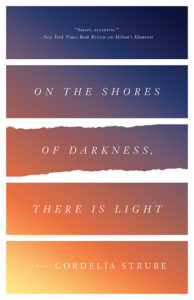 On the Shores of Darkness, There is Light, by Cordelia Strube
“At nearly 400 pages, the novel is long, but swiftly paced and never dull. The bleakness of its considerations are broken up with incredible humour, from the cacophony of the voices in its background to the sheer audacity of Harriet herself, her nerve, all the things she is willing to do and say. There is a humour too in the contrast between the child’s point of view and the world around her, and—in the case of Harriet’s friend, Darcy, in particular—the person she is trying to to be. The sheer naïveté of these would-be old souls. Darcy likes to go on about, “that Caitlin whore,” a friend from her old neighbourhood, and we learn about what Caitlin did to her at Guides: “I was a Sprite and she was a Pixie. That ho bag made like all the cool girls were Pixies….Then the skank fucked up my puppetry badge.””
*
 The Break, by Katherena Vermette
“The family tree at the beginning of the book is useful, but the reader soon becomes acquainted with the women of this family, so it won’t be referred to throughout. Momentum is strictly forward as the pieces begin to come together, Vermette deftly moving in and out of time to create a three-dimensional feel to the narrative—we come to feel we know this story from all sides. Four generations of a family, and how tragedy trickles down with all the goodness, the former not negating the latter though. As Vermette has made clear, this is a novel about women and about survival, a story that complements but also takes issue with stories and statistics about First Nations and Metis women as victims before they’re even people proper. But her characters are people here, people with flaws and foibles, strengths and weaknesses, and it’s the strength that endures: “‘It’s okay, my girl. It’s okay.’ Her answer to everything.”’
*
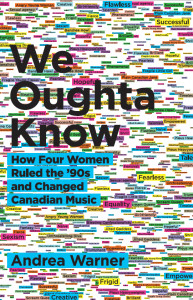 We Oughta Know, by Andrea Warner
In her book, We Oughta Know: How Four Women Ruled the ’90s and Changed Canadian Music, Andrea Warner articulates that whole scene, and the remarkable fact that four Canadian women were leading the charge of women in song: Celine Dion, Sarah McLachlan, Shania Twain, and Alanis Morissette. These four women too are (along with Diana Krall) are the only Canadians on Canada’s best-selling artists lists, coming in above the Beatles. And even more remarkably, they all made their mark during a five year period in the mid-1990s. What was going on exactly, Warner wonders? How did they do it?
*
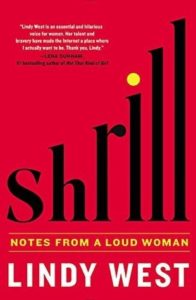 Shrill, by Lindy West
From Shrill: ““Everything happened in those five years after my abortion. I became myself. Not by chance, or because an abortion is some kind of mysterious, empowering feminist bloode-magick rite of passage (as many, many—too many for a movement ostensibly comprising grown-ups—anti-choices have accused me of being), but simply because it was time. A whole bunch of changes—set into motion years, even decades, back—all came together at once, like the tumblers in a lock clicking into place: my body, my work, my voice, my confidence, my power, my determination to demand a life as potent, vibrant, public, and complex as any man’s. My abortion wasn’t intrinsically significant, but it was my first big grown-up decision—the first time I asserted unequivocally, “I know the life that I want and this isn’t it”; the moment I stopped being a passenger in my own body and grabbed the rudder.”
*
 The Best Kind of People, by Zoe Whittall
While the entire book is fantastic, Whittall gets full points for her spectacular ending, however, which turns the story inside out and disturbingly rips us away from the singular perspectives of characters to reflect the wider culture of rape and sexual violence against whose context the entire novel has been taking place. Which is to say that this is not just a story about a family. And then the final sentence, which will haunt you long after you’ve finally finished reading, quiet, subtle, devastating and terrible, just like the injustice that is Justice, which isn’t anything like justice at all.
*
 Notes From a Feminist Killjoy, by Erin Wunker
Notes is a way of starting. Trying. Essai. If a manifesto is a red rag, then a note is a building block, a puzzle piece. The reader responds not by charging, but by saying, Yes and, or Yes but. She doesn’t respond by tearing the whole thing down.
I love the way the narrative thread of Wunker’s book makes its way with seeming effortlessness. There is nothing laboured about how a discussion of rape culture leads to the Jian Ghomeshi trial leads to women coming together leads to a chapter on friendship. (Which references The Babysitters Club. Yes, and!!) Why are so few of our formative texts about female friendship? “What is it about female friendship that inspires such insipid descriptors?” What are relationships between women often so fraught?
“Is it too hard to write your own narrative and witness another’s, simultaneously?”
*
 Five Roses, by Alice Zorn
“I loved Alice Zorn’s Five Roses, a novel that’s a love letter to Montreal, its neighbourhoods, and to the magic and serendipity of city life that is inevitably born from the fact of so many characters living in close proximity. It’s a bit of a mess, it is, city life, what with different cultures, and types of people, and old traditions and new traditions, and money and poverty, home and commercial enterprise, and history and the moment, which is now, and impossible to capture anyway…because the only thing that ever stands still in the city is the force of change. Zorn’s novel, however, manages to convey all this and not be a mess, disparate narratives woven together in a way that sparks magic but is left just untidy enough to still ring true.”
December 8, 2016
Holiday Reading Break
 I never plan my holiday reading breaks—they just sort of happen. One minute I’m reading the new Zadie Smith, with Eimear McBride, Deborah Levy, Paul Beatty on deck, and next thing I know I’m reading Linwood Barclay. (I’ve never read Linwood Barclay before—he comes much recommended and I’m loving this book so much.) So suddenly all the big books and ARCs are put aside, and I’m reading murder mysteries, juicy novels, and all the books on my shelf that I’ve been meaning to get around to for ages but haven’t because they’re not particularly timely and little of consequence. Which makes me not the best book blogger, because I’m going to make a 2016 Best Of and I’ve not really properly read 2016 yet. But a holiday reading break also makes me happy and sane as a reader and a person, and is the nicest way to wind down into the holiday season. I will be reporting in from my holiday reads, and do look forward to resuming Big Books again in the new year.
December 5, 2016
The Toronto Review of Books’ Seasonal Affective Party!

I’m looking forward to reading as part of the Toronto Review of Books’ Seasonal Affective Party on Tuesday December 6, 7pm at Poetry Jazz Cafe in Kensington Market. I’ll reading alongside Andrew Pyper, Trevor Corkum, and Catherine Graham. TRB Managing Editor and novelist Damian Tarnopolsky will be reading too, along with TRB Senior Editor and writer Kelli Deeth.
The Facebook event is here! See you there?
I’ll be reading the infamous pork shoulder scene from Mitzi Bytes, and it’s going to be great.
December 4, 2016
I regret the cake
 They say that over the course of a lifetime you never regret the cakes you baked, but instead the cakes you didn’t bake, although in one specific case I will make an exception—except I am also sorry for the butterfly cake I brought to a party in 2000 that was mostly paste, and the cake I over-mixed for my friend’s engagement in 2008 that had the consistency of cheese. But not this sorry.
I regret the cake, the Hillary Clinton victory cake I baked on November 7.
“If all else fails, there will be cake,” I blogged blithely, but it turned out that the cake didn’t taste very good. When I’m really upset, I don’t have an appetite for anything, and so that sad cake hung around our kitchen getting stale and eventually I threw it in the garbage. The day after the election, I had a task that involved cutting out thirty small squares of paper and using a hole punch, and it was about all I was up to. I sat there at my kitchen table cutting and punching, and weeping as I listened to Hillary Rodham Clinton’s concession speech on the radio. I probably ate some cake, but I didn’t taste it. There was no consolation.
If I had to do it again though, I’d probably still make the cake. Partly because I’m bloody-minded. And partly too because I refuse to budge from my vision of what the world could be and what it should be. I’d rather be wrong than be wrong, if you know what I’m saying. Although I did feel guilty after the fact—I know I inspired other people to embark upon similar baking projects, and there we all were sad in our kitchens on that terrible Wednesday morning. There was so much cake, physical evidence of disappointment, and all of it was my fault.
But I’ll take the fall. I was wrong, and I’ve been wrong before, but as I said above, at least I wasn’t wrong in fundamental ways. I’ve tried very hard to resist a dynamic of winner/loser from this election, not because I don’t like losing, but instead because I don’t mind if I do lose. It doesn’t matter. You might call me a crybaby, but I’ll just look at you confused, wondering why you’re delivering such a puerile insult, and I really don’t care what you think either way. (I’m not going to run out into the street and start firing off my stockpiled ammunition either, and there is really something to that.)
“The art of losing isn’t hard to master…” It’s true. I’ve lost before, over and over again, and what I learned from these experiences is that mastering losing can mean that you can do absolutely anything. I have no fear of failure because I’ve failed over and over again, and everything turned out…fine. Often the very worst thing that can happen isn’t. There are certain things that if I lost them, my life would be fractured irrevocably, but these things are mostly people and I don’t know that anyone can master that kind of loss, although I even know some strong, incredible friends who appear to have done so, who carry on under the weight of interminable grief. So there is loss and there is loss, I mean.
 The results of the election have been devastating, but I’ve resisted the idea that my/us having lost is part of the equation. No, it’s something more than that, which is what is actually lost on the simple-minded people who are gloating. Those gloating people aren’t why I was crying, but instead I was crying for everyone, for a vision of the world that’s not that I thought it was, what I hoped fervently it could be. I was wrong, and a whole lot of people proved me wrong, but I can handle that. And if necessary, I’ll be wrong over and over again. Until I’m right, because that’s how history swings.
It’s been a brutal month. On Thursday I finally got my ass back in gear, and started replying to hundreds of emails with apologies for being unable to anything much for this past month except stare at my computer screen in abject horror. I fell down terrible twitter rabbit holes that made me despair about everything, and to wonder about the bubble that I live in, confused and messed up by “voices obsessed with rhetorical fallacies and pedantic debating practices.” When reality starts to seem like a giant conspiracy theory in itself, it becomes hard to know what’s what, and where you stand on things when ground is ever-shifting.
What’s brought be back to earth? Books, of course. I started reading Caitlin Moran’s Moranifesto last week, and it set me straight about feminism, and class, and why I don’t want a revolution (“Personally, I’m not up for that. The kind of people who are up for mutinies and riots tend to be young men… I, however, am a forty-year-old woman with very inferior running abilities and two children… I’ve read enough history books to be resoundingly unseen on extreme politics of with the left or the right…They tend to work out badly for women and children. They tend to work out badly for everyone.) While there has been an effort to package this book as more than a collection of her columns, with a thesis and everything, it doesn’t quite work, but it doesn’t have to. Moran is terrific. “Why We Cheered in the Street When Margaret Thatcher Died.” “This is a World Formed by Abortion—It Always Has Been, And It Always Will Be.” “We Are All Migrants.” The world has gone so willy-nilly in the last year that some pieces in this collection are dated in a way that hurts my heart, but the fundamentals still stand. Last Tuesday evening I sat alone reading this book in a public place and I kept laughing aloud in a way that disturbed passersby, and that was a good thing. It was like a terribly funny person finally talking some sense back into me.
 And along those lines, I picked up Luvvie Ajayi’s essay collection next, I’m Judging You: The Do-Better Manual. A book whose first section left me unmoved, but I think it was tactical, some light and easy judgement toward people who don’t wash their bras regularly or who court unemployed boys with gambling addictions who call you to pick them up at the casino because it’s raining and their only form of transport is their bicycle. Breaking the reader in for the heavy stuff—”Racism is for Assholes,” “Rape Culture is Real and it Sucks.” Powerful, amazing sensible stuff that I so desperately need to hear right now when everything seems so upside down. A Black woman writing about feminism, a Christian woman critiquing how religion is messing so much up these days, a smart woman unwilling to withhold her judgement, so she gives it and it’s glorious and we’re better for it. Consistency is overrated. The point is to be good, to ourselves and to each other. I’m about two thirds into this book, and I’m loving it, reminding me that this upside-down world is the same as it ever was, and that striving for better is the least and the most we can do.
“But the ultimate pragmatism is to quietly note that idealism has won, time after time, in the last hundred years. Idealism has the upper hand. Idealism has some hot statistics. Idealism invented and fuelled the civil rights movement, votes for women, changes in rape laws, Equal Marriage, the Internet, IVF, organ transplants, the end of apartheid, independence in India, the Hadron Collider, Hairspray the musical, and my recent, brilliant loft conversion. Every reality we have now started with a seed-corn of idealism and impossibility—visions have to coalesce somewhere.” —Caitlin Moran
December 2, 2016
The Day Santa Stopped Believing in Harold

I full-on believed in Santa Claus until I was eleven, mostly through sheer force of will and because I was a strange child, and I’ve actually kind of still believed in him ever since then. If asked if there is a Santa, I’ll never say one way or another, because there are some kinds of magic that are beyond our understanding. If asked if I in fact partake in performing the duties of Santa, I may concede that I do, but that such partaking is in fact part of the magic, but no one’s asked me that question yet. There have been other question though, and I will answer them carefully, recalling my own longing to believe that so preoccupied me as a child, a longing that had me actually making notes on the books I was reading and tallying those in which Santa was confirmed as real or otherwise within said books (and there became more of the latter, obviously, as I became actually eleven—I think I was actually reading Sidney Sheldon novels when I was eleven, although Santa rarely came up in these).
The Day Santa Stopped Believing in Harold, by Maureen Fergus (Buddy and Earl) and Cale Atkinson (If I Had a Gryphon) is definitely pro-Santa, and the perfect book contending with these sorts of questions who’s just not quite ready to give up yet. Santa, it seems, has stopped believing in a child called Harold, because the letters Harold writes to Santa are penned by Harold’s mother and Santa’s snack each Christmas Eve is actually catered by Harold’s father. Santa’s wife tries to convince him otherwise, but Santa will not be deterred, and resolves to wait up until Christmas morning so he can see Harold for himself and finally discover whether or not he actually exists…
I bought this one to commemorate the beginning of the Christmas season, a new title for our Christmas book box, and we absolutely loved it. It’s sweet, silly, and the perfect Christmas book for the savvy kid who wants to go on believing just a little bit longer.
December 1, 2016
Swimming Lessons: Addendum
 Full disclosure necessitates I update you on how things have proceeded since I read about exiting Guardian Swim and the beginning of my new career reading on the poolside. I thought I was being so clever this time, not keeping my child in Guardian Swim until she was five, which was what happened last time. Never again was I going to have my school-age child in the same swimming class as an infant, and so Iris was enrolled in Sea Turtle. This time we were going to do it right, and it was so right, for the first two lessons, at least. Iris is part mermaid and was happily floating on her back, and she had the most excellent swimming instructor in the entire history of our life in recreational programs…and then, for absolutely no reason, when we arrived at class for Week 3, Iris refused to get into the pool. And there we’ve been ever since, Iris screaming whenever forced to come into contact with the water, turning her body into a plank or a noodle, whichever would prove most inconvenient. And when you’re a parent who’s been expecting to spent 30 minutes reading poolside, the prospect of a screaming kid refusing to enter the pool is most frustrating. There was swearing.
Last week was the second last class, and there was finally progress. Iris got in the pool, but in order for this to happen I had to be crouching at the pool’s edge, basically sitting in a puddle and being splashed whenever anyone practiced kicking. There was no reading.
All of which is to say that this underlines my growing suspicion that there is really no way to do parenthood right. No matter how you swing things, they’re probably always going to be a bit annoying.
November 30, 2016
Books of the Year (and on the radio too!)

49thShelf’s Books of the Year list came out on Monday, and I’m thrilled with it. It turns out that 2016 has not been a total disaster—maybe the books will save us after all? And I was on CBC Ontario Morning today talking about some of the picks that would also make great holiday gifts. You can listen to the podcast here; I come on at 37.30.
November 27, 2016
Swing Time, by Zadie Smith
 I can plot my adult life with Zadie Smith novels. I first read White Teeth during the summer of 2001 when I had a job that was in proximity of too many bookshops, and it was the first time it occurred to me in an undergraduate English stupor that there was such a thing as contemporary literature. (I reread it years later and the book was still brilliant, and shockingly prescient.) I got The Autograph Man out of the library a couple of years later when I was living in Nottingham, and I didn’t think much of it, and wasn’t the only one, but that didn’t matter much because On Beauty would come along in 2005, the year we moved to Canada and this modern take on Howards End would continue to expand my ideas about what contemporary literature could do. I bought her last novel, NW, the day that Harriet started playschool in 2012, when I was five minutes pregnant with Iris, and I can’t remember it so well now, partly because I was pregnant, but also because it was a difficult novel to hold in one’s grasp (as suggested by the surprisingly articulate review I wrote, but have no recollection of). And four years and a few months after that, it would be time for me to pick up my pre-ordered copy of her latest, Swing Time.
It took me nine days to read Swing Time, which for me is a literary eternity. Thankfully, I’m not pregnant, but I was busy and also distracted, and it’s not a novel whose plot exactly rivets. It’s also more than 400 pages long, which is heavy to lug, but I did so. It was not that I didn’t enjoy reading it, but sometimes I wondered what the point was. If NW took its reader up and down the streets and alleyways of northwest London, Swing Time transports across continents via jumbo jet and through decades too—its canvas is immense. It’s a novel about girlhood, friendship, race, dance, musical theatre, social media, celebrity, and social mobility. It’s more White Teeth than NW, and Irie even makes a cameo on page 34. And in all its material, I kept waiting for patterns to emerge, for parallels, binaries.
It’s the story of two girls, our unnamed narrator and her childhood friend Tracey who meet at dance class, and they’re both mixed-race children growing on the same housing estate. The novel moves between chapters that take us through their shared history and another contemporary storyline in which the narrator is a personal assistant to an international pop star, Aimee, modelled on Madonna and Kylie Minogue, and helping to establish a school for girls in an unnamed West African country. The notion of time is important through the book, in terms of music and rhythm, narrative time, and also just chronologically. Swing as in swing music, but also in how time swings back and forth between the two narrative threads. (Swing Time is also a 1936 movie musical starring Ginger Rogers and Fred Astaire). Common to both threads is the narrator’s relationship with women—to her mother, to Tracey, to Aimee—and her tendency to lose herself to another’s command. Except that such self-effacingness seems more like a convenient front than actual reality—the narrator is thoroughly in command of the 400+ story she sets out to tell, bending time to suit her own sense of things. Her tendency to not be present is a curious aspect of the book—to the point where other characters are replying to things she said that we never get to read, and what is her name?—but she’s also everywhere, in charge of shining the spotlight even as she ducks out of its glow.
For me, Smith has always been a masterful novelist whose works just kind of peter out before the end, and my explanation for that is that her stories are so excellent that the endings are always going to be a let-down and/or do we really expect her to come up with a novel like that and properly end it too? But in her fourth book, it seems she’s finally got the conclusion that comes with a gut punch, the last fifty pages or so finally bringing the pieces together, the patterns emerging. The conclusion of Swing Time is wonderful, devastating, and ambiguous in the most engaging fashion. Yes, the book is a bit bloated in the middle, but reading any of Smith’s prose is a pleasure. And all of it matters—you just don’t know how until the end.
November 25, 2016
How Do You Feel?

I’m going to say it—it’s been a rough few weeks. Yesterday I asked a parent in the school yard if he was American, intending to wish him a Happy Thanksgiving, and he looked so upset when I asked him. “I’m not accusing you of anything,” I said. “I’m just trying to create some distance from that mess,” he responded, and I got that. I’ve been trying to create some distance too. I took Twitter off my phone. Between conspiracy theories, white supremacy and CanLit ridiculousity, the platform has ceased to have much value except for to constantly have me exclaiming, “What that actual fuck?” I’ve tried telling men’s rights activists to eat various bags of dicks, and attempted to engage with a woman who insisted that the patriarchy wasn’t real (“That’s what they want you to think,” I told her, with a winky face, which she didn’t think was very funny, and my goodness, I thought feminists were the humourless ones) and watching what’s happening at Standing Rock just causes me to despair.

There are a whole lot of people on Twitter who, before November 8, I’d been in adamant disbelief that they were actually real. But it seems that they exist, human bots. Who refuse to read anything but Wikileaks emails, have eggs instead of heads (remember when once upon a time that implied intelligence?) and have no passion for anything except the things they hate. Which is anything the least bit challenging. And there is this atmosphere of disdain for feelings. Slinging “crybaby” like an epithet. This from people supporting a man whose supporters had been stockpiling arms for the event of their disappointment—and suddenly crying was something terrible? Speaking of alternate universes.

Who are they, the people who make fun of feelings. Do they not understand that it’s feelings that underline the dangerous fabric of nationalism? That there is nothing rational about screaming nonsensically at a rally, or screaming, “Kill the Bitch? (I am never going to forget that phrase.) That the notion of safety has become a joke. Why would denying others such a thing be the hill you’d choose to die on? And I keep getting emotional—of course I do. I feel terrible. I am sad, and angry, and frustrated, and disappointed. And really, really confused by the determination of others to put our precious, fragile, precarious arrangement in peril.

Pendulums swing though. And back. It’s the way of history. And it’s healthy to keep asking ourselves questions. “How do we keep what we believe in and know it’s right from becoming dogma?” I asked my friend May yesterday, and that’s a whole other blog post. We talked about how apparent injustices are now, all those things we were able to ignore before that have risen to the surface. To be acknowledged, looked in the face. Finally. It’s all very hard, but necessary. And in the meantime, the question of feelings are going to be more so. (See also this post: What are you going through?)

On Thursday I went to the Canadian Children’s Book Centre Awards Gala, and drank all the wine, which helped a bit with the whole feelings thing. And in my silly bubble of happy, I felt grateful to be surrounded by people who acknowledged the power of books and of story and truth and history. We need books more than we’ve ever needed them, books to keep us asking questions, books to make sense of the madness, and to underline to our children the things that are important and ever shall be.

Harriet remains a hedgehog fanatic, and therefore we have all become fond of the book, How Do You Feel?, by Rebecca Bender. I love the double meaning of the question (because anything that teaches that a single thing can have two realities is important), and that the answers to the questions are all about words and similes. The whole book is about connection, and it’s sweet and lovely, and also powerfully subversive in the most important way.
November 23, 2016
Mini Reviews
 The Keys of My Prison, by Frances Shelley Wees
I loved this one, a reissue of a 1956 novel by Wees who wrote more than 20 romance and mystery novels. The Keys of My Prison fits comfortably into the contemporary craze for domestic suspense novels; its a terrifically Toronto book*; and it reminds me of Hugh MacLennan’s The Watch the Ends the Night in a vague kind of way. It’s the story of a young wife and mother (and heiress!) whose husband is injured in a car crash, and when he emerges from a coma, he’s not the man he was before. Could the man in the bed really be Rafe or is he an imposter? Or is it possible that none of them really ever knew Rafe at all? *Had a bone to pick with the jacket copy though, which describes the family as residing in their Rosedale mansion, but they in fact live north of St. Clair on Russell Hill Road. There is also a mention of the “Bay Subway” which someone takes downtown (and which stops on the surface at the corner of Yonge and St. Clair?) and I couldn’t figure out what that was all about. But that I cared so much is a testament to the book’s appeal. Heartily recommended.
*

I liked this novel a lot, and it’s a story that will appeal to anyone who appreciated Jessica Grant’s Come Thou Tortoise a few years back, another story about a quirky character with an affinity for a non-human creature. Structurally, Cluck is a bit lacking, a big and sprawling narrative that could use more focus and tautness, but it has charm and the twists are interesting, and I appreciated the humour throughout, as well as the sensitivity with which Rowntree writes about mental illness and social exclusion. (She previously co-edited an anthology of stories about mental illness.) It begins with Henry playing with his farm set at a young age, and moves through his life as he struggles to find a place for himself in the world, build his own community, and discover an outlet for his passion for poultry. In a hopeful and realistic way, Rowntree depicts the complicated experience of a character for whom conformity is not an option, and has her readers plotting along with her on the road to his ultimate triumph.
*
 Sex and Death, edited by Sarah Hall and Peter Hobbs
This book was so good. I must confess that it initially gave me a case of CanLit Inferiority Complex, because the internationally-authored stories were so stellar I wondered how poor old Canada could ever compete. BUT…then I realized that it was just that the pieces in this anthology were so well selected (by acclaimed writers including Ben Marcus, Claire Vaye Watkins, Kevin Barry, Taiye Selasi, Ali Smith) rather than the rest of the world setting the bar so high (I am sure there are middling short story writers in the UK; I just never have to hear about them). AND Canadian literature has two stand-out contributions to this anthology, the amazing Lynn Coady and Alexander MacLeod (whose own story is worth the price of the entire book). My favourite story is Ceridwen Dovey’s “Fixations”, however, which is one of two postpartum stories in the collection and the best story I’ve ever read about an anal fissure. I also appreciated the badassedness of flashing this book’s cover on public transit. Funny too how much the thematic concerns of the anthology cease to be the point, partly because the stories are just so great, but also because sex and death pretty much covers everything you’d ever want to write about.