October 21, 2025
The Witch of Willow Sound, by Vanessa F. Penney
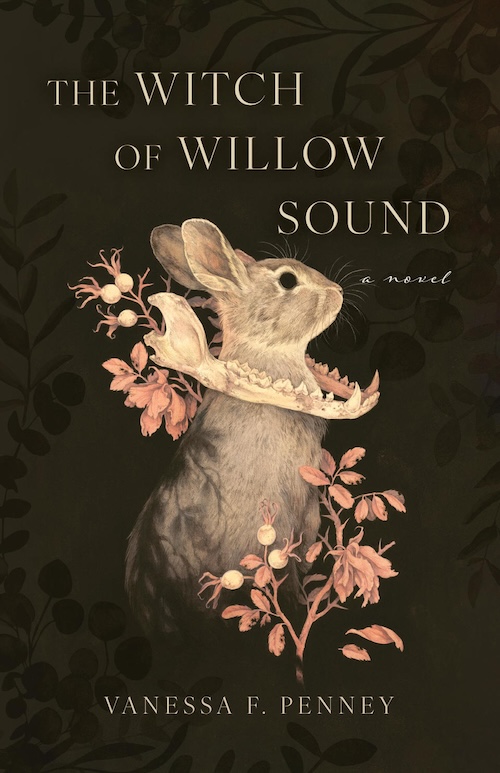
It was that cover that won me over first, and then it turned up on the inaugural CIBA Booksellers’ List among other stellar selections, and so when I finally got my hands on a copy of The Witch of Willow Sound, by Vanessa F. Penney, at Word in the Street in Toronto, I had to buy it. Even though stories of magic and witches aren’t always my speed, but there was something about Penney’s narrative—plain spoken, understated, somehow embedded in the actual world—that held me fast even when wild things were happening. And it’s the perfect book for October, Chapter 1 opening with Phaedra “Fade” Luck waking up from a slumber beneath a tombstone, “frost in my hair and bony little fingers digging in my hoodie pocket.” (The fingers belong to a skinny raccoon who is after her half-finished bag of ketchup chips.) She’s mostly estranged from her mother, but it turns out there’s no one else her mother can call when Fade’s Aunt Madeleine is reported missing, Fade tasked with travelling to Aunt Madeleine’s dreamy little cottage built on a cliff above the Northumberland Strait in Nova Scotia where she hasn’t been since her mother and aunt broke off contact more than 20 years before. But when Fade arrives, nothing is the way it’s supposed to be—the house is decaying, the gardens are dead, there’s almost no sign of Aunt Madeleine, and officials from the neighbouring town of Grand Tea (a somewhat nefarious place whose inhabitants live under the constant thread of being crushed by a mountain) seem far too up in Aunt Madeleine’s business. Meanwhile, a hurricane is approaching that threatens to flatten Aunt Madeleine’s little house for good and eliminate any chance that Fade will ever be able to figure out what’s happened to her once beloved aunt. But with her own doggedness (and useful detective skills), plus the help of a trusted archivist (every book needs one!) Fade might just be able to learn the true story of her family’s history—if she’s brave enough to face it! This fun and twisty story is also an ode to the wisdom of nature and the women who carry it, as well as reminder of the importance of balance and the way that histories will haunt us unless we are honest about what our stories really are.
October 20, 2025
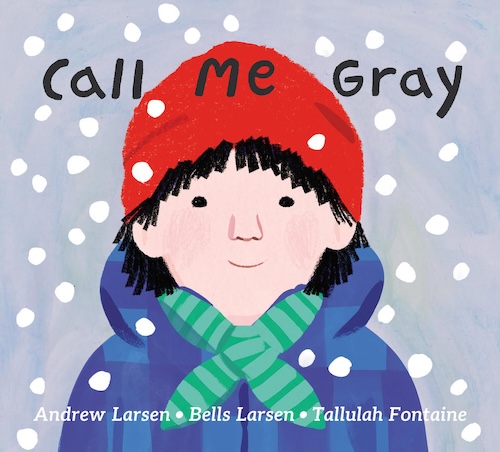
Call Me Gray, by Andrew Larsen, Bells Larsen, and Tallulah Fontaine
Some things are hard to intuit, difficult to understand if you only know about it in theory, instead of in practice, or if you only learn about it via, say, the Harry Potter lady’s unhinged tweets. As somebody whose gender has usually fit comfortably, I actually can imagine a very different world from the one I live in—where I happen to be surrounded by a wide range of gender expression and encountering trans people is an unremarkable everyday occurrence—where transness might be tricky to get my head around. And the reason why it’s not tricky is because I know people whose lives and stories are what we’re talking about when we’re talking about those things that other people like to yell about on Twitter, and let me tell you that this kind of knowledge—created of human connection and understanding—makes all the difference in the world.
And this kind of bridge between experiences serves as the foundation of CALL ME GRAY, the new picture book by my friend Andrew Larsen and his son, the musician Bells Larsen, illustrated by Tallulah Fontaine. It’s the story of a parent and child partaking in their annual tradition of constructing a backyard ice rink, the same way they do every year, continuity and tradition being oh so important—except that one thing has changed. Being a boy, the child explains to their dad, just doesn’t feel right. Which the father doesn’t understand at first—when asked if he ever feels mixed up about who he is, the father answers, ‘”I feel mixed up about a lot of things… I think most people do.”‘ It takes some time for him to actually catch on, as the two work together to build their rink.
Later the child tries again, “‘My name feels like an itchy sweater,’ I tell him. ‘I want to change it… [W]ill you call me Gray?'” The father answers, “‘I’ll try.'” And while the father doesn’t get it right immediately, he gets there eventually, the two completing the rink with their usual rituals of the first skate and hot chocolate, all those things that don’t have to change just because other things do.
What gifts the child in this book offers their parent—wisdom, trust, and the opportunity to receive their child’s essential self with abject love. Humanity is at the core of all of this, and CALL ME GRAY provides some hints for how we ought to show up for each other, whether the other person in question is our own child or somebody else’s.
October 17, 2025
Learning
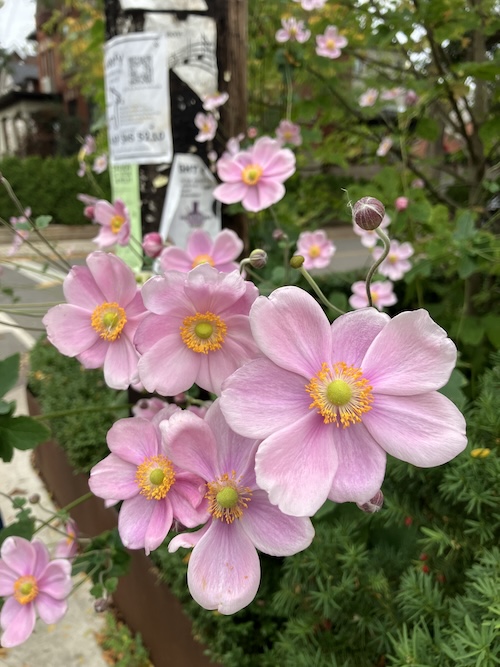
Brunswick Avenue, north of Bloor, has just been resurfaced, which makes flying down the bike lane there there smoothest and most exhilarating experience, and I was doing so not long ago on the most beautiful day (we’ve had a lot of those lately), speeding past the small group gathered at the Little Free Library, perusing the titles available, and there are always people there, a fact which, along with the blue blue sky, underlined me to how just how much the world was beneficent and people were good. And I felt a familiar compulsion to climb up on an online soapbox to declare this fact, because I’m still not entirely over the instinct that a feeling isn’t truly felt until it’s been broadcast on the internet. And thinking about this made me realize how much of my anxiety over the last ten years or more stemmed from me feeling responsible for the world in this way, in proving that hope was reasonable and that we were worth fighting for.
Which is weird, in a way, because doesn’t me feeling like I had to work so hard to make it true suggest I didn’t wholly believe it myself? The other evolution in my thinking since then, in addition to that I’m not responsible for proving the goodness of the world, is that that world actually isn’t good. Or isn’t just good. The way I’d wanted it to be, like managing to get a snapshot, A HA! There, you see, demonstrable evidence! I read a book earlier this year where the author reflected on how she used to think that we were all *this close* to getting on the right track politically, and then everything would be fine after that, and I could so relate to that naivete. And what I understand now is that the world is brutal, terrible, wondrous, perfect, violent, loving, balanced, unfair, beautiful, ugly, predictable, explosive, safe, dangerous, and miraculous all at the same time. The world (and its human inhabitants) are so many things, but “perfectable” isn’t one of them, and maybe I’m learning to accept this? That the world will always be good and bad in equal measure, and we can still love it all the same.
October 16, 2025
I Make My Own Fun, by Hannah Beer
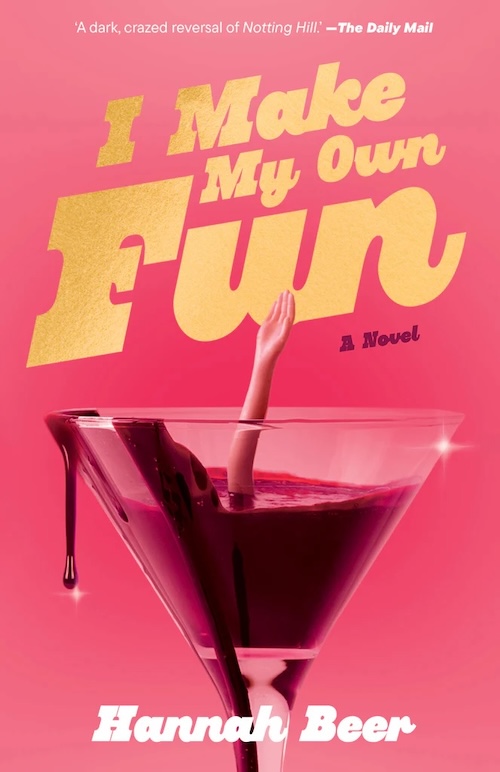
I LOVED I Make My Own Fun, the debut novel by UK journalist Hannah Beer, which has just been published in North America by House of Anansi Press. It’s a gripping, hilarious, agonizingly homicidally perfect take on celebrity, told from the perspective of the world famous and universally adored movie star, Marina, whose fans revere her to no end and track her every move, and who is able to control every aspect of her life and her press so that nobody suspects that she’s anything except the benevolent humanist that she pretends to be. Except that she’s actually a monster who’ll stop at nothing to get what she wants, until she meets the one thing she can’t get—Anna, a cute bartender, who fails to engage with Marina’s attempted manipulations via text after their one night stand. It’s a calamity that sends the already unhinged Marina even further off the rails as she sets her sights on winning Anna’s affections, completely oblivious to the way her obsession might be construed, her connection to Anna oddly mirroring the parasocial relationships Marina’s fans have with her, relationships the reader follows through the inclusion of fan forum threads throughout the narrative, which starts off nuts and only gets more and more wild. Beer pulls the whole thing off so perfectly, albeit very very darkly, and if you like that sort of thing, you’ll find this novel so delicious.
October 15, 2025
Property, by Kate Cayley
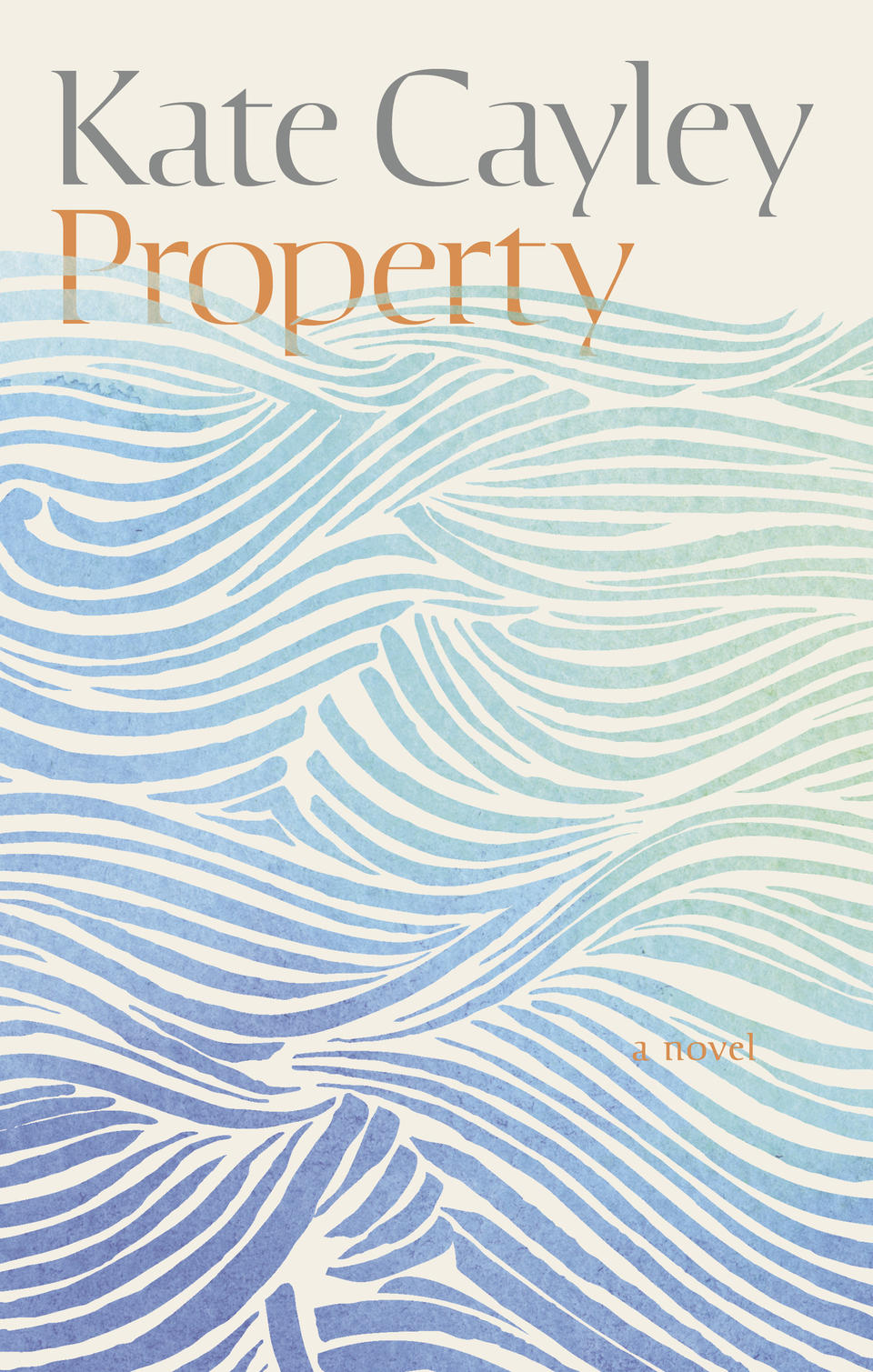
Property, the debut novel by the award-winner Cayley—who has previously published short fiction, poetry and plays—is set over a single day in west end Toronto, a contemporary riff on the Mrs. Dalloway arc with a little “Hurry up please it’s time” from “The Waste Land” thrown in for good measure, but it’s also unabashedly itself, rich and propulsive, the story of a neighbourhood and its motley crew of inhabitants including the rats scurrying around the very wet basement of a house under construction, and by the end of the day—we know from the start—somebody will be dead.
Property is the story of three mothers—Nat, a queer mother whose middle classness has crept up on her; Maddy, a former actress, who longs to escape her marriage; and the older woman across the street with her flickering curtain, one of the street’s long-time residents before people like Nat and Maddy moved in with their renos and lush strollers, who worries about her troubled adult son. It’s also the story of Ilya, Russian builder working on the excavated house, the lady smoking on the porch with her dog, Nat and Maddy’s children, and how not a single one of these characters’ inner lives is at all what the people around them imagine.
A novel about gentrification, community, secrets, fears and anxieties, about the unstable foundations at the base of so many of the stories we tell ourselves of who we are and what we’re becoming, Property, in all its delectable prose, fast becomes a heart-wrenching page-turner. The narrative culminates in an ending that manages to be inevitable, awful and perfect.
October 10, 2025
Sometimes Magic
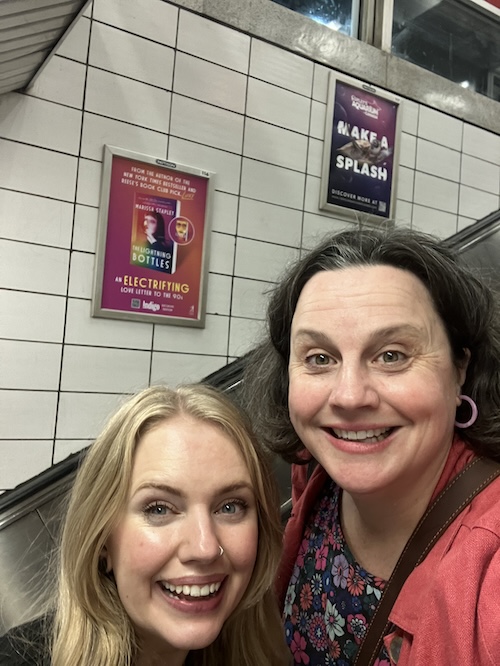
A year ago today was a great day, because it was the day I met Suzy Krause when she came to town to do an event with Marissa Stapley at Type Books in the Junction. Suzy is a ridiculously talented author and downright radiant human who came all the way from Saskatchewan to promote her novel I Think We’ve Been Here Before, and I loved her immediately, and not JUST because she’s a blogger-turned-novelist just like I am and had had a copy of my debut novel on her shelf for years before we finally connected. And before the event, we all went out for dinner, along with the writer Sherri Vanderveen, and we talked about everything, including where I was at in my own career, with a novel on submission, no clue as to what was coming next, and I was trying to be more comfortable with having no expectations, with just living in the moment I was in.
That night after the event, as Suzy and I caught the subway east on the Bloor Danforth line, I FINALLY managed to catch the transit poster for Marissa’s then-new release, The Lightning Bottles, a book I love so much and which was kind of the novel Marissa has been working towards her whole career in terms of literary achievement. It was also exciting because I’ve dreamed of having a book on a transit ad, and having my friend’s book on a transit ad is the closest I’ve come. Because it never rains but it pours, we encountered the poster again on our way out of the station, and I think you can tell by the look on our faces just how excited and happy we were. And if all that weren’t magic enough, I received an email from my agent the next morning (while waiting for Suzy to come over for tea and scones—she was staying at a hotel was close to my house) that House of Anansi was going to make an offer on my book.
A year later, I am still trying to be more comfortable with having no expectations, just living in the moment I am in, which is easier to do in a world where I know good things happen sometimes. I just finished up the final pass for my new novel, now called DEFINITELY THRIVING. Marissa is reading it now from Los Angeles where she is busy at work on exciting things in preparation for the release of the Apple TV series based on her novel LUCKY. Suzy is reading it too from her home in Regina, where she’s spent the past year working on her own next book, and SUZY THINKS MY NOVEL IS GENUINELY FUNNY (Woot!).
The writing life is full of up and downs, and I’m realizing that there is actually no level of success that ensures an end to that. But in the meantime, there are magical people, friends to celebrate, and—in our own books, and real life—wonderful twists that can catch us unaware.
October 8, 2025
The Pugilist and the Sailor, by Nadia Ragbar
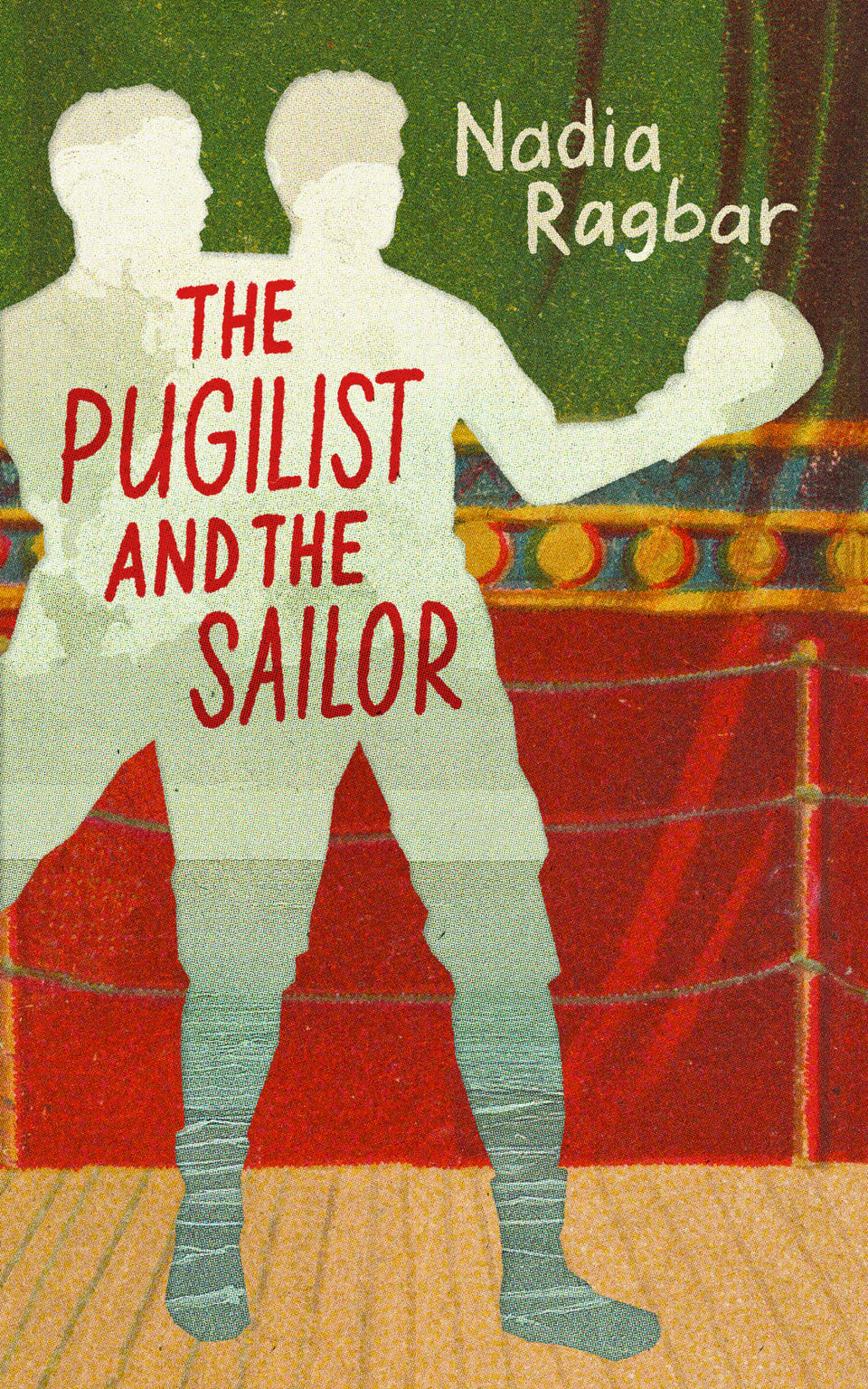
Imagine the impossible conundrum: a set of brothers, conjoined twins, and one’s entire existence is bound up in being a boxer, while the other just wants to read a story of a sailor all alone at sea. How do you reconcile that? A question that serves as jumping off point for Nadia Ragbar’s debut novel, The Pugilist and the Sailor, the story of the Reuben brothers, Bruce and Dougie, but which is also a meditation that draws into the narrative the boys’ loving parents, their neighbours, their co-workers, and a benevolent tailor determined to make the brothers a new suit. Ragbar’s story is a rich imagining of Bruce and Dougie’s physical experience—how they walk into a room, the way they sleep, how one brother hovers inside a door to give the other a bit of privacy to (maybe!) kiss a girl goodnight. And the boxing too, where the brothers are known as The Reuben Beat, two fists and three legs, a force to be reckoned with, except that Bruce doesn’t want to do it any longer, and Dougie has been having troubling neurological symptoms. Meanwhile, Bruce has been exchanging letters with a woman in the neighbourhood who has been overwhelmed by her own grief, but he hasn’t informed her yet of his physical situation, and the narrative encompasses her own point of view, and that of the brothers’ mother, Jane, who made her own choices when her sons were born, and might have to let go of her conviction that these were the best ones for them, that her sons were perfect as they were and they’d have to have the world bend to meet them rather than the other way around. Which has served them well, until now, and this is a story of holding on and letting go, and about the connections that persist in spite of unfathomable distances, a generous, human, and most moving read.
October 8, 2025
Gleanings
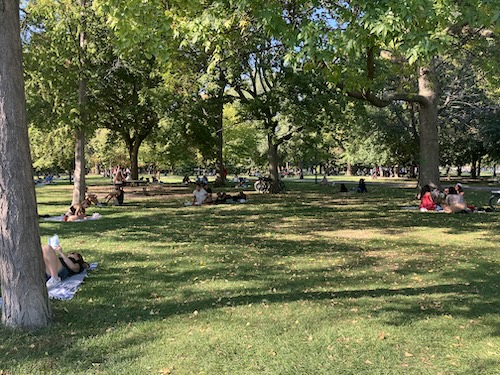
- My mom is not the kind of person to say, “Oh, a letter addressed to someone else; not my circus! Not my monkeys!” Which is good, because I’m really nosy and would like to know why Ethel hid the letter, and why Ethel was in jail, and also what happened to Ethel, period.
- I think if you get too obsessed with wringing the most value out of every moment, you’re pretty much guaranteed to fail to spend your time wisely.
- ‘Though I have walked this forest trail countless times, entering Kopegaron on Thursday morning, it all felt new and fresh and intoxicating — like returning to a beloved and enchanting world. My senses were immediately engaged — inhaling the peaty, earthy, and resinous arboreal smells; and feeling the unyielding, textured and deeply furrowed bark of the huge old trees, and listening to the myriad bird calls happening high above my head. As nature’s peace worked its magic, I felt reverence, contentment and immense gratitude.
- When I sew, I follow a line. My needle finds it in the fabric. It meanders, it spirals, it stretches out like a road on a map, like a river in a landscape. When I see some of the brush work in these paintings, I feel a kinship, across thousands of years. It is a wonderful thing to make a mark, to leave a trace — of thinking, of ceremony, of an encounter with mystery.
- It was there for the taking — the very thing that had sparked my envy. There are trails near the library. I didn’t have to be anywhere in particular. I actually did have the time (self-pity wasn’t a reliable source of information; it rarely is). I could just go for a walk.
- My sister gave me Joy Sullivan’s Instructions For Traveling West for Christmas, and “First, you must realise you’re homesick for all the lives you’re not living,” has become my new mantra. But I struggle. I can so easily picture a parallel world where Doug is well, and he and I are living happily ever after. Where he was joining me on this walk, meeting our friends, Tiff and Amy, exploring our favourite rooms of the V&A together.
- A very good thing is old-timey (and sometimes even modern British) cookbooks referring to “goat’s cheese.” It most certainly is not the goat’s cheese. It is cheese of the goat, sure. But the goat didn’t make the cheese, didn’t even know CHEESE WAS A THING at the time of their being milked. (Yelled through a megaphone: IN THE TIME OF THE GOAT’S MILKING)
- I used the term AI Sloppola recently and was applauded. It’s getting harder and harder to escape the stuff. I’m not sure what the solution is, but I think books, reading, art, literature, music, human creation is obviously part of it. To keep our mental health, I think we’ll be visiting book stores more, libraries maybe, museums, art galleries, live music. I say that, but I also realize I live in a total silo of artists, writers, book and art lovers. So I’m not sure. And I’m not sure what to do about any of it, especially as we all navigate the traumosphere.
- If I were properly reviewing, I would reread the novel until I could explain better how the parts hang together. Big words like “belonging” or “identity” feel relevant but also too general.
October 7, 2025
Run Like a Girl, by Catherine McKenna
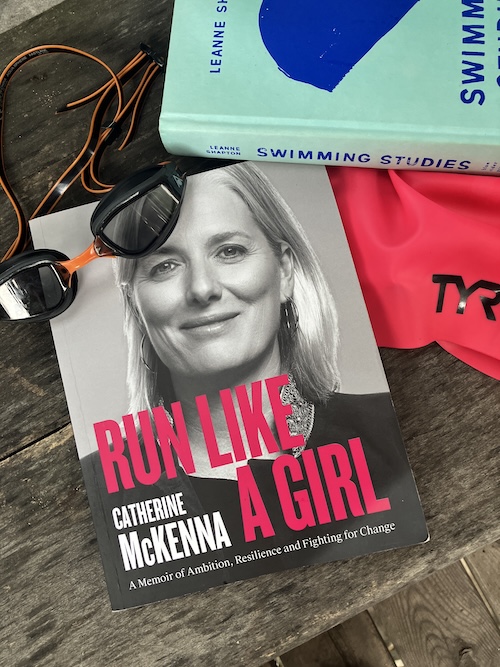
RUN LIKE A GIRL, the memoir by former MP and Environment Minister Catherine McKenna, was an impulse buy. I picked it up at the bookstore because I was curious about who’d published it (it was Sutherland House Publishing) and discovered that it was more of a scrapbook than a typical memoir, like those SOUVENIR OF CANADA books that Douglas Coupland published about 20 years ago, replete with snapshots, clippings, photos of objects (the shoes she wore canvassing, her collection of swim caps, an array of campaign buttons, the cover of U2’s WAR, the first album McKenna ever bought), Nike ads she cut out of magazines and taped on her bedroom wall during the ’90s (which is both cringe AND very relatable), along with short passages of text. I was drawn by the book’s format and also interested in McKenna’s story as a female politician who’d received outsized hate and abuse during her tenure (there are people thought they were being clever by calling her “Climate Barbie”), so I took the book home…where I read her acknowledgements and discovered that the book’s unique format was dreamed up in the company of McKenna’s “swim friend,” Leanne Shapton, whose own books which are collections of objects and images are some of my favourites, her memoir SWIMMING STUDIES in particular. So of course I wanted to read RUN LIKE A GIRL. (If McKenna had called her book SWIM LIKE A GIRL, I would have purchased with more alacrity, but possibly I am a niche audience for that.)
“Run like a girl” was a phrase that McKenna adopted during her campaign for office before the 2015 federal election (after a gruelling nomination process during which others were waiting for a more traditional [male] candidate to drop into her Ottawa Centre riding), which basically meant staying true to herself and her values, and honouring her own particular style in getting things done, a style honed from the outset during her upbringing in gritty Hamilton, ON, and her experience as a competitive swimmer. The swimming remains a through-line for McKenna, even after she becomes a parent, and then an MP—as Environment Minister, she had responsibility for Canada’s national parks, and there are photos and anecdotes from her swimming in pristine places all over the country; she also writes about being part of the parliamentary swim team and having to dive under water to get away from Elizabeth May’s very persistent lobbying.
McKenna’s is an inspiring story of determination and finding her own way—at law school, as a lawyer, as a mother, as a politician. She writes candidly about her frustrations as a part of Justin Trudeau’s government where promises of sunny ways dissolved into a dearth of support and real leadership from above for MPs, where she feels as though she was too optimistic as Environment Minister in envisioning the oil and gas industry collaborating with policy makers to enact meaningful change to meet Canada’s emissions targets. She writes about her decision to leave politics at a moment that was right for her, and also about her current role where she continues to work for climate action through the company she founded, Climate and Nature Solutions.
Inspiring, engaging, hopeful and human, RUN LIKE A GIRL was a fun, colourful, and most compelling read. To anyone who finds traditional political memoir a little dry or who wants to be reminded of the what’s possible for the future of climate, politics, and more, this book will be a winner.
October 5, 2025
The Story and Science of Hope
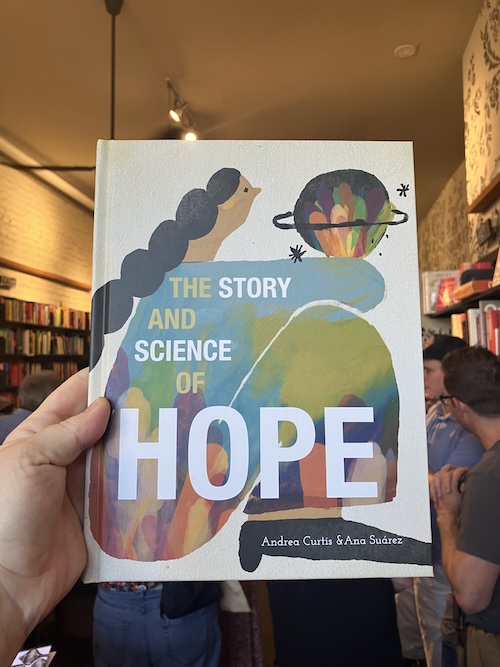
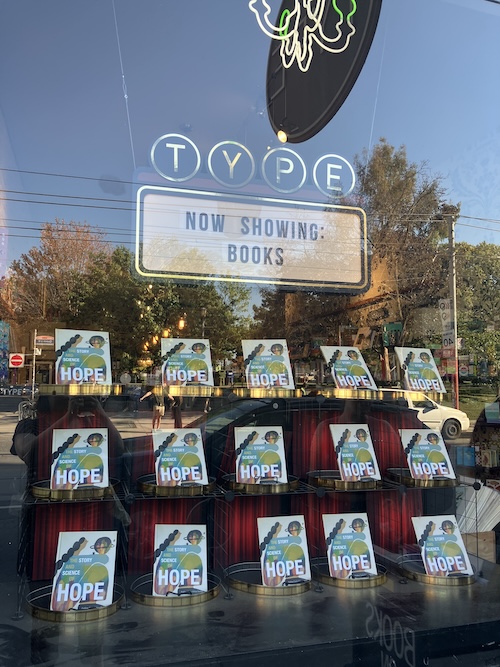
A packed house (and top tier snacks) to celebrate Andrea Curtis’s beautiful new book THE STORY AND SCIENCE OF HOPE today, a middle grade picture book for readers of all ages, out now from Groundwood Books gorgeously illustrated by Ana Suarez. Hope is the place to begin, Curtis tells us, with research backed by science to prove it. And it’s up to us to turn that hope into action, which all of us can do every single day.