September 16, 2026
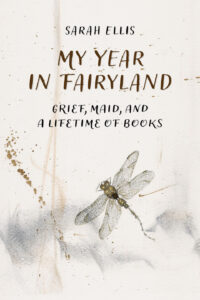
My Year in Fairyland, by Sarah Ellis
“I didn’t want Sherry to leave. I thought her decision was premature. In my sorrow, I felt the pull at every moment to appropriate her into the greedy organism of my own self. But Sherry was not me. She was her own self, in her own body, with her own history. My task and my ethical responsibility was to see her as clearly as I could and love her. To look closely and love is a principle that I’ve tried to apply to all the life presents. Sherry’s situation strengthened my belief in this principle even as it stretched it to the breaking point and often drained me.”
Acclaimed and award-winning children’s author Sarah Ellis’s memoir/essay collection My Year in Fairyland is many things—it’s a love story, a life story, a death story, a report from a journey into grief, an exploration of the books and reading that underline the author’s life, a consideration of the ethics of MAID and our responsibilities to one another as human beings, and so much more.
When Ellis met her wife Sherry (at a ukulele circle, but Sherry wasn’t there to play), Sherry had already made up her mind that she was going to end her life when she was ready, before her MS symptoms could take that life over altogether. Of course, Ellis didn’t entirely believe her, especially after the two of them stitched their worlds together. Surely their love, their life, would be enough to change Sherry’s mind? But no, Sherry’s mind was not for changing (and this was Sherry’s standard; Ellis’s illustration of her wife as a larger than life whirlwind of a character is one of the most delightful parts of this remarkable book), and it was out of love that Ellis committed to helping Sherry do what she’d always said she’d do, eventually being accepted for a medically assisted death in Switzerland in 2019.
The couple received the date for Sherry’s death a year ahead of time, and Ellis comes to see this liminal period as they were waiting for it to happen as a kind of fairyland. The usual rules are suspended, a surreality infuses everything, they’re working toward something inevitable that feels impossible. Ellis writes about realizing that notions of a bucket list would not work for them, that steeping themselves in ordinary everydayness was what they truly desired with the time they had left together.
But there are practical matters as well—they’d maintained separate households, and needed to clean out Sherry’s house. What to do with the two coffins she used as coffee tables? What things of Sherry’s does Ellis want to hold onto?
She writes about what fairyland and notions of play had meant to her as a child, of how they’d inform her perspective of the world and a child’s eye view. She writes about how notions of play underlined the life she built with Sherry: “It was the shape of our landscape.” About her struggle to accept Sherry’s wishes, and how her finally doing so is informed by an allusion to The Secret Garden. About riddles in general and the ultimate riddle, which is life itself. About the fairy stories that had “furnished the rooms of my imagination for a lifetime.” How writing helped her through the experience, and made her think about her writing differently, that maybe it had always been more personal than she’d ever imagined. About weddings, wifedom, queerness, and “The Owl and the Pussycat.” Dancing by the light of the moon. (The moon.) And finally of what it was to come home from the experience of Sherry’s death, the same but utterly changed. The riddle of that, her own personal Odyssey.
My Year in Fairyland is a gorgeously woven tapestry, a generous offering, and a pleasure to read.






