June 18, 2026
The Art of Looking Back, and Women Among Monuments
“Sometimes I felt his gaze on me as I rode my bike to work, sat at my desk thinking my way into poems, and later, much later, drank coffee by our woodstove in a beautiful silk robe given to me by a wonderful woman, a robe he never saw. I felt his gaze pinning me to paper like a bright butterfly. For years afterwards, a gaze followed me, whatever I did. “A coy black-haired girl wearing a vermilion red gown, on a green mauve ground with a pale summer green light from a window” (May 22, 1982). I was never her, never had a vermilion gown in pale summer light, and I never knew I could refuse the gaze. Until he was dead and I was too old.” —Theresa Kishkan
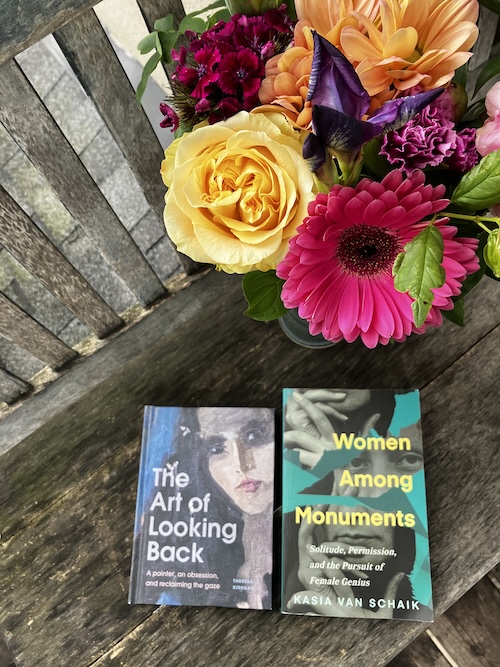
Never have there been two better suited literary companions than The Art of Looking Back: A Painter, an Obsession, and Reclaiming the Gaze, by Theresa Kishkan, and Kasia Van Schaik’s Women Among Monuments: Solitude, Permission, and the Pursuit of Female Genius, two works of nonfiction almost uncannily in conversation. Kishkan’s memoir is a deep study of her experience as a painter’s subject many years ago, when she was on the cusp of her whole life, and may or may not have had the agency she thought she did. One of the portraits now hangs on the landing in her home, and in this book, Kishkan is in conversation with her younger self, who’d never known that the gaze could be refused. Though perhaps her first notion of this began with a trip to Greece she writes about, to the Acropolis, and the Karyatids, statues of five women that for Kishkan became “profound emblems of strength.”
She writes, “Their bodies were foundational structural, they were not the objects of anyone’s gaze, or if they were or had been, it was immaterial after 2,500 years. Their own eyes were far-seeing. Their clothing loosely fit their strong bodies, one leg taking the burden of the building’s weight, that leg bent forward to demonstrate their strength. From behind I could see the intricate braiding of their long hair, thick and bold, serving to enforce the strength of their necks as they supported the burden of the entablature.”
In Women Among Monuments, Van Schaik questions why such monumental women are so rare, and why when we do encounter them, they’re as symbols of virtues rather than representative of actual historical people, object instead of subject. Her memoir is a record of a variety of experiences, among them Van Schaik as a young womn, devoting herself to studying the work of great artists, replicating their artworks. “As I sketched…I wondered what effect replicating all these paintings by men had on my brain. How was it shaping the way in which I women? I hadn’t learned about the male gaze yet, though I had experiences it, both as an obhject of it, but also inwardly, within my own mechanics of looking… All around me I could sense an ambient desire and disgust for women’s bodies. At this point, it was more a feeling of unease and the study of perspective in art seemed to be compounding this self-interrogation. But even without the vocabulary, I was starting to question where I, or anyone like me, fitted in the history of looking.”
And both of these books are a continuation of such questioning, meditative, inspiring, generative, generous and powerful.






