May 31, 2021
Crying in H Mart, by Michelle Zauner

I loved Michelle Zauner’s memoir, Crying in H Mart, a book which was born from a 2016 award-winning essay in Glamour about how learning to cook Korean food helped Zauner begin to heal from grieving her mother’s death. An experience made all the more complicated by the fact that Zauner, at age 25, had only just began knowing and appreciating her mother again after the tumultuous drama of her teenage years. Zauner’s mother was as strong a character as her daughter is—she writes about how her mother would yell at her when she got hurt, the opposite of the other mothers she knew who’d be all cuddles and consolation. That Zauner’s mother is Korean only underlines the gulf between them as Zauner is growing up in Oregon—her American father had met her mother while working abroad and then they’d come to America together. In many ways, Zauner and her mother are alien to each other for must of her life, and in this book she explores how much of that was culture versus the particular person her mother was.
Crying in H-Mart is a coming-of-age story, about how Zauner connects to her place in the world through losing the person who delivered her here. It’s not just about loss, but as much about abundant love—as her mother is dying, Zauner hastily organizes her wedding so her mother can be in attendance. She also becomes committed to caring for her mother during her illness, though has not idea what she’s signing up when she decides this. Her efforts are also thwarted by other caregivers to whom Zauner is just in the way—the connection between mother and daughter is ever being negotiated. As in any real story about death and dying, nothing ever goes according to script and there’s never anything close to closure. And the end is also its own kind of beginning, Zauner beginning to take control of her narrative, and as she starts to achieve success in writing and music (which Zauner performs as “Japanese Breakfast”). She also begins to see her mother as a more complicated person than she’d first supposed, as an artist in her own right, and that perhaps she and her mother aren’t as different as she thinks.
I’ve read other stories about children of immigrants growing up between cultures, about stories of Asian parenting ala Tiger Moms. Crying in H Mart takes on similar things, but with a depth and texture I haven’t encountered before. It’s a familiar story, but also a particular one, powerful for how it stands for itself most of all and one extraordinary ordinary mother-daughter relationship.
May 28, 2021
Pfingsten

I’ve been reading Barbara Pym all spring, as I’ve mentioned several hundred times, and the Anglican rituals, for me, have always been the most curious aspect of these books—the vicars, and the curates, and the cassocks. What’s a cassock? I don’t even know. And especially: what is Whitsun? Whitsun, which is never a major plot point, but simply part of the course of the year (and occasion for a bank holiday). I had to google it—Whitsun is the Pentecost (and then I had to google that, and I still don’t really get it), celebrated the seventh Sunday after Easter. And frankly, not a lot—Barbara Pym aside—has been going on this spring, as Ontario moves into its eleventeenth month of lockdown, so I decided this was the year I was going to make Whitsun a thing. What that would entail exactly, I wasn’t sure. Definitely not church. But we needed something to look forward to, a goal to shoot for, and so Whitsun it is. (And indeed, this is cultural appropriation. Church of England Cultural Appropriation. It’s not the same thing.)
I decided this during a terrible weekend in mid-April where our provincial government’s incompetence took a swan dive off a cliff. Finally, after the government waiting to see whether modelling numbers predicting ICUs being overwhelmed with patients would play out in reality (SPOILER: they did! Who would have guessed?) the province moved into a locked-downier lockdown from the lockdown we’ve been locked down in since November 23. Six weeks on from then would be Whitsun. Surely by Whitsun, I told myself, we would find ourselves in a better place? Keep looking in the direction of the place you want to get to has been my motto all along…
And here we are, with falling infection rates, with vaccine rates that are really high. We were still in lockdown for Whitsun and the lockdown carries on, but it was so good to mark a milestone on a weekend with such beautiful summer weather. I’d also ordered peonies, because I’d received an enticing ad from a local florist, and the great thing about made-up holidays (all holidays are made-up holidays, even Whitsun, though I’ll acknowledge that my version of Whitsun was particularly improvised) was that you get to make them whatever you want. Whitsun peonies, I decided. And we’d make a Victoria sponge cake. I booked a car so we could go somewhere. We were going to make this the best Whitsun ever!
And it was! It was already a holiday weekend in Ontario and we’d gone for an epic bike ride the day before (Whitsun Eve). On Whitsun itself, we had Sunday waffles as usual but they just tasted better for it being Whitsun. I finished the book I was reading (Day for Night, by Jean McNeil, which I’ll be writing about here soon…). We went to Ontario Place, and had a second weekend in a row with two lake days in a row. We got ice cream. We came home (no traffic) and had an amazing barbecue supper, and then just as I was assembling the Victoria sponge cake (which was beautiful and delicious and did not look like it had been assembled by a blindfolded toddler—a first for me!) a friend sent me a text and asked if our family would like to join theirs for fireworks in the park that evening.
I can’t believe they were lighting fireworks for Whitsun!
Our children have never seen fireworks before and it turned out to be the most magical display, the first real life communal experience we’ve had while not sitting in a vehicle since March 2020 (albeit at safe distance for other people and also explosives). It occurred to me that if everybody just carried around lit sparklers all the time, we’d have no trouble staying six feet apart at all.
Even more cool things: on Sunday I was scrolling through the #Whitsun hashtag on Instagram, and what do I find. Peonies! Whitsun peonies EVERYWHERE. It turns out that the Pentecost is a national holiday in Germany and peonies (pfingstrose, translation Whitsun Rose) are the official symbol. Sometimes when you’re making it up you get it exactly right.
Not all days are glorious. Our bike ride on the Saturday before Whitsun was hot and full of whining. When we finally got to our destination, the beach was full of thick green algae and bugs were swarming us. A very loud church service was being amplified unavoidably, and it was weird and obnoxious. I was allergic to something and broke out in a rash, and on the long ride home we got caught in a rainstorm. “That was awesome,” we said at the end of the journey (20km) but also absolutely awful.
Whitsun though. Whitsun was perfect. Sometimes you get lucky. Sometimes you get to make it up and everything goes right.

May 27, 2021
My Spring Obsession: Katherine Heiny

It started in February when I signed up for an online event celebrating Laurie Colwin, whose book Happy All The Time was appearing in a new edition with a foreword by Katherine Heiny. Heiny was also co-hosting the event, which was a pleasure to “attend” and there was a reference to her work being more than a little Colwin-esque. So I ordered her first novel Standard Deviation from the library. And I loved it. I loved it SO MUCH. I loved it in a where-have-you-been-all-my-life, I-ought-to-recommend-this-book-to-everybody-I-know kind of sense. It was the book that my husband demanded he would get to read right after I was finished with it, because he wanted to know what all the laughing was about, and then I got to listen to him laughing about it too.
Standard Deviation, like Nora Ephron’s Heartburn, like everything by Colwin, is a comic novel that break all the rules of novel-writing and is definitely the kind of book in which nothing much happens and yet everything does. Stories that fixate on minutiae and room decor and thread counts, and everybody is more than a little bit neurotic. Standard Deviation is a novel narrated by Graham, who is married to Audra, his second wife, who never stops talking and is on intimate terms with everybody they encounter. They have a son with Aspergers whose struggles are depicted poignantly but also hilariously—and what a balance is that. This is the most true-to-love depiction of the heartaches of parental love that I’ve ever encountered in a book, and it’s just the most remarkable combination of thoroughly absurd and utterly mundane. I could have read this book forever, Graham as a straight man casting Audra in the most compelling light, though he’s having his own complicated experience as he has a run-in with his first wife, Elspeth, on whom who cheated with Audra, and Elspeth is Audra’s polar opposite in every single way, and because Audra is Audra, she insists that they all get together, and (shockingly) it all doesn’t run so smoothly. Add to the mix their son Matthew’s origami club and its ensuing drama, and you’ve got a family comedy like nothing else you’ve read before…except maybe in Laurie Colwin.

I think maybe if I hadn’t had my mind blown by Standard Deviation, I would have been more ecstatic about her just-released novel Early Morning Riser, which has the same tone as the first novel but is perhaps lacking its tartness. The secondary characters aren’t as realized in this novel, and we encounter them at the beginning of their connection instead of in the midst of a long history which renders the story a little more shallow. Taking place over two decades too instead of the very focused narrative of Standard Deviation, it’s just too sprawling and meandering in terms of plot. But I still really enjoyed it, and bought a copy for my daughter’s Grade 2 teacher because Jane, the main character in the book, is a Grade 2 teacher, who rolls into town and finds love with Duncan, who’s a great guy but, unfortunately (and maybe consequently) has been intimately involved with every woman they encounter in their life together, which makes things a bit awkward for Jane, plus he has his own first wife, and other connections make their life together unnecessarily complicated and Jane is just not sure how she feels about having her domestic life be so crowded…
It was not a great novel by traditional standards, but it was a good novel, and that it was distinctly a Katherine Heiny novel—in terms of humour, character, description—made it a novel that’s thoroughly worth reading. Every since I read her books, my own fiction has included characters who are just a little less ordinary, prone to rashes and strange outbursts. Somebody will be walking into a room, and why not decide that they’re carrying a giant sombrero, you know? It’s a wonderful, inspiring kind of license, to write characters who are outside the ordinary, and I’m really enjoying playing with that.
And I’m also looking forward to finally reading her very first book, the short story collection Single, Carefree, Mellow, whose title story I’m most intrigued by and which I never would have picked up every because these are three adjectives that describe somebody so different from me that I feel like store alarms might go off if I tried to buy it. But I am going to buy it now, because I’m most certain that Katherine Heiny’s writing is meant for me.
May 25, 2021
Gleanings

- It’s amazing to me, that over a few short weeks, our city has turned from grey to green.
- Then there was the asparagus itself. It seemed magical. That it could grow in such sandy soil. That it came and went so quickly—just a few weeks in May and June. But most of all because every day we would pick the same field.
- Some mornings I feel as though I am hovering between this world and another and I don’t have the words to say who I am.
- So Constant Nobody is about power, duty, identity, and love and functions as a hybrid of espionage, feminist, historical, and literary fiction.
- I make it sound very innocent don’t I? If I told you that there are scenes both of blueberry picking and blueberry jam-making, that the cast is almost entirely female, and that much of the novel consists of the inner workings of a 54-year-old woman’s mind, you might be left with a certain kind of impression. Reader, you would be wrong.
- I didn’t plant a lilac at our first home because I knew we would likely be leaving, but here, I thought, here is where we will stay. Here is where we will raise our family, here is where we need a lilac tree.
- Understanding someone doesn’t mean we must agree with their worldviews or convert to their ideologies or repent for our own beliefs.
Do you like reading good things online and want to make sure you don’t miss a “Gleanings” post? Then sign up to receive “Gleanings” delivered to your inbox each week(ish). And if you’ve read something excellent that you think we ought to check out, share the link in a comment below.
May 19, 2021
A Lethal Lesson, by Iona Whishaw
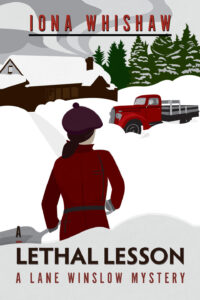
To be reading a new Lane Winslow book is one of my favourite states of being, and the best thing about this series, whose eighth and latest instalment is A Lethal Lesson, is that it just keeps getting better. A little out of season this time—the story is set at Christmas and one suspects that it might have come out last fall in an alternate universe in which contagion doesn’t roam the land. But oh, still a treat to be back in King’s Cove, whose vicar turns up at the Christmas Even gathering at the end of the book and reports that his flock at King’s Cove is the most exciting of all his parishioners, “with your resident detective Miss Winslow…and the inspector established here now, and murderers and would-be murderers turning up all the time. Better than a fictional English village!”
And it’s true! Whishaw’s story has a meta-charm as her characters compare the situations unfolding around them to what might be expected to happen within the pages of a book. The situation here being a rather curious one—the outgoing school teacher has been found with a head injury, her cottage ransacked, and the incoming teacher has disappeared altogether. Does one of the women have something to fear from her past—or even both of them? And more importantly—who is going to preside over the school in the meantime before the case is solved? Why, Lane Winslow, of course, with her Oxford education, and while she doesn’t have much experience of children herself, she’s surprised to find how inspiring she finds their company, which surely pleases her new husband, Inspector Darling, who’s putting out some not subtle suggestions that he’s interested in them having children of their own.
I absolutely love the modern sensibility of these novels, of their feminism, sense of justice, their anti-racism, their progressiveness, which somehow never seems out of place in a tiny BC hamlet in 1948. Darling proposes, “Let’s say she displayed what some might have termed dubious morals and incited locals…” to which Lane gently corrects him, “No, let’s not say that. We are making her responsible for being harassed, very unfair under any circumstances…” But it’s never preachy or pedantic, and Whishaw continues to use her murder mysteries to explore the limitations on women’s lives and freedom that were contemporary to the period, and which are not yet so far away in the rear view mirror.

May 18, 2021
Gleanings

- I hear the mantra, “This, too, shall pass.” Somehow, by the lake, it’s easier for me to believe it, to remain hopeful.
- Can light still change us? Can beauty? Can a seagull perched on top of a TacoTime cactus after rummaging through the trash show me something that I need to know?
- When I was younger I wanted to change the world, I think we all did. Now that I am older I am content in knowing that maybe, for only a few moments, I have made a difference in someone’s life.
- I started writing Pocketfuls as a personal creative project when I was home raising two young boys, and writing about parenthood there gave me the skills, the personal connections with other writers (who shared expertise and resources with me over the years), and the confidence to believe that I could write books.
- These May mornings are gifts…
- Perhaps the greatest proof of friendship is that, even in the midst of some pandemic gamesmanship, some awkward silences and some selfish or uncaring comments, our love and respect for each other survives, is even, eventually made lovely again.
- And Rhonda Douglas shares 7 online writing workshops, including mine! (Thank you, Rhonda! Sign up today!)
Do you like reading good things online and want to make sure you don’t miss a “Gleanings” post? Then sign up to receive “Gleanings” delivered to your inbox each week(ish). And if you’ve read something excellent that you think we ought to check out, share the link in a comment below.
May 17, 2021
On Archipelagos

Last March when the wheels fell off the (western) world, a former classmate of mine who lives in Shanghai was having none of everybody’s passionate proclamation that FINALLY we were all on this together. Well, where had been the rest of us, she was asking on Twitter, when she had her neighbours had been enduring lock-downs since January? 8 weeks by then, which seems quaint now, the pandemic was young. And where we’d been, of course, was living our comfortable little lives supposing that what was happening in China—and then Iran, and then Italy—was something that went on “over there” and it could possibly have nothing to do with us.
To be fair, I am not entirely sure what else we should have been doing in practice, but I am sure it was the principle of the thing that bothered her. That things that don’t affect us directly might as well not be happening at all, which is a comfortable way to live, it’s for sure, but the last year has made quite clear that no man is an island, and no country is either—except for New Zealand. (Why can’t we all be New Zealand?) I was thinking of my friend in China a couple of weeks ago as Nova Scotia went into lockdown, and everybody I know there was all in a tizzy, and I just wanted all of them to calm down. Because if I’m still here and doing okay on Day 175 of MY city being in lockdown, surely you might endure your own burden with a little more stoicism?
My irritation wasn’t very generous or kind, but it was born out of a suspicion that what had upset a lot of people was that they’d been hoping fate would exempt them from what everybody else was going through. That somehow, they thought they were different or they were better and therefore the rules did not apply, and also I’ve worked very hard to get through the last six months non-hysterically and so to see other people losing their minds over a handful of cases is really just a test of my patience. Can I just tell you that 175 days is a very long time?
I have this vivid memory of being in high school, and a friend and their sibling were fighting viciously. It had turned into a huge problem for their family, and their parent was really struggling, and I was over at their house witnessing on altercation, and I remember saying something like, “Hey, don’t worry! My family yells at each other all the time!” And I have a distinct recollection of the expression that passed over that parent’s face in response to what I’d just told them, that this wasn’t any kind of comfort. The kind of empathy that you wish was otherwise—I don’t want to know what it’s like to be you at all.
I don’t know where I’m going with this. I think it’s interesting that we ARE all in this together, but also we’re distinctly not. Or maybe we ARE islands, but we’re archipelagos too. And eventually the bad news come for everyone, for some more then others. These things aren’t given out fairly, for sure, and I’m think about peaks and troughs, whose meanings are turned inside out when we’re thinking about infection rates. April was a brutal month in Ontario, and one day I saw a photo of somebody out for a beer on a patio in the UK and I was absolutely filled with jealous rage, which isn’t my go-to. And now it’s mid-May, and things are getting better, finally, as they’re only getting worse in the province to the west of us. Steps forward and steps back again, and it requires so much patience.
I don’t pay attention to the numbers, unless they’re good. I wrote this last summer and I still stand by it, even though the numbers are so much higher now than they were then, and these numbers are the good news compared to weeks before. What a crappy time it’s been. I am still frustrated that bad policy has again and again wasted momentum we could have built upon to avert so much loss and tragedy. But such as it is, and another thing I’ve learned from the last 175 days and which I can probably share with people for whom lockdown is brand new is that it will probably get worse before it gets better. But also it gets better, which is the most fundamental point and reason to keep going. And this is what we can take away from those who’ve been through it before.
May 13, 2021
The Adventures of Miss Barbara Pym, by Paula Byrne

I…don’t like big books. They’re heavy to hold, don’t fit in my purse, and I’ve just got no time for that, for the most part. It just doesn’t groove with the pace of my life, and so at 612 pages, I was intimidated by The Adventures of Miss Barbara Pym, Paula Byrne’s biography of novelist, the first since a 1990 biography by Pym’s friend and literary executor Hazel Holt which might have revealed fewer insights that it could have out of respect for Pym herself, who’d died of cancer in 1980.
But reader, I read it in two days. Granted, these were two days I’d set aside especially for it, turning off my wifi and accompanying social media so all my attention could be focussed on the task at hand, which was giving my poor wrists the support they needed to hold Byrne’s biography up to my eyes. But it helped that Byrne had divided her book into short and action-packed chapters in the style of 18th century novels like Moll Flanders, chapters with titles such as “In which our Heroine is born in Oswestry,” “In which Miss Pym returns to Oxford,” and so on to “In which our Heroine goes to Germany for the third time and sleeps with her Nazi.”
TURN BACK, BARBARA! was what the residents of my household took to shouting as I kept them abreast of developments in the narrative, such as when Barbara was having an affair with her friend’s father, various gay men, her roommate’s estranged husband, and yes, a literal Nazi. Barbara Pym was an extraordinary person, a brilliant novelist, and had comically terrible judgment when it came to men (and 1930s’ political regimes). Although it occurs to me that her terrible judgment may have been what made her such a wonderful novelist, her ability to imagine her characters into the impossible situations she’d often encountered herself. She took the tragedies (and absurdities) of her own life and spun them into literary (and comic) gold.
Barbara Pym was a fascinating woman—a student at Oxford in the 1930s, she was an enthusiastic participant in sexual relationships, and imagined herself into all kinds of romantic dramas, her particular obsession with one lover occupying her for the rest of her life. She was very drawn to Germany in the 1930s, displaying that typical judgment I’ve always mentioned, but this did not persist into wartime, where she would serve with the WRENs in Naples. After the war, she was hired as an editor for an academic journal in anthropology, which served as fodder for her work (oh my gosh, her treatment of office dynamics and whose job it is to put the kettle on and how is SO SPOT ON) but also paid her a pittance. Being a novelist was most fundamental to her identity out of everything else she did—her first novel, Some Tame Gazelle, was published in 1950. She’d been working on the novel since her Oxford days.
Throughout the 1950s, she published five books, her sixth appearing in 1961. And after this, her new work was not accepted by her publisher, nor by any another. The fashions were changing, and so was the publishing industry (everyone thought the industry was just as dire then as they have ever since), and Pym’s understated humour and wry old-fashioned sensibility had not kept up to date, it was said. So she would toil in the wilderness, encouraged by her excellent friend Philip Larkin, and these years were hard ones for her—money was a struggle, she was depressed by romantic relationships that didn’t pan out, she encountered health struggles, and felt left behind by the literary scene.
And then everything turned around—in 1977, Pym was mentioned (twice!) in a Times Literary Supplement list of underrated writers. All of a sudden, the newspapers and radio were calling. Her publisher wanted to put her back into print, she relished in rejecting them this time, new works coming out with MacMillan, her earlier books re-released. Her next novel, Quartet in Autumn, was nominated for the Booker Prize. Pym would be celebrated before her death at the age of 66, which gives this life the happy ending her biography’s reader longs for. The kind of triumph that doesn’t always happen in life itself, and seems more fitting for a novel instead (but then we’d call the conclusion a little bit pat).
Byrne refreshes one’s perception of Pym in this biography, whose title and form is entirely suited to a life that wasn’t quiet at all, and which pushed the margins in all kinds of ways. She also shows the way that Pym’s work was a reflection of its times, and changed along with the fashions, responding to the world around her, even though many of her preoccupations (spinsters and curates especially) remained the same.
May 11, 2021
Gleanings

- The restorative qualities of being in nature, or “green space,” are well documented, but researchers have only recently begun to focus on what changes when water is part of the picture…
- …you don’t have to agree with everything he says but the point is to go on thinking about things, perceiving things, however desperately, to go on looking deeper at the world and how it works
- I’ve been making focaccia a lot this year…
- We have a new table in our kitchen. It’s not really a table and it’s decidedly not new, but it’s a surface we’ve recently unearthed and put back to use.
- For nearly 40 years I’ve come up our driveway to see the wisteria blooming in May and each time I’ve felt overcome with its beauty.
- Finally, there is also nothing like being welcomed to a team where you know absolutely no one, and the next thing you know, you’re bonding over books and authors and food and beer and music, and then just like that, you’ve made some lifelong friends.
- And as I have written before, understanding is not an agreement, or forgiveness or an apology.
- Here then, a celebratory list of the newsletters I’m glad to sit down with…
- I miss exposition, linearity, confidence that the novel as a form is robust enough to be “traditional” in these ways and still new.
- She worked and taught and dreamed mathematical dreams, and I am grateful to have seen that, every day, at home. Even though she yelled at me often about the inadequate sharpness of my pencils, I know she did it from love. As mothers do.
- There’s a kind of magic that happens in the gloaming; a glorious solasta before the sun dips below the horizon.
- The rhubarb was so tantalizing, I selected a few stocks to bring home for pie or a cake. Once home, not feeling like making pie crust, I thought of my mom and her favourite rhubarb cake.
- Barometric pressure affects me but there isn’t much I can do to control that…
- Cinnamon buns are perfect — they don’t need disruption, nobody needs a fresh new take on them, and they don’t need refining.
- I emptied my wallet today for the first time in well over a year and I felt like I was sifting through another woman’s things
My next blogging course starts on June 1 and it’s LET’S GET TOGETHER, a low stakes, low cost, HIGH FUN community experience. Hope you will join us!
May 10, 2021
Big Reader, by Susan Olding
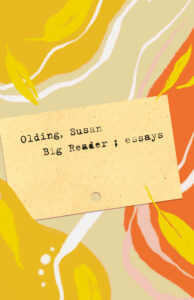
Susan Olding’s essay collection, Big Reader, is a bibliophile’s delight. The follow-up to her 2008 collection Pathologies affirms should be on the radar of all book-loving people whose hearts skip a beat at the sight of Natalie Olsen’s marbled cover art, a riff on vintage endpapers. But then of course if you look closely, you will notice that the design is less abstract than it first appears, and the marble is a river, and leaves are floating on its surface, and a leaf can be the page of a book or something growing on a tree, to be gathered with a rake when it eventually flutters to the ground, and there’s even an essay on rakes, as in the garden tool and the 18-century series of engravings by William Hogarth “A Rake’s Progress.” Mutability is a theme of, well, life itself, as Olding’s collection attests.
She writes about Anna Karenina and her own affair in a fabulous essay on rereading. She reflects on infertility at Keats’ house. (I just finished reading Barbara Pym’s new biography, which also includes a scene at Keats’ house, a tragic scene in which Pym occurs in a cameo role in one of her novels. It seems like no one has a lot of fun at Keats’ house.) Fairy tail tropes and stepmothering in her essay “Wicked,” which first appeared in the essay collection The M Word, which I edited in 2014. Inspired by Woolf, she writes of “Library Haunting.” On how her mother’s reading life changed as the result of her vision loss. About reading The Golden Notebook on a resort vacation to Hawaii, kind of incongruous. In “Another Writers Beginnings,” which is a response to Eudora Welty and seems in conversation (or at least keeping rhythm) with Joan Didion circa Slouching Toward Babylon, Olding writes a take on self-doubt that I found against the grain of our current moment and also absolutely refreshing—that our self-doubt can serve us as writers. Who would we be without it?
I’d read in a previous review that Oldings essays on Toronto during the AIDs crisis (and the Don River) and another on blood types seem incongruous with the collection’s theme of books and reading, but they actually worked for me, for the way that Olding reads the landscape like a story in the former, and the body in the latter, always searching for signs. She writes about working at a bookstore in downtown Toronto, and how she used to read at the counter, and the oversized atlas kept getting stolen on her watch. Throughout the whole book, she writes about a refusal to conform, to fall into line, to veer into the unexpected, to be one thing and then quite another. “I needed to wander. I wanted to follow a string of words.”






