July 26, 2012
Gone Fishing
 Well, not really. Fishing is kind of barbaric actually, but plans for the week do include lots of reading with a lakeview. And I’ve got great books packed. In fact, books are all I’ve got packed. So I need to get my act together, but yes. It’s going to be an excellent holiday.
July 25, 2012
Afternoon Tea: A Timeless Tradition by Muriel Moffat
 No surprise, really, that I’d find this little book appealing, Afternoon Tea: A Timeless Tradition by Muriel Moffat. I am the kind of person who has a tea books shelf in her kitchen (just above the tea things shelf, if you’re wondering). Moffat’s book is an ode to afternoon tea in general, and to tea at Victoria’s Fairmont Empress Hotel in the specific. She writes of her own connections to teatime, of the importance of English grandmothers in passing along such traditions. Her prose is light and punctuated mainly by exclamation marks. She addresses the history of tea and tea ceremonies, a guide to tea-taking (from how to warm the pot to what to wear), and then a chapter on tea at the Empress Hotel, the experience and its history. The rest of the book comprises recipes for scones, cookies, tiny sandwiches and other things (and now I see, I have to get myself a crumpet ring).
As tea books go, Afternoon Tea is hardly groundbreaking, but it’s a pretty little object and a perfect keepsake. Originally self-published with 30,000 copies sold at the Empress Hotel gift shop in five years, it’s now been gorgeously re-packaged by Douglas&McIntyre, and is about to find a wider readership among afternoon tea devotees.
July 25, 2012
Our shoebox dollhouse
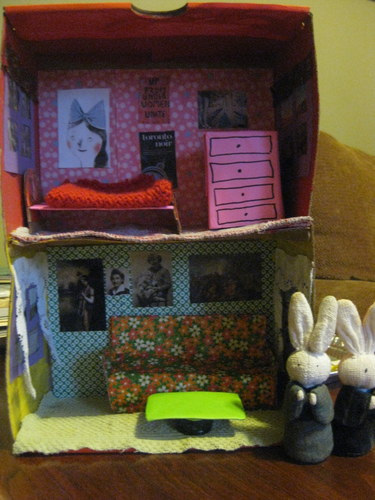

 Stuart has taken up running, which is exciting, and means that he bought a new pair of shoes. Also that Harriet was crabby on Saturday while Stuart was out for his run and I was making dinner, and so I distracted her by proposing that we build a shoebox dollhouse. And naturally, the first step was to consult the internet. We found these instructions, and got to work, painting the walls, selecting the wallpaper (which was origami paper). As with every physical object I’ve ever created (except for Harriet), the result is a little bit sloppy. I think the creator of the prototype was a perfectionist, while I am a half-ass-est, and they also didn’t use old kitchen rags for flooring. I don’t think I’m going to be sewing tiny throw cushions either or a bedskirt, but I’m still quite thrilled with the result and Harriet is forbidden to colour on it or put stickers on it. (I am absolutely no fun). I did knit a tiny bedspread (and incidentally, we’ve taken to referring to bedspreads as counterpanes ever since we learned what a counterpane was). We still want to make a few more things– a bookshelf, a clock. Note the lace curtains, and the cool posters in the bedroom. Anyway, Harriet has enjoyed playing with it, even while restricted from sticker putting-onning. And I’m just a little bit in love with the dollhouse too.
July 24, 2012
The Vicious Circle reads This All Happened by Michael Winter
 Oooh, summer nights with the Vicious Circle are the very best. Last evening, we assembled on one of our favourite West End porches as the night fell, trains rumbled by, lightning flashed, and a storm threatened to arrive. It never did. We ate ice cream sandwiches and delighted in our ever-excellent conversation.
And speaking of ever, we were once again a book club divided, this time on Michael Winter’s 2000 novel This All Happened. Apparently Gabriel English is meant to be a heartthrob, one of us pointed out, but another disagreed, remembering the Gabriel English from Winter’s previous story collection One Last Good Look. She said, “That Gabriel English is better than this.”
Half of us liked the book, the vignettes, an entry a day for a year about ordinary life. Others found it boring, weren’t pressed to care about anything that happened. (“What all happened?”) And all of us were weirded out by punctuation, the inconsistencies less than the strange choices. No one could give an explanation for the near-omission of apostrophes. One of us pointed out that it was strange that the punctuation was so experimental when the rest of the book decidedly… wasn’t.
But no, we disagreed from the other side of the table, the other side of the bowl of Magnum ice cream bars. It was experimental in particular in relation to his other books, that it was a character from a previous book who was writing a book that Winter himself would actually go on to publish. And it is experimental to write a novel composed of mundanities. A novel in which nothing happens.
The people in this book are annoying, we complained, the main character in particular. We liked the peripheral characters best. We liked Boyd Coady. We weren’t sure what the drippy Gabriel saw in Lydia though perhaps her problem was that we only ever saw her from his point of view. Aspects of her personality seemed contradictory, but then maybe it was just his failure to see her properly.
We remarked upon absurd details going by unremarked upon admist the mundanities, like Max who pokes a hole in a condom to get his girlfriend pregnant. The rest of us realize how awful it is that we hadn’t really considered how awful that was. That Max and Daphne are held up as the great example of love in this book, which is kind of horrifying to consider.
The one moment that gripped us all was the canoe trip, when the pregnant Daphne is thrown out of the boat. This event stands out so much from the rest of the novel. We note that Gabriel English is so passive, that he has these ideals of how things should be and seems content to live on these instead of reality. That nobody has a job in this book– the arts council grants seem very generous. We loved the names, that Craig Regular was never just called by his first name. And Maisie Pye! How remarkable in CanLit that a character with the name of Pye should be good and like-able. We thought about how immature these characters were, what it meant that Gabriel English had lived a whole life until this book begins and yet this sorry love is his most significant.
“Any resemblance to people living or dead is intentional and encouraged…” Winter tells us before his story begins, and we do spend time trying to map his fictions onto reality. The edges don’t quite line-up exactly, however, which is frustrating, interesting, and fascinating. We wonder if this novel of true stories is actually more interesting in theory than execution. Though it definitely succeeds in creating a sense of place, of community. Of arts communities in small towns (and we laugh about the scene in which the erotic poetry reading upstairs from the curling club is broadcast into the curling club by mistake). It’s a novel about ways of seeing, someone remarks, notions of cameras, film, Gabriel’s window which he refers to as the eyes of the city. How the ruggedness of Newfoundland creeps into this novel about a city, in the seasons, how the women are as game to the outdoors as the men are, the fish, the fish.
We think about autobiographical novels, which there is a recent trend for. It makes us think of the reader as being in a position of the only sober person at a table full of drunks. But yes, we think. This novel was intriguing enough. It left us with questions, and that is something.
July 22, 2012
Why You Can Never Have Too Many Mother Gooses
 When Harriet was very small, I read a prescription by Mem Fox, the mother of children’s literacy, that we were to give our children ” at least three stories and five nursery rhymes a day, if not more, and not only at bedtime, either.” And while we were doing just fine in the story department, I realized I really had to pick up the pace in terms of nursery rhymes. As much as nursery rhymes were nonsense, they were also so important to developing literacy skills, in their rhythm and rhyme, and I loved how they connected us back to stories that have been told to children for centuries.
 It was around this same time that Mother Goose collections began entering our lives, right when we needed them most. When Harriet was born, my friend Kate had sent us Scott Gustafson’s gorgeously illustrated Favourite Nursery Rhymes from Mother Goose. Not long after, our next door neighbours gave us their old copy of Iona Opie and Rosemary Wells’ My Very First Mother Goose (with characters, we’d realize later, who were Max and Ruby’s forebunnies).
 And so we were chugging along with a Mother Goose in the bedroom and a Mother Goose in the living room, which we thought was probably enough Mother Gooses for one small apartment (with Barbara Reid’s board book Sing a Song of Mother Goose tucked in my purse for days out), until our friends Curtis and Laura gave us Richard Scarry’s Best Mother Goose Ever. Excessive, I know, but we kept this copy in the bedroom too, and we loved Scarry’s cats and rabbits, and his collection’s deliciously violent edge.
 We picked up a copy of Nursery Rhyme Comics last year, because it was the coolest book we’d ever laid eyes on, and here were all of our favourite rhymes made anew by some of the best comic artists working today. The old woman who lives in the shoe heads a rock band, for example, and it’s the Grand Old Duke of York as imagined by Kate Beaton. We love this book, which isn’t as well thumbed through as all the others because it lives up on the shelf for special (which is often).
 And so you might suppose that receiving a second-hand copy of The Arnold Lobel Book of Mother Goose last month would have tipped us into too much Mother Goose, finally, but I don’t think so. We’ve chosen to keep this one in the living room, in case you’re wondering, right next to Iona Opie, and I’ve realized that in our excessive Mother Gooses, my entire parenting philosophy is inherent, the things I want to impart to my daughter most.
First, in that one can never have too many books. Second, that there are many, many versions of the same old story, different words entirely to tell it. Sometimes it’s hickory dickory, and sometimes it’s dickory dickory, is what I mean, and you are even free to make it your own. Third, that we are indeed connected to people who lived hundreds of years ago and told these same stories that we do, and some of them might have even made sense then. That we belong to something larger then ourselves. And then finally, as each of these collections is marvellously illustrated, that the same picture never looks the same to anyone. How different, valid and vivid is each of our separate points of view. That all of our favourite stories and characters are imagined over and over again, and we have to be open minded enough both to respect that, and also to recognize them when they appear.
July 19, 2012
Threading the Light: Explorations in Loss and Poetry by Lorri Neilsen Glenn
 “The essay wants to go its own way. In an unstable world, we want to know what we’re getting, and with an essay, we can never be sure. Partaking of the story, the poem, and the philosophical investigation in equal measure, the essay unsettles our accustomed ideas and takes us places we hadn’t expected to go. Places we may not want to go. We start out learning about embroidery stitches and pages later find ourselves knee-deep in somebody’s grave. That’s the risk we take when we pick up an essay.” –Susan Olding, The Trying Genre
In Lorri Neilsen Glenn’s essay collection Threading Light: Explorations in Loss and Poetry, we’re given a sense of what we’re getting with its first sentence, “This parcel of essay and verse and anecdote…”, and I love parcels. But it’s true that the reader embarks on the book with just just a vague idea of the parcel’s contents, unsure of where the sentences will lead. The title doesn’t help much either–my husband spotted the cover the other night, and was concerned a book exploring loss and poetry might send me melancholic (and as he has to live with me, he has a right to be concerned).
But it’s not like that at all; light is the word. The book takes its title from the painting by Mark Tobey which, Neilsen Glenn tells us, inspired John Cage to understand that “[w]hen we pay attention to anything–a bird wing, a man sleeping on an open grate, the horizon–it becomes a magnificent world worthy of your attention.” In her bookish parcel, Neilsen Glenn pays attention, digs to the foundations of her preoccupations, and most of these surround instances of loss, the irresolvable– a boyfriend’s suicide, her son’s disability, her mother’s death, the death of a friend, others’ losses, the crash of Swissair Flight 111 not far from her home ( a sound she thought was thunder). Compassion, late blooming (arm-in-arm with motherhood), war and sons, the domestic (“Whatever our differences, there is still laundry”), decades flying by, community and retreating, the art of losing, the gaps in women’s history, encounters with cultural others, on writing communities and the generosity and respect necessary for such communities to thrive. She is drawn to cemeteries, the graveyard in Halifax where the Titanic’s victims are buried, Margaret Lawrence’s grave. The shadows, of course, which come with the light. “The dead carry knowledge that the living cannot. It is we, here, now, who are in the dark.”
The book is the story of Neilsen Glenn’s own progress toward spirituality and poetry. Her narrative is circuitous, undulating, and if I traced it with a pencil, it would end up looking like the Mark Tobey painting. Which means that I’m having as much difficulty as the subtitle is in describing to you precisely what this book is, but I will tell you that the experience of reading it was was a pleasure. That it joins my list of amazing essay collections by Canadian women, books which I might line-up side-by-side and point to when I tell you, “Here’s my personal philosophy. Here’s what it’s all about.”
July 18, 2012
Our Best Book of the Library Haul: Big Red Lollipop by Rukhsana Khan and Sophie Blackall
 Big Red Lollipop by Rukhsana Khan and Sophie Blackall is the story of a young girl who is eager to fit at school, but who must also conform to her mother’s cultural expectations. When Rubina is invited to a birthday party, her mother sees no reason why her younger sister Sana can’t go too, even though Rubina protests that everyone will think it’s strange her sister comes. And she’s right, they do. When a while later, Sana is invited to a birthday party of her own and is expected to take along their smallest sister, Rubina overcomes the temptation for revenge and steps in to set their mother right
I’ve read this book five times today, at Harriet’s request, and I’m not sure what draws her to it exactly– she’s a bit too young to get it, and I think she’s mostly entranced by the idea of lollipops. And perhaps there is some attraction to the power struggles between the sisters in the book, the squabbling over sharing that she engages in herself with her own friends. I think both of us are also in love with Sophie Blackall’s illustrations, and the fact that two spreads are maps on which we trace our fingers to follow Rubina’s walk home from school, and the sisters’ dash around the furniture.
Big Red Lollipop defies picture book convention in so many ways. Significant time passes in this book, a good year or so. There are clear instances of injustice taking place in the text, no matter how petty, and it’s frustrating to encounter this as a reader. The characters are of an Asian-immigrant background, but the background is not the point of the story. Here is a book in which an Asian-Canadian child can see herself reflected, and in which my daughter can see people who look different than she is–a reflection of the community we live in. In which the parent is both honoured, but also shown as a person who can learn from her children. It is a picture book with the depth of a novel.
July 17, 2012
Mini Review: Offshore by Penelope Fitzgerald
 I’ve been trying to appreciate the British author Penelope Fitzgerald for so long, because she seems the kind of writer who’d be right up my alley, plus she’s admired by readers I revere. But the novels I’ve read so far have failed to take with me. I’ve read her novels contentedly enough, but then been baffled by what to make of their shapes, of their wholes in the end. The problem has not been hers but mine, I think, and I’ve really been quite determined to make our relationship work. And I think we may have finally had a breakthrough with her novel Offshore, which won the Booker Prize in 1979. Which had several things working to its benefit, as a matter of fact. First, that I read it while I was away last weekend, and I do find the books I read on pleasant holidays are always better thought of than usual. And further, I found a London Tube Pass stuck in my copy, which I bought second-hand (and whose cover is less attractive than this one). It was a weekend pass from 2003, and I love the idea that someone had this book on their own holiday. And while the Underground doesn’t factor so much in this story which takes place on its backstreets and on the Thames, it is still such a London book and so the tube pass seemed like the perfect prize.
Offshore is a messing about in boats book, about a group of Londoners in the 1960s who make their homes on barges tied up on Battersea Reach (which, obviously, has changed a bit since then). The boats are all in rough shape, their residents as unsteady in their lives as on land. The exception to this is Richard who has far more choice about where to live than the others, but takes to his boat anyway, The Lord Jim, much to the consternation of his wife Laura. He finds himself attracted to his neighbour Nenna James, who lives on Grace with her two precocious daughters who delighted me. Nenna’s husband has left her, and she’s unsure of how to get him back, or whether she wants to, which is not to say that she doesn’t love him, but she loves living on Grace most of all, even if she realizes that the precarious state of her life at the present has left her daughters troublingly vulnerable.
There is also Maurice, the male prositute who’s sheltering stolen goods in his barge for a shady character who’ll bring ill-fortune to the community, and Willis , a marine artist, whose boat is full of holes and who is hoping to get it sold while the tide is out so that nobody notices. And Nenna’s daughters, Tilda and Martha who swagger around the gangplanks, searching for treasure when the tide is out so they can buy Cliff Richard records, and who refuse to go to school because the nuns make a point of praying for them, for their father to come home.
The plot is small, but every gesture is inspired, with meaning. And often, even in its meaninglessness, the way life goes. One thing can happen, and then another, and another, with no connection between them except that each makes everything a little worse, and I thought of this when Nola is left without her purse and then is assaulted and has her shoes stolen so that she ends up coming home with bleeding feet. In its meaningless, the world is mean, but then there is illumination by human character and genuine connections between people, those moments when these people who are each adrift spy light upon the shore.
The ending is abrupt and unsettling, and reminded me of maybe why I don’t like Penelope Fitzgerald after all. For why can’t she tuck her characters safely into bed at the end of the story, on settled weather on dry land, but then that’s not how her books go, nor how life goes either. And I make sense of all of this with an analogy as to how I came to love the short story, by not yearning for more than what the author can give but making sense of that gift instead, of its limits. And acknowledging that it’s a powerful story after all whose characters are not finished with final page, that an author who gives us this really does give us something of enormous value.
And the the point is that Offshore‘s people are never going to find their proper moorings, really, which is the point of Offshore‘s people, of the Thames itself, running softly:
The river sweats
Oil and tar
The barges drift
With the turning tide
Red sails
Wide
To leeward, swing on the heavy spar.
The barges wash
Drifting logs
Down Greenwich reach
Past the Isle of Dogs.
Weialala leia
Wallala leialala
July 17, 2012
Downtown kids
 We do a lot of documenting and celebrating urban family life here at Pickle Me This, usually through a literary lens. Our family is quite passionate about engaging with the city, which is why we’ve been re-enacting Allan Moak’s A Big City Alphabet for the past year and a half. See also recent post Great City Picture Books and last year’s On urban picture books and concepts of home. We love the city so much that we don’t just live here–we read here too.
Last week, it was suggested that downtown Toronto is not an appropriate place for families, for children to grow up. I don’t actually think the suggestion pertained to leafy residential streets like mine, but we’re still downtown, don’t have a lick of sod (though the front garden is amazing), and we’re removed from the ground. And it’s a good life, with so many opportunities for every-day adventures. Clearly, other parents agree, which is why the Downtown Kids tumblr is such a delight to read. A compilation of letters from people who are raising kids all over the city, the site is a celebration of neighbourhoods, of city parks, storekeepers who know your name, and wonderful things like free-range pianos, museums, ferry-boats and community gardens.
Instead of writing off certain areas for family life, I do wonder how much better off we’d all be if we worked to make sure that everywhere was an appropriate place for kids to grow. I don’t think the kids would be alone in benefitting.
July 16, 2012
Letters were no longer brought by the postman
“…letters were no longer brought by the postman; after he had fallen twice from Maurice‘s ill-secured gangplank, the whole morning’s mail soaked in the great river’s load of rubbish, the GPO, with every reason on its side, had notified the Reach that they could no longer undertake deliveries. They acknowledged that Mr. Black, from Lord Jim, had rescued their employee on both occasions and they wished to record their thanks for this. The letters, since this, had had to be collected from the boatyard office, and Laura felt this made it not much better than living abroad. ” –from Offshore by Penelope Fitzgerald






