December 14, 2020
Enough
My word of the year, I have realized, is ENOUGH. Yes, of course, like, enough already. I’ve definitely had enough. We’ve all had more than enough of bad news, death and sadness, loss and heartache. Enough as in too much.
Enough as in, seriously? How much more…
*
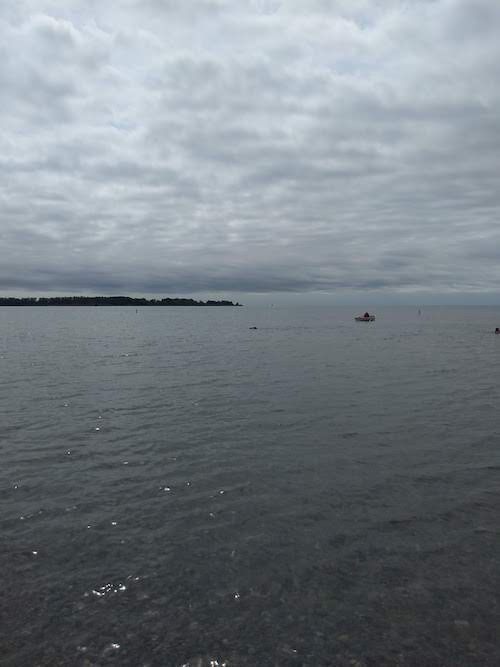
The spot right in the middle of this photograph is me, swimming back and forth across the Ward’s Island Beach one beautiful Wednesday in late August. A day that kept threatening to storm, whose breeze almost made swimming untenable but then it was warm enough, and the lake was warm too, and I swam.
Until March, I’d been swimming daily, but then after that very little, except for our week in Haliburton in July (what a gift) and dips in our amazing 8 foot plastic pool all summer long (never has a $77 purchase from Walmart delivered more magic). And I am not complaining. To have had a holiday. A backyard. $77 to spend. We have so much more than enough.
But I still wondered, as I was swimming under that big moody sky back in August, when I would next be able to swim again?
And then the thought that crossed my mind: “But I am swimming now. And maybe that is enough.”
*
2020 has taught me everything I’ve ever known about living in the moment, about not jumping too far into an unknown future. Which is not much, to be fair. And these are lessons I needed to learn even at the best of times, and it has been somewhat edifying to realize that nobody actually knows what’s going to happen next, even the people who know the universe right down to its most essential particles. But I find that really exciting, actually. Even during the most terrifying moments I felt in March and April, it was not lost on me what it means to have impossible things become possible, how expansive and amazing that actually is.
*
To meet the moments as they come has been my intention through much of this year, a year when I grappled with anxiety attacks, so much fear and loss of control. To just breathe, and be present, and acknowledge the totality of experience. And how much enoughness and more-than-enoughness is to be found in such an experience—to have enough food, enough shelter, enough money to buy my kids shoes. Fulfilling work that we can do from home. The sustaining enoughness of our neighbours and community, of nature, of trees, and the sky. Friends and family. Artisanal cheese.
I have always been fortunate to have not just enough but also a good sense of what enoughness is—our apartment is enough, our relatively modest salaries are enough because our expenses are low. This beautiful, ordinary life is enough.
But never before has enough felt like such abundance.
Against the bleakest backdrop I’ve ever set my eyes on, I’ve spent so much time this year counting blessings, tallying up just how lucky we are.
Enough. Enough. So much enough.
Such dizzy, dazzling gratitude.
December 11, 2020
Caste, by Isabel Wilkerson

Isabel Wilkerson’s Caste is one of the smartest, most illuminating and important books I’ve read this year—or ever. A rich, engaging and fascinating text that draws a connection between India’s caste system, the Nazis’ plans for Germany’s Jews, and America’s racial hierarchy—matter-of-factly, she shows that India and America’s hierarchies are parallel, and also how the Nazis drew on America’s example for their own purposes, though there were certain examples where the Nazis wouldn’t go that far (one instance: the one-drop rule.) And just think of it—when the Nazis think you’ve gone too far.
Americans are not widely known for using examples of other cultures to better understand or even benefit themselves—see: the reasons people come up with as to how measures to fight Covid all over the world couldn’t work in a place like Nebraska; or how while public healthcare functions just fine in Canada, in Florida it would be impossible (I SPEND TOO MUCH TIME READING SOCIAL MEDIA COMMENTS)—and so what Wilkerson is doing here is really radical and profound.
Caste, Wilkerson writes, is like grammar. Not explicitly taught, but absorbed, until it becomes part of the atmosphere, or perhaps foundation is a better metaphor, because everything else is built upon it, and she shares her observations for being able to tell what caste Indians are from by watching their interactions, the natural superiority one might assume to another, even somebody with very good intentions.
I found this book useful in a way that not all books on race and anti-racism have been to me. For the way it illuminating the questions I’ve been having for the last five years (why does the white working class keep voting against their interest? Because perpetuating the hierarchy is in their interest, even if they have to suffer for it.)
This is the kind of book whose reading only deepened the furrows on my brow, because I spent the whole time reading and wondering, “What the fuck?” Did you know that lynchings were once commemorating with wildly popular postcards? And when the postal service finally got wise and banned these, people just stuck the images in envelopes. People who threw glass into pools to keep Black people from swimming in them, and the district that just did without public schools altogether instead of segregating. Bull Connor paying a Black man to shake hands with the mayoral candidate he did not support, and a photographer to capture the moment, because it was unacceptable for a white man to shake hands with a Black man. And the legacy of Robert E. Lee, for whom schools across the nations are named, who got to become a university president after the Civil War (Wilkerson compares this to how Nazi Generals were NOT remembered after World War Two) and Wilkerson recounts a story of his torture of three of the people he enslaved: “Had these and even more gruesome atrocities occurred in another country, at another time, to another set of people other than the lowest caste, they would have been considered crimes against humanity… But the slaveholders…were not only not punished but were celebrated as pillars of society.”
And that this is the culture we are steeped in. (I am not American, but we are still steeped in American culture AND the history of my nation is not so vastly different even if we weren’t). It just seems like such a powerful way to explain the situation, and also to explain why racism is so hard to tackle, which is that racism is underlined by a caste system upon which not only institutions are built but which also informs our sense of self. Racism is just a symptom of a deeper and more insidious problem, which Wilkerson illuminates through a blend of anthropology, history, cultural studies, memoir, and reporting. A framework that has so long been invisible, but once you see it there, you realize it’s everywhere. You realize why the backlash to America’s first Black President, say, has been so awful and vicious, because of how so many are willing to gamble everything to keep that hierarchy intact.
Identifying a problem is the first step toward finding a solution, no matter how difficult finding that solution might be, and to that end, Pulitzer Prize-winning journalist Wilkerson has done something so powerful with this, her second book after the acclaimed The Warmth of Other Suns. This is a book that continues to shift our understanding of race and white supremacy in a moment where we’ve never needed it more.
December 10, 2020
Eating Food in 2020

It all started with food, the panic. March 11, 2020. We were supposed to fly to England the following Monday, but after two days of agonizing, we’d decided to cancel our trip, speaking of unprecedented. We’d been saving up for two years and there was $5000.00 down the tubes (no small potatoes), but I knew something was very wrong, and I didn’t want to chance it. Stories of ICU doctors in Italy, how what was happening there was nothing like what they’d ever seen before. Italy was not so very far from England, was what we were thinking, before it became clear that nowhere is actually far from anywhere.
And so I went shopping. I picked up my children from school and we went to the grocery store, the last time my children were at the grocery store. “This is the panic shop,” I told them, and they were delighted, because I told them they could have anything they wanted. Our cart was laden with chips and ice cream, but also frozen vegetables, and cans of soup and beans. It was too much for me to carry home, because I hadn’t brought my shopping buggy, but I carried it anyway (there’d be no such thing as hoarding if we all had to carry it home on our backs), all the way up the road to the Bulk Barn where we bought a huge bag of mini-eggs.
“I don’t know if any of this is actually necessary,” I noted, “but at least we’ll have mini-eggs.”
A month later, it was with a sense of disbelief that we finally cracked that bag of mini-eggs open, that whatever was going on had lasted all the way until Easter—and that the mini-eggs had lasted too, but I am by nature a stockpiler of splendid things. It’s how I roll. I would rather anticipate something than eat it any day.
These days I get emails from all the grocery stores, because in mid-March I passed along my details to all of them in an effort to have groceries delivered, and it was always after I’d signed up that I was informed that the next available delivery window was never. But then somebody I followed on Instagram alerted me to a office snack supply company who’d quickly pivoted to groceries, and my first delivery arrived the next day, which included a box of 40 bags of Miss Vickie’s chips a palimpsest of the pre-pivot times.
But the chips were important. Necessary for hunkering down, and also we needed to have cake every day at 3pm, and ice cream after dinner. Treats were mandatory, and delicious, giving shape and ceremony to our otherwise humdrum days. Croissants from the Harbord Bakery, once I finally started venturing out to small shops, where I could also buy fancy cheeses and crackers, and Kawartha Dairy Ice Cream in little tiny cartons, which my children had only ever seen on television before, and called “emotional support ice cream.”
I also really got into making sourdough bread, because my friend Marissa, very presciently, had given me a starter in January, and I baked the bread regularly until it got too hot to turn the oven on. Since summer ended, I have not resumed baking the bread however, because I don’t have the time like I did before, or maybe I just can’t be bothered, but my starter is still going strong, and we use it for sourdough waffles, and the bread I order from my Mama Earth Organics is more of a sure thing anyway. (Mine frequently turned out weird.)
We have been customers of Mama Earth Organics for ten years now, and have never valued them more than when grocery stores seemed inaccessible to us in the spring and yet we had fresh fruit, vegetables, eggs and yogurt delivered weekly. They increased their product list and we began to expand our orders with them, and appreciated the chance to purchase food from so many local producers. We also started buying chocolate and coffee and vegan cheeses to make better choices for the planet, inspired by everyone’s very enviro newsletter.
And speaking of local producers, and how food delivery broke up our days, I started ordering from Spade and Spoon to receive pickles, jams, maple syrup and more, and we ordered our Easter chocolate from a local producer, and there was even a woman who delivered us popsicles, and we’d order donuts too, and it was also so delicious and lovely and fun when little else was.
But not everything was fancy, A quick trip to the convenience store on the corner for mozzarella and milk, bananas, and they had flour. FLOUR. In April 2020, this was no small thing. (I’d previously purchased 44lbs of flour from an actual MILL [artisanal, of course], but then when I was alerted to just how much flour that was, with no preservatives at that, I had to cancel. It’s been a very strange year.)
And remember in April when we made a lasagne that was featured in the New York Times?
And then there was takeout, which was performed as a public service, and we were nervous about it the first time we did it, ordering sushi because it seemed like if anyone would be conscious of food safety and hygiene, sushi was it—but after that we didn’t worry so much anymore. Though I would also routinely have mini nervous breakdowns after people on Twitter outlined their intricate processes for receiving pizza delivery in the pandemic age (“our youngest child gets the pizza, and then we hose him down and burn all his clothing in the backyard”) and rue other people’s anxiety for piling on my own.
We started ordering takeout once a week, and we had the money to do so ($5000 lost dollars aside) because we weren’t doing anything else. Making a rule to only support restaurants that were local to us which we could walk to, mostly because walking to these places gave us something to do. And so we ordered from my favourite restaurant Chadwicks, and bbq, and more sushi, and tacos, and more. And then Chadwicks started doing fried chicken on Fridays, which we’d pick up and then go to eat in the park, and soon infection rates were falling and we could have other families join us in the park (picnic blankets six feet apart) and it was take out picnics all summer long, and the greatest pleasure.
I have eaten the most wonderful food this year. Chips have returned to rare occasions, because one should be sensible in some capacity, because we continue to have cake breaks (and cake fills up a container in our children’s lunches now that they’re back at school). Croissants are also less regular, but the takeout life continues, and now that the children leave us home in the daytime, we’re free to have the spicy food they don’t appreciate as much, and I have fallen in love with the butter chicken at Elchi Chai Shop.
I am probably fatter than I was in March—I wouldn’t know because that was also the last time I was near a scale before the gym closed. And I mention this only because this seems to be the preoccupation of many people in December at the best of times, which is ridiculous, and this isn’t even the best of times, so how about we just stop it?
I am so grateful for the food we’ve enjoyed this year, and the extra time at home to make great meals (March was the last time we had our signature hot-dogs-and-edamame busy night supper), and the pleasures that eating gave us when pleasures in general were few.
PS Support your local food bank and/or food justice organization. Everyone should have access to good things to eat.
December 9, 2020
Marching and Movement

We’re coming up fast to my annual winter internet holiday (away from the internet), which I am looking forward to (the number of books I can read while not scrolling Instagram is pretty epic), and I think it’s probably time for it. While I’ve been doing well and feeling fairly calm, I’m also in a weird post-publication creative freeze where I’m itching to start something new but I don’t know what it is yet (and you can’t rush these things) and I’m lacking the focus for blogging right now too, although I keep writing rather epic Instagram posts that turn out to be blog posts in disguise. I am looking forward to my holiday to give the spinning wheels in my brain a rest, to do some deeper thinking, and for a reset that hopefully will bring me #BackToTheBlog in the New Year.
But in the meantime, I want to write a bit about politics. About how while I have always been political in the choices I make, the stories I tell, and how I live my life, actual politics makes me squeamish. I think I hate being pinned down, is part of it, and also being told what to do. I hate speaking in chorus, can’t stand crowds, and/or suffering ninnies politely, and maybe I am deeply allergic to earnestness. All of this an aversion that four years ago, I decided to work to overcome, because staying on the sidelines was now out of the question with a burgeoning fascist regime in the country just south of us, a movement whose reach went well beyond those borders. How naive I’d been to imagine that politics (in the electoral sense) didn’t exactly apply to me. I was going to take to the streets. We were going to fight.
And we did. Kind of. There were placards on the porch and we marched, both in sunny weather and in snowstorms. We rallied for refugees, and for the climate, and over and over again in support of public education. I went to meetings and organized petitions and baked cakes and muffins and I’m not saying I did anything extraordinary or even was terribly involved (I like community in theory, but people, ugh), but I showed up. I stood up. It matters that people do so, even if there aren’t a ton of them. Even if nothing changes, standing up means one more person who did.
But the pandemic changed things for me. Though I was already tired—when everything fell apart in March, we’d been through a winter of labour unrest in our public schools. Before schools closed altogether, there had been rotating strikes for two months, and the ways things were going, they would only have escalated. And of course, we stood up with our teachers, for education. We showed up. So many days standing out in the cold, but this is no real hardship. Public schools matter more, and I have a very warm coat. But it was dispiriting, is what I mean. I really missed the era when I just sent my children to school and never thought of it again. Being a parent of school aged children in Ontario since 2017 has been stressful and heartbreaking, the constant erosion of all those things we care about, denigration of people and institutions who are the bedrock of our communities.
At some point, I had to stop going to meetings. Any political action I undertook would leave me to collapse into an emotional wreck three days later. I was way too emotionally invested, to the point of being unable to function sometimes. How do other people do this?
And then the pandemic hit, and I was just fucking done. I did spend about two weeks wracked by incredible anxiety, convinced we were all going to die (this was my Crocodile Dundee phase), but even after I got over that an stopped having heart palpitations and nightmares, my appetite for politics was even smaller than it originally had been. I guess at a moment when so much was at stake, doing anything other than having people work together just seemed counter-intuitive and just irritating. The pandemic, to me, underlined how perilous was absolutely everything, like absolute threads we were all just hanging by, and everything political just seemed made up and phony. Like, nobody really knows anything, and we just made all this shit up to feel important, to provide ourselves with purpose, but it’s nonsense, all of it nonsense. I mean, of course, there is meaning in life and in the universe, but almost everything else is just a whole lot of posturing.
I didn’t want to march anymore. It was a performance. There was no end-game. I was tired and bored, and also proximity to others had become potentially fatal. Which was the reason I gave for not marching with Black Lives Matter in June, which was a month that shifted my perspective in terms of police funding (ie defund it) and kept anti-Black racism in the forefront of my mind. A moment in which the radical point of view managed to touch if not infiltrate the mainstream, and that’s amazing. Shifting the dial, and that’s something, not nothing. But still—I was thinking of the Black woman in Toronto who was killed in an encounter with the police during the same time as people were rising up in the wake of yet another police killing in the US. And my discomfort with the way this woman’s death was meant to be a symbol of everything rather than the specific thing that it was, a thing I knew almost nothing about. I didn’t feel certain enough to go marching for that. Plus there was a pandemic on, and (also) I didn’t want to march in the first place.
I am reading the book Me and White Supremacy now, and to be honest, not finding it particularly revelatory. I am also reading Caste, by Isabel Wilkerson, and it’s blowing my mind. I think the former book would be more useful for the type of person who hasn’t been following Black women on Twitter since 2014 (except she’d never buy it) because everything Me and White Supremacy is telling me, I already learned from them, women like Mikki Kendall and Tressie McMillan Cottom, and so many others. Caste, however, is making my head explode, bringing the world into shocking, bewildering clarity and I know that I am only deepening the furrows on my brow as I read it, because my expression is perpetually, “What the actual fuck???”
But one interesting thing that Me and White Supremacy has me questioning is why I didn’t go marching in June, because the pandemic, I think, was definitely mainly an excuse. (That I did absolutely nothing else during this period with large groups of people is less important than it seems.) It has me wondering why I was willing to attend climate marches (two, I think) though I would not consider myself a climate radical by any means, but would be averse to marching for racial justice jus because I didn’t agree with absolutely every single item on the agenda. I mean, I agree with racial justice, obviously. But recall my previous point about the problem of the specific case standing in for the entire problem and my discomfort with that. Why do my scruples pop up sometimes and not others?
Part of the problem is the typical white person’s problem of seeing racism as a problem that does not concern one if one happens to be white. Fearing tension too—am I welcome at this party? Maybe also not knowing enough about what was going on. (Something else I’ve become tired of re activism and social media is the idea that everybody has to be aware of every single thing that’s occurring in every single place. Like, Instagram powerpoints: Why You Should Be Paying Attention to What’s Happening in the Back Shed of a Blue House on a Road in Dayton, Ohio.)
But where are we marching to, exactly? And is this what’s going to get us there? And let me tell me, my appetite for marching diminished even further once it became the primary pastime of right-wing nut-jobs. I honestly think there is nothing I would march for in December 2020, because marching has officially jumped the shark. We’ve brought the broomsticks in from the porch, finally, and the streets belong to the anti-maskers now. I think we have to find another way, and thinking about what this is is my new challenge.
Or am I just making excuses for doing nothing at all?
Because, of course, I have a lot invested in the status quo. And I don’t say this entirely glibly. I’m not a believer in the BURN IT ALL DOWN school of politics, because what this year has taught me is that it’s all just a tinderbox, and a house of cards anyway, no matter your leanings. This year has taught me a lot about the London Blitz, which is that it was probably a shitshow, but we just forgot about that part, and everybody is rational and stoic in the historical record. But that’s not how people work. People are messy, and muddly and it’s always bananas, and every good thing that ever happens maybe only happens by the skin of our teeth. And what if progress is actually that?
December 8, 2020
Gleanings
- When a child is ill
- It’s okay to act out of character. In fact, you can’t act “out of character” because you’re not an invented character that has to make sense in a constructed narrative — you’re an organic, self-creating being.
- Though there were gifts under her tree for everyone, I now know that the true gift was the togetherness and happiness of everyone in our extended family, and knowing we were all well-loved. Those Christmases were very special to me then and now.
- I miss the connectedness to the world you gain from just being around strangers.
- 10 Holiday Gifts for Writers in 2020 (that aren’t books)!
- These days, I’m thinking a lot about civil twilight.
- The internet will give you so many windows and doors to open, chasing ideas that you might tell yourself are inspirational or aspirational, when really, you just want to be as original and seemingly free as Joni Mitchell.
- I’m so glad that I was finally given that shove I needed to pick up a Muriel Spark.
- But maybe that was the point. Maybe what they saw was a couple of 20-somethings with their first child, without a real clue what to expect, fumbling along, doing their best in front of everyone.
- C is for Christmas, and Covid, and Caregiving
- Kendi’s book serves as an invitation to take a walk with him. A heartfelt, effective invitation–that also addresses difficult subjects in clear and compelling writing.
- I love advent calendars! Growing up, we only had picture ones, chocolate, or sweets were unheard of.
- I did wear a tuque. And it was very cold. But also exhilarating, the water silky the way it is in summer. I felt every cell in my body rejoice.
- In the 50+ years we have been together I think there was only one year that our Christmas included only the two of us. That was Christmas 1972 and we were stranded in Fez, Morocco.
- We don’t find the diamonds without sifting through the stones.
- Juggling motherhood and any career can be a struggle, but there seems to be something about the role of artist that makes the combination more than usually problematic,”
- It’s just a laptop but in a way it’s a room of my own. I’m lucky to have it.
- …as if the ginger tea and cat’s eyes weren’t enough.
- I am trying very hard to enter my sixty-fifth year with my heart wide open.
December 7, 2020
Radical Acts of Love, by Janie Brown

A rule of thumb that’s never steered me wrong is that if a book ever includes “Isabel Huggan at the Humber School for Writers” in its acknowledgements, I should just read it because it’s going to be good.
And since Isabel Huggan herself actually placed the book Radical Acts of Love (which falls into the aforementioned category) into my hands (not LITERALLY, because she gave it first to our friend Beth Kaplan, who then delivered it to my mailbox), my expectations were high for it.
But also perhaps this is the kind of book that you might not pick up UNLESS someone delivered it right to your mailbox, and even once someone does, you wait three months to pick it up, because who REALLY wants to read a series of oncology nurse and counsellor Janie Brown’s vignettes about her encounters with people at the end of their lives.
But oh, you SHOULD. Brown writes about how most people are able to live most of their lives without witnessing a death, and that this kind of distance and our society’s avoidance of thinking/talking about death makes us so ill-prepared for such a necessary part of life.
Death doesn’t have to be scary, Brown writes, or feared—though it can be messy and complicated (most often for loved ones left behind). RADICAL ACTS OF LOVE is a familarization with the process of death, a homecoming of sorts, and it’s warm, rich and even entertaining, remarkable in its scope.
At the darkest time of year, during a year in which so many have lost loved ones, a book like this seems particularly comforting, actually. That the dying of the light need not be raged raged against, but instead embraced as another of the seasons, an open heartedness that can deliver real peace, as Janie Brown’s stories show.
December 3, 2020
Be Large and Complicated

I don’t like faux.
I especially don’t like the obligatory faux self-effacement/self-deprecation a lot of women bring to their personal marketing/self-promotion efforts.
I think if you have to preface your self promotion with an apology, then you’ve probably already undermined your efforts anyway.
That said, I am GRATEFUL for those of you who follow me here— friends and acquaintances, online pals and everyone—who are patient with my blend of personal and professional posts, along with too many teacups.
I know that it’s common practice to split the personal and professional stuff into separate accounts, but twenty years of blogging has created a hybrid sensibility to my online life that makes that kind thing of impossible.
It also seems like a lot of work to maintain two (or more) online personas. And how do you know where one ends and the other begins anyway? They overlap, inform and complement each other. I think my posts are richer because of where my personal and professional selves intersect. Avoiding such separation also makes it easy to be a human, online and in the world.
I have become more comfortable with plastering my giant head all over the internet, and with being unabashed and unapologetic about efforts to market my work. It is what it is, and if you hate it, you probably unfollowed ages ago anyway.
BE LARGE AND COMPLICATED might be the best advice I have to offer today. And also that when you roar like a lion while getting your photo taken, you look like a big mouthed weirdo, but one who’s had a facelift, which is actually pretty great.
December 2, 2020
Butter Honey Pig Bread, by Francesca Ekwuyasi
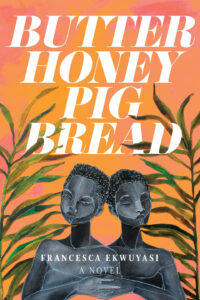
One more title that I am glad I got to before the year was out was the debut novel by Francesca Ekwuyasi, Butter Honey Pig Bread, which was longlisted for the Scotiabank Giller Prize. It was fantastic, a debut that was so polished and assured, hugely ambitious in its reach and just as successful in execution…and by page 19 it was clear I’d be baking the cake Taiye makes to celebrate the occasion of her twin sister’s homecoming, salted caramel chocolate. Which was baked before the day was out.
It’s a hugely evocative novel, gorgeous and sensual, rich with foods and cooking, and also with sex. Although it begins with something more unearthly, the birth of Kambirinachi, a Nigerian woman presented as an Ogbanje, “a spirit that plagues a family with grief by dying repeatedly in childhood and being reborn.” Except that Kambirinachi cheats the system and clings to her life, but she will pay a price for this. Which is how she explains tragedies that befall her when she loses her parents, and her husband dies, and then something terrible and traumatic is suffered by her twin daughters that tears the rest of their family apart.
The three strands of this novel belong to Kambirinachi and her daughters, Taiye and Kehinde, who grow up estranged from each other and head out into the world apart. Taiye goes to London, and then studies cooking in France, and eventually arrives in Halifax, Nova Scotia, before returning home to care for her ailing mother. Meanwhile, Kehinde is left behind when her sister moved to London, and makes her own way to study in Montreal and build a life there.
At the beginning of the novel, Kehinde is arriving home to Lagos with her new husband, meeting her mother and sister again for the first time in years. We learn her story in the first person, seeking to make sense of her traumatic past and move forward in her life. Similarly, Taiye’s tells a story that blends the present day experience with what she’s been through in her life, and finally their mother’s story is told chronologically, adding necessary context to the twins’ experience—for the twins themselves and the reader alike.
The progress of the novel is these three strands becoming re-woven together, braided tighter and tighter throughout the narrative. It’s a novel that in many ways reminded me of Saleema Nawaz’s Bone and Bread, for themes of family estrangement, loss and mystery, and also food, and I would definitely recommend it for anyone who enjoyed that book.
I also appreciated its treatment of Black communities among the diaspora, Nigerian Taiye in Halifax visiting the Africville museum commemorating that city’s historic Black community, and the other Africans she meets in London. And that a novel creates such a powerful sense of place in so many different places—Lagos, London, Montreal, Halifax—is also a remarkable achievement.
Butter Honey Pig Break is a standout debut, and as much as it will make you hungry, it will also more than satisfy.
December 1, 2020
Alfie’s Christmas
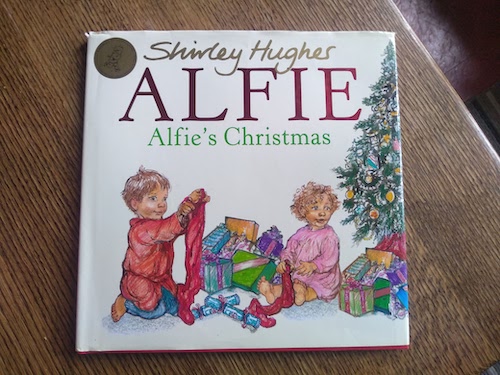
I’ve measured out my life by the children in Shirley Hughes’ Alfie books. I remember when we thought of Alfie as a big kid, and when we wondered what Iris would be like when she was as old as Annie Rose, and then my children kept on growing and now we’re looking in the rear view. Alfie and Annie Rose are tiny little relics now, but we’re so fond of them (okay, maybe it’s just me and everybody else is mostly just being indulgent) that we’ll never let them go completely, especially Alfie’s Christmas, which is the first book I’ll be writing about over the next few weeks as we blow the dust off the titles in our Christmas Book Box.
I love Shirley Hughes scenes of domestic life, the jumble of stuff in her illustrations, the clutter and mess of family life. I also love the shading in her illustrations, rich and vivid colour, but just muted enough that it’s sepia-toned. The books themselves are an exercise in nostalgia.
Which is another way of saying that they’re also timeless, in away, because they always appealed to my children, books written exactly from their point of view, and my favourite bits were always the parts in the margins—the pets who wandered into the spread, teapots on the counter, when Dad sits on a bench while Alfie splashes in puddles, and how I’d love to go have a cup of tea with his Mum and get to know her—I feel like we’d get along.
Alfie’s Christmas is a delight—not much of a plot, to be honest, apart from when they realize that Alfie’s new remote control car requires batteries. Alfie gets ready for Christmas, prepares presents for his parents, they put up a tree, carollers come by on Christmas Eve.
In typical baby sister fashion, Annie Rose gets up in the night and rummages through her stocking, and at first, Alfie thinks it’s Father Christmas creeping about his room. And then finally it’s Christmas morning, and the big day begins, and I like too that their family celebration is a bit modest, which our family can relate to. Alfie’s grandmother and her brother (from Australia turn up) and then Uncle Will and Alfie’s Dad get Christmas dinner on while Mum and Grandma head to church (taking along some of Alfie’s Christmas baking “to share with people who had no home to go to”).
Which is to say that these books are not so old fashioned at all, that their coziness is underlined by a progressive sensibility, and while Alfie gets some fun things for Christmas, connection is really what the holiday is truly about. “As they walked home they could see lit Christas trees shining out of all the windows and neighours like the MacNallys and the Santos family with their friends and relations, enjoying themselves, eating nice things, and watching television together.”
And oh, the colour of the sky at dusk! The most majestic ordinary splendour.
December 1, 2020
Gleanings
- No matter the disasters and disputes of the day, we were happy together following Bilbo Baggins to the Lonely Mountain, or Jules Verne’s adventurers on their way to the centre of the Earth.
- I wanted him to sleep under symbols of the place that is part of him, even though he doesn’t live here. And when those constellations appear in the sky over his home in Ottawa, he can look at them and imagine them in a slightly different orientation thousands of miles west.
- This leaf feels like my grandmother’s hand. No wonder I can’t stop holding it.
- I try to have a schedule, but I’m extremely bad at keeping schedules. I have watched corporate blog after corporate blog go to crap, because there was a posting schedule where you had to write five posts a day. I think that everybody would rather just write when you have something good to say.
- Now that I’ve discovered the true story, I’m highly motivated and loving the writing process.
- At this time of the year the light at latitude 53 arrives to pool in surprising places in the house.
- Here’s our VERY RETRO Advent Love-to-Do-List for 2020!
- “We are solitary travellers, having crossed paths in the land of stories.”
- If we want to fully reclaim the witch, let’s make sure that we are not ourselves ignorantly engaging in practices that harm others.
- Should dictionaries be trying to present us with a less biased world than the one we currently inhabit—or is their real obligation to reflect the world as it is, and as it shapes our use of words?
- Then I looked at the food mixer and realised that’s at least twenty five years old and suddenly I felt old and had another of those tempus fugit in a flash moments.
- These are cold days. Perhaps not in terms of temperature. No frost, no snow, no thin skittering of ice on the water. But there’s a chill at their centre. A chill of not-knowing.
- Beauty should never be only about pretty flowers and shallow depth of field.
- With November, comes a return to drinking tea.
- I regularly come away from our silent (and often not-so-silent!) book club feeling ready to burst: with book recommendations, with revitalized enthusiasm for my reading (when it has flagged or been kind of muddled in recent months), with sheer joy at connecting and sharing with such an amazing, generous and eclectically inclined group of booklovers.*
- I can’t seem to muster the mental or physical energy to keep up with regular blogging right now (blame an excess of computer time for other purposes plus a spell of back pain – happily now subsided – making it particularly unappealing to spend yet more time at my desk!). But I also can’t stand to watch the pile of read books growing without saying something about them.*
*Last two picks feature Waiting for a Star to Fall!
Do you like reading good things online and want to make sure you don’t miss a “Gleanings” post? Then sign up to receive “Gleanings” delivered to your inbox each week(ish). And if you’ve read something excellent that you think we ought to check out, share the link in a comment below.