December 7, 2020
Radical Acts of Love, by Janie Brown

A rule of thumb that’s never steered me wrong is that if a book ever includes “Isabel Huggan at the Humber School for Writers” in its acknowledgements, I should just read it because it’s going to be good.
And since Isabel Huggan herself actually placed the book Radical Acts of Love (which falls into the aforementioned category) into my hands (not LITERALLY, because she gave it first to our friend Beth Kaplan, who then delivered it to my mailbox), my expectations were high for it.
But also perhaps this is the kind of book that you might not pick up UNLESS someone delivered it right to your mailbox, and even once someone does, you wait three months to pick it up, because who REALLY wants to read a series of oncology nurse and counsellor Janie Brown’s vignettes about her encounters with people at the end of their lives.
But oh, you SHOULD. Brown writes about how most people are able to live most of their lives without witnessing a death, and that this kind of distance and our society’s avoidance of thinking/talking about death makes us so ill-prepared for such a necessary part of life.
Death doesn’t have to be scary, Brown writes, or feared—though it can be messy and complicated (most often for loved ones left behind). RADICAL ACTS OF LOVE is a familarization with the process of death, a homecoming of sorts, and it’s warm, rich and even entertaining, remarkable in its scope.
At the darkest time of year, during a year in which so many have lost loved ones, a book like this seems particularly comforting, actually. That the dying of the light need not be raged raged against, but instead embraced as another of the seasons, an open heartedness that can deliver real peace, as Janie Brown’s stories show.
December 3, 2020
Be Large and Complicated

I don’t like faux.
I especially don’t like the obligatory faux self-effacement/self-deprecation a lot of women bring to their personal marketing/self-promotion efforts.
I think if you have to preface your self promotion with an apology, then you’ve probably already undermined your efforts anyway.
That said, I am GRATEFUL for those of you who follow me here— friends and acquaintances, online pals and everyone—who are patient with my blend of personal and professional posts, along with too many teacups.
I know that it’s common practice to split the personal and professional stuff into separate accounts, but twenty years of blogging has created a hybrid sensibility to my online life that makes that kind thing of impossible.
It also seems like a lot of work to maintain two (or more) online personas. And how do you know where one ends and the other begins anyway? They overlap, inform and complement each other. I think my posts are richer because of where my personal and professional selves intersect. Avoiding such separation also makes it easy to be a human, online and in the world.
I have become more comfortable with plastering my giant head all over the internet, and with being unabashed and unapologetic about efforts to market my work. It is what it is, and if you hate it, you probably unfollowed ages ago anyway.
BE LARGE AND COMPLICATED might be the best advice I have to offer today. And also that when you roar like a lion while getting your photo taken, you look like a big mouthed weirdo, but one who’s had a facelift, which is actually pretty great.
December 2, 2020
Butter Honey Pig Bread, by Francesca Ekwuyasi
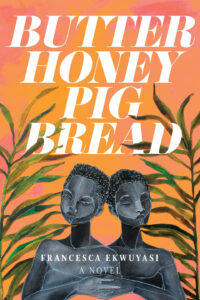
One more title that I am glad I got to before the year was out was the debut novel by Francesca Ekwuyasi, Butter Honey Pig Bread, which was longlisted for the Scotiabank Giller Prize. It was fantastic, a debut that was so polished and assured, hugely ambitious in its reach and just as successful in execution…and by page 19 it was clear I’d be baking the cake Taiye makes to celebrate the occasion of her twin sister’s homecoming, salted caramel chocolate. Which was baked before the day was out.
It’s a hugely evocative novel, gorgeous and sensual, rich with foods and cooking, and also with sex. Although it begins with something more unearthly, the birth of Kambirinachi, a Nigerian woman presented as an Ogbanje, “a spirit that plagues a family with grief by dying repeatedly in childhood and being reborn.” Except that Kambirinachi cheats the system and clings to her life, but she will pay a price for this. Which is how she explains tragedies that befall her when she loses her parents, and her husband dies, and then something terrible and traumatic is suffered by her twin daughters that tears the rest of their family apart.
The three strands of this novel belong to Kambirinachi and her daughters, Taiye and Kehinde, who grow up estranged from each other and head out into the world apart. Taiye goes to London, and then studies cooking in France, and eventually arrives in Halifax, Nova Scotia, before returning home to care for her ailing mother. Meanwhile, Kehinde is left behind when her sister moved to London, and makes her own way to study in Montreal and build a life there.
At the beginning of the novel, Kehinde is arriving home to Lagos with her new husband, meeting her mother and sister again for the first time in years. We learn her story in the first person, seeking to make sense of her traumatic past and move forward in her life. Similarly, Taiye’s tells a story that blends the present day experience with what she’s been through in her life, and finally their mother’s story is told chronologically, adding necessary context to the twins’ experience—for the twins themselves and the reader alike.
The progress of the novel is these three strands becoming re-woven together, braided tighter and tighter throughout the narrative. It’s a novel that in many ways reminded me of Saleema Nawaz’s Bone and Bread, for themes of family estrangement, loss and mystery, and also food, and I would definitely recommend it for anyone who enjoyed that book.
I also appreciated its treatment of Black communities among the diaspora, Nigerian Taiye in Halifax visiting the Africville museum commemorating that city’s historic Black community, and the other Africans she meets in London. And that a novel creates such a powerful sense of place in so many different places—Lagos, London, Montreal, Halifax—is also a remarkable achievement.
Butter Honey Pig Break is a standout debut, and as much as it will make you hungry, it will also more than satisfy.
December 1, 2020
Alfie’s Christmas
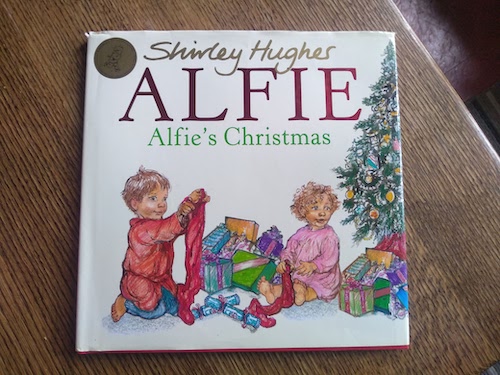
I’ve measured out my life by the children in Shirley Hughes’ Alfie books. I remember when we thought of Alfie as a big kid, and when we wondered what Iris would be like when she was as old as Annie Rose, and then my children kept on growing and now we’re looking in the rear view. Alfie and Annie Rose are tiny little relics now, but we’re so fond of them (okay, maybe it’s just me and everybody else is mostly just being indulgent) that we’ll never let them go completely, especially Alfie’s Christmas, which is the first book I’ll be writing about over the next few weeks as we blow the dust off the titles in our Christmas Book Box.
I love Shirley Hughes scenes of domestic life, the jumble of stuff in her illustrations, the clutter and mess of family life. I also love the shading in her illustrations, rich and vivid colour, but just muted enough that it’s sepia-toned. The books themselves are an exercise in nostalgia.
Which is another way of saying that they’re also timeless, in away, because they always appealed to my children, books written exactly from their point of view, and my favourite bits were always the parts in the margins—the pets who wandered into the spread, teapots on the counter, when Dad sits on a bench while Alfie splashes in puddles, and how I’d love to go have a cup of tea with his Mum and get to know her—I feel like we’d get along.
Alfie’s Christmas is a delight—not much of a plot, to be honest, apart from when they realize that Alfie’s new remote control car requires batteries. Alfie gets ready for Christmas, prepares presents for his parents, they put up a tree, carollers come by on Christmas Eve.
In typical baby sister fashion, Annie Rose gets up in the night and rummages through her stocking, and at first, Alfie thinks it’s Father Christmas creeping about his room. And then finally it’s Christmas morning, and the big day begins, and I like too that their family celebration is a bit modest, which our family can relate to. Alfie’s grandmother and her brother (from Australia turn up) and then Uncle Will and Alfie’s Dad get Christmas dinner on while Mum and Grandma head to church (taking along some of Alfie’s Christmas baking “to share with people who had no home to go to”).
Which is to say that these books are not so old fashioned at all, that their coziness is underlined by a progressive sensibility, and while Alfie gets some fun things for Christmas, connection is really what the holiday is truly about. “As they walked home they could see lit Christas trees shining out of all the windows and neighours like the MacNallys and the Santos family with their friends and relations, enjoying themselves, eating nice things, and watching television together.”
And oh, the colour of the sky at dusk! The most majestic ordinary splendour.
December 1, 2020
Gleanings
- No matter the disasters and disputes of the day, we were happy together following Bilbo Baggins to the Lonely Mountain, or Jules Verne’s adventurers on their way to the centre of the Earth.
- I wanted him to sleep under symbols of the place that is part of him, even though he doesn’t live here. And when those constellations appear in the sky over his home in Ottawa, he can look at them and imagine them in a slightly different orientation thousands of miles west.
- This leaf feels like my grandmother’s hand. No wonder I can’t stop holding it.
- I try to have a schedule, but I’m extremely bad at keeping schedules. I have watched corporate blog after corporate blog go to crap, because there was a posting schedule where you had to write five posts a day. I think that everybody would rather just write when you have something good to say.
- Now that I’ve discovered the true story, I’m highly motivated and loving the writing process.
- At this time of the year the light at latitude 53 arrives to pool in surprising places in the house.
- Here’s our VERY RETRO Advent Love-to-Do-List for 2020!
- “We are solitary travellers, having crossed paths in the land of stories.”
- If we want to fully reclaim the witch, let’s make sure that we are not ourselves ignorantly engaging in practices that harm others.
- Should dictionaries be trying to present us with a less biased world than the one we currently inhabit—or is their real obligation to reflect the world as it is, and as it shapes our use of words?
- Then I looked at the food mixer and realised that’s at least twenty five years old and suddenly I felt old and had another of those tempus fugit in a flash moments.
- These are cold days. Perhaps not in terms of temperature. No frost, no snow, no thin skittering of ice on the water. But there’s a chill at their centre. A chill of not-knowing.
- Beauty should never be only about pretty flowers and shallow depth of field.
- With November, comes a return to drinking tea.
- I regularly come away from our silent (and often not-so-silent!) book club feeling ready to burst: with book recommendations, with revitalized enthusiasm for my reading (when it has flagged or been kind of muddled in recent months), with sheer joy at connecting and sharing with such an amazing, generous and eclectically inclined group of booklovers.*
- I can’t seem to muster the mental or physical energy to keep up with regular blogging right now (blame an excess of computer time for other purposes plus a spell of back pain – happily now subsided – making it particularly unappealing to spend yet more time at my desk!). But I also can’t stand to watch the pile of read books growing without saying something about them.*
*Last two picks feature Waiting for a Star to Fall!
Do you like reading good things online and want to make sure you don’t miss a “Gleanings” post? Then sign up to receive “Gleanings” delivered to your inbox each week(ish). And if you’ve read something excellent that you think we ought to check out, share the link in a comment below.
November 30, 2020
Smitten

I loved EVERYTHING about this profile of Deb Perelman in The New Yorker. I had no idea that she was an old school blogger before she was a food blogger proper, but I should have guessed—and it’s possible that this is why I love her blog as much as I do.
Incidentally, my blog (if not this blog, but rather my blog in general) turned twenty years old last month. To mark this occasion, I just went back and found my OG blog in the Way Back Machine Internet Archive—the first archived post is VERY EMBARRASSING and possibly not anything to celebrate or commemorate. To be so obviously needy. It’s a miracle I had any friends—and not surprising that I didn’t have a boyfriend.
But—it’s hard to altogether rue the person who got me here, which is not a bad place to be. She was trying (really, really, REALLY hard).
Some sensibilities of old school blogging are totally baked in though, integral to my process. I recognized this from Deb Perelman: “I try to have a schedule, but I’m extremely bad at keeping schedules. I have watched corporate blog after corporate blog go to crap, because there was a posting schedule where you had to write five posts a day. I think that everybody would rather just write when you have something good to say.”
Or even when you have nothing good to say, but feel like checking in anyway.
November 27, 2020
Emperors
From Caitlin Moran’s More Than a Woman: “It is an unfortunate truth that, sometimes, it takes true horror to make you realize something you should have known all along: that a normal ordinary life is the most covetable thing on earth. A day in which nothing happens but breakfast, and school, and peeling potatoes, and monopoly, and sudden laughter over nothing really, before a sleepy movie and bed, is like paradise, relocated to a house in the suburbs. We feel beyond royal. We smile at each other like emperors ruling a whole continent of joy.”
November 25, 2020
The Seasons of My Life

I have outgrown picture books…again.
Which I feel nervous even writing. If you can’t say anything nice, don’t say anything at all, and all that jazz, and I have learned through my interest in kids’ books over the last eleven years that those who create these books can be a bit sensitive about their work, about its relegation to the world of childish things. Wonderful children’s literature appeals to readers of all ages, and readers who restrict themselves to a certain age group (or genre, etc.) are missing out. All of this is true.
But it’s nothing not-nice that I’m trying to say here. Instead, it’s a matter of practicality. That for a long time, picture books were my primary way of engaging with my children and this opened up whole worlds to me, and some of those worlds seemed as real as the one I walk around in every day—but time makes you bolder and children get older, and I’m getting older too?
We still read them sometimes. Iris is only seven and we have so many great books on our shelves that all of us enjoy, books we can recite by heart. There are picture books in our library I’ll never be able to part with, and yet—we’re reading them less and less. I used to blog about picture books weekly, but now I hardly do. Everybody in our family is firmly into chapter books now, books we read on our own and the ones we read together. Picture books don’t have the same integral place in our daily life that they once did.
And none of this is remarkable. Children outgrow a lot of things, and families do too. We used to go on road trips listening to the same CD on repeat, this song with a barking dog in the chorus, because Iris cried in the car otherwise, and we don’t do that anymore. I used to get a big kick out of reading Go Dog Go in ridiculous accents, but these days the dog party is over.
But I feel a little bit disloyal, admitting to giving up on my allegiance to picture books. Or rather, moving on from it—although the new frontier, for me, is middle grade and also graphic novels, and I’m getting the same pleasure from relating to Harriet through some of the novels she’s reading as I once did when we used to examine the illustrations in Allan and Janet Ahlberg’s Peepo together, her gummy baby fingers pointing out the dog in the corner that shouldn’t be there. But I’m also trying to give her space to develop her own relationship with books and reading, one that has nothing to do with me.
And this is what happens, of course, the way things come and go. And how when they go, new things grow up in their place, which I keep reminding myself of in these moments of unprecedented change and upheaval. As businesses shut down in my neighbourhood and city and it’s enough to drive one to despair sometimes, the extent of the loss, all of it so overwhelming and hard. But even harder is trying to hold on to it all.
(And remember: a blog needs space to grow and room to wander!)
It’s okay to grow. It’s okay to change. It’s okay to change again, is what I’m thinking, and for the thing that used to define you so much and mean everything to become a spot of the horizon. And those things we loved will always be a part of who we are, because of the way that we wouldn’t have become ourselves without them.
November 24, 2020
Gleanings
- Well, I just finished reading Pond, by Claire-Louise Bennett, and it was absolutely everything I’ve ever wanted in a book.
- Everything Will Be Okay. Also, everything absolutely won’t. Living with that understanding, that discomfort, is something I can do, but it’s incredibly hard for me.
- I love that we’re all so focused on figuring out creative ways to share, and to do the things we love, and to connect with people we love.
- Caregiving through Covid: the challenges of 2020 have presented a steep learning curve, and some days it feels like we’re all just making it up as we go along.
- I think the reason I haven’t posted in so long is because something CraAAazy happened to me between the beginning of the summer and now… I lost my need for outside validation.
- Couple that with the warmth and connection glowing from our device screens during this week’s “pop-up” (meaning somewhat spontaneously scheduled) silent book club zoom meeting and we know we’re going to make it through the swiftly descending darker days and nights.
- I opened A Writer’s Diary to see what Virginia Woolf was thinking in November, 1924
- workshops at the shelter: aka, what we write about when we write about avocados
- If it’s round and it comes on a plate, it is probably a dumpling.
- “Today is a gift. Open it up and take it for a ride.”
- What if we shared more stories, and fewer admonishments? (I’ve yet to see anyone change their mind because of an admonishment).
Do you like reading good things online and want to make sure you don’t miss a “Gleanings” post? Then sign up to receive “Gleanings” delivered to your inbox each week(ish). And if you’ve read something excellent that you think we ought to check out, share the link in a comment below.
November 23, 2020
More Stars!
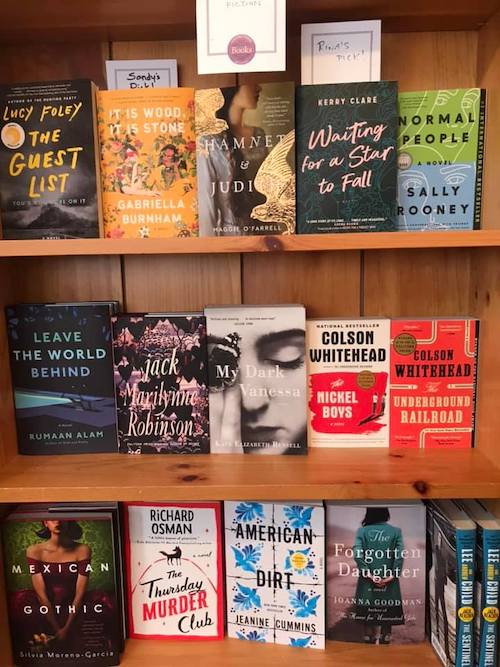
- Great review by Stacey May Fowles in Quill & Quire. “In sketching the nuance and power imbalances of Brooke and Derek’s romance, Clare has successfully rendered a spectrum of abusive behaviour and articulated a vital cultural tension between two seemingly opposed concepts: being 23 and being taken advantage of, and being 23 and having agency. In doing so, she asserts that both can exist simultaneously and that those who mistreat young women are not relieved of responsibility because their victims “should have known better.”
- Waiting for a Star to Fall is Style Canada’s Boreal Book Club Pick for November!
- Waiting for a Star to Fall is on sale in the Flying Books Bookshop!
- Chantel Guertin recommends Waiting for Star to Fall on CHCH’s Morning Live
- @CarlyIsReading on Instagram writes that Waiting for a Star to Fall “challenges a reader’s expectations related to the ‘right’ way for women to navigate these situations and shines light onto how and why they may respond differently. It’s brilliant in its composition and inspiring in its compassion.”
- And Karissa Reads Books writes: “Clare does a great job of capturing that early-20s uncertainty. That stage of life that is both real adulthood and on the cusp of adulthood. And she does so in a sympathetic and believable way so that it never feels like she’s looking down on or dismissing that stage.






