November 19, 2006
After Words
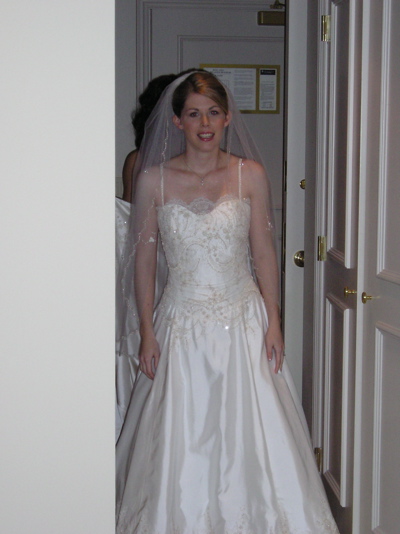
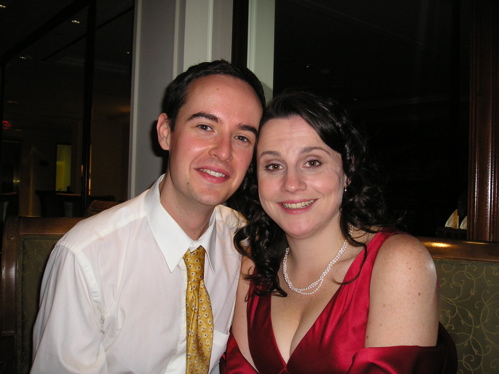
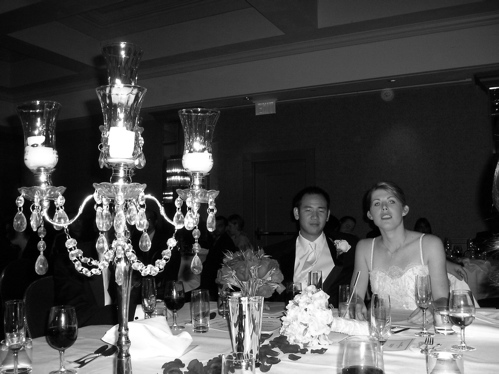
Da Vinci Code was abandoned after thirty pages because it seemed too long and uncompelling to finish. If it were the last book on earth, however, I’d definitely read to the end. I am tired/hung over as to be incoherent. In this sort of mood, I giggle a lot and Stuart seems like a comedy genius. Because he is. We’ve had a brilliant whirlwind of a weekend and it was wonderful to be a part of it. Wedding was beautiful, bride was stunning, groom handsome, weather was fine, fun was had, company was nice, food was good, husband was danced with, party was excellent and indeed, the whole thing was a sweet dream and I’ll remember it for the rest of my life. There is nothing better than seeing your friend with somebody so perfect for her.
The only fairy tale element absent was the horse and buggy. Katie was forbidden one, because of P. Bernardo’s strictly early 90s wedding.
November 19, 2006
Happily Ever After
And it’s you and me and all of the people
and I don’t know why I can’t keep my eyes off you
November 17, 2006
Wedding Weekend
Here for five women writers revealing their inspiration. The Beatles mash themselves up. The danger of naming a character. Books banned in Iran. Etc.
This weekend I am reading The Da Vinci Code. It’s true, but only because I am going to be maniacally busy this weekend with some blocks of sitting around time and require a novel that won’t require too much concentration and that can be finished for Monday so I can read the books I have to read for school. The qualification is necessary. 8 billion readers can’t be wrong though. Or can they?
This weekend is brought to us by the Doering/Lui Nuptials, which I expect will usurp these as the wedding of the year. A three day extravaganza really, and if you’re looking for me I’ll be the one riding around in a limo wearing a floor-length gown. A floor-length gown that doesn’t exactly fit. Ah yes, my career as a bridesmaid begins this afternoon, straight through to Sunday. I’ll be back in the aftermath, probably with pictures.
November 17, 2006
Bewilderment
From the wonderful Interpreter of Maladies: “While the astronauts, heroes forever, spent mere hours on the moon, I have remained in this new world for nearly thirty years. I know that my achievement is quite ordinary. I am not the only man to seek his fortune far from home, and certainly I am not the first. Still, there are times I am bewildered by each mile I have traveled, each meal I have eaten, each person I have known, each room in which I have slept. As ordinary as it all appears, there are times when it is beyond my imagination.”
November 15, 2006
Read This
Now reading Interpreter of Maladies by Jhumpa Lahiri, and it’s brilliant. I bought it at the Vic Book Sale, after Kim Dean picked it up and said, “Read this. It’s great.” I looked at the back, and a blurb by Amy Tan said, “Jhumpa Lahiri is the kind of writer who makes you want to grab the next person you see and say, ‘Read this!’. Indeed.
November 15, 2006
What I Found
~She is always delighted by the arrival of the post, though it ought to be routine by now because the postman comes each day at three. But no, she anticipates the tip tap of his shoes, the thunk in through the letterbox and the footsteps’ retreat. A bundle of ephemera waiting on the floor. There is always something, a stack of something.~
Oh, and what a stack. A package full of bookish goodness (stay tuned for reviews). A thank you note from Katie’s shower. Confirmation of our flights to England. And my penpal letter from Bronwyn, who wrote the letter just after learning we’d just booked our flights and so it all feels terribly real time. And my text-based treat from her: a clipping from the Sunday Times Magazine by Margaret Drabble about Sheffield, where she used to stomp (and in the Cathedral of which I once felt the presence of God while on a cheap daytrip).
November 14, 2006
What to know?
What to know? That my back aches from shelving all the books you brought back when you finished your paper on William Morris/ Charles Dickens/ Native Residential Schools/ Islam/ Urban Sprawl. That the Dog Accessory Store I pass every day has now gone out of business, which is proof to me that capitalism sometimes works. That the Bridesmaid Dress has been picked up from its second alterations and still doesn’t fit, but will do almost comfortably (and has only set me back $270. Remind me to buy a dress off the rack next time. They always fit right away). That Mr. Warbucks is proof that the American system works, and the Bolsheviks don’t want anybody to know that. That I am excited to read About Alice by Calvin Trillin when it comes out in December. I had my Scrabble Ass kicked Sunday night by Nina and Laryn, but then again I was reponsible for “rhubarb” (and I only had to cheat one tile to get it!). That it’s going to take a miracle to get done all that needs doing in the next month, and I’ll have to shake my hand once I’ve got through.
November 12, 2006
Something wonderful
My favourite discovery of late is what happens when a spoonful of sugar lands in a mug of Rooibos Tea.
November 12, 2006
Nearest Thing to Heaven
My New York Minute continues with Nearest Thing to Heaven: The Empire State Building and American Dreams by Mark Kingwell.
November 12, 2006
The Emperor's Children by Claire Messud
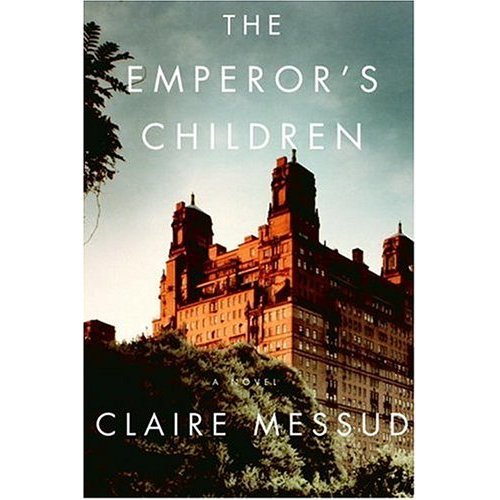 When I said that I read novels cheaply, what I meant was that I am usually more concerned with how it was to read a book than what the book stands up for once it’s done. I don’t mean that the latter is unimportant, or that I haven’t worked through my share of difficult novels in my time, but for me the optimum reading experience is for a book to be a pleasure. And really, The Emperor’s Children was.
I chose to read this book after reading this profile of Messud, whose work I’d never come across before. As I said previously, at 430 pages this book is not insubstantial, and I found it difficult to get into initially. Messud introduces each character and every room with an itemized description, which is disconcerting. If she’d been more brief, I could have filled in the blanks, but the paragraph-long listings of facial composition etc. I tended to gloss over. I said ick initally, or at least yawn. Encountering the main characters: three college friends now age thirty, pulling their lives together in New York City during the Spring of 2001. And I don’t know if Messud’s writing relaxed, or if I did, but I was hooked by page 100 and devastated that page 431 was blank.
What Messud manages to do so skillfully is demonstrate the sheer stupidity that was the summer of 2001. I remember: there was an environmental summit, and Chandra Levy. Messud’s character Danielle is producing a documentary about botched plastic surgery. Like Ian McEwan’s Saturday, Messud creates an incredible suspense from the quotidian, though of course in this book we know exactly which inevitable doom is headed. “Nobody could have foreseen this” someone comments, after September 11th and the twin towers have fallen. But of course as readers, we have foreseen it from the start.
A funny, satirical and intelligent novel that seems an encapsulation of the 1990s and a bit of a love letter to New York. Messud’s characters surprised me with their flaws and complexity, and also identifiability. I wanted to issue them a warning all the way through (“It’s behind you!”). Messud handles the terrorists attacks and their aftermath in a way that is neither overdone nor restrained. This is the first time I’ve encountered 9/11 in fiction, which was an eerie experience, and distanced the events from real life in a sense. Something I watched on real time (albeit on TV) stuck in a novel, which sort of made me feel like I’d just imagined it. But not really, of course, and this is a wonderful novel. Please note that it didn’t surprise me to learn that Messud considers Portrait of a Lady a formative read.






