December 1, 2006
Book Tip
I know there are a few of you out there who do follow up on my book recommendations, so this goes out to you, but everyone else– I beg you to take heed. I am reading The History of Love by Nicole Krauss, and it is breaking my heart in the most beautiful way imaginable. I’m sending out a blanket call for you to read this book.
November 30, 2006
The Uses of Enchantment
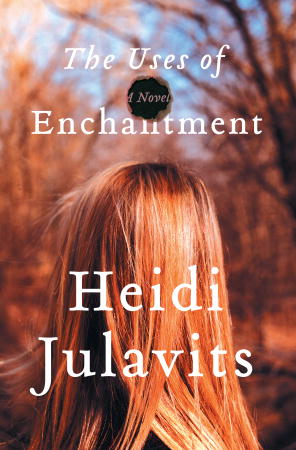 I don’t know what to do with Heidi Julavits’ The Uses of Enchantment. I mean, what a strange book. I’ve not read Julavits’ two previous novels, but the customer reviews I’ve read for them usually mention general weirdness and Julavits biting off more than she can chew. I get the sense that Julavits is chewing better now, but still, it’s quite a mouthful (this metaphor ends here, I say).
So, we’ve got the mysterious disappearence of a teenager, all right. Whose mysterious disappearence is repetitious of another teenager’s disappearence ten years before. Both girls obsessed with a seventeenth century story of a girl abducted by Indians, whose rescuer was subsequently hanged as a witch. And the first girl is apparently descended from a Salem witch. And she returns home fifteen years later after her mother’s funeral, in order to resolve what happened to her. And most of the narrative is played out through the rivalry of two psychotherapists with opposing missions. Incredibly intertextual, though the only text I was familar with was Dora. And that’s about it, I think. All in one book. It really doesn’t make sense until you read it.
And so I’m mystified, but I still enjoyed this book. There is a race to the end, and I think Julavits’ climax is worthy of the suspense she creates, and I found the ending satisfying. The main character (the derivatively disappeared girl, Mary Veal) is impossible to pin down, though this is created more by Julavits narrative than what the characters says or does. In fact, sometimes too much explanation is given and I wished the story had remained a bit more “enchanted”. Which is the problem. Julavits introduces so many fascinating avenues in her story, that of course many remain insufficiently explored. This isn’t completely annoying, because on a whole this book manages to function (I have no idea how though).
My confusion is somewhat akin to enchantment though. Whatever Heidi Julavits did, she did it right. I also like how when you remove the dust jacket of this book, in gold script on the black cover it simply says, “A Novel”. Indeed it is. Sort of.

November 30, 2006
Back to work then.
The next almost-three weeks will contain just about no fun. Except for one day off (for Christmas baking of course), I will be hard at work marking 5 papers a day, writing my own essay, writing my own creative stuff and tying up other odds and ends, and doing my shifts at the library. The prospect is dreadful, but the idea of a Christmas holiday with all that done is delicious. On December 15, I plan to sit down and finally crack open my copy of the latest Drabble. This all means that if I am here now, I really should be elsewhere. Back to work then.
November 29, 2006
Thank You Mr. Postman
Today he brought me Walrus, Taddle Creek, a box of books from amazon (not for me, but it does mean that I am that much closer to completing my Christmas shopping and I didn’t even have to leave the house), and a letter from Erin A. Sanko that set me beaming.
In an aside, I am currently marking and yesterday a student referred to Robinson Crusoe (*!*) as Robinson Caruso ala David! So exciting. I almost assigned a bonus point.
November 28, 2006
Bollocky Night
I’ve had a bollocky night, and so I’ve drowned my sorrows in Dairy Milk. I’ve also abandoned Tristram Shandy in Book 4, because I think I’ve got the point by now. (My second abandoned book in just over a week! I never do that.) Now reading The Uses of Enchantment by Heidi Julavitz. Now despairing the day I ever decided to pick up a pen. Bollocks bollocks bollocks! And 75 papers to be marked enter my life tomorrow. Sometimes I wish I lived in my bathtub like a fish.
November 28, 2006
Bloodletting & Miraculous Cures
 I’m not sure if it’s common to race to the end of a short story collection, but last night there I was, way up past bedtime reading Vincent Lam’s Bloodletting and Miraculous Cures (winner of this year’s Giller Prize). I wasn’t expecting to find this book enthralling; it had been pitched like an episode of ER. But Lam’s stories work, they really do, and they are connected in a way that provides this collection with a gripping narrative arc.
I’ve mentioned before that I find literature about science interesting, but the science wasn’t what hooked me here. I think more so, I appreciated a glimpse into the consciousness of a scientist, or more-interestingly, the aspiring scientist– the student desperate to get into med school. I knew people like this in university and Lam has provided good insight into their motivations and mindset with Ming’s character in the story “How to Get Into Medical School Part 1”. Her portrayal is so convincing, and at once sympathetic and awful, but this effectiveness is also the product of a well constructed short story. Similarly, in the story “Winston”, a patient’s mental health problems cast a mesmerizing spell and the twist at the end was shocking, particularly in the context of a dry and measured medical account. Purple birds do appear throughout this book in some of the most surprising places. I loved the SARS story “Contact Tracing”, which was full of action, suspense and human emotion. Not one story here could have been considered a dud, though a few did begin to drag a bit before they ended.
I had a problem with the didacticism of the text, however. Suggested by the book’s title and chapter titles beginning with “How to…”, but I didn’t take these clues all that seriously. Here we have a book of stories, I thought. I can read stories, and I did, and though it was about a world somewhat unfamiliar to me, I trusted my intelligence enough to fill in the blanks and get the gists. And then at the end of the book, I was gutted to find a “Glossary of Terms”. Seemed somehow patronizing, and unnecessary. I wasn’t reading this text as a tool, and I don’t think stories require indices usually. The stories should stand well enough on their own (and they do), but the inclusion of a glossary suggests Lam is second-guessing that they do, or he is second-guessing my own ability to read his stories without assistance.
I suspect, however, that the glossary is provided to emphasise this collection’s unique pigeonhole: from the point of view of an emergency room physician. Though it is notable that such an emphasis had previously led me to dismiss this book pre-reading as gimmicky and perhaps dull. And I was wrong. Here is a work of literature; they could be about the lives of doctors or dustbins, but these are stories and they’re good. Perhaps what was most disappointing about the “Glossary of Terms” was that I had figured I had a whole other story still ahead, and then was unhappy to find the book so suddenly done. Which does say something about the collection Lam has managed to create.
November 26, 2006
News Fun
I was so happy I bought The Globe yesterday, and I enjoyed the feature on the marvelous Mavis Gallant, and The Globe 100 Books (which I can’t find online). Here for Guardian Books of the Year. And I loved this profile of Ursula Franklin. Now, there’s work to be done.
November 26, 2006
Weekend Update
I am no longer very sick, but have completely lost my appetite. Anything other than mango sorbet makes me want to die. In spite of this, I have had a lovely weekend. On Thursday, we hit the echolocation launch, which was well attended and good fun. I was sorry not to have been feeling more alive. Friday, we had a Prose Board meeting, selected four stories from 79 and I am thrilled with what we chose. I also got to send out the acceptances, which was quite cool because I knew they’d be making a day or two. Friday night was Stuart’s birthday party in Chinatown, and we had to squeeze twelve around the table and it was unfortunate that I’d gone off food because the food was wonderful. I was content with my chickenballs. And so lovely to see so many friends at once. Yesterday, I had lunch with my dear dear Paul, who is in town for just a few days. We had a brilliant time, and I was excited to hear about his upcoming adventure: he’s going traveling in Asia for six months come January. Last night Stuart and I went to his birthday fete down on Queen Street, and we had a very nice time, and it was a perfect night for walking anyway. And now it is Sunday and I am doing schoolwork, etc. and hopefully I will feel good about what I have accomplished by the end of the day. I also feel like baking peanut butter cookies. So perhaps I will.
November 25, 2006
Gig Songs- Update
I am compiling a list of songs about live performances. So far, the list is short. I’ve got:
Woodstock: Joni Mitchell
Rock and Roll Song: Valdy
Garden Party: Rick Nelson
Piano Man: Billy Joel
Killing Me Softly: Roberta Flack
Super Trouper: Abba (thanks CG)
Don’t Play That Song: Aretha Franklin (thanks KM)
By the Way: Red Hot Chili Peppers (thanks C-Dawg)
Who else can help? Anyone? Anyone? (By which I mean you, Bueller. Oh, and you too.)