March 23, 2023
Bleed, by Tracey L. Lindeman
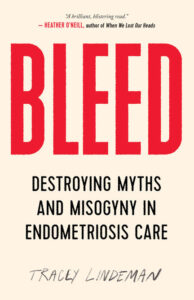
The first time I heard about this book was last fall while I was drinking tea in Jennifer Knoch’s garden and asked her about amazing books she’d edited that were coming down the pipeline, and she talked about BLEED so passionately and made clear that this was a book that everyone should read, not just people with experience suffering with endometriosis.
And then two more people I deeply admire—@aborshpod’s Rachel Cairns and @yellowmanteau (Julie L. Lalonde)—started posting about it on Instagram, weaving its threads into the stories they tell online about reproductive justice and feminism/violence against women respectively—and showing too that all these stories are connected, for worse (because such tangles makes everything so much more *complicated* and difficult to resolve) and also for better (improving healthcare for people with endometriosis means better outcomes for *everyone*).
In BLEED, Lindeman uses a mix of memoir and reporting to show how her brutal and painful experiences with endometriosis since age 11 is representative of the suffering of so many other people, and also how the lack of care endo patients receive highlights sexism, racism, classism, anti-fatness within the medical system. Most doctors aren’t aware of how to diagnose endometriosis, let alone how to treat it—thanks to the influence of pharmaceutical companies, patients are usually given pills before surgery, pills that are ineffectual at best, harmful at worst.
Those who ask for surgery receive push-back from doctors who wish to preserve patients’ fertility, even when patients are adamant that they do not want children. Patients are caught in a catch 22 where they’re able to mask their symptoms and remain high functioning, which comes to undermine their complaints, or else they’re overwhelmed by the physical and mental toll of endometriosis and dismissed as just hysterical.
It was interesting to read BLEED in the context of another book I’ve recently read, Felicia Kornbluh’s A WOMAN’S LIFE IS A HUMAN LIFE about the parallel battles for abortion access (by white middle class feminists) and against forced sterilization (by working class activists of colour). At first glance, these two through-lines seem entire separate, even opposed, from each other, let alone Lindeman’s narrative. In a politics of either/or, black and white, this is certainly the case—but life is not like that. And—as Kornbluh’s book made clear—insisting that it is undermines justice and progress for everybody.
Lindeman’s narrative overlaps with Kornbluh’s when she writes about how birth control drugs were tested on people in Puerto Rico…and then ultimately dispensed in huge amounts to the general public in what purported to be a kind of liberation, but perhaps at a cost that most people don’t like to talk about, mostly because the people who are talking already are religious zealots seeking to control women and also because who wants to be opposed to liberty?
This narrative is messy and demands attention to nuance, and it also challenges me as someone who has mostly been served by the medical establishment so far throughout my life, never meeting with the roadblocks and suffering that becomes standard for Lindeman and others with endometriosis (and PCOS, and a litany of other chronic illnesses, and also [the much feminized and therefore maligned] chronic pain). It’s also a narrative that doesn’t come with neat and tidy ending, for the patients themselves or the system at large. The end of BLEED is just the beginning, after all, of—hopefully—a powerful reset and reimagining of how our medical systems are structured, and what reproductive justice/’my body my choice’ really means.
March 22, 2023
Asking for a Friend: Cover Revealed!

I am beyond thrilled to finally be sharing with you the gorgeous cover for my new novel, ASKING FOR A FRIEND, coming September 5, 2023, from Doubleday Canada, designed by the talented Lisa Jager. It’s the cover of my wildest dreams, encompassing two of my favourite things, extravagant sunsets and SWIMMING, and it’s such a wonderful encapsulation of this story, which I’m so looking forward to sharing with the world.
You can preorder your copy now at the SHOP LOCAL link at my publisher’s homepage, or at your favourite bookseller. Stay tuned for preorder goodies and launch plans.
March 21, 2023
Gleanings
- It’s taken me years to realize that fancy notebooks are stifling. Beautiful, but stifling. Because unless I write really slowly, I’m a messy writer. And slow, pretty writing isn’t helpful when you’re just trying to get ideas out.
- This being human is so unique… to have the awareness of the past and future, the yesterday and the tomorrow can wreak havoc on my heart.
- How often — will it be for always? — how often will the vast emptiness astonish me like a complete novelty and make me say, ‘I never realized my loss until this moment’? The same leg is cut off time after time. The first plunge of the knife into the flesh is felt again and again.
- What makes for strong writing in math? I asked. Everything serves a purpose. It ties together. There’s not a lot of extraneous stuff. Importantly: there is clarity.
- I read in part because I like to. I also read because I write, and reading helps me learn. And I read because I enjoy stories, and people, and challenging ideas, and other peoples’ expertise.
- I’m not sure I even knew my Yiayia wasn’t Greek until my teens, which given her terrible Greek accent and strawberry blonde hair shows how very up my own arse I was.
- When I went out to see if the crocus in the garden had opened yet, wanting a photograph, I saw the rhubarb unfurling. Looking ahead, I am thinking about crumbles, pies, jam with ginger, and compote to have with yogourt.
- This book is so ambitious which made it also bulky. This put off some who wanted it trimmed down, but I’m here for women writers who want to take up space. After so many years of impressionistic, slim novels, I’m finding something revelatory about bigger novels. They aren’t afraid to sprawl.
March 20, 2023
March Break
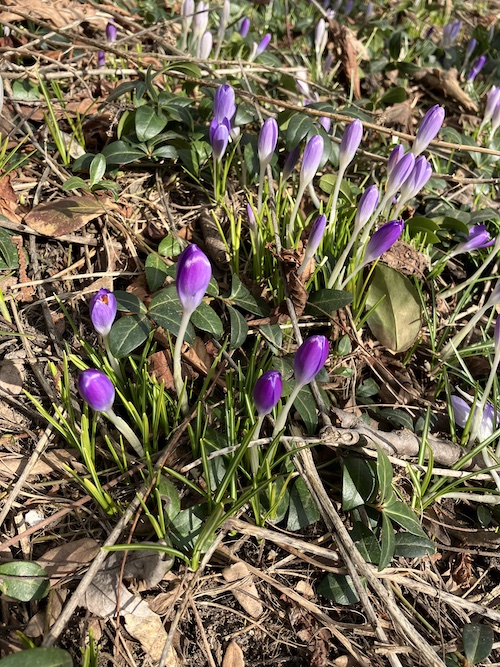
I loved our March Break holiday this year, a March Break so normal that I even forgot to find “normal” remarkable. Our kids brought their indoor shoes home, but not because we weren’t sure they might ever go to school again, and that Friday was a blizzard, and if I’m talking about it like it was 187 years ago, it’s because it feels like it, because our holiday was relaxing, a proper reset, but also because a week after that blizzard (which we weathered while eating pizza and watching Newsies [omg, so good, first time I’ve seen it in 30 years!]) there were crocuses in bloom, and it feels like spring. No doubt winter still has a few wallops in store, but spring feels possible now, and getting here feels like an achievement.
I handed in edits for my book just before the holiday and so I had the luxury of working half days in the mornings (after 8 am swims!) and spending the afternoons with my children on local adventures. They loved it too because it was just the right balance of lazing around playing video games until their eyes glazed over, and fun being out in the world (with friends!). And I liked that I genuinely had less to do, so it wasn’t me scrambling to fit everything into a smaller time-frame (which would make me very grumpy). It was a holiday for all of us, even Stuart, who still had to work while we were gadding about, but having no weekday activities in the evening was a break for everybody.
We went swimming at the community centre; went to see Winter Stations at Woodbine beach and went out to lunch with friends; our kids had friends over to help us eat our chocolate pie; we went to Leslieville to meet our pals and for cookies, book buying, and thrifting; our kids got awesome new haircuts; on Friday we went to see The Parent Trap at Paradise Theatre; more community centre swimming; and then we closed off the holiday yesterday with the T. rex Exhibit at the ROM, where I learned why it’s T. rex and not T-Rex, ie why T. rex isn’t J-Lo.
We had lots of time to laze, to rest, to read, to sleep, to visit, to sing, to whiz across town on transit, to snack, to wonder, to climb, to dance, to build, to spin, to dream, to be. I even got my taxes done! It was a very good week.
March 17, 2023
I Have Some Questions for You, by Rebecca Makkai
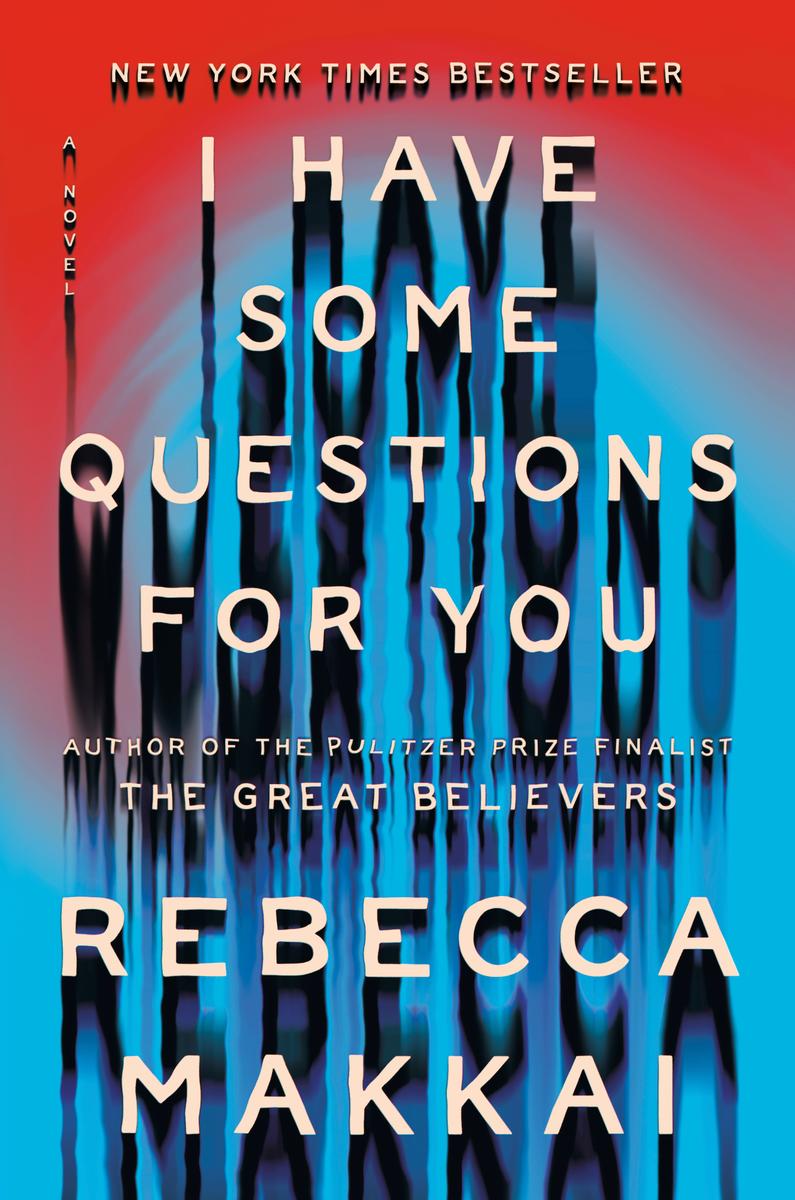
There were some moments in which I felt, reading I Have Some Questions for You, that perhaps Rebcca Makkai was trying to squeeze too much into this book. A novel 400+ pages long, a campus novel, murder mystery, #MeToo/cancel culture moral reckoning, Anti-Black racism and how the justice system is far from just for people of colour. Plus a treatise on true crime podcasts, because Mekkai’s narrator Bodie Kane is a podcaster too, in addition to being a film professor, and she casually rattles off old crime cases: “Wasn’t it the one where she was stabbed in—no. The one where she got in a cab with—different girl. There one where she went to the frat party, the one where he used a stick, the one where he used a hammer…” A story that’s specific and unspecific at once, positively amorpheous.
The specific part of the story is about Bodie returning to the scene of the crime in 2018, which is to say high school, which was, in her case, a mid-grade New Hampshire boarding school she’d been sent to in the 1990s by a benefactor after horrific tragedy had befallen her family in Indiana. Those years were, as high school always is, complicated, Bodie conscious of herself as an outsider, and then, in her senior year, her roommate from the year before is murdered. The school’s athletic assistant was found guilty, and he also happened to be one of the few Black people on campus. By 2018 and deeply steeped in true crime podcasts, Bodie is already mildly obsessed the case as she comes back to Granby to teach seminars on podcasting and film history.
At the same time, her husband (they’re separated; he lives next door/ they get along fine) is being cancelled on Twitter by a somewhat insufferable performance artist, and Bodie is slowly being undone by the complexity of these matters: what is the distance between what her ex is alleged to have done and other instances the prompted us all to #BelieveWomen, plus the absolute bullshit she and her peers had to put up with with in high school from male teachers, and even from each other as rumours spread (but then some of these rumours are what protected students from abusers—how do you ever know what/which women to believe?).
It’s been a busy week and I’ve not had as much time to read this book as I would have liked, to give it the focus it really deserved, so that I could get lost in it, but last night I sat down for a couple of hours to finish it and finally everything clicked, the over-stuffedness, the real answer to whodunnit:
“My point is, you were part of the machine… You drove the getaway car. You threw bricks through the window and someone else grabbed the jewelry. You distracted the feds while the spies got away You held her down while someone else beat her. You shot the deer and wounded it; when the second hunter came along, the deer could no longer run.”
What a marvelous, absorbing, complicated world of a book this is, a literary mystery, and a mirror.
March 15, 2023
Mitzi Bytes Turns 6!
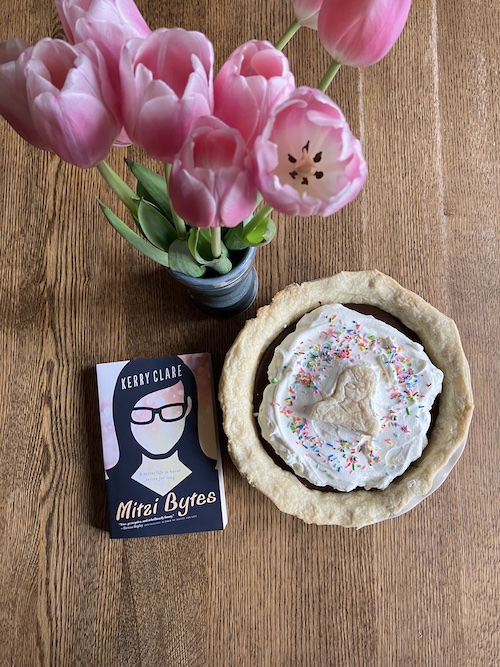
It’s March Break this week (low key staycation edition) and yesterday we celebrated Pi Day AND the sixth birthday of my very first novel with a chocolate pudding cake. It’s especially exciting to be celebrating this milestone as I’m hatching plans to bring my THIRD novel into the world on September 5. (Cover reveal is coming next week!! Stay tuned!).
March 14, 2023
Gleanings
- I’m amazed at how grateful people are for doing such a small and frankly entirely selfish thing – I wanted company and put the word out.
- One of the things I’ve missed the most during our COVID isolation is the kitchen conversations with my friends — each one of them kind, loving, loyal, inquisitive, adventurous, and smart as all get-out! We’d gather around the island, plug in the kettle, warm the pot, grab the cups, milk, spoons and biccies and settle in for an afternoon of solving the world’s problems. Or at least taking a stab at solving our own.
- But I think the desire to create is more than that, more than just a legacy. It’s different parts of yourself coming together – your experience, your talent, your learning, your emotions, your thoughts, your imagination – in one expression. With your creation you say: this is a glimpse of who I am. It satisfies a piece of your soul.
- it feels like such a gift to witness others in their everyday ordinary extra-ordinarines. sometimes i feel like I’m intruding, like I’m gawking, peeking through a window into someone else’s world …
- I have been off work the past two days—well today is the second day—because I’ve not been feeling well, and while I probably could have gone in today, I’m glad I didn’t. I am learning, finally, at the ripe old age of 56, to allow myself the opportunity to slow down when I need to.
- So a title first and then a decision about what to do with the manuscript. I don’t have forever. None of us do. So I’ve become quite purposeful about tying up threads.
- The story is thin, but at that time I was still figuring out a lot about writing myself. I still am. I also didn’t know how serious R was. Next time–if there’s a next time–I’ll write a better story. And I’ll revise it before I give it to R.
March 9, 2023
Ordinary
A year ago, my mental health was terrible—a sentence that will be evergreen for me until the end of June—but early March was a particular low point, my anxiety ramped up again and me still so far from understanding how it played such a dominant role in my mindset and how much of my worldview was informed by a catastrophic thinking I’d just accepted as normal. I remember one of our first dinners out in a restaurant and not being able to enjoy it at all, because I spent the entire meal quite sure that we were all going to die quite shortly, and it was almost a little bit fascinating to look around me and see how everybody else was just taking it on the chin.
It was not a good time. And yet, there was sweetness. We were moving through March and the first one in three years that didn’t come with absolute dread. When my children brought their indoor shoes home for March Break, it wasn’t because I wasn’t sure they wouldn’t see the inside of a school again until September. We were eagerly anticipating our long awaiting trip to England, but Covid was also still surging, the idea of travelling was stressing me out, and I wasn’t sure that every March until the end of time would not take the shape of a spiral toward doom. I was incredibly moved last year to have our first ordinary March Break in such a long time, and so have my kids return to class as normal afterwards—but it also still felt precarious. Those convoy people had broken my soul. It felt so good for things to finally be okay again, but I still felt so far from okay.
And then this morning, 365 days from then. Another day of sunshine and blue skies, and there is this way the sunbeams appear in my kitchen around 8:30 in the morning from the southeast, making their way around my neighbour’s house and onto the counter, my cupboards, so golden, and my children were happy. We were putting lunches in their backpacks. They’ve stopped wearing masks to school. Iris had a school trip to the art gallery yesterday. Harriet’s school had an open house today so we could visit and see the zoo exhibits she and her classmates had built. Yesterday I had a meeting with my publishing team to hatch plans for my upcoming book. I spent the afternoon in a cafe finishing edits and eavesdropping on idiots, and then attended an event for International Women’s Day with wine and cheese, the first event held in the PRH office since March 4, 2020, back when everyone was wiping down surfaces out of an abundance of caution.
And this. The sun. This week. Today. In the deepest pit of pandemic despair, this ordinariness was everything I longed for, everything I missed to my very marrow. Backpacks, and laughter, and learning, and growing, and walking the route to school that I’ve been walking now for a decade. Things to look forward to. Moments to steep in. I am so so grateful, and so very happy, and tomorrow’s the last day of school before March Break and it feels like, instead of being stuck or in a spiral, we’re marching forward, forging new paths. Finally, finally. What a long, long road it’s been.
March 7, 2023
Gleanings
- high need for closure.
- What’s courageous about the timeless combination of broccoli and pasta, Deb? It’s the cooking time. This broccoli is not al dente. It does not “retain a crunch,” “still have some bite to it,” or keep any of the verdant green hue it entered the pan with. And, even more audacious, it doesn’t wish to.
- May we follow his example and make our dreams come to fruition. So,we may not be tempted in the least to ride a bicycle and camp across the United States, but I bet there’s something for each of us. What’s calling you?
- Mark was very startled by the phrase “that’s a good-looking dog” when I first pointed one out on the sidewalk, but now he uses it too–it originated with my father.
- Like I said, I wasn’t asking for its input. I don’t need my phone to tell me how much I’ve walked or haven’t walked. Does my phone know that the sidewalks have been icy, the winds bitter and blustery? It should! It seems to know everything else.
- It’s more important to make good art than to garner a lot of attention on social media.
- simply because I want to cherish the sweetness (and ache) of this very fleeting now in which we travel with stuffed bunnies.
- We don’t know at the time that these ordinary moments will one day resonate in the way that they do. And that, in part, is what makes them so extraordinary.
- Just in general, it’s been valuable to challenge my preconceived ideas about the environment in which I work. It’s probably premature to use the term “post-pandemic,” but as spring 2023 approaches, I have a sense that many of us–individually and in groups–are looking around and within to see how our work in the world has changed in the past three years and what the future could hold.
March 6, 2023
Rereading Lucy Barton
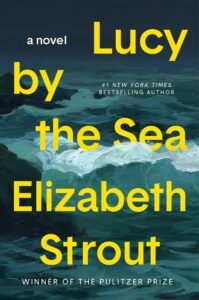
This is a post about a lot of things. It’s about being wrong, and dismissing certain ideas and ways of being, and the question of how one knows what’s good, all of which are actually themes of Elizabeth Strout’s Lucy Barton books, which begins with My Name is Lucy Barton, and continues with the story collection Anything is Possible, Oh, William, and, finally, Lucy By the Sea.
I first read My Name is Lucy Barton in 2016 and, if you’ll recall, I did not like it. I wrote, “I bought the book in hardback, paid $30+ for it and felt I’d paid a lot of money for something slight and unfinished. Which was inherent to the project, I supposed, but I was never able to quite figure out how, or what the point was, or why this wasn’t a novel proper.” At the time, I’d also noted that the book was short enough, however, that maybe I’d go back and read it again…but I didn’t. Even with the subsequent books, I was willing to let Lucy Barton go. But then the books started to be awfully celebrated, appearing on book lists, readers I admire a great deal declaring their love for them, and so this winter I decided to try them again. (No big chore either, they’re all very short!)
And I’ve got to tell you that everything I thought was weird and slight about the Lucy Barton novels is still right there. The downright unfashionableness of the project too, the quiet, the earnestnes, so many exclamation marks!! (!!). Telling, not showing. She’s breaking all the rules I know of how to write a novel well, and it’s my immediate instinct to dismiss these books again. I’m only considering them again because other people are telling me that they’re good, instead of me knowing that in my bones. And isn’t that everything we’re advised against as readers, as critics, as humans? Of following the crowd, reading like sheep?
I fervently believe that so much of what we regard as literary criticism is actually a matter of taste, and I also know that it takes all sorts, and books would be very boring if there were only one kind of book. Other people love books I loathe, and vice versa, and that’s precisely what gives books, and life, and the world, its flavour.
But still, to remain open. This is the object, I think. To stay curious. To look backwards and wonder if there is something you might have missed, some part of the puzzle you might have failed to understand.
What I missed about the Lucy Barton books in the first place is that I don’t think Strout was trying to write the novel as I know it anyway. (Similarly in her celebrated Olive Kitteridge, which was less a collection of linked stories [though it was also that] than an attempt to show the multitudinous of humanity and the universe, and the fundamental unknowability of another human being.) Strout’s books are less an exercise in narrative than one of character, and its variable layers, and the connections between them, and between places, ideas, and things,
Such as that Bob Burgess, who Lucy Barton meets Lucy By the Sea, has his own book, Strout’s 2013 novel The Burgess Boys, which I’ve just put on hold at the library. Or that Olive Kitteridge herself shows up, secondhand, in Lucy By the Sea, in conversations Lucy has with the cleaner from Olive’s apartment building. Or even just the way that one paragraph leads to another, leaping back and forth across time, between focusses and ideas, almost a randomness to their pattern—which had been my impression when I first read My Name is… back in 2016. When I hadn’t known enough to trust that I was in the literary hands of somebody I could trust.
“One of the reasons I believe this memory to be true is, first of all, it was so strange.” —Lucy by the Sea
It is the strangeness, and seeming randomness, of the Lucy Barton books that has me having real difficulty understanding it as fiction, has me struggling to believe that it is not true. Because the strangeness is so lifelike, as opposed to the constructedness of a literary narrative, the sense that a fictional world has to make, or so I assume—and Elizabeth Strout does no such thing.
I had a hard time with with Lucy by the Sea, a novel beginning in March 2020 and set against the unfolding pandemic, which is to say that it got into my head and tapped into my own pandemic (small t) trauma in such a visceral way. I also loved it and found it riveting, because any work of art that can so effectively tap into one’s nervous system is a wondrous thing, but it was upsetting to live that story again, to recall the fear and uncertainty, how dire things were, which is easy to forget now that we’re so much farther down the road.
It’s a novel (like all the others, and Olive too) about relatability, about what happens when we think we know when we don’t, about the limits (maybe?) of understanding people whose life experiences have been different from our own. Or about the ways that knowing and being known can be a burden—Lucy’s relationship to her sister, or even her own daughters, who—she realizes—remain at a remove from her because their own sadness affects her too much.
Books like the Lucy Barton books are never finished, there is no THE END. As Lauren Leblanc writes, “Like in any relationship, there are times in reading these books when certain stories demand attention, and there are times when personal moments are concealed or suppressed. There is inherent pleasure in that mystery. Her books read like familiar friends: complicated, timeless, achingly human, and compassionate.”
Elizabeth Strout doesn’t write novels so much as chart constellations, connecting points of light, moments of grace.





