August 27, 2009
The Mem Keeps Coming
Sometimes one thing leads to another, or else it just leads to the same thing over and over again. The latter in this case, which is the case of children’s author Mem Fox, beginning with her book finding its way into my house quite indirectly. From reader comments, I discover that everybody loves Mem Fox, and get some further Mem recommendations. The next week at the Library Story Time (which was incredible, incidently, are we ever lucky to have the Toronto Public Library system available to us!), the librarian pulls out Fox’s latest Hello Baby, as well as Ten Little Fingers and Ten Little Toes. (They are so good!) And then today I walked into a bookshop near my house and found a copy of Mem Fox’s Reading Magic: Why Reading Aloud to Our Children Will Change Their Lives Forever. Naturally, I bought it. Tomorrow I expect I’ll run into Mem Fox in the grocery store, never mind that she lives in Australia…
August 26, 2009
So lucky
 Harriet is three months today, which means I’ve got every right to post baby pictures. And we’ve got some gorgeous ones, taken this weekend by our friend Erin who makes everything beautiful, as well as another one displaying the ever-elusive, always precious Harriet smile. This third month has been a very fine one, real life returned to us. Harriet sleeps in her crib now, and for such long periods of time that I’m a very spoiled mom. During the past week we’ve gotten so that I get to come back downstairs after putting her to bed, rather than just collapsing into bed exhausted.
I kept a journal of letters to the baby throughout my pregnancy, and my plan was to write it throughout the postpartum too, but I didn’t write a word until Harriet was nearly two months old. Which is interesting– I’ve thought so much about how there is so little record of what that period is actually like for anybody, but I know that for me, I had no desire to write it all down so in essence to live it twice. Once was most certainly enough. It is, like much of motherhood, I am learning, better just to get on with it.
But part of the struggle, for me, was that my feelings weren’t at all what I’d expected them to be.  Not only did I not know how to articulate them properly, but I was uncomfortable even trying. I’d wondered if I’d see my baby and recognize her from the start, but I didn’t. Getting to know her has been a slow and involved project, and of course I have to say that of course I’ve always loved her, but it’s much more complicated than that, really. I’ve had to grow into this love, or perhaps it’s that my love for her is so entrenched within me that I barely recognize it. It’s way below the surface, is what I mean, so that I find myself staring at this tiny stranger and wondering who she is, and yet when we’re apart, she is the string of thoughts in my head. Meeting her needs is such a primal urge I’m scarcely conscious of it, and yet it’s overwhelming. When she’s sleeping, I want her to never ever change, and at the same time I’m so eager to mark her progress, to meet this person she’s slowly becoming. I can’t remember what I ever did before, who I was then, but I also don’t feel substantially changed. In that I’ve been Harriet’s mother forever and ever, is what I mean by that. Or something quite different at the very same time.
 I’ve heard tell of complaints that Toronto’s had a very rotten summer, but I’ve missed the rotten, playing with my baby under shady trees, taking long walks, taking her to yoga, to the library, to the museum to sit on a bench and watch the fish swim. We’ve cut down on our evening walks now that the baby goes to bed early, but they were what got me through June and July when Harriet screeched on schedule, and I will remember the fresh air of those nights with fondness forever. Too many trips leading to ice cream, but it kept us happy and sane(ish). And now lately, we’ve had weekend trips away, a jaunt over to Toronto Island, and we’re going away this weekend too for a tiny getaway, just for fun, just for summer. The summer that I thought would be lost to me, because certainly I do not remember June, but it all comes back, slowly, it does. And we’re happy, if not always, and so lucky, always, always.
August 25, 2009
Thinking is not a performance
I’ve just started reading The Wife’s Tale by Lori Lansens, whose novel The Girls I loved so very much a while back. And I’m starting Amy Jones’ fiction in The New Quarterly, which makes me look forward to her forthcoming book What Boys Like. Online, Lawrence Hill discusses his problem with the overuse of To Kill a Mockingbird in schools. Writer Laurel Snyder on overcoming her Twitter addiction: ” It’s the idea that thinking is not a performance, hard as that can be for someone like me to accept.”
August 24, 2009
Define "tuffet"
“The conventional wisdom is that a precocious reader is a child in possession of a prenatural grasp of both the facts and features of the adult world. This may well be true of some, but was not true of me. My reading list didn’t grant me access to the particulars of adult life, but to its moody interstices, the dark web of complex feeling that apparently suffused life after grade school. Like a child reciting nursery rhymes, I was consumed by the music of the words, not the circumstances surrounding Miss Muffet and her actual tuffet. (Well, can you, even now, define “tuffet”?)” –Lizzie Skurnick, from Shelf Discoveries

August 23, 2009
Swimming by Nicola Keegan
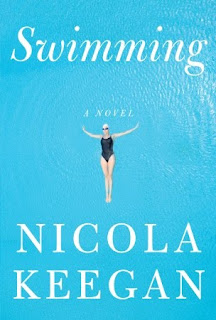 Swimming begins, “I’m a problematic infant, but everything seems okay to me.” Narrator Philomena, draped in rolls of baby fat, goes on, “I live simply; when something doesn’t seem okay, I scream until it is again… I am nine months old and the longest I’ve slept at one time is one hour and forty three minutes.” Poised on the edge of the pool before her first aqua babies class, she is slipped into the water and finds herself “liberated from my fleshly prison of gravity.” Philomena swims and she swims, kicking and rolling, amazing all those poolside, and when pulled from the water, she spits up, pees on her father, and then falls asleep for fourteen hours.
Her parents keep checking on her after: “It is an unspoken fact that they can finally love me now that I’m out cold. They bask in this love, as waves of breath ebb and flow, causing the dome of my stomach to stink, then swell. The silence of the household has opened a space for hope.”
I elaborate this first chapter in such detail in order to explain that Swimming isn’t what it sounds like. The journey of a girl from a small Kansas town swimming to Olympic stardom, an American-type story. Interestingly, however, Keegan turns out not to be American at all, and it shows in her writing. Her narrative reminiscent of Kate Atkinson’s in Behind the Scenes at the Museum, both books dark and hilarious in turns, eccentric family histories beginning with the narrator’s birth, except in the case of Philomena, this birth actually takes place that moment she first gets in the pool.
Only in this first chapter, however, do we get a sense of Philomena in the pool– how it feels to kick, to float, to duck underwater. Though swimming remains her passion throughout her life, “passion” isn’t the right word exactly, because swimming is more a means to an end, which is survival. Sink or swim? She chooses the latter, so that instead of swimming as the main exploration of the narrative, the sport is a metaphor for how Philomena lives her life. Tracing it back it to its very origins, she says, we all start out swimming anyway.
Despite her aptitude for all things aquatic, Philomena receives little encouragement from her parents regarding swimming. Once again, this won’t be the expected tale– of prodigies worked to the bone, of childhood lost. Her preparation for her olympic career isn’t years and years of practice and determination, but rather an eccentric family to start with, compounded by tragedy. In her mid-teens, Philomena starts swimming to save herself from nothingness, to avert her mind from traumatic memories, and her natural ability is still apparent. So that she catches up fast and she begins to win. Winning itself the object, the race, ripping through the water instead of focusing on what’s around her. She becomes the omniscient narrator of her own life, with all the distance that might imply, and her friends and family she renders brutal caricatures, because this is how life is bearable.
Swimming is Keegan’s first novel, which is obvious at times. Not that the book reads like a novice effort, but instead it’s clear that Keegan has poured into Swimming absolutely everything she’s got. The shape of the book is not quite perfect, but its substance is something remarkable. So that I hope that Keegan has not exhausted her store, and I look forward to seeing where her talent takes her.
August 21, 2009
Not an alternative
“It is not that I think every person should become a parent, or would claim that childbearing enhances one’s creative capacities (although I do think such an argument could easily be made given that childbirth, perhaps even more than other life-changing experiences, broadens one’s sense of meaning as well as being). It is that being a parent — a mother, especially — should not be narrated as an alternative to having an engaged, creative life, as if one must choose one or the other or be crippled by both.” –Amy Lavender Harris, “Pure Light”
August 19, 2009
Breaking up is never easy, I know.
Now reading Swimming by Nicola Keegan, which wasn’t at all what I expected, which is probably a fine thing. I’m also reading the latest issue of The New Quarterly, which is more than I expected, which is an amazing thing. Its contents are so diverse, surprising, current and consistently excellent. I’m not sure if it’s wrong of me to say it’s more “magazine” than “journal”. And not because it’s less high-brow, but just because it’s interesting. I also just broke up with a trashy novel I was expecting to love and tell you all about, but it was crap, or at least its first 124 pages were, and life is just too short to find out if the rest of it is better.