
February 17, 2010
Getting Settled
Oh, I do love my new website. I love the colours, and I love the doors (which I photographed in Elora last summer), and I love my cool twitter feed in the sidebar, and my “Features” buttons. In the wider world, I love that celebrating Valentines, Family Day and Mardi Gras, and though tomorrow is the first day in three days that isn’t a holiday, my husband’s got the week off work so the fun continues– tomorrow we’re going to the AGO. Though we’re completely exhausted already, and not just because of pancakes. I now see the advantages to preparing your baby’s nursery before the baby’s birth, as opposed to, say, when the baby is eight and a half months old, because it’s an all-consuming process, and then the baby gets so mad when you’re ignoring it to screw crescent-moon light covers into the wall. The one good thing about it though is that the baby gets an awesome room completely devoid of pastels, and perhaps a bit overstimulating, but something tells me our baby would have had that anyway.
Anyway, all this to say that we’ve had nary a spare moment, but I’m almost through Nicholas Ruddock’s The Parabolist and will be posting a review very soon. And next up for me is Patrick Swayze’s autobiography, if I actually decide to go through with it. Which seems like not the best idea in a world with so many books and so little time, but if I don’t, what might I be missing??
February 15, 2010
Housewarming
 Welcome to the new home of Pickle Me This, designed and built by the good people at Create Me This. We (and our extensive archives!) are very happy to be at home here. Looking forward to some great content up in the next few days, including an interview with Amy Jones and a rather shameful post on my own authorial encounters. For now, you can check out my Valentines recommendation for a different kind of love story.
And now, to warm up the house, please leave a note and let us know that you’ve dropped by.
February 15, 2010
Canada Reads 2010: UPDATE 5
 This week, Wild Geese went in at third in my personal rankings (so far). Charlotte Ashley is reading Canada Reads and Canada Reads Independently together, this time with Good to a Fault versus Hair Hat. Of Hair Hat, she writes: “Carrie Snyder showed an especial talent for directing me to the very heart of a character with a mere observation of his or her lifestyle… Snyder’s short, sparse book sparkles…” Melwyk reads Wild Geese and attests to its force: “I have to say this was a really uncomfortable read for me. In style, it was very much of its time, something I am used to reading in New Canadian Library selections. But it had a dark energy, a sexuality and a violence which was disturbing. Caleb literally made my skin crawl…” August Bourre determines that Ray Smith’s Century is ” just a spectacular fucking book.” Indeed! Julie Forrest reviews Moody Food to find that it “perfectly captures the experimental headiness of carefree youth… But it also strips away some romantic notions of the age, and exposes the limits of idealism, and the cost of chemically assisted creativity.” And Buried in Print with a take on How Happy to Be, which I’m going to be rereading next…
February 15, 2010
Oh, for a cup of tea and crumpets
 ” ‘Do you know, Wilmet–‘ the dark eyes looked so seriously into mine that I wondered what horror was going to be revealed next– ‘he hadn’t even got a teapot?’
‘Goodness! How did he make tea, then?’
‘He didn’t– he never made tea! Just fancy!’
‘Well, one doesn’t really associate Piers with drinking tea,’ I said.
‘He drinks it now,’ said Keith. ”
–from A Glass of Blessings by Barbara Pym
February 14, 2010
Valentines Day Recommendation: A different kind of love story
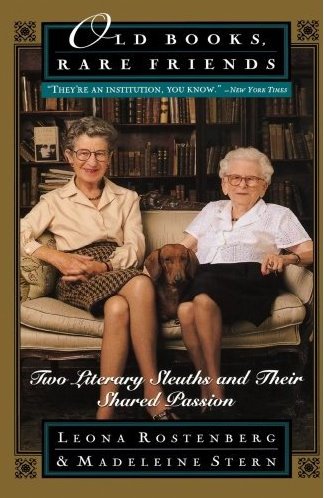 Old Friends, Rare Books is doubly a love story. About first, an incredible lifelong relationship. One which, the authors note, has been inferred to be sexual, but they say otherwise. That there had been men in their lives, and plenty of other friends, but in no one else did these women begin to find the sense of being so perfectly matched that they’d encountered in each other. Truly– as their joint autobiography attests to– Madeleine Stern and Leona Rostenberg speak in the very same voice, and mostly they’ve been talking about books since their meeting in New York at the beginning of the 1930s. And in recounting their adventures ever since then, the peculiarities of their relationship actually become quite unremarkable, or perhaps only as unremarkable as any extraordinary, enduring absolute partnership could be.
Stern’s work as a biographer brought much acclaim throughout her career– in particularly, her groundbreaking work on Louisa May Alcott. (And with a book on bookish connections, it’s worth noting that I only read Old Books, Rare Friends after seeing it referenced in Harriet Reisman’s new Alcott biography, which I only read because I’d read Little Women in the Fall, and I only did that because I’d found a battered copy in a curbside box two years ago and it had been sitting on my shelf forlorn ever since then). Rostenberg had completed a PhD dissertation on early printers and publishing, but it was unfairly rejected– a wrong that thirty years ago was righted with the granting her degree in 1972. In the meantime, she’d opened up her own business as a rare book dealer, Stern joining her a few years later, and their book recounts their adventures exploring bookshops throughout the world in search of precious volumes, which did have a knack of turning up rather serendipitously. Their sleuthing/detection skills were also put to use in their discovery of Louisa May Alcott’s vast body of salacious short fiction, published in 19th century periodicals under a pseudonym. This find would cast Alcott’s reputation as a kindly writer of children’s fiction into a new light.
All of which are part of this book’s other compelling love story– Stern and Rostenberg’s lifelong affair with books. An enthusiasm made contagious through such vivid and engaging prose. Truthfully, sixteenth century ephemera isn’t my cuppa tea, but I started to wish it was. Their adventures in literary sleuthing were like Possession but in real life! Their extraordinary lives were such a grand adventure, the stuff of a book lover’s dream.
I am so grateful for the literary luck that put me in touch with this marvelous volume. Love love love.
Happy Valentines Day.
February 12, 2010
Books I found in various boxes along the sidewalk on my walk home from Kensington Market
 1) If Life is a Bowl of Cherries, What Am I Doing in the Pits by Erma Bombeck. 2) Break, Blow, Burn by Camille Paglia. 3) Lost Girls by Andrew Pyper (personally autographed to boot, with many thanks, but I won’t say to who). 4) hardcover of What is the What by Dave Eggers. 5) Gertrude Bell: Queen of the Desert, Shaper of Nations by Georgina Howell
February 12, 2010
Why I love people…
“The idea grew as Morrison considered ways to make the cake pans fly better…”
From the obituary of Walter Morrison, who invented the frisbee.
February 12, 2010
Why I have business in the bedroom of Adam Giambrone
 I don’t know if there are two things I like more than passing judgement and reading stories, and so I’ve been wholly absorbed by the perils of Adam Giambrone this week. I’ve long had my eye on the guy, if only to use his surname as verb in various contexts, which is always funny when I’m overtired, and so I’ve been paying attention since Monday, however much that’s less than high-minded to admit.
I’ve been paying attention because I’m a follower of plot, of twists and turns, and wild leaps. Office couches, text messages, denials then tears at the press conference. The scintillating details, the text messages, and we’re not supposed to care because it’s his private life after all, but don’t you care just for that reason? The kind of access to private lives that we usually have to read novels for, and perhaps it’s why we read novels anyway. How can you turn away from it? I can’t.
Of course, there are real people involved, real lives at stake. To which I posit that there aren’t. Case in point, the picture above from The Toronto Star— have you ever seen a more calculated chemistry? I could say I’m sorry for the wife, but I wouldn’t really mean it. To pretend otherwise would be disingenuous. Giambrone himself has become a fiction, has probably long been one, but we know it now. If he were less lame, he’d be Jay Gatsby. And of course, there’s a real Giambrone still deep down inside him, but that’s not the guy upon whom I’m passing judgement.
The guy upon whom I’m passing judgement is an idiot. Not only does he think that women are disposable, but he dates the kind of woman who wouldn’t hesitate to destroy his whole career in a heartbeat. The kind of woman who’d date him even though she thinks he lives with his parents, and he’s 32. And– though this population is larger than I’d initially suspected — he dates the kind of woman who’d tolerate that haircut. He gets caught, and he lies about it. He someone who knows himself better than anyone else knows him and yet he sets himself up for this exact situation by pursuing public life (which, let’s face it, most people don’t do for really honorable reasons). Even the smartest guy would have trouble balancing his public face with a life that’s a lie.
I’m not condemning Adam Giambrone for immorality, for that kind of thing is always a little bit subjective, but I think I’m allowed to call it as I see it– he’s an idiot.
I hate the word “peccadillo”. Why do women never get to have those? A “peccadillo” trivializes all manner of sins, packs them up in a neat valise that rhymes with armadillo, and how convenient is that? And then someone will lecture me about casting first stones, but these guys get up to the kind of wrongdoing I’d never consider. I know I’m young, but I’m getting older every day, and I remain steadfast about this. And to suggest that I’m just naive then is an insult to men of integrity everywhere, and I’ve met an awful lot of these in my life. I just think we all deserve a lot better.






