September 1, 2010
On having read The Slap
 “One of the striking things about so-called literary fiction is that it tends to be not morally simplistic,” says Jonathan Franzen in his recent Globe & Mail interview, which means that Christos Tsiolkas’ The Slap might be about as literary as they get. Though I’m not so sure that lack of moral simplicity is that simple. What kind of fiction does a book get to be when everyone in it is totally awful?
But let’s go back to the beginning. I heard Christos Tsiolkas on a rerun of Writers and Company, and liked the sound of The Slap: a story that takes place at a suburban barbeque in Melbourne Australia, where a man slaps somebody else’s misbehaving child. The novel explores the ripples effects of that action, and also deals with the cultural climate of that country: the sons of Greek immigrant communities, their wives whose families come from India, the blonde-haired, blue-eyed “Australians”, the aboriginees (and in this case he’s converted to Islam, and changed his name to Bilal).
I saw The Slap in a bookstore when I was on vacation, so I scooped it up, and arrived home to find that the book had been long-listed for the Booker Prize, and was being called “unbelievably misogynistic”. I read it anyway, because it had appealed to me, but also as a kind of experiment in reading something I wouldn’t normally read.
Tsiolkas defends his book by saying that a book isn’t misogynistic just because its characters are. Which I agree with entirely, but I think the book is misogynistic if the hatred of women it expresses is so unrelenting, so pervasive that when you get to the end of the book and consider an underlying message, that message is probably, “Mothers are the source of all the world’s problems”. Nothing in the book refutes this. Motherhood, so says every narrative strand in this enormous book, makes women “selfish, uninterested, unmoved by the world”. (Women without children do receive a get out of jail free card).
The women in The Slap are all intelligent, interesting people, but each of them is complicit in her own degradation. Each of them is slim and beautiful, married to brutish men who like to have sex with prostitutes. They also treat their wives like prostitutes when they have sex with them, and pretend their wives are the prostitutes. That their wives are also the mothers of their children inspires a bit of tenderness, but it’s usually fleeting. The word “cunt” gets thrown around a lot. These men hate their wives, and they hate their lives, but mostly they hate their wives. Seethingly. Every single one of them.
Also, everybody does drugs. Everybody. It’s kind of boring actually, pill popping as a plot device. Is this really suburban reality? Do I not see that kind of thing in my own life because I live downtown.
So why did I like this book? Because it’s a soap opera. Because Tsiolkas is a master of plotting, and I raced through this 500 page book to see what would happen next. Because, although I didn’t like the answers, the novel posed provocative questions about motherhood and feminism. Because the novel is divided into sections, each from the point of view of a different person who’d been at the barbeque where the slap was slapped, and so we’re taken farther and farther into the future each time from a different perspective. The story becomes so layered, and multi-dimensional. Because each section adds pieces that fill out the past, sometimes to completely horrifying ends. Because where do we put our sympathy– disturbing to consider. Who do we cheer for in a crowd like this? What does it mean that we too want to see the kid get slapped? Want to slap him? Because the ending was totally wonderful. Because each character was so vivid, and how get to know them from within and without. Because the novel was unabashedly of right now. Because it was unabashedly everything.
Though I think it could have been more abashed. Seriously, I’m not an idiot. I know that Huckleberry Finn isn’t racist, is what I mean, because anti-racism is its underlying tenet, but all I took away from The Slap was that women are everything that’s wrong with men, which is everything that’s world with the world. That men hate women, blame them for their ills and justifiably so. And there was nothing in the book that refuted this. What am I supposed to make of that?
In the Guardian piece, Tsiolkas responds to such criticism: “I would call them lazy readers. I think they are confusing the writer with the character. I think there’s a laziness now in how we read. We read for confirmation of who we are, rather than for a challenge of who we are.” Which I get at some level, and he’s managed that challenge very effectively, but I don’t think my reaction is purely personal. Or maybe I just don’t think I really need to be challenged about who I am as a person who is not a worthless piece of shit based upon my gender.
September 1, 2010
The world is a Pymian place
 I discovered The Barbara Pym Society before I’d even discovered Barbara Pym, in 2007 when I read this wonderful article on the CBC Arts site. This article was mostly the reason I ended up reading my first Pym book last fall, which was Excellent Women (though I think I was also inspired by a reference in Susan Hill’s Howards End is on the Landing.) And that book was the way I fell in love with Barbara Pym, and how convenient that she had her own society that I could join. They hold annual conferences in Massachusetts and Oxford, both of which are just a bit too far out of my way, but I had a dream of one day getting there, and indulging in a bit of Pym talk with like-minded individuals.
It was to my great joy that I received a letter in July from Judy, a local Pym Society member who was looking for a meet-up. Turns out there are only a few of us in Canada– one in Montreal, three in the GTA, and four in Victoria (which makes it a veritable hotbed, no?). Judy orchestrated a get-together for those of us nearby, was gracious enough to move the venue to my house (as travelling alone with Harriet is less than fun), and we were thrilled to have our third member RSVP, and were pleased that she was to bring her daughter. Because, she and her daughter had visited Barbara Pym’s cottage during a trip to England in 2009, and they even met Barbara Pym’s sister. (Pym herself died in 1980).
And truly the world is a delightful place, because this group of strangers got together and there was immediately a kinship. We ranged in age (including Harriet) from 1-85, and we entertained one another with stories of how we’d found Barbara Pym, and what she meant to us. How her work is so deceptively simple, and how she invests the ordinary with meaning. Tea was served, scones were eaten (as this was my house, after all). At this point, Harriet left the room, and then returned wearing a hat and carrying a handbag. It was 40 degrees outside and we were sweltering in spite of the fan, but even still, the time went too quick and good conversation flowed. We wondered if Pym had ever fathomed that groups such as ours’ would be discussing her work (with such passion) thirty years after her death. Having recently read her biography, I suspected probably not, but I really wish I could have told her. Someone suggested that one couldn’t channel a spirit anymore than we were doing just then, and she was probably right.
It was a wonderful gathering, and we’re going to do it again, and I think I might have been the luckiest one there because I’ve still got unread Pyms before me. The others were inspired to reread. We said goodbye with enthusiastic hugs, and after everyone had left, I opened the hostess gift that Judy had brought me, and how thrilled I was to discover (wrapped in William Morris paper, of course) a jar of Ovaltine.
The world is a Pymian place.
August 30, 2010
The Beauty of Humanity Movement by Camilla Gibb

Camilla Gibb doesn’t reinvent the novel in her latest The Beauty of Humanity Movement, but she challenges the limits of what a book can hold. Her book is packed full with the expansiveness of its story, its vividness of place, of history, its multiple points of view, and voices, and languages, and cultures, and art. Depicting humanity at its ugliest, and most beautiful, all very tidily in under 300 pages of gorgeous prose, The Beauty of Humanity Movement was absolutely a pleasure to read.
The book takes place in Hanoi, “the Vietnamese heart”, the city from which was born pho: “a combination of the rice noodles that predominated after a thousand years of Chinese occupation and the taste for beef the Vietnamese acquired under the French”. In the city, Old Man Hung’s pho is famous, its mere aroma bringing men to their knees. He’d had a shop years ago, but lost it when everything was nationalized, and these days couldn’t afford the rents or the bribe money that would be required to even secure a lease.
Pho’s shop had been a gathering place for radicals in the 1950s, when the Vietnamese people were rising up to overthrow their French oppressors. The artists and poets who’d met there had been part of The Beauty of Humanity Movement, which envisioned a glorious kind of socialism, and not one that merely replicated the tyranny that had come before it. Of course, this kind of vision is the sort that gets men in trouble, and eventually the authorities clamped down on their expression. Their leader, the poet Dao, was sent away to an appropriately-ominous-sounding “re-education camp”, and he is never heard from again.
Two generations later, Dao’s grandson is a young man with endless potential, in comparison with his parents who’d toiled for years in a ping-pong ball factory. Tu had become a math teacher, and then realized that loving math and teaching math are not synonymous experiences. He’d left his profession to give tours of Hanoi to Americans, and to pursue happiness in both the material and ideal senses. Though he is not so forward-looking– he reveres Hung, his family patriarch, who took over the role after Dao was lost, and kept the poet’s memory alive for his descendants. And so Tu continues to visit Hung, who lives in a shack and serves his pho from a ramshackle cart, and who belongs to a older Vietnam that is quickly disappearing.
Gibb’s narrative spins all these strands around a character called Maggie, Vietnam-born but American-raised. An art dealer and curator, she has come to Vietnam to find a trace of her father, an artist, who may have been part of Dao’s movement. Everybody she speaks to tells her she should talk to Hung, but when she finally finds him, it seems the old man’s memory is beginning to fail. He and Maggie work together to possibly recover some pieces of the abundance that was lost.
Though The Beauty of Humanity Movement is her fourth novel, in many ways it represents a sophomore effort for Gibb, an attempt to follow the “break-out success” of 2005’s Sweetness in the Belly. Both novels are enriched by Gibb’s background as an anthropologist, and manage to contain the stuff of culture but get bogged down by it– Gibb spins the stuff into story. And though this new book does not quite mesmerize in the way that Sweetness… did, that’s a lot to ask of any book, and so I’ll settle for just being glad that Camilla Gibb has written another wonderful novel.
August 29, 2010
A whole month more of summer
 Though has been pointed out quite astutely, we’ve got almost a whole month more of summer left, and there aren’t even squash at the market yet, but still, that this week contains September is just a little bit overwhelming. Mostly because summer has gone by in an instant (but oh, such a wonderful, beautiful instant, that completely made up for last summer that got lost with the newborn baby), and September promises to be just as quick.
Tomorrow I’m hosting an afternoon tea for the local members of the Barbara Pym Society, and I’ve spent tonight baking scones, and cake, and learning how to make egg salad. On Sunday, I’ve got a best friend getting married, and Harriet is going to be a flower girl. I think there’s a free weekend in there somewhere, but that’s followed by Eden Mills, and we’ve got another wedding the week after that.
I’ve got plenty of get-togethers planned for the weeks in between, including a pie-date with some fine bloggers. The Vicious Circle will be reading The Comforters by Muriel Spark. I’m going to be interviewing Alison Pick, author of Far To Go. Harriet has her calendar fairly busy with friends of hers to meet, and I imagine I’ll be accompanying her on such outings. I’m going to read the new Jonathan Franzen. I’m going to finally go to the dentist (we’ve been between health insurers for a few months), and find out what’s gone wrong with my gums. I’m going to finally finished this reading project which has been taking up so much of my time, and I can turn my attention back to rereading. I’m going to write a review of Camilla Gibb’s latest novel, which I enjoyed very much and finished reading on Friday. I’m going to write blog posts about my feelings towards Mad Men, about whether an author’s life should matter in how we read their work, about what Ray Smith has in common with Jennifer Weiner, a review of a Zsuzsi Gartner short story, and the story of the time I got an OAP discount on a haircut when I was seventeen. And of course, I’ll be up to other things. (Like fiction!)
But now I’m going to go to bed because I’m exhausted already.
August 25, 2010
Notables: The Little Mother Goose
 Though I collect books, I am by no means a Book Collector, because most of my books are battered paperbacks that Penguin put out in the ’70s. I do, however, have some notable exceptions in my library, which are by no means valuable or rare, but they still possess a certain kind of charm. And so these books will be the subject of a new Pickle Me This feature, which I have just entitled Notables.
The first notable is The Little Mother Goose by Jessie Wilcox Smith, and the first cool thing about this book is that it’s available in its entirety as a Project Gutenbergy eBook, whose pictures are sharper than those in my book, which is points for digitization. My book doesn’t have hyperlinks either.
My book, however, unlike the digital version, is almost ninety years old, and is inscribed (in ink that hasn’t even faded), “To Helen on her fifth birthday. from Mama.” Helen is my late-grandmother, and her mother died when she was eight years old. My mother, who is Helen’s daughter, had the book rebound, and gave it to me for Christmas two years ago when I was pregnant with Harriet.
(The power of book as object [or I suppose the power of object in general, of relic] is underlined by what I find in my great-grandmother’s letters, which I have a collection of. On a whim, I just opened it to April 16, 1923, and found this: “My dear Susie, This is Helen’s birthday and she had quite a glorious time. She started kindergarten last week but I didn’t let her go today as she had quite a cold and I thoguht maybe she was developing measles…/ Your brass jardinier came long ago. She is very fond of it and spent about a half hour polishing it today. Other gifts she received were- A pair of gloves from Daddy/ A Child’s Garden of Verses by Stevenson from Clara…/ Skipping rope from James/ The Little Mother Goose illustrated by Jessie Wilcox Smith from Mama and a hankie from little Hazel Keenan who was here for tea. I made a lovely angel cake and of course it had candles, Mother brought ice cream for a treat too. So the child had quite an exciting day altogether.”
Indeed, as Tom Stoppard wrote in Arcadia, “We shed as we pick up, like travellers who must carry everything in their arms, and what we let fall will be picked up by those behind…” Though I wonder what happened to the hankie or the jardinier. I imagine the cake was devoured…)
Anyway, I’m way off track. In addition to its beautiful illustrations, this book is full of nursery rhymes you’ve never ever heard of, and the proportional few that you have.
Like, “Pickeleem, pickleem, pummis-stone! What is the news, my beautiful one? My pet doll-baby, Frances Maria, Suddenly fainted and fell in the fire; The clock on the mantle gave the alarm,/ But all we could save was one china arm.” And that little-known second verse to Jack and Jill: “Up Jack got and home did trot, As fast as he could caper; Dame Jill had the job to plaster his knob, With vinegar and brown paper.” Um, yes.
A few rhymes referencing something called “Chop a nose day.”
And many riddles, including “A riddle, a riddle, I suppose. A hundred eyes and never a nose.” (Answer: a cinder-sifter). I probably wouldn’t have got that one.
August 25, 2010
Hardly a good advertisement
“I’ve just made a cup of tea,” said Miss Caton, who was crouching near the gas-ring. “This will do you good– a strong cup of tea with plenty of sugar. I learnt that when I was doing first aid during the war– treatment for shock.”
Humphrey glanced distastefully at the tan-coloured liquid in the think white cup and waved it aside. “No, thank you, Miss Caton– I really couldn’t drink it– and where did you get that terrible cup?”
“It’s the one I have my elevenses and my tea out of every day,” she said briskly.
Humphrey took his mid-morning coffee elsewhere if he was not at a sale and was seldom on the premises in the afternoon either, so he had probably never noticed his typist drinking from the thick serviceable cup.
“Well, Miss Caton,” he said. “I can only hope that nobody has ever seen you drinking from such a monstrosity. It would hardly be a good advertisement, would it?”
“I take my tea in the back,” she said, on the defensive, “so no customer could have seen me.”
“And you, James– do you drink from such a cup?” asked his uncle sternly.
“I don’t know,” James mumbled. “I suppose I may have done on occasion.”
Humphrey exclaimed in horror.
“Perhaps a cup of China tea,” Miss Caton persisted, “though it wouldn’t have the same reviving effect, and without milk or sugar it might be too acid for you in your present condition.”
–from Barbara Pym’s The Sweet Dove Died
August 23, 2010
A Room of One's Own
 In March, I spent $130 signing up for ten yoga classes, of which I’ve gone to two, and my pass expires this week. Which is good actually, because then I get to feel less bad about the money that’s gone to waste. I’m not typically a quitter, or one who doesn’t follow through, but when I signed up for yoga class, thinking it would give me a fine escape from the stay-at-home nature of stay-at-home-motherhood, I really had the wrong idea. After a long day alone with a pre-verbal midget, the last thing I need is to be silent in a room of levitating hipsters. It is also distinctly possible that I just picked the wrong yoga studio, but that is another story.
What the story is, however, is that it turned out I didn’t need that much push to get out of the house after all. Yes, indeed, I could probably do with more exercise, but I’ve also joined a fabulous book club, take part in an incredible writers group, and do some work for a charity’s board, and that takes care of quite a few evenings each month. And I enjoy these evenings out so completely, their social nature in particular, because it turns out what I need at the end of the day is company and conversation, but I didn’t know that in March.
Similarly, I have abandoned my garret. Tragic, I know, that the garret is forced to make do without me, and I find myself garret-less. And yes, the garret was a bit bleak, actually being the back of my very strange bedroom closet/storage area, and now it’s packed to the sloped ceiling with newborn baby gear (which, yes, we haven’t gotten rid of. Though it won’t be put back into use for a very long time), but it was a garret, and it had a window, and an outlet, and it was nothing to scoff at, being a room of one’s own. Or at least a corner of an expansive closet of one’s own, which was plenty.
But it turns out that after a day at home alone with a young child, spending an evening alone in the back of a closet is bad for the soul. Or so I imagine, having not bothered to try. For the last year, my office has been a chair in the corner of my living room, by the window with my laptop, with my husband busy at his actual desk on the other side of the room. I miss him when he’s at work, and when he’s home I like to be close to him, even if neither of us are talking and both of us are working on various projects. I’ve contemplated moving back upstairs, but this arrangement seems to be working, and so my desk in the garret sits terribly empty, a magnet for layer upon layer of dust.
One of the best things I own is my A Room of One’s Own tea towel, which was a gift from my friend Paul. Due to its literary nature, it used to hang in our library, before the library became Harriet’s room. Since then, the tea towel has been homeless, and I’ve wondered where to put it, no longer actually having a room of my own (or rather, now that my room of my own is usually empty. Which would make hanging the tea towel there particularly sad).
Last night I finally hung it up in the living room, on the last bare spot left on our increasingly riotous walls. True, this room isn’t one of my own, but I’ve decided to regard Woolf’s idea as a metaphor. This idea underlined by Rachel Cusk’s suggestion that perhaps the greatness and distinction of women’s writing came from women not having rooms of their own, from their novels being composed amidst the hustle and bustle of family life.
Perhaps she’s right, or maybe that only works for some people, and I’ve no doubt my mind and my location will be changing one of these days, but having the tea towel up again, I feel that I’ve arrived somehow. Or that I’m home again, settled, and that it’s not so much a room of my own that I need as much as simply room.
*I guess this is my how NOT to be alone post. I never claimed to be consistant.
August 22, 2010
Eden Mills Festival Fringe!
 Today’s exciting news was that my story “You Can’t Run a Show on Stage Management Alone” was accepted as part of the Fringe Stage at the Eden Mills Writers Festival. This will be my third year attending the festival, and I was looking forward to it anyway, but that I’ll actually now be (a small) part of the event is overwhelming and really lovely. Hope some of you can make it out on Sunday September 19th, and we’ll start crossing our fingers for sunshine.
August 22, 2010
Cups and saucers
 Today we not only hopped in the car, but we went to the mall, both of which are novel experiences for mall-hating folks such as ourselves, who don’t even own a car. But it was raining outside, and Harriet needed new pajamas, and our dinnerware also needed replacing after more than five years of being chipped and broken. Due to financial reasons, I couldn’t get the dishes I really wanted, but I do like the ones we settled on instead. The teacups in particular, and how lovely to have a saucer for each one to rest upon.
August 21, 2010
Alone With You by Marisa Silver
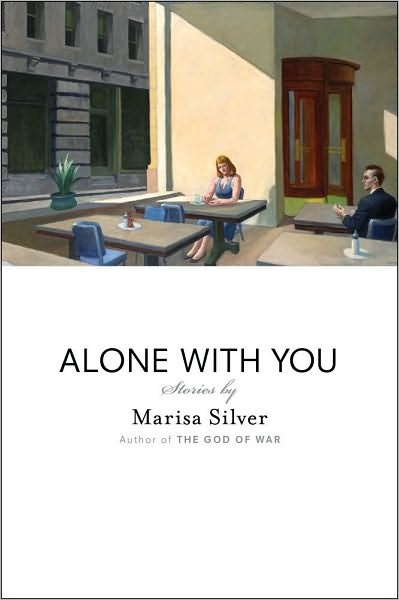 The very best pieces in Marisa Silver’s Alone With You are each expansive enough, containing more story than most novels do, so that the volume isn’t really slim; it only looks that way. Silver’s work has appeared in The New Yorker, she’s a winner of the O. Henry Prize, and has been much acclaimed for her novel The God of War. (It’s worth noting also that the New York Times review of this book is sets a benchmark for reviews we all should aspire to, and also that I don’t very many American short story collections, but now I digress…)
From the story “Night Train to Frankfurt”: “The fact of being was sometimes an unbearable mess and what was hoped for in life was so rarely reached. The shortfall between those two things was so much more fumbling and base than anything Helen had ever imagined.” And that shortfall, with all its fumbling, marks the development of most of these stories. They open up wide in the way that Alice Munro’s do, a decade passing in a paragraph break, and the narrative manages to never miss a beat.
In “Pond”, the mother of a disabled adult child confront her daughter’s pregnancy, her husband hovering in the background of the narrative only to be brought to the foreground at the story’s conclusion, as he’s forced to confront what his relationship with his glorious grandson implies about his feelings for his imperfect daughter. In “Three Girls”, the penultimate moment in a single night telescopes a young girl into the future and a vision of her older sister: “In that moment, Connie had the idea that she wouldn’t know Jean when they were older, that when Jean left the family, she would leave Connie too, because Connie would remind her of things she didn’t want to remember.”
Helen, from “Night Train to Frankfurt” accompanies her mother on a last-ditch attempt to cure her cancer, and their whole relationship, with all its ambivalence and love, is encapsulated in that train compartment. “The Visitor” tells of Candy, a nurse in a Veteran’s Hospital, whose patient has lost his legs and one arm: “It was sad. Of course it was sad. But she didn’t feel sad. Sad was what people said they were in the face of tragedies as serious as suicide bombings or as minor as a lost earring. It as a word that people used to tidy up and put the problem out of sight.”
Marisa Silver, however, does not do tidiness or sentimentality. Her stories are sad, yes, but they contain everything (and unfaithful men in particular), and something is glorious in all their messiness, in the deliberate perfection of their tangle.






