September 22, 2010
There is no such thing as a canon
 All the books of my dreams are coming out in the UK this fall: I want to read Comfort and Joy by India Knight, Started Early, Took My Dog by Kate Atkinson, and Burley Cross Postbox Theft by Nicola Barker (which is epistolary and about a postbox, if a book could be so full to bursting). I am going to read Room by Emma Donaghue, which seemed like the most wretched book imaginable when I first heard of it, and I still think so, but too many intelligent readers have convinced me to go there anyway. I have just moved Alexander MacLeod’s Light Lifting (which I keep calling Lift Lighting in my head) up near the top of my to-be-read stack, due to his Giller nomination, and Robert Wiersema’s review. I am going to be rereading Nikolski, We Need to Talk About Kevin, and Small Ceremonies in the coming weeks. Also from the Giller longlist, I think I am going to read Lemon by Cordelia Strube, and the rest I’m not really fussed about. Because I already read This Cake is for the Party, and it was wonderful, and Jessa Crispin has given me permission to shrug off everything else: “There is no such thing as a canon — what you should read or want to read or will read out of obligation is determined as much by your history, your loves, and your daily reality as by the objective merits of certain works.” Rock on, and bring on the old dead British ladies then with their hideously outdated Penguin covers and pages smelling of must.
In others, I am going to the Victoria College Book Sale on Saturday, but with a budget (how novel) and also, I am obsessive-compulsively fiction writing lately, which is wonderful, because I thought I lost the knack with the advent of my child, but I’m at 10,000 words and haven’t yet thought about giving up because the whole piece sucks (and the thing about having once completed three drafts of a bad novel is that you learn that just barrelling through to the conclusion won’t necessarily work out okay in the end, but at this point I still feel like there might be some worth in bothering).
And also, there is a pie in my oven. And on Saturday, that oven will be replaced with a new one that doesn’t require a barbecue lighter to start.
September 22, 2010
Congratulations
“The idea that as a literary person there are a certain set of books you must read because they are important parts of the literary conversation is constantly implied, yet quite ridiculous. Once you get done with the Musts — the Franzens, Mitchells, Vollmanns, Roths, Shteyngarts — and then get through the Booker long list, and the same half-dozen memoirs everyone else is reading this year (crack addiction and face blindness seem incredibly important this year), you have time for maybe two quirky choices, if you are a hardcore reader. Or a critic. And then congratulations, you have had the same conversations as everyone else in the literary world.” –Jessa Crispin from The Freedom World
September 21, 2010
"Banana": A poem by Alison Pick
Banana
Call him honey, call him
love, anything sending out
the high clear light
that is yellow.
Sunshine. So close
to white, the purest
of snow, granular
sand he toddles over, bucket
in hand.
Sugar. Come back
from the edge, my darling,
my dear,
and he does, brandishing mud
like a flower,
stacking your name like a tenuous
tower of blocks:
ma ma ma MA.
Call this true love.
Even on the longest of cloistered
afternoons when he reigns
in his highchair (call him
The King), the tin cup
dumped back onto the floor, banana
pushed back through his teeth
as though through a sieve;
in your mouth
the names clatter–
Sweet Pea, Sweet Cake–
like the rattle he shakes in his fist.
As though he desires
to be nothing
but the clear yellow light
he knows himself to be. Buttercup,
Angel,
call him what he is:
your Baby. Your Baby. Your Baby.
(from the collection Question & Answer: Poems, by Alison Pick).
September 20, 2010
The Sky is Falling by Caroline Adderson
 Caroline Adderson’s wonderful The Sky is Falling will not be outsmarted. The novel, in which Doris Lessing’s The Good Terrorist meets the short stories of Chekhov, is narrated by Jane Z., who opens the paper one morning to find a face she hasn’t seen in twenty years. The face belongs to Sonia, once Jane’s roommate, once a friend and possibly something more than that, and also a co-member of a movement campaigning for nuclear disarmament in the early 1980s. Sonia has just been freed from prison, after serving a twenty year sentence for a crime that will be the novel’s climax. The narrative flips back and forth between 1984 and 2004, as Jane explains what happened to her and her friends, and how her past connects with the very different life she lives now.
This is a novel deftly composed of fragments and allusions, whose construction is remarkably assured for this, and yet there are these moments throughout where something slips– a certain detail, an incongruency, we know one thing and then we’re told another–, and these moments take us outside the story for a moment. Poor editing, we can chalk it up to, and avid readers are encountering this kind of thing more and more these days.
And then. And then.
As I said already, Caroline Adderson’s novel will not be outsmarted, there are no slips. How Pascal was said to be a friend of Dieter’s, but Dieter doesn’t even appear to know him, and it’s not Adderson who’s slipped up here, but Jane, and her remarkably limited, unfiltered perspective. Or rather, a perspective that’s filtered solely through a lens of Chekhov stories and the Russian language she’s studying in her second year at UBC, and the stories are more real to her than her life is. She’s more of an agent in these stories, which she manipulates in her essays to suit her own political purposes, than she is in her own life where she is always on the periphery. She reads her life rather than lives it, and her readings are very often wrong.
Jane is the daughter of a Polish immigrant, she’s a foreigner in Vancouver where she has come from Edmonton for university. After a year of living three buses away from the campus with her eccentric aunt, she wins a spot in a shared house because she’s viewed as unthreatening enough to not steal somebody’s boyfriend. Here, she meets Sonia and the other housemates, all of whom have their own reasons for political action (and Adderson should be commended for her treatment of this ensemble cast). For Sonia, it’s a genuine desire to save the world (or perhaps to be the saver of the world, more particularly), and Adderson does a fine job of illustrating the heightened state of Cold War politics in 1984, with Star Wars, the Doomsday Clock, a rubber Ronald Reagan mask hanging by its eye-hole from a nail in the wall, and the Korean airliner that had been shot down by the Soviets the autumn before. To the insular group feeding off one another, all these were signs that the end was nigh, and to Jane, even more insulated within that insular group, it seemed her eyes were opening to reality for the very first time.
Twenty years away from all that, Jane is able to understand her own naivete– not necessarily that the end wasn’t nigh, but that she had a chance of changing any of it. She is just as powerless now as mother to a teenage boy who she fears is slipping away from her– it’s not his big leather boots she minds, or the piercings in his face, or his sullen friends, but that he’s becoming a stranger to her. Though Jane’s sympathy for teenagedom is admirable– Adderson has depicted the trappings of adolescence in a realistic way that would make Tabatha Southy proud. When Jane’s son finally seems interested in his mother, it’s only in her own surprising past, and Jane questions the ethics of using the allure of her past mistakes to connect with her son again. To what ends will he end up using her story?
The Sky is Falling is a great, smart and engaging novel that will appeal to Chekhov lovers, and make Chekhov seem appealing to the unconverted. Adderson’s allusions do not burden the story, but they serve to illustrate Jane’s lack of worldliness, and invest the whole novel with rich under-layers of meaning. The past and present strands of the story come together in a marvelously clever ending that both promises a brighter future, and also acknowledges that the thing about the future is that it’s always just escaping one’s grasp.
September 19, 2010
Eden Mills 2010
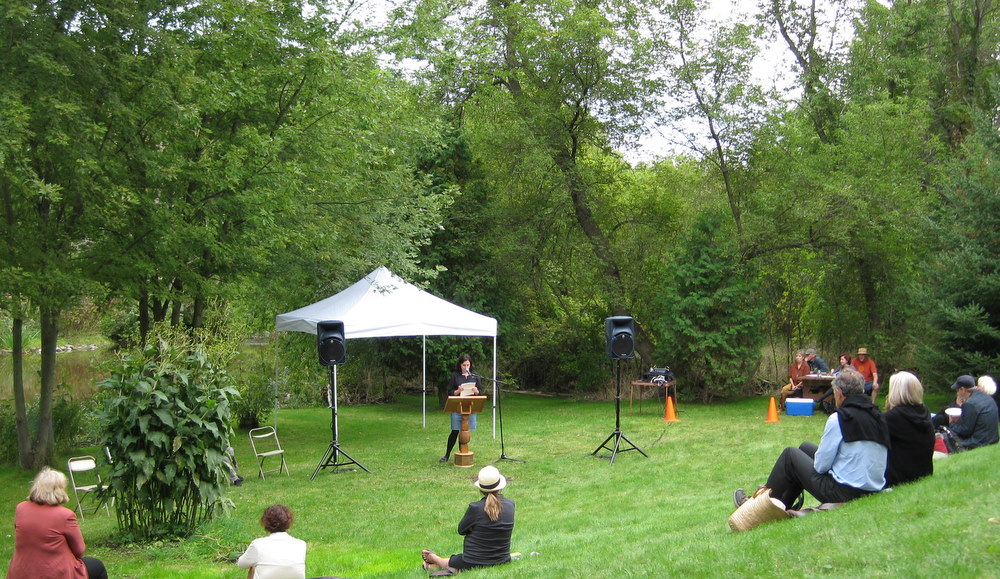 The story I’ve already told twice today is about how last year we went to see the Fringe show at the Eden Mills Writers’ Festival, and how at the end of the set, I said, “I want to do that next year.” I also remarked, upon strapping our four month old baby back into her stroller, that I should also probably get around to cleaning the spit-up off her seat cushion, and I’m pleased to report now that I’ve accomplished 50% of my goals.
This afternoon I had the great pleasure of reading my story “You Can’t Run a Show on Stage Management Alone” to a crowd on a hillside that was far more crowded than I’d expected, and not just with my friends either (although they were there, of course, because they’re wonderful). I so appreciated my fellow readers, the Fringe organizers for such a fantastic initiative, the attentive audience with their very warm response, and also Stuart who kept Harriet from rolling down the hill and into the stream, and snapped photos with his free hand.
We had a wonderful day. The weather was perfect, except for about five minutes when it was a little bit cold. I got to hear my friend Patricia read AND to watch the kids in the audience respond so enthuasiastically to her presentation. Things went a little awry after this, as Stuart and I became obsessed with Harriet taking an afternoon nap, but she wasn’t having any of it. Not sure why we were so concerned– Harriet was happy enough and didn’t want to miss a moment of Eden Mills. We did manage to hear Carol Off read, and Karen Connelly in the final set. We bought organic ice cream, which was delicious. I visted The New Quarterly and Biblioasis, and bought Alexander McLeod’s [GILLER-LISTED!] short story collection Light Lifting. I also bought Marthe Jocelyn’s Eats for Harriet, who thought the book’s conclusion was totally perfect. Later I also Coach House and Toronto Poetry Vendors and gave them scones. I bought a Poetry Fortune Teller, which was a creation of Dani Couture.
We left the festival very happy, and disappointed only that the kids selling baking at the end of the road had run of snickerdoodles. Too late for that, but we were full of scones and ice cream, and Stuart and I got in the exact same fight we’d had last year when we drove past a pumpkin patch and I was insistent that we pull over and photograph the baby amongst the squashes, and in the end, once again, I was right, because the pictures are totally adorable.
September 18, 2010
Dear Graphic Designers
 Dear Graphic Designers,
If you would like to buy your product solely based upon its packaging, please create a package that looks like the Clipper Tea tea box. I will buy it. I don’t care what you are selling, but I will buy it. And then I will bid you a “Well done” for creating a cardboard box that makes me feel like a better person for simply possessing it.
Love, Kerry
September 17, 2010
See you at Eden Mills!
 I will see you all at the Eden Mills Writers’ Festival this weekend. Not quite sure when we’ll be arriving, as we’re still working out napping logistics, but I hope to catch Patricia Storms, Dionne Brand, Stephen Heighton, the Leon Rooke interview, Marthe Jocelyn and Karen Connelly. I also hope to buy a few books. I will be reading on the second Fringe Stage (3:30-4:30 at “Cottage”– I’m last up). Come say hi, please, and I will give you a pumpkin scone* from our picnic!
*While supplies last.
September 16, 2010
Sandra Beck by John Lavery
 I could say that I’ve never before read a book like Sandra Beck by John Lavery, but then I would be lying, if only because I once read the book Elizabeth Costello by J.M. Coetzee. These two books are only alike in the strangest ways, both being oddly fragmented novels that aren’t quite novels. Both being about a woman who is never entirely present, who is never ever seen from the same perspective twice. Both novels even end with similarly strange conclusions at customs desks, though Sandra Beck in general, I think, is a less perplexing shade of weird.
It is true, however, that I’ve never read prose quite like John Lavery’s. His sentences are acrobats, flinging from trapezes with no sign of a net. His narrative goes backwards and forwards, overlapping and backing up again on itself. His writing manages to be gritty, ribald, and really beautiful, though it’s also challenging and takes a while to get a sense of the way it flows. The book eventually establishes a momentum, even dipping in and out of time as it does, but then just when you think you know what it’s doing, you realize you know nothing at all. Sandra Beck is the kind of book you could read thirteen times in a row, and it would be a different novel every time.
The book’s first section is from the perspective of Josee, daughter of Sandra Beck, who is everything to her daughter, and also at the same time, never enough. Who manages to be at the periphery of Josee’s life, but also at its centre. Sandra Beck walks with crutches, is perpetually busy as manager of the Montreal Symphony Orchestra, is married to Montreal police chief Paul-Francois Basterache, and though Josee refers to her mother as “my happiness”, she also makes her daughter miserable. Josee is in the midst of adolescence, has the voice of a child but is conducting a bizarre affair with a clarinetist’s birth-mark. Witnessing her mother from a distance at the section’s climax, Josee has the revelation that she has never known Sandra Beck at all.
The second section takes some years after the first, as Josee is now grown-up and self-sufficient, allegedy teaching theatre to children in Bogota. Almost 200 pages of a drive from Lennoxville to Montreal, the reader is an invisble passenger in the backseat of Paul-Francois’ LeSabre, and he’s addressing us directly. P-F, so I’ve been told, has appeared before as a character in Lavery’s short stories, and I can see how the writer can’t quite get enough the guy. He’s the police-chief, and a television personality (on the local crime show C’est le loi/It’s the Law, an ardent husband, impatient father, and a wonderful meandering storyteller who does not fear contradiction, the complicated nature of life. He is bilingual, and so duality is his thing. P-F makes the journey fly by, recounting his relationship with the elusive Sandra Beck. The difference in their mother tongues standing in for the differences between any two people, and that inevitable failure to communicate exactly what one means. “When you love someone, you often understand perfectly what they’re going to say before they say it. It’s when they say it that you find yourself struggling to grasp what they’re attempting to tell you.”
I’ll admit that it took me a long time to understand where the story was going, and that even once I was swept up in the momentum of P-F’s story, I sometimes still had a hard time trying to grasp what he was telling me. That I found Josee’s section a bit tedious at times. But when I got to the end of the story (and it hit me with a brutal wallop), there was no doubt that I’d just experienced something quite extraordinary. And yes, this is a novel that begs to be encountered for a second time, to bring the pieces all together, but even disassembled, this puzzle is oh so worth the read.
September 16, 2010
9 Tips for the Book Blogger in your life
I’m going to feign me some authority now, because this October marks ten years since I started blogging, and also because CBC Books so kindly just included me in their list of “Book Blogs We Appreciate”. This on the occasion of Book Blogger Appreciation Week, because apparently it’s been 52 weeks since the last one, and I thought that since I appreciate book bloggers too, I might impart a little bit of what I’ve learned in my career as a world-famous, would-be pickler. Feel free to chime in and let me know any I got wrong, or any you think I missed.
1) Book bloggers are not unpaid substitutes for publicity people or literary critics (and see here for an interesting piece on book blogging as unpaid labour). We are readers, and this is the best thing about us (and see here for a talk I once gave on this very subject, and Virginia Woolf’s quote about the responsibilities of the common reader: “The standards we raise and the judgments we pass steal into the air and become part of the atmosphere which writers breathe as they work”).
You do have a responsibility– take it seriously. But also, don’t take yourself too seriously.
2) In line with the first point, our obligation to the publishers that send us free books is to be the best and most honest readers we can be. This can be difficult– initially, I found making contacts with publishing people a bit overwhelming, and this was all happening as I was still finding my feet as a reader. I think some of my early reviews were too generous, though perhaps hindsight will always have that effect. But it took me a while to get confidence in my own opinions, to understand that while publicists are just as concerned as I am with fostering a strong literary culture, they’ve also got a product to sell. Our priorities are not always exactly the same, but that is okay. You’ve just got to know what your own are.
3) We have to buy books. Lots of books. Free books aside, if we don’t buy books, who will? Buy new books, and used books. Shop at Chapters if it’s the only show in your town, but if it isn’t, shop somewhere else. Buy books from small presses, buy poetry. Buy translations. I once read a quote by Annie Dillard regarding karma, and the obligation to buy new hardcovers if you ever hope to make money from the writing life yourself, and I think she’s right. If fostering a strong literary culture is what you’re after, buy lots of books (at full price!). If you are broke, then buy just one.
4) Accept free books with discrimination. It is expensive for publishers to ship books to us, so we’re doing not them a favour by receiving a book we have no intention of reading. Also, accept free books with discrimination because your time is valuable, and why read something that you’re not interested in? And because one person’s house can only hold so many books, and eventually, your postman will hate you.
5) Original content!! Don’t copy text from the publisher’s website– write about the book in your own words. Don’t merely recap literary gossip– what is your own particular take? And if you don’t have a take, the world won’t end because it’s lacking your two cents. You don’t have to write about what everybody else is writing about. What interests you? Write well, and write long (but not too long). And aim to be a better writer all the time.
6) Read an author or a book first before you agree to take part in promotions. Don’t be afraid to say no if the author or book is not your thing, or is not in keeping with your blog’s focus. We should aspire to mean everything we write on our blogs.
7) We should all blog like nobody is looking, if only because very often, nobody will be. We should write only to satisfy ourselves, so that the writing is inherently worth the trouble, and also because that kind of writing has a passion that shows.
8) Avoid taking the link bait! Very often, desperate newspapers will write terrible articles that insult us and ours in an effort to enrage us. They don’t actually mean what they’re saying– they just want hits from the links you post, but don’t lower yourself. Only link to awesome.
9) And along those lines, make your blog a portal rather than a virtual brick wall.
September 15, 2010
The Vicious Circle reads: The Comforters by Muriel Spark
 Seriously, this book club just gets better and better. We all headed out to the west end this month to read Muriel Spark’s first novel, The Comforters. The brilliant new edition by Virago (which, actually, we don’t think should be available in Canada, but a bunch of us managed to pick copies quite discounted) has an absolutely perfect cover. As with Shirley Jackson’s We Have Always Lived in the Castle, the book reads as up-t0-date as the day it was published, and so a stylish modern cover is not trying too hard.
Also much appreciated was Ali Smith’s introduction, which you can read in abridged form here. An amazing example of a book intro– no spoilers, she doesn’t have her own agenda, and she helpfully places the book in its contexts, which were (somewhat incongruously) the realist, angry young men of the 1950s; Spark’s own biographical experiences, her conversion to Catholicism in particular; and allusions to The Book of Job (and yes, one of us discovered that his name should rhyme with “lobe”, and not “lob”, though that wasn’t even remotely embarrassing compared to having shown up one hour early by mistake, but alas…).
Immediate response to The Comforters was a few notches above “meh”. A couple of us liked it, but most of us found it hard to get absorbed. We could understand how the novel was so clever– a character becomes aware that she’s a character in the story, can hear the typewriter clacking and the narrator’s voice, meanwhile her sort-of boyfriend is caught up in his own plot involving his grandmother being a diamond smuggler. We loved the dialogue, we loved Spark’s meta-workings, the prose is amazing, but it was hard to really get invested.
It was suggested that this may have been the point. That Spark was playing with our expectations of what a novel is supposed to do to us, using the novel’s conventions to show these are conventions. “I just couldn’t get lost in it,” a reader might complain, and Muriel Spark might have answered, “It’s a book. Not a cityscape.” That the book’s weaker points (flimsy/no plot, relience on coincidence and connections) were quite deliberate, to make us question how much about novels we actually take for granted. Amazing, we all thought, that this was first novel, and it shows very much that Spark had been a critic who’d considered the novel very carefully. Amazing also that she was a Catholic convert (like Graham Greene, whose Travels With My Aunt we thought was akin to this book), and yet she mocked the process of conversion here, she writes about the occult, she makes fun of Catholics. Also, that Laurence and Caroline had a sexual relationship and were unmarried, which was more than a little risque for 1956.
It was suggested that Caroline’s experience with the voices in her head were analogous to any writer whose hard at work, and struggling not to get lost in her story, to retain herself in the flow of narrative and not be swept away. And this led to a comment about the story as an analogy of Spark’s own experience as a Catholic, the struggle to define her spirituality within and without the confines of organized religion.
We loved Georgina Hogg. Loved, loved loved her. Though we weren’t unhappy about her eventual fate, because she was scratching off poor Caroline’s face (and I just thought of this now– was she trying to rub her out??) and trying to drown her, and it wasn’t like she had an inner life anyway. We loved everything about the enormity of her bosom (and I mean that word the way it is intended). Louisa Jepp was also appreciated, and we commented on the women in the novel having all the strength. Oh, and how the books deals with homosexuality, matter-of-fact, amazing, once again in particular for the ‘fifties. Laurence was sort of sweet, but a bit dumb, though quite patient to put up with Caroline who no longer had sex with him. We also loved the distinction between Eleanor and the Baron’s relationship, with no love lost, versus Caroline’s and Laurence’s, who had love left.
With all of our experiences of the book being suitably enhanced, it was now time to talk about other things, and eat lemon cake, and eat more cheese, and yes, some pumpkin scones too. We talked about babies, and perverts, and how married people have secrets too, and we talked underrated and overrated, books we loved and books we hated, and some of us said Fuck too much, and we laughed a lot, and talked about most other things, and probably at some point, we even mentioned you.
Meeting adjourned. Amazing.