November 7, 2010
A Fuzzy Realm
 The fact was that I struggled with Sheila Heti’s book, How Should a Person Be? About what it meant to call that book a novel, a novel that contains its author as a character, a book whose gratuitous sexuality I found more off-putting than titillating, a book that read like a punchline to a joke I’d missed hearing told. Though I engaged with the book on many levels, at various points jotting, “This is interesting…” in the margins, and throughout as I tried to understand what Heti’s project was.
Part of the problem, I think, was that Heti came from a point of departure that didn’t quite make sense to me. For instance, that the blow-job is the great art-form of our time, as the novel was to the 19th century. Or that “personality is just an invention of new media… characters exists from the outside alone”. I think I’d also have trouble with any protagonist who remarks, “It would have been so easy to count the ways I’d been betrayed by girls… It was not that way with men.” There are instances in the book where the protagonists’ all-knowingness is subtly undermined enough, however, that I wondered if the glibness was more wry than I gave it credit for, but I was never really sure.
Throughout the book, however, I kept thinking of Joan Didion, not because she and Heti are at all similar, but because Didion’s entire oeuvre seems to address a lot of the questions that Heti is posing. Didion who says that “We tell ourselves stories in order to live”, with Heti eventually answering her own question with Didion’s backwards: “A person lives by telling stories.” Except that the stories Didion tells take her far outside herself, far from home. Whether through actual travel, engaging with different kinds of people, or other works of literature. Didion has this amazing way of telling other people’s stories, but still making herself the centre. A strange, self-effaced blurry centre, but still the point everything else revolves around. And it’s this blur that Heti will engage with.
In trying to answer, “How should a person be?”, I can’t help thinking that Sheila Heti should have just read Didion’s essay, “On self-respect.” The essay referencing a difficult time similar to that endured by Heti’s protagonist, when “[one loses] the conviction that lights would always turn green.” Says Didion, “Although to be driven back upon oneself is an uneasy affair at best, rather like trying to cross a border with borrowed credentials, it seems to me now the one condition necessary to the beginnings of real self-respect.” And that self-respect stems from “character”, which Heti has determined is a societal construction (but maybe she’s being ironic? I don’t know). Joan Didion, however, has no truck with that: “character– the willingness to accept responsibility for one’s life.”
Self-respect, according to Didion, is a kind of investment. It’s not about never failing, never making mistakes, but rather knowing what you’re getting into, meaning what you say and the things that you do. And this kind of thinking, she writes, requires “discipline, a habit of mind that can never be faked but can be developed, trained, coaxed forth”– that there is no magic pill for it, then, or book with all the answers, or a drug that makes everything clear. Self-respect stems from knowing ourselves from the inside, keeps us from being “in thrall” to everything on the outside wherein, “At the mercy of those we cannot but hold in contempt [for if we don’t respect ourselves, how do we respect those who associate with us?] we play roles doomed to failure before they are begun, each defeat generating fresh despair at the urgency of divining and meeting the next demand made upon us.” Which is kind of the entire plot of How Should a Person Be?
Part of my problem with Heti’s book is that some of her questions did make me uncomfortable– what it means to think we’re important enough to be doing something important, or that any of us matter that much, and what that the stories we tell ourselves in order to live feature characters we’ve constructed with such tireless precision. Her honesty may have struck a nerve. But she places herself above reproach in a way that’s really a bit dishonest– in making her art so much about her, we can’t engage with it without engaging with her character, and as a reader, I’m not comfortable with the ethics of that. I’m not sure the material is so well served by existing a fuzzy realm somewhere between fact and fiction.
But maybe I’m missing the whole point– perhaps Sheila Heti never did really want to be the ideal of what a person should be. Perhaps in posing such a notion, she was really making a comment on our shallow, celebrity obsessed culture in which the blow-job is the ultimate art-form. And that in proclaiming the blow-job as the ultimate art-form, she is deriding a culture that might proclaim the blow-job to be the ultimate art-form, but I still don’t really understand what she means by that, so you can see why I’m a little bit lost.
November 5, 2010
Books wrote our life story
“Books wrote our life story, and as they accumulated on our shelves (and on our windowsills, and underneath our sofa, and on top of the refrigerator), they became chapters in it themselves. How could it be otherwise?”– Anne Fadiman, Ex Libris: Confessions of a Common Reader
November 4, 2010
Found things
1) Who knew metaphors were so useful? Who knew a box could be so poetic.
2) The very best postbox in our whole neighbourhood. Also has a delivered package waiting in the door. Coincidence?
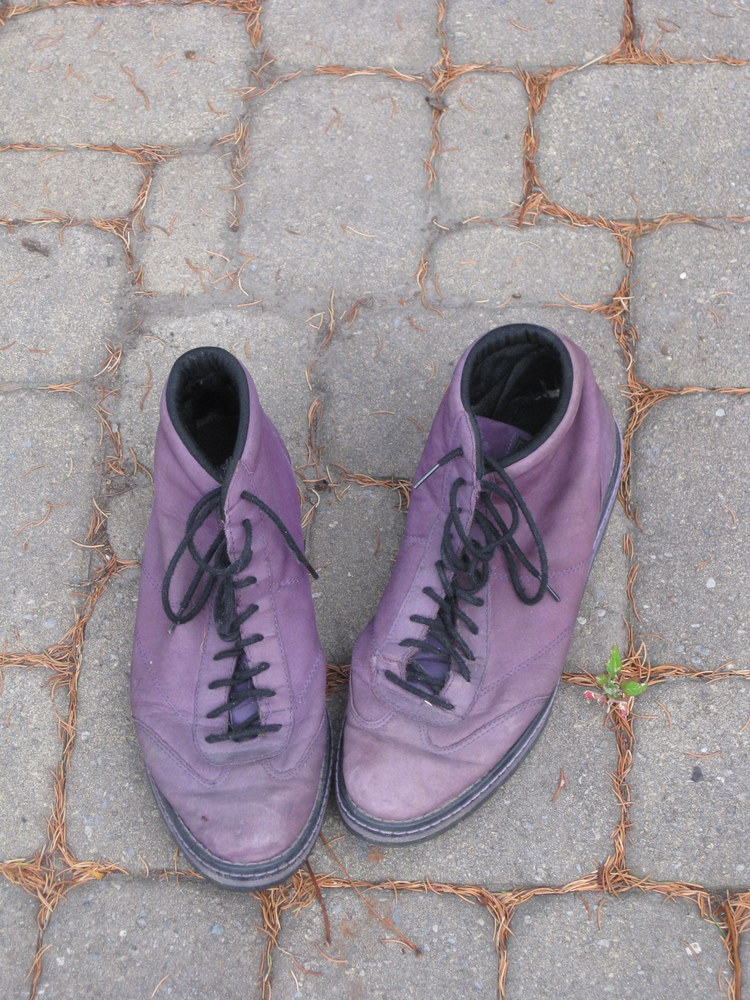
3) We found Mabel Murple’s shoes abandoned on the sidewalk!


November 4, 2010
Baking as Biography by Diane Tye
One of the best books I’ve read this year is Baking as Biography: A Life Story in Recipes by Diane Tye, which I reviewed for Quill & Quire. The weekend I was reading it, no one wanted to talk to me because I was so frightfully boring, starting all sentences with, “Did you know…?” and “Would you believe…?” and finishing with a fascinating fact from Tye’s book. Of which they were many, as Tye goes through her late mother’s recipe box to reconstruct her life and her times. The book beginning with the most fascinating fact of all– that this woman who baked and cooked for her family for decades once remarked that she didn’t even like baking. It took a few more decades for Tye to understand how interesting this was, and the resulting book explores the history of homemaking, feminism, family and eating, and the complex ways in which we understand all of these things. I loved this book. My review is here.
November 3, 2010
Two old books: Quartet in Autumn by Barbara Pym and Anne of Windy Poplars by LM Montgomery
 Last week I read Barbara Pym’s Quartet in Autumn as I slowly (savouringly) make my way through her books. Quartet is the book Pym published after her years in the wilderness, the fifteen years where her work was considered unpublishable and her books went out of print. Her famous redemption came about in 1977 when Philip Larkin and Lord David Cecil both (independently) nominated her as one of the century’s most underrated writers. Quartet was published not long after that, followed by The Sweet Dove Died, which had been written previously and was rejected and rejected and then was not anymore.
Quartet is the story of four office mates (and what they do is quite beside the point. When the women retire, their positions aren’t filled. Days mostly hinge around brewing kettles and cups of tea) who are near retirement and who, through various circumstances, have each found themselves much alone in the world. And yet the four aren’t close either, which makes the story particularly interesting: what if the people who are closest to you hardly know you at all? And what if you’re fine with that?
Pym does a wonderful job of showing the discomfort of a person rather set in her ways who is forced to face a world that is changing. Though this makes for uncomfortable reading at times– I am not sure whether or not we’re meant to empathize with Letty when she leaves her flat because a family of Nigerians have moved into the unit below. Even Letty is not proud of her uncomfortableness, and I suppose this storyline is racist, but I also think it’s an honest depiction of very human situation. It’s not so much that Pym is racist, or her story is, though the character is, but that’s kind of the point. And I’m not sure that’s a good enough reason not to read the novel anymore.
Was hoarding a diagnosis in the 1970s? Because it’s all the rage these days, of course, but Letty’s co-worker Marcia was hard at it back in the day, filling the house she’d shared with her late mother with unopened packages of nightware from Marks and Spencer, stocking the cupboards with cans, and filling her garden shed with milk bottles (just in case there’s another war, and it’s the last war, where there was no milk without bottles). Pym manages to make Marcia’s affliction mildly amusing, actually, but it’s also sad. But not so sad– this is not a sentimental book. It’s not that lonely people are funny, or that funny people are lonely, but just that lonely people are, and I think it’s an idea that’s still incredibly profound.
**
 I just finished reading Anne of Windy Poplars, which I’d been meaning to do since Kate posted about it ages ago. It’s a strange novel, the fourth in the Anne series (between of the Island and House of Dreams), but it was written after all of them. I don’t think I’ve read this book in over twenty years, but I have recently read two biographies of Montgomery and so have a better idea of its context than I did the first time. That Montgomery was being pushed by her publishers to give her readers more Anne, and so a novel like this was sort of cobbled together. That she was also limited it what she could do with Anne in this in-between story, because certainly nothing too profound could happen to her that would have to be accounted for in her already-established later history.
This novel takes place over three years in which Anne and Gilbert are living apart while she is working as principal of a high school in Summerside and Gilbert is studying at medical school. Much of the novel consists of letters she writes him, and I agree with Kate that these letters like nothing else express the true depth of their relationship. (Though unlike Kate, I never thought Gilbert was a dud. Perhaps that is because to me, he will always be Jonathan Crombie).
Because not much can happen to Anne then, this is an account of what happens to the people all around her– the people whose lives she touches, the curmudgeons she brings around, the wild people she manages to tame with her charm and by her wits. Some of these stories really are a bit much. We do see an Anne who is quite self-aware at times, and funny, remarking at one point of her tendency to meddle in the lives of others. This is less a novel really than a collection of episodes, almost short stories– it’s not so unlike The Blythes are Quoted in many respects, though of course Anne is much more central to what goes on. So many of the episodes are quite familiar to me from Anne of Green Gables: The Sequel which (please forgive me, and maybe I’m wrong because I’ve not seen it for a while) might be better than the book is. Which is not to say the book is bad, of course.
I had a similar problem with this book that I had with Budge Wilson’s Before Green Gables, with Anne encountering Anne-like characters. In Windy Poplars, it’s the story of Little Elizabeth, the lonely child who lives in the forbidding house next door and dreams of forever escaping into “tomorrow”– with all her talk of fairies and poetic trees, she’s like Anne Shirley on speed, and really, how can there be two of them? The whole point of Anne, her charm, is that she’s one in the million. Diana managed to be her kindred spirit while being nothing like Anne, and truth be told that dynamic made a lot more sense to me.
About Diana, a sad note in the novel– Anne goes home to Green Gables and Diana scarcely registers. She has a new baby, and Anne remarks at one point that Diana is busy in a whole other world, and that’s the end of it, but I found it disappointing. They were kindred spirits after all! Interesting also to see Montgomery locating her story in a wider context– there are mentions of boys, including Gilbert, going out west to work on “that railroad” they’re building out there. References to Anne teaching The War of 1812, and noting how lucky they were that days of war were far behind them, which was doubly not true by 1936 when the book was published.
November 2, 2010
A transfer of substance
“Once a book falls into our possession, it is ours, the same way children lay their claim: “That’s my book.” As if it were organically a part of them. That must be why we have so much trouble returning borrowed books. It’s not exactly theft (of course not, we’re not thieves. What are you implying?); it’s simply a slippage of ownership or, better still, a transfer of substance. That which belonged to someone else becomes mine when I look at it. And if I like what I read, naturally I’ll have difficulty giving it back.” –Daniel Pennac, Better than Life (which I’ve finished reading, so you’ll be relieved to know that this is my final quote from it).
November 2, 2010
Literature for Life Fundraiser
 Literature for Life invites you to our premiere fundraising event…
Black White and Read All Over
RBC Plaza South Tower, 40th Floor. 200 Bay St. Toronto
November 10, 2010 @ 7pm
In the past ten years Literature for Life has touched 1700 young women and their children and given them 20,000 books.
Join keynote speaker Terry O’Reilly host of CBC’s Age of Persuasion, CTV Newscaster Andria Case and Noelle Richardson, Chief Diversity Officer for the Ontario Public Service to commemorate this milestone.
Food and Beverage will be provided and sponsored by RBC.
Tickets cost $100 and will are available for sale on our site below. Order yours today from the Literature for Life website (scroll down for order form).
Tax receipts will be issued.
November 1, 2010
November bits and bobs
CBC Books’ Monthly Book Report Podcast is now online, and at about 8:40 you can here a panel discussion with me, Jen Knoch of the KIRBC, Ron Nurwisah from The Afterword (moderated by Erin Balser) about what’s going down with Canada Reads 2011. Admittedly, I was feeling a bit more optimistic about the Top 40 that day than I was last Friday, but you’ll be happy to know that I’ve come around a bit. That it might be the journey and not the destination that matters– if what I love best about Canada Reads is obscure recommendations, then here is a list of 20 books I haven’t read yet, and why not pursue those avenues? What if the authors pushing their books are not so much saying, “Win me a prize!”, but “Read me, read me, read me!” Which is the kind of plea I tend to listen to. You know, it was never so much Canada Reads itself and the panel discussions I cared about as much as the reading that led up it (and the conversations online with other readers), and perhaps this changed format is just going to extend that whole experience.
That said, have you voted for Sean Dixon’s The Girls Who Saw Everything yet? If I’ve got to have a reread in the final five, might as well be the one that I brought to the table.
Anyway, I’ve officially decided to bring on Canada Reads Independently 2011, because it was a great deal of fun last year, and complemented the actual Canada Reads in all kinds of interesting ways. And also because it was the Canada Reads subject to my whims, and how brilliant is that? I’m already a-thinking about panellists, and I think we can come up with something amazing. Watch this space.
Watch also for news of my work appearing in all kinds of interesting places– I’ve got essays and reviews coming out this month that I’m very excited about, and though I still have to keep my mouth shut about them, I look forward to soon when I no longer have to. I’ve finally got started on a blog for Literature for Life, and am going to visit their new digs tomorrow to get an update on where we are at. I will also be giving a guest lecture at Ryerson later this month about “Bringing Children’s Books to Life” and I’m wholly enjoying the preparation, looking forward to the delivery, but there’s still plenty of work to be done in the meantime, and so onward.
October 31, 2010
Fundamental Energy: Happy Halloween!
 “Sugar is an all-natural way of making most everything we eat taste better. Commonly found in plant foods, it’s also an excellent source of carbohydrates, the fundamental energy that powers our bodies.” — copy found on bag of Lantic Icing Sugar. Rock on.
October 29, 2010
About Canada Reads 2011: The good and the bad
 So, I am excited that Sean Dixon’s The Girls Who Saw Everything has made it into the CBC Canada Reads Top 40 list. It’s a fantastic book that you should probably read, and I’m not the only one who thinks so– it received a lot of support. This does mean, however, that we all have to vote for the book again to get it into the finals– go here and do so.
I’m a bit conflicted though, or maybe just confused. I think a lot of us having been coming at Canada Reads from a multiplicity of angles, and the whole thing might be turning into a convoluted mess. Because, for example, my understanding is that Canada Reads is a great opportunity to highlight a book one is particularly passionate about, to bring the public’s attention to something they might not have read before, but something they will probably love, which is why I picked Dixon’s brilliant, quirky, book that was published by an independent press.
But I realize that I’d missed the point, or that my understanding of Canada Reads is different from another’s– say, Perdita Felicien, who last year was a panelist championing Anne Marie McDonald’s Fall on Your Knees. Quite simply, she picked a book she loved, and that was that. Other critics have demonstrated they understand Canada Reads to be an opportunity for panelists to promote books that Canada should read, in order to better ourselves. And this year, CBC has made Canada Reads something a bit different altogether– a chance for us to revisit the best books from the past decade, as nominated by the readers who loved them.
Oh, and as nominated by writers too, which is kind of awkward. I love the idea of readers pushing their favourite books, the conversation that ellicits, the passions fuelled, but surely an author in the fray isn’t going to have the same kind of conversations, the same interests. If your book really was one of the essential books of the past decade, couldn’t you rely on your passionate readers to promote it? And if you don’t have those passionate readers, then, um, maybe your book wasn’t one of the essential books of the past decade? It sort of kills the fun, actually, and you can’t blame the authors really, because they were encouraged, but it all seems quite contrary to the spirit of the game.
When I first saw the top forty list, I was thrilled. Not only had Dixon’s book made it, but so many other books I’m passionate about are there as well– The Way the Crow Flies by Anne-Marie McDonald (so underrated– I love this book), Unless by Carol Shields (which is my favourite book ever), Sweetness in the Belly by Camilla Gibb (which is wonderful, and award-winning, but I don’t think we could be done talking about it yet), Skim by Mariko and Jillian Tamaki (a graphic novel– such a twist!), and Lisa Moore’s February (swoon). I guess all of these are books we’re not finished talking about already, or at least I’m not.
But there are two problems, and I only realized this a while after I first saw the list. 1) All the best books here, the books I most want to win, I’ve read already! So there goes 99% of the fun for me, really. [And there’s only book here that I’ve not yet read that I’ve been moved to pick up, and that’s Essex County by Jeff Lemire. I’ve read 20 of the others already, and the final 19 haven’t appealed to me yet.) 2) The books I most want to win probably won’t win– a lot of readers’ understanding is that we should vote for the most essential books of the last decade, and in general terms these probably are The Book of Negroes, Late Nights on Air, Lullabies for Little Criminals etc. Books we’ve already read to death, however– and I can’t imagine that I’d find myself reading these again.
I’m still hopeful that the CBC will come up with something excellent– the list does bode well for interesting, but if you’re like me and come to Canada Reads to encounter something new, things may not work out exactly as planned. Which is why, I think, I am probably going to do Canada Reads Independently 2011, CBC shortlist pending. So we’ll have to see what happens, and at least things aren’t boring (yet).






